REVIEW 5 major objections 6 minor 22 references
Timelike Quantum Energy Teleportation in the Nambu-Jona-Lasinio Model
T0 review · 5 major / 6 minor · reviewed 2026-08-07 · deepseek-v4-flash
Pith's one-line read The paper claims that a local measurement by Alice at one time allows Bob to extract energy from the interacting NJL fermionic vacuum at a later time, using only classical information, and presents lattice quantum-circuit simulations…
desk verdict Reasonable question, undone by a sign error and simulations that never actually condition Bob on Alice. read the letter →
The pith
A machine-rendered reading of the paper's core claim, the machinery that carries it, and where it could break.
The reading
What carries the argument
The load-bearing object is the scalar fermion bilinear $\bar\psi(x,t)\psi(x,t)$: it forms the chiral condensate that gives the NJL vacuum its entanglement, appears in Alice's detector coupling, and is exponentiated in Bob's unitary. Around it, the protocol uses two localized Unruh-DeWitt detectors at the same spatial point separated in time, with the intermediate free evolution generated by the NJL Hamiltonian. Numerically, the machinery is a lattice-regularized NJL Hamiltonian with staggered fermions and a Jordan-Wigner mapping to qubits; the four-fermion interaction is treated in mean-field form, and the energy accounting is $\Delta E_{\rm net}=\Delta E_B-\Delta E_A$.
What would settle it
Run the same circuit twice, once with Bob receiving Alice's actual classical outcome and once with Bob applying the same unitary without any message or with a random bit; if the extracted energy $\Delta E_B$ is unchanged, the protocol is not quantum energy teleportation. A second check is to measure the full distribution of Alice's outcomes and verify that Bob's operation changes according to $\mu$; the tables' near-constancy of $\Delta E_B$ under varying $\lambda_A$ makes this check relevant.
Extended reading notes
Core claim
The central claim is that the NJL vacuum's entanglement, carried by the chiral condensate $\langle\bar\psi\psi\rangle$ and the dynamical mass $m_{\rm dyn}$, allows a local measurement at time $t_0$ to be converted into extractable energy at a later time $t_1$ using only classical communication. Alice's detector couples to $\bar\psi(x_0,t)\psi(x_0,t)$; after her measurement, the field evolves freely under the NJL Hamiltonian, and Bob applies $U_B=\exp(i\lambda_B \hat m_B \bar\psi(x_0,t_1)\psi(x_0,t_1))$ at the same spatial point. The reported simulation results, with $\Delta E_A>0$, $\Delta E_B<0$, and $\Delta E_{\rm net}=\Delta E_B-\Delta E_A<0$, are read as evidence that Bob's operation extracts energy from vacuum fluctuations rather than receiving energy carried by particles. On the paper's own terms, this establishes the NJL model as a working platform for timelike QET in an interacting fermionic field theory.
Load-bearing premise
The protocol rests on assuming that the ten-site lattice state with dynamical mass 0.4 faithfully represents the NJL vacuum, and that Bob's unitary is truly conditioned on Alice's measurement outcome rather than an unconditioned operation that happens to lower local energy.
Editorial extensions
If this is right
- If the central claim is right, timelike quantum energy teleportation is not limited to free or non-interacting field theories; interacting fermionic vacua with broken chiral symmetry can serve as the entanglement resource.
- The chiral condensate and dynamical mass become tunable parameters for QET efficiency, so stronger symmetry breaking should support more robust energy extraction.
- The lattice Jordan-Wigner circuit provides a concrete route to realizing fermionic QET on gate-based quantum hardware, with $\lambda_A$, $\lambda_B$, and the time separation $t_1-t_0$ as control knobs.
- Energy conservation is preserved: the negative $\Delta E_{\rm net}$ is attributed to redistribution of vacuum energy, not to energy created by the protocol.
Reading between the lines
- As an inference from the reported tables, $\Delta E_B$ changes only in the fourth or fifth decimal as $\lambda_A$ ranges from 0.05 to 0.1; if Alice's outcome really controlled Bob's gate, one would typically expect a stronger dependence, so a decisive test is to run Bob's unitary without Alice's message and compare.
- Because the lattice replaces $\bar\psi\psi$ by a single-site $Z$-type operator, the same circuit could be adapted to spatially separated detectors to test whether the effect is genuinely timelike or persists for spacelike separations.
- If the mechanism is the condensate, analogous interacting models with chiral symmetry breaking, such as Gross-Neveu-type theories, should show similar timelike QET, giving a family of testbeds.
- A hardware experiment that measures Bob's local energy change with and without the classical bit would separate the quantum-information contribution from a purely local driving effect; until that comparison is made, the 'teleportation' reading of $\Delta E_{\rm net}<0$ remains an interpretation.
Editorial analysis
A structured set of objections, weighed in public.
Referee Report
Summary. The paper proposes a timelike quantum energy teleportation (QET) protocol in the 1+1-dimensional Nambu-Jona-Lasinio model. Alice couples a Unruh-DeWitt detector to the local fermion bilinear at time t0 and measures it, and Bob later applies a local unitary at the same spatial point at time t1. The manuscript derives energy-flow expressions, defines ΔE_A, ΔE_B, and ΔE_net = ΔE_B − ΔE_A, and reports quantum circuit simulations in which ΔE_A > 0, ΔE_B < 0, and ΔE_net < 0. The authors interpret these tables as confirming quantum energy teleportation.
Significance. If correct, this would be a first step toward demonstrating timelike QET in an interacting fermionic quantum field theory with spontaneous chiral symmetry breaking, which is a genuinely interesting direction. The manuscript provides a concrete lattice discretization, a Jordan-Wigner qubit mapping, Trotterized time evolution, and an explicit weak-coupling appendix. However, the central numerical validation is not logically tied to QET: the reported success criterion is automatic from the sign convention, the tables are inconsistent with an implemented Alice interaction, and no code or circuit-level verification is provided. The current results do not establish the paper's main claim.
major comments (5)
- [Section V.C, Eq. (19)] The success criterion ΔE_net = ΔE_B − ΔE_A < 0 is not a test of QET. Since Tables I–III always find ΔE_A > 0, ΔE_net < 0 holds even if Bob does nothing at all (ΔE_B = 0), and it would hold equally for an unconditioned Bob operation. A valid criterion must compare Bob's energy extraction in the protocol with a control run (for example, λ_A = 0 or an unconditional Bob unitary) and must account for Alice's injected energy in a way that does not make the inequality automatic.
- [Tables I–III] The numerical data are inconsistent with an implemented Alice interaction. ΔE_A is identical to 16 decimal places as λ_A varies from 0.05 to 0.10, and ΔE_B changes only at the seventh decimal over the same range, while ΔE_B changes by an order of magnitude when λ_B changes. Under the manuscript's own weak-coupling expansion, Eqs. (A3)–(A5), Alice's perturbation enters the post-measurement state at O(λ_A), so the energy shifts should depend on λ_A. The exact constancy of ΔE_A indicates that either Alice's interaction is not present in the simulated state or the energy is not evaluated after her measurement.
- [Section VI.C and Appendix A] No baseline with λ_A = 0 or with an unconditioned Bob operation is reported. Without such a baseline, the data cannot distinguish genuine teleportation from an energy shift caused solely by Bob's unitary. The text says that Bob's operator m_B is 'informed by μ' (Section IV.A) and that his unitary is 'optimized based on μ' (Section VI.D), but no circuit, code, or outcome-dependent data show that Bob's gate is actually conditioned on Alice's measurement outcome. The near-independence of ΔE_B on λ_A in Tables I–III makes such conditioning implausible.
- [Appendix A, Eqs. (A7) and (A14)] The appendix's leading term iλ_B ⟨φ_0|[F,T_00]|φ_0⟩ is independent of Alice's coupling, and the Alice-dependent term is suppressed in the stated weak-coupling limit. In addition, the measurement M_+ = |0⟩⟨0| on an initial detector state |0⟩ yields outcome +1 with probability p_+ ≈ 1; a deterministic outcome carries no classical information and cannot be used to condition Bob's operation. This undercuts the theoretical derivation of the protocol, not just the numerical implementation.
- [Appendix B, Eq. (B4)] The simulations replace the four-fermion interaction by a mean-field term proportional to G⟨ψ̄ψ⟩, reducing the simulated dynamics to a free massive fermion theory with a renormalized mass. The paper's claim to validate QET in an interacting fermionic QFT is therefore not supported by the numerics; the simulation does not implement the full NJL interaction.
minor comments (6)
- [Section VI.C, Eq. (27)] The discretized energy density uses a forward difference (ψ_n(t+δt) − ψ_n(t))/δt. This expression is not Hermitian as written; please specify how it is measured and how the continuum Noether charge is recovered.
- [Section II.C] The statement that the vacuum |Ω⟩ is 'self-consistent' with the dynamical mass m_dyn is asserted but not verified; please provide the gap-equation solution used and check that the lattice state is an eigenstate of H_lattice with the expected condensate.
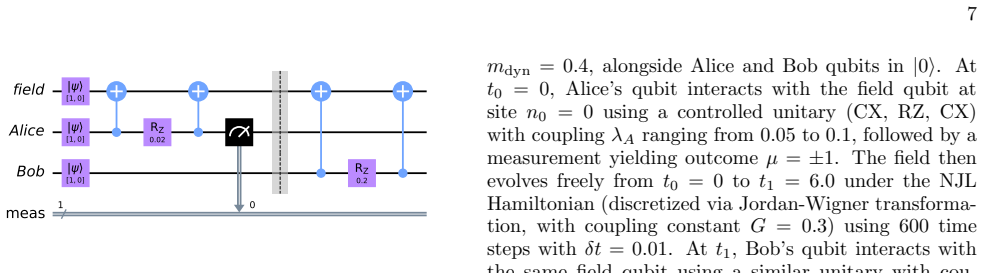
- [Section VI.D and Figure 1] The text says N = 10 lattice sites, but Figure 1 illustrates a single field qubit and its caption is garbled; please clarify the relationship between the simplified circuit and the full 10-site simulation.
- [References] Reference [12] (Coleman and Mandula) does not appear to be the correct citation for the Gross–Neveu dynamics described in Section II.B; please check and correct the references.
- [Appendix A, Eq. (A14)] The notation 'imag' in Eq. (A14) is undefined; presumably it denotes the imaginary part, but this should be stated explicitly and derived carefully.
- [Appendix B.1] There is a typo, 'with with spacing a'; also, the text at Section VI.D gives t_1 = 6.0 and 600 steps with δt = 0.01, which is consistent, but elsewhere 'steps × δt' is used without defining both quantities.
Circularity Check
The reported net-energy confirmation is forced by the definition ∆Enet = ∆EB − ∆EA, and the tabulated ∆EA is independent of Alice's coupling λA, so the numerical validation does not actually depend on the teleportation protocol's stated inputs.
-
self definitional
[Section V.C, Eqs. (17)–(19); Tables I–III]
"The net energy effect of the QET protocol is the difference between the energy changes induced by Bob and Alice: ∆Enet = ∆EB − ∆EA. (19) In a successful QET protocol, ∆Enet < 0, meaning that the energy extracted by Bob (−∆EB > 0) exceeds the energy injected by Alice (∆EA > 0)."
The paper defines ∆EA as the positive energy injected by Alice (Sec. V.A) and ∆EB < 0 as Bob extracting energy (Sec. IV.B). Under those sign conventions, ∆Enet = ∆EB − ∆EA = −|∆EB| − |∆EA|, which is negative for every parameter set regardless of the field dynamics or of whether Bob's operation is conditioned on Alice's outcome. The tables therefore 'confirm' a quantity that is negative by construction. The condition that Bob's extraction (−∆EB) exceeds Alice's injection would be (−∆EB) − ∆EA > 0, equivalently ∆EB + ∆EA < 0; the paper neither defines nor tests that condition, and its own numbers (e.g., −0.0157 + 0.1928 > 0) would fail it.
-
other
[Section VI.C–VI.D, Table I; Appendix A, Eqs. (A3)–(A8)]
"TABLE I. Energy differences for λB = 0.50 λA ∆EA Numerical ∆EB ∆Enet 0.0500 0.19284271247461859 -0.01573239957019066 -0.20857511204480925 0.0625 0.19284271247461873 -0.01573178947915396 -0.20857450195377267 0.0750 0.19284271247461865 -0.01573117942172845 -0.20857389189634709 0.0875 0.19284271247461868 -0.01573056939795206 -0.20857328187257071 0.1000 0.19284271247461859 -0.01572995940786323 -0.20857267188248185"
The paper's own Appendix A gives the post-measurement state as |ψ+⟩ ≈ (1 − iλA JA)|Ω⟩, Eq. (A8), so inserting this state into Eq. (25) makes ∆EA depend on λA at first or second order. Table I instead reports ∆EA = 0.19284271247461859 at λA = 0.05 and the same value to sixteen decimal places at λA = 0.10. The tabulated 'Alice energy injection' is therefore not a function of Alice's coupling, so the numerical validation does not probe the measurement input that is supposed to enable the teleportation. This is not a minor round-off; the constancy across a factor-of-two change in λA indicates the claimed input–output dependence was not computed, making the 'confirmation' independent of the protocol's defining Alice side.
full rationale
The paper contains no load-bearing self-citation: all references are to standard external literature (Nambu–Jona-Lasinio, Hotta's QET, Unruh detectors, lattice techniques), so patterns 3–5 do not apply. The central circularity is the net-energy success criterion: Eq. (19) defines ∆Enet as ∆EB − ∆EA, and because the paper already interprets ∆EB < 0 as extraction and ∆EA > 0 as injection, ∆Enet < 0 follows algebraically for every run, independent of whether Bob's operation is conditioned on Alice's measurement. The paper compounds this by reporting ∆EA values that are numerically constant in λA to 16 digits, contradicting its own O(λA) post-measurement state (A8), so the simulation does not even realize the Alice-side input it claims to vary. Consequently, the Tables I–III do not provide independent evidence for timelike QET: the sign of ∆Enet is forced by definition, and the magnitude/comparison between extraction and injection is never tested with the standard sum condition. This warrants a partial-circularity score of 7 rather than 0–2; it is not 8–10 because the protocol's analytical framework is not itself imported from a self-citation chain, and the circularity is concentrated in the validation metric rather than in the construction of the NJL vacuum.
Assumptions & free parameters
free parameters (6)
- dynamical mass mdyn =
0.4
- NJL coupling G =
0.3
- Alice coupling lambda_A =
0.05 to 0.1
- Bob coupling lambda_B =
0.5, 2.0, 3.0
- lattice size N and spacing a =
N=10, a=1.0
- Trotter step delta_t and evolution time =
delta_t=0.01, t1-t0=6.0
assumptions (4)
- ad hoc to paper The vacuum |Ω> defined by b_k|Ω>=d_k|Ω>=0 is the self-consistent non-perturbative NJL vacuum.
- domain assumption The energy density is T00 = i ψbar γ0 ∂t ψ.
- domain assumption The local operator ψbar(x0)ψ(x0) is a well-defined observable at a point.
- domain assumption Low-order perturbation theory in lambda_A and lambda_B is valid at the simulated couplings.
Cite this review
Pith. "Pith review of Timelike Quantum Energy Teleportation in the Nambu-Jona-Lasinio Model." pith.science (2026). https://pith.science/paper/QBOL523E
@misc{pith2026250522794,
  author       = {Pith},
  title        = {Pith review of: Timelike Quantum Energy Teleportation in the Nambu-Jona-Lasinio Model},
  year         = {2026},
  howpublished = {\url{https://pith.science/paper/QBOL523E}},
  note         = {Machine review of arXiv:2505.22794}
}
read the original abstract
We propose a novel timelike quantum energy teleportation (QET) protocol within the 1+1 dimensional Nambu-Jona-Lasinio (NJL) model, an interacting fermionic field theory exhibiting spontaneous chiral symmetry breaking. By coupling localized Unruh-DeWitt detectors to the fermionic field, we demonstrate how an initial observer's measurement enables a second observer to extract energy at a later time using only classical information transfer. This protocol leverages the NJL vacuum's rich entanglement structure, driven by the chiral condensate, to facilitate energy transfer without physical particle transport. We derive the energy flows and explore the roles of measurement and time evolution and validate the protocol through quantum circuit simulations on a lattice-regularized NJL model. Our findings highlight the NJL model's potential as a platform for exploring QET in interacting quantum field theories and pave the way for experimental realizations on quantum hardware.
Figures
Reference graph
Works this paper leans on
-
[1]
Alice’s Interaction and State Preparation Alice’s interaction Hamiltonian (Section (III)) is: H A int(t) = λAχA(t) ˆmA(t) ¯ψ(x0, t)ψ(x0, t). (A2) In the weak-coupling limit (λA ≪ 1), the evolution oper- ator is (Section (III)): UA ≈ I − iλA Z dt χA(t) ˆmA(t) ¯ψ(x0, t)ψ(x0, t). (A3) Since we assume that the detector is a two-level system with ˆmA(t) = σA z...
-
[2]
Time Evolution The state evolves to time t1: |ψ+(t1)⟩ = e−iHNJLt′ |ψ+⟩ ≈[|ϕ0⟩ −iλA|ϕ1⟩] ⊗ |0⟩A, (A9) where |ϕ0⟩ = e−iHNJLt′ |Ω⟩, |ϕ1⟩ = e−iHNJLt′ JA|Ω⟩, t′ = t1 − t0. (A10)
-
[3]
Bob’s Operation and ∆EB Bob’s unitary (Section (IV)) is: UB = exp[iλB ˆmB ¯ψ(x0, t1)ψ(x0, t1)]. (A11) Assuming ˆmB = µ = +1 (optimized for µ = +1) and λB ≪ 1: UB ≈ I + iλBF, F = ¯ψ(x0, t1)ψ(x0, t1). (A12) The state after Bob’s operation is: |ψ′ +⟩ = UB|ψ+(t1)⟩ ≈[|ϕ0⟩ −iλA|ϕ1⟩ + iλBF |ϕ0⟩ + λAλBF |ϕ1⟩] ⊗ |0⟩A. (A13) Compute ∆EB: ∆EB ≈ iλB⟨ϕ0|[F, T00]|ϕ0⟩ +...
-
[4]
Discretized NJL Hamiltonian Starting with the NJL Lagrangian (Section (II)): LNJL = ¯ψ(iγµ∂µ − m0)ψ + G 2 [( ¯ψψ)2 + ( ¯ψiγ 5ψ)2]. (B1) we discretize the system on a one-dimensional spatial lat- tice with with spacing a and N = L/a sites, using stag- gered fermions to preserve remnant chiral symmetry. The discretized Hamiltonian is: H lattice NJL = N −2X ...
-
[5]
(B5) Each term is implemented with Pauli gates (e.g., exp(−iθXnXn+1) via CNOT and rotation gates)
Quantum Circuit for Time Evolution The time-evolution operator over a time intervalt1 −t0 is implemented using the following first-order Trotteriza- tion(Section (VI)): e−iH lattice NJL (t1−t0) ≈ (t1−t0)/δtY j=1 exp(−iHkinδt) × exp(−iHmassδt) exp(−iHintδt). (B5) Each term is implemented with Pauli gates (e.g., exp(−iθXnXn+1) via CNOT and rotation gates). ...
-
[6]
Y. Nambu and G. Jona-Lasinio. Dynamical Model of Elementary Particles Based on an Analogy with Super- conductivity. I. Physical Review, 122(1):345–358, 1961
work page 1961
-
[7]
M. Hotta. Quantum Energy Teleportation in Spin Chain Systems. arXiv preprint arXiv:0808.0678, 2008
work page Pith review arXiv 2008
-
[8]
Entangle- ment farming in quantum fields
Kazuki Yamamoto and Masahiro Hotta. Entangle- ment farming in quantum fields. Physical Review D, 101(4):045011, 2020
work page 2020
Show all 22 references
-
[9]
Kogan, Alex Kovner, and Berfin Tekin
Ian I. Kogan, Alex Kovner, and Berfin Tekin. Bosoniza- tion and topological states. Nuclear Physics B , 544(3):729–747, 1999
1999
-
[10]
McDermott, and Mark Van Raamsdonk
Nima Lashkari, Michael B. McDermott, and Mark Van Raamsdonk. Towards the first law of entanglement entropy. Journal of High Energy Physics, 2016(4):195, 2016
2016
-
[11]
M. S. Kim. Quantum information processing with contin- uous variables. Journal of Physics B: Atomic, Molecular and Optical Physics, 41(13):133001, 2008
2008
-
[12]
Ignacio Cirac, and Benni Reznik
Erez Zohar, J. Ignacio Cirac, and Benni Reznik. Quan- tum simulations of lattice gauge theories using ultracold atoms in optical lattices. Reports on Progress in Physics, 79(1):014401, 2016
2016
-
[13]
Joshi, Petar Jurcevic, Ben P
Christoph Kokail, Chiara Maier, Rick van Bijnen, Thomas Brydges, Mahesh K. Joshi, Petar Jurcevic, Ben P. Lanyon, Markus Heyl, Philipp Hauke, Rainer Blatt, and Christian F. Roos. Self-verifying variational quantum simulation of lattice models. Nature, 569:355– 360, 2019
2019
-
[14]
Dumitrescu, and Martin J
Natalie Klco, Eugene T. Dumitrescu, and Martin J. Sav- age. Quantum-classical computation of Schwinger model dynamics using quantum computers. Physical Review A, 98(3):032331, 2018
2018
-
[15]
W. G. Unruh. Notes on Black-Hole Evaporation. Physical Review D, 14(4):870–892, 1976
1976
-
[16]
D. J. Gross and A. Neveu. Dynamical Symmetry Break- ing in Asymptotically Free Field Theories. Physical Re- view D, 10(10):3235–3253, 1974
1974
-
[17]
Coleman and J
S. Coleman and J. Mandula. All Possible Symmetries of the S Matrix. Physical Review, 159(5):1251–1256, 1967
1967
-
[18]
E. Witten. An Exactly Soluble Model for Chiral Symme- try Breaking. Nuclear Physics B, 160(1):57–115, 1980
1980
-
[19]
M. A. Nielsen and I. L. Chuang. Quantum Computation and Quantum Information. Cambridge University Press, 2010
2010
-
[20]
Hotta, J
M. Hotta, J. Matsumoto, and G. Yusa. Quantum Energy Teleportation with Trapped Ions. Physical Review A, 84(6):062336, 2011
2011
-
[21]
Kogut and L
J. Kogut and L. Susskind. Hamiltonian Formulation of Wilson’s Lattice Gauge Theories. Physical Review D, 11(2):395–408, 1975
1975
-
[22]
Takahashi and H
Y. Takahashi and H. Umezawa. Thermo Field Dynamics. Collective Phenomena, 2:55–80, 1975
1975
Reviewed August 7, 2026 · model on record in the stance chip above.
Discussion (0). Sign in to comment.