REVIEW 4 major objections 6 minor 63 references
Improving Contrastive Learning for Referring Expression Counting
T0 review · 4 major / 6 minor · reviewed 2026-08-07 · deepseek-v4-flash
Pith's one-line read A contrastive loss that stays in image space cuts referring-expression counting error by 22%.
desk verdict A solid REC paper with a genuine empirical gain, one unverified supporting number in the supplementary, and an overreaching 'key factor' claim; the core method is worth refereeing and likely worth citing. read the letter →
The pith
A machine-rendered reading of the paper's core claim, the machinery that carries it, and where it could break.
The reading
What carries the argument
The load-bearing object is the modified supervised contrastive loss $L^*_{sup}$ (Eq. 4), which uses only positive-class image tokens as anchors: each anchor is pulled toward its selected positive peers and pushed away from all other image tokens. The positive set is produced by a cosine-similarity ranking between image tokens and the masked referring-expression token, with the ground-truth count $N$ fixing how many top tokens become positives (Eqs. 2-3). The supporting machinery is the centroid-prediction baseline: Grounding DINO is fine-tuned with an L1 point-center loss and a cross-entropy classification loss instead of bounding-box regression, which the paper argues is the key component behind state-of-the-art detection-based counting.
What would settle it
Retrain C-REX exactly as described but replace the top-$N$ similarity selection with $N$ randomly chosen image tokens, keeping all other settings fixed; if REC-8K test MAE stays near 5.06 rather than degrading toward the 5.90 baseline, the similarity-based selection of positives is not what drives the gain. A supporting measurement is the actual precision of top-$N$ selection on held-out images: if it is far below the stated 80%, the loss is being trained on systematically wrong positives.
Extended reading notes
Core claim
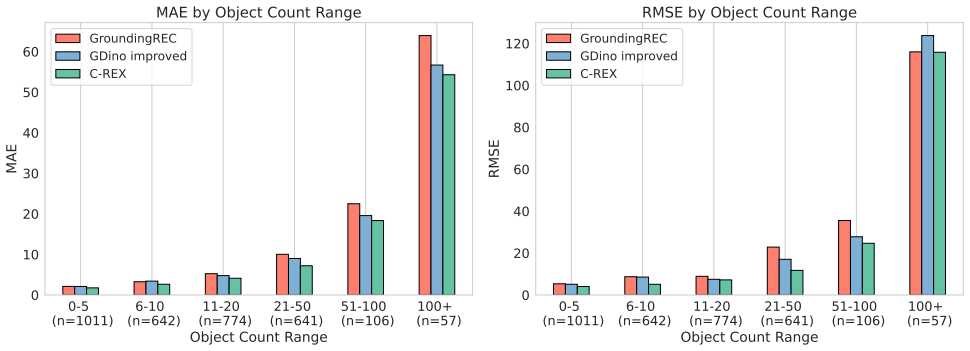
On its own terms, the paper establishes that the failure of earlier REC models to tell apart visually similar objects of the same class is largely a representation-learning problem, and that a modified supervised contrastive objective fixes it without any extra annotation. The method, C-REX, is built on a detection baseline that repurposes the open-set detector Grounding DINO from bounding-box prediction to object-centroid prediction, which the authors identify as the common success factor behind recent detection-based counters. On top of that baseline, the contrastive module computes a masked referring-expression token, ranks image tokens by cosine similarity, and labels the top $N$ as positives using the ground-truth count as $N$. The loss uses only positive tokens as anchors, so diverse negatives are not erroneously pulled together. Experiments on REC-8K show test MAE 5.06 versus 6.50 for GroundingREC and test RMSE 17.53 versus 19.79, with consistent gains across count ranges and attribute categories; a class-agnostic counting variant also matches or beats prior text-based methods on FSC-147.
Load-bearing premise
The whole contrastive signal rests on the similarity ranking being correct: the paper assumes the $N$ image tokens most similar to the referring expression are the objects it names, reporting only about 80% correct selections and giving no measured rule for when that ranking fails.
Editorial extensions
If this is right
- On REC-8K, C-REX sets a new state of the art with test MAE 5.06 and RMSE 17.53, beating GroundingREC by roughly 22% and 11% respectively; future REC systems should treat image-space contrastive positives as a strong default.
- The only extra supervision beyond the existing count labels is the referring expression itself, so the method scales to datasets that have text prompts and counts but no bounding-box or mask annotations.
- The centroid-detection baseline alone, without contrastive learning, already beats GroundingREC on MAE, so point-center prediction is a cheap upgrade for detection-based counting architectures.
- The positive-only anchor modification matters: replacing $L^*_{sup}$ with the unmodified supervised contrastive loss raises test MAE from 5.06 to 5.91, identifying anchor choice as a key ingredient.
- The same recipe transfers to class-agnostic counting by using class similarity instead of referring-expression similarity, and the resulting text-based results on FSC-147 are competitive with prior text-based methods.
Reading between the lines
- Beyond the paper: the reported "about 80%" precision of top-$N$ selection implies the loss tolerates roughly one in five noisy positives; a useful next experiment is to measure how this precision varies with object count, since the 100+ bin shows the smallest RMSE gain.
- Beyond the paper: the claim that image-space contrast is inherently more stable than image-text contrast still awaits a matched comparison with equal negative counts, because the paper removes GroundingREC's feature fusion but does not directly ablate its image-text contrastive loss in the same pipeline.
- Beyond the paper: the top-$N$ contrastive recipe should transfer to referring expression segmentation, where positive tokens could be selected from image features overlapping the target mask; this follows from the paper's generality claim but is not tested.
- Beyond the paper: if top-$N$ precision stays high for rare attribute categories such as gender and orientation, C-REX should generalize to unseen referring expressions at inference time, since no new positive labels would be required.
Editorial analysis
A structured set of objections, weighed in public.
Referee Report
Summary. The paper proposes C-REX, a contrastive learning framework for referring expression counting (REC). It builds on a Grounding DINO-based baseline that is repurposed from bounding-box prediction to object-centroid prediction, and adds a modified supervised contrastive loss (L*_sup) that treats the N image tokens most similar to the attribute-only referring expression as positives, where N is the ground-truth count. The authors report state-of-the-art results on REC-8K (test MAE 5.06 vs. 6.50 for GroundingREC) and competitive performance on class-agnostic counting benchmarks (FSC-147, CARPK). The main claimed contributions are: (1) identifying centroid detection as the key factor in recent detection-based counting models, (2) the proposed modified supervised contrastive loss, and (3) the versatility of the framework beyond REC.
Significance. If the results hold, the paper makes a useful empirical contribution: it provides a strong detection-based REC baseline and shows that a supervised contrastive loss operating on image tokens, with pseudo-positives selected by text similarity, can substantially improve counting accuracy. The released code and the clear ablations in Tables 4-6 are strengths. The empirical gain over the previous REC-specific method GroundingREC is large (22% relative MAE improvement on the test set). However, several load-bearing pieces of evidence are incomplete: the claimed 80% precision of the pseudo-label selection is unverified, the centroid-detection conclusion is not isolated in a controlled ablation, and the assertion that C-REX operates 'entirely within the image space' is overstated because positive selection uses text-image similarity.
major comments (4)
- [Supplementary §6] The statement that 'approximately 80% of selected samples correspond to correct instances' is presented without any methodology, experiment, or error tolerance to support it. This number is used to justify the top-N selection strategy and the choice of N as the ground-truth count, so it is load-bearing for the proposed training signal. Please provide the verification procedure and results, or remove the quantitative claim and soften the 'theoretically justified' language. Additionally, the label-noise citations appear as unresolved placeholders '[? ? ?]'.
- [Eq. (2) and §3.4] The claim that C-REX 'operates entirely within the image space' is contradicted by the positive-selection mechanism: in Eq. (2), pseudo-labels are assigned by computing cosine similarity between image tokens z_i and the masked referring-expression text token t_m. The contrastive loss is indeed computed in image space, but the pseudo-labeling still relies on image-text alignment. This undermines the stated advantage over image-text contrastive learning (e.g., avoiding misalignment, stability). Please qualify the claim to say that only the contrastive objective is image-space, and discuss how the quality of the frozen text encoder's alignment affects the selection.
- [§4.5.3 / Table 6] The conclusion that 'detecting object centroids instead of bounding boxes is the key common factor' behind the success of detection-based counting models is not supported by the provided ablation. Table 6 compares full GroundingREC, GroundingREC without feature fusion, and the proposed GDino improved baseline, but these variants differ simultaneously in output format (box vs. point), presence of the contrastive module, and feature-fusion components. The text says the CL module was removed to form the baseline, but that intermediate row is not shown. To support the claim, please add an ablation that holds the architecture fixed and varies only the output head (bounding box vs. centroid), and show the incremental effect of removing feature fusion and contrastive learning from GroundingREC.
- [Eq. (4)] The modified supervised contrastive loss L*_sup is undefined when the positive set I+ contains exactly one element (i.e., N=1): the inner average over p in I+ - {i} is empty and the 1/(|I+|-1) factor divides by zero; for N=0, the outer sum is empty. The paper does not specify how such anchors are handled during training. Please state the implementation detail (e.g., skipping anchors with no other positive, or excluding samples with N<2) and confirm that training is stable for the distribution of counts in REC-8K.
minor comments (6)
- [Global] There are several typographical and wording errors: 'choise' in §4.5.2, 'Noteably' in §4.3, 'differencese.g.' in the Introduction, and informal uses of 'sota' throughout. Please proofread the manuscript.
- [Supplementary §6] The unresolved citation placeholders '[? ? ?]' should be replaced with proper references for label noise in contrastive learning.
- [§4.2] The F1 score is reported for REC but its formula is not defined anywhere, including in the supplementary where it is only described verbally. Please provide the exact computation, including how true positives are matched to ground-truth points.
- [§4.1] The detection thresholds 0.30 (CLS token) and 0.36 (other text tokens) are stated without a sensitivity analysis or a description of how they were chosen. Please clarify whether these were selected on the validation set and how robust the results are to them.
- [§3.1] The description of the GDino improved baseline is sparse: it says bounding-box prediction is replaced by point-center prediction, but it is not specified which architecture changes are made, how the point head is attached, or which tokens are supervised by the L1 point-regression loss. More detail would aid reproducibility.
- [§1 and §4.5.2] The phrase 'theoretically justified' for the choice of N is stronger than what the supplementary actually provides, which is an intuitive argument about decision boundaries. Please align the wording with the level of support given.
Circularity Check
No significant circularity: test-time counts come from the detection head's thresholded outputs, not from the ground-truth count N used in the contrastive training loss.
full rationale
The paper's derivation chain is not circular. The training-time contrastive loss L*_sup (Eq. 4) uses the ground-truth count N to select top-N positives via image-text similarity (Eqs. 2-3), but the reported test counts are produced by thresholding the detection head's outputs, not by reading off N; the Table 1 numbers are therefore not forced by the training signal. The top-N selection is a pseudo-labeling/self-training auxiliary objective, and no equation in Section 3.2 reduces the predicted count to the ground-truth input. The supplementary Section 6 claim that 'approximately 80% of selected samples correspond to correct instances' is an unverified empirical reliability assertion, which is a correctness/robustness concern rather than a circular step: the 80% figure is not an input to, or an algebraic consequence of, the loss. The centroid-detection 'insight' is validated by ablations (Table 6), albeit with confounded comparisons, which is an experimental-validity issue, not circularity. Self-citations in the paper (e.g., Refs. [1], [40], [48], [53], [54]) are not load-bearing for the central REC claim. Hence no step in the claimed derivation is equivalent to its own input by construction.
Assumptions & free parameters
free parameters (6)
- lambda_c =
0.005
- lambda_cls =
5
- lambda_loc =
1
- detection_thresholds =
0.30 (CLS token), 0.36 (other text tokens)
- num_object_tokens =
900
- contrastive_temperature
assumptions (3)
- domain assumption Referring expressions can be split into class and attribute words, and masking the class token leaves an attribute-only text embedding that retains discriminative meaning.
- domain assumption The top-N image tokens by similarity to the masked RE are a sufficiently correct positive set (claimed ~80%) for contrastive learning.
- standard math Supervised contrastive loss (Khosla et al.) and its anchor modification are valid objectives for this setting.
Cite this review
Pith. "Pith review of Improving Contrastive Learning for Referring Expression Counting." pith.science (2026). https://pith.science/paper/VX6WX5VQ
@misc{pith2026250522850,
  author       = {Pith},
  title        = {Pith review of: Improving Contrastive Learning for Referring Expression Counting},
  year         = {2026},
  howpublished = {\url{https://pith.science/paper/VX6WX5VQ}},
  note         = {Machine review of arXiv:2505.22850}
}
read the original abstract
Object counting has progressed from class-specific models, which count only known categories, to class-agnostic models that generalize to unseen categories. The next challenge is Referring Expression Counting (REC), where the goal is to count objects based on fine-grained attributes and contextual differences. Existing methods struggle with distinguishing visually similar objects that belong to the same category but correspond to different referring expressions. To address this, we propose C-REX, a novel contrastive learning framework, based on supervised contrastive learning, designed to enhance discriminative representation learning. Unlike prior works, C-REX operates entirely within the image space, avoiding the misalignment issues of image-text contrastive learning, thus providing a more stable contrastive signal. It also guarantees a significantly larger pool of negative samples, leading to improved robustness in the learned representations. Moreover, we showcase that our framework is versatile and generic enough to be applied to other similar tasks like class-agnostic counting. To support our approach, we analyze the key components of sota detection-based models and identify that detecting object centroids instead of bounding boxes is the key common factor behind their success in counting tasks. We use this insight to design a simple yet effective detection-based baseline to build upon. Our experiments show that C-REX achieves state-of-the-art results in REC, outperforming previous methods by more than 22\% in MAE and more than 10\% in RMSE, while also demonstrating strong performance in class-agnostic counting. Code is available at https://github.com/cvlab-stonybrook/c-rex.
Figures


Figures from the paper (3 more)


Reference graph
Works this paper leans on
-
[1]
Shahira Abousamra, Minh Hoai, Dimitris Samaras, and Chao Chen. Localization in the crowd with topological con- straints.Proceedings of the AAAI Conference on Artificial Intelligence, 35(2):872–881, 2021. 2
work page 2021
-
[2]
Open-world text-specified object count- ing.ArXiv, abs/2306.01851, 2023
Niki Amini-Naieni, Kiana Amini-Naieni, Tengda Han, and Andrew Zisserman. Open-world text-specified object count- ing.ArXiv, abs/2306.01851, 2023. 2, 4, 6
arXiv 2023
-
[3]
N. Amini-Naieni, T. Han, and A. Zisserman. Countgd: Multi-modal open-world counting. InAdvances in Neural Information Processing Systems (NeurIPS), 2024. 2, 3, 4, 6
work page 2024
-
[4]
Alison Noble, and An- drew Zisserman
Carlos Arteta, Victor Lempitsky, J. Alison Noble, and An- drew Zisserman. Interactive object counting. InComputer Vision – ECCV 2014, pages 504–518, Cham, 2014. Springer International Publishing. 3
work page 2014
-
[5]
Vehicle counting for traffic management system using yolo and correlation fil- ter
C S Asha and A V Narasimhadhan. Vehicle counting for traffic management system using yolo and correlation fil- ter. In2018 IEEE International Conference on Electronics, Computing and Communication Technologies (CONECCT), pages 1–6, 2018. 2
work page 2018
-
[6]
End-to- end object detection with transformers
Nicolas Carion, Francisco Massa, Gabriel Synnaeve, Nicolas Usunier, Alexander Kirillov, and Sergey Zagoruyko. End-to- end object detection with transformers. InComputer Vision – ECCV 2020: 16th European Conference, Glasgow, UK, Au- gust 23–28, 2020, Proceedings, Part I, page 213–229, Berlin, Heidelberg, 2020. Springer-Verlag. 6
work page 2020
-
[7]
Countr: Transformer-based generalised visual counting
Liu Chang, Zhong Yujie, Zisserman Andrew, and Xie Weidi. Countr: Transformer-based generalised visual counting. In British Machine Vision Conference (BMVC), 2022. 2, 6
work page 2022
-
[8]
A simple framework for contrastive learning of visual representations
Ting Chen, Simon Kornblith, Mohammad Norouzi, and Ge- offrey Hinton. A simple framework for contrastive learning of visual representations. InInternational conference on ma- chine learning, pages 1597–1607. PmLR, 2020. 3, 5
work page 2020
Show all 63 references
-
[9]
Reproducible scal- ing laws for contrastive language-image learning
Mehdi Cherti, Romain Beaumont, Ross Wightman, Mitchell Wortsman, Gabriel Ilharco, Cade Gordon, Christoph Schuh- mann, Ludwig Schmidt, and Jenia Jitsev. Reproducible scal- ing laws for contrastive language-image learning. InPro- ceedings of the IEEE/CVF conference on computer v...
2023
-
[10]
Object counting and instance segmentation with image-level supervision
Hisham Cholakkal, Guolei Sun, Fahad Shahbaz Khan, and Ling Shao. Object counting and instance segmentation with image-level supervision. InCVPR, 2019. 3
2019
-
[11]
Referring ex- pression counting
Siyang Dai, Jun Liu, and Ngai-Man Cheung. Referring ex- pression counting. InProceedings of the IEEE/CVF Confer- ence on Computer Vision and Pattern Recognition (CVPR), pages 16985–16995, 2024. 2, 3, 4, 5, 6, 8, 12
2024
-
[12]
Video-based vehicle count- ing framework.IEEE Access, 7:64460–64470, 2019
Zhe Dai, Huansheng Song, Xuan Wang, Yong Fang, Xu Yun, Zhaoyang Zhang, and Huaiyu Li. Video-based vehicle count- ing framework.IEEE Access, 7:64460–64470, 2019. 2
2019
-
[13]
Bert: Pre-training of deep bidirectional trans- formers for language understanding
Jacob Devlin, Ming-Wei Chang, Kenton Lee, and Kristina Toutanova. Bert: Pre-training of deep bidirectional trans- formers for language understanding. InProceedings of the 2019 conference of the North American chapter of the asso- ciation for computational linguistics: human la...
2019
-
[14]
Counting dense object of multiple types based on fea- ture enhancement.Frontiers in Neurorobotics, 18, 2024
Qiyan Fu, Weidong Min, Weixiang Sheng, and Chunjiang Peng. Counting dense object of multiple types based on fea- ture enhancement.Frontiers in Neurorobotics, 18, 2024. 2, 3
2024
-
[15]
Girshick
Kaiming He, Georgia Gkioxari, Piotr Doll ´ar, and Ross B. Girshick. Mask r-cnn.2017 IEEE International Conference on Computer Vision (ICCV), pages 2980–2988, 2017. 3
2017
-
[16]
Momentum contrast for unsupervised visual rep- resentation learning
Kaiming He, Haoqi Fan, Yuxin Wu, Saining Xie, and Ross Girshick. Momentum contrast for unsupervised visual rep- resentation learning. InProceedings of the IEEE/CVF con- ference on computer vision and pattern recognition, pages 9729–9738, 2020. 3, 5
2020
-
[17]
Data-efficient image recognition with contrastive pre- dictive coding
Olivier J Henaff, Aravind Srinivas, Jeffrey De Fauw, Ali Razavi, Carl Doersch, SM Ali Eslami, and Aaron van den Oord. Data-efficient image recognition with contrastive pre- dictive coding. InInternational conference on machine learning, pages 4182–4192. PMLR, 2020. 3, 5
2020
-
[18]
Abc easy as 123: A blind counter for exemplar-free multi-class class-agnostic counting
Michael Hobley and Victor Prisacariu. Abc easy as 123: A blind counter for exemplar-free multi-class class-agnostic counting. InEuropean Conference on Computer Vision, pages 304–319. Springer, 2024. 2
2024
-
[19]
Meng-Ru Hsieh, Yen-Liang Lin, and Winston H. Hsu. Drone-based object counting by spatially regularized re- gional proposal network.2017 IEEE International Confer- ence on Computer Vision (ICCV), pages 4165–4173, 2017. 6, 7
2017
-
[20]
Count what you want: exemplar identification and few-shot counting of human actions in the wild
Yifeng Huang, Duc Duy Nguyen, Lam Nguyen, Cuong Pham, and Minh Hoai. Count what you want: exemplar identification and few-shot counting of human actions in the wild. InProceedings of the AAAI Conference on Artificial Intelligence, pages 10057–10065, 2024. 2
2024
-
[21]
Class-agnostic object counting with text-to-image diffusion model
Xiaofei Hui, Qian Wu, Hossein Rahmani, and Jun Liu. Class-agnostic object counting with text-to-image diffusion model. InComputer Vision – ECCV 2024, pages 1–18. Springer Nature Switzerland, 2025. 2
2024
-
[22]
Clip-count: To- wards text-guided zero-shot object counting.Proceedings of the 31st ACM International Conference on Multimedia,
Ruixia Jiang, Lin Liu, and Changan Chen. Clip-count: To- wards text-guided zero-shot object counting.Proceedings of the 31st ACM International Conference on Multimedia,
-
[23]
Vlcounter: Text-aware visual representation for zero- shot object counting
Seunggu Kang, WonJun Moon, Euiyeon Kim, and Jae-Pil Heo. Vlcounter: Text-aware visual representation for zero- shot object counting. InProceedings of the AAAI Conference on Artificial Intelligence, pages 2714–2722, 2024. 2, 6
2024
-
[24]
Supervised contrastive learning.Advances in neural information processing systems, 33:18661–18673,
Prannay Khosla, Piotr Teterwak, Chen Wang, Aaron Sarna, Yonglong Tian, Phillip Isola, Aaron Maschinot, Ce Liu, and 9 Dilip Krishnan. Supervised contrastive learning.Advances in neural information processing systems, 33:18661–18673,
-
[25]
D. Kong, D. Gray, and Hai Tao. A viewpoint invariant ap- proach for crowd counting. In18th International Conference on Pattern Recognition (ICPR’06), pages 1187–1190, 2006. 3
2006
-
[26]
Learning to count objects in images
Victor Lempitsky and Andrew Zisserman. Learning to count objects in images. InAdvances in Neural Information Pro- cessing Systems. Curran Associates, Inc., 2010. 3
2010
-
[27]
Align before fuse: Vision and language representation learn- ing with momentum distillation.Advances in neural infor- mation processing systems, 34:9694–9705, 2021
Junnan Li, Ramprasaath Selvaraju, Akhilesh Gotmare, Shafiq Joty, Caiming Xiong, and Steven Chu Hong Hoi. Align before fuse: Vision and language representation learn- ing with momentum distillation.Advances in neural infor- mation processing systems, 34:9694–9705, 2021. 5
2021
-
[28]
Grounding dino: Marrying dino with grounded pre-training for open-set object detection.European Confer- ence on Computer Vision, 2024
Shilong Liu, Zhaoyang Zeng, Tianhe Ren, Feng Li, Hao Zhang, Jie Yang, Chunyuan Li, Jianwei Yang, Hang Su, Jun Zhu, et al. Grounding dino: Marrying dino with grounded pre-training for open-set object detection.European Confer- ence on Computer Vision, 2024. 2, 3, 4, 5, 6
2024
-
[29]
Context- aware crowd counting
Weizhe Liu, Mathieu Salzmann, and Pascal Fua. Context- aware crowd counting. InThe IEEE Conference on Com- puter Vision and Pattern Recognition (CVPR), 2019. 2
2019
-
[30]
Swin transformer: Hierarchical vision transformer using shifted windows.2021 IEEE/CVF International Conference on Computer Vision (ICCV), pages 9992–10002, 2021
Ze Liu, Yutong Lin, Yue Cao, Han Hu, Yixuan Wei, Zheng Zhang, Stephen Lin, and Baining Guo. Swin transformer: Hierarchical vision transformer using shifted windows.2021 IEEE/CVF International Conference on Computer Vision (ICCV), pages 9992–10002, 2021. 6
2021
-
[31]
Class-agnostic counting
Erika Lu, Weidi Xie, and Andrew Zisserman. Class-agnostic counting. InComputer Vision – ACCV 2018, pages 669–684, Cham, 2019. Springer International Publishing. 2
2018
-
[32]
Instance-aware generalized referring expression seg- mentation.arXiv preprint arXiv:2411.15087, 2024
E-Ro Nguyen, Hieu Le, Dimitris Samaras, and Michael Ryoo. Instance-aware generalized referring expression seg- mentation.arXiv preprint arXiv:2411.15087, 2024. 3
2024
-
[33]
Few-shot object counting and detection
Thanh Nguyen, Chau Pham, Khoi Nguyen, and Minh Hoai. Few-shot object counting and detection. InComputer Vision – ECCV 2022: 17th European Conference, Tel Aviv, Israel, October 23–27, 2022, Proceedings, Part XX, page 348–365, Berlin, Heidelberg, 2022. Springer-Verlag. 2
2022
-
[34]
Dinov2: Learning robust visual features without supervision
Maxime Oquab, Timoth ´ee Darcet, Th ´eo Moutakanni, Huy V o, Marc Szafraniec, Vasil Khalidov, Pierre Fernandez, Daniel Haziza, Francisco Massa, Alaaeldin El-Nouby, et al. Dinov2: Learning robust visual features without supervision. Transactions on Machine Learning Research Jou...
2024
-
[35]
Dave – a detect-and-verify paradigm for low-shot counting.2024 IEEE/CVF Conference on Computer Vision and Pattern Recognition (CVPR), pages 23293–23302, 2024
Jer Pelhan, Alan Lukevzivc, Vitjan Zavrtanik, and Matej Kristan. Dave – a detect-and-verify paradigm for low-shot counting.2024 IEEE/CVF Conference on Computer Vision and Pattern Recognition (CVPR), pages 23293–23302, 2024. 3, 6
2024
-
[36]
A novel unified architecture for low-shot counting by de- tection and segmentation
Jer Pelhan, Alan Lukezic, Vitjan Zavrtanik, and Matej Kris- tan. A novel unified architecture for low-shot counting by de- tection and segmentation. InThe Thirty-eighth Annual Con- ference on Neural Information Processing Systems, 2024. 3
2024
-
[37]
Roland Perko, Manfred Klopschitz, Alexander Almer, and Peter M. Roth. Critical aspects of person counting and den- sity estimation.Journal of Imaging, 7, 2021. 2, 3
2021
-
[38]
Referring ex- pression comprehension: A survey of methods and datasets
Yanyuan Qiao, Chaorui Deng, and Qi Wu. Referring ex- pression comprehension: A survey of methods and datasets. IEEE Transactions on Multimedia, 23:4426–4440, 2020. 3
2020
-
[39]
Learning transferable visual models from natural language supervision
Alec Radford, Jong Wook Kim, Chris Hallacy, Aditya Ramesh, Gabriel Goh, Sandhini Agarwal, Girish Sastry, Amanda Askell, Pamela Mishkin, Jack Clark, Gretchen Krueger, and Ilya Sutskever. Learning transferable visual models from natural language supervision. InInternational Conf...
2021
-
[40]
Iterative crowd counting
Viresh Ranjan, Hieu Le, and Minh Hoai. Iterative crowd counting. InProceedings of the European Conference on Computer Vision (ECCV), 2018. 2
2018
-
[41]
Learning to count everything
Viresh Ranjan, Udbhav Sharma, Thu Nguyen, and Minh Hoai. Learning to count everything. InProceedings of the IEEE/CVF Conference on Computer Vision and Pattern Recognition (CVPR), 2021. 2, 6
2021
-
[42]
Learning to count everything
Viresh Ranjan, Udbhav Sharma, Thu Nguyen, and Minh Hoai. Learning to count everything. InProceedings of the IEEE/CVF Conference on Computer Vision and Pattern Recognition (CVPR), 2021. 6, 7
2021
-
[43]
Min Shi, Hao Lu, Chen Feng, Chengxin Liu, and ZHIGUO CAO. Represent, compare, and learn: A similarity-aware framework for class-agnostic counting.2022 IEEE/CVF Conference on Computer Vision and Pattern Recognition (CVPR), pages 9519–9528, 2022. 6
2022
-
[44]
Scan- former: Referring expression comprehension by iteratively scanning
Wei Su, Peihan Miao, Huanzhang Dou, and Xi Li. Scan- former: Referring expression comprehension by iteratively scanning. InProceedings of the IEEE/CVF Conference on Computer Vision and Pattern Recognition, pages 13449– 13458, 2024. 3
2024
-
[45]
Few-shot class-agnostic counting with occlusion augmentation and lo- calization
Yuejiao Su, Yi Wang, Lei Yao, and Lap-Pui Chau. Few-shot class-agnostic counting with occlusion augmentation and lo- calization. In2024 IEEE International Symposium on Cir- cuits and Systems (ISCAS), pages 1–5. IEEE, 2024. 2
2024
-
[46]
Con- trastive multiview coding
Yonglong Tian, Dilip Krishnan, and Phillip Isola. Con- trastive multiview coding. InComputer Vision–ECCV 2020: 16th European Conference, Glasgow, UK, August 23–28, 2020, Proceedings, Part XI 16, pages 776–794. Springer,
2020
-
[47]
Jia Wan, Ziquan Liu, and Antoni B. Chan. A general- ized loss function for crowd counting and localization. In 2021 IEEE/CVF Conference on Computer Vision and Pat- tern Recognition (CVPR), pages 1974–1983, 2021. 2
2021
-
[48]
Distribution matching for crowd counting
Boyu Wang, Huidong Liu, Dimitris Samaras, and Minh Hoai. Distribution matching for crowd counting. InAd- vances in Neural Information Processing Systems, 2020. 2
2020
-
[49]
Unveiling parts beyond objects: Towards finer-granularity referring expres- sion segmentation
Wenxuan Wang, Tongtian Yue, Yisi Zhang, Longteng Guo, Xingjian He, Xinlong Wang, and Jing Liu. Unveiling parts beyond objects: Towards finer-granularity referring expres- sion segmentation. InProceedings of the IEEE/CVF Con- ference on Computer Vision and Pattern Recognition, ...
2024
-
[50]
Satcount: A scale-aware transformer-based class- agnostic counting framework.Neural Networks, 172: 106126, 2024
Yutian Wang, Bin Yang, Xi Wang, Chao Liang, and Jun Chen. Satcount: A scale-aware transformer-based class- agnostic counting framework.Neural Networks, 172: 106126, 2024. 2 10
2024
-
[51]
Vi- sion transformer off-the-shelf: A surprising baseline for few- shot class-agnostic counting
Zhicheng Wang, Liwen Xiao, Zhiguo Cao, and Hao Lu. Vi- sion transformer off-the-shelf: A surprising baseline for few- shot class-agnostic counting. InProceedings of the AAAI Conference on Artificial Intelligence, 2024. 6
2024
-
[52]
Rg- san: Rule-guided spatial awareness network for end-to-end 3d referring expression segmentation.Advances in Neural Information Processing Systems, 37:110972–110999, 2025
Changli Wu, Jiayi Ji, Haowei Wang, Yiwei Ma, You Huang, Gen Luo, Hao Fei, Xiaoshuai Sun, Rongrong Ji, et al. Rg- san: Rule-guided spatial awareness network for end-to-end 3d referring expression segmentation.Advances in Neural Information Processing Systems, 37:110972–110999, 2025. 3
2025
-
[53]
Le, and Dimitris Samaras
Jingyi Xu, Hieu M. Le, and Dimitris Samaras. Learning from pseudo-labeled segmentation for multi-class object counting. WACV 2025, abs/2307.07677, 2023. 2
2025 arXiv
-
[54]
Le, and Dimitris Samaras
Jingyi Xu, Hieu M. Le, and Dimitris Samaras. Zero- shot object counting with language-vision models.ArXiv, abs/2309.13097, 2023. 4, 6
2023 arXiv
-
[55]
Learning spatial similarity distribution for few-shot object counting
Yuanwu Xu, Feifan Song, and Haofeng Zhang. Learning spatial similarity distribution for few-shot object counting. InProceedings of the Thirty-Third International Joint Con- ference on Artificial Intelligence, 2024. 2
2024
-
[56]
Training-free object counting with prompts
Mengmi Zhang Zenglin Shi, Ying Sun. Training-free object counting with prompts. InWACV, 2024. 2, 4, 6
2024
-
[57]
DINO: DETR with improved denoising anchor boxes for end-to-end object de- tection
Hao Zhang, Feng Li, Shilong Liu, Lei Zhang, Hang Su, Jun Zhu, Lionel Ni, and Heung-Yeung Shum. DINO: DETR with improved denoising anchor boxes for end-to-end object de- tection. InThe Eleventh International Conference on Learn- ing Representations, 2023. 3, 5, 12
2023
-
[58]
Qi Zhang and Antoni B. Chan. Calibration-free multi-view crowd counting. InComputer Vision – ECCV 2022: 17th Eu- ropean Conference, Tel Aviv, Israel, October 23–27, 2022, Proceedings, Part IX, page 227–244, Berlin, Heidelberg,
2022
-
[59]
Point, segment and count: A general- ized framework for object counting
Huang Zhizhong, Dai Mingliang, Zhang Yi, Zhang Junping, and Shan Hongming. Point, segment and count: A general- ized framework for object counting. InCVPR, 2024. 2 11 Improving Contrastive Learning for Referring Expression Counting Supplementary Material We organize the supple...
2024
-
[60]
confusing
Discussion on choice of number of selections Intuitively choosing the the topN(whereNis the ground truth count) samples based on their similarity to the re- ferring expression makes sense, as visually similar objects with incorrect referring expressions often lie near the deci...
-
[61]
location
Details on metrics We use MAE, RMSE and F1 as metrics. Givennsamples wherec i represents the ground truth counts andˆc i repre- sents the predicted counts for each samplei, the MAE and RMSE are calculated as: MAE= 1 n nX i=1 |ci −ˆci|,RMSE= vuut 1 n nX i=1 (ci −ˆci)2 (6) In th...
-
[62]
Qualitative Results from well performing at- tribute categories Figure 5 showcases the model’s localization and orienta- tion capabilities. Specifically, the first column of Figure 5 presents a cardboard with multiple rows of nail polishes, with the target referring expression...
-
[63]
Apple in the second top layer
Additional Qualitative Results In Figure 6, we present a series of examples where the pro- posed method achieved good and poor performance respec- tively. The former are presented in the top sub-figure, while the latter are found in the bottom sub-figure. For instance, in the ...
Reviewed August 7, 2026 · model on record in the stance chip above.
Discussion (0). Sign in to comment.