REVIEW 3 major objections 6 minor 32 references
Causal-PIK: Causality-based Physical Reasoning with a Physics-Informed Kernel
T0 review · 3 major / 6 minor · reviewed 2026-08-07 · deepseek-v4-flash
Pith's one-line read Causal-PIK claims that rating actions by their predicted physical effects, instead of their geometric distance, lets Bayesian optimization solve physical puzzles in fewer attempts.
desk verdict The physics-informed kernel is not a valid GP kernel, so the BO justification collapses; the empirical heuristic may still be worth a serious look. read the letter →
The pith
A machine-rendered reading of the paper's core claim, the machinery that carries it, and where it could break.
The reading
What carries the argument
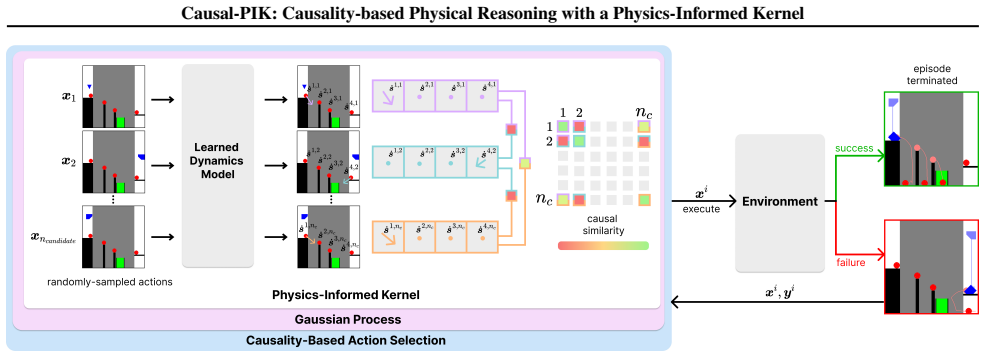
The load-bearing object is the Physics-Informed Kernel, the function $\mathrm{sim}_{csl}(a,b)$ defined by the paper's Eq. 6. It uses a learned dynamics model to predict the next $n_{\text{pred}}$ states after an action is executed; extracts, for each dynamic object $O$, the state change $\dot{s}^O$ at the first causal event $t_{\text{event}}$; and combines directional similarity (cosine of the state-change vectors) with magnitude similarity (a reciprocal-distance score) into a per-object score in $[0,1]$. Averaging over all dynamic objects and applying an exponential scaling yields the final kernel. This replaces the usual geometric-distance assumption of the RBF kernel with an effect-space assumption: two actions are similar when they push objects in similar directions and by similar amounts, so a failed attempt updates the model's belief about every untried action predicted to have the same causal effect.
What would settle it
Compute the Gram matrix of $\mathrm{sim}_{csl}$ for the candidate actions of one Virtual Tools attempt and inspect its smallest eigenvalue: if any such matrix has a negative eigenvalue, the function is not positive semi-definite, so the Gaussian-process posterior variance can go negative and the upper-confidence-bound acquisition becomes ill-defined.
Extended reading notes
Core claim
The central claim is that the objective function of a physical puzzle is modeled well by a Gaussian process whose kernel encodes causal-effect similarity. For two actions a and b, the kernel averages, over all dynamic objects, the product of a cosine similarity and a magnitude similarity between the state changes predicted by a learned dynamics model, then rescales the average by an exponential to sharpen the contrast; the paper asserts that this function qualifies as a valid kernel because it is symmetric and non-negative. Running this kernel inside an upper-confidence-bound acquisition loop, Causal-PIK reports AUCCESS of 65.0 versus 58.0 for SSUP on the twenty Virtual Tools puzzles, and on PHYRE-1B Cross it reports 41.6, comparable to the best reduced-action-space baseline while searching the full action space. The authors also report that per-puzzle difficulty scores correlate strongly with human performance on PHYRE (r = 0.73).
Load-bearing premise
The method assumes that the similarity function used as the Gaussian-process kernel is a legitimate covariance function; the paper verifies only symmetry and non-negativity, not the stronger positive semi-definiteness property that keeps posterior variances and the acquisition function well defined.
Editorial extensions
If this is right
- On Virtual Tools with at most ten attempts, Causal-PIK reports AUCCESS 65.0, above SSUP's 58.0 and the RBF-kernel ablation's 42.0.
- On PHYRE-1B Cross with at most one hundred attempts, Causal-PIK reports AUCCESS 41.6, comparable to the best reduced-action-space baseline (42.2) while searching the full action space, and above the best full-action-space baseline (30.24).
- Replacing the Physics-Informed Kernel with an RBF kernel drops AUCCESS by 23 points on Virtual Tools and by roughly 14 points on PHYRE, indicating that the causal-similarity kernel is the main driver of the reported gain.
- When the dynamics model is trained on similar puzzles, the L2 prediction error improves from 19.3 to 3.56 but AUCCESS only rises from 41.6 to 45, so the method degrades gracefully as prediction noise grows.
- Causal-PIK with one hundred attempts scores above the human baselines on both benchmarks, and its per-puzzle AUCCESS correlates with human scores at r = 0.73 on PHYRE.
Reading between the lines
- A consequence the paper leaves implicit is that a cheap repair exists if the kernel fails to be positive semi-definite: apply an RBF or Matérn kernel to the predicted state-change vectors, or add a diagonal jitter, and the rest of the pipeline would still stand.
- The same effect-space similarity idea should transfer to any Bayesian-optimization domain where a learned forward model can predict the outcome of an action, such as robot pushing, object rearrangement, or material design, since the kernel equations only require the predicted state changes.
- The paper's near-miss objective (closest distance to the goal at any timestep) suggests a concrete testable extension: humans' subjective judgments of which failed attempts were 'close' should match the ordering of that objective, a prediction the current aggregate correlation does not yet address.
Editorial analysis
A structured set of objections, weighed in public.
Referee Report
Summary. The paper proposes Causal-PIK, a Bayesian optimization (BO) method for single-intervention physical reasoning tasks on the Virtual Tools and PHYRE benchmarks. A learned dynamics model predicts short-horizon effects of candidate actions, and a 'Physics-Informed Kernel' compares actions by these predicted causal effects. This kernel is used in a Gaussian process (GP) surrogate, and an Upper Confidence Bound (UCB) acquisition function selects the next action to execute. The authors report AUCCESS gains over SSUP and prior PHYRE methods, compare against human performance including a new PHYRE user study, and provide an RBF-kernel ablation plus a robustness analysis with noisy dynamics predictions.
Significance. The core idea of using learned causal-effect predictions to define an action-similarity kernel for BO is appealing and potentially useful for sample-efficient physical reasoning. The new human PHYRE study, the cross-fold training protocol, the RBF ablation, and the noisy-prediction analysis are concrete contributions. However, the central mathematical claim that the proposed kernel is a valid GP kernel is incorrect, and the reported performance advantages over the strongest baselines are within one standard error. If the kernel is redefined to be positive semi-definite and the evaluation is tightened, the approach could still be a useful contribution; in its current form, the theoretical foundation and the headline empirical claim are not established.
major comments (3)
- [Section 3.2, Eqs. (3)-(6)] The validity argument for the Physics-Informed Kernel is incorrect. Symmetry and pointwise non-negativity do not imply positive semi-definiteness, and Eq. (6) is not even pointwise non-negative: writing m = (1/D) * sum_O sim_obj in [0,1], the formula is sim_csl(a,b) = m*exp(m) - 1, which equals -1 when m=0 (e.g., when all rectified cosine similarities are zero). The function is also indefinite. For D=1 and three unit state-change vectors separated by 120 degrees, every off-diagonal entry has sim_cos = max(0, cos(120 deg)) = 0, so off-diagonal sim_csl = -1 while diagonal entries are e - 1, approximately 1.718. The resulting Gram matrix has eigenvalues approximately {2.718, 2.718, -0.282}, including a negative eigenvalue. A GP with an indefinite kernel can yield a non-positive-semidefinite posterior covariance, making the UCB acquisition function in Algorithm 1, line 5, ill-defined. Since the Physics-Informed Kernel is the paper's core contribution, the theoretical basis for Causal-PIK as a BO/GP method is not established; a positive semi-definite kernel (e.g., an RBF over the per-object causal-effect feature vector) would be needed.
- [Section 3.3, Eq. (7)] The objective function f(x) contains an unspecified parameter beta. No value, range, or tuning procedure is given in the main text or appendices. Because f(x) is the target of the GP, beta directly affects the posterior and therefore the selected actions and all reported AUCCESS numbers. Without specifying beta, the method is not fully reproducible and the reported results cannot be independently verified.
- [Section 5, Tables 1 and 2] The claim of 'significantly outperforming' state-of-the-art models is not supported by the reported statistics. On PHYRE-1B Cross (Table 2), Causal-PIK reaches AUCCESS 41.6 +/- 9.33, which is lower than RPIN (42.2 +/- 7.1) and essentially tied with Ahmed et al. (41.9 +/- 8.8); the 11-point gap over Harter et al. (30.24) is only against a non-state-of-the-art full-action-space baseline. On Virtual Tools (Table 1), the gap over SSUP (65.0 vs. 58.0) is within one standard deviation (25.0 vs. 27.0). The paper needs paired or per-puzzle error bars and significance testing, and the wording should be revised to match the actual evidence.
minor comments (6)
- [Section 3.4] The sentence 'In Equation 7, the shortest observed distance dc is normalized by the counterfactual baseline distance dist(s0,sg)' is inaccurate: dist(s0,sg) is the distance between the initial state and the goal, not a counterfactual rollout without an action object, and Eq. (6) contains no counterfactual baseline term. Please correct the description or define what the counterfactual baseline actually is.
- [Section 3.2, Eq. (3)] The cosine similarity in Eq. (3) divides by ||sdot_O,a|| * ||sdot_O,b||; for actions that cause no motion, these norms can be zero and the expression is undefined. Please specify how zero state-change vectors are handled.
- [Section 3.1 and Section 5] The initial 9 rollouts are excluded from the attempt count ('warm-up samples that do not count towards the total attempt count'). This is consistent with the SSUP baseline, which also uses warm-up samples, but the comparison to humans, who have no warm-up, is misleading. The AUCCESS values labeled '@10+' also exclude these 9 evaluations, so they do not correspond to a literal maximum of 10 environment calls. Please report the total number of environment evaluations including warm-up alongside the attempt count.
- [Section 3.2, Eq. (6)] Equation (6) should be parenthesized as m*exp(m) - 1, where m = (1/D) * sum_O sim_obj(O,a,b). As typeset, it is easy to misread the formula as applying the exponential separately to each term or as multiplying before averaging, which affects interpretation of the kernel values.
- [Section 5, PHYRE paragraph] The sentence 'As shown in Table 2, Causal-PIK achieves an AUCCESS rate over 10 points higher than the best-performing baseline' conflicts with Table 2, where the reduced-action-space baselines RPIN and Ahmed et al. reach 42.2 and 41.9, respectively. Please specify that the comparison is only to full-action-space baselines or revise the claim.
- [Algorithm 1] If any of the n_initial warm-up samples happens to solve the task, the behavior of the while-success == False loop and the handling of successful initial points are unspecified. Please clarify whether success can be detected during initialization.
Circularity Check
No significant circularity; the core empirical claims are measured against external benchmarks and the kernel's PSD flaw is a soundness issue, not a circular reduction.
full rationale
The derivation chain is not circular. The dynamics model is trained on folds or variations disjoint from the test puzzles (Appendix A), and the Physics-Informed Kernel is defined from predicted state changes (Eqs. 2-6) rather than fitted to the observed rewards. AUCCESS scores in Tables 1-2 are empirical evaluations against external baselines (SSUP, RPIN, DQN, humans), so no fitted parameter is renamed as a prediction and no equation reduces to its own input by construction. The self-citations to Gerstenberg and Tenenbaum (2016) and Antonova et al. (2019) are motivational or related-work only and do not carry the argument. The main mathematical defect is in Section 3.2: the paper asserts that sim_csl is a valid kernel because it is symmetric and non-negative, but non-negativity does not imply positive semi-definiteness, and sim_csl is in fact provably indefinite (e.g., off-diagonal entries of -1 with diagonal entries of e-1 produce a negative eigenvalue). This invalidates the GP/BO posterior justification, but it is a soundness and correctness failure rather than circularity: the empirical results are not forced by the kernel definition. The low score reflects only minor non-load-bearing self-citations, not circular reasoning.
Assumptions & free parameters
free parameters (6)
- beta in objective function (Eq. 7) =
not reported
- UCB exploration coefficient =
not reported
- npred =
20
- n_initial =
9
- n_candidate =
500
- n_best =
5
assumptions (3)
- ad hoc to paper A symmetric, non-negative function is a valid kernel for a Gaussian process
- domain assumption The learned dynamics model (RPIN) provides sufficiently accurate state-change predictions for the kernel to reflect true causal similarities
- domain assumption Dynamics models trained on puzzle variations or training folds generalize to unseen test puzzles
Cite this review
Pith. "Pith review of Causal-PIK: Causality-based Physical Reasoning with a Physics-Informed Kernel." pith.science (2026). https://pith.science/paper/VBQSHZZD
@misc{pith2026250522861,
  author       = {Pith},
  title        = {Pith review of: Causal-PIK: Causality-based Physical Reasoning with a Physics-Informed Kernel},
  year         = {2026},
  howpublished = {\url{https://pith.science/paper/VBQSHZZD}},
  note         = {Machine review of arXiv:2505.22861}
}
read the original abstract
Tasks that involve complex interactions between objects with unknown dynamics make planning before execution difficult. These tasks require agents to iteratively improve their actions after actively exploring causes and effects in the environment. For these type of tasks, we propose Causal-PIK, a method that leverages Bayesian optimization to reason about causal interactions via a Physics-Informed Kernel to help guide efficient search for the best next action. Experimental results on Virtual Tools and PHYRE physical reasoning benchmarks show that Causal-PIK outperforms state-of-the-art results, requiring fewer actions to reach the goal. We also compare Causal-PIK to human studies, including results from a new user study we conducted on the PHYRE benchmark. We find that Causal-PIK remains competitive on tasks that are very challenging, even for human problem-solvers.
Figures


Figures from the paper (2 more)


Reference graph
Works this paper leans on
-
[1]
write newline
" write newline "" before.all 'output.state := FUNCTION n.dashify 't := "" t empty not t #1 #1 substring "-" = t #1 #2 substring "--" = not "--" * t #2 global.max substring 't := t #1 #1 substring "-" = "-" * t #2 global.max substring 't := while if t #1 #1 substring * t #2 global.max substring 't := if while FUNCTION format.date year duplicate empty "emp...
-
[2]
Physical reasoning using dynamics-aware models
Ahmed, E., Bakhtin, A., van der Maaten, L., and Girdhar, R. Physical reasoning using dynamics-aware models. arXiv preprint arXiv:2102.10336, 2021
arXiv 2021
-
[3]
Allen, K. R., Smith, K. A., and Tenenbaum, J. B. Rapid trial-and-error learning with simulation supports flexible tool use and physical reasoning. Proceedings of the National Academy of Sciences, 117 0 (47): 0 29302--29310, 2020
work page 2020
-
[4]
Antonova, R., Rai, A., and Atkeson, C. G. Deep Kernels for Optimizing Locomotion Controllers . In Conference on Robot Learning (CoRL). PMLR, 2017
work page 2017
-
[5]
Bayesian Optimization in Variational Latent Spaces with Dynamic Compression
Antonova, R., Rai, A., Li, T., and Kragic, D. Bayesian Optimization in Variational Latent Spaces with Dynamic Compression . In Conference on Robot Learning (CoRL). PMLR, 2019
work page 2019
-
[6]
Phyre: A new benchmark for physical reasoning
Bakhtin, A., van der Maaten, L., Johnson, J., Gustafson, L., and Girshick, R. Phyre: A new benchmark for physical reasoning. Advances in Neural Information Processing Systems, 32, 2019
work page 2019
-
[7]
Battaglia, P. W., Hamrick, J. B., and Tenenbaum, J. B. Simulation as an engine of physical scene understanding. Proceedings of the National Academy of Sciences, 110 0 (45): 0 18327--18332, 2013
work page 2013
-
[8]
Berkenkamp, F., Krause, A., and Schoellig, A. P. Bayesian optimization with safety constraints: safe and automatic parameter tuning in robotics. Machine Learning, 112 0 (10): 0 3713--3747, 2023
work page 2023
Show all 32 references
-
[9]
R., Gerstenberg, T., Tenenbaum, J
Bramley, N. R., Gerstenberg, T., Tenenbaum, J. B., and Gureckis, T. M. Intuitive experimentation in the physical world. Cognitive Psychology, 105: 0 9--38, 2018
2018
-
[10]
Bayesian Modeling for Optimization and Control in Robotics
Calandra, R. Bayesian Modeling for Optimization and Control in Robotics . PhD thesis, Darmstadt University of Technology, Germany, 2017
2017
-
[11]
Pip: Physical interaction prediction via mental simulation with span selection
Duan, J., Yu, S., Poria, S., Wen, B., and Tan, C. Pip: Physical interaction prediction via mental simulation with span selection. In European Conference on Computer Vision, pp.\ 405--421. Springer, 2022
2022
-
[12]
Feng, S., Whitman, E., Xinjilefu, X., and Atkeson, C. G. Optimization-based Full Body Control for the DARPA Robotics Challenge . Journal of Field Robotics, 32 0 (2): 0 293--312, 2015
2015
-
[13]
and Tenenbaum, J
Gerstenberg, T. and Tenenbaum, J. Understanding" almost": Empirical and computational studies of near misses. In CogSci, 2016
2016
-
[14]
Forward prediction for physical reasoning
Girdhar, R., Gustafson, L., Adcock, A., and van der Maaten, L. Forward prediction for physical reasoning. arXiv preprint arXiv:2006.10734, 2020
2006 arXiv
-
[15]
Solving physics puzzles by reasoning about paths
Harter, A., Melnik, A., Kumar, G., Agarwal, D., Garg, A., and Ritter, H. Solving physics puzzles by reasoning about paths. arXiv preprint arXiv:2011.07357, 2020
2011 arXiv
-
[16]
Bayesian optimization meets riemannian manifolds in robot learning
Jaquier, N., Rozo, L., Calinon, S., and B \"u rger, M. Bayesian optimization meets riemannian manifolds in robot learning. In Conference on Robot Learning, pp.\ 233--246. PMLR, 2020
2020
-
[17]
On the learning mechanisms in physical reasoning
Li, S., Wu, K., Zhang, C., and Zhu, Y. On the learning mechanisms in physical reasoning. Advances in Neural Information Processing Systems, 35: 0 28252--28265, 2022
2022
-
[18]
I-PHYRE: Interactive Physical Reasoning
Li, S., Wu, K., Zhang, C., and Zhu, Y. I-PHYRE: Interactive Physical Reasoning . In The Twelfth International Conference on Learning Representations, 2024
2024
-
[19]
P., Krause, A., Schaal, S., and Trimpe, S
Marco, A., Berkenkamp, F., Hennig, P., Schoellig, A. P., Krause, A., Schaal, S., and Trimpe, S. Virtual vs. real: Trading off simulations and physical experiments in reinforcement learning with Bayesian optimization . In 2017 IEEE International Conference on Robotics and Autom...
2017
-
[20]
I., Garg, A., Ritter, H., et al
Melnik, A., Schiewer, R., Lange, M., Muresanu, A. I., Garg, A., Ritter, H., et al. Benchmarks for Physical Reasoning AI . Transactions on Machine Learning Research, 2023
2023
-
[21]
K., Romeres, D., van Baar, J., Smith, K
Ota, K., Jha, D. K., Romeres, D., van Baar, J., Smith, K. A., Semitsu, T., Oiki, T., Sullivan, A., Nikovski, D., and Tenenbaum, J. B. Data-efficient learning for complex and real-time physical problem solving using augmented simulation, 2021
2021
-
[22]
Learning long-term visual dynamics with region proposal interaction networks
Qi, H., Wang, X., Pathak, D., Ma, Y., and Malik, J. Learning long-term visual dynamics with region proposal interaction networks. In ICLR, 2021
2021
-
[23]
Y., Bernard, M., Lerer, A., Fergus, R., Izard, V., and Dupoux, E
Riochet, R., Castro, M. Y., Bernard, M., Lerer, A., Fergus, R., Izard, V., and Dupoux, E. Intphys 2019: A benchmark for visual intuitive physics understanding. IEEE Transactions on Pattern Analysis and Machine Intelligence, 44 0 (9): 0 5016--5025, 2021
2019
-
[24]
P., and De Freitas, N
Shahriari, B., Swersky, K., Wang, Z., Adams, R. P., and De Freitas, N. Taking the human out of the loop: A review of bayesian optimization. Proceedings of the IEEE, 104 0 (1): 0 148--175, 2015
2015
-
[25]
Planck.js, 2017
Shakiba, A. Planck.js, 2017. URL https://piqnt.com/planck.js/docs/
2017
-
[26]
Different physical intuitions exist between tasks, not domains
Smith, K., Battaglia, P., and Vul, E. Different physical intuitions exist between tasks, not domains. Computational Brain & Behavior , 1, 07 2018. doi:10.1007/s42113-018-0007-3
2018 doi
-
[27]
Modeling expectation violation in intuitive physics with coarse probabilistic object representations
Smith, K., Mei, L., Yao, S., Wu, J., Spelke, E., Tenenbaum, J., and Ullman, T. Modeling expectation violation in intuitive physics with coarse probabilistic object representations. Advances in neural information processing systems, 32, 2019
2019
-
[28]
D., Stuhlm \"u ller, A., Goodman, N
Ullman, T. D., Stuhlm \"u ller, A., Goodman, N. D., and Tenenbaum, J. B. Learning physical parameters from dynamic scenes. Cognitive Psychology, 104: 0 57--82, 2018
2018
-
[29]
Recent advances in bayesian optimization
Wang, X., Jin, Y., Schmitt, S., and Olhofer, M. Recent advances in bayesian optimization. ACM Computing Surveys, 55 0 (13s): 0 1--36, 2023
2023
-
[30]
Learning to see physics via visual de-animation
Wu, J., Lu, E., Kohli, P., Freeman, B., and Tenenbaum, J. Learning to see physics via visual de-animation. Advances in neural information processing systems, 30, 2017
2017
-
[31]
Interpretable intuitive physics model
Ye, T., Wang, X., Davidson, J., and Gupta, A. Interpretable intuitive physics model. In Proceedings of the European Conference on Computer Vision (ECCV), pp.\ 87--102, 2018
2018
-
[32]
A., Tenenbaum, J
Zhou, L., Smith, K. A., Tenenbaum, J. B., and Gerstenberg, T. Mental jenga: A counterfactual simulation model of causal judgments about physical support. Journal of Experimental Psychology: General, 152 0 (8): 0 2237--2269, 2023
2023
Reviewed August 7, 2026 · model on record in the stance chip above.
Discussion (0). Sign in to comment.