REVIEW 5 major objections 6 minor 32 references
Emergence of Transverse Dielectric Response in Ferroelectric Dielectric Heterostructures
T0 review · 5 major / 6 minor · reviewed 2026-08-07 · deepseek-v4-flash
Pith's one-line read An electric field along one direction induces sizable local polarization responses along the orthogonal directions in PbTiO3/SrTiO3 superlattices hosting polar vortices, and the sign of these transverse responses can be reversed by…
desk verdict A plausible and interesting prediction of large transverse local dielectric response in ferroelectric vortex superlattices, but the quantitative claims need a finite-size convergence test and the sign-reversal claim goes beyond what is directly simulated. read the letter →
The pith
A machine-rendered reading of the paper's core claim, the machinery that carries it, and where it could break.
The reading
What carries the argument
The central object is the local electric susceptibility tensor $\chi_{ij}(\mathbf{r}) = \frac{1}{\varepsilon_0} \frac{\Delta P_i(\mathbf{r})}{\Delta E_j}$, computed by finite differences between Monte Carlo configurations at $\pm 0.026$ MV/cm applied along x, y, and z. The mechanism that produces the transverse response is the geometric buckling of the vortex cores: an applied field changes the magnitude of the polarization component along its own direction, and because the vortex texture is tilted and chiral, that change forces the orthogonal polarization components to readjust. The buckling sense therefore acts as a switch: inverting it reverses the signs of the off-diagonal susceptibility elements while leaving their magnitudes intact.
What would settle it
Repeat the same finite-difference susceptibility calculation on supercells with four or six unit cells along the y direction. If the off-diagonal susceptibility components no longer reach about half the diagonal values, or if their sign reversal with buckling disappears, the reported transverse response is a supercell artifact rather than a property of the vortex phase.
Extended reading notes
Core claim
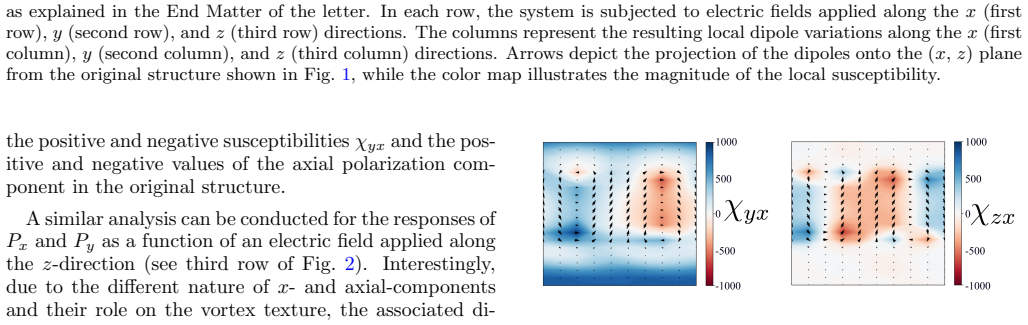
In the vortex phase of PbTiO3/SrTiO3 superlattices, the local electric susceptibility tensor acquires sizable off-diagonal elements: a field along x induces polarization responses along y and z, a field along z induces responses along x and y, and similarly for the other directions, with values around half those of the diagonal elements. These transverse responses are not random fluctuations; they follow the vortex geometry. The sign of the off-diagonal terms is set by the sense of vortex buckling: when the clockwise vortex moves from bottom to top, the entire pattern of positive and negative transverse susceptibilities reverses while the magnitudes stay the same. The paper further shows that at the transition to a polarization wave, reached at a field of 0.36 MV/cm along x or at a biaxial strain of 0.75%, the transverse susceptibility grows by 340% and becomes comparable to the diagonal components. The authors state that this is, to their knowledge, the first system where a local transverse dielectric response can be switched deterministically by a homogeneous electric field.
Load-bearing premise
The simulation supercell is only two perovskite unit cells wide along the y direction, and the paper assumes this width preserves the essential physics; no convergence test against wider cells is presented, so the magnitudes and sign patterns of the reported off-diagonal susceptibilities could in principle be artifacts of that narrow width.
Editorial extensions
If this is right
- An electric field along one direction produces local polarization changes along the perpendicular directions, with off-diagonal susceptibility elements about half the size of the diagonal elements.
- Reversing the vortex buckling, which is controlled by a homogeneous electric field, reverses the sign of the transverse susceptibility, giving a deterministic dielectric switch.
- During the field- or strain-induced transition to a polarization wave, the transverse susceptibility grows by about 340% and becomes comparable to the diagonal components.
- The effect may generalize to other topological polarization textures such as polar skyrmions, where collective dynamics have already been observed.
- Because the transverse response is local and switchable, it provides a mechanism for reconfigurable nanoscale dielectric devices, in the same spirit as negative capacitance ideas.
Reading between the lines
- A direct experimental check would be to measure the angular dependence of the macroscopic dielectric response of a vortex superlattice: a nonzero off-diagonal permittivity would show up as an induced polarization at right angles to the applied field in a capacitor geometry.
- The absence of a convergence test along the y direction means the quantitative claim of 'half the diagonal' should be verified on wider supercells before the effect is accepted as intrinsic.
- The same finite-difference susceptibility analysis could be run on polar skyrmion or meron lattices to see whether their peripheries, where negative permittivity appears, also host transverse responses with a similar magnitude.
- The sign-switching mechanism suggests a device concept: a nanoscale element whose transverse polarization output is toggled by a homogeneous field, acting as a non-volatile dielectric state variable.
Editorial analysis
A structured set of objections, weighed in public.
Referee Report
Summary. The manuscript reports second-principles SCALE-UP Monte Carlo simulations of a (PbTiO3)10/(SrTiO3)10 superlattice with a 0.25% tensile strain, in the polar-vortex phase. Using central finite differences in electric field ( 0.026 MV/cm) on top of Monte Carlo-averaged local polarizations, the authors compute spatially resolved dielectric susceptibility maps chi_ij(r). They report off-diagonal ('transverse') components with magnitudes of order half the diagonal components, a sign change of these off-diagonal maps when the vortex-core buckling is inverted, and a strong enhancement (about 340%) of the transverse response near a field- or strain-induced vortex-to-polarization-wave transition. The paper concludes that the local dielectric tensor of the vortex phase contains sizable, deterministic, switchable transverse components, potentially generalizable to other topological ferroelectric textures.
Significance. If the results hold, they identify a genuinely new functional property of polar vortices: a large, locally structured, and switchable off-diagonal dielectric response. The calculation has the strength of being a fully forward simulation against an established second-principles Hamiltonian (Refs. [13,20]), with no parameters fitted to the target susceptibility; the computational protocol and supercell geometry are described explicitly. The main risk is not circularity but robustness: the central quantitative claims rest on supercells only two unit cells wide along the vortex-axis direction, and the maps are presented without statistical uncertainty or finite-size/step convergence checks. If those checks pass, the paper would be a valuable contribution to the physics of topological ferroelectric textures.
major comments (5)
- [End Matter and main text, supercell dimensions] The supercell is 10x2x[(PbTiO3)10/(SrTiO3)10], i.e., only 2 unit cells along the vortex-axis direction y, and the text asserts that this 'maintain[s] the essential physics' because stripe domains are perfectly periodic. This assertion is load-bearing: the off-diagonal susceptibilities chi_yx, chi_zy, and chi_xy are attributed to the axial (Bloch) polarization component P_y at vortex cores and domain walls, and the 2-cell period is the shortest possible wavelength for any y-modulation of that component, which is also chosen to accommodate octahedral rotations that themselves break y-translational symmetry. No convergence test with N_y = 4, 6, or 8 is presented. I request such a test for the ground-state P_y profile and for the susceptibility maps, plus a statement of whether P_y is uniform or alternating along y; without it, the 'half the diagonal' magnitude and the sign pattern could be artifacts of the enforced y-periodicity.
- [End Matter, Eq. (1) and Fig. 2] The susceptibilities are computed as central differences of Monte Carlo-averaged polarizations over 10 realizations, but no statistical uncertainty is reported. Since the central claims include positive-versus-negative patterns in chi_yx and chi_zy and a 340% enhancement at the transition, the reader needs to know whether these features exceed the Monte Carlo noise. Please provide standard errors or a bootstrap over realizations, and test convergence of the finite-difference quotient with respect to the field step (e.g., +-0.013 and +-0.052 MV/cm) to confirm that 0.026 MV/cm lies in the linear-response regime.
- [Fig. 4 and the sentence 'under an electric bias of 0.36 MV/cm...'] Because the susceptibility uses central differences of +-0.026 MV/cm, the two field values may lie on opposite sides of the vortex-to-polarization-wave transition. In that case Eq. (1) measures a mixture of two phases rather than a differential susceptibility, and the reported '340% increase' would not be a dielectric response of a single state. Please specify the stable polarization texture at E0 +- delta E, and show that chi(E0) is independent of delta E when E0 is on either side of the transition.
- [Abstract and conclusion] The headline claim that transverse susceptibilities 'approach' or are 'approximately half' of the diagonal components is never quantified numerically in the text. The color maps alone do not allow the reader to verify the ratio, the spatial regions over which it holds, or the values at the transition. Please report concrete numbers, e.g., the maximum or domain-averaged |chi_off|/chi_diag in the PbTiO3 layers for Figs. 2, 3, and 4(a), with uncertainties.
- [Fig. 3 and the 'first system' claim] The sign reversal is demonstrated here by comparing two separately initialized buckling states, not by applying a field and observing the switch in the same simulation. To support the field-switching claim, either perform a field sweep that reverses the buckling and recomputes the susceptibility, or explicitly attribute the buckling reversal to the earlier demonstration in Ref. [18] and soften the 'first reported system' claim accordingly.
minor comments (6)
- [End Matter title] The heading 'Computational Deails' contains a typo and should read 'Computational Details'.
- [Figure captions] The color maps in Figs. 2-5 would be much more informative if the color bars were labeled with numerical values and units of chi; otherwise the 'half of the diagonal' claim cannot be checked from the figures.
- [Main text, paragraph before Fig. 3] The statement that 'the associated dielectric tensors are not symmetric' needs clarification: pointwise local tensors need not satisfy reciprocity, which applies to the nonlocal response chi_ij(r,r'), so the asymmetry itself is not suspicious, but the sentence should say this explicitly to avoid confusion.
- [Reference [29]] The author list of Ref. [29] appears malformed ('Huaiyu, Wang' rather than an initial-and-surname format); please correct the formatting.
- [Equation (1)] Eq. (1) uses 'Ej' for the applied field, while the text also discusses background fields E0; the notation should distinguish the background field from the finite-difference step to avoid ambiguity.
- [Acknowledgments] There is a typo, 'financil support', which should read 'financial support'.
Circularity Check
No significant circularity: the transverse dielectric response is a forward simulation output, not an input fitted in this paper.
full rationale
The central claim, off-diagonal local susceptibilities of order half the diagonal ones, is obtained by solving a fixed second-principles Hamiltonian from earlier work (Refs. [13,20]) and applying Eq. (1), a central finite-difference definition of the local susceptibility from the model's polarization response to ±0.026 MV/cm fields. No parameter is fitted to the transverse susceptibilities in this paper, and no equation reduces the predicted quantity to an assumed input by construction. The self-citations (Refs. [13,20,23,31,32]) provide the model Hamiltonian, the simulation methodology, and supercell-period justifications; they are prior, independently parameterized results rather than assertions that the target response exists. The reader's concern about the 2-unit-cell y-period is a convergence/correctness concern about the model prediction, not a circularity concern. Nothing in the derivation chain equates the predicted chi_ij to an input of the calculation; the result is an output of a forward simulation against a fixed model.
Assumptions & free parameters
free parameters (2)
- y-direction supercell width =
2 perovskite unit cells
- Electric field finite-difference step =
±0.026 MV/cm
assumptions (4)
- domain assumption The second-principles Hamiltonian (scale-up) accurately describes the dielectric response of PbTiO3/SrTiO3 superlattices.
- domain assumption Local polarization can be computed linearly from Born effective charges times atomic displacements.
- ad hoc to paper A supercell of 2 unit cells along y preserves the essential physics of the stripe vortex array.
- domain assumption The two vortex buckling configurations are degenerate and can be switched by homogeneous electric fields.
Cite this review
Pith. "Pith review of Emergence of Transverse Dielectric Response in Ferroelectric Dielectric Heterostructures." pith.science (2026). https://pith.science/paper/T5WJVU2M
@misc{pith2026250522870,
  author       = {Pith},
  title        = {Pith review of: Emergence of Transverse Dielectric Response in Ferroelectric Dielectric Heterostructures},
  year         = {2026},
  howpublished = {\url{https://pith.science/paper/T5WJVU2M}},
  note         = {Machine review of arXiv:2505.22870}
}
abstract
We report the emergence of a transverse dielectric response in PbTiO$_{3}$/SrTiO$_{3}$ superlattices hosting polar vortex structures. Using second-principles simulations, we find that an electric field applied along one direction induces significant local polarization responses along orthogonal directions, with magnitudes approaching half that of the diagonal susceptibility components. These off-diagonal responses are strongly dependent on the topology of the vortex structure and can be deterministically tuned or even reversed via homogeneous electric fields or epitaxial strain. Notably, the transverse susceptibilities become comparable to the diagonal components during a field- or strain-induced transition to a polarization wave state. This discovery opens avenues for engineering reconfigurable nanoscale dielectric responses in topologically textured ferroelectric systems.
Figures


Figures from the paper (2 more)


Reference graph
Works this paper leans on
-
[18]
P. Behera, M. A. May, F. G´ omez-Ortiz, S. Susarla, S. Das, C. T. Nelson, L. Caretta, S.-L. Hsu, M. R. Mc- Carter, B. H. Savitzky, E. S. Barnard, A. Raja, Z. Hong, P. Garc ´ ıa-Fernandez, S. W. Lovesey, G. van der Laan, P. Ercius, C. Ophus, L. W. Martin, J. Junquera, M. B. Raschke, and R. Ramesh, Electric field control of chiral- ity, Sci. Adv. 8, eabj8030 (2022)
work page 2022
-
[1]
J. Junquera, Y. Nahas, S. Prokhorenko, L. Bellaiche, J. ´I˜ niguez, D. G. Schlom, L.-Q. Chen, S. Salahuddin, D. A. Muller, L. W. Martin, and R. Ramesh, Topological phases in polar oxide nanostructures, Rev. Mod. Phys. 95, 025001 (2023)
work page 2023
-
[2]
A. K. Yadav, C. T. Nelson, S. L. Hsu, Z. Hong, J. D. Clarkson, C. M. Schlep¨ utz, A. R. Damodaran, P. Shafer, E. Arenholz, L. R. Dedon, D. Chen, A. Vishwanath, A. M. Minor, L. Q. Chen, J. F. Scott, L. W. Martin, and R. Ramesh, Observation of polar vortices in oxide superlattices, Nature 530, 198 (2016)
work page 2016
-
[3]
S. Das, Y. L. Tang, Z. Hong, M. A. P. Gon¸ calves, M. R. McCarter, C. Klewe, K. X. Nguyen, F. G´ omez-Ortiz, P. Shafer, E. Arenholz, V. A. Stoica, S.-L. Hsu, B. Wang, C. Ophus, J. F. Liu, C. T. Nelson, S. Saremi, B. Prasad, A. B. Mei, D. G. Schlom, J.´I˜ niguez, P. Garc ´ ıa-Fern´ andez, D. A. Muller, L. Q. Chen, J. Junquera, L. W. Martin, and R. Ramesh, ...
work page 2019
-
[4]
Y. J. Wang, Y. P. Feng, Y. L. Zhu, Y. L. Tang, L. X. Yang, M. J. Zou, W. R. Geng, M. J. Han, X. W. Guo, B. Wu, and X. L. Ma, Polar meron lattice in strained oxide ferroelectrics, Nat. Mater. 19, 881 (2020)
work page 2020
-
[5]
I. Luk’yanchuk, Y. Tikhonov, A. Razumnaya, and V. M. Vinokur, Hopfions emerge in ferroelectrics, Nature Com- mun. 11, 2433 (2020)
work page 2020
-
[6]
L. Bellaiche, A. Garc ´ ıa, and D. Vanderbilt, Finite- temperature properties of Pb(Zr 1−x Tix )O3 alloys from first principles, Phys. Rev. Lett. 84, 5427 (2000)
work page 2000
- [7]
Show all 32 references
-
[8]
Shafer, P
P. Shafer, P. Garc ´ ıa-Fern´ andez, P. Aguado-Puente, A. R. Damodaran, A. K. Yadav, C. T. Nelson, S.-L. Hsu, J. C. Wojde l, J. ´I˜ niguez, L. W. Martin, E. Arenholz, J. Jun- quera, and R. Ramesh, Emergent chirality in the electric polarization texture of titanate superlattice...
2018
-
[9]
Daranciang, M
D. Daranciang, M. J. Highland, H. Wen, S. M. Young, N. C. Brandt, H. Y. Hwang, M. Vattilana, M. Nicoul, F. Quirin, J. Goodfellow, T. Qi, I. Grinberg, D. M. Fritz, M. Cammarata, D. Zhu, H. T. Lemke, D. A. Walko, E. M. Dufresne, Y. Li, J. Larsson, D. A. Reis, K. Sokolowski-Tinte...
2012
-
[10]
Q. Li, V. A. Stoica, M. Pa´ sciak, Y. Zhu, Y. Yuan, T. Yang, M. R. McCarter, S. Das, A. K. Yadav, S. Park, C. Dai, H. J. Lee, Y. Ahn, S. D. Marks, S. Yu, C. Kadlec, T. Sato, M. C. Hoffmann, M. Chollet, M. E. Kozina, S. Nelson, D. Zhu, D. A. Walko, A. M. Lindenberg, P. G. Evans...
2021
-
[11]
A. M. Bratkovsky and A. P. Levanyuk, Very large di- electric response of thin ferroelectric films with the dead layers, Phys. Rev. B 63, 132103 (2001)
2001
-
[12]
Luk’yanchuk, Y
I. Luk’yanchuk, Y. Tikhonov, A. Sen´ e, A. Razumnaya, and V. M. Vinokur, Harnessing ferroelectric domains for negative capacitance, Commun. Phys. 2, 22 (2019)
2019
-
[13]
Zubko, J
P. Zubko, J. C. Wojde l, M. Hadjimichael, S. Fernandez- Pena, A. Sen´ e, I. Luk’yanchuk, J.-M. Triscone, and J. ´I˜ niguez, Negative capacitance in multidomain ferro- electric superlattices, Nature 534, 524 (2016)
2016
-
[14]
´I˜ niguez, P
J. ´I˜ niguez, P. Zubko, I. Luk’yanchuk, and A. Cano, Fer- roelectric negative capacitance, Nat. Rev. Mater. 4, 243 (2019)
2019
-
[15]
M. Graf, H. Aramberri, P. Zubko, and J. ´I˜ niguez, Giant voltage amplification from electrostatically induced in- cipient ferroelectric states, Nat. Mater. 21, 1252 (2022)
2022
-
[16]
Salahuddin and S
S. Salahuddin and S. Datta, Use of negative capacitance to provide voltage amplification for low power nanoscale devices, Nano Lett. 8, 405 (2008)
2008
-
[17]
A. K. Yadav, K. X. Nguyen, Z. Hong, P. Garc ´ ıa- Fern´ andez, P. Aguado-Puente, C. T. Nelson, S. Das, B. Prasad, D. Kwon, S. Cheema, A. I. Khan, C. Hu, J. ´I˜ niguez, J. Junquera, L.-Q. Chen, D. A. Muller, R. Ramesh, and S. Salahuddin, Spatially resolved steady- state negativ...
2019
-
[19]
Behera, E
P. Behera, E. Parsonnet, F. G´ omez-Ortiz, V. Srikrishna, P. Meisenheimer, S. Susarla, P. Kavle, L. Caretta, Y. Wu, Z. Tian, A. Fernandez, L. W. Martin, S. Das, J. Jun- quera, Z. Hong, and R. Ramesh, Emergent ferroelectric switching behavior from polar vortex lattice, Adv. Mat...
2023
-
[20]
J. C. Wojde l, P. Hermet, M. P. Ljungberg, P. Ghosez, and J. ´I˜ niguez, First-principles model potentials for lattice- 6 dynamical studies: general methodology and example of application to ferroic perovskite oxides, J. Phys.: Con- dens. Matter 25, 305401 (2013)
2013
-
[21]
Kittel, Physical theory of ferromagnetic domains, Rev
C. Kittel, Physical theory of ferromagnetic domains, Rev. Mod. Phys. 21, 541 (1949)
1949
-
[22]
Kittel, Theory of the structure of ferromagnetic do- mains in films and small particles, Phys
C. Kittel, Theory of the structure of ferromagnetic do- mains in films and small particles, Phys. Rev. 70, 965 (1946)
1946
-
[23]
G´ omez-Ortiz, H
F. G´ omez-Ortiz, H. Aramberri, J. M. L´ opez, P. Garc ´ ıa- Fern´ andez, J.´I˜ niguez, and J. Junquera, Kittel law and domain formation mechanism in PbTiO 3/SrTiO3 super- lattices, Phys. Rev. B 107, 174102 (2023)
2023
-
[24]
J. C. Wojde l and J. ´I˜ niguez, Ferroelectric transitions at ferroelectric domain walls found from first principles, Phys. Rev. Lett. 112, 247603 (2014)
2014
-
[25]
Zatterin, P
E. Zatterin, P. Ondrejkovic, L. Bastogne, C. Lichten- steiger, L. Tovaglieri, D. A. Chaney, A. Sasani, T. Sch¨ ulli, A. Bosak, S. Leake, P. Zubko, P. Ghosez, J. Hlinka, J.-M. Triscone, and M. Hadjimichael, Assessing the ubiquity of bloch domain walls in ferroelectric lead tita...
2024
-
[26]
Chege, L
S. Chege, L. Bastogne, F. G´ omez-Ortiz, J. Sifuna, G. Amolo, P. Ghosez, and J. Junquera, Strain de- pendence of the bloch domain component in 180 ◦ do- mains in bulk PbTiO 3 from first-principles (2025), arXiv:2505.08436 [cond-mat.mtrl-sci]
2025 arXiv
-
[27]
A. R. Damodaran, J. D. Clarkson, Z. Hong, H. Liu, A. K. Yadav, C. T. Nelson, S.-L. Hsu, M. R. Mc- Carter, K.-D. Park, V. Kravtsov, A. Farhan, Y. Dong, Z. Cai, H. Zhou, P. Aguado-Puente, P. Garc ´ ıa-Fern´ andez, J. ´I˜ niguez, J. Junquera, A. Scholl, M. B. Raschke, L.-Q. Chen,...
2017
-
[28]
S. Das, Z. Hong, V. A. Stoica, M. A. P. Gon¸ calves, Y. T. Shao, E. Parsonnet, E. J. Marksz, S. Saremi, M. R. McCarter, A. Reynoso, C. J. Long, A. M. Hagerstrom, D. Meyers, V. Ravi, B. Prasad, H. Zhou, Z. Zhang, H. Wen, F. G´ omez-Ortiz, P. Garc ´ ıa-Fern´ andez, J. Bokor, J. ...
2021
-
[29]
Stoica, C
Huaiyu, Wang, V. Stoica, C. Dai, M. Pa´ sciak, S. Das, T. Yang, M. A. P. Gon¸ calves, J. Kulda, M. R. Mc- Carter, A. Mangu, Y. Cao, H. Padma, U. Saha, D. Zhu, T. Sato, S. Song, M. Hoffmann, P. Kramer, S. Nelson, Y. Sun, Q. Nguyen, Z. Zhang, R. Ramesh, L. Martin, A. M. Lindenbe...
2025
-
[30]
Prosandeev, S
S. Prosandeev, S. Lisenkov, and L. Bellaiche, Kittel law in BiFeO3 ultrathin films: A first-principles-based study, Phys. Rev. Lett. 105, 147603 (2010)
2010
-
[31]
Garc ´ ıa-Fern´ andez, J
P. Garc ´ ıa-Fern´ andez, J. C. Wojde l, J. ´I˜ niguez, and J. Junquera, Second-principles method for materials sim- ulations including electron and lattice degrees of freedom, Phys. Rev. B 93, 195137 (2016)
2016
-
[32]
G´ omez-Ortiz, P
F. G´ omez-Ortiz, P. Garc ´ ıa-Fern´ andez, J. M. L´ opez, and J. Junquera, Melting of crystals of polarization vortices and chiral phase transitions in oxide superlattices, Phys. Rev. B 105, L220103 (2022). END MA TTER Computational Deails.- The second-principles simula- tion...
2022
Reviewed August 7, 2026 · model on record in the stance chip above.
Discussion (0). Sign in to comment.