REVIEW 3 major objections 8 minor 29 references
Spring-Brake! Handed Shearing Auxetics Improve Efficiency of Hopping and Standing
T0 review · 3 major / 8 minor · reviewed 2026-08-07 · deepseek-v4-flash
Pith's one-line read The paper claims that a single 3D-printed Handed Shearing Auxetic (HSA) can serve as both a parallel spring and a passive brake in a hopping robot, cutting electrical cost of transport by 24-32% and holding static loads with minimal power.
desk verdict First dynamic-hopping test of an auxetic spring-brake; the efficiency gain is plausible but rests on an admittedly untuned control baseline. read the letter →
The pith
A machine-rendered reading of the paper's core claim, the machinery that carries it, and where it could break.
The reading
What carries the argument
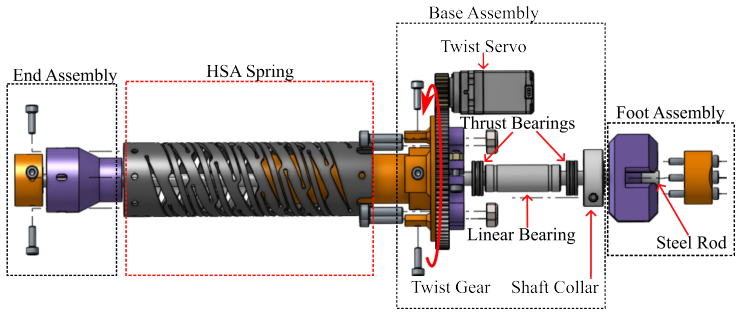
The central object is the Handed Shearing Auxetic (HSA), a 3D-printed metamaterial that converts applied shear into volumetric deformation: twisting one end makes the tube elongate and its inner diameter shrink. Mounted in parallel with the leg motor, the HSA acts as a spring that stores and returns energy during stance. Its braking function comes from a second degree of freedom: a small twist servo rotates the HSA's base up to 135 degrees, at which point the contracting inner diameter jams against a rigid cylindrical insert, blocking further deformation and generating high friction that locks the leg under load. The paper selects an 8-row, 3-column HSA using the auxetic trajectory that maximizes stroke, and characterizes it to have an average spring constant of 912 N/m and a peak stiffness over 21 times higher when jammed. The mechanism thus provides two functions from one structural part, with the jamming effect being the paper's first demonstration in a dynamic leg.
What would settle it
Measure the cost of transport for the same hopper with a physical steel spring of matched stiffness placed in parallel with the motor, and compare it against the HSA condition at equal hop height and frequency; if the physical-spring configuration matches or beats the HSA's cost of transport, the claimed dual-function advantage from the auxetic jamming is not supported. A second check: record motor winding temperature (or integrate I-squared-R loss) during hopping with and without the HSA to verify that the reported reduction in Joule heating, the paper's stated mechanism, actually appears.
Extended reading notes
Core claim
The central claim is that an HSA—a handed shearing auxetic metamaterial—can function simultaneously as a parallel elastic spring and as a passive brake, and that in doing so it improves the efficiency of both hopping and standing in a monopod robot. In the hopping experiments, the HSA reduced electrical cost of transport by 24-32% across tested body masses compared with a motor-only virtual-compliance baseline, with the gain coming from reduced thermal losses in the motor even though net mechanical motor work increased slightly. The HSA supplied about 35% of the total positive joint work during stance, but its spring efficiency (29% ± 1.7%) was lower than that of a steel spring, indicating the 3D-printed structure dissipates more energy. In the static experiments, rotating the HSA by 135 degrees makes its inner diameter contract against a rigid insert, jamming the structure and producing a capstan-like friction brake that holds large forces while the small twist servo draws only a few watts, far less than the main motor would require. The authors conclude that the HSA is an effective compliance component for direct-drive parallel elastic actuators, where reducing motor thermal losses is the primary benefit, and that it may be less suitable for series-elastic configurations where spring efficiency matters more.
Load-bearing premise
The load-bearing premise is that the motor-only "without HSA" condition—where the leg motor emulates a spring with a proportional controller—is a fair and reasonably well-tuned baseline for a direct-drive leg without parallel compliance; the gains of the HSA are measured against it, and the controller gains are not reported.
Editorial extensions
If this is right
- A leg using an HSA can store and return hopping energy and lock in place under load without a separate spring, clutch, or brake, reducing the mass and mechanical complexity of the leg.
- The reported 24-32% reduction in hopping cost of transport stems from lowering Joule heating in the motor, not from the spring doing more mechanical work; net motor work actually rises slightly.
- At high gear reductions (for example, a worm gear), the jammed HSA can hold a heavy load at near-zero electrical cost, since the brake is passive once engaged.
- Because the 3D-printed HSA dissipates more energy than a steel spring, the design is best suited to parallel-elastic, direct-drive legs; in series-elastic configurations, where motor losses are lower, the HSA's dissipation would be a disadvantage.
Reading between the lines
- The paper's 24-32% figures are relative to a virtual-compliance baseline in which the motor itself emulates a spring with a simple controller; if that controller were replaced by a well-tuned physical spring of the same stiffness, some of the measured advantage could shrink, since the comparison would then be between two physical compliant systems rather than a compliant system and an emulated one
- The same jamming mechanism could be exploited outside hopping: an HSA-based joint would be a natural candidate for variable-stiffness actuation, since the effective spring rate depends nonlinearly on both the linear and angular degrees of freedom, a property the authors note but do not test.
- If metal HSAs reduce dissipation as the authors suggest, the dual spring-brake function could make HSAs competitive with steel springs in series-elastic actuators, extending the claimed benefit to other actuator configurations.
- A direct comparison of the jammed HSA against an active motor holding a static pose, with the twist servo's gear ratio matched, would clarify how much of the braking advantage comes from the auxetic jamming versus simply from high gearing.
Editorial analysis
A structured set of objections, weighed in public.
Referee Report
Summary. This paper presents a monopod hopping robot in which a 3D-printed Handed Shearing Auxetic (HSA) serves simultaneously as parallel elastic compliance and as a jam-based brake. The authors characterize the HSA's stiffness, show in static experiments that a jammed HSA can support increasing loads with lower electrical power than the leg motor, and report hopping experiments at 5.2 cm hop height with and without the HSA. They report a 24-32% reduction in electrical cost of transport with the HSA, attribute the savings primarily to reduced Joule heating in the leg motor, and compare the measured cost of transport with the SPEAR hopper. They conclude that the HSA improves efficiency in both static braking and hopping locomotion.
Significance. If the central claims hold, the contribution is a single lightweight passive structure that provides both parallel elasticity and low-power static braking, which would be useful for legged robots that must both move efficiently and hold position. The paper has notable strengths: it is a direct hardware demonstration rather than a simulation study; the hopping comparison uses bootstrap confidence intervals; the analysis conservatively assumes perfect regeneration of negative motor work, which penalizes the HSA condition if that assumption favors the baseline; and the authors explicitly list limitations in Section VII-A. The static-braking result is well supported by the data. The hopping efficiency result is plausible but depends on the fairness of the virtual-compliance baseline, and the SPEAR comparison is not yet established.
major comments (3)
- [Section IV; Section VII-A] The headline 24-32% hopping COT reduction in the conclusion is measured against the "without HSA" baseline described in Section IV, where the leg motor emulates a virtual spring using proportional angle control. The controller gains and any tuning procedure are not reported, and Section VII-A states that the leg motor controls were not optimized for efficiency. Because the motor in that baseline performs both virtual compliance and push-off, the baseline may not represent a well-tuned direct-drive actuator, and a poorly tuned baseline would inflate the measured benefit. Please report the baseline controller parameters and provide evidence that the baseline is near its minimum achievable electrical COT at the 5.2 cm hop height (e.g., a parameter sweep or an optimized reference controller), or explicitly reframe the claim as a comparison against an unoptimized virtual-compliance implementation.
- [Section VI-D; Table III] The claim that the HSA hopper "matches state-of-the-art compliant hoppers" is supported in Section VI-D by interpolating three data points from SPEAR (Table III) and rescaling hop height by the ratio of touchdown leg lengths. A linear fit with R²=0.93 to three points, one of which (h=10.5 cm) strongly influences the fit, is not a reliable basis for interpolation, and no physical argument is given for the leg-length rescaling. Please either strengthen this comparison with a model or additional data, or explicitly label it as approximate and soften the "comparable to state-of-the-art" wording in the abstract and conclusion.
- [Section VI-E; Section VII] The spring-efficiency result in Section VI-E reports η=29% mean ± 1.7%, while the conclusion states that the spring provided 35% of the positive joint work. If η is defined by Eq. (3) as the fraction of positive joint work not supplied by the motor, these two numbers are inconsistent. Please reconcile the definitions and report the exact quantity used for the 35% figure.
minor comments (8)
- [Abstract] The abstract uses "break" where "brake" is meant in the phrases "acts as a spring and break" and "while including breaks."
- [Section VI-B] There are typos in Section VI-B: "boostrapping" should be "bootstrapping" and "cost-of-tranpsort" should be "cost-of-transport."
- [Section V] In the procedure list, "increasing applied force force" repeats "force"; remove the duplicate.
- [Table I; Section III-A] Table I labels "Leg Motor Reflected Inerta" (should be "Inertia"), and Section III-A contains "motor and cart cart"; fix these typos.
- [Section IV] Please define the cost-of-transport normalization explicitly (e.g., electrical energy divided by weight times vertical displacement per hop); the current text uses COT without a formal definition.
- [Section III-B; Section III-D] The stiffness characterization sweeps twist to only 120° in Section III-B, while the braking mechanism is described as engaging at 135° in Section III-D; clarify whether the braking state was characterized and whether the static brake experiment used 135°.
- [Section VI-D] The paper does not report the robot's touchdown leg length or actual hopping frequency, both of which are needed to reproduce the SPEAR rescaling in Section VI-D; please include these values.
- [Table II] The motor constant is listed as "105 Vs/rpm"; please verify the units, since Vs/rpm is an unusual expression for a motor constant.
Circularity Check
No significant circularity: the efficiency and braking claims are direct experimental measurements with external comparisons, not derivations from fitted inputs.
full rationale
The paper's central claims are empirical, not derived. The hopping comparison (Section IV and VI-B) measures electrical cost-of-transport with and without the HSA on the same robot hardware and controller, with power computed from measured motor current, torque, and angle via Pelec = RI^2 + τθdot in Eq. (2); the 24-32% reduction is a measured difference, not a quantity forced by construction. The design model in Section III-A is used only to size the HSA stiffness (K ≈ 1 kN/m) and is independently validated by Instron characterization (measured 912 N/m average), while the achieved hop height (5.2 cm) is a reported experimental outcome, not an input. The static braking power comparison in Section V is an empirical measurement of leg-motor versus twist-motor power under applied force; the curves in Figure 4 are descriptive fits, and the 1:8 gear-reduction line is explicitly labeled a projection, not presented as a measured result. The SPEAR comparison in Section VI-D uses external published data (Table III) and an explicit interpolation at a rescaled equivalent height; while the normalization could be debated as a modeling choice, it does not reduce to the paper's own fitted parameters. The self-citations (e.g., [27] for choosing the HSA geometry along the auxetic trajectory) are design heuristics from prior work by co-authors and are not load-bearing for the efficiency claims, since the actual stiffness and jamming behavior were measured directly. Finally, Section VII-A's admission that leg-motor controls were not optimized is a limitation on the strength of the without-HSA baseline, and thus a correctness risk for the headline improvement, but it is not circularity: an untuned baseline would make the comparison unfair or weak, not make the result equivalent to its inputs by definition. No step in the paper's own equations or cited chain exhibits a fitted parameter renamed as a prediction or a self-citation used to forbid alternatives. Therefore the circularity score is 0.
Assumptions & free parameters
free parameters (4)
- Push-off torque
- Virtual compliance controller gains
- Twist brake setpoint =
135 degrees
- SPEAR equivalent hop height =
15.8 cm
assumptions (5)
- standard math Stance dynamics can be approximated by a spring-mass oscillator with effective stiffness K.
- domain assumption Electrical power is P = R I^2 + tau * theta_dot, and negative motor work is perfectly regenerated.
- domain assumption Quasi-static Instron stiffness measurement of the HSA is representative of its dynamic behavior during hopping.
- ad hoc to paper SPEAR COT is a linear function of hop height and can be rescaled by leg-length ratio for comparison.
- ad hoc to paper The motor-emulated virtual compliance is a valid baseline for the without-HSA condition.
Cite this review
Pith. "Pith review of Spring-Brake! Handed Shearing Auxetics Improve Efficiency of Hopping and Standing." pith.science (2026). https://pith.science/paper/R5KPUXTV
@misc{pith2026250522898,
  author       = {Pith},
  title        = {Pith review of: Spring-Brake! Handed Shearing Auxetics Improve Efficiency of Hopping and Standing},
  year         = {2026},
  howpublished = {\url{https://pith.science/paper/R5KPUXTV}},
  note         = {Machine review of arXiv:2505.22898}
}
read the original abstract
Energy efficiency is critical to the success of legged robotics. Efficiency is lost through wasted energy during locomotion and standing. Including elastic elements has been shown to reduce movement costs, while including breaks can reduce standing costs. However, adding separate elements for each increases the mass and complexity of a leg, reducing overall system performance. Here we present a novel compliant mechanism using a Handed Shearing Auxetic (HSA) that acts as a spring and break in a monopod hopping robot. The HSA acts as a parallel elastic actuator, reducing electrical power for dynamic hopping and matching the efficiency of state-of-the-art compliant hoppers. The HSA\u2019s auxetic behavior enables dual functionality. During static tasks, it locks under large forces with minimal input power by blocking deformation, creating high friction similar to a capstan mechanism. This allows the leg to support heavy loads without motor torque, addressing thermal inefficiency. The multi-functional design enhances both dynamic and static performance, offering a versatile solution for robotic applications.
Figures


Figures from the paper (2 more)


Reference graph
Works this paper leans on
-
[17]
Handedness in shearing auxetics creates rigid and compliant structures,
J. I. Lipton, R. MacCurdy, Z. Manchester, L. Chin, D. Cellucci, and D. Rus, “Handedness in shearing auxetics creates rigid and compliant structures,” Science, vol. 360, no. 6389, pp. 632–635, 2018
work page 2018
-
[1]
An overview on principles for energy efficient robot locomotion,
N. Kashiri, A. Abate, S. J. Abram, A. Albu-Schaffer, P. J. Clary, M. Daley, S. Faraji, R. Furnemont, M. Garabini, H. Geyer et al. , “An overview on principles for energy efficient robot locomotion,” Frontiers in Robotics and AI , vol. 5, p. 129, 2018
2018
-
[2]
Why animals can outrun robots,
S. A. Burden, T. Libby, K. Jayaram, S. Sponberg, and J. M. Donelan, “Why animals can outrun robots,” Science Robotics, vol. 9, no. 89, p. eadi9754, 2024
work page 2024
-
[3]
The role and implementation of compliance in legged locomotion,
J. W. Hurst, “The role and implementation of compliance in legged locomotion,” Ph.D. dissertation, Carnegie Mellon University, 2008
work page 2008
-
[4]
Lock your robot: A review of locking devices in robotics,
M. Plooij, G. Mathijssen, P. Cherelle, D. Lefeber, and B. Vanderborght, “Lock your robot: A review of locking devices in robotics,” IEEE Robotics & Automation Magazine , vol. 22, no. 1, pp. 106–117, 2015
work page 2015
-
[5]
S. Seok, A. Wang, M. Y . Chuah, D. J. Hyun, J. Lee, D. M. Otten, J. H. Lang, and S. Kim, “Design principles for energy-efficient legged locomotion and implementation on the mit cheetah robot,” IEEE/ASME Transactions on Mechatronics , vol. 20, no. 3, pp. 1117– 1129, 2014
work page 2014
-
[6]
Dynamic walking with compliance on a cassie bipedal robot,
J. Reher, W.-L. Ma, and A. D. Ames, “Dynamic walking with compliance on a cassie bipedal robot,” in 2019 18th European Control Conference (ECC), pp. 2589–2595
work page 2019
-
[7]
Anymal-a highly mobile and dynamic quadrupedal robot,
M. Hutter, C. Gehring, D. Jud, A. Lauber, C. D. Bellicoso, V . Tsounis, J. Hwangbo, K. Bodie, P. Fankhauser, M. Bloesch et al. , “Anymal-a highly mobile and dynamic quadrupedal robot,” in 2016 IEEE/RSJ International Conference on Intelligent Robots and Systems (IROS) . IEEE, 2016, pp. 38–44
work page 2016
Show all 29 references
-
[8]
Atrias: Design and validation of a tether-free 3d-capable spring-mass bipedal robot,
C. Hubicki, J. Grimes, M. Jones, D. Renjewski, A. Spr ¨owitz, A. Abate, and J. Hurst, “Atrias: Design and validation of a tether-free 3d-capable spring-mass bipedal robot,” The International Journal of Robotics Research, vol. 35, no. 12, pp. 1497–1521, 2016
2016
-
[9]
Improving energy effi- ciency of hopping locomotion by using a variable stiffness actuator,
H. Q. Vu, X. Yu, F. Iida, and R. Pfeifer, “Improving energy effi- ciency of hopping locomotion by using a variable stiffness actuator,” IEEE/ASME Transactions on Mechatronics , vol. 21, no. 1, pp. 472– 486, 2016
2016
-
[10]
Reducing the energy cost of human walking using an unpowered exoskeleton,
S. H. Collins, M. B. Wiggin, and G. S. Sawicki, “Reducing the energy cost of human walking using an unpowered exoskeleton,” Nature, vol. 522, no. 7555, pp. 212–215, 2015
2015
-
[11]
A switchable parallel elastic actu- ator and its application to leg design for running robots,
X. Liu, A. Rossi, and I. Poulakakis, “A switchable parallel elastic actu- ator and its application to leg design for running robots,” IEEE/ASME Transactions on Mechatronics, vol. 23, no. 6, pp. 2681–2692, 2018
2018
-
[12]
Clutched elastic actuators,
M. Plooij, W. Wolfslag, and M. Wisse, “Clutched elastic actuators,” vol. 22, no. 2, pp. 739–750
-
[13]
A bipedal walking robot with efficient and human-like gait,
S. H. Collins and A. Ruina, “A bipedal walking robot with efficient and human-like gait,” in Proceedings of the 2005 IEEE International Conference on Robotics and Automation. IEEE, 2005, pp. 1983–1988
2005
-
[14]
A comparison of series and parallel elasticity in a monoped hopper,
Y . Yesilevskiy, W. Xi, and C. D. Remy, “A comparison of series and parallel elasticity in a monoped hopper,” in 2015 IEEE International Conference on Robotics and Automation (ICRA) , pp. 1036–1041, ISSN: 1050-4729
2015
-
[15]
Passive dynamics explain quadrupedal walking, trot- ting, and t ¨olting,
Z. Gan, T. Wiestner, M. A. Weishaupt, N. M. Waldern, and C. David Remy, “Passive dynamics explain quadrupedal walking, trot- ting, and t ¨olting,” Journal of computational and nonlinear dynamics , vol. 11, no. 2, p. 021008, 2016
2016
-
[16]
Design of a high torque density modular actuator for dynamic robots,
A. Hattori, “Design of a high torque density modular actuator for dynamic robots,” Ph.D. dissertation, Massachusetts Institute of Tech- nology, 2020
2020
-
[18]
Automated gait generation for walking, soft robotic quadrupeds,
J. Ketchum, S. Schiffer, M. Sun, P. Kaarthik, R. L. Truby, and T. D. Murphey, “Automated gait generation for walking, soft robotic quadrupeds,” in 2023 IEEE/RSJ International Conference on Intelli- gent Robots and Systems (IROS) , 2023, pp. 10 245–10 251
2023
-
[19]
A flexible, architected soft robotic actuator for motorized extensional motion,
T. Kim, P. Kaarthik, and R. L. Truby, “A flexible, architected soft robotic actuator for motorized extensional motion,” Advanced Intelli- gent Systems, p. 2300866, 2024
2024
-
[20]
Multiplexed ma- nipulation: Versatile multimodal grasping via a hybrid soft gripper,
L. Chin, F. Barscevicius, J. Lipton, and D. Rus, “Multiplexed ma- nipulation: Versatile multimodal grasping via a hybrid soft gripper,” in 2020 IEEE International Conference on Robotics and Automation (ICRA). IEEE, 2020, pp. 8949–8955
2020
-
[21]
Real-time gro- cery packing by integrating vision, tactile sensing, and soft fingers,
V . K. Chen, L. Chin, J. Choi, A. Zhang, and D. Rus, “Real-time gro- cery packing by integrating vision, tactile sensing, and soft fingers,” in 2024 IEEE 7th International Conference on Soft Robotics (RoboSoft) . IEEE, 2024, pp. 392–399
2024
-
[22]
Kinematic mod- eling of handed shearing auxetics via piecewise constant curvature,
A. Garg, I. Good, D. Revier, K. Airis, and J. Lipton, “Kinematic mod- eling of handed shearing auxetics via piecewise constant curvature,” in 2022 IEEE 5th International Conference on Soft Robotics (RoboSoft) . IEEE, 2022, pp. 423–430
2022
-
[23]
A recipe for electrically-driven soft robots via 3d printed handed shearing auxetics,
R. L. Truby, L. Chin, and D. Rus, “A recipe for electrically-driven soft robots via 3d printed handed shearing auxetics,” IEEE Robotics and Automation Letters , vol. 6, no. 2, pp. 795–802, 2021
2021
-
[24]
Automated recycling separation enabled by soft robotic material classification,
L. Chin, J. Lipton, M. C. Yuen, R. Kramer-Bottiglio, and D. Rus, “Automated recycling separation enabled by soft robotic material classification,” in 2019 2nd IEEE International Conference on Soft Robotics (RoboSoft), 2019, pp. 102–107
2019
-
[25]
Motorized, untethered soft robots via 3d printed auxetics,
P. Kaarthik, F. L. Sanchez, J. Avtges, and R. L. Truby, “Motorized, untethered soft robots via 3d printed auxetics,” Soft Matter , vol. 18, pp. 8229–8237, 2022
2022
-
[26]
Guiding soft robots with motor-imagery brain signals and impedance control,
M. St ¨olzle, S. S. Baberwal, D. Rus, S. Coyle, and C. D. Santina, “Guiding soft robots with motor-imagery brain signals and impedance control,” in 2024 IEEE 7th International Conference on Soft Robotics (RoboSoft), 2024, pp. 276–283
2024
-
[27]
Expanding the design space for electrically-driven soft robots through handed shearing auxetics,
I. Good, T. Brown-Moore, A. Patil, D. Revier, and J. I. Lipton, “Expanding the design space for electrically-driven soft robots through handed shearing auxetics,” in 2022 International Conference on Robotics and Automation (ICRA) . IEEE, 2022, pp. 10 951–10 957
2022
-
[28]
Mit cheetah 3: Design and control of a robust, dynamic quadruped robot,
G. Bledt, M. J. Powell, B. Katz, J. Di Carlo, P. M. Wensing, and S. Kim, “Mit cheetah 3: Design and control of a robust, dynamic quadruped robot,” in 2018 IEEE/RSJ International Conference on Intelligent Robots and Systems (IROS) , 2018, pp. 2245–2252
2018
-
[29]
Efficient and versatile locomotion with highly compliant legs,
M. Hutter, C. D. Remy, M. A. Hoepflinger, and R. Siegwart, “Efficient and versatile locomotion with highly compliant legs,” IEEE/ASME Transactions on Mechatronics, vol. 18, no. 2, pp. 449–458, 2012
2012
Reviewed August 7, 2026 · model on record in the stance chip above.
Discussion (0). Continue with ORCID to comment.