REVIEW 3 major objections 5 minor 51 references
HiLDe: Intentional Code Generation via Human-in-the-Loop Decoding
T0 review · 3 major / 5 minor · reviewed 2026-08-07 · deepseek-v4-flash
Pith's one-line read This paper reports that exposing the token-level decisions of an LLM code assistant cut security vulnerabilities by 31% in a user study.
desk verdict A genuinely new interaction technique with a promising security result, but the main quantitative claim is confounded by a security-tuned prompt, so the effect of the interface itself is not yet identified. read the letter →
The pith
A machine-rendered reading of the paper's core claim, the machinery that carries it, and where it could break.
The reading
What carries the argument
The load-bearing mechanism is the combination of critical decision highlighting with local alternatives. HiLDe first asks an analysis LLM to classify each alternative token at every generation step as Significant, Minor, or Incorrect, with an importance score from 0 to 1; it then computes a corrected entropy that upweights the token distribution by these importance scores, so only steps with behavior-changing alternatives are highlighted. When the user opens a highlighted token, the assistant shows short explanations of each alternative and, on selection, regenerates the completion suffix, choosing the most similar suffix to the original so the edit feels local. These two affordances—pointing at the decisions that matter and letting the user act on them with explanations—carry the argument that intentionality can be designed into LLM code generation.
What would settle it
Run the same security tasks with identical underlying prompts and completion model in both conditions, toggling only the highlighting and local-alternative UI; if the vulnerability count stays roughly equal, the reported 31% reduction is not attributable to the interface. Conversely, if the tuned prompt alone, without the UI, reproduces the reduction, the affordances are not the active ingredient.
Extended reading notes
Core claim
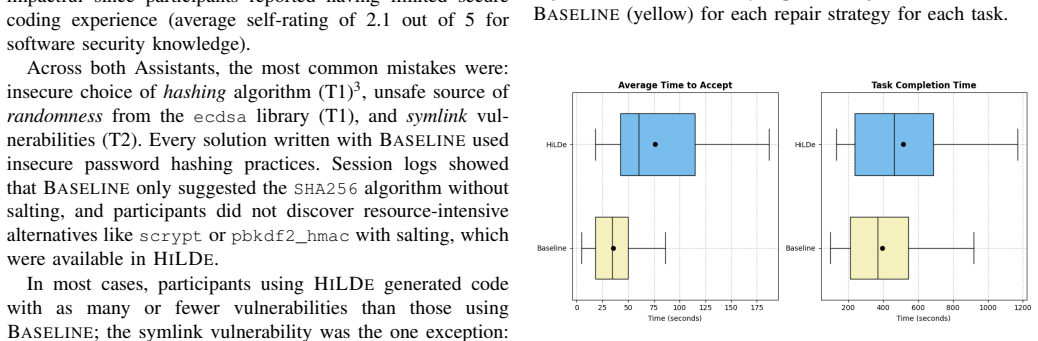
The paper's central discovery is that involving the user in the decoding process—the sequence of token choices the model makes—improves the security of the code they end up with. At each critical step HiLDe shows alternatives the model was weighing, ordered by likelihood and annotated with explanations, and lets the user swap a token in; the rest of the completion is regenerated to fit. The measured effect is a 31% average reduction in vulnerabilities ($M = 2.67$ vs. $3.89$, $p = 0.01$, $r = 0.53$), with 71% of the 42 intentional security repairs in the study occurring under HiLDe and a significantly higher proportion of those repairs being made via the UI rather than by re-prompting. The authors also report that participants spent longer reviewing HiLDe suggestions before accepting them, and that the slower pace was associated with more deliberate decision-making rather than higher cognitive load.
Load-bearing premise
The study's conclusion that the interface caused the security improvement rests on the assumption that HiLDe and the baseline differ only in the highlighting and local-alternative affordances; the paper itself notes the HiLDe prompt was "slightly tuned to surface security-related decision points," so the two conditions differ in prompt content as well.
Editorial extensions
If this is right
- If the effect holds, code assistants can reduce security vulnerabilities by changing the interface rather than by retraining the model or adding a safety filter.
- The 31% reduction came with a cost: participants took about twice as long to accept a suggestion, so the technique trades speed for intentionality—a trade-off the paper argues is worth making for critical domains.
- The same interaction framework can be aimed at other non-functional goals such as efficiency, maintainability, or personal style by re-tuning the prompt that asks the analysis model what counts as significant; the study only tuned it for security.
- Because participants with low security knowledge benefited most from local alternatives, the approach may specifically mitigate overreliance in users who cannot easily spot insecure suggestions.
- The finding that HiLDe users often discovered their own intent while looking at alternatives suggests the technique changes not just output quality but the user's understanding of what they want.
Reading between the lines
- The paper does not isolate the UI effect from the prompt-tuning confound; a cleaner test would run both conditions with identical prompts and toggle only the highlighting and alternatives, which would tell us whether the 31% reduction is an interface effect or partly a prompt effect.
- The corrected-entropy mechanism could be validated in isolation: if importance-weighted highlighting reliably marks the tokens whose alternatives actually change security, then the highlight-and-select loop is the active ingredient; if not, the explanations or the act of choosing may be doing the work.
- The downstream-regeneration fragility the paper reports—where swapping a token can overwrite prior user edits—could be addressed by anchoring regeneration to the user's edited context rather than the original completion; solving it would likely determine whether the technique scales beyond short completions to real refactorings.
- A direct comparison with a no-highlighting, only-alternatives condition would clarify how much of the benefit comes from drawing attention to decisions versus from offering choices; the paper's design bundles both affordances together.
Editorial analysis
A structured set of objections, weighed in public.
Referee Report
Summary. This paper introduces Human-in-the-Loop Decoding (HiLDe), an interaction technique for LLM-based code completion that highlights token-level "critical decision points" and lets users view and select local alternative tokens with explanatory annotations. The authors implement HiLDe as a VS Code extension and evaluate it in a within-subjects user study (N=18) with four security-related programming tasks, comparing it against a baseline assistant that uses the same underlying model but offers only global alternative completions. The main quantitative claim is that participants using HiLDe produced code with 31% fewer security vulnerabilities on average (M_HiLDe = 2.67, M_BASELINE = 3.89, p = 0.01, r = 0.53), and that 71% of intentional security repairs occurred with HiLDe. The paper also presents qualitative evidence that HiLDe encouraged users to discover, interpret, and act on implementation alternatives.
Significance. If the effect is real, HiLDe addresses an important problem: users of AI code assistants often over-rely on suggestions and fail to consider security-relevant alternatives. The paper's strengths include a concrete system implementation with a clear interaction design, a controlled within-subjects study with manual vulnerability counting by two authors, and rich qualitative case studies that illustrate the proposed discover-interpret-act loop. The central quantitative result is directionally compelling and the effect size is large. However, the comparison is compromised by a confound between the interaction affordances and the underlying prompt content, which is explicitly acknowledged in Section VI-B but not controlled for or listed as a limitation. Because the study's causal claim about the interaction technique depends on this confound being absent, the current evidence is not yet sufficient to support the title's claim about Human-in-the-Loop Decoding itself.
major comments (3)
- [Section VI-B / IV-C] The central comparison between HiLDe and BASELINE is confounded by prompt content. Section VI-B states that "the underlying prompt for HILDE is slightly tuned to surface security-related decision points," whereas Section IV-C describes BASELINE as using the same underlying model without highlighting or local alternatives and does not state that BASELINE uses the same tuned prompt. The observed reduction in vulnerabilities (M_HiLDe = 2.67 vs. M_BASELINE = 3.89, p = 0.01) and the availability of scrypt/pbkdf2_hmac alternatives could therefore be caused by the prompt tuning rather than by the interactive affordances. Section VI-D lists limitations but does not mention this confound. Please add a condition that holds the prompt content fixed across interfaces, or otherwise demonstrate that the prompt tuning does not affect which tokens and alternatives are surfaced.
- [Section III-B.2] The corrected-entropy highlighting method is not specified reproducibly. The paper states that after pilot experiments "we arrived at a configuration" for the effect of Importance Score on corrected entropy, but it does not provide the exact formula or the parameter values. Since highlighting is the mechanism claimed to drive the effect, the empirical results cannot be replicated or compared with related uncertainty-highlighting work (e.g., Vasconcelos et al.) without this information. Please report the full correction formula and the final parameter values.
- [Section V-A.2] The intentional-repair analysis conflates opportunity with agency. Participants using HiLDe had more opportunities to perform UI-driven repairs because HiLDe surfaced local alternatives; the comparison of repair counts (71% vs. 29%) does not account for the number of insecure suggestions or exposed decision points in each condition. The Fisher's exact test on strategy proportions (p = 0.03, r = 0.17) appears to be computed over repair instances rather than over participants, so the effective sample size and independence assumptions are unclear. Please report per-participant repair rates or use a mixed-effects model with participant as a random effect.
minor comments (5)
- [Section V-B.3] The text says participants reported significantly higher trust in AI-generated code with HiLDe, but the reported means (M_HiLDe = 3.39, M_BASELINE = 3.72) indicate the opposite direction; please correct either the wording or the means.
- [Abstract / Section V-C] The abstract's claim that HiLDe helps users "better align code generation with their goals" is supported mainly by qualitative case studies; the self-reported measures for control, helpfulness of alternatives, and understanding were not significantly different between conditions. Please soften the abstract or report which specific goals were better aligned.
- [Figure 3 caption] There is a typo: "yeild" should be "yield."
- [Section V-B.1] The reported acceptance times (76.20 and 35.55) and task completion times (514.98 and 396.39) should include units (seconds) to avoid ambiguity.
- [Section IV-E] The paper reports many significance tests across security counts, survey items, NASA-TLX subscales, and repair strategies without correcting for multiple comparisons; a brief note on this or a pre-registered primary outcome would strengthen the analysis.
Circularity Check
No significant circularity: the security outcome is an external behavioral measurement, but the system's security-tuned prompt (Sec. VI-B) confounds the causal attribution to the highlighting interface.
full rationale
The paper's central claim is an empirical A/B result: vulnerability counts were measured externally by two authors using criteria from prior work (Sec. IV-E: 'two authors used this list to independently count the number of vulnerabilities in each participant's final solutions'), not derived from HiLDe's own highlighting or alternatives, so the reported reduction (M_HiLDE=2.67 vs M_BASELINE=3.89, p=0.01) does not equal any system input by construction. The self-referential elements are minor and disclosed. First, the corrected-entropy weighting was tuned in pilots only to limit highlight volume: 'After experimenting with parameter choices for the effect of Importance Score on the corrected entropy, we arrived at a configuration that consistently highlights only a handful of critical decision points' (Sec. III-B.2); this calibrates UI salience, not the measured security outcome, and the tuning was not fit to the evaluation data. Second, the paper admits a genuine between-condition confound: 'The underlying prompt for HILDE is slightly tuned to surface security-related decision points' (Sec. VI-B), while the baseline 'uses the same underlying model as HILDE, but without the uncertainty highlighting or local alternatives' (Sec. IV-C); this threatens attribution of the security gain to the interaction technique rather than to prompt content and is not listed among limitations in Sec. VI-D. That is a validity/identification limitation, not a circular reduction: participants could and sometimes did ignore surfaced alternatives (P7 found highlighting overwhelming; baseline participants saw secure options yet accepted insecure code), so the effect is unforced human behavior. Third, self-citations [3] and [13] serve only as background and as an interpretive lens ('exploration' and 'acceleration' modes, Sec. VI-C); neither is load-bearing for the quantitative security claim. No parameter is fitted to the evaluation data and renamed a prediction, no uniqueness theorem is imported from the authors' prior work, and the highlighting design is not justified by a self-cited ansatz. The central result therefore has independent empirical content; the honest finding is no significant circularity, with the prompt-tuning confound flagged as a correctness risk.
Assumptions & free parameters
free parameters (2)
- Importance Score weighting in corrected entropy =
not reported (tuned in pilot experiments)
- Number of regenerated suffixes (10) for preserving downstream code =
10
assumptions (3)
- domain assumption The sample of 18 participants with mixed experience levels generalizes to the intended population of AI-assistant-using programmers.
- domain assumption The manually constructed vulnerability rubrics, adapted from prior security work, correctly identify security-relevant deficiencies in the four tasks.
- domain assumption The analysis LLM's importance scores and explanations accurately reflect the semantic significance of token alternatives.
Cite this review
Pith. "Pith review of HiLDe: Intentional Code Generation via Human-in-the-Loop Decoding." pith.science (2026). https://pith.science/paper/IQMV5ALB
@misc{pith2026250522906,
  author       = {Pith},
  title        = {Pith review of: HiLDe: Intentional Code Generation via Human-in-the-Loop Decoding},
  year         = {2026},
  howpublished = {\url{https://pith.science/paper/IQMV5ALB}},
  note         = {Machine review of arXiv:2505.22906}
}
read the original abstract
While AI programming tools hold the promise of increasing programmers' capabilities and productivity to a remarkable degree, they often exclude users from essential decision-making processes, causing many to effectively "turn off their brains" and over-rely on solutions provided by these systems. These behaviors can have severe consequences in critical domains, like software security. We propose Human-in-the-loop Decoding, a novel interaction technique that allows users to observe and directly influence LLM decisions during code generation, in order to align the model's output with their personal requirements. We implement this technique in HiLDe, a code completion assistant that highlights critical decisions made by the LLM and provides local alternatives for the user to explore. In a within-subjects study (N=18) on security-related tasks, we found that HiLDe led participants to generate significantly fewer vulnerabilities and better align code generation with their goals compared to a traditional code completion assistant.
Figures


Figures from the paper (3 more)


Reference graph
Works this paper leans on
-
[1]
Beyond code generation: An observational study of chatgpt usage in software engineering practice,
R. Khojah, M. Mohamad, P. Leitner, and F. G. de Oliveira Neto, “Beyond code generation: An observational study of chatgpt usage in software engineering practice,” Proceedings of the ACM on Software Engineering, vol. 1, no. FSE, pp. 1819–1840, 2024
work page 2024
-
[2]
A large-scale survey on the usability of ai programming assistants: Successes and challenges,
J. T. Liang, C. Yang, and B. A. Myers, “A large-scale survey on the usability of ai programming assistants: Successes and challenges,” in Proceedings of the 46th IEEE/ACM international conference on software engineering, 2024, pp. 1–13
2024
-
[3]
Grounded copilot: How programmers interact with code-generating models,
S. Barke, M. B. James, and N. Polikarpova, “Grounded copilot: How programmers interact with code-generating models,” Proceedings of the ACM on Programming Languages , vol. 7, no. OOPSLA1, pp. 85–111, 2023
2023
-
[4]
Supporting sensemaking of large language model outputs at scale,
K. I. Gero, C. Swoopes, Z. Gu, J. K. Kummerfeld, and E. L. Glassman, “Supporting sensemaking of large language model outputs at scale,” in Proceedings of the 2024 CHI Conference on Human Factors in Computing Systems, 2024, pp. 1–21
work page 2024
-
[5]
Do users write more insecure code with ai assistants?
N. Perry, M. Srivastava, D. Kumar, and D. Boneh, “Do users write more insecure code with ai assistants?” in Proceedings of the 2023 ACM SIGSAC conference on computer and communications security , 2023, pp. 2785–2799
2023
-
[6]
Asleep at the keyboard? assessing the security of github copilot’s code con- tributions,
H. Pearce, B. Ahmad, B. Tan, B. Dolan-Gavitt, and R. Karri, “Asleep at the keyboard? assessing the security of github copilot’s code con- tributions,” Communications of the ACM , vol. 68, no. 2, pp. 96–105, 2025
work page 2025
-
[7]
S. Oh, K. Lee, S. Park, D. Kim, and H. Kim, “Poisoned chatgpt finds work for idle hands: Exploring developers’ coding practices with inse- cure suggestions from poisoned ai models,” in 2024 IEEE Symposium on Security and Privacy (SP) . IEEE, 2024, pp. 1141–1159
work page 2024
-
[8]
Vulnerabilities in ai code generators: Exploring targeted data poisoning attacks,
D. Cotroneo, C. Improta, P. Liguori, and R. Natella, “Vulnerabilities in ai code generators: Exploring targeted data poisoning attacks,” in Pro- ceedings of the 32nd IEEE/ACM International Conference on Program Comprehension, 2024, pp. 280–292
work page 2024
Show all 51 references
-
[9]
Large language models for code: Security hardening and adversarial testing,
J. He and M. Vechev, “Large language models for code: Security hardening and adversarial testing,” in Proceedings of the 2023 ACM SIGSAC Conference on Computer and Communications Security , 2023, pp. 1865–1879
2023
-
[10]
Can we trust large language models generated code? a framework for in-context learning, security patterns, and code evaluations across diverse llms,
A. Mohsin, H. Janicke, A. Wood, I. H. Sarker, L. Maglaras, and N. Jan- jua, “Can we trust large language models generated code? a framework for in-context learning, security patterns, and code evaluations across diverse llms,” arXiv preprint arXiv:2406.12513 , 2024
2024 arXiv
-
[11]
Ai-resilient interfaces,
E. L. Glassman, Z. Gu, and J. K. Kummerfeld, “Ai-resilient interfaces,” arXiv preprint arXiv:2405.08447 , 2024
2024 arXiv
-
[12]
An ai- resilient text rendering technique for reading and skimming documents,
Z. Gu, I. Arawjo, K. Li, J. K. Kummerfeld, and E. L. Glassman, “An ai- resilient text rendering technique for reading and skimming documents,” in Proceedings of the 2024 CHI Conference on Human Factors in Computing Systems, 2024, pp. 1–22
2024
-
[13]
Validating ai-generated code with live programming,
K. Ferdowsi, R. Huang, M. B. James, N. Polikarpova, and S. Lerner, “Validating ai-generated code with live programming,” in Proceedings of the 2024 CHI Conference on Human Factors in Computing Systems , 2024, pp. 1–8
2024
-
[14]
Neural machine translation of rare words with subword units,
R. Sennrich, B. Haddow, and A. Birch, “Neural machine translation of rare words with subword units,” arXiv preprint arXiv:1508.07909, 2015
2015 arXiv
-
[15]
Sentencepiece: A simple and language inde- pendent subword tokenizer and detokenizer for neural text processing,
T. Kudo and J. Richardson, “Sentencepiece: A simple and language inde- pendent subword tokenizer and detokenizer for neural text processing,” arXiv preprint arXiv:1808.06226 , 2018
2018 arXiv
-
[16]
Evaluating large language models trained on code,
M. Chen, J. Tworek, H. Jun, Q. Yuan, H. P. D. O. Pinto, J. Kaplan, H. Edwards, Y . Burda, N. Joseph, G. Brockman et al., “Evaluating large language models trained on code,” arXiv preprint arXiv:2107.03374 , 2021
2021 arXiv
-
[17]
Generation probabilities are not enough: Uncertainty highlighting in ai code completions,
H. Vasconcelos, G. Bansal, A. Fourney, Q. V . Liao, and J. W. Vaughan, “Generation probabilities are not enough: Uncertainty highlighting in ai code completions,” ACM Transactions on Computer-Human Interaction, 2024
2024
-
[18]
Effect of confidence and explanation on accuracy and trust calibration in ai-assisted decision mak- ing,
Y . Zhang, Q. V . Liao, and R. K. Bellamy, “Effect of confidence and explanation on accuracy and trust calibration in ai-assisted decision mak- ing,” in Proceedings of the 2020 conference on fairness, accountability, and transparency, 2020, pp. 295–305
2020
-
[19]
On the design of ai-powered code assistants for notebooks,
A. M. McNutt, C. Wang, R. A. Deline, and S. M. Drucker, “On the design of ai-powered code assistants for notebooks,” in Proceedings of the 2023 CHI Conference on Human Factors in Computing Systems , 2023, pp. 1–16
2023
-
[20]
Do llms consider security? an empirical study on responses to programming questions,
A. Sajadi, B. Le, A. Nguyen, K. Damevski, and P. Chatterjee, “Do llms consider security? an empirical study on responses to programming questions,” Empirical Software Engineering, vol. 30, no. 3, p. 101, 2025
2025
-
[21]
Secuguard: Leveraging pattern-exploiting training in language models for advanced software vulnerability detec- tion,
M. Basharat and M. Omar, “Secuguard: Leveraging pattern-exploiting training in language models for advanced software vulnerability detec- tion,” International Journal of Mathematics and Computer in Engineer- ing, vol. 3, no. 1, pp. 47–56, 2024
2024
-
[22]
Finetuning large language models for vulnerability detection,
A. Shestov, R. Levichev, R. Mussabayev, E. Maslov, P. Zadorozhny, A. Cheshkov, R. Mussabayev, A. Toleu, G. Tolegen, and A. Krasso- vitskiy, “Finetuning large language models for vulnerability detection,” IEEE Access, 2025
2025
-
[23]
Vuldetectbench: Evaluating the deep capability of vulnerability de- tection with large language models,
Y . Liu, L. Gao, M. Yang, Y . Xie, P. Chen, X. Zhang, and W. Chen, “Vuldetectbench: Evaluating the deep capability of vulnerability de- tection with large language models,” arXiv preprint arXiv:2406.07595 , 2024
2024 arXiv
-
[24]
Examining zero-shot vulnerability repair with large language models,
H. Pearce, B. Tan, B. Ahmad, R. Karri, and B. Dolan-Gavitt, “Examining zero-shot vulnerability repair with large language models,” in 2023 IEEE Symposium on Security and Privacy (SP) . IEEE, 2023, pp. 2339–2356
2023
-
[25]
Evaluating large language models for real-world vulnerability repair in c/c++ code,
L. Zhang, Q. Zou, A. Singhal, X. Sun, and P. Liu, “Evaluating large language models for real-world vulnerability repair in c/c++ code,” in Proceedings of the 10th ACM International Workshop on Security and Privacy Analytics, 2024, pp. 49–58
2024
-
[26]
A study of vulnerability repair in javascript programs with large language models,
T. K. Le, S. Alimadadi, and S. Y . Ko, “A study of vulnerability repair in javascript programs with large language models,” in Companion Proceedings of the ACM Web Conference 2024 , 2024, pp. 666–669
2024
-
[27]
Security implications of large language model code assistants: A user study,
G. Sandoval, H. Pearce, T. Nys, R. Karri, B. Dolan-Gavitt, and S. Garg, “Security implications of large language model code assistants: A user study,” arXiv preprint arXiv:2208.09727 , 2022
2022 arXiv
-
[28]
Coladder: Manipulating code generation via multi-level blocks,
R. Yen, J. S. Zhu, S. Suh, H. Xia, and J. Zhao, “Coladder: Manipulating code generation via multi-level blocks,” in Proceedings of the 37th Annual ACM Symposium on User Interface Software and Technology , 2024, pp. 1–20
2024
-
[29]
Waitgpt: Monitoring and steering conversational llm agent in data analysis with on-the-fly code visualization,
L. Xie, C. Zheng, H. Xia, H. Qu, and C. Zhu-Tian, “Waitgpt: Monitoring and steering conversational llm agent in data analysis with on-the-fly code visualization,” in Proceedings of the 37th Annual ACM Symposium on User Interface Software and Technology , 2024, pp. 1–14
2024
-
[30]
Intention is all you need: Refining your code from your intention,
Q. Guo, X. Xie, S. Liu, M. Hu, X. Li, and L. Bu, “Intention is all you need: Refining your code from your intention,” arXiv preprint arXiv:2502.08172, 2025
2025 arXiv
-
[31]
Dynavis: Dynamically synthesized ui widgets for visualization editing,
P. Vaithilingam, E. L. Glassman, J. P. Inala, and C. Wang, “Dynavis: Dynamically synthesized ui widgets for visualization editing,” in Pro- ceedings of the 2024 CHI Conference on Human Factors in Computing Systems, 2024, pp. 1–17
2024
-
[32]
An ex- ploratory study of ml sketches and visual code assistants,
L. F. Gomes, V . J. Hellendoorn, J. Aldrich, and R. Abreu, “An ex- ploratory study of ml sketches and visual code assistants,” arXiv preprint arXiv:2412.13386, 2024
2024 arXiv
-
[33]
Improving steering and verification in ai- assisted data analysis with interactive task decomposition,
M. Kazemitabaar, J. Williams, I. Drosos, T. Grossman, A. Z. Henley, C. Negreanu, and A. Sarkar, “Improving steering and verification in ai- assisted data analysis with interactive task decomposition,” in Proceed- ings of the 37th Annual ACM Symposium on User Interface Software...
2024
-
[34]
Beyond code generation: Llm-supported exploration of the program design space,
J. Zamfirescu-Pereira, E. Jun, M. Terry, Q. Yang, and B. Hartmann, “Beyond code generation: Llm-supported exploration of the program design space,” in Proceedings of the 2025 CHI Conference on Human Factors in Computing Systems , 2025, pp. 1–17
2025
-
[35]
Luminate: Structured generation and exploration of design space with large language models for human-ai co-creation,
S. Suh, M. Chen, B. Min, T. J.-J. Li, and H. Xia, “Luminate: Structured generation and exploration of design space with large language models for human-ai co-creation,” in Proceedings of the 2024 CHI Conference on Human Factors in Computing Systems , ser. CHI ’24. New York, NY...
2024
-
[36]
Ivie: Lightweight anchored explanations of just-generated code,
L. Yan, A. Hwang, Z. Wu, and A. Head, “Ivie: Lightweight anchored explanations of just-generated code,” in Proceedings of the 2024 CHI Conference on Human Factors in Computing Systems , 2024, pp. 1–15
2024
-
[37]
Biscuit: Scaffolding llm-generated code with ephemeral uis in computational notebooks,
R. Cheng, T. Barik, A. Leung, F. Hohman, and J. Nichols, “Biscuit: Scaffolding llm-generated code with ephemeral uis in computational notebooks,” in 2024 IEEE Symposium on Visual Languages and Human- Centric Computing (VL/HCC) . IEEE, 2024, pp. 13–23
2024
-
[38]
Investigating explainability of generative ai for code through scenario-based design,
J. Sun, Q. V . Liao, M. Muller, M. Agarwal, S. Houde, K. Talamadupula, and J. D. Weisz, “Investigating explainability of generative ai for code through scenario-based design,” in Proceedings of the 27th International Conference on Intelligent User Interfaces , 2022, pp. 212–228
2022
-
[39]
Expectation vs. experi- ence: Evaluating the usability of code generation tools powered by large language models,
P. Vaithilingam, T. Zhang, and E. L. Glassman, “Expectation vs. experi- ence: Evaluating the usability of code generation tools powered by large language models,” in Chi conference on human factors in computing systems extended abstracts , 2022, pp. 1–7
2022
-
[40]
”i’m not sure, but
S. S. Y . Kim, Q. V . Liao, M. V orvoreanu, S. Ballard, and J. W. Vaughan, “”i’m not sure, but...”: Examining the impact of large language models’ uncertainty expression on user reliance and trust,” in Proceedings of the 2024 ACM Conference on Fairness, Accountability, and Tra...
2024
-
[41]
Binary Codes Capable of Correcting Deletions, Insertions and Reversals,
V . I. Levenshtein, “Binary Codes Capable of Correcting Deletions, Insertions and Reversals,” Soviet Physics Doklady , vol. 10, p. 707, Feb. 1966
1966
-
[42]
Qwen2. 5-coder technical report,
B. Hui, J. Yang, Z. Cui, J. Yang, D. Liu, L. Zhang, T. Liu, J. Zhang, B. Yu, K. Dang et al., “Qwen2. 5-coder technical report,” arXiv preprint arXiv:2409.12186, 2024
2024 arXiv
-
[43]
Efficient memory management for large language model serving with pagedattention,
W. Kwon, Z. Li, S. Zhuang, Y . Sheng, L. Zheng, C. H. Yu, J. E. Gonzalez, H. Zhang, and I. Stoica, “Efficient memory management for large language model serving with pagedattention,” in Proceedings of the ACM SIGOPS 29th Symposium on Operating Systems Principles , 2023
2023
-
[44]
Github codespaces,
GitHub, “Github codespaces,” 2024. [Online]. Available: https: //github.com/features/codespaces
2024
-
[45]
Development of nasa-tlx (task load index): Results of empirical and theoretical research,
S. G. Hart and L. E. Staveland, “Development of nasa-tlx (task load index): Results of empirical and theoretical research,” in Advances in psychology. Elsevier, 1988, vol. 52, pp. 139–183
1988
-
[46]
Using thematic analysis in psychology,
V . Braun and V . Clarke, “Using thematic analysis in psychology,” Qualitative research in psychology , vol. 3, no. 2, pp. 77–101, 2006
2006
-
[47]
Content analysis and thematic analysis: Implications for conducting a qualitative descriptive study,
M. Vaismoradi, H. Turunen, and T. Bondas, “Content analysis and thematic analysis: Implications for conducting a qualitative descriptive study,” Nursing & health sciences , vol. 15, no. 3, pp. 398–405, 2013
2013
-
[48]
The impact of ai on developer productivity: Evidence from github copilot,
S. Peng, E. Kalliamvakou, P. Cihon, and M. Demirer, “The impact of ai on developer productivity: Evidence from github copilot,” arXiv preprint arXiv:2302.06590, 2023
2023 arXiv
-
[49]
Trade-offs for substi- tuting a human with an agent in a pair programming context: the good, the bad, and the ugly,
S. K. Kuttal, B. Ong, K. Kwasny, and P. Robe, “Trade-offs for substi- tuting a human with an agent in a pair programming context: the good, the bad, and the ugly,” in Proceedings of the 2021 CHI Conference on Human Factors in Computing Systems , 2021, pp. 1–20
2021
-
[50]
Measuring github copilot’s impact on productivity,
A. Ziegler, E. Kalliamvakou, X. A. Li, A. Rice, D. Rifkin, S. Simister, G. Sittampalam, and E. Aftandilian, “Measuring github copilot’s impact on productivity,”Communications of the ACM, vol. 67, no. 3, pp. 54–63, 2024
2024
-
[51]
Assistance or disruption? exploring and evaluating the design and trade-offs of proactive ai programming support,
K. Pu, D. Lazaro, I. Arawjo, H. Xia, Z. Xiao, T. Grossman, and Y . Chen, “Assistance or disruption? exploring and evaluating the design and trade-offs of proactive ai programming support,” arXiv preprint arXiv:2502.18658, 2025
2025 arXiv
Reviewed August 7, 2026 · model on record in the stance chip above.
Discussion (0). Sign in to comment.