REVIEW 3 major objections 5 minor 75 references
Beyond mean-field dynamics of the Dicke model with non-Markovian dephasing
T0 review · 3 major / 5 minor · reviewed 2026-08-07 · deepseek-v4-flash
Pith's one-line read This paper argues that a time-dependent projection operator retaining two-spin correlations, with the memory kernel expanded to second order in the light-matter coupling, gives a controlled beyond-mean-field description of the open Dicke…
desk verdict A useful and honest beyond-mean-field method for non-Markovian Dicke dynamics, but the headline claim overstates what is actually shown. read the letter →
The pith
A machine-rendered reading of the paper's core claim, the machinery that carries it, and where it could break.
The reading
What carries the argument
The central object is a self-consistent, time-dependent projection operator $P(t)$ (built following the Willis-Picard construction) whose relevant state is the photon factor times a site cluster expansion cut off at two-site irreducible correlations, Eq. (3). Its companion is the exact Nakajima-Zwanzig equation for the relevant part, with the memory kernel expanded to second order in the fluctuation Liouvillians $\Delta\mathcal{L}'_i$, which yields corrections of order $g^2/N$. Because the photon sector enters only through first and second moments, the large cavity Hilbert space never needs to be represented, and the non-Markovian baths enter through the two-site equations via efficient bath representations (pseudo-mode or influence-functional/TEMPO methods). This machinery is what converts the otherwise-conserved $\hat{\sigma}^z$ of the mean-field normal phase into a decaying observable, producing the $N/g^2$ and $\log N$ time scales.
What would settle it
Run the same two-site projection-operator scheme but retain three-site irreducible correlations (or push the memory kernel to fourth order in $g$) for $N=10$ and $g=0.2\,g_c$; if the convergence time of $\langle\hat{\sigma}_z\rangle$ no longer scales as $N/g^2$, or if initial-state dependence reappears, the truncation is the origin of the cure. Alternatively, measure $\langle\hat{\sigma}_z\rangle$ relaxation in a finite ensemble with tunable $N$ and coupling $g<g_c$ and test the predicted linear-in-$N$, inverse-quadratic-in-$g$ time.
Extended reading notes
Core claim
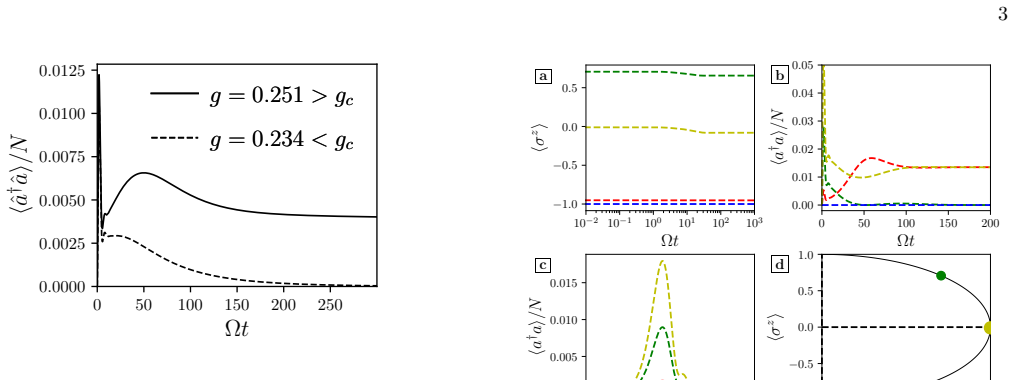
On its own terms, the paper establishes that the projected density matrix $\hat{\rho}_{\mathrm{rel}}=\hat{\rho}_0\otimes[\bigotimes_i \hat{\rho}_i + \sum_{j<i}(\hat{\rho}_{ij}-\hat{\rho}_i\otimes\hat{\rho}_j)\otimes\bigotimes_{k\neq i,j}\hat{\rho}_k]$ plus a Nakajima-Zwanzig memory kernel at second order in the fluctuation Liouvillians $\Delta \mathcal{L}'_i$ yields a closed, numerically treatable set of equations for the photon first and second moments and the two-site spin density matrices. Solving these equations for the Dicke model with zero-temperature Ohmic dephasing baths shows that different initial spin orientations no longer freeze to different steady states: the beyond-mean-field dynamics restores a unique steady state, with a relaxation time $\tau\propto N/g^2$ in the normal phase and a photon rise time above threshold that grows as $\log N$. The same equations capture the sharpening of the steady-state photon crossover with increasing $N$ towards the mean-field superradiant transition. The paper also reports the method's known failure mode: for sufficiently large $N$ it produces $Z_2$-broken steady states from symmetry-breaking initial states, which a finite system should not do.
Load-bearing premise
The whole correction rests on the assumption that irreducible correlations involving three or more spins, and memory terms beyond second order in the light-matter coupling, are negligible at the couplings and timescales studied.
Editorial extensions
If this is right
- In the normal phase, the relaxation time of the spin imbalance grows linearly with $N$ and as $1/g^2$, a time scale absent from mean-field dynamics.
- Above threshold, the scaled photon number first seeds at $O(1/N)$ then grows exponentially with an $N$-independent Lyapunov rate, so the rise time increases as $\log N$.
- Different initial spin orientations converge to a common steady state under the beyond-mean-field equations, curing the mean-field pathology of initial-state dependence.
- The steady-state photon crossover sharpens with increasing $N$, consistent with a mean-field superradiant transition in the thermodynamic limit.
- The same projection-operator formalism applies to other one-to-all coupled quantum optical systems with non-Markovian local baths, including finite temperature, and requires only photon second moments.
Reading between the lines
- If the truncation is controlled, the $N/g^2$ relaxation time should be observable in finite-size cavity-QED or ensemble experiments: a direct measurement of $\langle\hat{\sigma}_z\rangle$ relaxation in the normal phase as a function of $N$ and $g$ would test the predicted scaling.
- The mechanism suggests that for observables sensitive to three-site connected correlators (e.g., higher-order spin cumulants), the two-site truncation will eventually break down; extending the cluster expansion to three-site irreducible correlations would provide a sharper validity test.
- The paper's admission of $Z_2$-broken steady states for large $N$ implies the method is blind to exponentially small ($e^{-N}$) instanton-like processes that restore symmetry; a future method capturing those would likely modify the late-time asymptotics, though probably not the early-time $N/g^2$ window.
- The $\log N$ photon rise time above threshold implies that finite-size corrections set a practical time beyond which mean-field predictions are unreliable, even when the initial state is a mean-field fixed point.
Editorial analysis
A structured set of objections, weighed in public.
Referee Report
Summary. The paper develops a time-dependent projection operator formalism for all-to-all spin-boson systems with non-Markovian local baths, retaining two-site spin correlations in the relevant subspace and expanding the memory kernel to second order in the light-matter coupling. The method is applied to the zero-temperature Dicke model with local Ohmic dephasing. The authors report that beyond-mean-field terms remove the conserved-σz obstruction of mean-field theory, producing a slow N/g^2 relaxation in the normal phase, a log-N photon-number rise time above threshold, and a sharpening of the steady-state crossover with N. The central claim is that this formalism resolves the spurious initial-state dependence found in mean-field dynamics.
Significance. If the truncation is controlled, the formalism is a potentially valuable new tool for molecular polaritonics and other one-to-all coupled open systems with structured environments. The explicit master equations for the second photon moments, the scaling predictions (τ ∝ N/g^2, t_r ∝ log N, and 1/N decay of connected two-site correlators), and the demonstration in SM-V that a naive projector fails are concrete and useful contributions. The central mechanism—two-site correlations converting a conserved mean-field quantity into a slow relaxation channel—is physically compelling. However, the significance is tempered by the acknowledged failure to capture Z2-symmetry-restoring instantons for large N, which directly limits the scope of the initial-state-independence claim.
major comments (3)
- [Beyond mean-field / Abstract] The unqualified claim that the formalism 'resolves this pathology of initial state dependence' (Abstract and Introduction) is contradicted by the final paragraph of the 'Beyond mean-field' section, which concedes that for sufficiently large N the equations produce Z2-broken steady states when the initial state does not respect the Z2 symmetry, whereas the exact finite-N steady state is symmetric. In the normal phase, the mean-field pathology is a manifold of initial-condition-dependent ⟨σz⟩ values; replacing that manifold by two symmetry-broken states selected by the initial condition does not restore uniqueness in that regime. The claim of a cured initial-state dependence is therefore demonstrated only for the finite-N range shown in Fig. 3(a,b) (N=10), and the large-N, long-time regime requires an additional argument that is not provided.
- [SM-IV] The self-consistency check of the cluster expansion is performed at Ωt=20 and g=0.26>g_c, whereas the central long-time claims (N/g^2 relaxation and steady-state crossover) concern g<g_c and times t≫1/κ. The 1/N decay of connected two-site correlators at a single fixed time in the superradiant phase does not establish that three-site or higher irreducible correlations, or higher-order memory-kernel terms, remain negligible on the O(N/g^2) timescale in the normal phase. A self-consistency check in the actual relaxation regime, or an independent finite-N benchmark, is needed to support the central timescale claim.
- [SM-II, 'N-dependent relaxation time'] The analytic argument that the memory terms are O(g^2/N) assumes that the irreducible part of ρ_ij is O(1/N) and that partial traces such as Tr_j Δσ^x_j ρ_ij inherit this smallness. This is the very property the derivation is meant to establish, so the estimate is partly self-referential. The numerical self-consistency check in SM-IV only partially mitigates this concern, because it is not performed in the regime where the N/g^2 relaxation is claimed to occur.
minor comments (5)
- [Mean-field limit] The sentence 'This can be can be understood as a pathology of mean-field theory' contains a duplicated word and should be corrected.
- [Discussion] The word 'non-Marovian' should be 'non-Markovian'.
- [Formalism, Eq. (4)] The trace notation Tr0 and Tri,j is terse in the main text; a brief definition in the main text, rather than only in the supplement, would improve readability.
- [Fig. 3(a,b)] The four initial spin states are described only in the Fig. 2 caption; restating them in the Fig. 3 caption would make the convergence claim easier to evaluate.
- [SM-I] The notation Δ≡2g Re a_ss is used before it is introduced in Eq. (S3); consider defining it at first use.
Circularity Check
Mostly self-contained derivation; only mild circularity in that the N/g^2 relaxation timescale is the parametric scaling of the second-order memory kernel built into the truncation, with the O(1/N) irreducibility assumption checked self-consistently rather than externally.
-
self definitional
[Supplementary Material, SM-II.A (N-dependent relaxation time), Eqs. (S32)-(S39)]
"It remains to show that these will indeed have magnitude proportional to g2/N, leading to timescales of N/g2. ... the latter are corrections of order O(1/N). Not only must this be the case in order for the N→∞ limit to be exactly given by the factorized ansatz ... but one sees that this must be self-consistently true in Eq. (S32) ... Thus, the leading order contribution (in 1/N) to the first time-nonlocal term in Eq. (S32) for ⟨σz_i⟩ will be ... has leading dependence on N as ∝ g2/N."
The relaxation time τ∼N/g^2 is not an emergent prediction: Eqs. 4 are obtained by truncating the memory kernel at second order in ΔL′, so every memory term carries an explicit prefactor g^2/N. The SM-II argument then assumes that the irreducible two-site correlations feeding this memory are O(1/N) ('the latter are corrections of order O(1/N)... this must be self-consistently true'), and from that concludes the rate is g^2/N. The parametric form is thus fixed by the order of the truncation plus an O(1/N) assumption about the very correlations the equations are meant to predict. The SM-IV check runs the same truncated equations and shows the connected correlators decay as 1/N, so it confirms internal consistency but does not supply an independent derivation of the timescale.
full rationale
Most of the paper's quantitative results are computed, not fitted: the critical coupling g_c comes from linear response (Eq. 9), the log-N rise time follows from exponential mean-field growth seeded at O(1/N), and the convergence shown in Fig. 3(a,b) is a numerical output of the truncated equations. The one place where a 'prediction' reduces to an input is the O(N/g^2) relaxation time in the normal phase: Eqs. 4 are obtained by expanding the memory kernel to second order in ΔL′ (i.e., O(g^2/N)), and SM-II then argues that the irreducible two-site part is O(1/N) and concludes the rate is g^2/N. The parametric scaling is therefore fixed by the order of the chosen truncation, and the SM-IV numerical check is performed with the same truncated equations, so it does not provide an independent first-principles justification. This is a mild self-consistency circularity, not a fatal one, because the paper does not use the timescale as an input to fit something else, and it does check recovery of the mean-field limit. The Discussion's admission that the method still produces Z2-broken steady states for large N is a limitation on the central initial-state-independence claim, but it is a correctness caveat, not a circular step. No load-bearing self-citation or imported uniqueness theorem appears; the formalism cites prior projection-operator work externally and the tensor-network influence-functional reference is an implementation tool.
Assumptions & free parameters
free parameters (6)
- Ohmic bath coupling strength α =
0.3
- bath cutoff frequency ω_c =
1.0 Ω
- spin frequency ω_z =
0.025 Ω
- photon loss rate κ =
1.0 Ω
- exponential growth rate γ =
≈ 0.045 Ω
- mean-field initial perturbation in ⟨a⟩/√N =
10^(-3) (1 + i)
assumptions (8)
- standard math Exact Nakajima-Zwanzig equation with the state-dependent projector P(t) satisfying P(t)P(t') = P(t), [P(t), d/dt]ρ(t) = 0, and related properties
- domain assumption Memory kernel truncated to second order in the fluctuation Liouvillians ΔL'_i (Born-type, order g^2/N)
- domain assumption Cluster expansion truncated at two-site irreducible correlations (Eq. 3)
- domain assumption Photon state closes at first and second moments
- domain assumption Late-time memory kernel becomes time-translationally invariant and decays on the timescale 1/κ
- domain assumption Diamagnetic A^2 term is neglected
- domain assumption Zero-temperature, factorized initial bath state
- standard math Property [Q(t), L_α]Q(t') = 0 for single-degree-of-freedom Liouvillians
Cite this review
Pith. "Pith review of Beyond mean-field dynamics of the Dicke model with non-Markovian dephasing." pith.science (2026). https://pith.science/paper/2BYCLPTW
@misc{pith2026250523028,
  author       = {Pith},
  title        = {Pith review of: Beyond mean-field dynamics of the Dicke model with non-Markovian dephasing},
  year         = {2026},
  howpublished = {\url{https://pith.science/paper/2BYCLPTW}},
  note         = {Machine review of arXiv:2505.23028}
}
read the original abstract
We present a density matrix-based time dependent projection operator formalism to calculate the beyond mean-field dynamics of systems with non-Markovian local baths and one-to-all interactions. Such models encapsulate the physics of condensed phase systems immersed in optical cavities. We use this method, combined with tensor network influence functionals, to study the dynamics of the Dicke model coupled to non-Markovian local dephasing baths at zero temperature, which has a superradiant phase transition in the mean-field limit. The method corrects a spurious initial state dependence found in the mean-field dynamics and describes the emergence of new time scales which are absent in the mean-field dynamics. Our formalism, based on density matrices, is applicable to other quantum optical systems with one-to-all interactions at finite temperatures.
Figures

Reference graph
Works this paper leans on
- [1]
-
[2]
R. F. Ribeiro, L. A. Mart ´ ınez-Mart ´ ınez, M. Du, J. Campos-Gonzalez-Angulo, and J. Yuen-Zhou, Chem- ical Science9, 6325–6339 (2018)
work page 2018
-
[3]
T. W. Ebbesen, A. Rubio, and G. D. Scholes, Chemical Reviews123, 12037–12038 (2023)
work page 2023
- [4]
- [5]
-
[6]
D. Xu, A. Mandal, J. M. Baxter, S.-W. Cheng, I. Lee, H. Su, S. Liu, D. R. Reichman, and M. Delor, Nature Communications14(2023), 10.1038/s41467-023-39550- x
-
[7]
J. A. Hutchison, T. Schwartz, C. Genet, E. Devaux, and T. W. Ebbesen, Angewandte Chemie International Edi- tion51, 1592–1596 (2012)
work page 2012
-
[8]
A. D. Dunkelberger, B. T. Spann, K. P. Fears, B. S. Simpkins, and J. C. Owrutsky, Nature Communications 7(2016), 10.1038/ncomms13504
Show all 75 references
-
[9]
Mandal and P
A. Mandal and P. Huo, The Journal of Physical Chem- istry Letters10, 5519–5529 (2019)
2019
-
[10]
Pannir-Sivajothi, J
S. Pannir-Sivajothi, J. A. Campos-Gonzalez-Angulo, L. A. Mart ´ ınez-Mart ´ ınez, S. Sinha, and J. Yuen-Zhou, Nature Communications13(2022), 10.1038/s41467-022- 29290-9
2022 doi
-
[11]
D. M. Coles, N. Somaschi, P. Michetti, C. Clark, P. G. Lagoudakis, P. G. Savvidis, and D. G. Lidzey, Nature Materials13, 712–719 (2014)
2014
-
[12]
Reitz, F
M. Reitz, F. Mineo, and C. Genes, Scientific Reports8 (2018), 10.1038/s41598-018-27396-z
2018 doi
-
[13]
Zhong, T
X. Zhong, T. Chervy, S. Wang, J. George, A. Thomas, J. A. Hutchison, E. Devaux, C. Genet, and T. W. Ebbesen, Angewandte Chemie International Edition55, 6202–6206 (2016)
2016
-
[14]
Xiang, R
B. Xiang, R. F. Ribeiro, M. Du, L. Chen, Z. Yang, J. Wang, J. Yuen-Zhou, and W. Xiong, Science368, 665–667 (2020)
2020
-
[15]
K´ ena-Cohen and S
S. K´ ena-Cohen and S. R. Forrest, Nature Photonics4, 371–375 (2010)
2010
-
[16]
J. D. Plumhof, T. St¨ oferle, L. Mai, U. Scherf, and R. F. Mahrt, Nature Materials13, 247–252 (2013)
2013
-
[17]
K. S. Daskalakis, S. A. Maier, R. Murray, and S. K´ ena- Cohen, Nature Materials13, 271–278 (2014)
2014
-
[18]
R. T. Grant, P. Michetti, A. J. Musser, P. Gregoire, T. Virgili, E. Vella, M. Cavazzini, K. Georgiou, F. Ga- leotti, C. Clark, J. Clark, C. Silva, and D. G. Lidzey, Advanced Optical Materials4, 1615–1623 (2016)
2016
-
[19]
Herrera and F
F. Herrera and F. C. Spano, ACS Photonics5, 65–79 (2017)
2017
-
[20]
M. A. Zeb, P. G. Kirton, and J. Keeling, ACS Photonics 5, 249–257 (2017)
2017
-
[21]
A. W. Chin, J. Prior, R. Rosenbach, F. Caycedo-Soler, S. F. Huelga, and M. B. Plenio, Nature Physics9, 113–118 (2013)
2013
-
[22]
Iles-Smith, A
J. Iles-Smith, A. G. Dijkstra, N. Lambert, and A. Nazir, The Journal of Chemical Physics144(2016), 10.1063/1.4940218
2016 doi
-
[23]
del Pino, F
J. del Pino, F. A. Y. N. Schr¨ oder, A. W. Chin, J. Feist, and F. J. Garcia-Vidal, Phys. Rev. B98, 165416 (2018)
2018
-
[24]
del Pino, F
J. del Pino, F. A. Y. N. Schr¨ oder, A. W. Chin, J. Feist, and F. J. Garcia-Vidal, Phys. Rev. Lett.121, 227401 (2018)
2018
-
[25]
Fowler-Wright, B
P. Fowler-Wright, B. W. Lovett, and J. Keeling, Phys. Rev. Lett.129, 173001 (2022)
2022
-
[26]
G. E. Fux, P. Fowler-Wright, J. Beckles, E. P. But- ler, P. R. Eastham, D. Gribben, J. Keeling, D. Kilda, P. Kirton, E. D. C. Lawrence, B. W. Lovett, E. O’Neill, A. Strathearn, and R. de Wit, The Journal of Chemical Physics161(2024), 10.1063/5.0225367
2024 doi
-
[27]
Non-markovian effects in long- range polariton-mediated energy transfer,
K. B. Arnardottir, P. Fowler-Wright, C. Tserkezis, B. W. Lovett, and J. Keeling, “Non-markovian effects in long- range polariton-mediated energy transfer,” (2024)
2024
-
[28]
Mori, Journal of Statistical Mechanics: Theory and Experiment2013, P06005 (2013)
T. Mori, Journal of Statistical Mechanics: Theory and Experiment2013, P06005 (2013)
2013
-
[29]
Kirton and J
P. Kirton and J. Keeling, Phys. Rev. Lett.118, 123602 (2017)
2017
-
[30]
Rubies-Bigorda, S
O. Rubies-Bigorda, S. Ostermann, and S. F. Yelin, Phys. Rev. Res.5, 013091 (2023)
2023
-
[31]
Kira and S
M. Kira and S. W. Koch, Phys. Rev. A78, 022102 (2008)
2008
-
[32]
E. G. D. Torre, S. Diehl, M. D. Lukin, S. Sachdev, and P. Strack, Phys. Rev. A87, 023831 (2013)
2013
-
[33]
E. G. Dalla Torre, Y. Shchadilova, E. Y. Wilner, M. D. Lukin, and E. Demler, Phys. Rev. A94, 061802 (2016)
2016
-
[34]
Shchadilova, M
Y. Shchadilova, M. M. Roses, E. G. Dalla Torre, M. D. Lukin, and E. Demler, Phys. Rev. A101, 013817 (2020)
2020
-
[35]
C. R. Willis and R. H. Picard, Phys. Rev. A9, 1343 (1974)
1974
-
[36]
R. H. Picard and C. R. Willis, Phys. Rev. A16, 1625 (1977)
1977
-
[37]
Degenfeld-Schonburg and M
P. Degenfeld-Schonburg and M. J. Hartmann, Physical Review B89, 245108 (2014)
2014
-
[38]
Degenfeld-Schonburg,Self-consistent projection opera- tor theory, Ph.D
P. Degenfeld-Schonburg,Self-consistent projection opera- tor theory, Ph.D. thesis, Technische Universit¨ at M¨ unchen (2016)
2016
-
[39]
Link, H.-H
V. Link, H.-H. Tu, and W. T. Strunz, Phys. Rev. Lett. 132, 200403 (2024)
2024
-
[40]
Nguyen, N
H. Nguyen, N. Ng, L. P. Lindoy, G. Park, A. J. Millis, G. Kin-Lic Chan, and D. R. Reichman, The Journal of Chemical Physics161(2024), 10.1063/5.0224880
2024 doi
-
[41]
Hepp and E
K. Hepp and E. H. Lieb, Annals of Physics76, 360–404 (1973)
1973
-
[42]
Y. K. Wang and F. T. Hioe, Phys. Rev. A7, 831 (1973)
1973
-
[43]
Dimer, B
F. Dimer, B. Estienne, A. S. Parkins, and H. J. Carmichael, Physical Review A75(2007), 10.1103/phys- reva.75.013804
2007 doi
-
[44]
Kirton, M
P. Kirton, M. M. Roses, J. Keeling, and E. G. Dalla Torre, Advanced Quantum Technologies2(2018), 10.1002/qute.201800043
2018 doi
-
[45]
See URL for the Supplementary Materials, which con- tains references [64, 65], detailing the critical properties of the mean-field transition; an outline of the derivation of the beyond mean-field equations of motion; analysis of the rise time; self-consistency of the cluster ...
-
[46]
B. M. Garraway, Phys. Rev. A55, 2290 (1997)
1997
-
[47]
Dorda, M
A. Dorda, M. Nuss, W. von der Linden, and E. Arrigoni, Phys. Rev. B89, 165105 (2014)
2014
-
[48]
Tamascelli, A
D. Tamascelli, A. Smirne, S. F. Huelga, and M. B. Ple- nio, Phys. Rev. Lett.120, 030402 (2018)
2018
-
[49]
Lambert, S
N. Lambert, S. Ahmed, M. Cirio, and F. Nori, Nature Communications10(2019), 10.1038/s41467-019-11656- 1
2019 doi
-
[50]
Pleasance, B
G. Pleasance, B. M. Garraway, and F. Petruccione, Phys. Rev. Res.2, 043058 (2020)
2020
-
[51]
G. Park, Z. Huang, Y. Zhu, C. Yang, G. K.-L. Chan, and L. Lin, Phys. Rev. B110, 195148 (2024)
2024
-
[52]
Debecker, J
B. Debecker, J. Martin, and F. m. c. Damanet, Phys. Rev. A110, 042201 (2024)
2024
-
[53]
Tanimura and R
Y. Tanimura and R. Kubo, Journal of the Physical Soci- ety of Japan58, 101–114 (1989)
1989
-
[54]
Makri and D
N. Makri and D. E. Makarov, The Journal of Chemical Physics102, 4600 (1995)
1995
-
[55]
Q. Shi, Y. Xu, Y. Yan, and M. Xu, The Journal of Chemical Physics148(2018), 10.1063/1.5026753
2018 doi
-
[56]
Strathearn, P
A. Strathearn, P. Kirton, D. Kilda, J. Keeling, and B. W. Lovett, Nature Communications9(2018), 10.1038/s41467-018-05617-3
2018 doi
-
[57]
Fowler-Wright,Mean-field and cumulant approaches to modelling organic polariton physics, Ph.D
P. Fowler-Wright,Mean-field and cumulant approaches to modelling organic polariton physics, Ph.D. thesis, Univer- sity of St Andrews (2024)
2024
-
[58]
Simulating many-body non- markovian open quantum systems,
P. Fowler-Wright, “Simulating many-body non- markovian open quantum systems,” (2021), (un- published)
2021
-
[59]
Weiss,Quantum Dissipative Systems, 4th ed
U. Weiss,Quantum Dissipative Systems, 4th ed. (World Scientific, 2012)
2012
-
[60]
Fowler-Wright, K
P. Fowler-Wright, K. B. Arnard´ ottir, P. Kirton, B. W. Lovett, and J. Keeling, Physical Review Research5, 033148 (2023)
2023
-
[61]
J. B. P´ erez-S´ anchez, A. Koner, N. P. Stern, and J. Yuen- Zhou, Proceedings of the National Academy of Sciences 120(2023), 10.1073/pnas.2219223120
2023 doi
-
[62]
J. B. P´ erez-S´ anchez, A. Koner, S. Raghavan-Chitra, and J. Yuen-Zhou, The Journal of Chemical Physics162 (2025), 10.1063/5.0244452
2025 doi
-
[63]
Ivander, L
F. Ivander, L. P. Lindoy, and J. Lee, Nature Communi- cations15(2024), 10.1038/s41467-024-52081-3
2024 doi
-
[64]
K¨ onenberg, M
M. K¨ onenberg, M. Merkli, and H. Song, Communica- tions in Mathematical Physics336, 261–285 (2014)
2014
-
[65]
Beyond mean-field dynamics of the Dicke model with non-Markovian dephasing
P. N. Argyres and P. L. Kelley, Phys. Rev.134, A98 (1964). 7 Supplementary Material for “Beyond mean-field dynamics of the Dicke model with non-Markovian dephasing” This supplement is divided into 5 parts, detailing:
1964
-
[66]
the critical properties of the mean-field SR transition (Sec. SM-I),
-
[67]
a sketch of the derivation of the beyond mean-field equations of motion using time-dependent projection oper- ators (Sec. SM-II),
-
[68]
SM-III),
details on initial exponential growth of photon number in finiteNdynamics (Sec. SM-III),
-
[69]
self-consistency of the assumption underlying the cluster expansion (Sec. SM-IV),
-
[70]
and an explicit demonstration of the failure of using a na ¨ ıve projection operator within the Born approximation to describe macroscopic photon occupations at the steady state limit of finiteNsystems (Sec. SM-V). SM-I. CRITICAL PROPER TIES OF THE MEAN-FIELD TRANSITION As sta...
-
[71]
We will therefore situate ourselves infinitesimally aboveg c, in the superradiant phase (assuming that it exists)
Analytically approaching the phase boundary from the normal phase is ill-defined, since there are infinitely many states of the TLS+bath that are stationary with respect to the steady state Hamiltonian, which is of pure- dephasing form by definition. We will therefore situate ...
-
[72]
The steady state Hamiltonian for parameters infinitesimally beyond the superradiant phase boundary describes a biased spin-boson model with a small tunnelling matrix element, ∆≪1. We assume [64] that there are unique values for long time averages, which are equal to thermodyna...
-
[73]
This is only needed for us to make analytical calculations, but is not necessary in general
We assume that the polarization of the TLS along the x-direction is adequately described by perturbation theory. This is only needed for us to make analytical calculations, but is not necessary in general. The above assumptions allow us to work directly at the steady state, ig...
-
[74]
PN (t), d dt (Tr0 ˆρ(t)) = 0,
Tri,j PN (t)•= Tr i,j •, 2. PN (t), d dt (Tr0 ˆρ(t)) = 0,
-
[75]
self-consistent field expansion
Tr0 P(t)•= Tr 0 •, 4.P(t)P(t ′) =P(t) for allt, t ′, which implies that, forQ(t)≡1−P(t),Q(t)Q(t ′) =Q(t ′) andP(t)Q(t ′) = 0, 5. P(t), d dt ˆρ(t) = 0. The last two properties are essential for the derivation of the exact Nakajima-Zwanzig equation for the beyond mean-field dyna...
Reviewed August 7, 2026 · model on record in the stance chip above.
Discussion (0). Sign in to comment.