REVIEW 3 major objections 5 minor 62 references
ProDiff: Prototype-Guided Diffusion for Minimal Information Trajectory Imputation
T0 review · 3 major / 5 minor · reviewed 2026-08-07 · deepseek-v4-flash
Pith's one-line read The paper claims that a missing human trajectory can be reconstructed from only its two endpoints, with a prototype-guided diffusion model beating state-of-the-art imputation methods.
desk verdict The minimal-information formulation is a good idea, but a training-condition leak means the headline gains don't yet prove endpoints suffice. read the letter →
The pith
A machine-rendered reading of the paper's core claim, the machinery that carries it, and where it could break.
The reading
What carries the argument
The carrying mechanism is a prototype condition extractor (PCE) feeding a conditioned denoising diffusion probabilistic model. Prototypes are learned vectors that stand for generic movement patterns; a trajectory is embedded by summing encoder outputs over its points, and K-means pseudo-labels plus a contrastive separation loss refine the prototypes. At inference, an endpoint-only query is projected onto the prototype space, and the resulting prototype condition is combined with the base endpoint condition through a Wide & Deep network to form the joint condition used by the denoiser. The paper supports this design with a theorem stating that, under a mixture-of-manifolds assumption, any global optimum of the prototype objective approximates conditional expectations and keeps prototypes pairwise separated.
What would settle it
Retrain the prototype condition extractor so that it sees only masked trajectories with endpoints visible and interiors hidden during training, then rerun the WuXi and Foursquare evaluations; if trajectory coverage drops substantially, the gains came from training-time access to the missing points rather than from the learned movement prior.
Extended reading notes
Core claim
On its own terms, ProDiff establishes that endpoint-only information is sufficient to impute the interior of a trajectory, provided the model can draw on a learned library of human movement patterns. The diffusion backbone reconstructs the missing sequence by iteratively denoising a corrupted version of the full trajectory, while the prototype condition extractor embeds each trajectory as a sum of per-point encodings, learns a small set of prototypes representing recurring movement behaviors, and turns an endpoint-only query into a prototype-conditioned feature. These two signals are combined into a joint condition $J_c = \mathrm{WD}(B_c) + \mathrm{WD}(P_c)$ that conditions every reverse diffusion step. The joint training objective adds K-means classification consistency and contrastive prototype separation to the diffusion loss, with ablations showing the prototype module yields the largest gains at longer window sizes.
Load-bearing premise
The load-bearing premise is that the prototype library learned from complete trajectories transfers to endpoint-only queries; if the library secretly encodes the missing interior points, the reported endpoint-only success would not validate the minimal-information claim.
Editorial extensions
If this is right
- Trajectory imputation benchmarks should be re-run under endpoint-only conditions, since ProDiff removes the need for velocity or intermediate samples.
- Large unlabeled trajectory collections become a reusable prior: the more unlabeled mobility data available, the better the prototype library and the imputation.
- Joint training is essential: decoupling prototype learning from diffusion training should be strictly worse, matching the paper's argument against multi-stage error accumulation.
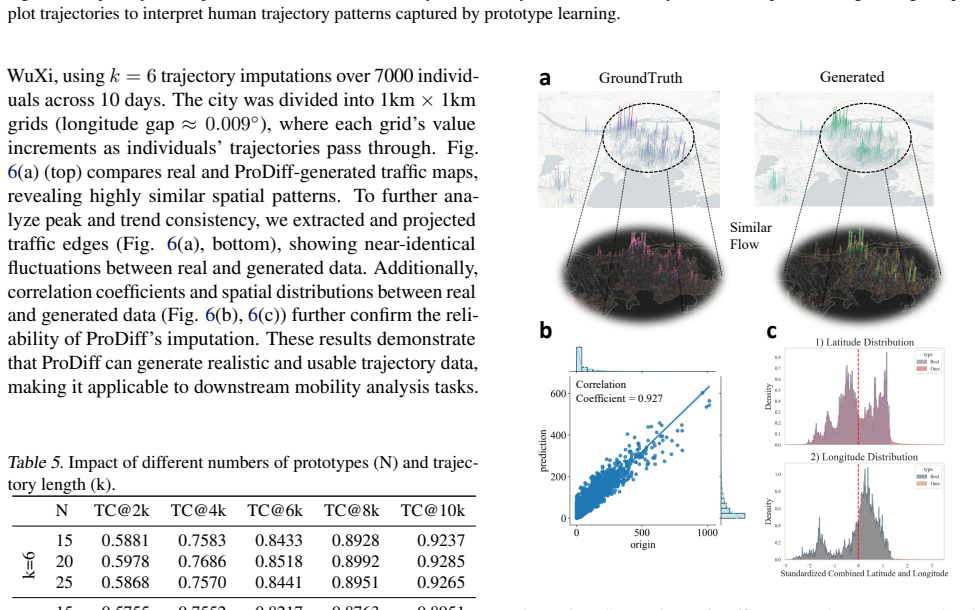
- The traffic-flow experiment implies that imputed trajectories are usable in downstream mobility analytics, not just visually similar to real ones.
- The ablation results imply that the prototype module matters most for long windows, so endpoint-only recovery of longer gaps depends more heavily on the learned movement prior.
Reading between the lines
- Editorial inference: the paper does not test a masked-prototype training variant in which the prototype extractor never sees the missing interior points during training; such an experiment would separate genuine prior knowledge from potential information leakage.
- Editorial inference: the prototype condition extractor appears portable, since the paper's own cVAE and cGAN experiments show the module improves other generative backbones, suggesting it could be reused independently of diffusion.
- Editorial inference: a natural next application is data augmentation for downstream tasks such as travel-time estimation or epidemic mobility modeling, where endpoint-only recovery could expand historically sparse datasets.
- Editorial inference: the high correlation with real traffic flow concerns macro-level statistics such as density and edge flows; individual-level route fidelity may be much weaker, which would matter for privacy and for tasks requiring exact routes.
Editorial analysis
A structured set of objections, weighed in public.
Referee Report
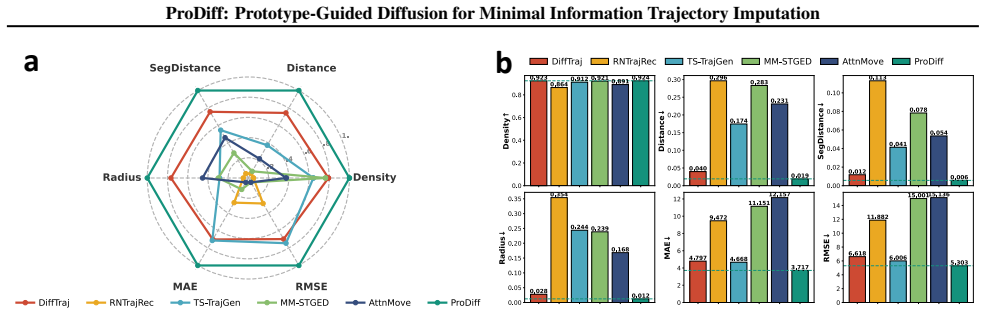
Summary. The paper proposes ProDiff, a prototype-guided denoising diffusion framework for trajectory imputation under a minimal-information setting in which only the two endpoints of a trajectory segment are observed. The method combines a 1D-UNet diffusion backbone with a Prototype Condition Extractor (PCE) that embeds trajectory movement patterns, and it is trained with a joint loss that includes a denoising objective, a K-means consistency loss, and a prototype-separation contrastive loss. The authors report trajectory-coverage results on WuXi and Foursquare across several window sizes, claiming accuracy improvements of 6.28% on FourSquare and 2.52% on WuXi over state-of-the-art baselines, along with ablations, hyperparameter sensitivity, acceleration variants, and a downstream traffic-flow utility analysis.
Significance. If the central claim holds, the paper would make a useful contribution: it relaxes the common assumption that sparse trajectories must retain enough sampled points for imputation, and it demonstrates that large-scale trajectory embeddings can be leveraged through prototype learning as conditioning for a generative model. The manuscript has several strengths: the code is released, the experimental section is extensive, and the ablations, hyperparameter studies, and acceleration variants give a fairly complete picture of the method's components. The interpretability and downstream-utility analyses are also valuable. However, the current evidence does not yet establish the headline minimal-information claim because of a train/test conditioning mismatch, an evaluation metric that includes trivially known endpoints, and the absence of error bars or significance tests.
major comments (3)
- [Sec. 3.3-3.4, Eq. (11), Algorithms 1-2] The training and inference conditions are not aligned. Eq. (11) trains the denoiser against f_gamma(Z0), and Algorithm 1 makes this explicit by setting f_gamma(Z0)=Jc. The PCE's trajectory representation in Eq. (3) sums Encoder(si,j) over all points of the segment, and Fig. 3 states that complete trajectories are used to train the prototype network. At inference, Algorithm 2 can build Pc only from the endpoint-derived base condition Bc. As written, the denoising network is therefore trained with a condition that encodes the very points it is supposed to impute and is tested without that information. This unaddressed train/test distribution shift means the reported TC values do not yet establish the minimal-information claim. The 'w.o. Pro' ablation in Table 3 removes the PCE entirely and does not isolate the effect of masking the PCE input at training time. A decisive experiment is to train the model with Pc computed from the endpoint-only Bc (or otherwise align the training-time condition with the test-time condition) and report the resulting TC.
- [Sec. 4.2, Eq. (15)] The TC@tau metric is averaged over all k points, including the two observed endpoints. Since the endpoints are known, a model that simply copies them receives a free 2/k contribution. This explains the 0.5 floors in the k=4 FourSquare rows of Table 1 and the 0.33 floors for k=6, and it inflates all reported numbers. The headline relative improvements should be recomputed on the missing interior points only, or after subtracting the endpoint contribution, because the current numbers conflate trivial endpoint reproduction with actual imputation quality.
- [Sec. 4.4-4.7, Tables 1, 3, 4, 5, 7, 8, 9] No error bars or significance tests are reported. The advantage over the strongest baseline is often only a few hundredths of TC (e.g., Table 1, WuXi k=4, TC@2k: 0.7155 vs 0.6958), which is within plausible run-to-run noise for diffusion models. Please provide results from multiple seeds with standard deviations and, where possible, paired significance tests for the headline comparisons, especially since the paper claims a specific percentage improvement over state-of-the-art methods.
minor comments (5)
- [Sec. 3.2, Eq. (2)] The endpoint mask in Eq. (2) uses j=0 for an endpoint, but the segment is indexed as j=1,...,k; it should be j=1 (or j=k) to define the two endpoints consistently.
- [Sec. 3.6, Theorem 3.4] The proof refers to InfoNCE-based contrastive loss and the Saunshi et al. margin property, but the implemented loss LC2 in Eq. (13) is a margin-based triplet loss, not InfoNCE. The claimed orthogonality bound between prototypes does not follow from the stated loss without additional assumptions; please align the theorem with the actual loss or remove the theorem.
- [Throughout] There are several typos and wording issues: 'signficantly' (Sec. 1), 'accerlation' (Sec. 4.5), 'verisons' (Table 9 caption), 'Guassian' (Fig. 2), 'construst' (Appendix B), and 'foundamental' (Sec. 1). A careful proofread is needed.
- [Abstract and Sec. 4.4] The abstract's improvement percentages (6.28% on FourSquare and 2.52% on WuXi) do not specify the threshold, window size, or baseline configuration. Table 1's relative differences vary substantially across settings, so the headline numbers should be pinned to a specific experimental configuration.
- [Sec. 3.3, Eq. (7)] The 'Wide & Deep' (WD) network is not described: there is no detail about its architecture, input/output dimensions, or whether the two WD blocks for Bc and Pc share parameters. Please add a brief description or a reference.
Circularity Check
Training-time conditioning leaks the full trajectory into the diffusion loss (Eq. 11, Alg. 1), so the reported endpoint-only imputation results do not validate the minimal-information claim.
-
self definitional
[Sec. 3.3–3.4, Eq. (3), Eq. (7), Eq. (11), Algorithm 1, Fig. 3 caption]
"The joint loss function is: L_J(θ, γ) = E_{t∼U}E_{Z0∼p,ϵ∼N}[∥ϵ−ϵθ(Zt, t, fγ(Z0))∥2] ... where the joint condition J_c = f_γ(Z_0). ... fγ(Z0) = J_c. ... J_c = WD(B_c) + WD(P_c). ... H_i = sum_j Encoder(s_i,j). ... Complete trajectories are used to train the prototype network, enhancing the generation of prototypes that accurately represent movement patterns."
The denoising network is trained by minimizing Eq. (11), whose condition is fγ(Z0). Algorithm 1 explicitly sets fγ(Z0) = J_c, and Eq. (7) defines J_c = WD(B_c) + WD(P_c). The PCE that produces P_c is trained on complete trajectories (Eq. (3) sums encoder features over all points of the trajectory; Fig. 3 states complete trajectories are used to train the prototype network). Thus the training-time conditioning signal contains information about the interior points that the model is supposed to impute. At inference, Algorithm 2 can form P_c only by querying prototypes with the base condition B_c, which contains just the two endpoints. The train/test condition distributions therefore differ, and the paper does not analyze this mismatch.
full rationale
The core circularity is that the diffusion model is trained with a condition that is a function of the ground-truth trajectory. Eq. (11) defines the denoising objective using fγ(Z0), Algorithm 1 sets fγ(Z0) = J_c = WD(B_c) + WD(P_c), and the PCE producing P_c is trained on complete trajectories (Eq. (3), Fig. 3 caption). Hence the training-time condition contains the very interior points the model is supposed to reconstruct, while at inference only the two endpoints are available to build the condition. The paper never addresses this train/test distribution shift, and the ablation that removes the PCE ('w.o. Pro') does not isolate endpoint-only prototype queries, so it cannot rule out leakage. Consequently, the headline accuracy improvements and the 0.927 correlation are partially circular as evidence for the 'minimal information' claim: the model was fitted with access to the target through the condition. Apart from this leakage, the comparisons are against external baselines and no load-bearing self-citation chain was found; Theorem 3.4 is an informal sketch relying on standard external results (Pollard, InfoNCE) and is not itself the source of the circularity. Score 7 reflects that the central empirical claim is partially circular by construction, though the model is not literally equivalent to its input at test time.
Assumptions & free parameters
free parameters (4)
- Loss weights λ1, λ2, λ3 =
1, 1, 1
- Number of prototypes Np =
20
- Diffusion steps =
500 (main); 300 optimal in Tab. 7
- Learning rate =
2e-4
assumptions (4)
- domain assumption Trajectory segments from a sliding window are i.i.d. samples from a common distribution.
- domain assumption Human movement patterns lie on a low-dimensional manifold that local linear neighborhoods can reconstruct.
- standard math Pollard's consistency theorem applies to the prototype learning objective.
- ad hoc to paper InfoNCE contrastive loss at the optimum guarantees a margin δ between the correct prototype and all others.
Cite this review
Pith. "Pith review of ProDiff: Prototype-Guided Diffusion for Minimal Information Trajectory Imputation." pith.science (2026). https://pith.science/paper/7XSK2UZY
@misc{pith2026250523048,
  author       = {Pith},
  title        = {Pith review of: ProDiff: Prototype-Guided Diffusion for Minimal Information Trajectory Imputation},
  year         = {2026},
  howpublished = {\url{https://pith.science/paper/7XSK2UZY}},
  note         = {Machine review of arXiv:2505.23048}
}
read the original abstract
Trajectory data is crucial for various applications but often suffers from incompleteness due to device limitations and diverse collection scenarios. Existing imputation methods rely on sparse trajectory or travel information, such as velocity, to infer missing points. However, these approaches assume that sparse trajectories retain essential behavioral patterns, which place significant demands on data acquisition and overlook the potential of large-scale human trajectory embeddings. To address this, we propose ProDiff, a trajectory imputation framework that uses only two endpoints as minimal information. It integrates prototype learning to embed human movement patterns and a denoising diffusion probabilistic model for robust spatiotemporal reconstruction. Joint training with a tailored loss function ensures effective imputation. ProDiff outperforms state-of-the-art methods, improving accuracy by 6.28\% on FourSquare and 2.52\% on WuXi. Further analysis shows a 0.927 correlation between generated and real trajectories, demonstrating the effectiveness of our approach.
Figures


Figures from the paper (3 more)

Reference graph
Works this paper leans on
-
[1]
A bilstm-cnn model for predicting users’ next locations based on geotagged social media
Bao, Y., Huang, Z., Li, L., Wang, Y., and Liu, Y. A bilstm-cnn model for predicting users’ next locations based on geotagged social media. International Journal of Geographical Information Science, 35 0 (4): 0 639--660, 2021
work page 2021
-
[2]
Linear interpolation revitalized
Blu, T., Th \'e venaz, P., and Unser, M. Linear interpolation revitalized. IEEE Transactions on Image Processing, 13 0 (5): 0 710--719, 2004
work page 2004
-
[3]
Recurrent neural networks for multivariate time series with missing values
Che, Z., Purushotham, S., Cho, K., Sontag, D., and Liu, Y. Recurrent neural networks for multivariate time series with missing values. Scientific reports, 8 0 (1): 0 6085, 2018
2018
-
[4]
Deep learning for trajectory data management and mining: A survey and beyond
Chen, W., Liang, Y., Zhu, Y., Chang, Y., Luo, K., Wen, H., Li, L., Yu, Y., Wen, Q., Chen, C., et al. Deep learning for trajectory data management and mining: A survey and beyond. arXiv preprint arXiv:2403.14151, 2024
arXiv 2024
-
[5]
Trajvae: A variational autoencoder model for trajectory generation
Chen, X., Xu, J., Zhou, R., Chen, W., Fang, J., and Liu, C. Trajvae: A variational autoencoder model for trajectory generation. Neurocomputing, 428: 0 332--339, 2021
work page 2021
-
[6]
Rntrajrec: Road network enhanced trajectory recovery with spatial-temporal transformer
Chen, Y., Zhang, H., Sun, W., and Zheng, B. Rntrajrec: Road network enhanced trajectory recovery with spatial-temporal transformer. In 2023 IEEE 39th International Conference on Data Engineering (ICDE), pp.\ 829--842. IEEE, 2023
work page 2023
-
[7]
A., Verleysen, M., and Blondel, V
De Montjoye, Y.-A., Hidalgo, C. A., Verleysen, M., and Blondel, V. D. Unique in the crowd: The privacy bounds of human mobility. Scientific reports, 3 0 (1): 0 1--5, 2013
work page 2013
-
[8]
Tutorial on variational autoencoders
Doersch, C. Tutorial on variational autoencoders. arXiv preprint arXiv:1606.05908, 2016
arXiv 2016
Show all 62 references
-
[9]
Saits: Self-attention-based imputation for time series
Du, W., C \^o t \'e , D., and Liu, Y. Saits: Self-attention-based imputation for time series. Expert Systems with Applications, 219: 0 119619, 2023
2023
-
[10]
Generative adversarial networks
Goodfellow, I., Pouget-Abadie, J., Mirza, M., Xu, B., Warde-Farley, D., Ozair, S., Courville, A., and Bengio, Y. Generative adversarial networks. Communications of the ACM, 63 0 (11): 0 139--144, 2020
2020
-
[11]
H., Ji, J., Xiang, S., Long, C., Cong, G., and Wang, J
Hettige, K. H., Ji, J., Xiang, S., Long, C., Cong, G., and Wang, J. Airphynet: Harnessing physics-guided neural networks for air quality prediction. In The 12th International Conference on Learning Representations, 2024
2024
-
[12]
Denoising diffusion probabilistic models
Ho, J., Jain, A., and Abbeel, P. Denoising diffusion probabilistic models. Advances in neural information processing systems, 33: 0 6840--6851, 2020
2020
-
[13]
Context-aware road travel time estimation by coupled tensor decomposition based on trajectory data
Huang, L., Yang, Y., Chen, H., Zhang, Y., Wang, Z., and He, L. Context-aware road travel time estimation by coupled tensor decomposition based on trajectory data. Knowledge-Based Systems, 245: 0 108596, 2022
2022
-
[14]
Robust spatial temporal imputation based on spatio-temporal generative adversarial nets
Huang, L., Huang, J., Li, H., and Cui, J. Robust spatial temporal imputation based on spatio-temporal generative adversarial nets. Knowledge-Based Systems, 279: 0 110919, 2023
2023
-
[15]
Stden: Towards physics-guided neural networks for traffic flow prediction
Ji, J., Wang, J., Jiang, Z., Jiang, J., and Zhang, H. Stden: Towards physics-guided neural networks for traffic flow prediction. In Proceedings of the AAAI conference on artificial intelligence, volume 36, pp.\ 4048--4056, 2022 a
2022
-
[16]
Precision cityshield against hazardous chemicals threats via location mining and self-supervised learning
Ji, J., Wang, J., Wu, J., Han, B., Zhang, J., and Zheng, Y. Precision cityshield against hazardous chemicals threats via location mining and self-supervised learning. In Proceedings of the 28th ACM SIGKDD Conference on Knowledge Discovery and Data Mining, pp.\ 3072--3080, 2022 b
2022
-
[17]
Spatio-temporal self-supervised learning for traffic flow prediction
Ji, J., Wang, J., Huang, C., Wu, J., Xu, B., Wu, Z., Zhang, J., and Zheng, Y. Spatio-temporal self-supervised learning for traffic flow prediction. In Proceedings of the AAAI conference on artificial intelligence, volume 37, pp.\ 4356--4364, 2023
2023
-
[18]
S., Lu, X., Yuan, Y., Xu, G., Jia, J., and Christakis, N
Jia, J. S., Lu, X., Yuan, Y., Xu, G., Jia, J., and Christakis, N. A. Population flow drives spatio-temporal distribution of covid-19 in china. Nature, 582 0 (7812): 0 389--394, 2020
2020
-
[19]
X., and Wang, J
Jiang, J., Han, C., Zhao, W. X., and Wang, J. Pdformer: Propagation delay-aware dynamic long-range transformer for traffic flow prediction. In Proceedings of the AAAI conference on artificial intelligence, volume 37, pp.\ 4365--4373, 2023 a
2023
-
[20]
X., Wang, J., and Jiang, J
Jiang, W., Zhao, W. X., Wang, J., and Jiang, J. Continuous trajectory generation based on two-stage gan. In Proceedings of the AAAI Conference on Artificial Intelligence, volume 37, pp.\ 4374--4382, 2023 b
2023
-
[21]
Transformers are rnns: Fast autoregressive transformers with linear attention
Katharopoulos, A., Vyas, A., Pappas, N., and Fleuret, F. Transformers are rnns: Fast autoregressive transformers with linear attention. In International conference on machine learning, pp.\ 5156--5165. PMLR, 2020
2020
-
[22]
Crafting papers on machine learning
Langley, P. Crafting papers on machine learning. In Langley, P. (ed.), Proceedings of the 17th International Conference on Machine Learning (ICML 2000), pp.\ 1207--1216, Stanford, CA, 2000. Morgan Kaufmann
2000
-
[23]
Bcdiff: Bidirectional consistent diffusion for instantaneous trajectory prediction
Li, R., Li, C., Ren, D., Chen, G., Yuan, Y., and Wang, G. Bcdiff: Bidirectional consistent diffusion for instantaneous trajectory prediction. Advances in Neural Information Processing Systems, 36: 0 14400--14413, 2023
2023
-
[24]
Multi-task representation learning for travel time estimation
Li, Y., Fu, K., Wang, Z., Shahabi, C., Ye, J., and Liu, Y. Multi-task representation learning for travel time estimation. In Proceedings of the 24th ACM SIGKDD international conference on knowledge discovery & data mining, pp.\ 1695--1704, 2018
2018
-
[25]
Online anomalous trajectory detection with deep generative sequence modeling
Liu, Y., Zhao, K., Cong, G., and Bao, Z. Online anomalous trajectory detection with deep generative sequence modeling. In 2020 IEEE 36th International Conference on Data Engineering (ICDE), pp.\ 949--960. IEEE, 2020
2020
-
[26]
Full bayesian significance testing for neural networks in traffic forecasting
Liu, Z., Wang, J., Li, Z., and He, Y. Full bayesian significance testing for neural networks in traffic forecasting. In Proceedings of the 33rd International Joint Conference on Artificial Intelligence (IJCAI), 2024
2024
-
[27]
Predictability of population displacement after the 2010 haiti earthquake
Lu, X., Bengtsson, L., and Holme, P. Predictability of population displacement after the 2010 haiti earthquake. Proceedings of the National Academy of Sciences, 109 0 (29): 0 11576--11581, 2012
2010
-
[28]
New introduction to multiple time series analysis
L \"u tkepohl, H. New introduction to multiple time series analysis. Springer Science & Business Media, 2005
2005
-
[29]
Vector autoregressive models
L \"u tkepohl, H. Vector autoregressive models. In Handbook of research methods and applications in empirical macroeconomics, pp.\ 139--164. Edward Elgar Publishing, 2013
2013
-
[30]
Cdsa: cross-dimensional self-attention for multivariate, geo-tagged time series imputation
Ma, J., Shou, Z., Zareian, A., Mansour, H., Vetro, A., and Chang, S.-F. Cdsa: cross-dimensional self-attention for multivariate, geo-tagged time series imputation. arXiv preprint arXiv:1905.09904, 2019
1905 arXiv
-
[31]
Future directions in human mobility science
Pappalardo, L., Manley, E., Sekara, V., and Alessandretti, L. Future directions in human mobility science. Nature Computational Science, 3 0 (7): 0 588–600, July 2023. ISSN 2662-8457. doi:10.1038/s43588-023-00469-4. URL http://dx.doi.org/10.1038/s43588-023-00469-4
2023 doi
-
[32]
Strong consistency of k-means clustering
Pollard, D. Strong consistency of k-means clustering. The annals of statistics, pp.\ 135--140, 1981
1981
-
[33]
Ppca-based missing data imputation for traffic flow volume: A systematical approach
Qu, L., Li, L., Zhang, Y., and Hu, J. Ppca-based missing data imputation for traffic flow volume: A systematical approach. IEEE Transactions on intelligent transportation systems, 10 0 (3): 0 512--522, 2009
2009
-
[34]
Roweis, S. T. and Saul, L. K. Nonlinear dimensionality reduction by locally linear embedding. science, 290 0 (5500): 0 2323--2326, 2000
2000
-
[35]
A theoretical analysis of contrastive unsupervised representation learning
Saunshi, N., Plevrakis, O., Arora, S., Khodak, M., and Khandeparkar, H. A theoretical analysis of contrastive unsupervised representation learning. In International Conference on Machine Learning, pp.\ 5628--5637. PMLR, 2019
2019
-
[36]
Ttpnet: A neural network for travel time prediction based on tensor decomposition and graph embedding
Shen, Y., Jin, C., Hua, J., and Huang, D. Ttpnet: A neural network for travel time prediction based on tensor decomposition and graph embedding. IEEE Transactions on Knowledge and Data Engineering, 34 0 (9): 0 4514--4526, 2020
2020
-
[37]
Shi, F., Zhang, D., Chen, J., and Karimi, H. R. Missing value estimation for microarray data by bayesian principal component analysis and iterative local least squares. Mathematical Problems in Engineering, 2013 0 (1): 0 162938, 2013
2013
-
[38]
A deep gravity model for mobility flows generation
Simini, F., Barlacchi, G., Luca, M., and Pappalardo, L. A deep gravity model for mobility flows generation. Nature communications, 12 0 (1): 0 6576, 2021
2021
-
[39]
Denoising diffusion implicit models
Song, J., Meng, C., and Ermon, S. Denoising diffusion implicit models. arXiv preprint arXiv:2010.02502, 2020
2010 arXiv
-
[40]
Anomalous trajectory detection using recurrent neural network
Song, L., Wang, R., Xiao, D., Han, X., Cai, Y., and Shi, C. Anomalous trajectory detection using recurrent neural network. In Advanced Data Mining and Applications: 14th International Conference, ADMA 2018, Nanjing, China, November 16--18, 2018, Proceedings 14, pp.\ 263--277. ...
2018
-
[41]
Recovering individual’s commute routes based on mobile phone data
Song, X., Ouyang, Y., Du, B., Wang, J., and Xiong, Z. Recovering individual’s commute routes based on mobile phone data. Mobile Information Systems, 2017 0 (1): 0 7653706, 2017
2017
-
[42]
A tensor-based method for missing traffic data completion
Tan, H., Feng, G., Feng, J., Wang, W., Zhang, Y.-J., and Li, F. A tensor-based method for missing traffic data completion. Transportation Research Part C: Emerging Technologies, 28: 0 15--27, 2013
2013
-
[43]
Traffic speed prediction and congestion source exploration: A deep learning method
Wang, J., Gu, Q., Wu, J., Liu, G., and Xiong, Z. Traffic speed prediction and congestion source exploration: A deep learning method. In 2016 IEEE 16th international conference on data mining (ICDM), pp.\ 499--508. IEEE, 2016
2016
-
[44]
X., and Feng, K
Wang, J., Wu, N., Lu, X., Zhao, W. X., and Feng, K. Deep trajectory recovery with fine-grained calibration using kalman filter. IEEE Transactions on Knowledge and Data Engineering, 33 0 (3): 0 921--934, 2019
2019
-
[45]
Wang, J., Wu, N., and Zhao, W. X. Personalized route recommendation with neural network enhanced search algorithm. IEEE Transactions on Knowledge and Data Engineering, 34 0 (12): 0 5910--5924, 2021
2021
-
[46]
Learning to estimate the travel time
Wang, Z., Fu, K., and Ye, J. Learning to estimate the travel time. In Proceedings of the 24th ACM SIGKDD international conference on knowledge discovery & data mining, pp.\ 858--866, 2018
2018
-
[47]
Micro-macro spatial-temporal graph-based encoder-decoder for map-constrained trajectory recovery
Wei, T., Lin, Y., Lin, Y., Guo, S., Zhang, L., and Wan, H. Micro-macro spatial-temporal graph-based encoder-decoder for map-constrained trajectory recovery. IEEE Transactions on Knowledge and Data Engineering, 2024
2024
-
[48]
Timesnet: Temporal 2d-variation modeling for general time series analysis
Wu, H., Hu, T., Liu, Y., Zhou, H., Wang, J., and Long, M. Timesnet: Temporal 2d-variation modeling for general time series analysis. In International Conference on Learning Representations, 2023
2023
-
[49]
X., and Jin, Y
Wu, N., Wang, J., Zhao, W. X., and Jin, Y. Learning to effectively estimate the travel time for fastest route recommendation. In Proceedings of the 28th ACM International Conference on Information and Knowledge Management, pp.\ 1923--1932, 2019
1923
-
[50]
W., Wang, J., and Pan, D
Wu, N., Zhao, X. W., Wang, J., and Pan, D. Learning effective road network representation with hierarchical graph neural networks. In Proceedings of the 26th ACM SIGKDD international conference on knowledge discovery & data mining, pp.\ 6--14, 2020
2020
-
[51]
Attnmove: History enhanced trajectory recovery via attentional network
Xia, T., Qi, Y., Feng, J., Xu, F., Sun, F., Guo, D., and Li, Y. Attnmove: History enhanced trajectory recovery via attentional network. In Proceedings of the AAAI Conference on Artificial Intelligence, volume 35, pp.\ 4494--4502, 2021
2021
-
[52]
Uncovering the missing pattern: Unified framework towards trajectory imputation and prediction
Xu, Y., Bazarjani, A., Chi, H.-g., Choi, C., and Fu, Y. Uncovering the missing pattern: Unified framework towards trajectory imputation and prediction. In Proceedings of the IEEE/CVF Conference on Computer Vision and Pattern Recognition, pp.\ 9632--9643, 2023
2023
-
[53]
X., Liu, Z., and Chang, E
Yang, C., Sun, M., Zhao, W. X., Liu, Z., and Chang, E. Y. A neural network approach to jointly modeling social networks and mobile trajectories. ACM Transactions on Information Systems (TOIS), 35 0 (4): 0 1--28, 2017
2017
-
[54]
W., and Yu, Z
Yang, D., Zhang, D., Zheng, V. W., and Yu, Z. Modeling user activity preference by leveraging user spatial temporal characteristics in lbsns. IEEE Transactions on Systems, Man, and Cybernetics: Systems, 45 0 (1): 0 129--142, 2014
2014
-
[55]
Serm: A recurrent model for next location prediction in semantic trajectories
Yao, D., Zhang, C., Huang, J., and Bi, J. Serm: A recurrent model for next location prediction in semantic trajectories. In Proceedings of the 2017 ACM on Conference on Information and Knowledge Management, pp.\ 2411--2414, 2017
2017
-
[56]
and Qiao, Y
Yuan, X. and Qiao, Y. Diffusion-ts: Interpretable diffusion for general time series generation. In International Conference on Learning Representations, 2024
2024
-
[57]
Zandbergen, P. A. Ensuring confidentiality of geocoded health data: Assessing geographic masking strategies for individual-level data. Advances in medicine, 2014 0 (1): 0 567049, 2014
2014
-
[58]
G., et al
Zhang, J., Tan, S., Peng, C., Xu, X., Wang, M., Lu, W., Wu, Y., Sai, B., Cai, M., Kummer, A. G., et al. Heterogeneous changes in mobility in response to the sars-cov-2 omicron ba. 2 outbreak in shanghai. Proceedings of the National Academy of Sciences, 120 0 (42): 0 e2306710120, 2023
2023
-
[59]
Urban computing: concepts, methodologies, and applications
Zheng, Y., Capra, L., Wolfson, O., and Yang, H. Urban computing: concepts, methodologies, and applications. ACM Transactions on Intelligent Systems and Technology (TIST), 5 0 (3): 0 1--55, 2014
2014
-
[60]
Zhu, Y., Ye, Y., Zhang, S., Zhao, X., and Yu, J. J. Difftraj: generating gps trajectory with diffusion probabilistic model. In Proceedings of the 37th International Conference on Neural Information Processing Systems, 2024 a
2024
-
[61]
J., Zhao, X., Liu, Q., Ye, Y., Chen, W., Zhang, Z., Wei, X., and Liang, Y
Zhu, Y., Yu, J. J., Zhao, X., Liu, Q., Ye, Y., Chen, W., Zhang, Z., Wei, X., and Liang, Y. Controltraj: Controllable trajectory generation with topology-constrained diffusion model. In Proceedings of the 30th ACM SIGKDD Conference on Knowledge Discovery and Data Mining, pp.\ 4...
2024
-
[62]
write newline
" write newline "" before.all 'output.state := FUNCTION n.dashify 't := "" t empty not t #1 #1 substring "-" = t #1 #2 substring "--" = not "--" * t #2 global.max substring 't := t #1 #1 substring "-" = "-" * t #2 global.max substring 't := while if t #1 #1 substring * t #2 gl...
Reviewed August 7, 2026 · model on record in the stance chip above.
Discussion (0). Sign in to comment.