REVIEW 3 major objections 4 minor 34 references
A Silicon Microstrip Detector for Power-Limited and Large Sensitive Area Applications
T0 review · 3 major / 4 minor · reviewed 2026-08-07 · deepseek-v4-flash
Pith's one-line read A silicon microstrip detector with three floating strips reaches 99.8% efficiency and 7.6 µm resolution for MIPs.
desk verdict Credible engineering result with a genuinely new strip layout and a new position algorithm, but the headline resolution rests on an unvalidated telescope-subtraction factor and no systematic uncertainties. read the letter →
The pith
A machine-rendered reading of the paper's core claim, the machinery that carries it, and where it could break.
The reading
What carries the argument
The central mechanism is the floating-strip geometry: one of every four p+ strips is AC-coupled to an aluminum readout strip, and the three intervening strips are left electrically floating, so a particle's charge is capacitively shared to neighboring readout strips and the cluster size grows (mean 2.03 in Region A versus 1.38 in Region C). The double-eta algorithm is the companion reconstruction: it first finds the highest-signal strip and compares the two candidate neighboring strips, using both eta values to resolve which neighbor truly shared the charge, which removes the "swapping" distortion near readout strips. The bias-resistor layout places the large polysilicon resistors for the floating strips between aluminum readout strips, reducing bonding-wire length on daisy-chained ladders; the comparison of Regions A and B shows this layout introduces only about a 1% increase in cluster size and no resolution loss.
What would settle it
Re-analyze the same beam-test data with an alignment and track fit that treats each telescope layer's resolution as a free parameter, or repeat the measurement with a higher-resolution reference telescope; if the fitted intrinsic DUT resolution then moves by more than about half a micron, the quoted 7.6 µm area-weighted resolution is not robust.
Extended reading notes
Core claim
The paper claims that a silicon microstrip detector can simultaneously satisfy three constraints that usually conflict: large sensitive area, low power (few readout channels), and high spatial resolution. The claimed discovery is that three floating p+ strips between adjacent readout strips more than double the charge-sharing effect, and that this improved sharing translates directly into spatial resolution: the measured residual distribution narrows from 17.2 µm to 8.1 µm (intrinsic 15.2 µm to 7.2 µm) when the floating strips are present. The paper further claims that placing the bias resistors of the floating strips between two aluminum readout strips—a layout needed to keep bonding wires short on long ladders—does not degrade either detection efficiency (99.8% in all three regions) or spatial resolution (7.2 µm in Regions A and B). Area-weighting Regions A, B, and C gives an overall spatial resolution of 7.6 µm for MIPs.
Load-bearing premise
The quoted intrinsic resolutions rest on the assumption that all ten telescope layers have the same intrinsic resolution, so their contribution can be removed by one fixed factor (0.89) taken from an earlier beam-test study; if that factor or the identical-layer assumption is off, the stated 7.2 µm and 7.6 µm numbers change, even though the 99.8% efficiency claim does not.
Editorial extensions
If this is right
- A large-area tracker can keep readout channel count low while achieving resolution near that of finer-pitch detectors, because floating strips do the interpolation in hardware.
- The AMS-02 Layer-0 ladders of 8, 10, or 12 daisy-chained SSDs can use this design with short bonding wires and the required roughly 100-times larger bias resistance.
- The double-eta algorithm removes a specific failure mode (strip swapping) that otherwise broadens residuals to 10.6 µm, and it can likely be applied to other high-charge-sharing strip detectors.
- The three floating strips cut the collected-charge most probable value from about 65 LSB to 46 LSB, yet efficiency stays at 99.8%, so the design tolerates lower charge collection when noise is low.
Reading between the lines
- The paper tests a single sensor in a lab beam; the real test not covered here is whether the 7.6 µm resolution and 99.8% efficiency survive when 8–12 sensors are daisy-chained into a ladder, where per-channel capacitance and noise change.
- The same floating-strip layout could be tried at different strip pitches; a short simulation of charge-sharing fractions could predict whether more or fewer floating strips per readout gap would improve resolution further.
- If the 0.89 telescope-subtraction factor is not exactly valid for this 5X/5Y geometry, the intrinsic-resolution numbers shift by a fraction of a micron, while the efficiency claim is essentially independent of that factor and depends mainly on the 3.5-sigma seed threshold.
Editorial analysis
A structured set of objections, weighed in public.
Referee Report
Summary. The paper presents the design and beam-test characterization of a p+-in-n silicon microstrip detector (SSD) with three floating strips between readout strips and bias resistors placed between the aluminum readout strips. The sensor, developed for the AMS-02 Layer-0 upgrade, has a 27.25 um strip pitch and 113x80 mm2 area. Beam tests at the CERN SPS with 5 X-layers and 5 Y-layers are used to evaluate charge sharing, detection efficiency, and spatial resolution. The authors report a total detection efficiency of 99.8% and an area-weighted spatial resolution of 7.6 um for MIPs, with the three floating strips improving the intrinsic resolution from 15.2 um to 7.2 um. A double-eta position-finding algorithm is introduced to reduce strip-swapping effects in the high-charge-sharing configuration.
Significance. If the reported performance is robust, this is a valuable engineering result for large-area, power-limited silicon trackers: the floating-strip design improves resolution without adding readout channels, and the bias-resistor layout shortens bond wires in long daisy-chained ladders. The paper is based on direct beam-test measurements with more than ten million reconstructed tracks, which is a strength. The double-eta algorithm and the comparative study of Regions A, B, and C are useful contributions. However, the central numerical claims, especially the headline 7.6 um resolution, depend on an imported telescope-resolution subtraction factor that is not justified in the manuscript, and no uncertainties are quoted for the efficiency or resolution values. These issues affect the conclusions as stated and need to be addressed.
major comments (3)
- [Sec. V C, Eq. (8)] The intrinsic resolution values quoted in the abstract and in Sec. V C depend on the telescope-subtraction step sigma_dut = 0.89 sigma_mea. The manuscript states that this follows from assuming each layer has the same intrinsic resolution and cites Ref. [33], but it does not establish that the 5X/5Y telescope geometry satisfies the conditions under which the 0.89 coefficient was derived, nor that the telescope layers have the same resolution as the DUT. In Region C the DUT has no floating strips, and its measured sigma_mea is 17.23 um, roughly twice the value in Regions A/B, so the equal-resolution assumption is implausible there. If the actual telescope contribution differs from the one implied by the 0.89 factor, the inferred sigma_dut for Region C shifts by more than 1.5 um, and this propagates directly into the area-weighted 7.6 um headline value. Please derive the coefficient for the actual geometry, include a closure test (for example, treating one telescope layer as a pseudo-DUT), or quote a systematic uncertainty that covers the range of plausible telescope resolutions.
- [Secs. V B and V C, Figs. 10-13] The efficiency and resolution results are quoted without statistical or systematic uncertainties: total efficiency 99.8%, sigma_mea values of 8.1/8.1/17.2 um, sigma_dut values of 7.2/7.2/15.2 um, and the final area-weighted 7.6 um have no error bars. The cluster thresholds th_seed = 3.5 and th_side = 2.0 in Sec. IV A are chosen without a threshold scan or robustness study. Because these thresholds determine cluster membership and therefore affect both efficiency and the residual distributions, the paper should provide statistical errors and a threshold-variation systematic for the efficiency and resolution claims. Such uncertainties are also needed to support the statement that placing bias resistors between the aluminum strips does not affect efficiency or resolution in Region B.
- [Sec. IV B and Sec. V C 1] The double-eta algorithm selects x* for each layer by comparing the residuals of x12 and x13 to an initial trajectory reconstructed from the x12 values of all layers, including the DUT. The final track is then refit using x*, and the reported resolution is the residual between the DUT and the telescope prediction. Because the same track information is used both to choose the candidate hit position and to evaluate the residual, there is a risk of selection bias that artificially narrows the measured distribution. The paper should demonstrate that the procedure is unbiased, for example by excluding the DUT from the initial trajectory used for the x* selection, or by splitting the data into selection and evaluation samples, and it should quantify any effect on the quoted resolutions.
minor comments (4)
- [Sec. V C 1, Fig. 12] The text says the Z-shaped structure before the double-eta correction is shown in Fig. 12(c), but the caption identifies (c) as the double-eta residual distribution; the Z-shape should be in Fig. 12(b).
- [Sec. V A] The definition of 'hit position inner strip' as the position mapped onto [-54.5, 54.5] um is introduced in Sec. V A but would be clearer if stated before the first reference to Fig. 6.
- [Sec. V C 2] The notation 'Fig.13(a)(c)' in the text should read 'Fig. 13(a)-(c)' for clarity, and the same formatting issue appears in the caption of Fig. 12.
- [Sec. IV B] The variables eta_12 and eta_13 are used in the double-eta algorithm but it is not explicitly stated that they follow the same definition as Eq. (5); adding one sentence would improve the readability of the algorithm.
Circularity Check
No significant circularity: the efficiency and resolution are measured against a telescope, not derived from the model; the only fragile step is an imported telescope-subtraction factor, which is an assumption rather than a circular input.
full rationale
The paper's central quantities are beam-test measurements. Efficiency (99.8%) is obtained by comparing DUT clusters with telescope predictions, and the resolution is the width of measured residuals, so neither is generated by fitting a model to the quantity it claims to predict. The double-eta algorithm calibrates f(eta) from the test-beam data and then uses it for reconstruction; this is a standard in-situ calibration, not a fitted input that is later renamed a prediction, and no derivation is claimed from first principles. The telescope-subtraction step in Sec. V C ('Assuming each layer having the same intrinsic spatial resolution, the telescope's contribution can be readily subtracted [33], giving the sigma_dut = 0.89 sigma_mea in our beam test setup') is an external geometric assumption about equal layer resolutions and the 5X/5Y layout; it is load-bearing for the quoted intrinsic resolutions but it is not circular, because the factor is not obtained from the DUT data being characterized and the paper makes no claim to derive it. The area-weighted 7.6 um result is arithmetic from the region resolutions and does not reduce to an input by construction. Hence no circular step can be exhibited; the concern about equal-resolution assumptions and missing systematics belongs to correctness risk, not circularity.
Assumptions & free parameters
free parameters (3)
- Cluster seed threshold th_seed =
3.5 times per-channel noise sigma
- Cluster side threshold th_side =
2.0 times per-channel noise sigma
- Per-region eta calibration function f(eta) =
Empirical cumulative distribution estimated from beam test data
assumptions (4)
- standard math General Broken Lines track fitting correctly propagates multiple scattering and provides unbiased track covariance.
- domain assumption All beam-test telescope layers have the same intrinsic spatial resolution, and Ref. [33] justifies sigma_dut = 0.89 sigma_mea.
- domain assumption The SPS H6 beam behind the dumper consists mostly of muons with momentum in the tens of GeV and behaves as minimum ionizing particles.
- domain assumption Daisy-chaining N sensors in a ladder connects coupling capacitances and bias resistors in parallel, scaling capacitance by N and resistance by 1/N, which motivates the ~N^2 larger bias resistance.
Cite this review
Pith. "Pith review of A Silicon Microstrip Detector for Power-Limited and Large Sensitive Area Applications." pith.science (2026). https://pith.science/paper/YNZYCGCD
@misc{pith2026250523050,
  author       = {Pith},
  title        = {Pith review of: A Silicon Microstrip Detector for Power-Limited and Large Sensitive Area Applications},
  year         = {2026},
  howpublished = {\url{https://pith.science/paper/YNZYCGCD}},
  note         = {Machine review of arXiv:2505.23050}
}
abstract
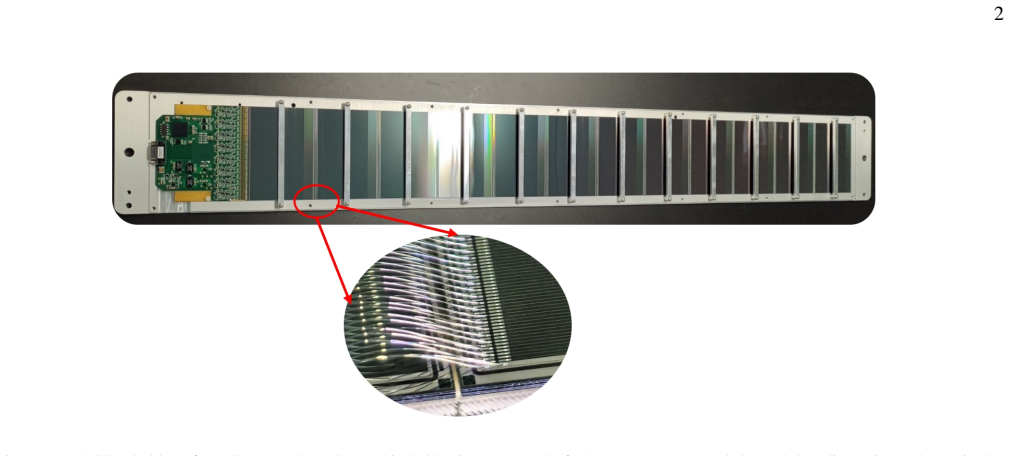
A silicon microstrip detector (SSD) has been developed to have state of the art spatial resolution and a large sensitive area under stringent power constraints. The design incorporates three floating strips with their bias resistors inserted between two aluminum readout strips. Beam test measurements with the single sensor confirmed that this configuration achieves a total detection efficiency of $99.8 \, \%$ and spatial resolution $7.6 \, \mathrm{\mu m}$ for MIPs. A double-$\eta$ algorithm was developed to optimize hit position reconstruction for this SSD. The design can be adapted for large area silicon detectors.
Figures


Figures from the paper (10 more)


Reference graph
Works this paper leans on
-
[33]
Fast align- ment of a complex tracking detector using advanced track mod- els.Comput
V olker Blobel, Claus Kleinwort, and Frank Meier. Fast align- ment of a complex tracking detector using advanced track mod- els.Comput. Phys. Commun., 182:1760–1763, 2011
work page 2011
-
[1]
Effect of the double-ηAlgorithm The measured residual distributions for Region-A obtained using theηalgorithm and the double-ηalgorithm are shown in Fig. 12(a)(a), respectively. It can be seen that the first one exhibits a broader distribution, with pronounced tails on both sides. Meanwhile, in the two-dimensional distribution of measured residual versus ...
-
[2]
Improvement from the three floating strips The measured residual distribution with and without the three floating strips as shown in Fig.13(a)(c). The three float- ing strips significantly improves theσ mea from17.2µmto 8.1µm(σ dut from15.2µmto7.2µm). This enhancement is primarily due to the larger charge sharing effect introduced by the floating strips. ...
-
[3]
Silicon strip and pixel detectors for particle physics experiments.Phys
Sally Seidel. Silicon strip and pixel detectors for particle physics experiments.Phys. Rept., 828:1–34, 2019
work page 2019
-
[4]
Characterization of silicon microstrip sensors for space astronomy.Nucl
Jia-Ju Wei, Jian-Hua Guo, and Yi-Ming Hu. Characterization of silicon microstrip sensors for space astronomy.Nucl. Sci. Tech., 31(10):97, 2020
work page 2020
-
[5]
Augusto Alves, Jr
A. Augusto Alves, Jr. et al. The LHCb Detector at the LHC. JINST, 3:S08005, 2008
2008
-
[6]
S. Chatrchyan et al. The CMS Experiment at the CERN LHC. JINST, 3:S08004, 2008
work page 2008
- [7]
Show all 34 references
-
[8]
Advances in nuclear detection and readout tech- niques.Nucl
Rui He et al. Advances in nuclear detection and readout tech- niques.Nucl. Sci. Tech., 34(12):205, 2023
2023
-
[9]
Straulino et al
S. Straulino et al. The PAMELA silicon tracker.Nucl. Instrum. Meth. A, 530:168–172, 2004
2004
-
[10]
Bonechi et al
L. Bonechi et al. Status of the PAMELA silicon tracker.Nucl. Instrum. Meth. A, 570:281–285, 2007
2007
-
[11]
P. W. Cattaneo et al. First results about on-ground calibration of the Silicon Tracker for the AGILE satellite.Nucl. Instrum. Meth. A, 630:251–257, 2011
2011
-
[12]
Bulgarelli et al
A. Bulgarelli et al. The AGILE silicon tracker: Pre-launch and in-flight configuration.Nucl. Instrum. Meth. A, 614:213–226, 2010
2010
-
[13]
Sgro et al
C. Sgro et al. Construction, test and calibration of the GLAST silicon tracker.Nucl. Instrum. Meth. A, 583:9–13, 2007. 9
2007
-
[14]
GLAST: The Gamma ray Large Area Space Telescope.J
Claudia Cecchi. GLAST: The Gamma ray Large Area Space Telescope.J. Phys. Conf. Ser., 120:062017, 2008
2008
-
[15]
The DAMPE silicon–tungsten tracker
Philipp Azzarello et al. The DAMPE silicon–tungsten tracker. Nucl. Instrum. Meth. A, 831:378–384, 2016
2016
-
[16]
DAMPE silicon tracker on-board data compression algorithm.Chin
Yi-Fan Dong, Fei Zhang, Rui Qiao, Wen-Xi Peng, Rui-Rui Fan, Ke Gong, Di Wu, and Huan-Yu Wang. DAMPE silicon tracker on-board data compression algorithm.Chin. Phys. C, 39(11):116202, 2015
2015
-
[17]
Vievering, Lindsay Glesener, P
Juliana T. Vievering, Lindsay Glesener, P. S. Athiray, Juan Camilo Buitrago-Casas, Sophie Musset, Daniel Ryan, Shin-nosuke Ishikawa, Jessie Duncan, Steven Christe, and Säm Krucker. FOXSI-2 Solar Microflares II: Hard X-ray Imaging Spectroscopy and Flare Energetics.Astrophys. J....
2021
-
[18]
Lubelsmeyer et al
K. Lubelsmeyer et al. Upgrade of the Alpha Magnetic Spec- trometer (AMS-02) for long term operation on the International Space Station (ISS).Nucl. Instrum. Meth. A, 654:639–648, 2011
2011
-
[19]
The AMS-02 Silicon Tracker after 500 days in space.PoS, Vertex2012:052, 2013
Matteo Duranti. The AMS-02 Silicon Tracker after 500 days in space.PoS, Vertex2012:052, 2013
2013
-
[20]
Turchetta
R. Turchetta. Spatial resolution of silicon microstrip detectors. Nucl. Instrum. Meth. A, 335:44–58, 1993
1993
-
[21]
Casse, P
G. Casse, P. Dervan, D. Forshaw, A. Greenall, T. Huse, I. Tsurin, and M. Wormald. Degradation of charge sharing af- ter neutron irradiation in strip silicon detectors with different geometries.Nucl. Instrum. Meth. A, 730:54–57, 2013
2013
-
[22]
Aaij et al
R. Aaij et al. Performance of the LHCb Vertex Locator.JINST, 9:P09007, 2014
2014
-
[23]
A. J. Furgeri, W. de Boer, and F. Hartmann. Results of irra- diation quality assurance of CMS silicon microstrip detectors. Nucl. Instrum. Meth. A, 573:264–267, 2007
2007
-
[24]
Latoˇnová et al
V . Latoˇnová et al. Characterization of the polysilicon resistor in silicon strip sensors for ATLAS inner tracker as a function of temperature, pre- and post-irradiation.Nucl. Instrum. Meth. A, 1050:168119, 2023. [23]https://ideas.no/products/ide1140/
2023
-
[25]
Design and test for the CEPC muon subdetector based on extruded scintillator and SiPM.JINST, 19(06):P06020, 2024
Hongyu Zhang, Xiyang Wang, et al. Design and test for the CEPC muon subdetector based on extruded scintillator and SiPM.JINST, 19(06):P06020, 2024
2024
-
[26]
Common-mode noise analysis of silicon mi- crostrip detectors.Nucl
Yu-Xin Cui et al. Common-mode noise analysis of silicon mi- crostrip detectors.Nucl. Instrum. Meth. A, 1059:168962, 2024
2024
-
[27]
Testbeam studies of pre-prototype silicon strip sensors for the LHCb UT upgrade project.Nucl
Andrea Abba et al. Testbeam studies of pre-prototype silicon strip sensors for the LHCb UT upgrade project.Nucl. Instrum. Meth. A, 806:244–257, 2016
2016
-
[28]
Hubbeling et al
L. Hubbeling et al. Measurement of spatial resolution of a dou- ble sided AC coupled microstrip detector.Nucl. Instrum. Meth. A, 310:197–202, 1991
1991
-
[29]
H. W. Kraner, R. Beuttenmuller, T. Ludlam, A. L. Hanson, K. W. Jones, V . Radeka, and E. H. M. Heijne. CHARGE COL- LECTION IN SILICON STRIP DETECTORS. (TALK).IEEE Trans. Nucl. Sci., 30:405–414, 1983
1983
-
[30]
General Broken Lines as advanced track fit- ting method.Nucl
Claus Kleinwort. General Broken Lines as advanced track fit- ting method.Nucl. Instrum. Meth. A, 673:107–110, 2012
2012
-
[31]
Alignment of the Alpha Magnetic Spectrometer (AMS) in space.Eur
Qi Yan and Vitaly Choutko. Alignment of the Alpha Magnetic Spectrometer (AMS) in space.Eur. Phys. J. C, 83:245, 2023
2023
-
[32]
PhD thesis, Hamburg U., 2023
Younes Otarid.Pixel-Strip Modules for the CMS Tracker Phase-2 Upgrade: From DAQ test system development to mod- ule assembly and qualification. PhD thesis, Hamburg U., 2023
2023
-
[34]
L. K. Li, M. Y . Dong, Z. Gao, et al. Effect of multiple coulomb scattering on the beam tests of silicon pixel detectors.Nuclear Science and Techniques, 35(83), 2024
2024
Reviewed August 7, 2026 · model on record in the stance chip above.
Discussion (0). Sign in to comment.