REVIEW 3 major objections 5 minor 1 cited by
Networked Quantum Services
T0 review · 3 major / 5 minor · reviewed 2026-08-07 · deepseek-v4-flash
Pith's one-line read The paper argues that networked quantum services form a distinct field—combining small quantum processors over classical and quantum links—and provides a structured survey of architectures, software, and hardware implementations.
desk verdict A useful but uneven survey of networked quantum services; the taxonomy is fine, the hardware tables are not. read the letter →
The pith
A machine-rendered reading of the paper's core claim, the machinery that carries it, and where it could break.
The reading
What carries the argument
The load-bearing organizing device is the classification of networked quantum services by which communication resources distant quantum processing units can use. Multichip execution keeps circuits local and combines outputs classically; circuit distribution assumes quantum communication and distributes a decomposed circuit across nodes; circuit splitting assumes only classical communication and cuts the circuit, as in gate-cutting or wire-cutting. This taxonomy is what lets the survey place dozens of algorithms, compilers, and experimental demonstrations into one structure. Secondary machinery includes the layered architectures for quantum computers and distributed computation, the data-splitting versus circuit-splitting distinction for distributed quantum neural networks, and the fidelity-based quality model in which entanglement purification improves fidelity from $F' = F_0^2/p_S$ with $p_S = F_0^2 + (1-F_0)^2$, making entangled states usable only above a threshold $F_{\rm thr}$.
What would settle it
Choose any row in Table 15 or Table 18 and check the stated gate error rate or coherence time against the cited primary paper or the vendor's current specification sheet; if a value is off by an order of magnitude, the survey's implementation-basis tables are not a reliable quantitative record and the map's hardware layer would need source-level verification.
Extended reading notes
Core claim
The central claim is that networked quantum services are a coherent emerging category whose core idea is to combine several smaller quantum processing units in parallel, then merge their outputs by post-processing, with classical communication always available and quantum communication available in some variants. The paper establishes a three-way taxonomy: multichip approaches need no quantum communication between circuits; circuit distribution cuts a large circuit across distant nodes that share entangled links; circuit splitting runs subcircuits with only classical coordination. On top of this, the review classifies distributed quantum machine learning into data splitting versus circuit splitting, surveys the quantum software stack from languages and SDKs to API gateways and OpenAPI-based service descriptions, and reviews the physical basis of quantum channels, repeaters, quantum memories, and error correction. It draws the practical conclusion that all devices in a quantum network must meet three conditions—synchronization, error-correction coding, and adequate memory coherence—and that network generations can be typed by how they handle loss and errors (Types I–III), with end-to-end Bell pairs per second and fidelity thresholds as service-level quality measures.
Load-bearing premise
The survey's quantitative tables (gate error rates and coherence times) present hardware numbers without a primary source attached to each row, so the entire survey's implementation picture stands on vendor-reported figures that the text does not independently verify.
Editorial extensions
If this is right
- If the taxonomy is adopted, any proposed networked quantum service can be classified by its quantum-communication capability, which determines which algorithms, compilers, and error-management methods apply.
- Distributed execution over many small QPUs becomes a credible near-term path: it avoids the high gate counts and decoherence of a single large machine and allows low-complexity error correction in each node.
- Interoperability, not raw qubit count, is the next bottleneck: without standardized APIs, service descriptions, and programming interfaces, quantum services cannot be combined across vendors.
- Quantum networks will evolve in generations, with Type I using distillation and two-way classical communication, Type II using quantum error correction, and Type III using QEC for both loss and errors without classical side-information, each trading rate, complexity, and hardware demands.
- Fidelity-aware service quality can be engineered: end-to-end Bell pairs per second plus a fidelity threshold gives a concrete quality-of-service contract for networked quantum services.
Reading between the lines
- The paper leaves implicit that the same three-way split by quantum-communication availability could organize distributed quantum sensing, where some protocols need shared entanglement and others coordinate classically.
- The tables of processor error rates and memory coherence times, if each entry were tied to a primary source, would become a yearly trackable benchmark of whether network-component requirements are being met; the paper stops short of providing that provenance.
- The fidelity-threshold model suggests a testable service-engineering rule: a quantum cloud could advertise a distribution of delivered Bell-pair fidelities and route jobs to paths whose purified fidelity exceeds the application threshold, making QoS a measurable contract rather than a hardware specification.
- The networked-beats-monolithic argument leads to a testable prediction: a distributed computation over smaller QPUs should show slower fidelity decay than a single larger QPU at the same total gate count, provided synchronization overhead stays below the error-reduction gain.
Editorial analysis
A structured set of objections, weighed in public.
Referee Report
Summary. This survey reviews the emerging area of networked quantum services: the use of quantum computers and quantum networking to provide services such as distributed quantum computing, networked quantum machine learning, blind quantum computation, quantum cloud platforms, and quantum-enhanced sensing. It organizes the material around architectural concepts (multichip, circuit distribution, circuit splitting), software and programming-language support, standardization efforts, and an implementation basis covering quantum channels, repeaters, error correction, and quantum memories. The stated novel contribution is a compact and comprehensive state-of-the-art overview with structured tables and a discussion of open problems.
Significance. Read as a curated overview, the paper has real value: the related-work comparison is broad, the taxonomy of distributed-computing approaches is useful, and the separation of data splitting from circuit splitting in quantum neural networks is a helpful organizing device. Because the paper makes no technical derivations, its soundness rests on the accuracy of its factual claims and tables. The paper's own advertised contribution, 'well structured, easy-to-access tables,' is weakened by internal contradictions and by state-of-the-art numbers that lack primary sources. If the tables are corrected and sourced, the survey could be a useful entry point for readers entering this field; in its present form, the hardware-performance tables cannot be relied on without external checking.
major comments (3)
- [Table 15 and §3.2] Table 15 is internally inconsistent with the timeline given in §3.2. The table dates Google Sycamore to 2020, but §3.2 states that Google announced its 53-qubit processor in 2019; it dates IBM Hummingbird to 2023, while §3.2 places that processor in 2020; and it dates IBM Eagle to 2019, while §3.2 places the 127-qubit processor in 2021. Since Section 1.1 presents the tables as a central contribution of the survey, these date errors make the table unusable as a reliable hardware map and need to be corrected against primary sources.
- [Table 15 and §5.4] The error-rate column in Table 15 is presented without any definition of the reported metric (single-qubit versus two-qubit gate error, median versus best qubit, and whether values are percentages or fractions), and no primary source is cited in the table or in the surrounding text. The statement in §5.4 that 'the current ε error rate (%) of quantum gates is in the range of ε ≈ 0.01' is ambiguous: if 0.01 means percent, it matches only the last row of the table, and the claimed 'two orders of magnitude improvement in the last few years' is not substantiated by the table. The table should state the metric, the unit, and a source for each row or be removed.
- [§5.4 and Table 18] The text in §5.4 says that the highest achievable coherence times in quantum network hardware are 'in the range of few seconds to few minutes,' but Table 18 lists a single ion qubit with ~1 hour coherence time and a single trapped ion qubit with ~10 min. The summary statement directly contradicts the table it refers to; either the text or the table must be corrected.
minor comments (5)
- [§5.2] The claim that physical qubit numbers are 'increasing exponentially (2^n) every year' and that the state space grows 'super-exponentially (2^{2n})' is imprecise and appears to conflate the qubit count with its exponential growth; please rephrase with a concrete source and the correct formula.
- [§3.2 and Table 11] In §3.2, Google's 2019 processor is described as 53-qubit, while Table 11 lists Google Cloud as 54 qubits; clarify whether the table refers to the same device or a different generation.
- [§5.3] The phrase 'TheF fidelity' appears to be a typo for 'The fidelity'.
- [§2 and §6] There are several proofreading errors, including 'an comprehensive overview' in §2 and 'coincidence' instead of 'coincide' in §6; the manuscript would benefit from a careful language pass.
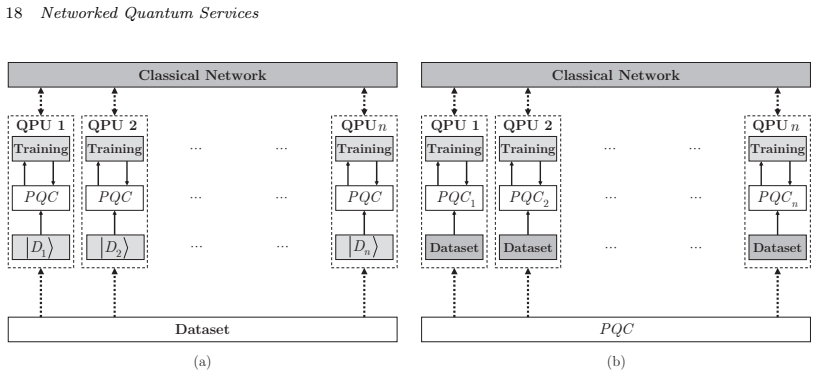
- [Figure 3 and Figure 6] The relations Σ_i w_i QC_i = QC and Σ_i c_i PQC_i = PQC are used in the figure captions, but the meaning of the weights w_i and c_i is never defined; please state what these coefficients represent.
Circularity Check
No circular reasoning identified: the paper is a literature survey without a derivation chain, and its self-citations are used as background summaries rather than load-bearing premises.
full rationale
The manuscript is a review of networked quantum services; it makes no predictions and derives no quantities from fitted parameters. Its claims are organizational and comparative: it categorizes architectures, summarizes prior results, and provides tables. Self-citations (e.g., Refs. [12,45,56-58]) appear in the related-work discussion and in tables as pointers to earlier publications, but no argument depends on accepting the authors' own prior results as a premise. The claim that no existing survey specifically addresses networked quantum services is supported by the comparative table of related surveys, not by a self-referential chain. The most significant weakness is Table 15, whose gate-error rows and release dates lack primary citations and contradict the text in Section 3.2 (e.g., the Eagle is dated 2019 in the table but the text says the 127-qubit processor was released in 2021, and the Hummingbird is dated 2023 in the table while the text says it was announced in 2020); this undermines verifiability and accuracy, but it is a correctness and external-evidence problem, not circularity. Therefore the paper is not circular.
Assumptions & free parameters
assumptions (1)
- domain assumption Cited experimental results and performance numbers are accurately reported by the original sources.
Cite this review
Pith. "Pith review of Networked Quantum Services." pith.science (2026). https://pith.science/paper/ZD2VAPC5
@misc{pith2026250523074,
  author       = {Pith},
  title        = {Pith review of: Networked Quantum Services},
  year         = {2026},
  howpublished = {\url{https://pith.science/paper/ZD2VAPC5}},
  note         = {Machine review of arXiv:2505.23074}
}
read the original abstract
The intense growth of quantum computation and communication allows the development of advanced solutions and services. Networked quantum services are provided for the users via quantum computers and quantum networking. Here, we review the fundamental concepts and recent achievements of networked quantum services. We present a comprehensive study of the state of the art, the different technologies, platforms and applications. We analyze the implementation basis and identify key challenges.
Figures


Figures from the paper (4 more)



Forward citations
Cited by 1 Pith paper
-
Intelligence-Guided Adaptive Purification for DDoS-Resilient Quantum Networks: A CUDA-Q based Study
IDS-driven adaptive purification in a simulated 8-node quantum repeater chain restores fidelity-qualified entanglement delivery under SSDP-induced degradation (0.098 to 0.344 above-target; oracle 0.335).
Reference graph
Works this paper leans on
-
[1]
C. H. Bennett, S. J. Wiesner (1992). Communication via 1- and 2-particle operators on Einstein-Podolsky-Rosen states. Phys. Rev. Lett. , 69:2881-2884. https://doi.org/10.1103/PhysRevLett.69.2881
-
[2]
C. H. Bennett, G. Brassard, C. Crepeau, R. Jozsa, A. Peres, W. K. Wootters (1993). Teleporting an unknown quantum state via dual classic and Einstein-Podolsky-Rosen channels. Phys. Rev. Lett., 70:1895-1899. https://doi.org/10.1103/PhysRevLett.70.1895. 32 Networked Quantum Services
-
[3]
S. Imre and M. Berces (2021). Entanglement-Based Competition Resolution in Distributed Sys- tems. IEEE Access, vol. 9, pp. 10253-10262. https://doi.org/10.1109/ACCESS.2021.3050271
arXiv 2021
-
[4]
P. W. Shor (2002). Introduction to quantum algorithms. AMS PSAPM , 58:143-159. https://doi.org/10.48550/arXiv.quant-ph/0005003
-
[5]
R. Jozsa (1998). Quantum algorithms and the Fourier transform. Proc. Roy. Soc. London Ser. A , 454:323-337. https://doi.org/10.1098/rspa.1998.0163
arXiv 1998
-
[6]
S. Imre (2007). Quantum Existence Testing and Its Application for Finding Extreme Val- ues in Unsorted Databases. IEEE Transactions on Computers , vol. 56, no. 5, pp. 706-710. https://doi.org/10.1109/TC.2007.1032
arXiv 2007
-
[7]
L. Gyongyosi, S. Imre, H. V. Nguyen (2018). A Survey on Quantum Channel Capacities. IEEE Communications Surveys and Tutorials , Volume: 20, Issue: 2. https://doi.org/10.1109/COMST.2017.2786748
arXiv 2018
-
[8]
Q. A. Memon, M. Al Ahmad and M. Pecht, M (2024). Quantum Computing: Navigating the Future of Computation, Challenges, and Technological Breakthroughs. Quantum Rep. 6, pp. 627–663. https://doi.org/10.3390/quantum6040039
Show all 290 references
-
[9]
Z. Yang, M. Zolanvari, and R. Jain (2023). A survey of important issues in quantum computing and communications. IEEE Communications and Surveys Tutorials , vol. 25, no. 2, pp. 1059-1094. https://doi.org/10.1109/COMST.2023.3254481
2023
- [10]
-
[11]
Singh, R
P. Singh, R. Dasgupta, A. Singh et al (2024). A Survey on Available Tools and Technologies Enabling Quantum Computing. IEEE Access , pp. 57974-57991. https://doi.org/10.1109/ACCESS.2024.3388005
2024
-
[12]
Gyongyosi and S
L. Gyongyosi and S. Imre (2019). A Survey on Quantum Computing Technology.Computer Science Review, Volume 31, pp. 51-71. https://doi.org/10.1016/j.cosrev.2018.11.002
2019 doi
-
[13]
S. S. Gill et al (2021). Quantum Computing: A Taxonomy, Systematic Review and Future Direc- tions. Software: Practice and Experience. https://doi.org/10.1002/spe.3039
2021 doi
-
[14]
E. Chae, J. Choi, J. Kim (2024). An elementary review on basic principles and developments of qubits for quantum computing. Nano Convergence, 11:11. https://doi.org/10.1186/s40580-024- 00418-5
2024 doi
- [15]
-
[16]
Y. Li, M. Tian, G. Liu, C. Peng, and L. Jiao (2020). Quantum optimization and quantum learning: A survey. IEEE Access, vol. 8, pp. 23 568-23 593. https://doi.org/10.1109/ACCESS.2020.2970105
2020
-
[17]
Kusyk, S
J. Kusyk, S. M. Saeed, and M. U. Uyar (2021). Survey on quantum circuit compilation for noisy intermediate-scale quantum computers: Artificial intelligence to heuristics. IEEE Transactions on Quantum Engineering, vol. 2, pp. 1-16. https://doi.org/10.1109/TQE.2021.3068355
2021
-
[18]
Upama, M
P. Upama, M. J. Hossain Faruk, M. Nazim, M. Masum, H. Shahriar, G. Uddin, S. Barzanjeh, A. Rahman, and S. Ahamed (2022). Evolution of Quantum Computing: A Systematic Survey on the Use of Quantum Computing Tools. 2022 IEEE Computers, Software, and Applications Conference. https...
2022
-
[19]
F. V. Massoli, L. Vadicamo, G. Amato, and F. Falchi (2022). A leap among quan- tum computing and quantum neural networks: A survey. ACM Comput. Surv. , 55, 5. https://doi.org/10.1145/3529756
2022 doi
-
[20]
S. B. Ramezani, A. Sommers, H. K. Manchukonda, S. Rahimi, and A. Amirlatifi (2020). Machine learning algorithms in quantum computing: A survey. 2020 International Joint Conference on Neural Networks (IJCNN) , pp. 1-8. https://doi.org/10.1109/IJCNN48605.2020.9207714
2020
-
[21]
Peral-Garcia et al (2024)
D. Peral-Garcia et al (2024). Systematic literature review: Quantum machine learning and its applications. Computer Science Review , https://doi.org/10.1016/j.cosrev.2024.100619
2024
-
[22]
M. D. Garcia, A. M. Romero (2024). Survey on Computational Applications of Tensor Network Simulations. IEEE Access , DOI: 10.1109/ACCESS.2024.3519676. https://doi.org/10.1109/ACCESS.2024.3519676. Laszlo Gyongyosi and Sandor Imre 33
2024
-
[23]
Ayral, P
T. Ayral, P. Besserve, D. Lacroix, E. A. R. Guzman (2023). Quantum comput- ing with and for many-body physics. The European Physical Journal A , 59, 227. https://doi.org/10.1140/epja/s10050-023-01141-1
2023 doi
-
[24]
Moguel, J
E. Moguel, J. R. and V. Garcia-Alonso (2022). Quantum service-oriented computing: cur- rent landscape and challenges. Software Quality Journal , Volume 30, pages 983–1002. https://doi.org/10.1007/s11219-022-09589-y
2022 doi
-
[25]
M. A. Serrano, J. A. Cruz-Lemus, R.-P. Castillo and M. Piattini (2022). Quantum Software Com- ponents and Platforms: Overview and Quality Assessment. ACM Comput. Surveys, 55, 8 pp. 1-31. https://doi.org/10.1145/3548679
2022 doi
-
[26]
A. A. Khan, A. Ahmad, M. Waseem, P. Liang, M. Fahmideh, T. Mikkonen, and P. Abrahamsson (2023). Software architecture for quantum computing systems - A systematic review. Journal of Systems and Software 201, 111682. https://doi.org/10.1016/j.jss.2023.111682
2023
-
[27]
Jimnez-Navajas, F
L. Jimnez-Navajas, F. Bhler, F. Leymann et al (2024). Quantum Software Development: A Survey. Quantum Information and Computation, 24, 7-8, 0609-0642. https://doi.org/10.26421/qic24.7-8-4
2024 doi
-
[28]
Garhwal, M
S. Garhwal, M. Ghorani, and A. Ahmad (2021). Quantum programming language: A systematic review of research topic and top cited languages. Archives of Computational Methods in Engineer- ing vol. 28, pp. 289-310. https://doi.org/10.1007/s11831-019-09372-6
2021 doi
-
[29]
Dwivedi, M
K. Dwivedi, M. Haghparast, T. Mikkonen (2024). Quantum software engineering and quan- tum software development lifecycle: a survey. Cluster Computing , Volume 27, pp. 7127.7145. https://doi.org/10.1007/s10586-024-04362-1
2024
-
[30]
Cuomo, M
D. Cuomo, M. Caleffi (2020). Towards a distributed quantum computing ecosystem.IET Quantum Communication 1, 1 pp. 3–8. https://doi.org/10.1049/iet-qtc.2020.0002
2020
-
[31]
Caleffi, M
M. Caleffi, M. Amoretti, D. Ferrari et al (2024). Distributed Quantum Computing: A Survey. Computer Networks , 254, 110672. https://doi.org/10.1016/j.comnet.2024.110672
2024
- [32]
- [33]
-
[34]
G. M. Jones, H.-A. Jacobsen (2024). Distributed Quantum Computing for Chemical Applica- tions. 2024 IEEE International Conference on Quantum Computing and Engineering (QCE) . https://doi.org/10.1109/QCE60285.2024.10270
2024
-
[35]
Pira and C
L. Pira and C. Ferrie (2023). An Invitation to Distributed Quantum Neural Networks. Quantum Machine Intelligence , https://doi.org/10.1007/s42484-023-00114-3
2023 doi
- [36]
-
[37]
Moguel, J
E. Moguel, J. Garcia-Alonso, J. M. Murillo (2024). Development and Deployment of Quantum Services. In: I. Exman et al.(eds.), Quantum Software , Springer. https://doi.org/10.1007/978-3- 031-64136-7 8
2024 doi
-
[38]
Phillipson (2023)
F. Phillipson (2023). Quantum Computing in Telecommunication-A Survey. Mathematics, 2023, 11(15), 3423; https://doi.org/10.3390/math11153423
2023 doi
- [39]
- [40]
-
[41]
Z. Li, K. Xue, J. Li, L. Chen, R. Li, Z. Wang, et al (2023). Entanglement-assisted quantum net- works: Mechanics, enabling technologies, challenges, and research directions. IEEE Communica- tions Surveys and Tutorials , 25, 4 pp. 2133-2189. https://doi.org/10.1109/COMST.2023.3294240
2023
-
[42]
Mehic et al (2023)
M. Mehic et al (2023). Quantum Cryptography in 5G Networks: A Comprehen- 34 Networked Quantum Services sive Overview. IEEE Communications Surveys and Tutorials , Volume: 26, Issue: 1, https://doi.org/10.1109/COMST.2023.3309051
2023
- [43]
-
[44]
Abane, M
A. Abane, M. Cubeddu, V. S. Mai, A. Battou (2025). Entanglement Routing in Quantum Networks: A Comprehensive Survey. IEEE Transactions on Quantum Engineering , pp. 1-36. https://doi.org/10.1109/TQE.2025.3541123
2025
-
[45]
Gyongyosi, S
L. Gyongyosi, S. Imre (2022). Advances in the Quantum Internet. Communications of the ACM , Volume 65, Issue 8, pp. 52-63. https://doi.org/10.1145/3524455
2022 doi
-
[46]
Wehner, D
S. Wehner, D. Elkouss, R. Hanson (2018). Quantum internet: A vision for the road ahead. Science 362, 6412. https://doi.org/10.1126/science.aam9288
2018 doi
-
[47]
Y. Li. et al (2024). A Survey of Quantum Internet Protocols From a Layered Perspective. IEEE Communications Surveys and Tutorials , Volume: 26, Issue: 3. https://doi.org/10.1109/COMST.2024.3361662
2024
-
[48]
J. Ang, G. Carini, Y. Chen, I. Chuang et al (2024). Architectures for Multinode Superconducting Quantum Computers. ACM Transactions on Quantum Computing , Volume 5, Issue 3, pp. 1-59. https://doi.org/10.1145/3674151
2024 doi
-
[49]
Barz et al (2012)
S. Barz et al (2012). Demonstration of blind quantum computing. Science, vol. 335, 6066, pp. 303-308. https://doi.org/10.1126/science.1214707
2012 doi
-
[50]
Ruiting et al (2021)
S. Ruiting et al (2021). Verifiable Multi-Party Universal Blind Quantum Computing in Distributed Networks. Chinese Journal of Electronics , vol. 30, no. 4, pp. 712-718. https://dx.doi.org/10.1049/cje.2021.05.013
2021 doi
-
[51]
Mantri, C
A. Mantri, C. Perez-Delgado and J. Fitzsimons (2013). Optimal blind quantum computation.Phys- ical Review Letters, vol. 111, no. 23, p. 230502. https://doi.org/10.1103/PhysRevLett.111.230502
2013 doi
-
[52]
J. I. Cirac, A. K. Ekert, S. F. Huelga, C. Macchiavello (1999). Distributed quantum computation over noisy channels. Phys. Rev. A 59. 4249-4254. https://doi.org/10.1103/PhysRevA.59.4249
1999 doi
-
[53]
Collins, N
D. Collins, N. Linden, S. Popescu (2001). Nonlocal content of quantum operations.Physical Review A 64, 7. https://doi.org/10.1103/PhysRevA.64.032302
2001 doi
-
[54]
Eisert, K
J. Eisert, K. Jacobs, P. Papadopoulos, M. B. Plenio (2000). Optimal local implementation of nonlocal quantum gates. Physical Review A 62 (5). https://doi.org/10.1103/PhysRevA.62.052317
2000 doi
-
[55]
Gidney, M
C. Gidney, M. Ekera (2021). How to factor 2048 bit RSA integers in 8 hours using 20 million noisy qubits. Quantum 5 (2021). https://doi.org/10.22331/q-2021-04-15-433
2021 doi
-
[56]
Gyongyosi, S
L. Gyongyosi, S. Imre (2018). Multiple Access Multicarrier Continuous-Variable Quantum Key Distribution. Chaos, Solitons and Fractals , 114, pp. 491-505. https://doi.org/10.1016/j.chaos.2018.07.006
2018 doi
-
[57]
Gyongyosi, S
L. Gyongyosi, S. Imre (2020). Resource Prioritization and Balancing for the Quantum Internet. Scientific Reports, https://doi.org/DOI: 10.1038/s41598-020-78960-5
2020 doi
-
[58]
Gyongyosi, S
L. Gyongyosi, S. Imre (2021). Scalable distributed gate-model quantum computers. Sci. Rep., 11,
2021
- [59]
-
[60]
N. M. Neumann, R. van Houte, T. Attema (2020). Imperfect distributed quantum phase estimation. Computational Science-ICCS 2020 , Vol. 12142 of LNCS, Springer, pp. 605-615. https://doi.org/10.1007/978-3-030-50433-5 46
2020 doi
-
[61]
Y. Shi, T. Nguyen, S. Stein, T. Stavenger, M. Warner, M. Roetteler et al (2023). A reference implementation for a quantum message passing interface. Proc. of the SC’23 Workshops of The Int. Conf. on High Performance Computing , Network, Storage, and Analysis, ACM, New York, NY...
2023
-
[62]
J. Tan, L. Xiao, D. Qiu, L. Luo, P. Mateus (2022). Distributed quantum algorithm for Simon’s problem. Physical Review A 106, 3. https://doi.org/10.1103/PhysRevA.106.032417
2022 doi
-
[63]
Van Meter, W
R. Van Meter, W. J. Munro, K. Nemoto, K. M. Itoh (2008). Arithmetic on a distributed- memory quantum multicomputer. ACM J. on Emerging Technologies in Computing Systems 3, 4. Laszlo Gyongyosi and Sandor Imre 35 https://doi.org/10.1145/1324177.1324179
2008
- [64]
-
[65]
Zhang and Q
Z. Zhang and Q. Zhuang (2021). Distributed quantum sensing. Quantum Science and Technology, vol. 6, no. 4, p. 043001. https://doi.org/10.1088/2058-9565/abd4c3
2021 doi
-
[66]
C. L. Degen, F. Reinhard, and P. Cappellaro (2017). Quantum sensing.Reviews of Modern Physics, vol. 89, no. 3, p. 035002. https://doi.org/10.1103/RevModPhys.89.035002
2017 doi
-
[67]
X. Zhou, D. Qiu, L. Luo (2023). Distributed Bernstein-Vazirani algorithm. Physica A: Statistical Mechanics and its Applications 629, 129209. https://doi.org/10.1016/j.physa.2023.129209
2023
-
[68]
X. Zhou, D. Qiu, L. Luo (2023). Distributed exact Grover’s algorithm. Frontiers of Physics 18 (5) 1-25. https://doi.org/10.1007/s11467-023-1327-x
2023 doi
-
[69]
B. He, D. Zhang, S. W. Loke, S. Lin, L. Lu (2024). Building a Hierarchical Architecture and Com- munication Model for the Quantum Internet.IEEE Journal on Selected Areas in Communications, 42, 7. https://doi.org/10.1109/JSAC.2024.3380103
2024
-
[70]
Kozlowski, S
W. Kozlowski, S. Wehner, R. V. Meter, B. Rijsman, A. S. Cacciapuoti, M. Caleffi et al (2023). RFC 9340: Architectural principles for a quantum Internet , Internet Research Task Force (IRTF). https://doi.org/10.17487/RFC9340
2023 doi
-
[71]
Roffe (2019)
J. Roffe (2019). Quantum Error Correction: An Introductory Guide. Contemporary Physics, Vol. 60, 3. https://doi.org/10.1080/00107514.2019.1667078
2019
-
[72]
Paler, S
A. Paler, S. J. Devitt (2015). An introduction to Fault-tolerant Quantum Com- puting. DAC’15 Proceedings of the 52nd Annual Design Automation Conference , 60. https://doi.org/10.1145/2744769.2747911
2015
-
[73]
Heshami, D
K. Heshami, D. G. England, P. C. Humphreys (2016). Quantum memories: emerg- ing applications and recent advances. Journal of Modern Optics 63, No. S3, S42-S65. https://doi.org/10.1080/09500340.2016.1148212
2016
-
[74]
B. M. Terhal (2015). Quantum Error Correction for Quantum Memories. Rev. Mod. Phys. 87,
2015
-
[75]
Bravyi, D
S. Bravyi, D. Gosset, and R. Konig (2018). Quantum advantage with shallow circuits. Science 362, 308. https://doi.org/10.1126/science.aar3106
2018 doi
-
[76]
J. D. Hidary (2021). Quantum computing: an Applied Approach . Springer, ISBN-10: 3030832732
2021
-
[77]
T. D. Ladd, F. Jelezko, R. Laflamme, Y. Nakamura, C. Monroe, and J. L. O’Brien (2010). Quantum computers. Nature, vol. 464, no. 7285, pp. 45–53. https://doi.org/10.1038/nature08812
2010 doi
- [78]
-
[79]
Kjaergaard, M
M. Kjaergaard, M. E. Schwartz, J. Braumuller, P. Krantz, J. I.-J. Wang, S. Gustavsson, and W. D. Oliver (2020). Superconducting qubits: Current state of play. Annual Review of Condensed Matter Physics, vol. 11, pp. 369–395. https://doi.org/10.1146/annurev-conmatphys-031119-050605
2020 doi
-
[80]
Arute et al (2019)
F. Arute et al (2019). Quantum supremacy using a programmable superconducting processor. Nature, Vol 574. https://doi.org/10.1038/s41586-019-1666-5
2019 doi
-
[81]
Maurand, X
R. Maurand, X. Jehl, D. Kotekar-Patil, A. Corna, H. Bohuslavskyi, R. Lavieville, L. Hutin, S. Barraud, M. Vinet, M. Sanquer et al (2016). A cmos silicon spin qubit. Nature communications, vol. 7, no. 1, p. 13575. https://doi.org/10.1038/ncomms13575
2016 doi
-
[82]
Henriet, L
L. Henriet, L. Beguin, A. Signoles, T. Lahaye, A. Browaeys, G.-O. Reymond, and C. Jurczak (2020). Quantum computing with neutral atoms. Quantum, vol. 4, p. 327. https://doi.org/10.22331/q-2020-09-21-327
2020 doi
- [83]
-
[84]
C. D. Bruzewicz, J. Chiaverini, R. McConnell, and J. M. Sage (2019). Trapped-ion quan- tum computing: Progress and challenges. Applied Physics Reviews , vol. 6, no. 2, p. 021314. https://doi.org/10.1063/1.5088164
2019 doi
-
[85]
Nayak, S
C. Nayak, S. H. Simon, A. Stern, M. Freedman, and S. D. Sarma (2008). Non-abelian anyons 36 Networked Quantum Services and topological quantum computation. Reviews of Modern Physics , vol. 80, no. 3, p. 1083. https://doi.org/10.1103/RevModPhys.80.1083
2008 doi
-
[86]
Pezzagna, J
S. Pezzagna, J. Meijer (2021). Quantum computer based on color centers in diamond. Appl. Phys. Rev. 8, 011308. https://doi.org/10.1063/5.0007444
2021 doi
-
[87]
L. M. K. Vandersypen et al (2001). Experimental realization of Shor’s quantum factoring algorithm using nuclear magnetic resonance. Nature 414, 883-887. https://doi.org/10.1038/414883a
2001 doi
-
[88]
L. M. K. Vandersypen, I. L. Chuang (2005). NMR Techniques for Quantum Control and Compu- tation. Rev. Mod. Phys. 76, 1037. https://doi.org/10.1103/RevModPhys.76.1037
2005 doi
-
[89]
N. C. Jones, R. Van Meter, A. G. Fowler, P. L. McMahon, J. Kim, T. D. Ladd, Y. Ya- mamoto (2012). Layered architecture for quantum computing. Phys. Rev. X , vol. 2, 031007. https://doi.org/10.1103/PhysRevX.2.031007
2012 doi
-
[90]
Rodrigo, S
S. Rodrigo, S. Abadal, E. Alarcon et al (2021). On Double Full-Stack Communication- Enabled Architectures for Multicore Quantum Computers. IEEE Micro , 41, 48–56. https://doi.org/10.1109/MM.2021.3092706
2021
-
[91]
Van Meter (2014)
R. Van Meter (2014). Quantum Networking . ISBN 1118648927, 9781118648926, John Wiley and Sons Ltd
2014
-
[92]
Illiano, M
J. Illiano, M. Caleffi, A. Manzalini, A. S. Cacciapuoti (2022). Quantum Inter- net protocol stack: A comprehensive survey. Computer Networks 213, 109092. https://doi.org/10.1016/j.comnet.2022.109092
2022
-
[93]
Z. Li, K. Xue, J. Li, N. Yu, J. Liu, D. S. L. Wei et al (2021). Building a large scale and wide- area quantum Internet based on an OSI-alike model. China Communications 18, 10, pp. 1-14. https://doi.org/10.23919/JCC.2021.10.001
2021 doi
-
[94]
Dahlberg, M
A. Dahlberg, M. Skrzypczyk, T. Coopmans, L. Wubben, F. Rozpundefineddek, M. Pom- pili et al (2019). A link layer protocol for quantum networks. Proceedings of the ACM Special Interest Group on Data Communication , ACM, New York, NY, USA, pp. 159-173. https://doi.org/10.1145/33...
2019
-
[95]
Pirker, W
A. Pirker, W. Dur (2019). A quantum network stack and protocols for reliable entanglement-based networks. New Journal of Physics 21, 3. https://doi.org/10.1088/1367-2630/ab05f7
2019 doi
-
[96]
R. V. Meter, J. Touch (2013). Designing quantum repeater networks. IEEE Communications Magazine 51, 8 pp. 64-71. https://doi.org/10.1109/MCOM.2013.6576340
2013
-
[98]
Preskill (2018)
J. Preskill (2018). Quantum Computing in the NISQ era and beyond. Quantum 2, 79. https://doi.org/10.22331/q-2018-08-06-79
2018 doi
-
[99]
A. W. Harrow and A. Montanaro (2017). Quantum Computational Supremacy. Nature, vol 549, pages 203-209. https://doi.org/10.1038/nature23458
2017 doi
-
[100]
Aaronson and L
S. Aaronson and L. Chen (2017). Complexity-theoretic foundations of quantum supremacy experi- ments. Proceedings of the 32nd Computational Complexity Conference, CCC ’17, pages 22:1-22:67. https://doi.org/10.4230/LIPIcs.CCC.2017.22
2017 doi
- [101]
-
[102]
Mastriani (2024)
M. Mastriani (2024). Explaining the results of quantum mechanics via entanglement closed loop. Optical and Quantum Electronics , 56, 801. https://doi.org/10.1007/s11082-024-06393-9
2024 doi
-
[103]
Alexeev et al (2019)
Y. Alexeev et al (2019). Quantum Computer Systems for Scientific Discovery. PRX Quantum 2, 017001. https://doi.org/10.1103/PRXQuantum.2.017001
2019 doi
-
[104]
Loncar et al (2019)
M. Loncar et al (2019). Development of Quantum InterConnects for Next-Generation Information Technologies. PRX Quantum 2, 017002. https://doi.org/10.1103/PRXQuantum.2.017002
2019 doi
-
[105]
Foxen et al (2020)
B. Foxen et al (2020). Demonstrating a Continuous Set of Two-qubit Gates for Near-term Quantum Algorithms. Phys. Rev. Lett , 125, 120504. https://doi.org/10.1103/PhysRevLett.125.120504
2020 doi
-
[106]
Ajagekar, T
A. Ajagekar, T. Humble, and F. You (2020). Quantum Computing based Hybrid Solution Strate- gies for Large-scale Discrete-Continuous Optimization Problems. Computers and Chemical Engi- Laszlo Gyongyosi and Sandor Imre 37 neering Vol 132, 106630. https://doi.org/10.1016/j.compch...
2020
-
[107]
Ajagekar and F
A. Ajagekar and F. You (2019). Quantum computing for energy systems optimization: Challenges and opportunities. Energy, Volume 179, pp. 76-89. https://doi.org/10.1016/j.energy.2019.04.186
2019 doi
-
[108]
Harrigan et al (2020)
M. Harrigan et al (2020). Quantum Approximate Optimization of Non-Planarusing eigenen- ergies Graph Problems on a Planar Superconducting Processor. Nature Physics 17, 332-336. https://doi.org/10.1038/s41567-020-01105-y
2020 doi
-
[109]
Rubin et al (2020)
N. Rubin et al (2020). Hartree-Fock on a superconducting qubit quantum computer. Science 69 (6507), 1084-1089. https://doi.org/10.1126/science.abb9811
2020 doi
- [110]
-
[111]
Farhi, J
E. Farhi, J. Goldstone, S. Gutmann and L. Zhou, L (2019). The Quantum Approximate Op- timization Algorithm and the Sherrington-Kirkpatrick Model at Infinite Size. Quantum 6, 759. https://doi.org/10.22331/q-2022-07-07-759
2019 doi
- [112]
-
[114]
K. A. Brown and T. Roser (2020). Towards storage rings as quantum computers. Phys. Rev. Accel. Beams 23, 054701. https://doi.org/10.1103/PhysRevAccelBeams.24.049901
2020 doi
-
[115]
J. Bae, P. M. Alsing, D. Ahn et al (2020). Quantum circuit optimization using quantum Karnaugh map. Sci Rep 10, 15651, https://doi.org/10.1038/s41598-020-72469-7
2020 doi
-
[116]
Li et al (2020)
S. Li et al (2020). Programmable Unitary Operations for Orbital Angular Mo- mentum Encoded States. National Science Open , Volume 1, Issue 2: 20220019. https://doi.org/10.1360/nso/20220019
2020
-
[117]
S. Bugu, F. Ozaydin and T. Kodera (2020). Surpassing the Classical Limit in Magic Square Game with Distant Quantum Dots Coupled to Optical Cavities. Sci Rep . DOI: https://doi.org/10.1038/s41598-020-79295-x
2020 doi
-
[118]
Teplukhin, B
A. Teplukhin, B. Kendrick and D. Babikov (2020). Solving complex eigenvalue problems on a quantum annealer with applications to quantum scattering resonances. Phys. Chem. Chem. Phys . https://doi.org/10.1039/D0CP04272B
2020 doi
- [119]
-
[120]
Q. Zhu. et al (2022). Quantum computational advantage via 60-qubit 24-cycle random circuit sampling. Science bulletin , 67(3):240-245. https://doi.org/10.1016/j.scib.2021.10.017
2022 doi
-
[121]
Aaronson, A
S. Aaronson, A. Arkhipov (2013). The computational complexity of linear optics. Theory of Com- puting, 9(4):143-252. https://doi.org/10.1145/1993636.1993682
2013
-
[122]
Zhong et al (2020)
H-S. Zhong et al (2020). Quantum computational advantage using photons. Science, 370(6523):1460-1463. https://doi.org/10.1126/science.abe8770
2020 doi
-
[123]
L. S. Madsen et al (2022). Quantum computational advantage with a programmable photonic processor. Nature, 606(7912):75-81. https://doi.org/10.1038/s41586-022-04725-x
2022 doi
-
[124]
Reiher, N
M. Reiher, N. Wiebe, K. M. Svore et al (2017). Elucidating reaction mechanisms on quantum computers. Proc Natl Acad Sci 114:7555-7560. https://doi.org/10.1073/pnas.1619152114
2017 doi
-
[125]
Mandra and H
S. Mandra and H. G. Katzgraber (2018). A deceptive step towards quantum speedup detection. Quantum Sci Technol, 3:04LT. https://doi.org/10.1088/2058-9565/aac8b2
2018 doi
-
[126]
Moret-Bonillo (2015)
V. Moret-Bonillo (2015). Can artificial intelligence benefit from quantum computing? Prog Artif Intell, 3:89-105. https://doi.org/10.1007/s13748-014-0059-0
2015 doi
-
[127]
Yamakawa and M
T. Yamakawa and M. Zhandry (2022). Verifiable quantum advantage without structure. 2022 IEEE 63rd Annual Symposium on Foundations of Computer Science (FOCS) , pages 69-74. https://doi.org/10.1145/3658665
2022 doi
-
[128]
T. F. Ronnow, Z. Wang, J. Job et al (2014). Defining and detecting quantum speedup. Science, 345:420-424. https://doi.org/10.1126/science.1252319. 38 Networked Quantum Services
2014 doi
-
[129]
Aaronson (2015)
S. Aaronson (2015). Quantum Machine Learning Algorithms: Read the Fine Print. Nature Physics 11:291-293. https://doi.org/10.1038/nphys3272
2015 doi
-
[130]
Bharti, A
K. Bharti, A. Cervera-Lierta, T. H. Kyaw, T. Haug, S. Alperin-Lea, A. Anand, M. Degroote, H. Heimonen, J. S. Kottmann, T. Menke, et al (2022). Noisy intermediate-scale quantum (NISQ) algorithms. Rev. Mod. Phys. 94, 015004. https://doi.org/10.1103/RevModPhys.94.015004
2022 doi
-
[131]
P. W. Shor (1994). Algorithms for quantum computation: discrete logarithms and fac- toring. Proceedings 35th Annual Symposium on Foundations of Computer Science 124-134. https://doi.org/10.1109/SFCS.1994.365700
1994
-
[132]
V. S. Denchev, S. Boixo, S. V. Isakov et al (2016). What is the computational value of finite-range tunneling? Phys Rev X 6, 1-17. https://doi.org/10.1103/PhysRevX.6.031015
2016 doi
-
[133]
P. J. J. O’Malley et al (2016). Scalable Quantum Simulation of Molecular Energies. Phys Rev X , 6, 031007. https://doi.org/10.1103/PhysRevX.6.031007
2016 doi
- [134]
-
[135]
Aleiner et al (2020)
I. Aleiner et al (2020). Accurately computing electronic properties of materials using eigenenergies. arXiv:2012.00921. https://doi.org/10.1038/s41586-021-03576-2
2020 arXiv
- [136]
- [137]
-
[138]
Peruzzo et al (2014)
A. Peruzzo et al (2014). A variational eigenvalue solver on a photonic quantum processor. Nat. Commun. 5, 4213. https://doi.org/10.1038/ncomms5213
2014 doi
-
[139]
Wecker, M
D. Wecker, M. B. Hastings, and M. Troyer (2015). Progress towards practical quantum variational algorithms. Phys. Rev. A 92, 042303. https://doi.org/10.1103/PhysRevA.92.042303
2015 doi
-
[141]
Yuan et al (2019)
X. Yuan et al (2019). Theory of variational quantum simulation. Quantum 3, 191. https://doi.org/10.22331/q-2019-10-07-191
2019 doi
-
[143]
Mitarai and K
K. Mitarai and K. Fujii (2021). Constructing a virtual two-qubit gate by sampling single-qubit operations. New Journal of Physics 23. https://doi.org/10.1088/1367-2630/abd7bc
2021 doi
-
[144]
T. Peng, A. W. Harrow, M. Ozols, and X. Wu (2020). Simulating Large Quan- tum Circuits on a Small Quantum Computer. Physical Review Letters 125, 150504. https://doi.org/10.1103/PhysRevLett.125.150504
2020 doi
-
[145]
Brenner, C
L. Brenner, C. Piveteau, D. Sutter (2023). Optimal wire cutting with classical communication. arXiv.2302.03366. https://doi.org/10.48550/arXiv.2302.03366
2023 doi
-
[146]
Gokhale, O
P. Gokhale, O. Angiuli, Y. Ding, K. Gui, T. Tomesh, M. Suchara, et al (2019). Minimizing state preparations in variational quantum eigensolver by partitioning into commuting families. arXiv.1907.13623
2019 arXiv
-
[147]
Tilly, H
J. Tilly, H. Chen, S. Cao, D. Picozzi, K. Setia, Y. Li, et al (2022). The variational quantum eigensolver: A review of methods and best practices. Physics Reports 986, 1–128. https://doi.org/10.1016/j.physrep.2022.08.003
2022 doi
-
[148]
Y. Wang, L. M. Sager-Smith, D. A. Mazziotti (2023). Quantum simulation of bosons with the contracted quantum eigensolver. New Journal of Physics 25, 10. https://doi.org/10.1088/1367- 2630/acf9c3
2023 doi
-
[149]
Schuld, V
M. Schuld, V. Bergholm, C. Gogolin, J. Izaac, and N. Killoran (2019). Evaluating analytic gradi- ents on quantum hardware. Physical Review A 99. https://doi.org/10.1103/PhysRevA.99.032331. Laszlo Gyongyosi and Sandor Imre 39
2019 doi
-
[150]
A. J. McCaskey, D. I. Lyakh, E. F. Dumitrescu, S. S. Powers, T. S. Humble (2019). XACC: A system-level software infrastructure for heterogeneous quantum-classical computing. Quantum Science and Technology, Volume 5, Number 2. https://doi.org/10.1088/2058-9565/ab6bf6
2019 doi
-
[151]
A. J. McCaskey, T. Nguyen, A. Santana, D. Claudino, T. Kharazi, H. Finkel (2021). Extending C++ for heterogeneous quantum-classical computing. ACM Trans. on Quantum Computing 2, 2, 1–36. https://doi.org/10.1145/3462670
2021 doi
- [152]
-
[153]
Gambetta (2022)
J. Gambetta (2022). Quantum-centric supercomputing: The next wave of computing. URL: https: //www.ibm.com/quantum/blog/next-wave-quantum-centric-supercomputing
2022
-
[154]
Gambetta (2023)
J. Gambetta (2023). The hardware and software for the era of quantum utility is here . URL: https://www.ibm.com/quantum/blog/quantum-roadmap-2033
2023
-
[155]
L. Liu, X. Dou (2021). QuCloud: A new qubit mapping mechanism for multiprogramming quantum computing in cloud environment. IEEE Int. Symposium on High-performance Computer Architec- ture (HPCA), IEEE, pp. 167–178. https://doi.org/10.1109/HPCA51647.2021.00024
2021
-
[156]
L. Liu, X. Dou, QuCloud+ (2024). A holistic qubit mapping scheme for single/multi-programming on 2D/3D NISQ quantum computers. ACM Trans. on Architecture and Code Optimization 21, 1, 1–27. https://doi.org/10.1145/3631525
2024 doi
-
[157]
Bandic, C
M. Bandic, C. G. Almudever, S. Feld (2023). Interaction graph-based characterization of quantum benchmarks for improving quantum circuit mapping techniques. Quantum Machine Intelligence 5, 1–30. https://doi.org/10.1007/s42484-023-00124-1
2023 doi
-
[158]
K. Li, D. Qiu, L. Li, S. Zheng, Z. Rong (2017). Application of distributed semiquan- tum computing model in phase estimation. Information Processing Letters 120, 23-29. https://doi.org/10.1016/j.ipl.2016.12.002
2017 doi
-
[159]
Tanaka, Y
T. Tanaka, Y. Suzuki, S. Uno, R. Raymond, T. Onodera, N. Yamamoto (2021). Amplitude esti- mation via maximum likelihood on noisy quantum computer. Quantum Information Processing 20, 1-29. https://doi.org/10.1007/s11128-021-03215-9
2021 doi
-
[160]
Zhang, P
K. Zhang, P. Rao, K. Yu, H. Lim, V. Korepin (2021). Implementation of efficient quan- tum search algorithms on NISQ computers. Quantum Information Processing , 20, 233. https://doi.org/10.1007/s11128-021-03165-2
2021 doi
-
[161]
G. Park, K. Zhang, K. Yu, V. Korepin (2023). Quantum multi-programming for Grover’s search. Quantum Information Processing 22, 1. https://doi.org/10.1007/s11128-022-03793-2
2023 doi
-
[162]
P. Das, S. S. Tannu, P. J. Nair, M. Qureshi (2019). A case for multiprogramming quantum comput- ers. Proceedings of the 52nd Annual IEEE/ACM International Symposium on Microarchitecture , pp. 291-303. https://doi.org/10.1145/3352460.3358287
2019
-
[163]
S. Niu, A. Todri-Sanial (2023). Enabling multi-programming mechanism for quantum computing in the NISQ era. Quantum 7. https://doi.org/10.22331/q-2023-02-16-925
2023 doi
-
[164]
Ash-Saki, M
A. Ash-Saki, M. Alam, S. Ghosh (2020). Analysis of crosstalk in NISQ devices and security im- plications in multi-programming regime. Proceedings of the ACM/IEEE International Symposium on Low Power Electronics and Design , pp. 25–30. https://doi.org/10.1145/3370748.3406570
2020
-
[165]
Ohkura (2021)
Y. Ohkura (2021). Crosstalk-aware NISQ multi-programming . Bachelor’s thesis, Faculty Policy Manage., Keio Univ., Tokyo, Japan
2021
-
[166]
Parekh, A
R. Parekh, A. Ricciardi, A. Darwish, and S. DiAdamo (2021). Quantum Algorithms and Simulation for Parallel and Distributed Quantum Computing. 2021 IEEE/ACM Second International Workshop on Quantum Computing Software (QCS) , pp. 9-19. https://doi.ieeecomputersociety.org/10.1109...
2021
-
[167]
Andres-Martinez, C
P. Andres-Martinez, C. Heunen (2019). Automated distribution of quan- tum circuits via hypergraph partitioning. Physical Review A 100, 3, 032308. https://doi.org/10.1103/PhysRevA.100.032308
2019 doi
- [168]
-
[169]
Akhremtsev, T
Y. Akhremtsev, T. Heuer, P. Sanders, S. Schlag (2017). Engineering a direct k-way hypergraph partitioning algorithm. Proceedings of the Meeting on Algorithm Engineering and Experiments (ALENEX), SIAM, pp. 28-42. https://doi.org/10.1137/1.9781611974768.3
2017 doi
-
[170]
Schlag, T
S. Schlag, T. Heuer, L. Gottesburen, Y. Akhremtsev, C. Schulz, P. Sanders (2023). High-quality hypergraph partitioning. ACM Journal of Experimental Algorithmics 27, 1-39. https://doi.org/10.1145/3529090
2023 doi
-
[172]
Andres-Martinez, T
P. Andres-Martinez, T. Forrer, D. Mills, J.-Y. Wu, L. Henaut, K. Yamamoto et al (2023). Dis- tributing circuits over heterogeneous, modular quantum computing network architectures. Quan- tum Science and Technology, 9, 4. https://doi.org/10.1088/2058-9565/ad6734
2023 doi
-
[173]
R. G. Sundaram, H. Gupta, C. R. Ramakrishnan (2021). Efficient distribution of quantum circuits. 35th Int. Symp. on Distributed Computing (DISC) , Vol. 209 of Leibniz International Proceedings in Informatics (LIPIcs). https://doi.org/10.4230/LIPIcs.DISC.2021.41
2021 doi
-
[174]
R. G. Sundaram, H. Gupta, C. R. Ramakrishnan (2022). Distribution of quantum circuits over gen- eral quantum networks. 2022 IEEE Int. Conf. on Quantum Computing and Engineering (QCE) , pp. 415-425. https://doi.ieeecomputersociety.org/10.1109/QCE53715.2022.00063
2022
-
[175]
R. G. Sundaram, H. Gupta (2023). Distributing quantum circuits using tele- portations. 2023 IEEE Int. Conf. on Quantum Software (QSW) , pp. 186-192. https://doi.ieeecomputersociety.org/10.1109/QSW59989.2023.00030
2023
-
[176]
Davarzani, M
Z. Davarzani, M. Zomorodi-Moghadam, M. Houshmand, M. Nouri-Baygi (2020). A dynamic pro- gramming approach for distributing quantum circuits by bipartite graphs. Quantum Information Processing 19, 9. https://doi.org/10.1007/s11128-020-02871-7
2020 doi
-
[177]
B. W. Kernighan, S. Lin (1970). An efficient heuristic procedure for partitioning graphs. The Bell system technical journal 49, 2, 291-307. https://doi.org/10.1002/j.1538-7305.1970.tb01770.x
1970
-
[178]
Zomorodi-Moghadam, M
M. Zomorodi-Moghadam, M. Houshmand, M. Houshmand (2018). Optimizing teleportation cost in distributed quantum circuits. International Journal of Theoretical Physics 57, 3, 848-861. https://doi.org/10.1007/s10773-017-3618-x
2018 doi
-
[179]
Houshmand, Z
M. Houshmand, Z. Mohammadi, M. Zomorodi-Moghadam, M. Houshmand (2020). An evolution- ary approach to optimizing teleportation cost in distributed quantum computation. International Journal of Theoretical Physics 59, 4. https://doi.org/10.1007/s10773-020-04409-0
2020 doi
-
[180]
O. Daei, K. Navi, M. Zomorodi-Moghadam (2020). Optimized quantum circuit partitioning. In- ternational Journal of Theoretical Physics 59, 12, https://doi.org/3804-3820
2020
-
[181]
Nikahd, N
E. Nikahd, N. Mohammadzadeh, M. Sedighi, M. S. Zamani (2021). Automated window-based partitioning of quantum circuits. Physica Scripta 96, 3, 035102. 10.1088/1402-4896/abd57c
2021 doi
-
[182]
C. M. Fiduccia, R. M. Mattheyses (1982). A linear-time heuristic for improving net- work partitions. Papers on Twenty-five years of electronic design automation , pp. 175-181. https://doi.org/10.1109/DAC.1982.1585498
1982
-
[184]
Clark, T
J. Clark, T. Humble, H. Thapliyal (2023). TDAG: Tree-based directed acyclic graph partitioning for quantum circuits. Proceedings of the Great Lakes Symposium on VLSI 2023 , GLSVLSI ’23, ACM, New York, NY, USA, p. 587-592. https://doi.org/10.1145/3583781.3590234
2023
-
[185]
T. Park, C. Y. Lee (1995). Algorithms for partitioning a graph. Computers and Industrial Engi- neering 28, 4, 899–909. https://doi.org/10.1016/0360-8352(95)00003-J
1995 doi
-
[186]
J. M. Baker, C. Duckering, A. Hoover, F. T. Chong (2020). Time-sliced quantum circuit partition- ing for modular architectures. 17th ACM Int. Conf. on Computing Frontiers 2020 Proceedings , ACM, pp. 98-107. https://doi.org/10.1145/3387902.3392617. Laszlo Gyongyosi and Sandor Imre 41
2020
-
[187]
Escofet, A
P. Escofet, A. Ovide, C. G. Almudever, E. Alarcon, S. Abadal (2023). Hungarian qubit assign- ment for optimized mapping of quantum circuits on multi-core architectures. IEEE Computer Architecture Letters. https://doi.org/10.1109/LCA.2023.3318857
2023
-
[188]
Bandic, L
M. Bandic, L. Prielinger, J. Nublein, A. Ovide, S. Rodrigo, S. Abadal et al (2023). Mapping quantum circuits to modular architectures with QUBO. 2023 IEEE Int. Conf. on Quantum Computing and Engineering (QCE) , Vol. 1, IEEE, pp. 790–801. https://doi.org/10.1109/QCE57702.2023.00094
2023
- [190]
-
[191]
Gupta, A
M. Gupta, A. Pathak (2007). A scheme for distributed quantum search through simultaneous state transfer mechanism. Annalen der Physik 16, 12, pp. 791–797. https://doi.org/10.1002/andp.200710265
2007 doi
-
[192]
Yimsiriwattana and S
A. Yimsiriwattana and S. J. Lomonaco (2004). Distributed quantum computing: A distributed Shor algorithm. Quantum Information and Computation II , vol. 5436. International Society for Optics and Photonics, pp. 360–372. DOI: https://doi.org/10.1117/12.546504
2004 doi
-
[193]
Ekera, J
M. Ekera, J. Hastad (2017). Quantum algorithms for computing short discrete logarithms and factoring RSA integers. in: T. Lange, T. Takagi (Eds.), Post-Quantum Cryptography, no. 10346 in LNCS, Springer, pp. 347-363. https://doi.org/10.1007/978-3-319-59879-6 20
2017 doi
-
[194]
Z.-Y. Chen, Q. Zhou, C. Xue, X. Yang, G.-C. Guo, and G.-P. Guo (2018). 64-Qubit Quantum Circuit Simulation. Science Bulletin 63, 964. https://doi.org/10.1016/j.scib.2018.06.007
2018 doi
-
[195]
Eddins, M
A. Eddins, M. Motta, T. P. Gujarati, S. Bravyi, A. Mezzacapo, C. Hadfield, and S. Sheldon (2022). Doubling the size of quantum simulators by entanglement forging. PRX Quantum 3. https://doi.org/10.1103/PRXQuantum.3.010309
2022 doi
-
[196]
M. A. Perlin, Z. H. Saleem, M. Suchara, and J. C. Osborn (2021). Quantum Circuit Cut- ting with Maximum Likelihood Tomography. npj Quantum Information , Vol. 7, No. 1, pp. 64. https://doi.org/10.1038/s41534-021-00390-6
2021 doi
-
[197]
W. Tang, T. Tomesh, M. Suchara, J. Larson, and M. Martonosi (2021). CutQC: using small Quantum computers for large Quantum circuit evaluations. Proceedings of the 26th ACM Inter- national Conference on Architectural Support for Programming Languages and Operating Systems (ASPL...
2021
- [198]
-
[199]
Lowe et al (2023)
A. Lowe et al (2023). Fast quantum circuit cutting with randomized measurements. Quantum 7,
2023
-
[200]
S. C. Marshall, C. Gyurik, and V. Dunjko (2022). High Dimensional Quantum Machine Learn- ing With Small Quantum Computers. arXiv:2203.13739. https://doi.org/10.22331/q-2023-08-09- 1078
2022 arXiv
-
[201]
Piveteau and D
C. Piveteau and D. Sutter (2023). Circuit knitting with classical communica- tion. IEEE Transactions on Information Theory , DOI: 10.1109/TIT.2023.3310797. https://doi.org/10.1109/TIT.2023.3310797
2023
-
[202]
Tuysuz et al (2021)
C. Tuysuz et al (2021). Classical Splitting of Parametrized Quantum Circuits. Quantum Mach. Intell. 5, 34. https://doi.org/10.1007/s42484-023-00118-z
2021 doi
-
[203]
Mitarai and K
K. Mitarai and K. Fujii (2021). Overhead for simulating a non-local channel with local channels by quasiprobability sampling. Quantum 5, 388. https://doi.org/10.22331/q-2021-01-28-388
2021 doi
-
[204]
Bravyi, G
S. Bravyi, G. Smith, and J. A. Smolin (2016). Trading classical and quantum computational resources. Physical Review X 6. https://doi.org/10.1103/PhysRevX.6.021043
2016 doi
-
[205]
A. W. Harrow, A. Lowe (2025). Optimal quantum circuit cuts with application to clustered Hamil- tonian simulation. PRX Quantum 6, 010316. https://doi.org/10.1103/PRXQuantum.6.010316. 42 Networked Quantum Services
2025 doi
-
[206]
Z. Zhou, Y. Du, X. Tian, D. Tao (2023). QAOA-in-QAOA: Solving large-scale max- cut problems on small quantum machines. Physical Review Applied 19 (2) (2023) 024027. https://doi.org/10.1103/PhysRevApplied.19.024027
2023 doi
-
[207]
Fujii, K
K. Fujii, K. Mizuta, H. Ueda, K. Mitarai, W. Mizukami, Y. O. Nakagawa (2022). Deep variational quantum eigensolver: A divide-and-conquer method for solving a larger problem with smaller size quantum computers. PRX Quantum 3. https://doi.org/10.1103/PRXQuantum.3.010346
2022 doi
-
[208]
S. C. Marshall, C. Gyurik, V. Dunjko (2023). High dimensional quantum machine learning with small quantum computers. Quantum 7. https://doi.org/10.22331/q-2023-08-09-1078
2023 doi
-
[209]
Gottesman, I
D. Gottesman, I. L. Chuang (1999). Demonstrating the viability of universal quantum computation using teleportation and single-qubit operations. Nature 402 6760, 390–393. https://doi.org/10.1038/46503
1999 doi
-
[210]
Y. F. Huang, X. F. Ren, Y. S. Zhang, L. M. Duan, G. C. Guo (2004). Exper- imental teleportation of a quantum controlled-NOT gate. Physical Review Letters 93. https://doi.org/10.1103/PhysRevLett.93.240501
2004 doi
-
[211]
K. S. Chou, J. Z. Blumoff, C. S. Wang, P. C. Reinhold, C. J. Axline, Y. Y. Gao, et al. (2018). Deterministic teleportation of a quantum gate between two logical qubits. Nature 561, 7723, 368–373. https://doi.org/10.1038/s41586-018-0470-y
2018 doi
-
[212]
Y. Wan, D. Kienzler, S. Erickson, K. Mayer, T. Tan, J. Wu, et al (2019). Quantum gate teleportation between separated qubits in a trapped-ion processor. Science 364 875–878. https://doi.org/10.1126/science.aaw9415
2019 doi
-
[213]
Daiss, S
S. Daiss, S. Langenfeld, S. Welte, E. Distante, P. Thomas, L. Hartung, et al (2021). A quantum-logic gate between distant quantum-network modules. Science 371, 6529, 614–617. https://doi.org/10.1126/science.abe3150
2021 doi
-
[214]
C. Qiao, Y. Zhao, G. Zhao, H. Xu (2022). Quantum Data Networking for Dis- tributed Quantum Computing: Opportunities and Challenges. Proceedings of the IEEE Conference on Computer Communications Workshop , New York, NY, USA, pp. 1–6. https://doi.org/10.1109/INFOCOMWKSHPS54753.2...
2022
- [215]
-
[216]
Alarcon, S
E. Alarcon, S. Abadal, F. Sebastiano et al (2023). Scalable multi-chip quantum architec- tures enabled by cryogenic hybrid wireless/quantum-coherent network-in-package. Proceedings of the IEEE International Symposium on Circuits and Systems , Monterey, CA, USA, pp. 1–5. https:...
2023
-
[217]
Zheng, C
Y. Zheng, C. Zhai, D. Liu et al (2023). Multichip multidimensional quantum networks with en- tanglement retrievability. Science, 381, 221–226. https://doi.org/10.1126/science.adg9210
2023 doi
-
[218]
Field, A
M. Field, A. Chen, B. Scharmann et al (2024). Modular superconducting-qubit architecture with a multichip tunable coupler. Phys. Rev. Appl. , 21, 054063. https://doi.org/10.1103/PhysRevApplied.21.054063
2024 doi
-
[219]
Stokes, J
J. Stokes, J. Izaac, N. Killoran, G. Carleo (2020). Quantum Natural Gradient. Quantum 4, 269. https://doi.org/10.22331/q-2020-05-25-269
2020 doi
-
[220]
M. S. Alvarez-Alvarado, F. E. Alban-Chacon, E. A. Lamilla-Rubio et al (2021). Three novel quantuminspired swarm optimization algorithms using different bounded potential fields.Scientific Reports 11, 1, 11655. https://doi.org/10.1038/s41598-021-90847-7
2021 doi
-
[221]
Wierichs, J
D. Wierichs, J. Izaac, C. Wang, C. Y.-Y. Lin (2022). General parameter-shift rules for quantum gradients. Quantum 6, 677. https://doi.org/10.22331/q-2022-03-30-677
2022 doi
-
[222]
E. R. Anschuetz, B. T. Kiani (2022). Quantum variational algorithms are swamped with traps. Nature Communications 13, 1, 7760. https://doi.org/10.1038/s41467-022-35364-5
2022 doi
-
[223]
Failde, J
D. Failde, J. D. Viqueira, M. Mussa Juane, A. Gomez (2023). Using differential evolution to avoid local minima in variational quantum algorithms. Scientific Reports 13, 1 16230. https://doi.org/10.1038/s41598-023-43404-3
2023 doi
-
[224]
J. D. Viqueira, D. Failde, M. M. Juane, A. Gomez, D. Mera (2025). Density matrix emulation Laszlo Gyongyosi and Sandor Imre 43 of quantum recurrent neural networks for multivariate time series prediction. Mach. Learn.: Sci. Technol. 6, 015023. https://doi.org/10.1088/2632-2153/ad9431
2025 doi
-
[225]
Ferrari, S
D. Ferrari, S. Carretta, M. Amoretti (2023). A Modular Quantum Compilation Frame- work for Distributed Quantum Computing. IEEE Trans. Quantum Eng. 2023, 4, 2500213. https://doi.org/10.1109/TQE.2023.3303935
2023
-
[226]
Mukhanov, B
O. Mukhanov, B. L. T. Plourde, A. Opremcak et al (2019). Scalable Quantum Com- puting Infrastructure Based on Superconducting Electronics. Proceedings of the IEEE International Electron Devices Meeting , San Francisco, CA, USA, pp. 31.2.1–31.2.4. https://doi.org/10.1109/IEDM19...
2019
-
[227]
Baheri, Q
B. Baheri, Q. Guan, S. Xu, V. Chaudhary (2022). SQCC: Smart Quantum Circuit Cutting. Pro- ceedings of the IEEE International Parallel and Distributed Processing Symposium Workshops , Lyon, France, pp. 614–615. https://doi.org/10.1109/IPDPSW55747.2022.00104
2022
-
[228]
Smith, M
K. Smith, M. Perlin, P. Gokhale et al (2023). Clifford-based Circuit Cutting for Quantum Simula- tion. Proceedings of the 50th Annual International Symposium on Computer Architecture, Orlando, FL, USA, pp. 1–13. https://doi.org/10.1145/3579371.3589352
2023
-
[229]
El-Araby, N
E. El-Araby, N. Mahmud, M. J. Jeng et al (2023). Towards Complete and Scalable Emulation of Quantum Algorithms on High-Performance Reconfigurable Computers. IEEE Trans. Comput. 72, 2350–2364. https://doi.org/10.1109/TC.2023.3248276
2023
-
[230]
Andres, M
E. Andres, M. P. Cuellar, G. Navarro (2023). Efficient Dimensionality Reduction Strategies for Quantum Reinforcement Learning. IEEE Access , 11, 104534–104553. https://doi.org/10.1109/ACCESS.2023.3318173
2023
-
[232]
Schuld, I
M. Schuld, I. Sinayskiy, and F. Petruccione (2014). The quest for a Quantum Neural Network. Quantum Information Processing 13. https://doi.org/10.1007/s11128-014-0809-8
2014 doi
-
[233]
K. Beer, D. Bondarenko, T. Farrelly, T. Osborne, R. Salzmann, D (2020). Scheiermann, and R. Wolf. Training deep quantum neural networks. Nature Communications 11, 808. https://doi.org/10.1038/s41467-020-14454-2
2020 doi
-
[234]
Cerezo, A
M. Cerezo, A. Arrasmith, R. Babbush, S. C. Benjamin, S. Endo, K. Fujii, J. R. McClean, K. Mi- tarai, X. Yuan, L. Cincio, et al (2021). Variational Quantum Algorithms. Nature Reviews Physics 3, 625. https://doi.org/10.1038/s42254-021-00348-9
2021 doi
-
[235]
Mangini, F
S. Mangini, F. Tacchino, D. Gerace, D. Bajoni, and C. Macchiavello (2021). Quan- tum computing models for artificial neural networks. Europhysics Letters 134, 10002. https://doi.org/10.1209/0295-5075/134/10002
2021 doi
-
[236]
Kandala, A
A. Kandala, A. Mezzacapo, K. Temme, M. Takita, M. Brink, J. M. Chow, and J. M. Gambetta (2017). Hardware-efficient variational quantum eigensolver for small molecules and quantum mag- nets. Nature 549, 242. https://doi.org/10.1038/nature23879
2017 doi
-
[237]
Sweke, F
R. Sweke, F. Wilde, J. Meyer, M. Schuld, P. K. Faehrmann, B. Meynard-Piganeau, and J. Eisert (2020). Stochastic gradient descent for hybrid quantum-classical optimization. Quantum 4, 314. https://doi.org/10.22331/q-2020-08-31-314
2020 doi
-
[238]
Biamonte et al (2017)
J. Biamonte et al (2017). Quantum Machine Learning. Nature, 549, 195-202. https://doi.org/10.1038/nature23474
2017 doi
-
[239]
Yang et al (2017)
Z.-C. Yang et al (2017). Optimizing Variational Quantum Algorithms Using Pontryagin’s Mini- mum Principle. Phys. Rev. X 7, 021027. https://doi.org/10.1103/PhysRevX.7.021027
2017 doi
- [240]
-
[241]
Biamonte (2021)
J. Biamonte (2021). Universal variational quantum computation. Physical Review A , 103(3):L030401. https://doi.org/10.1103/PhysRevA.103.L030401
2021 doi
-
[242]
Havlicek et al (2019)
V. Havlicek et al (2019). Supervised learning with quantum-enhanced feature spaces. Nature, 567(7747):209-212. https://doi.org/10.1038/s41586-019-0980-2
2019 doi
- [243]
-
[244]
Dunjko, J
V. Dunjko, J. M. Taylor, and H. J. Briegel (2016). Quantum-enhanced machine learning. Physical Review Letters 117. https://doi.org/10.1103/PhysRevLett.117.130501
2016 doi
-
[245]
Pira (2024)
L. Pira (2024). The Fundamentals of Quantum Neural Networks. PhD Dissertation. University of Technology Sydney
2024
-
[246]
Tang (2019)
E. Tang (2019). A quantum-inspired classical algorithm for recommendation systems. Proceedings of the 51st Annual ACM SIGACT Symposium on Theory of Computing . https://doi.org/10.1145/3313276.3316310
2019
- [247]
-
[248]
Giovannetti, S
V. Giovannetti, S. Lloyd, and L. Maccone (2008). Architectures for a quantum random access memory. Physical Review A 78. https://doi.org/10.1103/PhysRevA.78.052310
2008 doi
-
[249]
Giovannetti, S
V. Giovannetti, S. Lloyd, and L. Maccone (2008). Quantum Random Access Memory. Physical Review Letters 100. https://doi.org/10.1103/PhysRevLett.100.160501
2008 doi
-
[250]
Arunachalam, V
S. Arunachalam, V. Gheorghiu, T. Jochym-O’Connor, M. Mosca, and P. V. Srinivasan (2015). On the robustness of bucket brigade quantum RAM. New Journal of Physics 17, 123010. https://doi.org/10.1088/1367-2630/17/12/123010
2015 doi
-
[251]
Gyongyosi and S
L. Gyongyosi and S. Imre (2019). Training Optimization for Gate-Model Quantum Neural Net- works. Sci Rep., DOI: 10.1038/s41598-019-48892-w. https://doi.org/10.1038/s41598-019-48892-w
2019 doi
-
[252]
Carleo, I
G. Carleo, I. Cirac, K. Cranmer, L. Daudet, M. Schuld, N. Tishby, L. Vogt-Maranto, and L. Zdeborova (2019). Machine learning and the physical sciences. Reviews of Modern Physics 91. https://doi.org/10.1103/RevModPhys.91.045002
2019 doi
-
[253]
Dawid, J
A. Dawid, J. Arnold, B. Requena, A. Gresch, M. P lodzien, K. Donatella, K. A. Nicoli, P. Stornati, R. Koch, M. Buttner, et al (2022). Modern applications of machine learning in quantum sciences. arXiv:2204.04198. https://doi.org/10.48550/arXiv.2204.04198
2022 doi
-
[254]
Bukov, A
M. Bukov, A. G. R. Day, D. Sels, P. Weinberg, A. Polkovnikov, and P. Mehta (2018). Reinforcement Learning in Different Phases of Quantum Control. Physical Review X 8. https://doi.org/10.1103/PhysRevX.8.031086
2018 doi
-
[255]
M. Y. Niu, S. Boixo, V. N. Smelyanskiy, and H. Neven (2019). Universal Quantum Control through Deep Reinforcement Learning. npj Quantum Information 5, 1. https://doi.org/10.1038/s41534- 019-0141-3
2019 doi
-
[256]
H. P. Nautrup, N. Delfosse, V. Dunjko, H. J. Briegel, and N. Friis (2019). Optimizing Quantum Er- ror Correction Codes with Reinforcement Learning. Quantum 3, 215. https://doi.org/10.22331/q- 2019-12-16-215
2019 doi
-
[257]
Torlai and R
G. Torlai and R. G. Melko (2017). A Neural Decoder for Topological Codes. Physical Review Letters 119, 030501. https://doi.org/10.1103/PhysRevLett.119.030501
2017 doi
-
[258]
Torlai, G
G. Torlai, G. Mazzola, J. Carrasquilla, M. Troyer, R. Melko, and G. Carleo (2018). Many-body quantum state tomography with neural networks. Nature Physics 14. https://doi.org/10.1038/s41567-018-0048-5
2018 doi
-
[259]
Xu and S
Q. Xu and S. Xu (2018). Neural network state estimation for full quantum state tomography. arXiv:1811.06654. https://doi.org/10.1103/PhysRevA.106.012409
2018 arXiv
-
[260]
Sentis, A
G. Sentis, A. Monras, R. Munoz Tapia, J. Calsamiglia, and E. Bagan (2019). Unsupervised Classification of Quantum Data. Physical Review X 9, 041029. https://doi.org/10.1103/PhysRevX.9.041029
2019 doi
-
[261]
Liu and P
N. Liu and P. Rebentrost (2018). Quantum machine learning for quantum anomaly detection. Physical Review A 97, 042315. https://doi.org/10.1103/PhysRevA.97.042315
2018 doi
-
[262]
Wang et al (2021)
S. Wang et al (2021). Noise-induced barren plateaus in variational quantum algorithms. Nature Communications, 12(1):6961. https://doi.org/10.1038/s41467-021-27045-6
2021 doi
-
[263]
J. R. McClean, S. Boixo, V. N. Smelyanskiy, R. Babbush, and H. Neven (2018). Bar- ren plateaus in quantum neural network training landscapes. Nature Communications 9. https://doi.org/10.1038/s41467-018-07090-4. Laszlo Gyongyosi and Sandor Imre 45
2018 doi
-
[264]
Cerezo, A
M. Cerezo, A. Sone, T. Volko, L. Cincio, and P. J. Coles (2021). Cost Function Dependent Barren Plateaus in Shallow Parametrized Quantum Circuits. Nature Communications 12, 1. https://doi.org/10.1038/s41467-021-21728-w
2021 doi
-
[266]
Cerezo et al (2022)
M. Cerezo et al (2022). Challenges and opportunities in quantum machine learning. Nature Com- putational Science, 2(9):567-576. https://doi.org/10.1038/s43588-022-00311-3
2022 doi
-
[267]
Herbst (2024)
S. Herbst (2024). Beyond 0’s and 1’s: Exploring the Impact of Noise, Data Encoding, and Hyper- parameter Optimization in Quantum Machine Learning. Diploma Thesis , Technische Universitat Wien
2024
-
[268]
Suchan (2024)
D. Suchan (2024). Hyperparameter Tuning for Quantum Machine Learning.Diploma Thesis, Tech- nische Universitat Wien
2024
-
[270]
Wiebe (2020)
N. Wiebe (2020). Key questions for the quantum machine learner to ask themselves. New Journal of Physics 22, 091001. https://doi.org/10.1088/1367-2630/abac39
2020 doi
-
[271]
Ventura and T
D. Ventura and T. Martinez (2000). Quantum Associative Memory. Information Sciences 126,
2000
-
[272]
LaRose and B
R. LaRose and B. Coyle (2020). Robust data encodings for quantum classifiers. Physical Review A 102. https://doi.org/10.1103/PhysRevA.102.032420
2020 doi
-
[273]
https://doi.org/10.1016/S0020-0255(99)00101-2
-
[274]
Huang, M
H.-Y. Huang, M. Broughton, M. Mohseni, R. Babbush, S. Boixo, H. Neven, and J. R. McClean (2021). Power of data in quantum machine learning. Nature Communications 12. https://doi.org/10.1038/s41467-021-22539-9
2021 doi
-
[275]
Schuld and N
M. Schuld and N. Killoran (2019). Quantum Machine Learning in Feature Hilbert Spaces. Phys. Rev. Lett. 122, 040504. https://doi.org/10.1103/PhysRevLett.122.040504
2019 doi
-
[276]
Skolik, J
A. Skolik, J. R. McClean, M. Mohseni, P. van der Smagt, and M. Leib (2021). Layerwise learning for quantum neural networks. Quantum Machine Intelligence 3, 1. https://doi.org/10.1007/s42484- 020-00036-4
2021 doi
-
[277]
Schuld and F
M. Schuld and F. Petruccione (2018). Supervised Learning with Quantum Computers , Springer, DOI: 10.1007/978-3-319-96424-9
2018 doi
- [278]
-
[279]
C. Cade, L. Mineh, A. Montanaro, and S. Stanisic (2020). Strategies for solving the Fermi-Hubbard model on near-term quantum computers. Physical Review B 102. https://doi.org/10.1103/PhysRevB.102.235122
2020 doi
-
[280]
Wiersema, C
R. Wiersema, C. Zhou, Y. de Sereville, J. F. Carrasquilla, Y. B. Kim, and H. Yuen (2020). Explor- ing entanglement and optimization within the Hamiltonian Variational Ansatz. PRX Quantum 1. https://doi.org/10.1103/PRXQuantum.1.020319
2020 doi
-
[281]
T. Haug, C. N. Self, and M. S. Kim (2023). Quantum machine learning of large datasets using randomized measurements. Mach. Learn.: Sci. Technol. 4 015005. https://doi.org/10.1088/2632- 2153/acb0b4
2023 doi
-
[282]
Weigold, J
M. Weigold, J. Barzen, F. Leymann, and M. Salm (2021). Expanding Data Encoding Patterns For Quantum Algorithms. 2021 IEEE 18th International Conference on Software Architecture Companion (ICSA-C), pp. 95-101. https://doi.org/10.1109/ICSA-C52384.2021.00025
2021
-
[283]
Schuld, M
M. Schuld, M. Fingerhuth and F. Petruccione (2017). Implementing a distance-based classifier with a quantum interference circuit. Europhysics Letters 119, 60002. https://doi.org/10.1209/0295- 5075/119/60002. 46 Networked Quantum Services
2017 doi
-
[284]
Romero, J.P
J. Romero, J.P. Olson, and A. Aspuru-Guzik (2017). Quantum autoencoders for efficient compres- sion of quantum data. Quantum Science and Technology 2, 045001. https://doi.org/10.1088/2058- 9565/aa8072
2017 doi
-
[285]
Weigold, J
M. Weigold, J. Barzen, F. Leymann, and M. Salm (2020). Data encoding patterns for quantum computing. Proceedings of the 27th Conference on Pattern Languages of Programs , https://doi.org/10.5555/3511065.3511068
2020
- [286]
-
[287]
Tomesh, P
T. Tomesh, P. Gokhale, E. R. Anschuetz, and F. T. Chong (2021). Coreset Clustering on Small Quantum Computers. Electronics 10. https://doi.org/10.3390/electronics10141690
2021 doi
- [288]
-
[289]
M. H. Amin, E. Andriyash, J. Rolfe, B. Kulchytskyy, and R. Melko (2018). Quantum Boltzmann Machine. Phys. Rev. X 8, 021050. https://doi.org/10.1103/PhysRevX.8.021050
2018 doi
-
[290]
Y. Du, Y. Qian, X. Wu, D. Tao (2022). A distributed learning scheme for variational quantum algorithms. IEEE Trans. Quantum Eng. 3 1–16. https://doi.org/10.1109/TQE.2022.3175267
2022
-
[291]
J. F. Fitzsimons (2017). Private quantum computation: an introduction to blind quantum com- puting and related protocols. npj Quantum Inf 3, 23. https://doi.org/10.1038/s41534-017-0025-3
2017 doi
- [292]
-
[293]
C. N. Self, K. E. Khosla, A. W. R. Smith, F. Sauvage, P. D. Haynes, J. Knolle, F. Mintert, and M. S. Kim (2021). Variational quantum algorithm with information sharing. npj Quantum Information 7. https://doi.org/10.1038/s41534-021-00452-9
2021 doi
-
[294]
P. J. Karalekas, T. Ryan, R. S. Smith (2020). A quantum-classical cloud platform optimized for variational hybrid algorithms. Quantum Science and Technology 5, 2. https://doi.org/10.1088/2058-9565/ab7559
2020 doi
-
[295]
Ding and A
Y. Ding and A. Javadi-Abhari. Quantum and post-Moore’s law computing (2022). IEEE Internet Computing, vol. 26, no. 1, pp. 5–6. https://doi.org/10.1109/MIC.2021.3133675
2022
-
[296]
Subhi and L
D. Subhi and L. Bacsardi (2023). Using quantum nodes connected via the quantum cloud to perform IOT quantum network. Condensed Matter , vol. 8, no. 1, p. 24. https://doi.org/10.3390/condmat8010024
2023 doi
-
[297]
M. A. Serrano, L. E. Sanchez, A. Santos-Olmo et al (2023). Minimizing incident response time in real-world scenarios using quantum computing. Software Quality Journal, Volume 32, pp. 163–192. https://doi.org/10.1007/s11219-023-09632-6
2023 doi
-
[307]
https://doi.org/10.1103/RevModPhys.87.307
-
[934]
https://doi.org/10.22331/q-2023-03-02-934
2023 doi
-
[5172]
https://doi.org/10.1038/s41598-020-76728-5
Reviewed August 7, 2026 · model on record in the stance chip above.
Discussion (0). Sign in to comment.