REVIEW 4 major objections 4 minor 5 cited by
Taub-NUT-like Black Holes in Einstein-Bumblebee Gravity
T0 review · 4 major / 4 minor · reviewed 2026-08-07 · deepseek-v4-flash
Pith's one-line read A new Taub-NUT-like black hole in Einstein-Bumblebee gravity satisfies the first law and Smarr relation.
desk verdict New Taub-NUT-like bumblebee solution is real; the thermodynamics is constructed rather than derived, and the entropy choice needs independent justification. read the letter →
The pith
A machine-rendered reading of the paper's core claim, the machinery that carries it, and where it could break.
The reading
What carries the argument
The working machinery is a two-function metric ansatz $ds^2=-h(r)(dt+2n\cos\theta\,d\phi)^2+dr^2/f(r)+(r^2+n^2)(d\theta^2+\sin^2\theta\,d\phi^2)$ together with the proportionality ansatz $f(r)=h(r)/(1+l)$, which reduces the field equations to the same metric function as the ordinary Taub-NUT solution. On the thermodynamic side, the paper uses the Iyer-Wald formalism, the method of defining conserved charges and entropy from the Noether charge of a diffeomorphism-invariant Lagrangian, to write the symplectic 2-form of the bumblebee theory. The decisive fact is that this symplectic form is exactly $\sqrt{1+l}$ times the Einstein-gravity expression, so every thermodynamic quantity inherits a controlled rescaling and the first law closes. In the AdS case, a linear bumblebee potential plays the role of a Lagrange multiplier that fixes the effective cosmological constant $\Lambda_e=\Lambda/(1+l)$, and a scaling symmetry of the planar limit supplies a Noether charge that independently supports the mass formula $\sqrt{1+l}\,m$.
What would settle it
Evaluate the radial component of the bumblebee field equation $\nabla^\mu B_{\mu\nu}+(\gamma/\kappa)B^\mu R_{\mu\nu}$ at the horizon with the proposed profile; a delta-function source there would rule out the vacuum solution. Alternatively, compute the covariant on-shell charge at infinity with a regulator and check whether the mass still equals $\sqrt{1+l}(m+n^2/r_0)$ once the horizon divergence is resolved.
Extended reading notes
Core claim
The central claim is that the metric $$$ds^{2}$=-f_0(r)(dt+2n\cos\$\theta$\,d\phi)^2+\frac{1+l}{f_0(r)}$dr^{2}$+($r^{2}$+$n^{2}$)(d\$theta^{2}$+\$sin^{2}$\$\theta$\,d\$phi^{2}$),\qquad f_0(r)=\frac{$r^{2}$-2mr-$n^{2}$}{$r^{2}$+$n^{2}$},$$ with the bumblebee field frozen at a spacelike vacuum value $b_\mu=(0,b/\sqrt{f(r)},0,0)$ and $f(r)=f_0(r)/(1+l)$, is an exact solution of the Einstein-Bumblebee field equations. The bumblebee coupling enters only through the constant $l=\gamma b^2$, and it cannot be absorbed by rescaling $t$ because the NUT parameter $n$ appears in the cross term $2n\cos\theta\,d\phi$. The solution is not Ricci-flat, it has a finite Kretschmann scalar at $r=0$ rather than a curvature singularity, and it reduces to the Schwarzschild-like bumblebee black hole when $n\to 0$ and to the ordinary Taub-NUT metric when $l\to 0$. Using the Iyer-Wald formalism, the paper derives $T=1/(4\pi\sqrt{1+l}\,r_0)$, $S=\pi(1+l)(r_0^2+n^2)$, $M=\sqrt{1+l}(m+n^2/r_0)$, $Q_N=n/r_0$, and $\Phi_N=\sqrt{1+l}\,n/2$, and verifies the first law and the Smarr relation. With a cosmological constant, the same construction yields a Taub-NUT-AdS-like solution in which the first law acquires a $V\delta P$ term and the Smarr relation becomes $M=2(TS-PV)$.
Load-bearing premise
The load-bearing premise is that a field called the bumblebee field can be frozen in its lowest-energy configuration with a purely radial profile whose radial component grows without bound at the black-hole horizon; if the field equations are not genuinely satisfied at that singular configuration, the metric is not an exact solution.
Editorial extensions
If this is right
- As $n\to 0$, the solution and its thermodynamics reduce to the known Schwarzschild-like bumblebee black hole, and as $l\to 0$ they reduce to the Einstein-gravity Taub-NUT solution, so the new family interpolates between these two known systems.
- The first law $\delta M=T\delta S+\Phi_N\,\delta Q_N$ and the Smarr relation $M=2TS$ hold for a spacetime that is not Ricci-flat, showing that NUT charge remains a well-defined thermodynamic variable when Lorentz symmetry is spontaneously broken.
- In the AdS extension the pressure is $P=-\Lambda_e/(8\pi)$ and the thermodynamic volume is $V=\frac{4\pi}{3}r_0^3(1+l)^{3/2}(1+\frac{3n^2}{r_0^2})$, so the bumblebee field rescales the equation of state of the black hole.
- The entropy read off from the first law differs from the Wald entropy by $\Delta S=\frac{l}{2}\pi(r_0^2+n^2)$; the paper ties this discrepancy to the branch-cut singularity of the bumblebee field at the horizon and notes the same feature in Horndeski gravity.
Reading between the lines
- If the solution is globally exact, the $\sqrt{1+l}$ rescaling of the mass and NUT potential is a concrete Lorentz-violation signature: for fixed $m$ and $n$, the ratios $M/(TS)$ and $\Phi_N Q_N/(TS)$ change with $l$, which could in principle be probed by observations of a NUT-charged candidate.
- The paper leaves open whether the horizon divergence of the radial bumblebee profile is physical; imposing smoothness of the vector field on the horizon would likely require a different gauge choice or profile, a check the paper does not perform.
- The proportionality of the bumblebee and Einstein symplectic forms suggests that other asymptotically flat or AdS Taub-NUT-like solutions in bumblebee gravity, if constructed, would carry the same $\sqrt{1+l}$ factor in their thermodynamic charges; that is a testable prediction for future work.
- The entropy discrepancy points toward a generalized entropy functional for non-minimally coupled vector fields; a concrete next step would be to test whether subtracting $S_{\mathrm{extra}}=\frac{l}{2}\pi(r_0^2+n^2)$ from the Noether entropy aligns the result with Euclidean or quasilocal entropy methods.
Editorial analysis
A structured set of objections, weighed in public.
Referee Report
Summary. The manuscript constructs a static, axisymmetric Taub-NUT-like black hole solution in four-dimensional Einstein-Bumblebee gravity, with metric (24) containing the bumblebee coupling l, and argues that the solution reduces to the known Taub-NUT metric for l→0 and to the Schwarzschild-like bumblebee black hole for n→0. It then applies the Iyer-Wald covariant phase space formalism to propose a consistent set of thermodynamic quantities (temperature, entropy, mass, NUT charge and potential) satisfying the first law and the Smarr relation, and extends the construction to include a cosmological constant, where the first law is augmented by a pressure-volume term. The paper also computes the Kretschmann scalar, discusses the absence of a curvature singularity at r=0, and uses a planar-limit Noether charge to motivate the sqrt(1+l) factor in the mass.
Significance. If the metric (24) is a genuine solution, it is a useful addition to the small family of exact bumblebee black holes and provides a NUT-charge extension relevant for Lorentz-violation phenomenology. The paper is transparent about the discrepancy between its entropy and the Wald entropy, and it provides explicit field equations and a Noether charge expression that can be checked independently. However, the thermodynamic claims are not yet independently supported: the central first-law statement relies on entropy, mass, and NUT charge assignments that are read off from identities rather than derived from conserved charges, so the results are better described as a construction of a consistent thermodynamics under specified conventions than as a confirmation by the Wald formalism.
major comments (4)
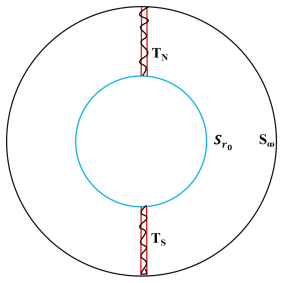
- [§4.3, Eqs. (65)-(66), (78)] The entropy S=(1+l)π(r0^2+n^2) is obtained by demanding that δH_r0 equal TδS, not by evaluating a Noether charge integral on the horizon. The paper itself computes the Wald entropy in Eq. (78) as S_W=π(r0^2+n^2)(1+l/2), which differs from S. The appeals to Horndeski gravity and to the branch-cut divergence of b_r do not amount to an independent derivation of S, and the Wald formula is normally applicable to diffeomorphism-invariant Lagrangians such as (1). Consequently the first law (70) is enforced by the choice of S rather than confirmed by the formalism. The authors should either compute the Noether-charge entropy for the horizon and show it equals (66), or show why S_W is not the entropy in this theory, or explicitly present S as a convention and soften the confirmation claim.
- [§4.3, Eq. (69); Appendix A] The mass M and NUT charge Q_N are assigned as sqrt(1+l)(m+n^2/r0) and n/r0, respectively, based on proportionality with the Einstein-gravity result. This is not a derivation for the NUT-like spacetime: the Noether charge (59)-(60) is not closed for l≠0, since V'+2nU does not vanish, so the generalized Komar extraction used in Eq. (50) cannot be repeated. The planar Noether charge in Appendix A is derived from the scaling symmetry (74), which is specific to the planar ansatz (73), and therefore does not fix the normalization for the metric (24). Since these quantities then enter Eq. (70), the first law is close to circular. The paper should evaluate the covariant phase space charges directly for the NUT-like metric, or state plainly that (69) is a choice of charge convention.
- [§3, Eqs. (11)-(12), (20)-(24)] The solution claim rests on the radial bumblebee field b_r=sqrt(b^2/f0(r)), whose coordinate component diverges as f0(r)^(-1/2) at the horizon. The Einstein equations (13) contain second covariant derivatives of b_μ b_ν, and the paper does not demonstrate that the resulting energy-momentum tensor is regular on the horizon or that the configuration is admissible beyond the formal algebraic field equations. In addition, the bumblebee equation is reduced to b^r R_rr=0 without explicitly checking the remaining components R_{rν} for ν≠r. A regularity analysis in regular coordinates, for example in ingoing coordinates, should be provided before Eq. (24) can be regarded as an established black hole solution of the theory.
- [§5.3, Eqs. (99)-(101)] In extended phase space the volume V and pressure P are introduced so that the residual term in Eq. (99) is exactly VδP. This makes the first law (101) valid by construction under the chosen identifications, and the identification of Λe as pressure is supported by the energy-momentum tensor (89). However, the thermodynamic volume is read off rather than derived from an independent potential, so the extended first law inherits the same convention-dependence as S and M in Sec. 4.3. The authors should state this limitation explicitly when claiming that the first law holds.
minor comments (4)
- [§2 and §4.2] There are typographical errors: 'Hoge dual' should be 'Hodge dual', and 'Stocks theorem' should be 'Stokes' theorem'.
- [Eq. (25)] The coefficient '42l^2+11l^2' in the Kretschmann scalar appears to be a typo; from the surrounding structure it should likely be '42l+11l^2'.
- [Eqs. (69) and (75)] The symbol Q_N is used both for the NUT charge in Eqs. (50) and (69) and for the Noether charge in Eq. (75), which is confusing; one of the two quantities should be renamed.
- [§2, Eq. (1)] The sign conventions in the Lagrangian and the definition κ=8π should be stated more explicitly, since a reader checking the Noether charge expression (41) against Ref. [41] must otherwise reverse-engineer the conventions.
Circularity Check
The thermodynamic first law is assembled from quantities read off the symplectic form, not independently verified; the entropy differs from Wald entropy.
-
fitted input called prediction
[Section 4.3, Eqs. (65)-(66) and (70)]
"δHr0 = 1/2√(1+l)(δr0 + nδn/r0) = TδS. And the temperature T is already known, we can then read off the entropy S S=(1+l)π(r0^2+n^2)."
The entropy is not computed from an independent entropy functional; it is defined as the quantity that makes the horizon symplectic-form variation equal to TδS. With T already fixed, Eq. (65) is an equation for S. The later first law (70) then states δH=0 with M, Φ_N, and S all chosen so that the equality holds identically. The paper itself acknowledges that Wald's entropy formula gives S_W=π(r0^2+n^2)(1+l/2) ≠ S (Eqs. (78)-(79)), so the identification rests on declaring the Wald formula inapplicable rather than on a derivation of S.
-
self definitional
[Section 4.3, Eqs. (61), (67)-(70)]
"ΦN ∝ n, the overall constant will be fixed later. ... δH∞+δHTN−δHTS = δM−ΦNδQN, with ΦN=√(1+l)n/2, QN=n/r0, M=√(1+l)(m+n^2/r0). And the first law is automatically satisfied."
M, Q_N, and Φ_N are assigned so that the evaluated symplectic form at infinity and on the Misner tubes equals δM−Φ_NδQ_N. The overall constant of Φ_N was explicitly left free ('will be fixed later') and is fixed by matching this expression. The NUT-dependent part of M is imported from the Einstein-gravity result via the proportionality (64), not computed directly for the bumblebee theory; the planar Noether charge in the Appendix explains only the √(1+l)m factor, not the n^2/r0 term. Hence the first law is an identity by construction rather than a validated prediction.
1 more flagged steps
-
self citation load bearing
[Section 4.3, Eqs. (78)-(79) and following paragraph]
"The entropy discrepancy may imply that the Wald formula is inapplicable for Einstein-Bumblebee theory. And Einstein-Bumblebee theory is not the only theory where the entropy discrepancy emerges. It is pointed out that the Wald entropy is not suitable in Horndeski gravity theories [42, 44]."
The rejection of the independently computed Wald entropy S_W is load-bearing for the first law, because with S_W the relation (70) fails. The only support offered is an analogy to Horndeski gravity backed by references [42,44], which are prior works by the present author H.S. Liu and collaborators; no independent derivation is given for why the Wald formula fails specifically in Einstein-Bumblebee gravity. This self-citation is used to remove the contradiction between the read-off entropy and the Wald entropy.
full rationale
The metric construction in Section 3 is not circular: the ansatz (10)-(12), the field equations (20), the proportionality assumption f=c h, and the resulting solution (24) are derived from the stated action, and the Kretschmann scalar computation is an independent check. The circularity is confined to the thermodynamic confirmation. In the Wald-based section, the entropy is read off from δH_r0=TδS (Eqs. (65)-(66)) rather than computed from an independent entropy functional; the mass, NUT charge, and NUT potential are assigned so that the symplectic-form expression at infinity equals δM−Φ_NδQ_N (Eqs. (67)-(69)). The first law (70) is therefore 'automatically satisfied' by construction, not verified against an independent standard. The paper itself computes the Wald entropy S_W≠S (Eqs. (78)-(79)) and dismisses it via an analogy to Horndeski theory backed by self-citations [42,44], which is the only support for keeping the read-off S. Thus the central claim that the first law and Smarr relation hold is not independently established; it is built into the definitions. The solution itself may still be new and valid, so the circularity is partial rather than total.
Assumptions & free parameters
assumptions (4)
- domain assumption The bumblebee potential V(B^2 ± b^2) and its derivative V' vanish at the vacuum, leaving the field equation γ/κ b^μ R_{μν} = 0.
- ad hoc to paper The metric functions are assumed proportional, f(r) = c h(r) with constant c, which is later fixed to 1/(1+l).
- ad hoc to paper The NUT charge Q_N is taken as n/r0 and the NUT potential Φ_N is taken proportional to n, with the constant fixed to make the first law hold.
- domain assumption The Wald formalism applies to the horizon even though the bumblebee field diverges there, and the Hamiltonian entropy from δH_r0 is physical.
Cite this review
Pith. "Pith review of Taub-NUT-like Black Holes in Einstein-Bumblebee Gravity." pith.science (2026). https://pith.science/paper/TDHCXYU4
@misc{pith2026250523104,
  author       = {Pith},
  title        = {Pith review of: Taub-NUT-like Black Holes in Einstein-Bumblebee Gravity},
  year         = {2026},
  howpublished = {\url{https://pith.science/paper/TDHCXYU4}},
  note         = {Machine review of arXiv:2505.23104}
}
read the original abstract
We consider Einstein-Bumblebee gravity and construct a novel Taub-NUT-like black hole solution within this theory. Different from the Taub-NUT black hole in Einstein gravity (which is Ricci-flat), our newly constructed Taub-NUT-like black hole is not Ricci-flat. Armed with the Wald formalism, we extensively study the thermodynamics of this black hole solution and confirm that both the first law of thermodynamics and the Smarr relation hold. We then take a further step by adding a cosmological constant to the Einstein-Bumblebee theory, and successfully construct a Taub-NUT-AdS-like black hole. We derive all the thermodynamic quantities, including treating the cosmological constant as a pressure, and confirm that the first law and Smarr relation hold as well.
Figures
Forward citations
Cited by 5 Pith papers
-
Axial Obstructions to Rotating Bumblebee Vacuum Solutions
Rotating constant-norm vector vacua in bumblebee gravity cannot be axis-regular: horizon-pole symmetries force the vector to vanish, and axis-dependent conicity produces a 1/rho curvature divergence.
-
Black holes and neutron stars in massive Hellings-Nordtvedt theory
In massive Hellings-Nordtvedt theory, a nonzero vector vacuum asymptotically forbids both curvature-vector couplings at once, and the A²R sector yields Schwarzschild-like black holes plus neutron stars that can deviat...
-
Signatures of Lorentz violation in bright ring for Sgr A* images by radiation ineffective accretion flows
For a rotating Lorentz-violating black hole, increasing the LV parameter shrinks and broadens Sgr A*'s image ring, and EHT data bound the parameter over a spin-dependent range.
-
Boson Stars in Bumblebee Gravity and Their Gravitational Waveforms from Extreme-Mass-Ratio Inspirals
In bumblebee gravity, the Lorentz-violating parameter ℓ makes mini-boson stars more compact for positive ℓ and produces LISA-detectable, sustained EMRI waveforms for penetrating orbits.
-
Exact Black Hole Solutions in Bumblebee Gravity with Lightlike or Spacelike VEVS
New exact Schwarzschild-like, (A)dS-like, and charged black holes in bumblebee gravity with a two-component vector VEV keep Lorentz-violating corrections even when the VEV is lightlike, with Wald and first-law entropi...
Reference graph
Works this paper leans on
-
[1]
Spontaneous Lorentz violation, Nambu-Goldstone modes, and gravity,
R. Bluhm and V. A. Kostelecky, “Spontaneous Lorentz violation, Nambu-Goldstone modes, and gravity,” Phys. Rev. D71, 065008 (2005) doi:10.1103/PhysRevD.71.065008 [arXiv:hep-th/0412320 [hep-th]]
arXiv 2005
-
[2]
Spontaneous Breaking of Lorentz Symmetry in String Theory,
V. A. Kostelecky and S. Samuel, “Spontaneous Breaking of Lorentz Symmetry in String Theory,” Phys. Rev. D39, 683 (1989) doi:10.1103/PhysRevD.39.683
-
[3]
Gravity, Lorentz violation, and the standard model,
V. A. Kostelecky, “Gravity, Lorentz violation, and the standard model,” Phys. Rev. D 69, 105009 (2004) doi:10.1103/PhysRevD.69.105009 [arXiv:hep-th/0312310 [hep-th]]
arXiv 2004
-
[4]
Exact Schwarzschild- like solution in a bumblebee gravity model,
R. Casana, A. Cavalcante, F. P. Poulis and E. B. Santos, “Exact Schwarzschild- like solution in a bumblebee gravity model,” Phys. Rev. D97, no.10, 104001 (2018) doi:10.1103/PhysRevD.97.104001 [arXiv:1711.02273 [gr-qc]]. 20
arXiv 2018
-
[5]
C. Ding, C. Liu, R. Casana and A. Cavalcante, “Exact Kerr-like solution and its shadow in a gravity model with spontaneous Lorentz symmetry breaking,” Eur. Phys. J. C80, no.3, 178 (2020) doi:10.1140/epjc/s10052-020-7743-y [arXiv:1910.02674 [gr-qc]]
arXiv 2020
-
[6]
Rotating BTZ-like black hole and central charges in Einstein-bumblebee gravity,
C. Ding, Y. Shi, J. Chen, Y. Zhou, C. Liu and Y. Xiao, “Rotating BTZ-like black hole and central charges in Einstein-bumblebee gravity,” Eur. Phys. J. C83, no.7, 573 (2023) doi:10.1140/epjc/s10052-023-11761-y [arXiv:2302.01580 [gr-qc]]
arXiv 2023
-
[7]
Black holes with a cosmological constant in bumble- bee gravity,
R. V. Maluf and J. C. S. Neves, “Black holes with a cosmological constant in bumble- bee gravity,” Phys. Rev. D103, no.4, 044002 (2021) doi:10.1103/PhysRevD.103.044002 [arXiv:2011.12841 [gr-qc]]
arXiv 2021
-
[8]
Static spherical vacuum solutions in the bumblebee grav- ity model,
R. Xu, D. Liang and L. Shao, “Static spherical vacuum solutions in the bumblebee grav- ity model,” Phys. Rev. D107, no.2, 024011 (2023) doi:10.1103/PhysRevD.107.024011 [arXiv:2209.02209 [gr-qc]]
arXiv 2023
Show all 44 references
-
[9]
A Four-Parameter Black-Hole Solution in the Bumblebee Gravity Model,
R. Xu, “A Four-Parameter Black-Hole Solution in the Bumblebee Gravity Model,” doi:10.1142/9789811275388 0036 [arXiv:2301.12666 [gr-qc]]
-
[10]
Polarizations of gravitational waves in the bumblebee gravity model,
D. Liang, R. Xu, X. Lu and L. Shao, “Polarizations of gravitational waves in the bumblebee gravity model,” Phys. Rev. D106, no.12, 124019 (2022) doi:10.1103/PhysRevD.106.124019 [arXiv:2207.14423 [gr-qc]]
2022 arXiv
-
[11]
Extended thermodynamics of the bumblebee black holes,
Z. F. Mai, R. Xu, D. Liang and L. Shao, “Extended thermodynamics of the bumblebee black holes,” Phys. Rev. D108, no.2, 024004 (2023) doi:10.1103/PhysRevD.108.024004 [arXiv:2304.08030 [gr-qc]]
2023 arXiv
-
[12]
Notes on thermodynamics of Schwarzschild-like bumblebee black hole,
Y. S. An, “Notes on thermodynamics of Schwarzschild-like bumblebee black hole,” Phys. Dark Univ.45, 101520 (2024) doi:10.1016/j.dark.2024.101520 [arXiv:2401.15430 [gr-qc]]
2024
-
[13]
QNMs of slowly rotating Einstein–Bumblebee black hole,
W. Liu, X. Fang, J. Jing and J. Wang, “QNMs of slowly rotating Einstein–Bumblebee black hole,” Eur. Phys. J. C83, no.1, 83 (2023) doi:10.1140/epjc/s10052-023-11231-5 [arXiv:2211.03156 [gr-qc]]
2023 arXiv
-
[14]
Lorentz violation induces isospectrality breaking in Einstein-bumblebee gravity theory,
W. Liu, X. Fang, J. Jing and J. Wang, “Lorentz violation induces isospectrality breaking in Einstein-bumblebee gravity theory,” Sci. China Phys. Mech. Astron.67, no.8, 280413 (2024) doi:10.1007/s11433-024-2405-y [arXiv:2402.09686 [gr-qc]]
2024 arXiv
-
[15]
Lorentz violation alleviates gravitationally in- duced entanglement degradation,
W. Liu, C. Wen and J. Wang, “Lorentz violation alleviates gravitationally in- duced entanglement degradation,” JHEP01, 184 (2025) doi:10.1007/JHEP01(2025)184 [arXiv:2410.21681 [gr-qc]]. 21
2025 arXiv
-
[16]
Harvesting correlations from BTZ black hole coupled to a Lorentz-violating vector field,
X. Liu, W. Liu, Z. Liu and J. Wang, “Harvesting correlations from BTZ black hole coupled to a Lorentz-violating vector field,” [arXiv:2503.06404 [gr-qc]]
-
[17]
Empty space-times admitting a three parameter group of motions,
A.H. Taub, “Empty space-times admitting a three parameter group of motions,” Annals Math.53, 472-490 (1951) doi:10.2307/1969567
1951 doi
-
[18]
Empty space generalization of the Schwarzschild metric,
E. Newman, L. Tamburino and T. Unti, “Empty space generalization of the Schwarzschild metric,” J. Math. Phys.4, 915 (1963) doi:10.1063/1.1704018
1963 doi
-
[19]
The flatter regions of Newman, Unti and Tamburino’s generalized Schwarzschild space,
C.W. Misner, “The flatter regions of Newman, Unti and Tamburino’s generalized Schwarzschild space,” J. Math. Phys.4, 924-938 (1963) doi:10.1063/1.1704019
1963 doi
-
[20]
Thermodynamics of Lorentzian Taub-NUT spacetimes,
R. A. Hennigar, D. Kubizˇ n´ ak and R. B. Mann, “Thermodynamics of Lorentzian Taub-NUT spacetimes,” Phys. Rev. D100, no.6, 064055 (2019) doi:10.1103/PhysRevD.100.064055 [arXiv:1903.08668 [hep-th]]
2019 arXiv
-
[21]
Thermodynamical hairs of the four-dimensional Taub-Newman- Unti-Tamburino spacetimes,
S.Q. Wu and D. Wu, “Thermodynamical hairs of the four-dimensional Taub-Newman- Unti-Tamburino spacetimes,” Phys. Rev. D100, no.10, 101501 (2019) doi:10.1103/Phys RevD.100.101501 [arXiv:1909.07776 [hep-th]]
2019 arXiv
-
[22]
Thermodynamics of Taub-NUT and Plebanski solutions,
H. S. Liu, H. Lu and L. Ma, “Thermodynamics of Taub-NUT and Plebanski solutions,” JHEP10, 174 (2022) doi:10.1007/JHEP10(2022)174 [arXiv:2208.05494 [gr-qc]]
2022 arXiv
-
[23]
Thermodynamics of Taub-NUT-AdS spacetimes,
J. F. Liu and H. S. Liu, “Thermodynamics of Taub-NUT-AdS spacetimes,” Eur. Phys. J. C84, no.5, 515 (2024) doi:10.1140/epjc/s10052-024-12826-2 [arXiv:2309.01609 [hep-th]]
2024 arXiv
-
[24]
Taub-NUT black hole in higher deriva- tive gravity and its thermodynamics,
Y. Q. Chen, H. S. Liu and H. Lu, “Taub-NUT black hole in higher deriva- tive gravity and its thermodynamics,” Phys. Rev. D110, no.10, 104068 (2024) doi:10.1103/PhysRevD.110.104068 [arXiv:2409.07692 [gr-qc]]
2024 arXiv
-
[25]
GW170817: Observation of Gravitational Waves from a Binary Neutron Star Inspiral,
B. P. Abbottet al.[LIGO Scientific and Virgo], “GW170817: Observation of Gravitational Waves from a Binary Neutron Star Inspiral,” Phys. Rev. Lett.119, no.16, 161101 (2017) doi:10.1103/PhysRevLett.119.161101 [arXiv:1710.05832 [gr-qc]]
2017 arXiv
-
[26]
Gravita- tional Waves and Gamma-rays from a Binary Neutron Star Merger: GW170817 and GRB 170817A,
B. P. Abbottet al.[LIGO Scientific, Virgo, Fermi-GBM and INTEGRAL], “Gravita- tional Waves and Gamma-rays from a Binary Neutron Star Merger: GW170817 and GRB 170817A,” Astrophys. J. Lett.848, no.2, L13 (2017) doi:10.3847/2041-8213/aa920c [arXiv:1710.05834 [astro-ph.HE]]
2017 arXiv
-
[27]
First M87 Event Horizon Telescope Results. I. The Shadow of the Supermassive Black Hole,
K. Akiyamaet al.[Event Horizon Telescope], “First M87 Event Horizon Telescope Results. I. The Shadow of the Supermassive Black Hole,” Astrophys. J. Lett.875, L1 (2019) doi:10.3847/2041-8213/ab0ec7 [arXiv:1906.11238 [astro-ph.GA]]. 22
2019 arXiv
-
[28]
Akiyamaet al.[Event Horizon Telescope], Astrophys
K. Akiyamaet al.[Event Horizon Telescope], Astrophys. J. Lett.875, no.1, L2 (2019) doi:10.3847/2041-8213/ab0c96 [arXiv:1906.11239 [astro-ph.IM]]
2019 arXiv
-
[29]
First M87 Event Horizon Telescope Re- sults. III. Data Processing and Calibration,
K. Akiyamaet al.[Event Horizon Telescope], “First M87 Event Horizon Telescope Re- sults. III. Data Processing and Calibration,” Astrophys. J. Lett.875, no.1, L3 (2019) doi:10.3847/2041-8213/ab0c57 [arXiv:1906.11240 [astro-ph.GA]]
2019 arXiv
-
[30]
First M87 Event Horizon Telescope Results. IV. Imaging the Central Supermassive Black Hole,
K. Akiyamaet al.[Event Horizon Telescope], “First M87 Event Horizon Telescope Results. IV. Imaging the Central Supermassive Black Hole,” Astrophys. J. Lett.875, no.1, L4 (2019) doi:10.3847/2041-8213/ab0e85 [arXiv:1906.11241 [astro-ph.GA]]
2019 arXiv
-
[31]
First M87 Event Horizon Telescope Results. V. Physical Origin of the Asymmetric Ring,
K. Akiyamaet al.[Event Horizon Telescope], “First M87 Event Horizon Telescope Results. V. Physical Origin of the Asymmetric Ring,” Astrophys. J. Lett.875, no.1, L5 (2019) doi:10.3847/2041-8213/ab0f43 [arXiv:1906.11242 [astro-ph.GA]]
2019 arXiv
-
[32]
First M87 Event Horizon Telescope Results. VI. The Shadow and Mass of the Central Black Hole,
K. Akiyamaet al.[Event Horizon Telescope], “First M87 Event Horizon Telescope Results. VI. The Shadow and Mass of the Central Black Hole,” Astrophys. J. Lett.875, no.1, L6 (2019) doi:10.3847/2041-8213/ab1141 [arXiv:1906.11243 [astro-ph.GA]]
2019 arXiv
-
[33]
Circular orbits in Kerr-Taub-NUT spacetime and their implications for accreting black holes and naked singularities,
C. Chakraborty and S. Bhattacharyya, “Circular orbits in Kerr-Taub-NUT spacetime and their implications for accreting black holes and naked singularities,” JCAP05, 034 (2019) doi:10.1088/1475-7516/2019/05/034 [arXiv:1901.04233 [astro-ph.HE]]
2019 arXiv
-
[34]
Investigating the existence of gravitomagnetic monopole in M87*,
M. Ghasemi-Nodehi, C. Chakraborty, Q. Yu and Y. Lu, “Investigating the existence of gravitomagnetic monopole in M87*,” Eur. Phys. J. C81, no.10, 939 (2021) doi:10.1140/ epjc/s10052-021-09696-3 [arXiv:2109.14903 [astro-ph.HE]]
2021 arXiv
-
[35]
Modelling the Sgr A ∗ and M87∗ shadows by using the Kerr-Taub-NUT metrics in the presence of a scalar field,
k. Jafarzade, M. Ghasemi-Nodehi, F. Sadeghi and B. Mirza, “Modelling the Sgr A ∗ and M87∗ shadows by using the Kerr-Taub-NUT metrics in the presence of a scalar field,” [arXiv:2501.11692 [gr-qc]]
-
[36]
Does the gravitomagnetic monopole exist? A clue from a black hole x-ray binary,
C. Chakraborty and S. Bhattacharyya, “Does the gravitomagnetic monopole exist? A clue from a black hole x-ray binary,” Phys. Rev. D98, no.4, 043021 (2018) doi:10.1103/ PhysRevD.98.043021 [arXiv:1712.01156 [astro-ph.HE]]
2018 arXiv
-
[37]
Primordial black holes having gravitomagnetic monopole,
C. Chakraborty and S. Bhattacharyya, “Primordial black holes having gravitomagnetic monopole,” Phys. Rev. D106, no.10, 103028 (2022) doi:10.1103/PhysRevD.106.103028 [arXiv:2211.03610 [astro-ph.HE]]. 23
2022
-
[38]
Geometric phase in Taub-NUT spacetime,
C. Chakraborty and B. Mukhopadhyay, “Geometric phase in Taub-NUT spacetime,” Eur. Phys. J. C83, no.10, 937 (2023) doi:10.1140/epjc/s10052-023-12070-0 [arXiv:2306.16318 [gr-qc]]
2023 arXiv
-
[39]
Black hole entropy is the Noether charge,
R. M. Wald, “Black hole entropy is the Noether charge,” Phys. Rev. D48, no.8, R3427- R3431 (1993) doi:10.1103/PhysRevD.48.R3427 [arXiv:gr-qc/9307038 [gr-qc]]
1993 arXiv
-
[40]
Some properties of Noether charge and a proposal for dynam- ical black hole entropy,
V. Iyer and R. M. Wald, “Some properties of Noether charge and a proposal for dynam- ical black hole entropy,” Phys. Rev. D50, 846-864 (1994) doi:10.1103/PhysRevD.50.846 [arXiv:gr-qc/9403028 [gr-qc]]
1994 arXiv
-
[41]
Black holes in vector-tensor theories and their thermodynamics,
Z. Y. Fan, “Black holes in vector-tensor theories and their thermodynamics,” Eur. Phys. J. C78, no.1, 65 (2018) doi:10.1140/epjc/s10052-018-5540-7 [arXiv:1709.04392 [hep-th]]
2018 arXiv
-
[42]
Thermodynamics of Charged Black Holes in Einstein-Horndeski-Maxwell Theory,
X. H. Feng, H. S. Liu, H. L¨ u and C. N. Pope, “Thermodynamics of Charged Black Holes in Einstein-Horndeski-Maxwell Theory,” Phys. Rev. D93, no.4, 044030 (2016) doi:10.1103/PhysRevD.93.044030 [arXiv:1512.02659 [hep-th]]
2016 arXiv
-
[43]
Global Scaling Symmetry, Noether Charge and Universality of Shear Viscosity,
H. S. Liu, “Global Scaling Symmetry, Noether Charge and Universality of Shear Viscosity,” Phys. Rev. D93, no.10, 106001 (2016) doi:10.1103/PhysRevD.93.106001 [arXiv:1601.07875 [hep-th]]
2016 arXiv
-
[44]
Black Hole Entropy and Viscos- ity Bound in Horndeski Gravity,
X. H. Feng, H. S. Liu, H. L¨ u and C. N. Pope, “Black Hole Entropy and Viscos- ity Bound in Horndeski Gravity,” JHEP11, 176 (2015) doi:10.1007/JHEP11(2015)176 [arXiv:1509.07142 [hep-th]]. 24
2015 arXiv
Reviewed August 7, 2026 · model on record in the stance chip above.
Discussion (0). Sign in to comment.