REVIEW 4 major objections 5 minor 58 references
The Narrow Formation Pathway of Hot Saturns: Constraints on Initial Planetary Properties
T0 review · 4 major / 5 minor · reviewed 2026-08-07 · deepseek-v4-flash
Pith's one-line read This paper claims the hot Saturn desert is the fossil of a narrow formation window: planets must start below 0.5 Jupiter masses, with cores above 30% and dim intrinsic luminosity, then lose most of their envelope.
desk verdict A clearly written grid study that maps the hot Saturn desert back to a narrow initial-condition window, but the headline Lp threshold is contradicted by its own M-dwarf run and the quantitative boundaries are conditional on the evaporation model. read the letter →
The pith
A machine-rendered reading of the paper's core claim, the machinery that carries it, and where it could break.
The reading
What carries the argument
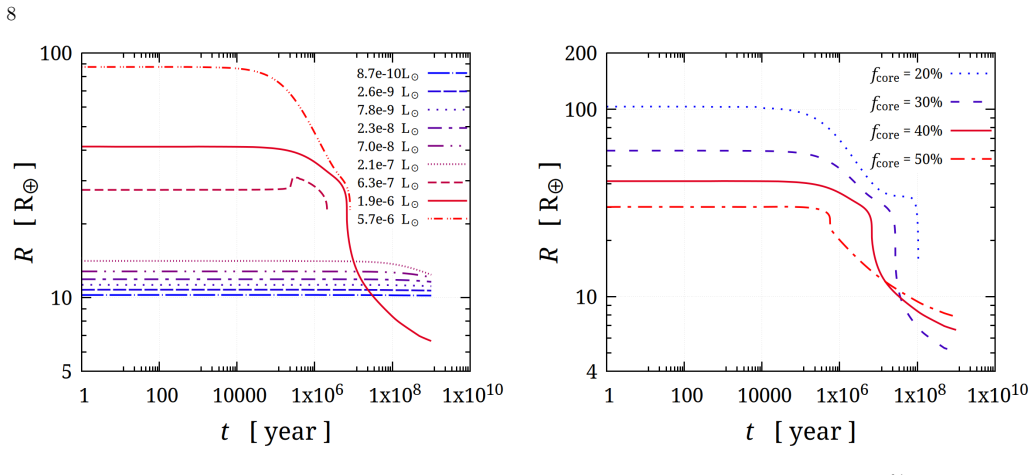
The machinery is a one-dimensional two-layer planet model, a fixed solid core with a hydrogen-helium envelope, whose radiative-convective structure is solved under stellar irradiation using a semi-grey analytic temperature profile, coupled to a hydrodynamic escape prescription. Escape switches between an X-ray-driven energy-limited regime and an EUV-driven regime that is either recombination-limited or energy-limited depending on the incident flux, and the mass-loss rates include a Roche-lobe correction for close-in planets. The model is run across a four-dimensional grid of 10,000 combinations of mass, semi-major axis, core mass fraction, and intrinsic luminosity around a solar-type star and again around an M1 dwarf; the load-bearing output is the narrow slice of that grid that lands in the desert after 1 Gyr.
What would settle it
Find a single well-characterized hot Saturn in the desert whose measured mass and radius require a final core mass fraction well below about 75%; the paper's claim that all desert occupants are envelope-stripped remnants would then be wrong.
Extended reading notes
Core claim
On the paper's own terms, the hot Saturn desert is an evaporation-sculpted graveyard, not an empty accident. The central discovery is that the boundary of the desert in the $a$--$R$ diagram selects a narrow band of initial conditions: immediately after the gas disk dissipates, a planet destined to be a hot Saturn must have total mass less than $0.5\,M_{\rm Jup}$ for solar-type hosts (less than $0.4\,M_{\rm Jup}$ for M dwarfs), a core mass fraction of at least 30%, an intrinsic luminosity around $10^{-6}\,L_\odot$ or below, and a semi-major axis within roughly 0.035 AU. These planets then lose 80--90% of their gaseous envelope over a billion years, ending with final core mass fractions above 75% and radii between 6 and 8.5 Earth radii. The paper reads the rarity of such survivors as evidence that these initial states are difficult to form under the core-accretion scenario, and predicts that observed hot Saturns such as TOI-1194 b should be envelope-stripped, core-dominated objects.
Load-bearing premise
The results hinge on the atmospheric evaporation model's mass-loss rates being close to right; if the heating efficiency or the adopted stellar X-ray/EUV evolution is materially different, the derived mass, core-fraction, and luminosity thresholds shift.
Editorial extensions
If this is right
- Any hot Saturn found in the desert should be an evaporation remnant with a final core mass fraction above roughly 75%, so bulk-density measurements of objects like TOI-1194 b are a direct test.
- Around M dwarfs the desert window shifts to initial masses of $0.3$--$0.4\,M_{\rm Jup}$, so surveys around M dwarfs should find rarer or lighter hot Saturns than around Sun-like stars.
- The observed boundary of the hot Saturn desert can be read as a population-level fingerprint of atmospheric evaporation strength on close-in giant planets.
- Planets that start above $0.5\,M_{\rm Jup}$ or with core mass fractions below 30% do not land in the desert; they become hot Jupiters or bare rocky cores instead.
- The narrow initial-luminosity window excludes formation pathways that leave a giant planet hot, with high entropy and luminosity above a few $10^{-6}\,L_\odot$, when the gas disk dissipates.
Reading between the lines
- The exact numerical thresholds are model-dependent: the paper states that changing the escape efficiency shifts the derived initial parameters, so the robust conclusion is the qualitative corridor of low mass, big core, and dim start rather than the specific numbers.
- The same backward approach could be applied to the sub-Neptune evaporation valley to place joint constraints on giant-planet heating efficiencies and stellar X-ray/EUV histories.
- If high-eccentricity migration also contributes to the sub-Jovian desert, the two pathways could be separated by orbital properties: evaporation remnants should be circularized and spin-aligned, while dynamically scattered hot Saturns need not be.
- Because the paper's structure model under-predicts hot-Jupiter radii, real desert occupants may have radii larger than $8.5\,R_\oplus$; surveys should target inflated radii as well as the nominal desert box.
Editorial analysis
A structured set of objections, weighed in public.
Referee Report
Summary. The manuscript uses a four-dimensional grid of 10,000 synthetic short-period gas giants around solar-type stars and another 10,000 around an M1-type star, evolving them for 1 Gyr with a two-layer planetary structure model and an X-ray/EUV-driven atmospheric evaporation model. It identifies 11 hot Saturn analogues around solar-type stars and 5 around M dwarfs, defined as final radii between 6 and 8.5 Earth radii at semimajor axes below 0.04 AU. From these survivors the authors derive initial conditions after disk dissipation: sub-Jovian initial mass at or below 0.5 Jupiter masses, core mass fraction at or above 30%, and initial intrinsic luminosity near or below 1e-6 solar luminosities. They interpret these initial conditions as unfavorable within the core-accretion scenario and therefore as an explanation of the hot Saturn desert.
Significance. If the derived initial-property windows are robust, the paper provides a useful, falsifiable connection between late-time exoplanet demographics and post-formation initial conditions, and it makes a concrete prediction that desert objects such as TOI-1194 b should have substantial core mass fractions. The study's design has clear strengths: the survival criteria are not fitted to the observed desert; the simulations are forward evolutions over a systematic grid; and the authors explicitly test a second stellar type and discuss limitations of their evaporation and radius models. However, the quantitative 'narrow pathway' is currently conditional on fixed evaporation efficiencies and on a coarse grid, so the headline constraints are not yet demonstrated to be robust.
major comments (4)
- [Section 4 and Section 2.3] The central quantitative claim depends on the fixed evaporation strengths encoded in the energy-limited mass-loss rates of Eqs. (4) and (7), with heating efficiencies epsilon_X = 0.1-0.25 and epsilon_EUV = 0.3. Section 4 explicitly states that choosing an alternative epsilon will result in different derived initial parameters that can form hot Saturn analogues, and the M-dwarf grid in Table 3 already demonstrates that the allowed L_p window shifts with the adopted stellar flux history. Because the paper does not vary epsilon or the stellar XUV tracks, the claimed 'narrow formation pathway' has not been shown to be narrower than the model uncertainty; the cited robustness argument from Jin et al. (2014) concerns final evolutionary outcomes generally, not the precise location of the hot-Saturn analogue window. The authors should either run a sensitivity study or explicitly reframe the headline numbers as conditional on the adopted evaporation model.
- [Table 3 and Abstract] The abstract and Section 4 state that hot Saturn analogues have initial L_p on the order of 1e-6 L_sun or less, but the M-dwarf grid in Table 3 includes hot Saturn analogues with initial L_p = 1.7e-5 L_sun (index 02) and a range extending to that value, with initial masses only 0.3-0.4 M_Jup. The statement in Section 4 that the mass threshold is 'less than 0.5 or 0.4 M_Jup' is also ambiguous when the solar-type grid has a clear 0.5 M_Jup boundary and the M-dwarf grid has a 0.4 M_Jup boundary. This internal inconsistency should be resolved by presenting stellar-type-dependent ranges or by restricting the summary claims to the solar-type case.
- [Table 1 and Section 3.1] The grid spacing in L_p is a factor of roughly 3 between adjacent values (e.g., 6.3e-7, 1.9e-6, and 5.7e-6 L_sun), and each grid dimension has only 10 values. The solar-type grid produces 11 hot Saturn analogues out of 10,000 planets, and the M-dwarf grid produces only 5, so the inferred 'narrow window' is represented by one or two grid points per dimension. The paper does not test whether adjacent unexplored parameter values would also produce hot Saturn analogues, nor does it estimate how the identified boundaries move with grid resolution. Without a convergence test or a finer sub-grid around the surviving parameter values, the narrowness of the formation pathway may be an artifact of the discrete grid rather than a physical property.
- [Section 3.2 and Section 4] The hot Saturn analogue selection depends on the model's final radius window of 6-8.5 Earth radii, but Section 4 acknowledges that the planetary structure model underestimates radii of short-period giants and that the real desert would lie at slightly larger radii. Because the mass-loss rate and the Roche-lobe correction depend on the computed radius, this radius offset could change which initial conditions produce survivors in the selected desert window. The paper's argument that the derived initial parameters are insensitive to this shortcoming is plausible but not quantified; a test with an inflated-radius prescription would make the central claim more secure.
minor comments (5)
- [Section 3.2] The text twice says the reference planet is located at '0.3 AU', but Table 2 and the surrounding analysis clearly indicate 0.03 AU; this should be corrected.
- [Section 3.3] The same '0.3 AU' typo appears again when the comparison planets are described as being at 0.3 AU, whereas the table and the definition of the hot Saturn desert region use 0.03 AU.
- [Section 4] The discussion says the initial f_core of hot Saturn analogues is 'between 30% and 50%', but the grid maximum is 50% and the solar-type analogues include f_core = 30%, 40%, and 50%; this may simply reflect the grid boundaries, but the text should state that the range is an upper-truncated grid range rather than a physical upper bound.
- [Section 2.3] The paper states that epsilon_X is 'in the range of 0.1-0.25' but does not state which single value is used in the simulations; specifying the exact adopted value would aid reproducibility.
- [Section 3.4] For M-dwarf X-ray fluxes, the manuscript applies 'wavelength-dependent flux proportions from Ribas et al. (2005)' to convert Engle (2024) data, which is a model-dependent bandpass correction; a sentence explaining the uncertainty introduced by this conversion would be appropriate.
Circularity Check
No circular derivation; the initial-property windows emerge from a forward evolution grid, with model dependence openly disclosed.
full rationale
The paper's logic is forward rather than circular: it draws a fixed four-dimensional grid of initial Mp, Lp, fcore, and a (Table 1), integrates the same thermal-evolution/evaporation model forward for 1 Gyr, and then reads off which initial states land in the chosen 6-8.5 Earth-radius desert box. Nothing is fitted to the observed hot Saturn desert: no model parameter is adjusted to make analogues appear, and the survival window (Mp below 0.5 Jupiter masses, fcore above 30%, and Lp around 1e-6 solar luminosity or less) is an emergent subset of the grid, not an input. The definitional statement that 'hot Saturn analogues' are synthetic planets with radii 6-8.5 Re is a label, and the paper explicitly notes that the true observed desert would sit at a slightly larger radius because its structure model under-predicts inflated radii; this weakens the observational mapping but does not make the derivation circular. The evaporation model is taken from the authors' earlier Jin et al. (2014) and Jin & Mordasini (2018), but those are published, independently described tools, with equations from Murray-Clay et al. (2009) and Owen & Jackson (2012) restated in Section 2.3, not a restatement of the present conclusion. The admitted sensitivity of the derived windows to the fixed escape efficiency (Section 4: 'Choosing an alternative value for the parameter epsilon will result in different derived initial parameters that can form hot Saturn analogues') is honest model dependence, not circularity: varying epsilon changes the forward physics, but the prediction is still computed, never fitted to the desert. No circular step can be exhibited from the text, so the appropriate score is low.
Assumptions & free parameters
free parameters (5)
- X-ray heating efficiency epsilon_X =
0.1-0.25
- EUV heating efficiency epsilon_EUV =
0.3
- Atmosphere/envelope boundary in optical depth =
tau = 100/(sqrt(3) gamma), roughly 10 bar
- Initial luminosity grid spacing =
10 discrete values from 8.7e-10 to 1.7e-5 L_sun, factor-of-3 steps
- Hot Saturn analogue radius window =
6-8.5 R_earth
assumptions (8)
- standard math The H/He envelope is spherically symmetric and in hydrostatic equilibrium.
- domain assumption The semi-grey atmosphere model of Guillot (2010) with the given temperature profile (Eq. 1) correctly describes the irradiated atmosphere.
- domain assumption The core mass remains fixed and follows a fixed composition template (5.1% ice, rest Earth-like silicate and iron).
- domain assumption Atmospheric mass-loss rates are given by the X-ray/EUV energy-limited and radiation-recombination-limited formulas.
- domain assumption Stellar X-ray and EUV evolution for solar-type stars follows Ribas et al. 2005; for M-dwarfs, Engle 2024 and Lecavelier Des Etangs 2007.
- domain assumption Planets have ceased orbital migration and mass accretion at the start of evolution (post-disk dissipation).
- domain assumption The observed hot Saturn desert is a genuine scarcity, not a selection effect, and the a-R desert boundaries are as plotted.
- domain assumption 1 Gyr is a representative evolution timescale for comparing with the observed population.
Cite this review
Pith. "Pith review of The Narrow Formation Pathway of Hot Saturns: Constraints on Initial Planetary Properties." pith.science (2026). https://pith.science/paper/TZ6OU3LG
@misc{pith2026250523148,
  author       = {Pith},
  title        = {Pith review of: The Narrow Formation Pathway of Hot Saturns: Constraints on Initial Planetary Properties},
  year         = {2026},
  howpublished = {\url{https://pith.science/paper/TZ6OU3LG}},
  note         = {Machine review of arXiv:2505.23148}
}
abstract
The observed exoplanet population exhibits a scarcity of short-period Saturn-mass planets, a phenomenon referred to as the ``hot Saturn desert". This observational scarcity can be utilized to validate the theories regarding the formation and evolution of gas planets. In this study, we conduct large-scale numerical simulations to explore how the initial conditions of gas planets orbiting solar-type and M-dwarf stars influence their evolutionary trajectories in the semi-major axis versus planetary radius ($a$-$R$) parameter space. We generate a synthetic population of 10,000 short-period gaseous planets by systematically varying their initial planetary masses ($M_{\rm p}$), initial planetary luminosities ($L_{\rm p}$), initial core mass fractions ($f_{\rm core}$), and semi-major axis ($a$). Furthermore, we assume these gaseous planets have ceased orbital migration and model their long-term thermal evolution, taking into account the impacts of atmospheric evaporation. Our results show that the initial mass, $L_{\rm p}$, and $f_{\rm core}$ are the dominant factors controlling radius evolution for short-period gas planets. The key to survival as a hot Saturn analogue appears to be having just the right combination of properties after gas disk dissipation: an $M_{\rm p}$ below 0.5 Jupiter Mass ($M_{\rm Jup}$), a substantial $f_{\rm core}$ of $\geq$ 30%, and relatively low $L_{\rm p}$ on the order of $10^{-6}$ solar luminosity ($L_{\odot}$) or less. The survival criteria for hot Saturn analogs align with theoretically unfavorable initial conditions of gas planets formed via core accretion scenario, naturally explaining the observed boundaries of the hot Saturn desert.
Figures


Reference graph
Works this paper leans on
-
[1]
, " * write output.state after.block = add.period write newline
ENTRY address archivePrefix author booktitle chapter doi edition editor eprint howpublished institution journal key month number organization pages publisher school series title misctitle type volume year version url label extra.label sort.label short.list INTEGERS output.state before.all mid.sentence after.sentence after.block FUNCTION init.state.consts ...
-
[2]
write newline
" write newline "" before.all 'output.state := FUNCTION format.url url empty "" new.block "" url * "" * if FUNCTION format.eprint eprint empty "" archivePrefix empty "" archivePrefix "arXiv" = new.block " " eprint * " " * new.block " " eprint * " " * if if if FUNCTION format.doi doi empty "" " " doi * " " * if FUNCTION format.pid doi empty eprint empty ur...
-
[3]
00",editor=
thebibliography [1] 20pt to REFERENCES 6pt =0pt -12pt 10pt plus 3pt =0pt =0pt =1pt plus 1pt =0pt =0pt -12pt =13pt plus 1pt =20pt =13pt plus 1pt \@M =10000 =-1.0em =0pt =0pt 0pt =0pt =1.0em @enumiv\@empty 10000 10000 `\.\@m \@noitemerr \@latex@warning Empty `thebibliography' environment \@ifnextchar \@reference \@latexerr Missing key on reference command E...
2021
-
[4]
doi:10.1051/0004-6361:20040129
Baraffe, I., Selsis, F., Chabrier, G., et al.\ 2004, , The effect of evaporation on the evolution of close-in giant planets, 419, L13. doi:10.1051/0004-6361:20040129
-
[5]
Bell, K. R. & Lin, D. N. C.\ 1994, , Using FU Orionis Outbursts to Constrain Self-regulated Protostellar Disk Models, 427, 987. doi:10.1086/174206
doi:10.1086/174206 1994
-
[6]
Chen, H. & Rogers, L. A.\ 2016, , Evolutionary Analysis of Gaseous Sub-Neptune-mass Planets with MESA, 831, 2, 180. doi:10.3847/0004-637X/831/2/180
-
[7]
Dalgarno, A. & McCray, R. A.\ 1972, , Heating and Ionization of HI Regions, 10, 375. doi:10.1146/annurev.aa.10.090172.002111
arXiv 1972
-
[8]
Engle, S. G.\ 2024, , Living with a Red Dwarf: X-Ray, UV, and Ca II Activity-Age Relationships of M Dwarfs, 960, 1, 62. doi:10.3847/1538-4357/ad0840
Show all 58 references
-
[9]
V., Kulikov, Y
Erkaev, N. V., Kulikov, Y. N., Lammer, H., et al.\ 2007, , Roche lobe effects on the atmospheric loss from ``Hot Jupiters'', 472, 1, 329. doi:10.1051/0004-6361:20066929
2007 doi
-
[10]
S., Marley, M
Freedman, R. S., Marley, M. S., & Lodders, K.\ 2008, , Line and Mean Opacities for Ultracool Dwarfs and Extrasolar Planets, 174, 2, 504. doi:10.1086/521793
2008 doi
-
[11]
& Showman, A
Guillot, T. & Showman, A. P.\ 2002, , Evolution of ``51 Pegasus b-like'' planets, 385, 156. doi:10.1051/0004-6361:20011624
2002 doi
-
[12]
doi:10.1051/0004-6361/200913396
Guillot, T.\ 2010, , On the radiative equilibrium of irradiated planetary atmospheres, 520, A27. doi:10.1051/0004-6361/200913396
2010 doi
-
[13]
H.\ 2024, Nature Astronomy, Characterization of the regimes of hydrodynamic escape from low-mass exoplanets, 8, 920
Guo, J. H.\ 2024, Nature Astronomy, Characterization of the regimes of hydrodynamic escape from low-mass exoplanets, 8, 920. doi:10.1038/s41550-024-02269-w
2024 doi
-
[14]
\ 2024, , Hot Jupiters from Disruption of Resonant Chains in Postdisk Evolution, 530, 4, 3934
He, Y., Wu, D.-H., & Jin, S. \ 2024, , Hot Jupiters from Disruption of Resonant Chains in Postdisk Evolution, 530, 4, 3934. doi:10.1093/mnras/stae1076
2024 doi
-
[15]
& Lin, D
Ida, S. & Lin, D. N. C.\ 2004, , Toward a Deterministic Model of Planetary Formation. I. A Desert in the Mass and Semimajor Axis Distributions of Extrasolar Planets, 604, 1, 388. doi:10.1086/381724
2004 doi
-
[16]
& Lin, D
Ida, S. & Lin, D. N. C.\ 2005, , Toward a Deterministic Model of Planetary Formation. III. Mass Distribution of Short-Period Planets around Stars of Various Masses, 626, 2, 1045. doi:10.1086/429953
2005 doi
-
[18]
doi:10.1111/j.1365-2966.2010.17012.x
Jackson, B., Miller, N., Barnes, R., et al.\ 2010, , The roles of tidal evolution and evaporative mass loss in the origin of CoRoT-7 b, 407, 2, 910. doi:10.1111/j.1365-2966.2010.17012.x
2010
-
[19]
doi:10.1007/s10569-016-9704-1
Jackson, B., Jensen, E., Peacock, S., et al.\ 2016, Celestial Mechanics and Dynamical Astronomy, Tidal decay and stable Roche-lobe overflow of short-period gaseous exoplanets, 126, 1-3, 227. doi:10.1007/s10569-016-9704-1
2016 doi
-
[20]
doi:10.3847/1538-4357/835/2/145
Jackson, B., Arras, P., Penev, K., et al.\ 2017, , A New Model of Roche Lobe Overflow for Short-period Gaseous Planets and Binary Stars, 835, 2, 145. doi:10.3847/1538-4357/835/2/145
2017 doi
-
[21]
doi:10.1088/0004-637X/795/1/65
Jin, S., Mordasini, C., Parmentier, V., et al.\ 2014, , Planetary Population Synthesis Coupled with Atmospheric Escape: A Statistical View of Evaporation, 795, 1, 65. doi:10.1088/0004-637X/795/1/65
2014 doi
-
[22]
Jin, S. & Mordasini, C.\ 2018, , Compositional Imprints in Density-Distance-Time: A Rocky Composition for Close-in Low-mass Exoplanets from the Location of the Valley of Evaporation, 853, 2, 163. doi:10.3847/1538-4357/aa9f1e
2018 doi
-
[23]
doi:10.3847/1538-3881/ada945
Jin, S., Wu, D.-H., Cao, Y.-X., et al.\ 2025, , The Heating Efficiency of Hot Jupiters from a Data-driven Perspective, 169, 3, 132. doi:10.3847/1538-3881/ada945
2025 doi
-
[24]
& Poppenhaeger, K.\ 2023, , The influence of host star activity evolution on the population of super-Earths and mini-Neptunes, 518, 2, 1683
Ketzer, L. & Poppenhaeger, K.\ 2023, , The influence of host star activity evolution on the population of super-Earths and mini-Neptunes, 518, 2, 1683. doi:10.1093/mnras/stac2643
2023 doi
-
[25]
doi:10.1093/mnras/stad3197
Ketzer, L., Poppenhaeger, K., Baratella, M., et al.\ 2024, , Three young planets around the K-dwarf K2-198: high-energy environment, evaporation history, and expected future, 527, 1, 374. doi:10.1093/mnras/stad3197
2024 doi
-
[26]
J., et al.\ 2019, , The Kepler-11 system: evolution of the stellar high-energy emission and initial planetary atmospheric mass fractions, 632, A65
Kubyshkina, D., Fossati, L., Mustill, A. J., et al.\ 2019, , The Kepler-11 system: evolution of the stellar high-energy emission and initial planetary atmospheric mass fractions, 632, A65. doi:10.1051/0004-6361/201936581
2019 doi
-
[27]
A., Fossati, L., et al.\ 2020, , Coupling thermal evolution of planets and hydrodynamic atmospheric escape in MESA, 499, 1, 77
Kubyshkina, D., Vidotto, A. A., Fossati, L., et al.\ 2020, , Coupling thermal evolution of planets and hydrodynamic atmospheric escape in MESA, 499, 1, 77. doi:10.1093/mnras/staa2815
2020 doi
-
[28]
& Vidotto, A
Kubyshkina, D. & Vidotto, A. A.\ 2021, , How does the mass and activity history of the host star affect the population of low-mass planets?, 504, 2, 2034. doi:10.1093/mnras/stab897
2021 doi
-
[29]
A., Villarreal D'Angelo, C., et al.\ 2022, , Atmospheric mass loss and stellar wind effects in young and old systems - II
Kubyshkina, D., Vidotto, A. A., Villarreal D'Angelo, C., et al.\ 2022, , Atmospheric mass loss and stellar wind effects in young and old systems - II. Is TOI-942 the past of TOI-421 system?, 510, 2, 3039. doi:10.1093/mnras/stab3620
2022 doi
-
[30]
doi:10.1086/380815
Lammer, H., Selsis, F., Ribas, I., et al.\ 2003, , Atmospheric Loss of Exoplanets Resulting from Stellar X-Ray and Extreme-Ultraviolet Heating, 598, 2, L121. doi:10.1086/380815
2003 doi
-
[31]
doi:10.1051/0004-6361/200911922
Lammer, H., Odert, P., Leitzinger, M., et al.\ 2009, , Determining the mass loss limit for close-in exoplanets: what can we learn from transit observations?, 506, 1, 399. doi:10.1051/0004-6361/200911922
2009 doi
-
[32]
doi:10.1051/0004-6361:20065014
Lecavelier Des Etangs, A.\ 2007, , A diagram to determine the evaporation status of extrasolar planets, 461, 3, 1185. doi:10.1051/0004-6361:20065014
2007 doi
-
[33]
Lin, D. N. C., Bodenheimer, P., & Richardson, D. C.\ 1996, , Orbital migration of the planetary companion of 51 Pegasi to its present location, 380, 6575, 606. doi:10.1038/380606a0
1996 doi
-
[34]
& Ji, J.\ 2020, Research in Astronomy and Astrophysics, A tale of planet formation: from dust to planets, 20, 10, 164
Liu, B. & Ji, J.\ 2020, Research in Astronomy and Astrophysics, A tale of planet formation: from dust to planets, 20, 10, 164. doi:10.1088/1674-4527/20/10/164
2020 doi
-
[35]
D., Fortney, J
Lopez, E. D., Fortney, J. J., & Miller, N.\ 2012, , How Thermal Evolution and Mass-loss Sculpt Populations of Super-Earths and Sub-Neptunes: Application to the Kepler-11 System and Beyond, 761, 1, 59. doi:10.1088/0004-637X/761/1/59
2012 doi
-
[36]
doi:10.1089/ast.2014.1215
Luger, R., Barnes, R., Lopez, E., et al.\ 2015, Astrobiology, Habitable Evaporated Cores: Transforming Mini-Neptunes into Super-Earths in the Habitable Zones of M Dwarfs, 15, 1, 57. doi:10.1089/ast.2014.1215
2015
-
[37]
& Cumming, A.\ 2014, , Constraining the initial entropy of directly detected exoplanets, 437, 2, 1378
Marleau, G.-D. & Cumming, A.\ 2014, , Constraining the initial entropy of directly detected exoplanets, 437, 2, 1378. doi:10.1093/mnras/stt1967
2014 doi
-
[38]
& K \"o nigl, A.\ 2016, , On the Origin of the Sub-Jovian Desert in the Orbital-period-Planetary-mass Plane, 820, 1, L8
Matsakos, T. & K \"o nigl, A.\ 2016, , On the Origin of the Sub-Jovian Desert in the Orbital-period-Planetary-mass Plane, 820, 1, L8. doi:10.3847/2041-8205/820/1/L8
2016 doi
-
[39]
Mordasini, C., Alibert, Y., Klahr, H., et al.\ 2012 a , , Characterization of exoplanets from their formation. I. Models of combined planet formation and evolution, 547, A111. doi:10.1051/0004-6361/201118457
2012 doi
-
[40]
Mordasini, C., Alibert, Y., Georgy, C., et al.\ 2012 b , , Characterization of exoplanets from their formation. II. The planetary mass-radius relationship, 547, A112. doi:10.1051/0004-6361/201118464
2012 doi
-
[41]
A., Chiang, E
Murray-Clay, R. A., Chiang, E. I., & Murray, N.\ 2009, , Atmospheric Escape From Hot Jupiters, 693, 1, 23. doi:10.1088/0004-637X/693/1/23
2009 doi
-
[42]
Owen, J. E. & Jackson, A. P.\ 2012, , Planetary evaporation by UV & X-ray radiation: basic hydrodynamics, 425, 4, 2931. doi:10.1111/j.1365-2966.2012.21481.x
2012
-
[43]
Owen, J. E. & Wu, Y.\ 2013, , Kepler Planets: A Tale of Evaporation, 775, 2, 105. doi:10.1088/0004-637X/775/2/105
2013 doi
-
[44]
Owen, J. E. & Alvarez, M. A.\ 2016, , UV Driven Evaporation of Close-in Planets: Energy-limited, Recombination-limited, and Photon-limited Flows, 816, 1, 34. doi:10.3847/0004-637X/816/1/34
2016 doi
-
[45]
Owen, J. E. & Lai, D.\ 2018, , Photoevaporation and high-eccentricity migration created the sub-Jovian desert, 479, 4, 5012. doi:10.1093/mnras/sty1760
2018 doi
-
[46]
B., Hubickyj, O., Bodenheimer, P., et al.\ 1996, , Formation of the Giant Planets by Concurrent Accretion of Solids and Gas, 124, 1, 62
Pollack, J. B., Hubickyj, O., Bodenheimer, P., et al.\ 1996, , Formation of the Giant Planets by Concurrent Accretion of Solids and Gas, 124, 1, 62. doi:10.1006/icar.1996.0190
1996
-
[47]
F., G \"u del, M., et al.\ 2005, , Evolution of the Solar Activity over Time and Effects on Planetary Atmospheres
Ribas, I., Guinan, E. F., G \"u del, M., et al.\ 2005, , Evolution of the Solar Activity over Time and Effects on Planetary Atmospheres. I. High-Energy Irradiances (1-1700 A ), 622, 1, 680. doi:10.1086/427977
2005 doi
-
[48]
A., Bodenheimer, P., Lissauer, J
Rogers, L. A., Bodenheimer, P., Lissauer, J. J., et al.\ 2011, , Formation and Structure of Low-density exo-Neptunes, 738, 1, 59. doi:10.1088/0004-637X/738/1/59
2011 doi
-
[49]
M.\ 1995, , An Equation of State for Low-Mass Stars and Giant Planets, 99, 713
Saumon, D., Chabrier, G., & van Horn, H. M.\ 1995, , An Equation of State for Low-Mass Stars and Giant Planets, 99, 713. doi:10.1086/192204
1995 doi
-
[50]
doi:10.1051/0004-6361/201731454
Sestovic, M., Demory, B.-O., & Queloz, D.\ 2018, , Investigating hot-Jupiter inflated radii with hierarchical Bayesian modelling, 616, A76. doi:10.1051/0004-6361/201731454
2018 doi
-
[51]
B., Pavlov, A
Tian, F., Toon, O. B., Pavlov, A. A., et al.\ 2005, , Transonic Hydrodynamic Escape of Hydrogen from Extrasolar Planetary Atmospheres, 621, 2, 1049. doi:10.1086/427204
2005 doi
-
[52]
The case of CoRoT-7b, 516, A20
Valencia, D., Ikoma, M., Guillot, T., et al.\ 2010, , Composition and fate of short-period super-Earths. The case of CoRoT-7b, 516, A20. doi:10.1051/0004-6361/200912839
2010 doi
-
[53]
doi:10.1088/1674-4527/ad057b
Wang, J.-Q., Jiang, X.-J., Zheng, J., et al.\ 2024, Research in Astronomy and Astrophysics, Confirmation of a Sub-Saturn-size Transiting Exoplanet Orbiting a G Dwarf: TOI-1194 b and a Very Low Mass Companion Star: TOI-1251 B from TESS, 24, 3, 035012. doi:10.1088/1674-4527/ad057b
2024 doi
-
[54]
J., Donahue, T
Watson, A. J., Donahue, T. M., & Walker, J. C. G.\ 1981, , The dynamics of a rapidly escaping atmosphere: Applications to the evolution of Earth and Venus, 48, 2, 150. doi:10.1016/0019-1035(81)90101-9
1981 doi
-
[55]
& Kelley, C.\ 2022, Gnuplot 5.4: an interactive plotting program
Williams, T. & Kelley, C.\ 2022, Gnuplot 5.4: an interactive plotting program. http://www.gnuplot.info
2022
-
[56]
Wu, D.-H. & He, Y. \ 2023, , Hot Jupiters from Disruption of Resonant Chains in Postdisk Evolution, 166, 6, 267. doi:10.3847/1538-3881/ad09b0
2023 doi
-
[57]
V.\ 2004, , Aeronomy of extra-solar giant planets at small orbital distances, 170, 1, 167
Yelle, R. V.\ 2004, , Aeronomy of extra-solar giant planets at small orbital distances, 170, 1, 167. doi:10.1016/j.icarus.2004.02.008
2004 doi
-
[58]
& Dong, S.\ 2021, , Exoplanet Statistics and Theoretical Implications, 59, 291
Zhu, W. & Dong, S.\ 2021, , Exoplanet Statistics and Theoretical Implications, 59, 291. doi:10.1146/annurev-astro-112420-020055
2021 doi
-
[59]
\@endnotelabel
#2 \@endnotetext#1 @relax \@bibdataout @FOOTNOTE \@endnotelabel, key="\@endnotelabel", note="#1" \@bibdataout @relax \( \) \\ \@unexpandable@protect `\^^M @documenthook \@bibdataout@init \@bibdataout@init \@bibdataout @bibdata. @ext \@bibdataout@rev \@bibdataout @CONTROL REVTE...
2010
Reviewed August 7, 2026 · model on record in the stance chip above.
Discussion (0). Sign in to comment.