REVIEW 2 major objections 4 minor 51 references
FSL-SAGE: Accelerating Federated Split Learning via Smashed Activation Gradient Estimation
T0 review · 2 major / 4 minor · reviewed 2026-08-07 · deepseek-v4-flash
Pith's one-line read FSL-SAGE claims that federated split learning can match FedAvg's O(1/√T) convergence rate while cutting communication and client memory.
desk verdict A genuinely useful method with an overclaimed O(1/sqrt(T)) rate; the dropped auxiliary approximation term and an incomplete server-side proof are fixable but require a revision. read the letter →
The pith
A machine-rendered reading of the paper's core claim, the machinery that carries it, and where it could break.
The reading
What carries the argument
The central object is the auxiliary model $x_{a,i}$ at each client, a small network that outputs an estimated backward-pass gradient $\hat{z}_{i,b}(x_{a,i}; z_{i,f}, y_i)$ for the cut-layer features $z_{i,f}$ (the smashed activations). Every $l$ rounds the S-server refits each client's auxiliary model on stored smashed activations by minimizing the squared $\ell^2$ error between the auxiliary estimate and the true server-side gradient (the alignment objective, Eq. (2)), then sends the updated auxiliary model back to the client, where it stays frozen until the next alignment. In the analysis, the quality of this fit enters through the estimation error $\varepsilon_t$, and the proof controls four coupled time-scales—client local steps, $Q$ server updates per round, federated averaging, and the slower alignment step—using a client-drift lemma and step-size choices that make variance and drift terms decay as $O(1/\sqrt{T})$.
What would settle it
Train FSL-SAGE with a fixed auxiliary architecture while measuring the minimum gradient-estimation error that architecture can achieve on held-out smashed activations (cut-layer features) after abundant alignment data; if that floor stays bounded away from zero and the stationarity gap plateaus at a level proportional to it instead of continuing to decay as $1/\sqrt{T}$, then the assumption that $\varepsilon_t^\star$ should shrink fast enough is what failed.
Extended reading notes
Core claim
On the paper's own terms, the core claim is that replacing the server's returned cut-layer gradients with estimates from a periodically aligned auxiliary model does not change the asymptotic convergence rate of federated training. For step sizes $\eta_L = O(1/\sqrt{T})$ and $\eta = O(1/(m\sqrt{T}))$, non-lazy FSL-SAGE achieves a stationarity gap of $\min_t \mathbb{E}[\|\nabla f(x_t)\|^2] = O(1/\sqrt{T})$ (Corollary 4.9), the same rate as FedAvg. The general bound (Theorem 4.3) separates the usual variance and client-drift terms from the method-specific term $\varepsilon_t$, the clients' averaged squared error in estimating the server-side gradient; an in-expectation PAC-learnability assumption (Assumption 4.6) converts that term into an $O(1/\sqrt{T})$ learnability term plus an irreducible best-approximation error $\varepsilon_t^\star$ of the auxiliary hypothesis class, which the paper argues can be made arbitrarily small by universal approximation. Empirically, on ResNet-18/CIFAR-10, ResNet-18/CIFAR-100, and LoRA fine-tuning of GPT2-medium on E2E, FSL-SAGE reports accuracies on par with or above SplitFed and CSE-FSL at lower communication load.
Load-bearing premise
The load-bearing premise is that the deliberately small auxiliary models can approximate the server-side cut-layer gradient mapping with negligible error; the $O(1/\sqrt{T})$ conclusion requires the average best-approximation error $\varepsilon_t^\star$ to be zero or to shrink at rate $O(1/\sqrt{T})$, which the paper justifies through universal approximation for sufficiently expressive networks.
Editorial extensions
If this is right
- Clients can train models much larger than their local memory: each device stores only the client-side model plus the auxiliary model, while the server keeps the rest of the network.
- A federated split system can keep FL-style parallelism and periodic aggregation without giving up the asymptotic rate, since $O(1/\sqrt{T})$ stationarity matches FedAvg even when local data is heterogeneous.
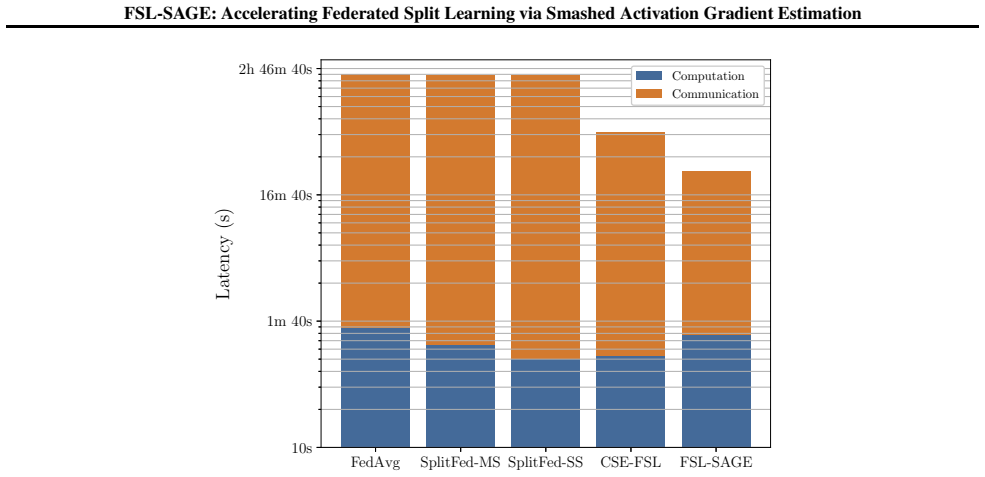
- Communication load drops because the server receives cut-layer features only $Q$ times per round and transmits updated auxiliary models once every $l$ rounds, instead of exchanging cut-layer gradients every iteration or full models every round.
- The lazy variant gives a tunable cost–accuracy knob: stopping alignment after $T'$ rounds replaces the $O(1/\sqrt{T})$ learnability term with roughly $(1+T'/T)/\sqrt{T'}$, quantifying the communication saved by freezing the auxiliary models.
- On the reported workloads, the accuracy at fixed communication budgets is on par with or above SplitFed and CSE-FSL, e.g., roughly 2.2x less communication than CSE-FSL to reach 81% test accuracy on CIFAR-10.
Reading between the lines
- The ablation results suggest an auxiliary-size and alignment-interval frontier that the paper does not optimize: CIFAR-100 accuracy degrades as the alignment interval $l$ grows, so a schedule that aligns more often early in training and less often later could yield further communication savings.
- If $\varepsilon_t^\star$ is the dominant error floor, then the alignment loss on held-out smashed activations could serve as an online stopping signal for the lazy variant, replacing the fixed freeze point $T'$ with the round at which the auxiliary fit stops improving.
- The same cut-layer gradient estimation mechanism could be applied to split fine-tuning of larger generative models, where repeated transmission of smashed activations rather than model weights is the dominant communication cost; the paper's LoRA GPT2-medium experiment is a first step in that direction.
- The proof's lack of linear speedup in the number of clients is a structural consequence of one sequentially updated server-side model; a clustered or multi-head server design might recover part of that speedup while keeping the auxiliary-alignment machinery.
Editorial analysis
A structured set of objections, weighed in public.
Referee Report
Summary. The paper proposes FSL-SAGE, a federated split learning algorithm in which each client uses a small auxiliary model to estimate the server-side cut-layer gradient, with the auxiliary models periodically aligned to the true server-side gradient mapping. The main theoretical claim is a finite-time stationarity convergence rate of O(1/sqrt(T)) for the non-lazy version, which would match FedAvg, together with a 'lazy' variant that stops alignment after T' rounds. The paper also reports experiments with ResNet-18 on CIFAR-10/100 and LoRA fine-tuning of GPT2-medium on E2E, comparing communication load and accuracy against FedAvg, SplitFed, and CSE-FSL, and includes ablations on the alignment interval and auxiliary model size.
Significance. The algorithmic idea has clear practical value: using periodically aligned auxiliary models to provide server feedback while retaining client-side parallelism is a natural and promising middle ground between FL and SL, and the paper supports it with extensive experiments, ablations, and released source code. The general decomposition in Theorem 4.3, which separates optimization error, stochastic variance, data heterogeneity, and auxiliary estimation error, is also a useful conceptual contribution that could inform later FSL analyses. However, the headline O(1/sqrt(T)) claim is not established by the displayed proofs: the bound in Theorem 4.8 contains a non-vanishing best-approximation term that Corollary 4.9 discards without proof, and the server-side half of the main theorem is asserted rather than proved. These issues are load-bearing for the central claim, so the paper needs major revision even though the overall approach and experiments are promising.
major comments (2)
- [§4.2, Theorem 4.8 (Eq. (14)) and Corollary 4.9] Corollary 4.9 does not follow from Theorem 4.8. The last term in Eq. (14) is (3K eta_L L_f^2)/(2cQ min{eta_L, m eta}) * (1/T) sum_{t=1}^T epsilon_t^*, and with the stated step sizes eta_L = O(1/sqrt(T)) and eta = O(1/(m sqrt(T))) the prefactor is O(1). The proven bound is therefore O(1/sqrt(T)) + O((1/T) sum epsilon_t^*), not O(1/sqrt(T)). Assumption 4.6 does not control epsilon_t^*: it only bounds the ERM excess relative to the best auxiliary hypothesis, whereas epsilon_t^* is the best-approximation error of the auxiliary model class for the current server-side mapping. The universal-approximation discussion after Eq. (14) gives no rate, no uniformity in t, and is in tension with the deliberately small auxiliary models used in the experiments (e.g., a 2.1M-parameter auxiliary for a 10.5M-parameter server model). If the auxiliary class has positive approximation error, the bound has a constant floor and does not vanish as T grows. The abstract, Corollary 4.9, and the conclusion should either add an explicit condition such as (1/T) sum epsilon_t^* = O(1/sqrt(T)) or state the rate as O(1/sqrt(T)) plus an auxiliary-approximation floor rather than claiming it matches FedAvg.
- [Appendix B.1, server-side bound (Eqs. (B.16)-(B.18))] The server-side half of Theorem 4.3 is asserted by saying that Eq. (B.17) is 'identical' to Eq. (B.5) under substitutions and that the client-side steps can be followed. This is not a proof: the server model is updated Qm times per round, so the gradients g_{s,i}^{t,q} in Eq. (B.16) are evaluated at intermediate server parameters x_s^{t,q} that drift within the round. On the client side, drift is controlled by Lemma B.1, but no analogous server-drift lemma is stated or proved. Without a bound on E ||x_s^{t,q} - x_s^t||^2, the inequality (B.18) is unsupported. The authors need to add the server analogue of Lemma B.1 or restructure the server update so that the existing argument applies.
minor comments (4)
- [Theorem 4.3, Eq. (3)] The right-hand side of Eq. (3) contains the random quantity epsilon_t defined in Eq. (5), while the left-hand side is the expectation min_t E ||grad f(x^t)||^2. The proof's final step says 'taking full expectation on both sides,' suggesting the intended term is E[epsilon_t], as later written in Eq. (B.21). Please restate the theorem with E[epsilon_t] in the bound or define epsilon_t in Eq. (5) as an expectation.
- [Appendix B.2, derivation after Eq. (B.27)] The transition from r_i(epsilon) = O(1/epsilon^2) to an excess term O(1/sqrt(t)) should account for the fact that alignment occurs every l rounds, so the number of alignment samples at round t is proportional to t/l. The resulting constant sqrt(l) factor does not change the rate, but the substitution should be explicit.
- [Figures 11 and 12 captions] The captions of Figures 11 and 12 say 'Effect of auxiliary model size on final test performance', but the x-axes are labeled 'Alignment interval (l)'. Either the figures or the captions are mislabeled, and this should be corrected.
- [Appendix D.2, latency analysis] There is a typo in the sentence 'which can is computationally expensive for the server'; it should read 'which can be computationally expensive for the server.'
Circularity Check
No significant circularity: the auxiliary-model estimation error is explicitly separated in Theorems 4.3 and 4.8, neither fitted to data nor defined in terms of the claimed O(1/√T) rate; the only overlapping-author citation (Yang et al. 2021) is non-load-bearing. The unstated εt* decay condition in Corollary 4.9 is a correctness gap, not a circular reduction.
full rationale
The paper's headline claim (O(1/√T) stationarity convergence 'matching FedAvg') is the output of a derivation chain that is self-contained given standard assumptions. Theorem 4.3 bounds the stationarity gap under smoothness and bounded-variance assumptions (4.1, 4.2), leaving an explicit residual (3Kη_L/2cQ min{η_L,mη})·(1/T)Σε_t for the auxiliary-model gradient estimation error (eq. 5). Corollary 4.4 honestly displays this as O(1/√T) + O(1)·(1/T)Σε_t. Theorem 4.8 then bounds ε_t by the best-in-class approximation error ε_t* plus a PAC-learnability term C₁/√t, using in-expectation learnability (Assumption 4.6) from external results (Grunwald et al. 2021; Mey 2022; Steinke & Zakynthinou 2020). The in-manuscript text itself states that the coefficient of (1/T)Σε_t* is O(1) and that ε_t* is 'entirely determined by the architecture of the auxiliary model'; the term is a genuine residual, neither fitted to the training data nor defined so as to force the rate. The transition to Corollary 4.9's clean O(1/√T) tacitly requires ε_t* = O(1/√T) or zero, which is not implied by the displayed bound (14); this is an overstatement/correctness gap (the skeptical reading) rather than circularity, because no equation in the paper makes the rate equal to the auxiliary error by construction, and the universal-approximation citations (all external) supply no rate. No load-bearing self-citation appears: Yang et al. 2021 (Jia Liu is a co-author of both papers) is cited only for standard assumptions and the linear-speedup comparison, and the same assumptions are cited to Karimireddy et al. 2019 and Reddi et al. 2021; the client-drift lemma follows Reddi et al. 2021, which has no author overlap. Per the reviewing rule, in-manuscript limitations were weighed: the post-Theorem 4.8 admission about ε_t*, the stated lack of linear speedup, and the server-side half of Theorem 4.3 asserted by 'following the same steps' as the client side without a displayed server-drift lemma (B.17 to B.18). These are flagged correctness risks and omitted-proof issues, not circular steps. Verdict: no significant circularity; score 1 reflects only the single non-load-bearing overlapping-author citation.
Assumptions & free parameters
free parameters (3)
- alignment interval l =
10
- auxiliary model architecture =
2.1M params (CIFAR), 92.4M params (GPT-2)
- cut layer location =
after block 2 of ResNet-18; after first attention block of GPT-2
assumptions (6)
- domain assumption Assumption 4.1: client and server loss gradients are Lc- and Lhatc-Lipschitz smooth
- domain assumption Assumption 4.2: unbiased local gradients with bounded variance (σL², σhatL²) and bounded heterogeneity (σG²)
- ad hoc to paper Assumption 4.6: auxiliary models are in-expectation PAC-learnable with sample complexity O(1/ε²)
- domain assumption Assumption 4.7: client cut-layer activation zi,f is Lzf-Lipschitz in client parameters
- ad hoc to paper Exact ERM solution for auxiliary alignment in Eq. (2) and sufficiently large server storage
- ad hoc to paper Universal approximation: εt* can be made arbitrarily small with sufficiently large auxiliary models
Cite this review
Pith. "Pith review of FSL-SAGE: Accelerating Federated Split Learning via Smashed Activation Gradient Estimation." pith.science (2026). https://pith.science/paper/3GXBF3FM
@misc{pith2026250523182,
  author       = {Pith},
  title        = {Pith review of: FSL-SAGE: Accelerating Federated Split Learning via Smashed Activation Gradient Estimation},
  year         = {2026},
  howpublished = {\url{https://pith.science/paper/3GXBF3FM}},
  note         = {Machine review of arXiv:2505.23182}
}
abstract
Collaborative training methods like Federated Learning (FL) and Split Learning (SL) enable distributed machine learning without sharing raw data. However, FL assumes clients can train entire models, which is infeasible for large-scale models. In contrast, while SL alleviates the client memory constraint in FL by offloading most training to the server, it increases network latency due to its sequential nature. Other methods address the conundrum by using local loss functions for parallel client-side training to improve efficiency, but they lack server feedback and potentially suffer poor accuracy. We propose FSL-SAGE (Federated Split Learning via Smashed Activation Gradient Estimation), a new federated split learning algorithm that estimates server-side gradient feedback via auxiliary models. These auxiliary models periodically adapt to emulate server behavior on local datasets. We show that FSL-SAGE achieves a convergence rate of $\mathcal{O}(1/\sqrt{T})$, where $T$ is the number of communication rounds. This result matches FedAvg, while significantly reducing communication costs and client memory requirements. Our empirical results also verify that it outperforms existing state-of-the-art FSL methods, offering both communication efficiency and accuracy.
Figures


Figures from the paper (6 more)




Reference graph
Works this paper leans on
-
[1]
PAC-Bayesian Statistical Learning Theory
Audibert, J.-Y. PAC-Bayesian Statistical Learning Theory. PhD thesis, Paris 6, Jul 2004
work page 2004
-
[2]
Bartlett, P. L. and Mendelson, S. Empirical minimization. Probability theory and related fields, 135 0 (3): 0 311--334, 2006
work page 2006
-
[3]
Bhatti, H. I. and Moon, J. Locally supervised learning with periodic global guidance. arXiv preprint arXiv:2208.00821, 2022
work page Pith review arXiv 2022
-
[4]
Cybenko, G. V. Approximation by superpositions of a sigmoidal function. Mathematics of Control, Signals and Systems, 2: 0 303--314, 1989. URL https://api.semanticscholar.org/CorpusID:3958369
work page 1989
-
[5]
Bert: Pre-training of deep bidirectional transformers for language understanding
Devlin, J., Chang, M.-W., Lee, K., and Toutanova, K. Bert: Pre-training of deep bidirectional transformers for language understanding. In Proceedings of the 2019 conference of the North American chapter of the association for computational linguistics: human language technologies, volume 1 (long and short papers), pp.\ 4171--4186, 2019
2019
-
[6]
and Lan, G
Ghadimi, S. and Lan, G. Stochastic first-and zeroth-order methods for nonconvex stochastic programming. SIAM journal on optimization, 23 0 (4): 0 2341--2368, 2013
2013
-
[7]
Grunwald, P., Steinke, T., and Zakynthinou, L. Pac-bayes, mac-bayes and conditional mutual information: Fast rate bounds that handle general vc classes. In Conference on Learning Theory, pp.\ 2217--2247. PMLR, 2021
work page 2021
-
[8]
Gupta, O. and Raskar, R. Distributed learning of deep neural network over multiple agents. Journal of Network and Computer Applications, 116: 0 1--8, 2018
work page 2018
Show all 51 references
-
[9]
I., Lee, J., and Moon, J
Han, D.-J., Bhatti, H. I., Lee, J., and Moon, J. Accelerating federated learning with split learning on locally generated losses. In ICML 2021 workshop on federated learning for user privacy and data confidentiality. ICML Board, 2021
2021
-
[10]
Convergence analysis of split federated learning on heterogeneous data
Han, P., Huang, C., Tian, G., Tang, M., and Liu, X. Convergence analysis of split federated learning on heterogeneous data. In The Thirty-eighth Annual Conference on Neural Information Processing Systems, 2024. URL https://openreview.net/forum?id=ud0RBkdBfE
2024
-
[11]
Universal function approximation by deep neural nets with bounded width and relu activations
Hanin, B. Universal function approximation by deep neural nets with bounded width and relu activations. Mathematics, 7 0 (10): 0 992, 2019
2019
-
[12]
and Sellke, M
Hanin, B. and Sellke, M. Approximating continuous functions by relu nets of minimal width, 2018. URL https://arxiv.org/abs/1710.11278
2018 arXiv
-
[13]
Group knowledge transfer: Federated learning of large cnns at the edge
He, C., Annavaram, M., and Avestimehr, S. Group knowledge transfer: Federated learning of large cnns at the edge. Advances in Neural Information Processing Systems, 33: 0 14068--14080, 2020
2020
-
[14]
Deep residual learning for image recognition
He, K., Zhang, X., Ren, S., and Sun, J. Deep residual learning for image recognition. In Proceedings of the IEEE conference on computer vision and pattern recognition, pp.\ 770--778, 2016
2016
-
[15]
Distilling the knowledge in a neural network
Hinton, G., Vinyals, O., and Dean, J. Distilling the knowledge in a neural network. arXiv preprint arXiv:1503.02531, 2015
2015 arXiv
-
[16]
A., Welbl, J., Clark, A., et al
Hoffmann, J., Borgeaud, S., Mensch, A., Buchatskaya, E., Cai, T., Rutherford, E., de Las Casas, D., Hendricks, L. A., Welbl, J., Clark, A., et al. An empirical analysis of compute-optimal large language model training. Advances in neural information processing systems, 35: 0 3...
2022
-
[17]
Multilayer feedforward networks are universal approximators
Hornik, K., Stinchcombe, M., and White, H. Multilayer feedforward networks are universal approximators. Neural networks, 2 0 (5): 0 359--366, 1989
1989
-
[18]
H., Qi, H., and Brown, M
Hsu, T.-M. H., Qi, H., and Brown, M. Measuring the effects of non-identical data distribution for federated visual classification. arXiv preprint arXiv:1909.06335, 2019
1909 arXiv
-
[19]
J., Shen, Y., Wallis, P., Allen-Zhu, Z., Li, Y., Wang, S., Wang, L., and Chen, W
Hu, E. J., Shen, Y., Wallis, P., Allen-Zhu, Z., Li, Y., Wang, S., Wang, L., and Chen, W. Lora: Low-rank adaptation of large language models. arXiv preprint arXiv:2106.09685, 2021
2021 arXiv
-
[20]
B., Chess, B., Child, R., Gray, S., Radford, A., Wu, J., and Amodei, D
Kaplan, J., McCandlish, S., Henighan, T., Brown, T. B., Chess, B., Child, R., Gray, S., Radford, A., Wu, J., and Amodei, D. Scaling laws for neural language models. arXiv preprint arXiv:2001.08361, 2020
2001 arXiv
-
[21]
P., Kale, S., Mohri, M., Reddi, S
Karimireddy, S. P., Kale, S., Mohri, M., Reddi, S. J., Stich, S. U., and Suresh, A. T. SCAFFOLD: stochastic controlled averaging for on-device federated learning. CoRR, abs/1910.06378, 2019. URL http://arxiv.org/abs/1910.06378
1910 arXiv
-
[22]
Kingma, D. P. and Ba, J. Adam: A method for stochastic optimization. In Bengio, Y. and LeCun, Y. (eds.), 3rd International Conference on Learning Representations, ICLR 2015, San Diego, CA, USA, May 7-9, 2015, Conference Track Proceedings , 2015. URL http://arxiv.org/abs/1412.6980
2015 arXiv
-
[23]
Learning multiple layers of features from tiny images
Krizhevsky, A., Hinton, G., et al. Learning multiple layers of features from tiny images. 2009
2009
-
[24]
and Lyu, X
Li, Y. and Lyu, X. Convergence analysis of sequential federated learning on heterogeneous data. Advances in Neural Information Processing Systems, 36: 0 56700--56755, 2023
2023
-
[25]
Lin, Z., Qu, G., Wei, W., Chen, X., and Leung, K. K. Adaptsfl: Adaptive split federated learning in resource-constrained edge networks. arXiv preprint arXiv:2403.13101, 2024
2024 arXiv
-
[26]
The expressive power of neural networks: A view from the width
Lu, Z., Pu, H., Wang, F., Hu, Z., and Wang, L. The expressive power of neural networks: A view from the width. In Advances in Neural Information Processing Systems, volume 30. Curran Associates, Inc., 2017. URL https://proceedings.neurips.cc/paper_files/paper/2017/file/32cbf68...
2017
-
[27]
S., Hare, J
Marquez, E. S., Hare, J. S., and Niranjan, M. Deep cascade learning. IEEE transactions on neural networks and learning systems, 29 0 (11): 0 5475--5485, 2018
2018
-
[28]
B., Moore, E., Ramage, D., and y Arcas, B
McMahan, H. B., Moore, E., Ramage, D., and y Arcas, B. A. Federated learning of deep networks using model averaging. CoRR, abs/1602.05629, 2016. URL http://arxiv.org/abs/1602.05629
2016 arXiv
-
[29]
A note on high-probability versus in-expectation guarantees of generalization bounds in machine learning, 2022
Mey, A. A note on high-probability versus in-expectation guarantees of generalization bounds in machine learning, 2022. URL https://arxiv.org/abs/2010.02576
2022 arXiv
-
[30]
and Shen, C
Mu, Y. and Shen, C. Communication and storage efficient federated split learning. In ICC 2023 - IEEE International Conference on Communications, pp.\ 2976--2981, 2023. doi:10.1109/ICC45041.2023.10278891
2023
-
[31]
The E 2 E dataset: New challenges for end-to-end generation
Novikova, J., Du s ek, O., and Rieser, V. The E 2 E dataset: New challenges for end-to-end generation. In Jokinen, K., Stede, M., DeVault, D., and Louis, A. (eds.), Proceedings of the 18th Annual SIG dial Meeting on Discourse and Dialogue , pp.\ 201--206, Saarbr \"u cken, Germ...
2017 doi
-
[32]
Locfedmix-sl: Localize, federate, and mix for improved scalability, convergence, and latency in split learning
Oh, S., Park, J., Vepakomma, P., Baek, S., Raskar, R., Bennis, M., and Kim, S.-L. Locfedmix-sl: Localize, federate, and mix for improved scalability, convergence, and latency in split learning. In Proceedings of the ACM Web Conference 2022, WWW '22, pp.\ 3347–3357, New York, N...
2022
-
[33]
Gpt-4 technical report, 2024
OpenAI, Achiam, J., et al. Gpt-4 technical report, 2024. URL https://arxiv.org/abs/2303.08774
2024 arXiv
-
[34]
Language models are unsupervised multitask learners
Radford, A., Wu, J., Child, R., Luan, D., Amodei, D., Sutskever, I., et al. Language models are unsupervised multitask learners. OpenAI blog, 1 0 (8): 0 9, 2019
2019
-
[35]
W., Hallacy, C., Ramesh, A., Goh, G., Agarwal, S., Sastry, G., Askell, A., Mishkin, P., Clark, J., Krueger, G., and Sutskever, I
Radford, A., Kim, J. W., Hallacy, C., Ramesh, A., Goh, G., Agarwal, S., Sastry, G., Askell, A., Mishkin, P., Clark, J., Krueger, G., and Sutskever, I. Learning transferable visual models from natural language supervision, 2021. URL https://arxiv.org/abs/2103.00020
2021 arXiv
-
[36]
Hierarchical text-conditional image generation with clip latents, 2022
Ramesh, A., Dhariwal, P., Nichol, A., Chu, C., and Chen, M. Hierarchical text-conditional image generation with clip latents, 2022. URL https://arxiv.org/abs/2204.06125
2022 arXiv
-
[37]
J., Charles, Z., Zaheer, M., Garrett, Z., Rush, K., Kone c n \'y , J., Kumar, S., and McMahan, H
Reddi, S. J., Charles, Z., Zaheer, M., Garrett, Z., Rush, K., Kone c n \'y , J., Kumar, S., and McMahan, H. B. Adaptive federated optimization. In International Conference on Learning Representations, 2021. URL https://openreview.net/forum?id=LkFG3lB13U5
2021
-
[38]
K., Li, T., Sanjabi, M., Zaheer, M., Talwalkar, A., and Smith, V
Sahu, A. K., Li, T., Sanjabi, M., Zaheer, M., Talwalkar, A., and Smith, V. On the convergence of federated optimization in heterogeneous networks. CoRR, abs/1812.06127, 2018. URL http://arxiv.org/abs/1812.06127
2018 arXiv
-
[39]
Photon: Federated llm pre-training
Sani, L., Iacob, A., Cao, Z., Lee, R., Marino, B., Gao, Y., Cai, D., Li, Z., Zhao, W., Qiu, X., et al. Photon: Federated llm pre-training. arXiv preprint arXiv:2411.02908, 2024 a
2024
-
[40]
F., Aleksandrov, P., Qiu, X., and Lane, N
Sani, L., Iacob, A., Cao, Z., Marino, B., Gao, Y., Paulik, T., Zhao, W., Shen, W. F., Aleksandrov, P., Qiu, X., and Lane, N. D. The future of large language model pre-training is federated. In International Workshop on Federated Foundation Models in Conjunction with NeurIPS 20...
2024
-
[41]
and Zakynthinou, L
Steinke, T. and Zakynthinou, L. Reasoning about generalization via conditional mutual information. In Conference on Learning Theory, pp.\ 3437--3452. PMLR, 2020
2020
-
[42]
Improving lo RA in privacy-preserving federated learning
Sun, Y., Li, Z., Li, Y., and Ding, B. Improving lo RA in privacy-preserving federated learning. In The Twelfth International Conference on Learning Representations, 2024. URL https://openreview.net/forum?id=NLPzL6HWNl
2024
-
[43]
Thapa, C., Arachchige, P. C. M., Camtepe, S., and Sun, L. Splitfed: When federated learning meets split learning. In Proceedings of the AAAI Conference on Artificial Intelligence, volume 36, pp.\ 8485--8493, 2022
2022
-
[44]
Llama: Open and efficient foundation language models, 2023
Touvron, H., Lavril, T., Izacard, G., Martinet, X., Lachaux, M.-A., Lacroix, T., Rozière, B., Goyal, N., Hambro, E., Azhar, F., Rodriguez, A., Joulin, A., Grave, E., and Lample, G. Llama: Open and efficient foundation language models, 2023. URL https://arxiv.org/abs/2302.13971
2023 arXiv
-
[45]
Split learning for health: Distributed deep learning without sharing raw patient data
Vepakomma, P., Gupta, O., Swedish, T., and Raskar, R. Split learning for health: Distributed deep learning without sharing raw patient data. arXiv preprint arXiv:1812.00564, 2018
2018 arXiv
-
[46]
FL o RA : Federated fine-tuning large language models with heterogeneous low-rank adaptations
Wang, Z., Shen, Z., He, Y., Sun, G., Wang, H., Lyu, L., and Li, A. FL o RA : Federated fine-tuning large language models with heterogeneous low-rank adaptations. In The Thirty-eighth Annual Conference on Neural Information Processing Systems, 2024. URL https://openreview.net/f...
2024
-
[47]
Split learning over wireless networks: Parallel design and resource management
Wu, W., Li, M., Qu, K., Zhou, C., Shen, X., Zhuang, W., Li, X., and Shi, W. Split learning over wireless networks: Parallel design and resource management. IEEE Journal on Selected Areas in Communications, 41 0 (4): 0 1051--1066, 2023
2023
-
[48]
Achieving linear speedup with partial worker participation in non- IID federated learning
Yang, H., Fang, M., and Liu, J. Achieving linear speedup with partial worker participation in non- IID federated learning. In International Conference on Learning Representations, 2021. URL https://openreview.net/forum?id=jDdzh5ul-d
2021
-
[49]
Parallel restarted sgd with faster convergence and less communication: Demystifying why model averaging works for deep learning
Yu, H., Yang, S., and Zhu, S. Parallel restarted sgd with faster convergence and less communication: Demystifying why model averaging works for deep learning. In Proceedings of the AAAI conference on artificial intelligence, volume 33, pp.\ 5693--5700, 2019
2019
-
[50]
From -entropy to kl-entropy: Analysis of minimum information complexity density estimation
Zhang, T. From -entropy to kl-entropy: Analysis of minimum information complexity density estimation. The Annals of Statistics, pp.\ 2180--2210, 2006
2006
-
[51]
write newline
" write newline "" before.all 'output.state := FUNCTION n.dashify 't := "" t empty not t #1 #1 substring "-" = t #1 #2 substring "--" = not "--" * t #2 global.max substring 't := t #1 #1 substring "-" = "-" * t #2 global.max substring 't := while if t #1 #1 substring * t #2 gl...
Reviewed August 7, 2026 · model on record in the stance chip above.
Discussion (0). Sign in to comment.