REVIEW 5 major objections 6 minor 50 references
JAPAN: Joint Adaptive Prediction Areas with Normalising-Flows
T0 review · 5 major / 6 minor · reviewed 2026-08-07 · deepseek-v4-flash
Pith's one-line read JAPAN constructs conformal prediction regions by thresholding a normalising-flow estimate of the predictive density, giving compact, possibly disconnected, context-adaptive sets with finite-sample coverage.
desk verdict Sound split-conformal validity with a sensible density-based score, but the area-efficiency claim is not yet proven because the direct density-based baseline is missing and baseline area computation is opaque. read the letter →
The pith
A machine-rendered reading of the paper's core claim, the machinery that carries it, and where it could break.
The reading
What carries the argument
The machine that carries the argument is the normalising-flow change-of-variables identity, which turns a bijection $z = h(y,x)$ into a tractable conditional log-density, $\log \hat{p}(y \mid x) = \log p_Z(h(y,x)) + \Phi(y,x)$, where $\Phi$ is the log-volume correction (a log-determinant Jacobian for discrete flows). This log-density is the conformity score, and the prediction region is its superlevel set above the calibrated threshold $\tau_\epsilon$. The same identity also gives an area estimator: sample $z$ from the base density $p_Z$, map back through $h^{-1}$, and reweight by $|\det J_{h^{-1}}|/p_Z(z)$, so region volume is computed in latent space without integrating over the data space. The supporting propositions transfer density accuracy to area efficiency: exact monotone agreement with the true density gives identical regions, uniform density error gives error-controlled area, and bounded misranking gives bounded excess area.
What would settle it
On a synthetic regression with a known two-mode density, train a deliberately restricted flow (for example, a shallow affine flow) so that its density ranking of the two modes is reversed, then compare JAPAN's region area at nominal coverage with the true level-set area. A near-true area despite the reversal would show the rank assumption is not load-bearing; a much larger area would confirm that misranking, not miscalibration, is what destroys efficiency.
Extended reading notes
Core claim
The central claim is that a conformal prediction region can be made both valid and near-minimal by thresholding an estimated conditional density instead of transforming residuals. After training a conditional normalising flow, the paper uses $\log \hat{p}(y_i \mid x_i)$ as the calibration score for each calibration pair and defines the test-time set as all $y$ whose estimated log-density is at least the empirical $(1-\epsilon)$-quantile. The finite-sample coverage guarantee follows from standard conformal calibration and does not depend on the flow being accurate; the efficiency claim rests on the flow's ranking being close to the true density's ranking. Under exact rank preservation the constructed region coincides with the true density level set, and under approximate rank preservation or bounded misranking the excess area is controlled and goes to zero as estimation error goes to zero. The empirical section demonstrates the mechanism on spiral, moons, and checkerboard densities, where only the density-thresholded region tracks all disconnected modes, and shows smaller reported areas on tabular and time-series benchmarks while coverage stays near the nominal level.
Load-bearing premise
The area-efficiency claim rests on the trained flow ordering candidate outputs the way the true conditional density does; the theory also assumes the conditional densities are shape-invariant in $x$, $p(y \mid x) = \varphi(T_x(y))$, which real regression problems generally violate.
Editorial extensions
If this is right
- Prediction sets for multimodal outputs can be split into several disconnected high-density pieces rather than a single ball or box centred on the mean.
- The same conformal pipeline serves multivariate regression and multi-step time-series forecasting by changing only how the flow is conditioned on a context representation.
- Region volume can be estimated efficiently by Monte Carlo sampling in the flow's latent space, avoiding expensive data-space integration.
- JAPAN can be layered on top of an existing point predictor by modelling $p(y \mid \hat{y})$, $p(\hat{y} \mid y)$, or $p(y)$; its latent-space variant is shown to coincide with CONTRA.
- The adaptive-threshold extension modulates $\tau_\epsilon(x)$ using the flow's volume-change term, which on a crescent-density example improves coverage at a small cost in area.
Reading between the lines
- Since conformal calibration enforces coverage no matter how bad the score is, the practical bottleneck for JAPAN is density quality, not calibration: a better density estimator should shrink areas while leaving the conformal machinery unchanged.
- The homogeneity assumption $p(y \mid x) = \varphi(T_x(y))$ in the optimality proofs is unlikely to hold in heteroscedastic or multi-scale data; an implied open problem is an area bound that depends on how much level-set geometry varies with $x$.
- A cheap deployment check would be to run JAPAN on synthetic data with known level sets and compare its thresholded region with the oracle-density region; a large area gap would diagnose rank failure rather than calibration failure.
- The $\tau_\epsilon(x)$ extension points toward conditional coverage, and combining it with local neighbourhood calibration is a natural testable follow-up that the paper leaves open.
Editorial analysis
A structured set of objections, weighed in public.
Referee Report
Summary. The paper proposes JAPAN, a split-conformal method for multivariate prediction regions. A normalising flow is trained to estimate the conditional density p(y|x); the log-density is used as the conformity score, and the prediction region is the superlevel set {y : log p̂(y|x) ≥ τ}, where τ is a calibration quantile. The authors state optimality propositions under rank preservation, give an importance-sampling formula for area estimation, and report experiments on toy densities, multivariate regression benchmarks, and time-series datasets, comparing against eleven baselines. Extensions cover unconditional, conditional-on-prediction, posterior, latent-space, and adaptive-threshold variants.
Significance. If the efficiency results hold, JAPAN is a practically useful instantiation of density-threshold conformal prediction, producing geometry-free, potentially disjoint, context-adaptive regions with finite-sample marginal coverage inherited from split conformal prediction. The calibration half of the method is standard and sound, and the latent-space importance-sampling area estimator (Proposition 3) is a useful implementation device. The theoretical efficiency claims, however, rest on strong assumptions that are not stated in the main text, and the empirical efficiency comparison is not yet auditable: the most direct density-based predecessor, HPD-split, is cited but never benchmarked, and the area-computation protocol is specified only for flow-based methods. With those gaps addressed, the paper would be a solid empirical contribution; as it stands, the central efficiency claim is not fully supported.
major comments (5)
- [Appendix A, Theorem 2 (main-text Proposition 2)] The proof asserts that uniform density approximation |fθ(y|x) − g(p(y|x))| ≤ δ implies |τ* − g^{-1}(τ)| ≤ ε(δ) with ε(δ)→0, but this is not a consequence of uniform density error unless additional regularity is assumed: the quantile map from density level to threshold is not automatically Lipschitz, and density error near the level set does not by itself control the threshold shift. The proof also silently uses the homogeneity assumption p(y|x)=φ(T_x(y)), which is absent from Proposition 2 in Section 3.1 and is violated in heteroscedastic or input-dependent multimodal settings. Please state the regularity conditions explicitly and prove the threshold-transfer step, or present the result as a heuristic motivation rather than a theorem.
- [Appendix A, Theorem 1 (main-text Proposition 1)] The proof concludes g^{-1}(τ)=τ* from the fact that both regions 'achieve the same coverage level', but the conformal region has a random calibration threshold and satisfies only P(y ∈ Γϵ(x)) ≥ 1−ϵ in finite samples; exact equality of regions therefore holds only in an idealized population/continuity sense, not for the actual split-conformal procedure. The fixed strictly increasing transformation g and the homogeneity assumption should be stated in the main-text Proposition 1, and the statement should be qualified to reflect the finite-sample, randomized nature of the conformal threshold.
- [Section 4 and Tables 1, 3, 4] HPD-split (Izbicki et al., 2021), the most direct density-threshold conformal predecessor, is cited in Section 6 but is not included in any experiment. Without this baseline, the experiments show only that JAPAN improves on residual-based and geometric methods, not that density-threshold scoring itself drives the area gains. Please add HPD-split (and ideally CD-split) to the comparison, or explicitly restrict the empirical claim to the baselines actually evaluated.
- [Appendix B.2 and Tables 1, 3, 4] Area computation is specified only for flow-based methods: Appendix B.2 states 3,000 Monte Carlo samples for JAPAN, CONTRA, and PCP, but no protocol is given for CQR, RCP, NLE, Dist-Split, or the copula baselines. If those areas are computed via exact box or ellipsoid formulas while JAPAN uses a stochastic estimator on its own fitted density, the reported area gaps could be partly a measurement artifact. Please report the area estimator used for every baseline, and include Monte Carlo standard errors or otherwise quantify estimator uncertainty.
- [Appendix A, Proposition 4] The misranking probability mass µ(x) is a probability with respect to p(y1|x)p(y2|x), but the proposition claims a bound on the Lebesgue measure of a symmetric difference of level sets. Small µ(x) does not imply small Lebesgue measure of the boundary strip unless the density is bounded away from zero on the relevant level sets and the level sets have controlled perimeter; these conditions are not stated. The proposition should be proved with explicit regularity assumptions, or removed from the set of theoretical efficiency claims.
minor comments (6)
- [Algorithm 1, line 5] The rank formula k = ⌊ϵ·(1−1/m)·m⌋ = ⌊ϵ(m−1)⌋ is nonstandard; with this k the test score at the k-th calibration value gives a p-value slightly below ϵ, so the procedure is conservative. Please reconcile the formula with the p-value definition in Section 2.1 and state the intended finite-sample convention.
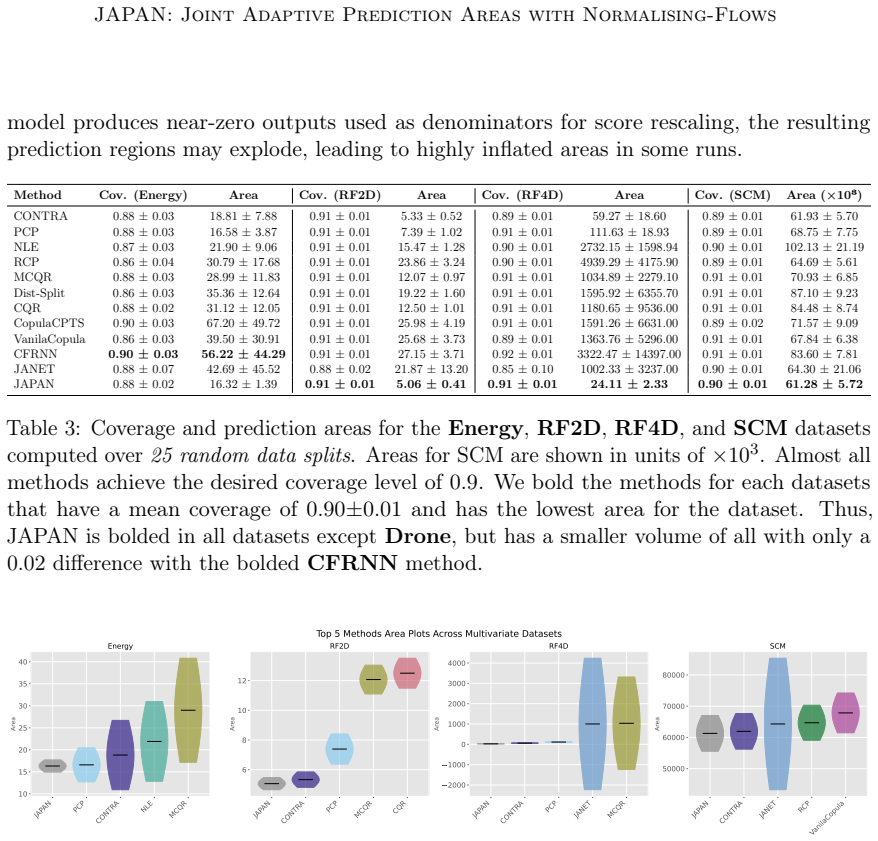
- [Table 3 caption] The caption mentions 'except Drone', but Table 3 reports only tabular datasets; this appears to be a typo for 'SCM'.
- [Appendix C.2 and Table 7] The Particle-1 text says the dataset includes 5,000 samples, while Table 7 reports 2,000 + 500 + 500 = 3,000 samples; please reconcile the numbers.
- [Appendix A, Theorem 3] The estimator uses exp(ϕ(z,x)) but ϕ is never defined; please either connect it to Φ in Eq. (1) or define ϕ as the log absolute determinant of the inverse Jacobian.
- [Figures 10–15 captions] The captions refer to 'the bottom panel', but the panels are arranged side by side; please update the captions to match the layout.
- [Section 3.1] The text refers to 'Propositon A'; this should be Proposition 4.
Circularity Check
No circularity found: the conformal threshold is calibrated on held-out scores, the optimality propositions are conditional level-set equivalences from Lei et al., and the area estimator is a change-of-variables identity.
full rationale
The central JAPAN construction is standard split conformal prediction: the flow is fit on Dtrain, conformity scores log p-hat(y|x) are computed on the held-out calibration set, and the quantile tau is calibrated there; regions are then evaluated on test data. No calibration score enters the flow training, so the coverage guarantee is not a fitted-input prediction. The efficiency propositions (Proposition 1, 2, 4 in Appendix A) are conditional theorems: if the estimated density is a monotone transformation of, or uniformly close to a monotone transformation of, the true density, then the density-trimmed level sets coincide or nearly coincide. These restate the known level-set optimality of Lei et al. (2013) and do not redefine the method's output in terms of the reported metric. The area estimator in Proposition 3 is an exact importance-sampling identity under the flow's change of variables, correct up to Monte Carlo error; it does not smuggle the conclusion into the measurement. Self-citations (English et al. 2023, 2024) appear only as baseline and architecture choices and are not load-bearing for the conformal validity or area-efficiency claim. The absence of HPD-split and the underspecified area protocol for non-flow baselines are experimental completeness concerns, not circularity.
Assumptions & free parameters
free parameters (3)
- NF architecture size for tabular experiments =
9 coupling layers, 512 hidden units per layer
- NF architecture size for time series =
10 autoregressive flow layers, 2 attention heads, 64-dim embeddings, 2 LSTM context layers
- Monte Carlo samples for area estimation =
3000 per test point
assumptions (5)
- domain assumption Calibration and test data are exchangeable, typically i.i.d. from an unknown distribution P.
- ad hoc to paper The flow density f_theta is a fixed monotone transformation of the true density p(y|x), or is uniformly close to one within an error delta.
- ad hoc to paper Conditional densities are homogeneous across x: p(y|x) = phi(T_x(y)) for a base density phi.
- ad hoc to paper Density level sets have enough boundary regularity that the symmetric difference area is bounded by a function C(delta) going to zero.
- domain assumption For time series, the available objects are exchangeable trajectories, not exchangeable time points.
Cite this review
Pith. "Pith review of JAPAN: Joint Adaptive Prediction Areas with Normalising-Flows." pith.science (2026). https://pith.science/paper/TLSZWNGK
@misc{pith2026250523196,
  author       = {Pith},
  title        = {Pith review of: JAPAN: Joint Adaptive Prediction Areas with Normalising-Flows},
  year         = {2026},
  howpublished = {\url{https://pith.science/paper/TLSZWNGK}},
  note         = {Machine review of arXiv:2505.23196}
}
read the original abstract
Conformal prediction provides a model-agnostic framework for uncertainty quantification with finite-sample validity guarantees, making it an attractive tool for constructing reliable prediction sets. However, existing approaches commonly rely on residual-based conformity scores, which impose geometric constraints and struggle when the underlying distribution is multimodal. In particular, they tend to produce overly conservative prediction areas centred around the mean, often failing to capture the true shape of complex predictive distributions. In this work, we introduce JAPAN (Joint Adaptive Prediction Areas with Normalising-Flows), a conformal prediction framework that uses density-based conformity scores. By leveraging flow-based models, JAPAN estimates the (predictive) density and constructs prediction areas by thresholding on the estimated density scores, enabling compact, potentially disjoint, and context-adaptive regions that retain finite-sample coverage guarantees. We theoretically motivate the efficiency of JAPAN and empirically validate it across multivariate regression and forecasting tasks, demonstrating good calibration and tighter prediction areas compared to existing baselines. We also provide several \emph{extensions} adding flexibility to our proposed framework.
Figures


Figures from the paper (12 more)


Reference graph
Works this paper leans on
-
[1]
Alaa and Mihaela van der Schaar
Ahmed M. Alaa and Mihaela van der Schaar. Frequentist uncertainty in recurrent neural networks via blockwise influence functions, 2020
work page 2020
-
[2]
Building Normalizing Flows with Stochastic Interpolants
Michael Samuel Albergo and Eric Vanden-Eijnden. Building Normalizing Flows with Stochastic Interpolants . September 2022. URL https://openreview.net/forum?id=li7qeBbCR1t
work page 2022
-
[3]
Angelopoulos and Stephen Bates
Anastasios N. Angelopoulos and Stephen Bates. A gentle introduction to conformal prediction and distribution-free uncertainty quantification, 2022
2022
-
[4]
Candes, Aaditya Ramdas, and Ryan J
Rina Foygel Barber, Emmanuel J. Candes, Aaditya Ramdas, and Ryan J. Tibshirani. Predictive inference with the jackknife+, 2020
work page 2020
-
[5]
Candes, Aaditya Ramdas, and Ryan J
Rina Foygel Barber, Emmanuel J. Candes, Aaditya Ramdas, and Ryan J. Tibshirani. Conformal prediction beyond exchangeability, 2023
work page 2023
- [6]
-
[7]
Exact and robust conformal inference methods for predictive machine learning with dependent data
Victor Chernozhukov, Kaspar W\" u thrich, and Zhu Yinchu. Exact and robust conformal inference methods for predictive machine learning with dependent data. In Sébastien Bubeck, Vianney Perchet, and Philippe Rigollet, editors, Proceedings of the 31st Conference On Learning Theory, volume 75 of Proceedings of Machine Learning Research, pages 732--749. PMLR,...
work page 2018
-
[8]
Matthew Cleaveland, Insup Lee, George J. Pappas, and Lars Lindemann. Conformal prediction regions for time series using linear complementarity programming, 2024
work page 2024
Show all 50 references
-
[9]
Normalizing flows for conformal regression, 2024
Nicolo Colombo. Normalizing flows for conformal regression, 2024. URL https://arxiv.org/abs/2406.03346
2024 arXiv
-
[10]
Density estimation using real nvp, 2017
Laurent Dinh, Jascha Sohl-Dickstein, and Samy Bengio. Density estimation using real nvp, 2017
2017
-
[11]
Multiple Comparisons among Means
Olive Jean Dunn. Multiple Comparisons among Means . Journal of the American Statistical Association, 56 0 (293): 0 52--64, 1961. ISSN 0162-1459, 1537-274X. doi:10.1080/01621459.1961.10482090. URL http://www.tandfonline.com/doi/abs/10.1080/01621459.1961.10482090
1961
-
[12]
Neural spline flows, 2019
Conor Durkan, Artur Bekasov, Iain Murray, and George Papamakarios. Neural spline flows, 2019
2019
-
[13]
Kernelised normalising flows, 2023
Eshant English, Matthias Kirchler, and Christoph Lippert. Kernelised normalising flows, 2023
2023
-
[14]
Janet: Joint adaptive prediction-region estimation for time-series, 2024
Eshant English, Eliot Wong-Toi, Matteo Fontana, Stephan Mandt, Padhraic Smyth, and Christoph Lippert. Janet: Joint adaptive prediction-region estimation for time-series, 2024. URL https://arxiv.org/abs/2407.06390
2024 arXiv
-
[15]
CONTRA : Conformal Prediction Region via Normalizing Flow Transformation
Zhenhan Fang, Aixin Tan, and Jian Huang. CONTRA : Conformal Prediction Region via Normalizing Flow Transformation . October 2024. URL https://openreview.net/forum?id=pOO9cqLq7Q
2024
-
[16]
Calibrated Multiple - Output Quantile Regression with Representation Learning
Shai Feldman, Stephen Bates, and Yaniv Romano. Calibrated Multiple - Output Quantile Regression with Representation Learning . Journal of Machine Learning Research, 24 0 (24): 0 1--48, 2023. ISSN 1533-7928. URL http://jmlr.org/papers/v24/21-1280.html
2023
-
[17]
Multi-scale attention flow for probabilistic time series forecasting, 2023
Shibo Feng, Chunyan Miao, Ke Xu, Jiaxiang Wu, Pengcheng Wu, Yang Zhang, and Peilin Zhao. Multi-scale attention flow for probabilistic time series forecasting, 2023
2023
-
[18]
Gammerman, V
A. Gammerman, V. Vovk, and V. Vapnik. Learning by transduction. In Proceedings of the Fourteenth Conference on Uncertainty in Artificial Intelligence, UAI'98, page 148–155, San Francisco, CA, USA, 1998. Morgan Kaufmann Publishers Inc. ISBN 155860555X
1998
-
[19]
Adaptive conformal inference under distribution shift, 2021
Isaac Gibbs and Emmanuel Candès. Adaptive conformal inference under distribution shift, 2021
2021
-
[20]
Will Grathwohl, Ricky T. Q. Chen, Jesse Bettencourt, Ilya Sutskever, and David Duvenaud. FFJORD : Free - Form Continuous Dynamics for Scalable Reversible Generative Models . September 2018. URL https://openreview.net/forum?id=rJxgknCcK7
2018
-
[21]
Flexible distribution-free conditional predictive bands using density estimators
Rafael Izbicki, Gilson Shimizu, and Rafael Stern. Flexible distribution-free conditional predictive bands using density estimators. In Proceedings of the Twenty Third International Conference on Artificial Intelligence and Statistics , pages 3068--3077. PMLR, June 2020. URL ht...
2020
-
[22]
Rafael Izbicki, Gilson Shimizu, and Rafael B. Stern. Cd-split and hpd-split: efficient conformal regions in high dimensions, 2021
2021
-
[23]
Conformal uncertainty sets for robust optimization
Chancellor Johnstone and Bruce Cox. Conformal uncertainty sets for robust optimization. In Proceedings of the Tenth Symposium on Conformal and Probabilistic Prediction and Applications , pages 72--90. PMLR, September 2021. URL https://proceedings.mlr.press/v152/johnstone21a.html
2021
-
[24]
Kingma and Prafulla Dhariwal
Diederik P. Kingma and Prafulla Dhariwal. Glow: Generative flow with invertible 1x1 convolutions, 2018
2018
-
[25]
Neural relational inference for interacting systems, 2018
Thomas Kipf, Ethan Fetaya, Kuan-Chieh Wang, Max Welling, and Richard Zemel. Neural relational inference for interacting systems, 2018
2018
-
[26]
Distribution Free Prediction Sets
Jing Lei, James Robins, and Larry Wasserman. Distribution Free Prediction Sets . Journal of the American Statistical Association, 108 0 (501): 0 278--287, 2013. ISSN 0162-1459. doi:10.1080/01621459.2012.751873
2013
-
[27]
Yaron Lipman, Ricky T. Q. Chen, Heli Ben-Hamu, Maximilian Nickel, and Matthew Le. Flow Matching for Generative Modeling . September 2022. URL https://openreview.net/forum?id=PqvMRDCJT9t
2022
-
[28]
Conformal multi-target regression using neural networks
Soundouss Messoudi, S\' e bastien Destercke, and Sylvain Rousseau. Conformal multi-target regression using neural networks. In Alexander Gammerman, Vladimir Vovk, Zhiyuan Luo, Evgueni Smirnov, and Giovanni Cherubin, editors, Proceedings of the Ninth Symposium on Conformal and ...
2020
-
[29]
Copula-based conformal prediction for multi-target regression, 2021
Soundouss Messoudi, Sébastien Destercke, and Sylvain Rousseau. Copula-based conformal prediction for multi-target regression, 2021
2021
-
[30]
Inductive confidence machines for regression
Harris Papadopoulos, Kostas Proedrou, Volodya Vovk, and Alex Gammerman. Inductive confidence machines for regression. In Machine learning: ECML 2002: 13th European conference on machine learning Helsinki, Finland, August 19--23, 2002 proceedings 13, pages 345--356. Springer, 2002
2002
-
[31]
Masked autoregressive flow for density estimation, 2018
George Papamakarios, Theo Pavlakou, and Iain Murray. Masked autoregressive flow for density estimation, 2018
2018
-
[32]
Normalizing flows for probabilistic modeling and inference, 2021
George Papamakarios, Eric Nalisnick, Danilo Jimenez Rezende, Shakir Mohamed, and Balaji Lakshminarayanan. Normalizing flows for probabilistic modeling and inference, 2021
2021
-
[33]
Probabilistic Conformal Prediction with Approximate Conditional Validity
Vincent Plassier, Alexander Fishkov, Mohsen Guizani, Maxim Panov, and Eric Moulines. Probabilistic Conformal Prediction with Approximate Conditional Validity . October 2024. URL https://openreview.net/forum?id=Nfd7z9d6Bb
2024
-
[34]
Multivariate probabilistic time series forecasting via conditioned normalizing flows, 2021
Kashif Rasul, Abdul-Saboor Sheikh, Ingmar Schuster, Urs Bergmann, and Roland Vollgraf. Multivariate probabilistic time series forecasting via conditioned normalizing flows, 2021
2021
-
[35]
Conformalized Quantile Regression
Yaniv Romano, Evan Patterson, and Emmanuel Candes. Conformalized Quantile Regression . In Advances in Neural Information Processing Systems , volume 32. Curran Associates, Inc., 2019. URL https://proceedings.neurips.cc/paper/2019/hash/5103c3584b063c431bd1268e9b5e76fb-Abstract.html
2019
-
[36]
Pythonrobotics: a python code collection of robotics algorithms, 2018
Atsushi Sakai, Daniel Ingram, Joseph Dinius, Karan Chawla, Antonin Raffin, and Alexis Paques. Pythonrobotics: a python code collection of robotics algorithms, 2018
2018
-
[37]
A tutorial on conformal prediction
Glenn Shafer and Vladimir Vovk. A tutorial on conformal prediction. Journal of Machine Learning Research, 9 0 (3), 2008
2008
-
[38]
Kingma, Abhishek Kumar, Stefano Ermon, and Ben Poole
Yang Song, Jascha Sohl-Dickstein, Diederik P. Kingma, Abhishek Kumar, Stefano Ermon, and Ben Poole. Score- Based Generative Modeling through Stochastic Differential Equations . October 2020. URL https://openreview.net/forum?id=PxTIG12RRHS&utm_campaign=NLP
2020
-
[39]
Maximum likelihood training of score-based diffusion models
Yang Song, Conor Durkan, Iain Murray, and Stefano Ermon. Maximum likelihood training of score-based diffusion models. Advances in neural information processing systems, 34: 0 1415--1428, 2021. URL https://proceedings.neurips.cc/paper/2021/hash/0a9fdbb17feb6ccb7ec405cfb85222c4-...
2021
-
[40]
Multi- Target Regression via Input Space Expansion : Treating Targets as Inputs
Eleftherios Spyromitros-Xioufis, Grigorios Tsoumakas, William Groves, and Ioannis Vlahavas. Multi- Target Regression via Input Space Expansion : Treating Targets as Inputs . Machine Learning, 104 0 (1): 0 55--98, July 2016. ISSN 0885-6125, 1573-0565. doi:10.1007/s10994-016-554...
2016 arXiv
-
[41]
Alaa, and Mihaela van der Schaar
Kamile Stankeviciute, Ahmed M. Alaa, and Mihaela van der Schaar. Conformal Time -series Forecasting . In M. Ranzato, A. Beygelzimer, Y. Dauphin, P. S. Liang, and J. Wortman Vaughan, editors, Advances in Neural Information Processing Systems , volume 34, pages 6216--6228. Curra...
2021
-
[42]
Copula conformal prediction for multi-step time series prediction
Sophia Huiwen Sun and Rose Yu. Copula conformal prediction for multi-step time series prediction. In The Twelfth International Conference on Learning Representations, 2024. URL https://openreview.net/forum?id=ojIJZDNIBj
2024
-
[43]
Accurate quantitative estimation of energy performance of residential buildings using statistical machine learning tools
Athanasios Tsanas and Angeliki Xifara. Accurate quantitative estimation of energy performance of residential buildings using statistical machine learning tools. Energy and Buildings, 49: 0 560--567, June 2012. ISSN 03787788. doi:10.1016/j.enbuild.2012.03.003. URL https://linki...
2012 doi
-
[44]
Reciprocal Velocity Obstacles for real-time multi-agent navigation
Jur van den Berg, Ming Lin, and Dinesh Manocha. Reciprocal Velocity Obstacles for real-time multi-agent navigation. In 2008 IEEE International Conference on Robotics and Automation , pages 1928--1935, May 2008. doi:10.1109/ROBOT.2008.4543489. URL https://ieeexplore.ieee.org/do...
2008
-
[45]
Attention is All you Need
Ashish Vaswani, Noam Shazeer, Niki Parmar, Jakob Uszkoreit, Llion Jones, Aidan N Gomez, Ł ukasz Kaiser, and Illia Polosukhin. Attention is All you Need . In Advances in Neural Information Processing Systems , volume 30. Curran Associates, Inc., 2017. URL https://proceedings.ne...
2017
-
[46]
Algorithmic learning in a random world, volume 29
Vladimir Vovk, Alexander Gammerman, and Glenn Shafer. Algorithmic learning in a random world, volume 29. Springer, 2005
2005
-
[47]
Probabilistic Conformal Prediction Using Conditional Random Samples
Zhendong Wang, Ruijiang Gao, Mingzhang Yin, Mingyuan Zhou, and David Blei. Probabilistic Conformal Prediction Using Conditional Random Samples . In Proceedings of The 26th International Conference on Artificial Intelligence and Statistics , pages 8814--8836. PMLR, April 2023. ...
2023
-
[48]
Learning Likelihoods with Conditional Normalizing Flows
Christina Winkler, Daniel Worrall, Emiel Hoogeboom, and Max Welling. Learning Likelihoods with Conditional Normalizing Flows . September 2019. URL https://openreview.net/forum?id=rJg3zxBYwH
2019
-
[49]
Normalizing Flows are Capable Generative Models , December 2024
Shuangfei Zhai, Ruixiang Zhang, Preetum Nakkiran, David Berthelot, Jiatao Gu, Huangjie Zheng, Tianrong Chen, Miguel Angel Bautista, Navdeep Jaitly, and Josh Susskind. Normalizing Flows are Capable Generative Models , December 2024. URL https://ui.adsabs.harvard.edu/abs/2024arX...
2024
-
[50]
Conformalized adaptive forecasting of heterogeneous trajectories, 2024
Yanfei Zhou, Lars Lindemann, and Matteo Sesia. Conformalized adaptive forecasting of heterogeneous trajectories, 2024
2024
Reviewed August 7, 2026 · model on record in the stance chip above.
Discussion (0). Sign in to comment.