REVIEW 3 major objections 4 minor 1 cited by
MMBoundary: Advancing MLLM Knowledge Boundary Awareness through Reasoning Step Confidence Calibration
T0 review · 3 major / 4 minor · reviewed 2026-08-07 · deepseek-v4-flash
Pith's one-line read This paper claims that teaching multimodal large language models to attach a natural-language confidence statement to every sentence of their reasoning, rather than one overall score, cuts calibration error and improves answer accuracy.
desk verdict Well-engineered step-level confidence calibration for MLLMs, with a likely sign error in the CLIPScore term that needs checking before its results can be trusted. read the letter →
The pith
A machine-rendered reading of the paper's core claim, the machinery that carries it, and where it could break.
The reading
What carries the argument
The load-bearing component is the confidence estimation module, which measures per-sentence uncertainty from the model’s internal state: length-normalized log probability, mean token entropy, tokenSAR (relevance-weighted token likelihood), and CLIPScore (image–sentence agreement). These signals are min-max normalized, weighted equally, and mapped to five confidence levels using the dataset-wide mean and standard deviation. The second piece is the mutual score–statement mapping: each level has a pool of 40 preset natural-language statements, so the model can be trained to say them and, at reinforcement-learning time, have its expressed statements converted back into scores via encoder cosine similarity. The third piece is the reinforcement learning stage, which optimizes a weighted sum of three rewards — knowledge accuracy against an automatically annotated reference chain, expected calibration against step correctness, and self-calibration against the internal signal — using PPO.
What would settle it
Take a held-out set where each reasoning step’s correctness is known, and check whether the four internal signals rank correct steps above incorrect ones; if they do not, MMBoundary’s warm-up labels and self-calibration reward are teaching the model to express a signal that is not its true uncertainty, and the apparent calibration gains would have to be re-attributed to the reinforcement-learning structure rather than to the confidence measurement.
Extended reading notes
Core claim
The central discovery is that per-step confidence calibration works: an MLLM can learn to state, in natural language, how confident it is in each sentence of its reasoning chain, and training it to do so narrows the gap between expressed confidence and actual step correctness. The framework estimates a confidence score for each generated sentence from a weighted blend of four signals — length-normalized log probability, mean token entropy, tokenSAR, and CLIPScore — then bins scores into five confidence levels and maps each level to a pool of preset statements such as “with total certainty” or “but I’m not entirely sure.” The model is first fine-tuned to emit these statements, then trained with PPO so the expressed confidence is pulled toward both the internal signal and the actual correctness of each step, while a knowledge-accuracy reward keeps the reasoning chain faithful to an annotated reference chain. The paper’s empirical results show average reductions in confidence calibration error of 7.5% and up to 8.3% improvement in task performance across A-OKVQA, ScienceVQA, and CulturalVQA.
Load-bearing premise
The load-bearing premise is that the model’s internal signals — token likelihoods, entropy, relevance weighting, and image–text agreement — genuinely measure how certain the model is about each reasoning step, because those signals provide the training labels for every confidence statement the model learns to say.
Editorial extensions
If this is right
- If MMBoundary works as reported, MLLMs can be trained to flag uncertain steps during inference, letting a system retry or revise those steps before finalizing an answer.
- Unlike whole-response confidence scores, the per-step statements give a direct handle on where a reasoning chain begins to go wrong, not just that it ended wrong.
- The method transfers to a different backbone model and to an out-of-distribution dataset, indicating the calibration behavior is not tied to one model.
- Even without the reinforcement learning stage, the supervised warm-up alone improves over baselines; the three rewards add further calibration gains.
- Reasoning-chain F1 and human ratings of faithfulness and granularity improve alongside calibration, so the model is not trading accuracy for better-sounding uncertainty.
Reading between the lines
- The paper does not test decoding-time use, but its natural-language confidence tags could be consumed during generation to re-sample or revise any sentence the model marks uncertain before continuing the chain.
- The same per-step calibration recipe could be applied to text-only language models or to agentic loops where each tool call is a link in the chain, though the paper only demonstrates visual question answering.
- A stress test the paper does not run is to train with deliberately corrupted internal confidence labels: if calibration gains persist, the reward design, not the internal signal, is doing the work.
- The five-level statement pools are a discrete interface; a wider or continuous confidence vocabulary might capture more of the internal signal, but it would make the statement-to-score mapping harder.
Editorial analysis
A structured set of objections, weighed in public.
Referee Report
Summary. The paper introduces MMBoundary, a two-stage framework that trains multimodal large language models (MLLMs) to emit per-sentence natural-language confidence statements. In the warm-up stage, an internal confidence estimator combines length-normalized log probability, mean token entropy, TokenSAR, and CLIPScore into a scalar UFinal (Eq. 7), which is mapped to one of five confidence levels; the corresponding confidence statements are inserted into the model's responses and the model is fine-tuned on 55K such sentences. In the reinforcement learning stage, PPO is applied with three rewards: knowledge accuracy (RKA, Eq. 10), expected calibration (REC, Eq. 11), and confidence self-calibration (RCS, Eq. 12). Experiments on A-OKVQA, ScienceVQA, and CulturalVQA report reduced ECE/MECE, improved accuracy and Reasoning Chain F1, and higher human evaluation scores, with ablations and a Qwen2VL transfer experiment.
Significance. If the technical details hold, the paper addresses a genuine gap: prior confidence-calibration methods operate at the response level and cannot localize which reasoning step is unreliable. The claimed average 7.5% MECE reduction and up to 8.3% task improvement on an out-of-distribution dataset would be practically important for trustworthy multimodal reasoning. Strengths include public code, extensive ablations, human evaluation with inter-annotator agreement, and validation on a second backbone. However, the core internal-confidence estimator contains apparent sign errors that are load-bearing for both the warm-up labels and the RCS reward, and the only validation of the estimator (Section 5.2) is too weak to detect those errors. The empirical results therefore cannot be fully trusted as written.
major comments (3)
- [Section 3.1.1, Eqs. (3), (6), (7)] Two of the four terms in Eq. (7) enter with the wrong sign under the paper's own convention. Eq. (3) defines ULNLP = exp(-(1/L) log P(y|x,theta)) = P(y|x,theta)^(1/L), which is a probability-like score; larger values mean higher probability and thus higher confidence, not lower uncertainty. Eq. (6) defines UCLIPScore = max(cos(v,s),0), which is a similarity score; larger values mean stronger image-text alignment and thus higher confidence. Yet Eq. (7) adds both with positive weights to UFinal, with the explicit statement that the closer UFinal is to 0, the greater the certainty. Consequently, a well-grounded, high-probability sentence receives a high UFinal and is mapped to a low confidence level, while a poorly grounded sentence can receive a high confidence level. Because UFinal determines the 55K warm-up labels and the RCS reward in Eq. (12), the training signal is reversed for two of the four components. The authors should correct Eqs. (3) and (6)–(7) or state the alternative convention explicitly, and re-run the experiments; if the code uses different definitions, the paper must say so.
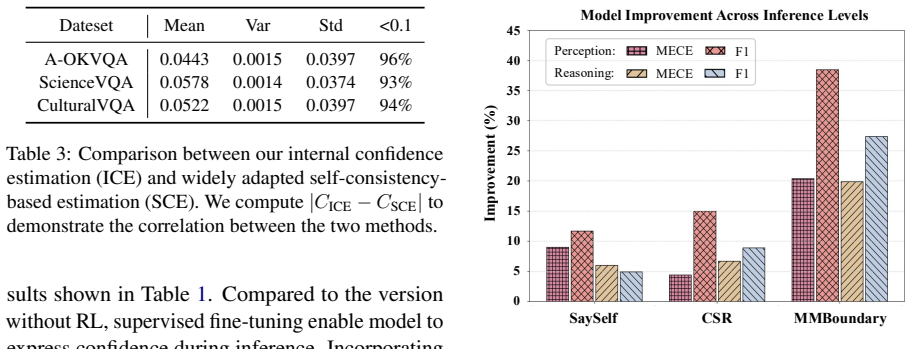
- [Section 5.2, Table 3] The validation of the internal confidence estimator (ICE) is insufficient for the claim being made. It uses only 50 randomly sampled examples, reports no error bars, confidence intervals, or significance tests, and compares ICE against self-consistency-based confidence (SCE) rather than against ground-truth correctness. A systematic sign error in Eq. (7) would not be exposed by a small average absolute difference between two noisy confidence estimates. The paper should validate ICE directly against per-sentence correctness (e.g., AUROC for distinguishing correct from incorrect reasoning steps) with confidence intervals, and should also clarify the statement that the method has 'about 6 instances of deviation': with 50 samples and an average |CICE - CSCE| of 0.0578, the total deviation is about 2.89, not 6, unless 'instances' means something else.
- [Section 4.2 / Appendix B (CulturalVQA)] The out-of-distribution claim rests on a test set of 800 CulturalVQA samples that were 'manually selected and annotated' by the authors. The selection criteria are not described, and no evidence is provided that the selected subset is representative of the full dataset rather than cherry-picked. Because the OOD generalization result is one of the main contributions (Table 1), the authors should document the selection procedure, provide the annotation instructions, and ideally use a predefined public split or multiple random subsets with variance estimates.
minor comments (4)
- [Section 3.1.1] The confidence-level interval specification is ambiguous: 'Confidence levels Cv from 5 to 1 correspond to the intervals of UFinal as [0, mu - sigma, mu + sigma, mu + 2sigma, mu + 3sigma, 1]' lists six endpoints for five intervals. Please state the five intervals separately and specify explicitly which interval maps to which confidence level.
- [Section 4.3 and Table 2] The human evaluation claims 'statistically significant improvements' but no p-values, standard deviations, or details of the statistical test are reported for the three dimensions (Faithful, Concise, Granular). Please provide this information.
- [Appendix E] For the Qwen2VL experiments, the paper should specify which CLIP model is used to compute CLIPScore, since Qwen2VL's vision encoder is not a CLIP ViT; otherwise it is unclear how Eq. (6) is applied to that backbone.
- [Throughout] There are several typographical and referencing issues: 'Se cion' in Section 3.2; the 'Step Matched' example is referenced as Figure 6 without defining the matching procedure in the main text; and the sentence about 'about 6 instances of deviation' in Section 5.2 is numerically unclear. Please clean these up.
Circularity Check
No significant circularity: final calibration is anchored to external correctness signals (RKA, REC, MECE); RCS is only a self-consistency regularizer.
full rationale
I find no circular step in the derivation chain. The warm-up stage (Sec. 3.1) builds confidence labels from internal signals (Eqs. 3-7) and trains the model to emit statements matching those labels; this is self-referential in the loose sense that the target signal comes from the model's own logits, but it is not the paper's only or final calibration signal. The RL stage (Sec. 3.2) includes RKA (Eq. 10) and REC (Eq. 11), both anchored to annotated reference chains, i.e., external ground truth, and the final evaluation (MECE, Eq. 15; AUROC, Eq. 18) compares expressed confidence against sentence-level correctness. RCS (Eq. 12) only regularizes expressed confidence toward internal confidence; it cannot by itself explain the reported calibration gains, and the ablations treat it as one component. No load-bearing claim rests on a self-citation: He et al. 2024a, Huang et al. 2025a, and Fan et al. 2025 appear in related or future-work contexts, not as justification for the framework. The Limitation section explicitly concedes that 'more research is needed to determine whether uncertainty methods can accurately reflect the model's confidence in its output,' which is an honest correctness caveat, not a circularity. Separately, the sign convention in Eqs. 6-7 (adding raw CLIPScore as if it were an uncertainty term) is a serious correctness concern, but it is an error in the estimator, not a reduction of the conclusion to its inputs.
Assumptions & free parameters
free parameters (3)
- confidence level thresholds =
μ+σ, μ+2σ, μ+3σ of the UFinal distribution
- reward weights α, β, γ =
equal to each other (exact value not reported)
- number of confidence levels =
5
assumptions (3)
- domain assumption The four uncertainty estimates (ULNLP, MTE, TokenSAR, CLIPScore) are valid proxies for the model's per-step confidence.
- domain assumption GPT-4o-generated reference reasoning chains are accurate per-step ground truth.
- domain assumption Sentence matching via RoBERTa with threshold 0.64 correctly identifies semantically aligned knowledge.
Cite this review
Pith. "Pith review of MMBoundary: Advancing MLLM Knowledge Boundary Awareness through Reasoning Step Confidence Calibration." pith.science (2026). https://pith.science/paper/PHBGAU2H
@misc{pith2026250523224,
  author       = {Pith},
  title        = {Pith review of: MMBoundary: Advancing MLLM Knowledge Boundary Awareness through Reasoning Step Confidence Calibration},
  year         = {2026},
  howpublished = {\url{https://pith.science/paper/PHBGAU2H}},
  note         = {Machine review of arXiv:2505.23224}
}
read the original abstract
In recent years, multimodal large language models (MLLMs) have made significant progress but continue to face inherent challenges in multimodal reasoning, which requires multi-level (e.g., perception, reasoning) and multi-granular (e.g., multi-step reasoning chain) advanced inferencing. Prior work on estimating model confidence tends to focus on the overall response for training and calibration, but fails to assess confidence in each reasoning step, leading to undesirable hallucination snowballing. In this work, we present MMBoundary, a novel framework that advances the knowledge boundary awareness of MLLMs through reasoning step confidence calibration. To achieve this, we propose to incorporate complementary textual and cross-modal self-rewarding signals to estimate confidence at each step of the MLLM reasoning process. In addition to supervised fine-tuning MLLM on this set of self-rewarded confidence estimation signal for initial confidence expression warm-up, we introduce a reinforcement learning stage with multiple reward functions for further aligning model knowledge and calibrating confidence at each reasoning step, enhancing reasoning chain self-correction. Empirical results show that MMBoundary significantly outperforms existing methods across diverse domain datasets and metrics, achieving an average of 7.5% reduction in multimodal confidence calibration errors and up to 8.3% improvement in task performance.
Figures


Figures from the paper (6 more)


Forward citations
Cited by 1 Pith paper
-
CultureCLIP: Empowering CLIP with Cultural Awareness through Synthetic Images and Contextualized Captions
CultureCLIP fine-tunes CLIP on synthetic twin image-caption pairs of visually similar, culturally distinct concepts, improving fine-grained cultural accuracy by up to 5.49% while preserving general performance.
Reference graph
Works this paper leans on
-
[1]
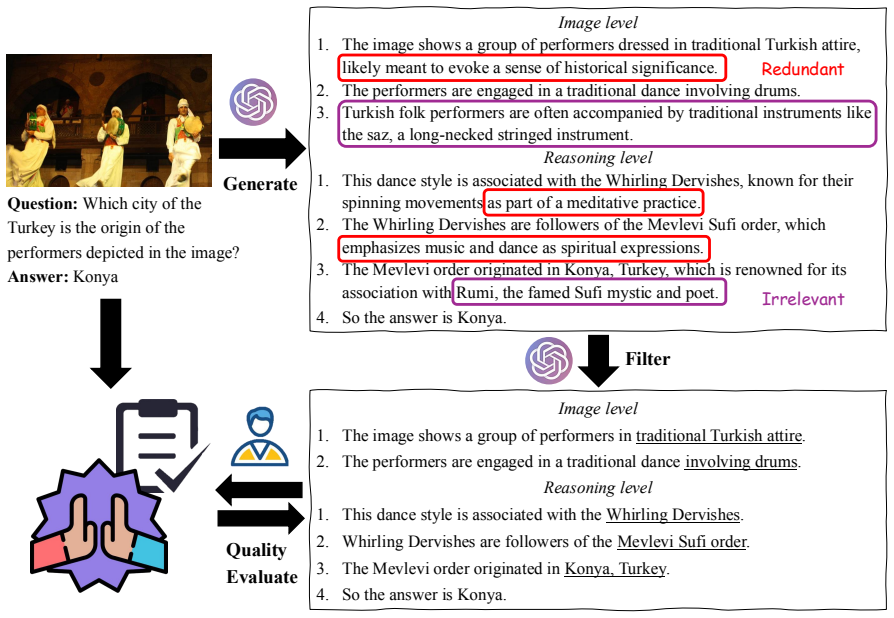
The image shows a group of performers dressed in traditional Turkish attire, likely meant to evoke a sense of historical significance
-
[2]
Advances in Neu- ral Information Processing Systems, 36
Direct preference optimization: Your language model is secretly a reward model. Advances in Neu- ral Information Processing Systems, 36. John Schulman, Philipp Moritz, Sergey Levine, Michael Jordan, and Pieter Abbeel. 2015. High-dimensional continuous control using generalized advantage esti- mation. arXiv preprint arXiv:1506.02438. John Schulman, Filip W...
arXiv 2015
-
[3]
arXiv preprint arXiv:2405.20974
Sayself: Teaching llms to express confi- dence with self-reflective rationales. arXiv preprint arXiv:2405.20974. Yao Xu, Mingyu Xu, Fangyu Lei, Wangtao Sun, Xi- angrong Zeng, Bingning Wang, Guang Liu, Shizhu He, Jun Zhao, and Kang Liu. 2025. Amplify ad- jacent token differences: Enhancing long chain- of-thought reasoning with shift-ffn. Preprint, arXiv:25...
arXiv 2025
- [4]
-
[5]
The performers are engaged in a traditional dance involving drums
-
[6]
Turkish folk performers are often accompanied by traditional instruments like the saz, a long-necked stringed instrument. Reasoning level
-
[7]
This dance style is associated with the Whirling Dervishes, known for their spinning movements as part of a meditative practice
-
[8]
The Whirling Dervishes are followers of the Mevlevi Sufi order, which emphasizes music and dance as spiritual expressions
Show all 17 references
-
[9]
The Mevlevi order originated in Konya, Turkey, which is renowned for its association with Rumi, the famed Sufi mystic and poet
-
[11]
The image shows a group of performers in traditional Turkish attire
-
[12]
Reasoning level
The performers are engaged in a traditional dance involving drums. Reasoning level
-
[13]
This dance style is associated with the Whirling Dervishes
-
[14]
Whirling Dervishes are followers of the Mevlevi Sufi order
-
[15]
The Mevlevi order originated in Konya, Turkey
-
[16]
Filter Generate Quality Evaluate Figure 5: The Annotation Pipeline
So the answer is Konya. Filter Generate Quality Evaluate Figure 5: The Annotation Pipeline. We first prompt GPT-4o to generate an analysis (reasoning chain) structured at the perception and reasoning levels. Then, we have GPT-4o filter and correct the initially annotated chain...
2016
-
[2022]
matches
to evaluate the quality of the reasoning chain generated by the model. We compare the knowl- edge contained in the predictions and references. First, we split the predicted and reference chains into “steps” by sentence. We then compute a matrix Score 10 8 6 4 2 Faithful Concis...
2022
-
[2024]
arXiv preprint arXiv:2404.18930
Hallucination of multimodal large language models: A survey. arXiv preprint arXiv:2404.18930. Xiang Chen, Chenxi Wang, Yida Xue, Ningyu Zhang, Xiaoyan Yang, Qiang Li, Yue Shen, Lei Liang, Jin- jie Gu, and Huajun Chen. 2024. Unified hallucina- tion detection for multimodal larg...
2024 arXiv
Reviewed August 7, 2026 · model on record in the stance chip above.
Discussion (0). Sign in to comment.