REVIEW 5 major objections 4 minor 40 references
How to Evaluate Participant Contributions in Decentralized Federated Learning
T0 review · 5 major / 4 minor · reviewed 2026-08-07 · deepseek-v4-flash
Pith's one-line read TRIP-Shapley estimates every client's contribution in decentralized federated learning by tracing how local contributions propagate through peer-to-peer model exchanges, closing the gap to exact Shapley values.
desk verdict First practical contribution evaluation for DFL; the recursive propagation idea is new and the small-scale validation is honest, but the central recursion lacks derivation and a no-propagation baseline is missing. read the letter →
The pith
A machine-rendered reading of the paper's core claim, the machinery that carries it, and where it could break.
The reading
What carries the argument
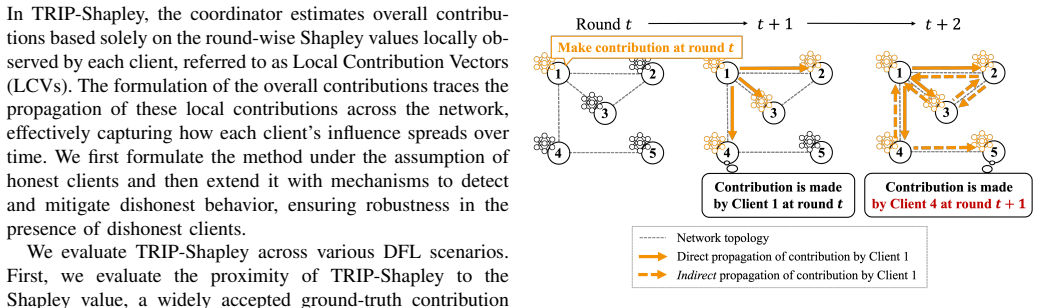
The central object is the Local Contribution Vector (LCV), a per-client, per-round Shapley-value vector computed by evaluating hypothetical aggregates in which a non-selected neighbor's post-training model is replaced by its pre-training model, isolating that round's true marginal contribution. LCVs feed the recursive propagation update (Eq. 3), whose first term mirrors the weighted-average model aggregation to carry inherited contributions forward and whose second term injects the new round's local contributions. This recursion is what lets the coordinator assemble global totals without ever seeing a model.
What would settle it
Run an n=8 DFL training run where a dataset useful to one client only becomes valuable after passing through several intermediate clients, compute the exact Shapley value by rerunning training for every client subset, and check whether TRIP-Shapley's cosine distance to that ground truth stays small; if the distance grows with the number of hops or rounds, the linear propagation recursion is missing real training dynamics.
Extended reading notes
Core claim
The central claim is that a client's cumulative contribution to a final model can be recovered by recursively averaging the previous round's contribution vectors of the client and its neighbors, weighted exactly like the model aggregation, and then adding the current round's locally observed Shapley contributions. This recursion, $\phi_i^{(t+1)} = \frac{\sum_{j \in N(i,t)} w_j \phi_j^{(t)}}{\sum w_j} + \psi_{(i,t)}$, turns a dynamic, network-mediated credit-assignment problem into a lightweight computation the coordinator can run from reported vectors. The paper reports that the resulting scores sit close to the exact Shapley value, with cosine distances as low as 0.007 and 0.012 under varied data distributions and topologies, and that high-scoring clients are the ones whose removal hurts accuracy most.
Load-bearing premise
The load-bearing premise is that every client evaluates candidate aggregates on one shared held-out test set, so a local Shapley value can be computed at all; on top of that, the recursion assumes contributions flow through model averaging as a linear, additive diffusion, an assumption stated but not derived from training dynamics.
Editorial extensions
If this is right
- In DFL systems with a lightweight coordinator, participant rewards and aggregation weights can be set from TRIP-Shapley scores without collecting model parameters.
- The method captures delayed influence: a client whose update travels through intermediate nodes still receives credit in the final models of distant clients.
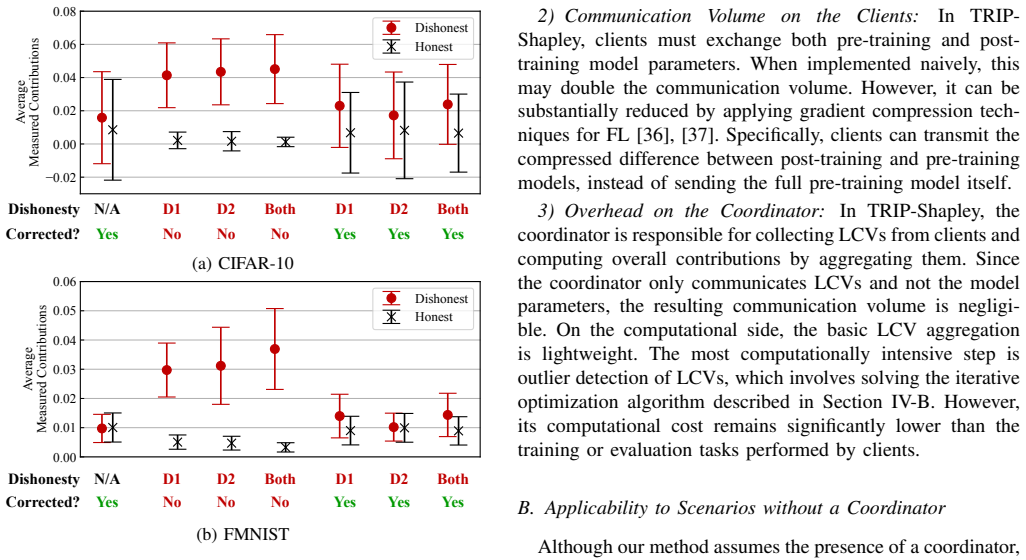
- The protocol detects two concrete manipulations—falsified pre-training models and falsified LCVs—and corrects them through filtering and sparse-outlier regression, so measured contributions stay close to honest baselines.
- Because LCV computation can be approximated by Monte Carlo Shapley estimators, TRIP-Shapley scales to large client counts, and it was tested with 100 clients in the paper.
- The coordinator's overhead stays light; only vectors and metadata pass through it, preserving the decentralized design.
Reading between the lines
- If the linear propagation assumption is a faithful model of influence, the same recursion could be used for credit assignment in other gossip-style averaging systems, such as decentralized consensus or peer-to-peer optimization, not just federated learning.
- The reliance on a shared test set is likely the hard boundary in practice; an extension that derives LCVs from local-data-free metrics or from a small public calibration set would broaden deployment to privacy-constrained settings.
- The validation against exact Shapley uses eight clients; a natural stress test would compare TRIP-Shapley against exact Shapley on a graph with long chains to see whether approximation error grows with graph diameter.
- TRIP-Shapley scores could be used as adaptive aggregation weights, but the paper only validates the metric, not the feedback loop; testing contribution-weighted aggregation is a next step.
Editorial analysis
A structured set of objections, weighed in public.
Referee Report
Summary. The paper proposes TRIP-Shapley, a contribution-evaluation protocol for decentralized federated learning with a lightweight coordinator. Each client computes a local contribution vector (LCV) by evaluating Shapley values over its one-hop neighborhood on a shared test set, and reports this vector to the coordinator. The coordinator then updates estimated per-client contribution vectors via the recursion in Eq. (3), which combines a weighted average of previous contributions from neighbors with the new LCV. The authors claim that the resulting scores closely approximate the exact Shapley value (cosine distances as low as 0.007 and 0.012), scale to n=100 clients, and remain robust when 20% of clients falsify pre-training models or LCVs. The evaluation includes small-scale exact-Shapley comparisons under five data distributions and three topologies, client-removal experiments, correlation with dataset size/quality, and dishonesty countermeasure experiments.
Significance. If the central claim holds, TRIP-Shapley fills a genuine gap: existing FL contribution-evaluation methods are centralized and do not account for delayed propagation of influence in DFL. The protocol's reliance on locally observable LCVs and a lightweight coordinator is well matched to the DFL setting. The paper's strengths include comparing against exact Shapley values at n=8, covering multiple data distributions and topologies, and including a dishonest-client evaluation with two concrete attack types. However, the central recursion is asserted rather than derived, the evaluation lacks a no-propagation DFL baseline and variance estimates, and one reported correlation is weak; these issues currently leave the quantitative claims under-supported.
major comments (5)
- [§IV-A, Eq. (3)] The central recursion ϕ_i^{(t+1)} = (Σ w_j ϕ_j^{(t)})/(Σ w_j) + ψ_{(i,t)} is stated without derivation. It assumes that cumulative contribution vectors propagate linearly through the weighted-average aggregation rule and that the round-local LCV is an additive increment. This is not justified: model accuracy is a nonlinear function of parameters, and local training can amplify, dampen, or recombine inherited contributions. No error bound or scaling analysis with n, T, or graph diameter is given, and the only direct empirical evidence is at n=8, T=10 in Tables I and II, where the 4-regular graph has diameter 2. I recommend either deriving the rule under explicit linearity assumptions or presenting it as an approximation with a formal error bound, and supplementing with experiments that vary n, T, and network diameter.
- [§V-B, Tables I and II] The comparison against MR, TMR, GTG-Shapley, and OR does not isolate the contribution of the propagation-tracing recursion, because those baselines are evaluated in CFL settings and are, as the paper states, inapplicable to DFL. To support the claim that Eq. (3) adds value beyond round-wise LCV accumulation, the authors should include a no-propagation DFL baseline (e.g., summing LCVs without the inherited term) under the same protocol and data splits. In addition, Tables I and II report single point estimates; without variance across seeds or bootstrap intervals, the cosine distances cannot be distinguished from baseline noise.
- [§V-D, Figure 5] The text states that TRIP-Shapley scores 'generally align well' with dataset quantity, supported by 'strong correlation coefficients: 0.246 and 0.533.' A correlation of 0.246 for CIFAR-10 dataset size is weak, and the plotted outliers make the linear trend unclear. Please report the correlation type (e.g., Pearson/Spearman), confidence intervals, and the fraction of variance explained, and temper the claim accordingly.
- [§III and §V-A] The protocol requires every client to hold the same held-out test set Dtest and to evaluate candidate aggregate models on it (Eq. (5); Algorithm 1, lines 9 and 16). If no common evaluation set is available, which is common in privacy-sensitive FL deployments, the LCVs cannot be computed at all. This is a substantive deployment limitation that should be stated in the abstract and conclusion, and the paper should discuss alternatives or relaxations (e.g., using a public proxy set or local validation sets).
- [§IV-B, §V-E] The dishonest-client countermeasures depend on three unquantified hyperparameters: v_threshold in pre-training model filtering, λ in the LCV outlier-detection objective (Eq. (7)), and the L2-distance threshold for replacing LCVs. The robustness experiments in Section V-E do not report the values used or any sensitivity analysis. Without this, the claim that the countermeasures 'remain unaffected' by dishonest clients is underdetermined; please report the settings and vary them across a reasonable range.
minor comments (4)
- [§V-A] The statement that 500 entries are randomly selected from the test set 'since it is unrealistic for clients to have access to a large-scale shared test dataset' still assumes access to the test set; this should be clarified as a research setting rather than a realistic assumption.
- [§V-D, Figure 5] Figure 5 would benefit from fitted regression lines and per-point labels for the outlier clients, which would make the reported correlations easier to assess visually.
- [§IV-A and Figure 2] The notation N(i,t) is used both for the set of neighbors plus self and, in Figure 2, for the reported neighbor set; please define the notation once and use it consistently throughout.
- [§VI-A1] The overhead expression Ttrain + (m + 2^{m+1})Teval should be derived in one sentence; as written it is clear that 2^{m+1} counts subset evaluations, but the m term for pre-training filtering should be explicitly tied to Algorithm 1, line 10.
Circularity Check
No significant circularity: TRIP-Shapley is an independently specified estimator compared against an exact Shapley benchmark, with no fitted parameter or load-bearing self-citation.
full rationale
TRIP-Shapley's central recursion (Eq. 3) is an explicitly proposed estimator, not a quantity fitted to the Shapley benchmark. The LCVs (Eqs. 4-5) are local round-wise Shapley values computed from locally observable models, and the exact Shapley baseline (Eq. 1, Section V-B) is computed by independent re-simulation of the DFL process with dummy non-training clients for all 2^n subsets. No parameter or hyperparameter is tuned to minimize the cosine distances in Tables I-II; the distances are reported after the method is fully specified. The method does not rely on a self-citation chain: the coordinator assumption cites external work and the robust-regression solver is an external algorithm. The strongest caveats are that Eq. 3 assumes an additive/linear propagation of contributions and requires a shared Dtest, and the approximation is only directly tested at n=8; these are unproven assumptions and scalability limitations, not circularity. The structural similarity between the LCV 'pre-training model as dummy' construction and the ground truth 'dummy clients do not train' modification may make the benchmark congenial, but TRIP-Shapley's outputs are not computed from the Shapley values and the agreement is an empirical finding.
Assumptions & free parameters
free parameters (3)
- v_threshold (pre-training model filtering threshold) =
not reported (Section IV-B2, Algorithm 1 line 10)
- lambda (LCV outlier detection penalty) =
not reported (Equation 7)
- L2 distance threshold for LCV replacement =
not reported (Section IV-B4)
assumptions (4)
- domain assumption Every client has access to a shared test dataset Dtest and evaluates model accuracy on it.
- ad hoc to paper Client contribution vectors propagate linearly through the weighted-average aggregation rule, so the overall contribution is an additive combination of inherited and round-local parts.
- domain assumption The coordinator is honest and observes all exchange metadata, and honest clients report approximately consistent LCVs unless attacked.
- domain assumption DFL is synchronous, all clients participate in every round, and aggregation is a weighted average of model parameters.
Cite this review
Pith. "Pith review of How to Evaluate Participant Contributions in Decentralized Federated Learning." pith.science (2026). https://pith.science/paper/X5RM3QNG
@misc{pith2026250523246,
  author       = {Pith},
  title        = {Pith review of: How to Evaluate Participant Contributions in Decentralized Federated Learning},
  year         = {2026},
  howpublished = {\url{https://pith.science/paper/X5RM3QNG}},
  note         = {Machine review of arXiv:2505.23246}
}
read the original abstract
Federated learning (FL) enables multiple clients to collaboratively train machine learning models without sharing local data. In particular, decentralized FL (DFL), where clients exchange models without a central server, has gained attention for mitigating communication bottlenecks. Evaluating participant contributions is crucial in DFL to incentivize active participation and enhance transparency. However, existing contribution evaluation methods for FL assume centralized settings and cannot be applied directly to DFL due to two challenges: the inaccessibility of each client to non-neighboring clients' models, and the necessity to trace how contributions propagate in conjunction with peer-to-peer model exchanges over time. To address these challenges, we propose TRIP-Shapley, a novel contribution evaluation method for DFL. TRIP-Shapley formulates the clients' overall contributions by tracing the propagation of the round-wise local contributions. In this way, TRIP-Shapley accurately reflects the delayed and gradual influence propagation, as well as allowing a lightweight coordinator node to estimate the overall contributions without collecting models, but based solely on locally observable contributions reported by each client. Experiments demonstrate that TRIP-Shapley is sufficiently close to the ground-truth Shapley value, is scalable to large-scale scenarios, and remains robust in the presence of dishonest clients.
Figures


Figures from the paper (2 more)

Reference graph
Works this paper leans on
-
[1]
Communication-Efficient Learning of Deep Networks from Decentralized Data
Brendan McMahan, Eider Moore, Daniel Ramage, Seth Hampson, and Blaise Aguera y Arcas. Communication-Efficient Learning of Deep Networks from Decentralized Data. In Proceedings of the 20th Inter- national Conference on Artificial Intelligence and Statistics (AISTATS) , volume 54, pages 1273–1282, 20–22 Apr 2017
work page 2017
-
[2]
Fully decentralized federated learning
Anusha Lalitha, Shubhanshu Shekhar, Tara Javidi, and Farinaz Koushan- far. Fully decentralized federated learning. In Third workshop on bayesian deep learning (NeurIPS) , volume 2, 2018
work page 2018
-
[3]
BrainTorrent: A Peer-to-Peer Environment for Decentralized Federated Learning
Abhijit Guha Roy, Shayan Siddiqui, Sebastian P ¨olsterl, Nassir Navab, and Christian Wachinger. BrainTorrent: A Peer-to-Peer Environment for Decentralized Federated Learning. arXiv:1905.06731, May 2019
arXiv 1905
-
[4]
GossipFL: A Decentralized Federated Learning Framework With Sparsified and Adap- tive Communication
Zhenheng Tang, Shaohuai Shi, Bo Li, and Xiaowen Chu. GossipFL: A Decentralized Federated Learning Framework With Sparsified and Adap- tive Communication. IEEE Transactions on Parallel and Distributed Systems, 34(3):909–922, March 2023
work page 2023
-
[5]
Adaptive Configuration for Heterogeneous Participants in Decentralized Federated Learning
Yunming Liao, Yang Xu, Hongli Xu, Lun Wang, and Chen Qian. Adaptive Configuration for Heterogeneous Participants in Decentralized Federated Learning. In IEEE Conference on Computer Communications (INFOCOM 2023), May 2023
work page 2023
-
[6]
Incentive Mechanisms in Federated Learning and A Game-Theoretical Approach
Rongfei Zeng, Chao Zeng, Xingwei Wang, Bo Li, and Xiaowen Chu. Incentive Mechanisms in Federated Learning and A Game-Theoretical Approach. IEEE Network, 36(6):229–235, November 2022
work page 2022
-
[7]
Incentive Mechanism for Horizontal Federated Learning Based on Reputation and Reverse Auction
Jingwen Zhang, Yuezhou Wu, and Rong Pan. Incentive Mechanism for Horizontal Federated Learning Based on Reputation and Reverse Auction. In Proceedings of the Web Conference 2021 (WWW 2021) , pages 947–956, 2021
work page 2021
-
[8]
Efficient Participant Contribution Evaluation for Horizontal and Vertical Federated Learning
Junhao Wang, Lan Zhang, Anran Li, Xuanke You, and Haoran Cheng. Efficient Participant Contribution Evaluation for Horizontal and Vertical Federated Learning. In 2022 IEEE 38th International Conference on Data Engineering (ICDE) , pages 911–923, May 2022
work page 2022
Show all 40 references
-
[9]
Optimizing Federated Learning on Non-IID Data Using Local Shapley Value
Zuoqi Tang, Feifei Shao, Long Chen, Yunan Ye, Chao Wu, and Jun Xiao. Optimizing Federated Learning on Non-IID Data Using Local Shapley Value. In Artificial Intelligence, pages 164–175, 2021
2021
-
[10]
Profit Allocation for Federated Learning
Tianshu Song, Yongxin Tong, and Shuyue Wei. Profit Allocation for Federated Learning. In 2019 IEEE International Conference on Big Data (Big Data) , pages 2577–2586, February 2019
2019
-
[11]
GTG- Shapley: Efficient and Accurate Participant Contribution Evaluation in Federated Learning
Zelei Liu, Yuanyuan Chen, Han Yu, Yang Liu, and Lizhen Cui. GTG- Shapley: Efficient and Accurate Participant Contribution Evaluation in Federated Learning. ACM Transactions on Intelligent Systems and Technology, 13(4):1–21, August 2022
2022
-
[12]
Efficient and Fair Data Valuation for Horizontal Federated Learning
Shuyue Wei, Yongxin Tong, Zimu Zhou, and Tianshu Song. Efficient and Fair Data Valuation for Horizontal Federated Learning. In Federated Learning: Privacy and Incentive , pages 139–152. 2020
2020
-
[13]
Toward understanding the influence of individual clients in federated learning
Yihao Xue, Chaoyue Niu, Zhenzhe Zheng, Shaojie Tang, Chengfei Lyu, Fan Wu, and Guihai Chen. Toward understanding the influence of individual clients in federated learning. In Proceedings of the AAAI Conference on Artificial Intelligence , volume 35, pages 10560–10567, 2021
2021
-
[14]
Measure Contribu- tion of Participants in Federated Learning
Guan Wang, Charlie Xiaoqian Dang, and Ziye Zhou. Measure Contribu- tion of Participants in Federated Learning. In 2019 IEEE International Conference on Big Data (Big Data) , pages 2597–2604, February 2019
2019
-
[15]
Procaccia
Tom Yan and Ariel D. Procaccia. If You Like Shapley Then You’ll Love the Core. Proceedings of the AAAI Conference on Artificial Intelligence, 35(6):5751–5759, May 2021
2021
-
[16]
Contribution Evaluation of Heterogeneous Participants in Federated Learning via Prototypical Representations
Qi Guo, Minghao Yao, Zhen Tian, Saiyu Qi, Yong Qi, Yun Lin, and Jin Song Dong. Contribution Evaluation of Heterogeneous Participants in Federated Learning via Prototypical Representations. arXiv:2407.02073, July 2024
2024 arXiv
-
[17]
SPACE: Single-round Participant Amalgamation for Contribution Evalu- ation in Federated Learning
Yi-Chung Chen, Hsi-Wen Chen, Shun-Gui Wang, and Ming-syan Chen. SPACE: Single-round Participant Amalgamation for Contribution Evalu- ation in Federated Learning. Advances in Neural Information Processing Systems (NeurIPS), 36:6422–6441, December 2023
2023
-
[18]
Fast, Robust and Interpretable Participant Contribution Estimation for Federated Learning
Yong Wang, Kaiyu Li, Yuyu Luo, Guoliang Li, Yunyan Guo, and Zhuo Wang. Fast, Robust and Interpretable Participant Contribution Estimation for Federated Learning. In 2024 IEEE 40th International Conference on Data Engineering (ICDE) , pages 2298–2311, May 2024
2024
-
[19]
Roth, Wenqi Li, Dong Yang, Can Zhao, Vishwesh Nath, Daguang Xu, Qi Dou, and Ziyue Xu
Meirui Jiang, Holger R. Roth, Wenqi Li, Dong Yang, Can Zhao, Vishwesh Nath, Daguang Xu, Qi Dou, and Ziyue Xu. Fair Federated Medical Image Segmentation via Client Contribution Estimation. In 2023 IEEE/CVF Conference on Computer Vision and Pattern Recogni- tion (CVPR), pages 16...
2023
-
[20]
Data-free evaluation of user contri- butions in federated learning
Hongtao Lv, Zhenzhe Zheng, Tie Luo, Fan Wu, Shaojie Tang, Lifeng Hua, Rongfei Jia, and Chengfei Lv. Data-free evaluation of user contri- butions in federated learning. In 2021 19th International Symposium on Modeling and Optimization in Mobile, Ad hoc, and Wireless Networks (W...
2021
-
[21]
A value for n-person games
Lloyd S Shapley. A value for n-person games. Contribution to the Theory of Games , 2, 1953
1953
-
[22]
Algorithmic stability and sanity-check bounds for leave-one-out cross-validation
Michael Kearns and Dana Ron. Algorithmic stability and sanity-check bounds for leave-one-out cross-validation. In Proceedings of the tenth annual conference on Computational learning theory , pages 152–162, 1997
1997
-
[23]
Rohit Parasnis, Seyyedali Hosseinalipour, Yun-Wei Chu, Mung Chiang, and Christopher G. Brinton. Connectivity-Aware Semi-Decentralized Federated Learning over Time-Varying D2D Networks. In Proceedings of the Twenty-fourth International Symposium on Theory, Algorithmic Foundatio...
2023
-
[24]
TravellingFL: Communication Efficient Peer-to-Peer Federated Learning
Vansh Gupta, Alka Luqman, Nandish Chattopadhyay, Anupam Chat- topadhyay, and Dusit Niyato. TravellingFL: Communication Efficient Peer-to-Peer Federated Learning. IEEE Transactions on Vehicular Technology, 73(4):5005–5019, April 2024
2024
-
[25]
Angelia Nedi ´c, Alex Olshevsky, and Michael G. Rabbat. Network Topology and Communication-Computation Tradeoffs in Decentralized Optimization. Proceedings of the IEEE , 106(5):953–976, May 2018
2018
-
[26]
Personalized and private peer-to-peer machine learning
Aur ´elien Bellet, Rachid Guerraoui, Mahsa Taziki, and Marc Tommasi. Personalized and private peer-to-peer machine learning. In International Conference on Artificial Intelligence and Statistics (AISTATS) , pages 473–481, 2018
2018
-
[27]
Robust estimation and wavelet thresholding in partially linear models
Ir `ene Gannaz. Robust estimation and wavelet thresholding in partially linear models. Statistics and Computing , 17(4):293–310, December 2007
2007
-
[28]
Yiyuan She and Art B. Owen. Outlier Detection Using Nonconvex Penalized Regression. Journal of the American Statistical Association , 106(494):626–639, June 2011
2011
-
[29]
MacEachern, and Yoonsuh Jung
Yoonkyung Lee, Steven N. MacEachern, and Yoonsuh Jung. Regu- larization of Case-Specific Parameters for Robustness and Efficiency. Statistical Science, 27(3):350–372, August 2012
2012
-
[30]
Learning multiple layers of features from tiny images
Alex Krizhevsky, Geoffrey Hinton, et al. Learning multiple layers of features from tiny images. 2009
2009
-
[31]
Fashion-mnist: a novel image dataset for benchmarking machine learning algorithms
Han Xiao, Kashif Rasul, and Roland V ollgraf. Fashion-mnist: a novel image dataset for benchmarking machine learning algorithms. arXiv:1708.07747, 2017
2017 arXiv
-
[32]
Watts and Steven H
Duncan J. Watts and Steven H. Strogatz. Collective dynamics of ‘small- world’ networks. Nature, 393(6684):440–442, June 1998
1998
-
[33]
Impact of Network Topol- ogy on the Convergence of Decentralized Federated Learning Systems
Hanna Kavalionak, Emanuele Carlini, Patrizio Dazzi, Luca Ferrucci, Matteo Mordacchini, and Massimo Coppola. Impact of Network Topol- ogy on the Convergence of Decentralized Federated Learning Systems. In 2021 IEEE Symposium on Computers and Communications (ISCC) , pages 1–6, S...
2021
-
[34]
Data shapley: Equitable valuation of data for machine learning
Amirata Ghorbani and James Zou. Data shapley: Equitable valuation of data for machine learning. In International Conference on Machine Learning (ICML), pages 2242–2251, 2019
2019
-
[35]
A new approximation method for the Shapley value applied to the WTC 9/11 terrorist attack
Tjeerd van Campen, Herbert Hamers, Bart Husslage, and Roy Lindelauf. A new approximation method for the Shapley value applied to the WTC 9/11 terrorist attack. Social Network Analysis and Mining , 8(1):3, December 2017
2017
-
[36]
Robust and Communication-Efficient Federated Learning From Non-i.i.d
Felix Sattler, Simon Wiedemann, Klaus-Robert M ¨uller, and Wojciech Samek. Robust and Communication-Efficient Federated Learning From Non-i.i.d. Data. IEEE Transactions on Neural Networks and Learning Systems, 31(9):3400–3413, September 2020
2020
-
[37]
Eldar, H
Nir Shlezinger, Mingzhe Chen, Yonina C. Eldar, H. Vincent Poor, and Shuguang Cui. UVeQFed: Universal Vector Quantization for Federated Learning. IEEE Transactions on Signal Processing , 69:500–514, 2021
2021
-
[38]
The Byzantine generals strike again
Danny Dolev. The Byzantine generals strike again. Journal of Algorithms, 3(1):14–30, March 1982
1982
-
[39]
On Byzantine Broadcast in Loosely Connected Networks
Alexandre Maurer and S ´ebastien Tixeuil. On Byzantine Broadcast in Loosely Connected Networks. In Distributed Computing , pages 253– 266, Berlin, Heidelberg, 2012
2012
-
[40]
Byzantine Reliable Broadcast with Low Communica- tion and Time Complexity
Thomas Locher. Byzantine Reliable Broadcast with Low Communica- tion and Time Complexity. arXiv:2404.08070, January 2025
2025 arXiv
Reviewed August 7, 2026 · model on record in the stance chip above.
Discussion (0). Sign in to comment.