REVIEW 3 major objections 5 minor 75 references
Holistic Large-Scale Scene Reconstruction via Mixed Gaussian Splatting
T0 review · 3 major / 5 minor · reviewed 2026-08-07 · deepseek-v4-flash
Pith's one-line read MixGS reconstructs whole large-scale scenes as one holistic Gaussian model, without block partitioning, and claims this beats divide-and-conquer quality while training on a single 24GB GPU.
desk verdict MixGS is a plausible, well-engineered holistic alternative to block-based large-scale 3DGS, but its decoder inherits every gap in the coarse stage, and the paper doesn't test that dependence. read the letter →
The pith
A machine-rendered reading of the paper's core claim, the machinery that carries it, and where it could break.
The reading
What carries the argument
The load-bearing mechanism is the view-aware representation plus the mixing operation. For each training view, Gaussians inside the frustum are filtered by opacity, their positions are encoded with multi-resolution hash encoding and a tiny MLP into spatial features $h_s$, while rotation, scale, and camera pose are encoded as auxiliary features $h_a$ that modulate $h_s$ through an attention-gated fusion (Eq. 9). A multi-head MLP decodes the fused features into new Gaussian attributes $\{\tilde{\alpha}, \tilde{r}, \tilde{s}, \tilde{c}\}$, and decoded positions are computed as the original positions plus per-Gaussian offsets taken from an offset pool (Eq. 11). The decoded Gaussians $G_\Phi$ are then unioned with the frustum Gaussians $G_v$ into mixed Gaussians $G_h = G_v \cup G_\Phi$ that are rasterized; this union is what preserves the coarse global structure while the decoded half adds fine detail. Training runs in three stages: coarse Gaussian training, detail-stage feature learning with coarse Gaussians frozen, then joint fine-tuning of all parameters.
What would settle it
Run MixGS on one of the four benchmark scenes with the coarse stage truncated (for example 3,000 iterations instead of 30,000) or with random rather than structure-from-motion initialization, and compare PSNR and SSIM against the full pipeline; a large drop would confirm that the offset-pool decoder cannot repair missing coarse geometry, while a small drop would show the claim survives even when that assumption is weakened.
Extended reading notes
Core claim
MixGS claims that the divide-and-conquer paradigm is unnecessary for large-scale Gaussian Splatting. The paper optimizes the holistic objective $\min_{G_c,\Phi} \sum_i \mathcal{L}(\xi(G_c \cup G_\Phi, \tau_i), I^{\mathrm{gt}}_i)$ (Eq. 5), where coarse Gaussians $G_c$ are trained first, a view-aware hash-encoded representation decodes auxiliary fine Gaussians $G_\Phi$, and the union is rendered. It reports the highest SSIM on all four tested scenes, best or near-best PSNR and LPIPS (e.g., Rubble PSNR 26.66, Residence PSNR 23.39), real-time rendering above 30 FPS on a single 24GB GPU, and memory use that stays below a few gigabytes in its reported table.
Load-bearing premise
Decoded Gaussians only nudge the coarse Gaussians' positions by small learned offsets, so the whole method depends on the coarse stage already placing a Gaussian near every surface that matters; if the coarse stage misses a structure, such as a textureless region or a badly initialized area, the decoder cannot invent it.
Editorial extensions
If this is right
- Scene-specific partitioning parameters, such as block count, visibility thresholds, and intersection thresholds, disappear from the pipeline, so applying the method to a new environment no longer requires re-tuning.
- Global illumination and geometry remain consistent across the whole scene because the objective couples all Gaussians through shared camera views instead of optimizing each block in isolation.
- Gaussian densification becomes implicit: decoded Gaussians add detail without globally multiplying the primitive count, which is what keeps training within a single 24GB GPU.
- Rendering stays real-time, above 30 FPS on the tested scenes, so the holistic model does not trade away interactive speed.
- On the Mill19 and UrbanScene3D scenes, the method reports the highest SSIM on every scene and best or competitive PSNR and LPIPS, and the margin improves further when images are downsampled by 6x.
Reading between the lines
- If coarse-stage quality is the real bottleneck, adding depth or LiDAR supervision to the coarse stage is a natural next step, because decoded Gaussians only add offsets around existing positions and cannot create entirely missing geometry.
- The freedom from block counts suggests a testable scaling path: hold the decoder fixed and grow the scene by streaming batches of images, which would turn the single-GPU holistic objective into a distributed one without reintroducing boundaries.
- The mixing operation doubles the number of Gaussians inside each view, so the claimed memory savings depend on not densifying the global set; a stress test with an order-of-magnitude larger scene would show whether the bounded-memory result persists.
Editorial analysis
A structured set of objections, weighed in public.
Referee Report
Summary. The paper proposes MixGS, a holistic framework for large-scale 3D Gaussian splatting that avoids explicit scene partitioning. The method first trains coarse Gaussians, then for each view extracts the Gaussians in the frustum, encodes their positions with multi-resolution hash encoding together with auxiliary attributes and camera pose, and decodes per-Gaussian refinements (opacity, rotation, scale, color, and position offset) via a lightweight MLP. The decoded Gaussians are mixed with the original coarse Gaussians and rendered with the standard 3DGS rasterizer. A three-stage optimization trains the coarse stage, the implicit feature decoder, and then a joint fine-tune. Experiments on Mill19 and UrbanScene3D report improvements in PSNR/SSIM over several divide-and-conquer baselines, with training on a single RTX 3090 24GB GPU, and the appendix provides additional comparisons at 6x downsampling, computational overhead, and qualitative depth results.
Significance. If the reported results hold, MixGS offers a conceptually attractive alternative to divide-and-conquer large-scale reconstruction: a single, globally consistent optimization without scene-block tuning, which is a useful direction for the community. The method is clearly formulated and the paper provides quantitative comparisons on established benchmarks, memory/timing measurements, and a component ablation. The strengths are the clean holistic objective, the view-aware feature decoding, and the demonstration that a single 24GB GPU can train on these scenes. However, the evidence for the central claim rests on experiments that, as detailed below, need additional robustness and fairness checks before the state-of-the-art claim is fully supported.
major comments (3)
- [Sec. 3.3, Eq. (11)] The decoder produces exactly one Gaussian per coarse Gaussian in the view frustum (N_Phi = N_v), with positions given by the coarse position plus a learned offset. This means the decoder can perturb existing primitives but cannot create primitives in regions where the coarse stage has no Gaussians. The paper itself states the offset approach is effective only "when the coarse Gaussian position is already close to the target structure" (Sec. 3.3). This precondition is load-bearing for the claimed holistic fine-detail reconstruction, yet the only ablation of the coarse stage is binary (Table 3, "w/o CT"), which removes it entirely. I recommend adding experiments that vary coarse-stage quality, for example coarse-stage iteration count, image downsampling factor, or COLMAP point density, to show that the method's fidelity does not degrade sharply when the coarse stage is weaker. Without such evidence, the central claim is not robustly supported.
- [Table 1 and Sec. 4.1] The main quantitative comparison mixes deprecation factors: DOGS is evaluated at 6x downsampling while all other methods, including MixGS, are evaluated at 4x. The authors acknowledge this and provide a 6x comparison in Appendix A (Table 4), where MixGS at 6x outperforms DOGS. However, the main table is the basis for the abstract's "state-of-the-art rendering quality" claim, and presenting a mixed-resolution table without a clear visual separation is misleading. I recommend restructuring the main results to report a consistent downsampling factor for all methods, or at minimum moving the 6x comparison into the main table and clearly labeling the downsampling factor for each entry. Additionally, the claim that MixGS "consistently delivers either the best or highly competitive results" is not fully supported by Table 1: on Building and Rubble, the LPIPS of MixGS is worse than DOGS (0.261 vs. 0.204 and 0.267 vs. 0.257, respectively), and on Sci-Art the PSNR is below Mega-NeRF and Switch-NeRF. The wording should be made more precise.
- [Sec. 4.3, Table 3] The ablation study is performed on a single scene (Rubble) and without multiple seeds or error bars. Since the relative gains of MixGS vary considerably across the four scenes (e.g., Sci-Art PSNR is below several NeRF baselines), a one-scene ablation is not sufficient to establish that each component contributes consistently to the reported improvements. I ask the authors to report ablations on at least one additional scene, or to provide a clear justification for why Rubble is representative, and to include variance or repeated-run information where feasible.
minor comments (5)
- [Sec. 4.1, Implementation Details] Several key hyperparameters are not specified, including the hash encoding bounds (N_min, N_max), number of levels L, hash table size T, the opacity filtering threshold used to select Gaussians in the view frustum, and the design/initialization/update rule of the offset pool. These details are necessary for reproducibility and should be reported in the paper or in a supplementary file.
- [Table 2 and Sec. 4.2] The FPS comparison uses different hardware: MixGS runs on an RTX 3090 while the compared methods run on an A100. While the conclusion that MixGS achieves real-time speed on a single consumer GPU is interesting, the claim that it "outperforms or matches methods with more powerful A100 GPUs" should be carefully qualified, because raw FPS across different GPU generations is not directly comparable.
- [Sec. 5 and Appendix B] The abstract says the method "significantly reduc[es] computational requirements," but Table 5 shows that the wall-clock training time of MixGS (e.g., 14:39 on Building) is much larger than that of plain 3DGS (2:39) and comparable to some multi-GPU methods when measured in wall-clock time. The reduction is in total GPU resources and single-GPU memory. The text should clarify this distinction to avoid overstatement.
- [Throughout] The manuscript contains several typos and minor wording issues, e.g., "follow-up workss" (Sec. 2), "we conduct a experiments" (Sec. 4.1), and inconsistent use of "deprecation" vs. "downsampling" in some places. A careful proofread would improve readability.
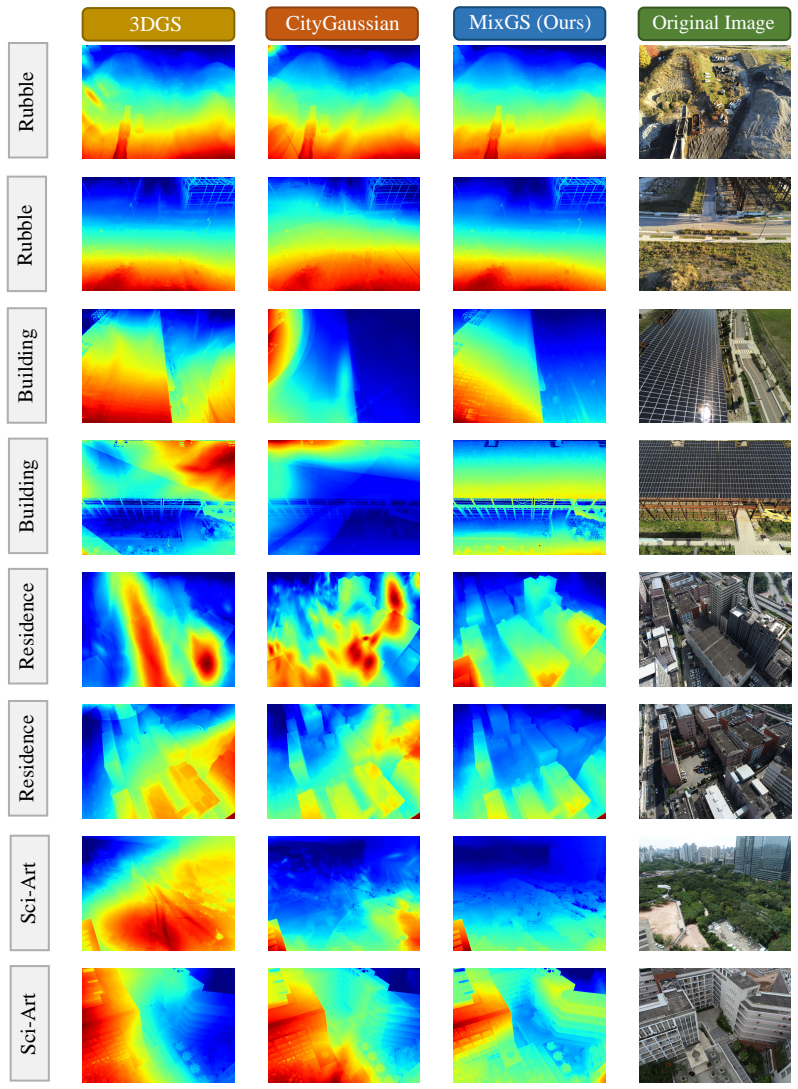
- [Appendix C, Fig. 6] The depth rendering comparison is qualitative and would benefit from quantitative depth error metrics if the claim of "highly accurate geometric representation" is to be substantiated. If depth is not a central contribution, this claim should be softened.
Circularity Check
No circularity: MixGS is trained with a single supervised objective (Eq. 5) and evaluated on held-out test views; no fitted parameter is renamed as a prediction and no load-bearing self-citation is used.
full rationale
The paper's derivation chain is self-contained. The central objective (Eq. 5) is min over G_c and Phi of sum_i L(render(G_c union G_Phi, tau_i), I_gt_i), a standard supervised reconstruction loss over training images, and the reported PSNR/SSIM/LPIPS values use separate test-view splits (Sec. 4.1: Building, Rubble, Residence, and Sci-Art contain 1920, 1657, 2582, and 3620 training images and 20, 21, 21, and 21 testing images, respectively). Eq. 11 expresses decoded centers as coarse centers plus learned offsets (tilde mu = mu + o), which is an architectural choice rather than a definition of the target metric; the offsets are optimized, not fitted to test data. The ablation study (Table 3) is run on the Rubble scene, and each removed component is retrained under the same data split, so the contribution claims are benchmark-based rather than circular. The paper cites standard prior work (3DGS, hash encoding, Mega-NeRF, CityGaussian, DOGS) but does not import any uniqueness theorem and does not rely on a self-citation chain; I find no author self-citations in the reference list. The only mild weakness is that the offset decoder cannot create primitives far from coarse Gaussians, which is a robustness limitation the paper itself acknowledges ('when the coarse Gaussian position is already close to the target structure', Sec. 3.3), not a circular reduction. Therefore the circularity score is 0.
Assumptions & free parameters
free parameters (5)
- Hash encoding resolution bounds (N_min, N_max, number of levels L, table size T) =
not specified
- Training stage iterations (coarse/detail/joint) =
30,000 / 40,000 / 260,000
- Image downsampling factor =
4x main, 6x appendix
- Opacity filtering threshold =
not specified
- SSIM loss weight lambda =
adopted from 3DGS default
assumptions (4)
- domain assumption COLMAP initialization and coarse 3DGS training provide a strong geometric prior for the scene.
- domain assumption Visible Gaussians selected by view frustum and opacity filtering are sufficient to represent the content of each view.
- domain assumption Per-view decoded Gaussians mixed with originals maintain global consistency without explicit cross-view regularization.
- standard math The volume rendering equation and multi-resolution hash encoding from prior work are correct and applicable.
Cite this review
Pith. "Pith review of Holistic Large-Scale Scene Reconstruction via Mixed Gaussian Splatting." pith.science (2026). https://pith.science/paper/7VF4YJC6
@misc{pith2026250523280,
  author       = {Pith},
  title        = {Pith review of: Holistic Large-Scale Scene Reconstruction via Mixed Gaussian Splatting},
  year         = {2026},
  howpublished = {\url{https://pith.science/paper/7VF4YJC6}},
  note         = {Machine review of arXiv:2505.23280}
}
read the original abstract
Recent advances in 3D Gaussian Splatting have shown remarkable potential for novel view synthesis. However, most existing large-scale scene reconstruction methods rely on the divide-and-conquer paradigm, which often leads to the loss of global scene information and requires complex parameter tuning due to scene partitioning and local optimization. To address these limitations, we propose MixGS, a novel holistic optimization framework for large-scale 3D scene reconstruction. MixGS models the entire scene holistically by integrating camera pose and Gaussian attributes into a view-aware representation, which is decoded into fine-detailed Gaussians. Furthermore, a novel mixing operation combines decoded and original Gaussians to jointly preserve global coherence and local fidelity. Extensive experiments on large-scale scenes demonstrate that MixGS achieves state-of-the-art rendering quality and competitive speed, while significantly reducing computational requirements, enabling large-scale scene reconstruction training on a single 24GB VRAM GPU. The code will be released at https://github.com/azhuantou/MixGS.
Figures


Figures from the paper (3 more)


Reference graph
Works this paper leans on
-
[1]
Barron, Ben Mildenhall, Matthew Tancik, Peter Hedman, Ricardo Martin-Brualla, and Pratul P
Jonathan T. Barron, Ben Mildenhall, Matthew Tancik, Peter Hedman, Ricardo Martin-Brualla, and Pratul P. Srinivasan. Mip-nerf: A multiscale representation for anti-aliasing neural radiance fields. In2021 IEEE/CVF International Conference on Computer Vision, ICCV 2021, Montreal, QC, Canada, October 10-17, 2021, pages 5835–5844. IEEE, 2021. 3
work page 2021
-
[2]
Barron, Ben Mildenhall, Dor Verbin, Pratul P
Jonathan T. Barron, Ben Mildenhall, Dor Verbin, Pratul P. Srinivasan, and Peter Hedman. Mip-nerf 360: Unbounded anti-aliased neural radiance fields. InIEEE/CVF Conference on Computer Vision and Pattern Recognition, CVPR 2022, New Orleans, LA, USA, June 18-24, 2022, pages 5460–5469. IEEE, 2022. 3
work page 2022
-
[3]
Barron, Ben Mildenhall, Dor Verbin, Pratul P
Jonathan T. Barron, Ben Mildenhall, Dor Verbin, Pratul P. Srinivasan, and Peter Hedman. Zip-nerf: Anti-aliased grid-based neural radiance fields. InIEEE/CVF International Conference on Computer Vision, ICCV 2023, Paris, France, October 1-6, 2023, pages 19640–19648. IEEE, 2023. 3
work page 2023
-
[4]
Au-air: A multi-modal unmanned aerial vehicle dataset for low altitude traffic surveillance
Ilker Bozcan and Erdal Kayacan. Au-air: A multi-modal unmanned aerial vehicle dataset for low altitude traffic surveillance. In2020 IEEE International Conference on Robotics and Automation (ICRA), pages 8504–8510. IEEE, 2020. 1
work page 2020
-
[5]
Textured gaussians for enhanced 3d scene appearance modeling.CoRR, abs/2411.18625, 2024
Brian Chao, Hung-Yu Tseng, Lorenzo Porzi, Chen Gao, Tuotuo Li, Qinbo Li, Ayush Saraf, Jia-Bin Huang, Johannes Kopf, Gordon Wetzstein, and Changil Kim. Textured gaussians for enhanced 3d scene appearance modeling.CoRR, abs/2411.18625, 2024. 3
arXiv 2024
-
[6]
Tensorf: Tensorial radiance fields
Anpei Chen, Zexiang Xu, Andreas Geiger, Jingyi Yu, and Hao Su. Tensorf: Tensorial radiance fields. In Computer Vision - ECCV 2022 - 17th European Conference, volume 13692, pages 333–350, 2022. 3
work page 2022
-
[7]
Mvsnerf: Fast generalizable radiance field reconstruction from multi-view stereo
Anpei Chen, Zexiang Xu, Fuqiang Zhao, Xiaoshuai Zhang, Fanbo Xiang, Jingyi Yu, and Hao Su. Mvsnerf: Fast generalizable radiance field reconstruction from multi-view stereo. In2021 IEEE/CVF International Conference on Computer Vision, ICCV 2021, Montreal, QC, Canada, October 10-17, 2021, pages 14104– 14113. IEEE, 2021. 3
work page 2021
-
[8]
Junyi Chen, Weicai Ye, Yifan Wang, Danpeng Chen, Di Huang, Wanli Ouyang, Guofeng Zhang, Yu Qiao, and Tong He. Gigags: Scaling up planar-based 3d gaussians for large scene surface reconstruction.arXiv preprint arXiv:2409.06685, 2024. 3
arXiv 2024
Show all 75 references
-
[9]
Dreg-nerf: Deep registration for neural radiance fields
Yu Chen and Gim Hee Lee. Dreg-nerf: Deep registration for neural radiance fields. InIEEE/CVF International Conference on Computer Vision, ICCV 2023, Paris, France, October 1-6, 2023, pages 22646–22656. IEEE, 2023. 3
2023
-
[10]
Dogs: Distributed-oriented gaussian splatting for large-scale 3d reconstruction via gaussian consensus
Yu Chen and Gim Hee Lee. Dogs: Distributed-oriented gaussian splatting for large-scale 3d reconstruction via gaussian consensus. InAdvances in Neural Information Processing Systems, volume 37, pages 34487–34512, 2024. 1, 3, 7, 8, 14
2024
-
[11]
Letsgo: Large-scale garage modeling and rendering via lidar-assisted gaussian primitives.ACM Transactions on Graphics (TOG), 43(6):1–18, 2024
Jiadi Cui, Junming Cao, Fuqiang Zhao, Zhipeng He, Yifan Chen, Yuhui Zhong, Lan Xu, Yujiao Shi, Yingliang Zhang, and Jingyi Yu. Letsgo: Large-scale garage modeling and rendering via lidar-assisted gaussian primitives.ACM Transactions on Graphics (TOG), 43(6):1–18, 2024. 3
2024
-
[12]
Depth-supervised nerf: Fewer views and faster training for free
Kangle Deng, Andrew Liu, Jun-Yan Zhu, and Deva Ramanan. Depth-supervised nerf: Fewer views and faster training for free. InIEEE/CVF Conference on Computer Vision and Pattern Recognition, CVPR 2022, New Orleans, LA, USA, June 18-24, 2022, pages 12872–12881. IEEE, 2022. 3
2022
-
[13]
Momentum-gs: Momentum gaussian self-distillation for high-quality large scene reconstruction.arXiv preprint arXiv:2412.04887, 2024
Jixuan Fan, Wanhua Li, Yifei Han, and Yansong Tang. Momentum-gs: Momentum gaussian self-distillation for high-quality large scene reconstruction.arXiv preprint arXiv:2412.04887, 2024. 3
2024 arXiv
-
[14]
Lightgaussian: Unbounded 3d gaussian compression with 15x reduction and 200+ FPS
Zhiwen Fan, Kevin Wang, Kairun Wen, Zehao Zhu, Dejia Xu, and Zhangyang Wang. Lightgaussian: Unbounded 3d gaussian compression with 15x reduction and 200+ FPS. In Amir Globersons, Lester Mackey, Danielle Belgrave, Angela Fan, Ulrich Paquet, Jakub M. Tomczak, and Cheng Zhang, ed...
2024
-
[15]
Flashgs: Efficient 3d gaussian splatting for large-scale and high-resolution rendering
Guofeng Feng, Siyan Chen, Rong Fu, Zimu Liao, Yi Wang, Tao Liu, Zhilin Pei, Hengjie Li, Xingcheng Zhang, and Bo Dai. Flashgs: Efficient 3d gaussian splatting for large-scale and high-resolution rendering. arXiv preprint arXiv:2408.07967, 2024. 3
2024 arXiv
-
[16]
Plenoxels: Radiance fields without neural networks
Sara Fridovich-Keil, Alex Yu, Matthew Tancik, Qinhong Chen, Benjamin Recht, and Angjoo Kanazawa. Plenoxels: Radiance fields without neural networks. InIEEE/CVF Conference on Computer Vision and Pattern Recognition, pages 5491–5500, 2022. 3
2022
-
[17]
nerf2nerf: Pairwise registration of neural radiance fields
Lily Goli, Daniel Rebain, Sara Sabour, Animesh Garg, and Andrea Tagliasacchi. nerf2nerf: Pairwise registration of neural radiance fields. InIEEE International Conference on Robotics and Automation, ICRA 2023, London, UK, May 29 - June 2, 2023, pages 9354–9361. IEEE, 2023. 3
2023
-
[18]
Ue4-nerf: Neural radiance field for real-time rendering of large-scale scene
Jiaming Gu, Minchao Jiang, Hongsheng Li, Xiaoyuan Lu, Guangming Zhu, Syed Afaq Ali Shah, Liang Zhang, and Mohammed Bennamoun. Ue4-nerf: Neural radiance field for real-time rendering of large-scale scene. In Alice Oh, Tristan Naumann, Amir Globerson, Kate Saenko, Moritz Hardt, ...
2023
-
[19]
2d gaussian splatting for geometrically accurate radiance fields
Binbin Huang, Zehao Yu, Anpei Chen, Andreas Geiger, and Shenghua Gao. 2d gaussian splatting for geometrically accurate radiance fields. InACM SIGGRAPH 2024 conference papers, pages 1–11, 2024. 3
2024
-
[20]
Ying Jiang, Chang Yu, Tianyi Xie, Xuan Li, Yutao Feng, Huamin Wang, Minchen Li, Henry Y . K. Lau, Feng Gao, Yin Yang, and Chenfanfu Jiang. VR-GS: A physical dynamics-aware interactive gaussian splatting system in virtual reality. In Andres Burbano, Denis Zorin, and Wojciech Ja...
2024
-
[21]
Geonerf: Generalizing nerf with geometry priors
Mohammad Mahdi Johari, Yann Lepoittevin, and François Fleuret. Geonerf: Generalizing nerf with geometry priors. InIEEE/CVF Conference on Computer Vision and Pattern Recognition, CVPR 2022, New Orleans, LA, USA, June 18-24, 2022, pages 18344–18347. IEEE, 2022. 3
2022
-
[22]
3d gaussian splatting for real-time radiance field rendering.ACM Trans
Bernhard Kerbl, Georgios Kopanas, Thomas Leimkühler, and George Drettakis. 3d gaussian splatting for real-time radiance field rendering.ACM Trans. Graph., 42(4):139:1–139:14, 2023. 1, 3, 4, 5, 6, 7, 8, 9, 14
2023
-
[23]
A hierarchical 3d gaussian representation for real-time rendering of very large datasets.ACM Transactions on Graphics (TOG), 43(4):1–15, 2024
Bernhard Kerbl, Andreas Meuleman, Georgios Kopanas, Michael Wimmer, Alexandre Lanvin, and George Drettakis. A hierarchical 3d gaussian representation for real-time rendering of very large datasets.ACM Transactions on Graphics (TOG), 43(4):1–15, 2024. 3, 7, 8, 15
2024
-
[24]
Retinags: Scalable training for dense scene rendering with billion-scale 3d gaussians.arXiv preprint arXiv:2406.11836, 2024
Bingling Li, Shengyi Chen, Luchao Wang, Kaimin Liao, Sijie Yan, and Yuanjun Xiong. Retinags: Scalable training for dense scene rendering with billion-scale 3d gaussians.arXiv preprint arXiv:2406.11836, 2024. 3
2024 arXiv
-
[25]
Nerf-xl: Scaling nerfs with multiple gpus
Ruilong Li, Sanja Fidler, Angjoo Kanazawa, and Francis Williams. Nerf-xl: Scaling nerfs with multiple gpus. InEuropean Conference on Computer Vision, pages 92–107. Springer, 2024. 3
2024
-
[26]
Aads: Augmented autonomous driving simulation using data-driven algorithms.Science robotics, 4(28):eaaw0863, 2019
Wei Li, CW Pan, Rong Zhang, JP Ren, YX Ma, Jin Fang, FL Yan, QC Geng, XY Huang, HJ Gong, et al. Aads: Augmented autonomous driving simulation using data-driven algorithms.Science robotics, 4(28):eaaw0863, 2019. 1
2019
-
[27]
Dreammesh4d: Video-to-4d generation with sparse-controlled gaussian-mesh hybrid representation.Advances in Neural Information Processing Systems, 37:21377– 21400, 2024
Zhiqi Li, Yiming Chen, and Peidong Liu. Dreammesh4d: Video-to-4d generation with sparse-controlled gaussian-mesh hybrid representation.Advances in Neural Information Processing Systems, 37:21377– 21400, 2024. 1
2024
-
[28]
Analytic-splatting: Anti-aliased 3d gaussian splatting via analytic integration
Zhihao Liang, Qi Zhang, Wenbo Hu, Lei Zhu, Ying Feng, and Kui Jia. Analytic-splatting: Anti-aliased 3d gaussian splatting via analytic integration. In Ales Leonardis, Elisa Ricci, Stefan Roth, Olga Russakovsky, Torsten Sattler, and Gül Varol, editors,Computer Vision - ECCV 202...
2024
-
[29]
Vastgaussian: Vast 3d gaussians for large scene reconstruction
Jiaqi Lin, Zhihao Li, Xiao Tang, Jianzhuang Liu, Shiyong Liu, Jiayue Liu, Yangdi Lu, Xiaofei Wu, Songcen Xu, Youliang Yan, et al. Vastgaussian: Vast 3d gaussians for large scene reconstruction. InProceedings of the IEEE/CVF Conference on Computer Vision and Pattern Recognition...
2024
-
[30]
Capturing, reconstructing, and simulating: The urbanscene3d dataset
Liqiang Lin, Yilin Liu, Yue Hu, Xingguang Yan, Ke Xie, and Hui Huang. Capturing, reconstructing, and simulating: The urbanscene3d dataset. In Shai Avidan, Gabriel J. Brostow, Moustapha Cissé, Gio- vanni Maria Farinella, and Tal Hassner, editors,Computer Vision - ECCV 2022 - 17...
2022
-
[31]
Neural sparse voxel fields
Lingjie Liu, Jiatao Gu, Kyaw Zaw Lin, Tat-Seng Chua, and Christian Theobalt. Neural sparse voxel fields. InAdvances in Neural Information Processing Systems 33, 2020. 3
2020
-
[32]
Deraings: Gaussian splatting for enhanced scene reconstruction in rainy environments
Shuhong Liu, Xiang Chen, Hongming Chen, Quanfeng Xu, and Mingrui Li. Deraings: Gaussian splatting for enhanced scene reconstruction in rainy environments. In Toby Walsh, Julie Shah, and Zico Kolter, editors,AAAI-25, Sponsored by the Association for the Advancement of Artificia...
2025
-
[33]
Citygaussian: Real-time high-quality large-scale scene rendering with gaussians
Yang Liu, Chuanchen Luo, Lue Fan, Naiyan Wang, Junran Peng, and Zhaoxiang Zhang. Citygaussian: Real-time high-quality large-scale scene rendering with gaussians. InEuropean Conference on Computer Vision, pages 265–282. Springer, 2024. 1, 2, 3, 4, 7, 8, 9, 14, 15
2024
-
[34]
Citygaussianv2: Efficient and geometrically accurate reconstruction for large-scale scenes.arXiv preprint arXiv:2411.00771, 2024
Yang Liu, Chuanchen Luo, Zhongkai Mao, Junran Peng, and Zhaoxiang Zhang. Citygaussianv2: Efficient and geometrically accurate reconstruction for large-scale scenes.arXiv preprint arXiv:2411.00771, 2024. 3
2024 arXiv
-
[35]
Neural rays for occlusion-aware image-based rendering
Yuan Liu, Sida Peng, Lingjie Liu, Qianqian Wang, Peng Wang, Christian Theobalt, Xiaowei Zhou, and Wenping Wang. Neural rays for occlusion-aware image-based rendering. InIEEE/CVF Conference on Computer Vision and Pattern Recognition, CVPR 2022, New Orleans, LA, USA, June 18-24,...
2022
-
[36]
David G. Lowe. Distinctive image features from scale-invariant keypoints.Int. J. Comput. Vis., 60(2):91– 110, 2004. 3
2004
-
[37]
Scaffold-gs: Structured 3d gaussians for view-adaptive rendering
Tao Lu, Mulin Yu, Linning Xu, Yuanbo Xiangli, Limin Wang, Dahua Lin, and Bo Dai. Scaffold-gs: Structured 3d gaussians for view-adaptive rendering. InIEEE/CVF Conference on Computer Vision and Pattern Recognition, CVPR 2024, Seattle, WA, USA, June 16-22, 2024, pages 20654–20664...
2024
-
[38]
Nerf in the wild: Neural radiance fields for unconstrained photo collections
Ricardo Martin-Brualla, Noha Radwan, Mehdi SM Sajjadi, Jonathan T Barron, Alexey Dosovitskiy, and Daniel Duckworth. Nerf in the wild: Neural radiance fields for unconstrained photo collections. In Proceedings of the IEEE/CVF conference on computer vision and pattern recognitio...
-
[39]
Srinivasan, Matthew Tancik, Jonathan T
Ben Mildenhall, Pratul P. Srinivasan, Matthew Tancik, Jonathan T. Barron, Ravi Ramamoorthi, and Ren Ng. Nerf: Representing scenes as neural radiance fields for view synthesis. In Andrea Vedaldi, Horst Bischof, Thomas Brox, and Jan-Michael Frahm, editors,Computer Vision - ECCV ...
2020
-
[40]
tiny-cuda-nn, 4 2021
Thomas Müller. tiny-cuda-nn, 4 2021. 6
2021
-
[41]
Instant neural graphics primitives with a multiresolution hash encoding.ACM Trans
Thomas Müller, Alex Evans, Christoph Schied, and Alexander Keller. Instant neural graphics primitives with a multiresolution hash encoding.ACM Trans. Graph., 41(4):102:1–102:15, 2022. 3, 5
2022
-
[42]
Mip-grid: Anti-aliased grid representa- tions for neural radiance fields
Seungtae Nam, Daniel Rho, Jong Hwan Ko, and Eunbyung Park. Mip-grid: Anti-aliased grid representa- tions for neural radiance fields. In Alice Oh, Tristan Naumann, Amir Globerson, Kate Saenko, Moritz Hardt, 11 and Sergey Levine, editors,Advances in Neural Information Processing...
2023
-
[43]
Urban radiance fields
Konstantinos Rematas, Andrew Liu, Pratul P Srinivasan, Jonathan T Barron, Andrea Tagliasacchi, Thomas Funkhouser, and Vittorio Ferrari. Urban radiance fields. InProceedings of the IEEE/CVF Conference on Computer Vision and Pattern Recognition, pages 12932–12942, 2022. 3
2022
-
[44]
Octree-gs: Towards consistent real-time rendering with lod-structured 3d gaussians.CoRR, abs/2403.17898, 2024
Kerui Ren, Lihan Jiang, Tao Lu, Mulin Yu, Linning Xu, Zhangkai Ni, and Bo Dai. Octree-gs: Towards consistent real-time rendering with lod-structured 3d gaussians.CoRR, abs/2403.17898, 2024. 3
2024 arXiv
-
[45]
Scube: Instant large-scale scene reconstruction using voxsplats
Xuanchi Ren, Yifan Lu, Jay Zhangjie Wu, Huan Ling, Mike Chen, Sanja Fidler, Francis Williams, Jiahui Huang, et al. Scube: Instant large-scale scene reconstruction using voxsplats. InThe Thirty-eighth Annual Conference on Neural Information Processing Systems, 2024. 3
2024
-
[46]
Barron, Ben Mildenhall, Pratul P
Barbara Roessle, Jonathan T. Barron, Ben Mildenhall, Pratul P. Srinivasan, and Matthias Nießner. Dense depth priors for neural radiance fields from sparse input views. InIEEE/CVF Conference on Computer Vision and Pattern Recognition, CVPR 2022, New Orleans, LA, USA, June 18-24...
2022
-
[47]
Schönberger and Jan-Michael Frahm
Johannes L. Schönberger and Jan-Michael Frahm. Structure-from-motion revisited. In2016 IEEE Conference on Computer Vision and Pattern Recognition, CVPR 2016, Las Vegas, NV , USA, June 27-30, 2016, pages 4104–4113. IEEE Computer Society, 2016. 3, 5, 7
2016
-
[48]
Seitz, and Richard Szeliski
Noah Snavely, Steven M. Seitz, and Richard Szeliski. Photo tourism: exploring photo collections in 3d. ACM Trans. Graph., 25(3):835–846, 2006. 3
2006
-
[49]
SA-GS: scale-adaptive gaussian splatting for training-free anti-aliasing.CoRR, abs/2403.19615,
Xiaowei Song, Jv Zheng, Shiran Yuan, Huan-ang Gao, Jingwei Zhao, Xiang He, Weihao Gu, and Hao Zhao. SA-GS: scale-adaptive gaussian splatting for training-free anti-aliasing.CoRR, abs/2403.19615,
-
[50]
Light field neural rendering
Mohammed Suhail, Carlos Esteves, Leonid Sigal, and Ameesh Makadia. Light field neural rendering. In IEEE/CVF Conference on Computer Vision and Pattern Recognition, CVPR 2022, New Orleans, LA, USA, June 18-24, 2022, pages 8259–8269. IEEE, 2022. 3
2022
-
[51]
Block-nerf: Scalable large scene neural view synthesis
Matthew Tancik, Vincent Casser, Xinchen Yan, Sabeek Pradhan, Ben Mildenhall, Pratul P Srinivasan, Jonathan T Barron, and Henrik Kretzschmar. Block-nerf: Scalable large scene neural view synthesis. In Proceedings of the IEEE/CVF conference on computer vision and pattern recogni...
-
[52]
Mega-nerf: Scalable construction of large-scale nerfs for virtual fly-throughs
Haithem Turki, Deva Ramanan, and Mahadev Satyanarayanan. Mega-nerf: Scalable construction of large-scale nerfs for virtual fly-throughs. InProceedings of the IEEE/CVF conference on computer vision and pattern recognition, pages 12922–12931, 2022. 1, 2, 3, 4, 7, 8, 9, 14, 16, 17
2022
-
[53]
Suds: Scalable urban dynamic scenes
Haithem Turki, Jason Y Zhang, Francesco Ferroni, and Deva Ramanan. Suds: Scalable urban dynamic scenes. InProceedings of the IEEE/CVF Conference on Computer Vision and Pattern Recognition, pages 12375–12385, 2023. 3
2023
-
[54]
SAGS: structure-aware 3d gaussian splatting
Evangelos Ververas, Rolandos Alexandros Potamias, Jifei Song, Jiankang Deng, and Stefanos Zafeiriou. SAGS: structure-aware 3d gaussian splatting. In Ales Leonardis, Elisa Ricci, Stefan Roth, Olga Rus- sakovsky, Torsten Sattler, and Gül Varol, editors,Computer Vision - ECCV 202...
2024
-
[55]
Dc-gaussian: Improving 3d gaussian splatting for reflective dash cam videos
Linhan Wang, Kai Cheng, Shuo Lei, Shengkun Wang, Wei Yin, Chenyang Lei, Xiaoxiao Long, and Chang-Tien Lu. Dc-gaussian: Improving 3d gaussian splatting for reflective dash cam videos. InNeural Information Processing Systems, 2024. 3
2024
-
[56]
Srinivasan, Howard Zhou, Jonathan T
Qianqian Wang, Zhicheng Wang, Kyle Genova, Pratul P. Srinivasan, Howard Zhou, Jonathan T. Barron, Ricardo Martin-Brualla, Noah Snavely, and Thomas A. Funkhouser. Ibrnet: Learning multi-view image- based rendering. InIEEE Conference on Computer Vision and Pattern Recognition, C...
2021
-
[57]
Kot, and Bihan Wen
Yufei Wang, Zhihao Li, Lanqing Guo, Wenhan Yang, Alex C. Kot, and Bihan Wen. Contextgs : Compact 3d gaussian splatting with anchor level context model. In Amir Globersons, Lester Mackey, Danielle Belgrave, Angela Fan, Ulrich Paquet, Jakub M. Tomczak, and Cheng Zhang, editors,A...
2024
-
[58]
Bovik, Hamid R
Zhou Wang, Alan C. Bovik, Hamid R. Sheikh, and Eero P. Simoncelli. Image quality assessment: from error visibility to structural similarity.IEEE Trans. Image Process., 13(4):600–612, 2004. 7
2004
-
[59]
Nerfingmvs: Guided optimization of neural radiance fields for indoor multi-view stereo
Yi Wei, Shaohui Liu, Yongming Rao, Wang Zhao, Jiwen Lu, and Jie Zhou. Nerfingmvs: Guided optimization of neural radiance fields for indoor multi-view stereo. In2021 IEEE/CVF International Conference on Computer Vision, ICCV 2021, Montreal, QC, Canada, October 10-17, 2021, pages 5590–
2021
-
[60]
Blockgaussian: Efficient large-scale scene novelview synthesis via adaptive block-based gaussian splatting.arXiv preprint arXiv:2504.09048, 2025
Yongchang Wu, Zipeng Qi, Zhenwei Shi, and Zhengxia Zou. Blockgaussian: Efficient large-scale scene novelview synthesis via adaptive block-based gaussian splatting.arXiv preprint arXiv:2504.09048, 2025. 3
2025 arXiv
-
[61]
Grid4d: 4d decomposed hash encoding for high-fidelity dynamic gaussian splatting
Jiawei Xu, Zexin Fan, Jian Yang, and Jin Xie. Grid4d: 4d decomposed hash encoding for high-fidelity dynamic gaussian splatting. In Amir Globersons, Lester Mackey, Danielle Belgrave, Angela Fan, Ulrich Paquet, Jakub M. Tomczak, and Cheng Zhang, editors,Advances in Neural Inform...
2024
-
[62]
Grid-guided neural radiance fields for large urban scenes
Linning Xu, Yuanbo Xiangli, Sida Peng, Xingang Pan, Nanxuan Zhao, Christian Theobalt, Bo Dai, and Dahua Lin. Grid-guided neural radiance fields for large urban scenes. InProceedings of the IEEE/CVF Conference on Computer Vision and Pattern Recognition, pages 8296–8306, 2023. 1...
2023
-
[63]
Multi-scale 3d gaussian splatting for anti-aliased rendering
Zhiwen Yan, Weng Fei Low, Yu Chen, and Gim Hee Lee. Multi-scale 3d gaussian splatting for anti-aliased rendering. InIEEE/CVF Conference on Computer Vision and Pattern Recognition, CVPR 2024, Seattle, WA, USA, June 16-22, 2024, pages 20923–20931. IEEE, 2024. 3
2024
-
[64]
Leonard, and Yogesh A
Daniel Yang, John J. Leonard, and Yogesh A. Girdhar. Seasplat: Representing underwater scenes with 3d gaussian splatting and a physically grounded image formation model.CoRR, abs/2409.17345, 2024. 1
2024 arXiv
-
[65]
Surfelgan: Synthesizing realistic sensor data for autonomous driving
Zhenpei Yang, Yuning Chai, Dragomir Anguelov, Yin Zhou, Pei Sun, Dumitru Erhan, Sean Rafferty, and Henrik Kretzschmar. Surfelgan: Synthesizing realistic sensor data for autonomous driving. InProceedings of the IEEE/CVF Conference on Computer Vision and Pattern Recognition, pag...
2020
-
[66]
Deformable 3d gaussians for high-fidelity monocular dynamic scene reconstruction
Ziyi Yang, Xinyu Gao, Wen Zhou, Shaohui Jiao, Yuqing Zhang, and Xiaogang Jin. Deformable 3d gaussians for high-fidelity monocular dynamic scene reconstruction. InIEEE/CVF Conference on Computer Vision and Pattern Recognition, CVPR 2024, Seattle, WA, USA, June 16-22, 2024, page...
2024
-
[67]
Differentiable surface splatting for point-based geometry processing.ACM Transactions On Graphics (TOG), 38(6):1–14, 2019
Wang Yifan, Felice Serena, Shihao Wu, Cengiz Öztireli, and Olga Sorkine-Hornung. Differentiable surface splatting for point-based geometry processing.ACM Transactions On Graphics (TOG), 38(6):1–14, 2019. 4
2019
-
[68]
Plenoctrees for real-time rendering of neural radiance fields
Alex Yu, Ruilong Li, Matthew Tancik, Hao Li, Ren Ng, and Angjoo Kanazawa. Plenoctrees for real-time rendering of neural radiance fields. InIEEE/CVF International Conference on Computer Vision, pages 5732–5741, 2021. 3
2021
-
[69]
Mip-splatting: Alias-free 3d gaussian splatting
Zehao Yu, Anpei Chen, Binbin Huang, Torsten Sattler, and Andreas Geiger. Mip-splatting: Alias-free 3d gaussian splatting. InIEEE/CVF Conference on Computer Vision and Pattern Recognition, CVPR 2024, Seattle, WA, USA, June 16-22, 2024, pages 19447–19456. IEEE, 2024. 3
2024
-
[70]
Geolrm: Geometry-aware large reconstruction model for high-quality 3d gaussian generation
Chubin Zhang, Hongliang Song, Yi Wei, Chen Yu, Jiwen Lu, and Yansong Tang. Geolrm: Geometry-aware large reconstruction model for high-quality 3d gaussian generation. InAdvances in Neural Information Processing Systems, volume 37, pages 55761–55784, 2024. 3
2024
-
[71]
Efros, Eli Shechtman, and Oliver Wang
Richard Zhang, Phillip Isola, Alexei A. Efros, Eli Shechtman, and Oliver Wang. The unreasonable effectiveness of deep features as a perceptual metric. In2018 IEEE Conference on Computer Vision and Pattern Recognition, CVPR 2018, Salt Lake City, UT, USA, June 18-22, 2018, pages...
2018
-
[72]
Efficient large-scale scene representation with a hybrid of high-resolution grid and plane features.Pattern Recognition, 158:111001, 2025
Yuqi Zhang, Guanying Chen, and Shuguang Cui. Efficient large-scale scene representation with a hybrid of high-resolution grid and plane features.Pattern Recognition, 158:111001, 2025. 3
2025
-
[73]
Switch-nerf: Learning scene decomposition with mixture of experts for large-scale neural radiance fields
MI Zhenxing and Dan Xu. Switch-nerf: Learning scene decomposition with mixture of experts for large-scale neural radiance fields. InThe Eleventh International Conference on Learning Representations,
-
[74]
Diffgs: Functional gaussian splatting diffusion.Advances in Neural Information Processing Systems, 37:37535–37560, 2024
Junsheng Zhou, Weiqi Zhang, and Yu-Shen Liu. Diffgs: Functional gaussian splatting diffusion.Advances in Neural Information Processing Systems, 37:37535–37560, 2024. 1
2024
-
[75]
Surface splatting
Matthias Zwicker, Hanspeter Pfister, Jeroen Van Baar, and Markus Gross. Surface splatting. InProceedings of the 28th annual conference on Computer graphics and interactive techniques, pages 371–378, 2001. 4 13 A Analysis of6×Downsampling Table 4. Quantitative results of our me...
2001
Reviewed August 7, 2026 · model on record in the stance chip above.
Discussion (0). Sign in to comment.