REVIEW 4 major objections 5 minor 22 references
GenCAD-Self-Repairing: Feasibility Enhancement for 3D CAD Generation
T0 review · 4 major / 5 minor · reviewed 2026-08-07 · deepseek-v4-flash
Pith's one-line read GenCAD-Self-Repairing converts 65.84% of geometry-infeasible CAD outputs into valid B-reps, raising feasibility from 0.931 to 0.970 at a modest 11.11% increase in MMD.
desk verdict A clever feasibility-repair framework for GenCAD, but the headline numbers don't match the paper's own counts, so the claimed improvement is unverifiable as written. read the letter →
The pith
A machine-rendered reading of the paper's core claim, the machinery that carries it, and where it could break.
The reading
What carries the argument
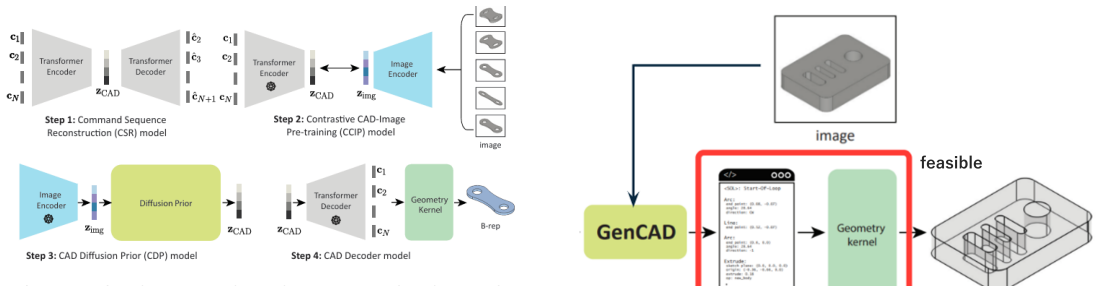
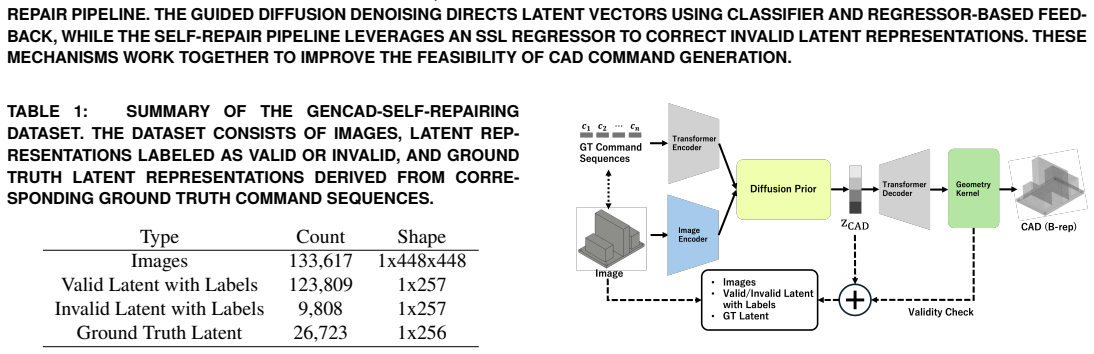
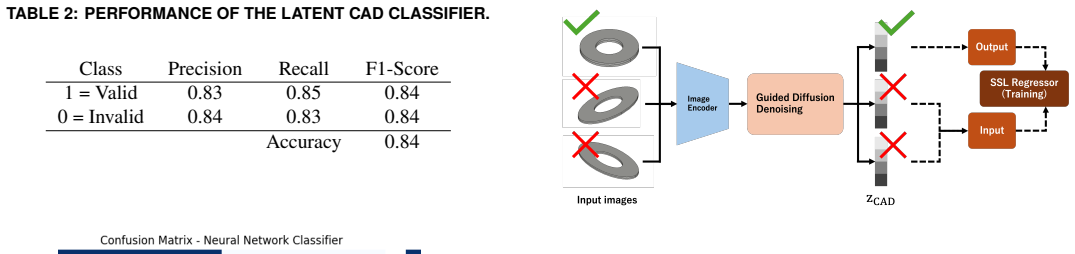
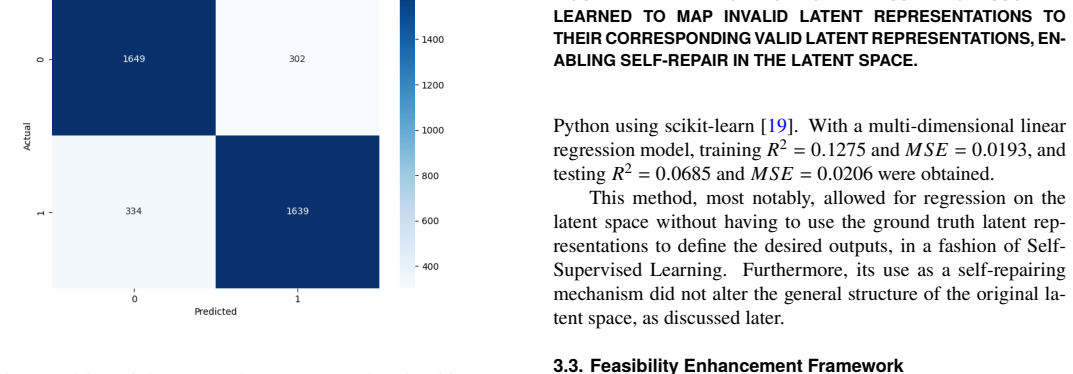
The machinery is a latent-space correction loop wrapped around GenCAD's diffusion prior and transformer decoder. The Latent CAD Classifier is an MLP with layers of 128, 64, and 1 neurons that scores whether a 256-dimensional latent vector will decode to a feasible B-rep; the SSL Regressor is a multi-dimensional linear regression trained self-supervised on 9,029 invalid-valid latent pairs to predict the valid latent for a given invalid one. Trained on 133,617 images, the classifier reaches 0.84 accuracy. The guidance uses Equations (3)-(5): the classifier's infeasibility-probability gradient and the regressor's MSE gradient are subtracted from the posterior mean at each denoising step; the self-repair pass applies the regressor again if the geometry kernel rejects the decoded command sequence. The regressor's low test $R^2=0.0685$ is reported but the method still relies on it as the correction operator.
What would settle it
Take the 808 latent vectors that the baseline GenCAD fails to decode, apply the full GenCAD-Self-Repairing correction, and pass each corrected command sequence through the geometry kernel. The claim that two-thirds of infeasible designs are converted is falsified if substantially fewer than 532 of the 808 re-decoded outputs are feasible B-reps, or if the mean MMD of the corrected set exceeds the reported 0.200 when measured against the ground-truth point clouds.
Extended reading notes
Core claim
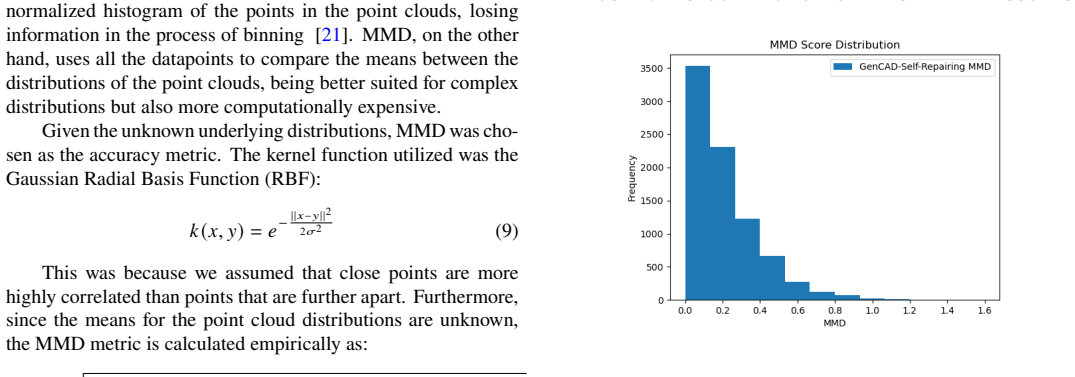
GenCAD-Self-Repairing claims that feasibility of an autoregressive CAD generator can be improved without retraining or changing the generator, by operating only on its latent space. Its guided diffusion uses two trained auxiliary models: an MLP classifier that separates valid from invalid latents and a self-supervised linear regressor that maps an invalid latent to the valid latent of the same image. During denoising, gradients from both models are subtracted from the posterior mean at scale $s_{clf}=s_{reg}=10$; after decoding, if the geometry kernel rejects the command sequence, the same regressor corrects the latent and decoding is retried. The reported result is that feasibility rises from 0.931 to 0.970 on 8,515 validation images, with 532 of 808 baseline failures repaired, at an MMD cost from 0.180 to 0.200. The authors also show a 2D PCA in which the corrected latent distribution closely overlaps the baseline, supporting the claim that the correction preserves the generative behavior.
Load-bearing premise
The load-bearing premise is that a linear mapping trained on 9,029 invalid-to-valid latent pairs, which explains almost none of the variance in held-out data (test $R^2 = 0.0685$), still points invalid latents toward the region where the geometry kernel can decode them; if that mapping is not informative, the claimed conversion of two-thirds of failures collapses.
Editorial extensions
If this is right
- If the claimed feasibility gain holds, the 8,239 feasible outputs on the validation set expand the usable training pool for downstream CAD generation models by roughly 532 designs relative to the baseline.
- The method suggests that infeasibility in autoregressive CAD generation is concentrated in a region of latent space reachable by gradient-based correction, so future generators can be made reliable by post-hoc latent repair rather than architectural changes.
- The 11.11% MMD increase implies a feasibility-accuracy tradeoff: applications that tolerate slightly less precise geometry could adopt the method as-is, while high-precision tasks would need the guidance scales tuned per shape class.
- Because the repair happens in latent space, the same wrapper could in principle be re-trained for a different decoder or geometry kernel as long as validity labels can be produced by decoding.
Reading between the lines
- An extension the paper leaves implicit is that the 276 unrepaired failures could be clustered in latent space; if they form a distinct infeasible mode, a nonlinear or piecewise correction would be needed rather than the single linear regressor.
- A test $R^2$ of 0.0685 might still suffice for repair if the feasibility boundary is locally flat and crossing it needs only a coarse direction, not a precise endpoint; this interpretation is not tested in the paper.
- A natural transfer experiment would apply the same guided-diffusion wrapper to other autoregressive CAD generators to see whether the latent boundary geometry generalizes across generators.
- Reconciling the low test $R^2$ with the strong end-to-end conversion rate would require a sensitivity study of the guidance scales $s_{clf}$ and $s_{reg}$, which the paper leaves for future work.
Editorial analysis
A structured set of objections, weighed in public.
Referee Report
Summary. The paper proposes GenCAD-Self-Repairing, a post-hoc feasibility-enhancement framework for the GenCAD image-to-CAD model. The method adds classifier-guided and regressor-guided diffusion in GenCAD's latent space, and a separate self-repair pass that maps invalid latent vectors to predicted valid ones before decoding. The authors report that on an 8,515-image validation set the method converts 532 of 808 baseline-infeasible images (65.84%) into feasible B-reps, raising the feasibility rate from 0.931 to 0.970 while increasing mean MMD from 0.180 to 0.200 (an 11.11% relative increase). The paper includes an ablation over five variants (Var1–Var5) to isolate the contributions of the classifier, the regressor, and the self-repair pipeline.
Significance. If the reported gains are reproducible, the framework is practically valuable because it improves the feasibility of an existing generative CAD model without retraining the base transformer or diffusion prior, and it uses an external geometry kernel (Open CASCADE) as the feasibility oracle, which avoids circularity between the fitted guidance and the evaluation metric. The five-variant ablation is a useful attempt to attribute the improvement to specific components. However, the central quantitative claim is internally inconsistent as written, and the mechanism attributed to a regressor with near-zero test R^2 is not convincingly explained. These issues must be resolved before the results can be assessed.
major comments (4)
- [Section 4, Table 3, Eq. (7)] The reported valid counts and the feasibility rates in Table 3 are mutually inconsistent. The text states that baseline GenCAD converted 7,707 B-reps from 8,515 images and GenCAD-Self-Repairing converted 8,239, implying baseline infeasible count 808. Direct computation using Eq. (7) gives 7,707/8,515 = 0.905, not the tabulated 0.931, and 8,239/8,515 = 0.968, not 0.970. If the counts are correct, the table and the headline '0.931 to 0.970' improvement are wrong; if the rates are correct, the counts and the '532/808' repair statistic are wrong. Since the abstract, introduction, and conclusion all rest on these numbers, the authors must correct the discrepancy and recompute all derived statistics (repair rate, MMD comparison) from the corrected counts.
- [Section 3.2.2] The regressor is called 'Self-Supervised Learned Regressor' and the text claims it learns 'without having to use the ground truth latent representations to define the desired outputs.' This is contradicted by the training description: invalid latent vectors are inputs and the corresponding valid latent vectors from the same image serve as outputs, and those valid latent vectors are derived from ground truth command sequences via the GenCAD transformer encoder (Section 3.1). That is supervised regression with ground-truth paired targets, not self-supervised learning. The authors should rename the component and revise the rationale, because the claimed advantage of avoiding ground-truth targets is false and the method name appears throughout the paper.
- [Section 4, Table 3 and Section 3.3] The mechanism by which a linear regressor with test R^2 = 0.0685 (Section 3.2.2) drives large feasibility gains is unexplained. In the ablation, Var1 (self-repair with this regressor alone) raises feasibility from 0.931 to 0.961, and the full method raises it to 0.970, yet the regressor explains almost no variance in the target mapping. The paper provides no analysis of what the regressor actually predicts (e.g., whether predictions are close to identity, whether they consistently shift latents toward the valid side of the classifier boundary) and no sensitivity study over the guidance scales s_clf and s_reg. Such an analysis is needed to support the claim that the reported gains are due to the proposed guidance and repair mechanism rather than to incidental properties of the post-processing.
- [Section 4, Table 3] All results are reported from a single evaluation run with no error bars, confidence intervals, or repeated runs. Several differences in Table 3 are small (e.g., Var3 and Var4 at 0.936 vs. baseline 0.931), so without variance information it is impossible to tell whether those ablations differ from baseline at all. The authors should report means and standard deviations over multiple seeds or at least provide a statistical significance test for the key feasibility-rate and MMD differences.
minor comments (5)
- [Section 3.2.2] The reported regressor metrics are given as 'training R^2 = 0.1275 and MSE = 0.0193, and testing R^2 = 0.0685 and MSE = 0.0206'; please add the sample counts and the latent dimension used for the regressor, and keep the formatting of the numbers consistent.
- [Section 4.2] The subsection heading '4.2. Evaluation Metrics' is followed by another subsection also numbered '4.2. Benchmark Evaluation'; the second should be renumbered 4.3.
- [Section 3.2.2] The sentence 'not all the images with invalid latent vectors were paired with at least one valid latent vector' is unclear; please specify how the 9,029 invalid-valid pairs were selected from the 9,808 invalid latents, since this affects the representativeness of the regressor training set.
- [Section 4.2, Eq. (9)] The Gaussian RBF kernel bandwidth sigma in Eq. (9) is never specified; since MMD values are the paper's accuracy metric, the authors should state the value of sigma used in the empirical MMD computation.
- [Section 1] The abstract and introduction state that GenCAD produces approximately 10% infeasible B-reps, but the baseline feasibility in this paper's own evaluation is 0.905 (or 0.931 as tabulated); please reconcile the stated percentage with the actual validation-set numbers.
Circularity Check
No circularity: external geometry-kernel oracle and independent validation keep the feasibility claim from reducing to its inputs.
full rationale
The derivation chain is self-contained with respect to the claimed novelty. Baseline infeasibility and repaired feasibility are scored by the Open CASCADE geometry kernel, an external oracle that the paper does not fit, so the feasibility improvement is not predetermined by the regression or guidance objectives. The SSL Regressor is trained on paired invalid-latent/valid-latent vectors (Sec. 3.2.2) and then applied to latents from the GenCAD validation set; although the text calls this self-supervised, the training actually uses ground-truth valid latents as targets, but the evaluation metric (kernel-decoded B-rep feasibility) is not identical to the regressor's MSE loss, so the improvement is an empirical outcome rather than a definitional tautology. Reliance on GenCAD [1] is as a baseline and backbone, and the comparison is externally scored; no uniqueness theorem or ansatz is imported via self-citation. Separately, the internal arithmetic inconsistency in Sec. 4.2 (7,707/8,515 = 0.905 vs Table 3's 0.931; 8,239/8,515 = 0.968 vs 0.970) is a correctness and verifiability defect, not a circularity, and does not affect this verdict.
Assumptions & free parameters
free parameters (3)
- s_clf =
10
- s_reg =
10
- MMD RBF kernel bandwidth sigma =
unspecified
assumptions (3)
- domain assumption Open CASCADE geometry kernel success is a valid and consistent indicator of CAD command sequence feasibility
- domain assumption GenCAD latent space is locally structured enough for linear regression and gradient guidance to move invalid latents into feasible regions
- standard math Empirical MMD estimator in Eq. (10) is a consistent measure of point-cloud distribution distance
Cite this review
Pith. "Pith review of GenCAD-Self-Repairing: Feasibility Enhancement for 3D CAD Generation." pith.science (2026). https://pith.science/paper/YA46O7VH
@misc{pith2026250523287,
  author       = {Pith},
  title        = {Pith review of: GenCAD-Self-Repairing: Feasibility Enhancement for 3D CAD Generation},
  year         = {2026},
  howpublished = {\url{https://pith.science/paper/YA46O7VH}},
  note         = {Machine review of arXiv:2505.23287}
}
read the original abstract
With the advancement of generative AI, research on its application to 3D model generation has gained traction, particularly in automating the creation of Computer-Aided Design (CAD) files from images. GenCAD is a notable model in this domain, leveraging an autoregressive transformer-based architecture with a contrastive learning framework to generate CAD programs. However, a major limitation of GenCAD is its inability to consistently produce feasible boundary representations (B-reps), with approximately 10% of generated designs being infeasible. To address this, we propose GenCAD-Self-Repairing, a framework that enhances the feasibility of generative CAD models through diffusion guidance and a self-repairing pipeline. This framework integrates a guided diffusion denoising process in the latent space and a regression-based correction mechanism to refine infeasible CAD command sequences while preserving geometric accuracy. Our approach successfully converted two-thirds of infeasible designs in the baseline method into feasible ones, significantly improving the feasibility rate while simultaneously maintaining a reasonable level of geometric accuracy between the point clouds of ground truth models and generated models. By significantly improving the feasibility rate of generating CAD models, our approach helps expand the availability of high-quality training data and enhances the applicability of AI-driven CAD generation in manufacturing, architecture, and product design.
Figures


Figures from the paper (8 more)




Reference graph
Works this paper leans on
-
[1]
Alam, Md Ferdous and Ahmed, Faez. “GenCAD: Image-Conditioned Computer-Aided Design Generation with Transformer-Based Contrastive Representation and Diffusion Priors.” (2024). URL 2409.16294, URL https: //arxiv.org/abs/2409.16294
arXiv 2024
-
[2]
Keskar, Ankush. “Driving operational excellence in manu- facturingthroughgenerativeAI:Transformativeapproaches for efficiency, innovation, and scalability.”International JournalofResearchandAnalyticalReviews Vol.11(2024): pp. 245–261
work page 2024
-
[3]
High-Resolution Image Synthesis With Latent Diffusion Models
Rombach, Robin, Blattmann, Andreas, Lorenz, Dominik, Esser, Patrick and Ommer, Björn. “High-Resolution Image Synthesis With Latent Diffusion Models.”Proceedings of theIEEE/CVFConferenceonComputerVisionandPattern Recognition (CVPR): pp. 10684–10695. 2022
work page 2022
-
[4]
Hierarchical text-conditional image generation with clip latents
Ramesh, Aditya, Dhariwal, Prafulla, Nichol, Alex, Chu, Casey and Chen, Mark. “Hierarchical text-conditional image generation with clip latents.” arXiv preprint arXiv:2204.06125Vol. 1 No. 2 (2022): p. 3
arXiv 2022
-
[5]
DreamFusion: Text-to-3Dusing2DDiffusion
Poole, Ben, Jain, Ajay, Barron, Jonathan T. and Milden- hall,Ben. “DreamFusion: Text-to-3Dusing2DDiffusion.” arXiv (2022)
work page 2022
-
[6]
Shap-e: Generat- ing conditional 3d implicit functions
Jun, Heewoo and Nichol, Alex. “Shap-e: Generat- ing conditional 3d implicit functions.” arXiv preprint arXiv:2305.02463(2023)
arXiv 2023
-
[7]
Evaluating large language models trained on code
Chen, Mark, Tworek, Jerry, Jun, Heewoo, Yuan, Qiming, Pinto, Henrique Ponde De Oliveira, Kaplan, Jared, Ed- wards, Harri, Burda, Yuri, Joseph, Nicholas, Brockman, Greg et al. “Evaluating large language models trained on code.” arXiv preprint arXiv:2107.03374(2021)
arXiv 2021
-
[8]
CodeGen: AnOpenLargeLanguageModelforCodewith Multi-Turn Program Synthesis
Nijkamp,Erik,Pang,Bo,Hayashi,Hiroaki,Tu,Lifu,Wang, Huan,Zhou,Yingbo,Savarese,SilvioandXiong,Caiming. “CodeGen: AnOpenLargeLanguageModelforCodewith Multi-Turn Program Synthesis.”ICLR (2023)
work page 2023
Show all 22 references
-
[9]
Denoising diffusion probabilistic models
Ho, Jonathan, Jain, Ajay and Abbeel, Pieter. “Denoising diffusion probabilistic models.”Advances in neural infor- mation processing systemsVol. 33 (2020): pp. 6840–6851
2020
-
[10]
Attention is all you need
Vaswani, Ashish, Shazeer, Noam, Parmar, Niki, Uszkoreit, Jakob, Jones, Llion, Gomez, Aidan N, Kaiser, Łukasz and Polosukhin, Illia. “Attention is all you need.”Advances in neural information processing systemsVol. 30 (2017)
2017
-
[11]
Topological structures for geometric modeling (Boundary representation, manifold, radial edge structure)
Weiler, Kevin J. Topological structures for geometric modeling (Boundary representation, manifold, radial edge structure). Rensselaer Polytechnic Institute (1986)
1986
-
[12]
ABC:A Big CAD Model Dataset For Geometric Deep Learning
Koch, Sebastian, Matveev, Albert, Jiang, Zhongshi, Williams, Francis, Artemov, Alexey, Burnaev, Evgeny, Alexa,Marc,Zorin,DenisandPanozzo,Daniele. “ABC:A Big CAD Model Dataset For Geometric Deep Learning.” (2019). URL 1812.06216, URL https://arxiv.org/abs/1812. 06216
2019 arXiv
-
[13]
DeepCAD: A Deep Generative Network for Computer-Aided Design Models
Wu,Rundi,Xiao,ChangandZheng,Changxi. “DeepCAD: A Deep Generative Network for Computer-Aided Design Models.” (2021). URL 2105.09492, URL https://arxiv.org/ abs/2105.09492
2021 arXiv
-
[14]
Fusion 360 Gallery: A Dataset andEnvironmentforProgrammaticCADConstructionfrom HumanDesignSequences
Willis, Karl D. D., Pu, Yewen, Luo, Jieliang, Chu, Hang, Du, Tao, Lambourne, Joseph G., Solar-Lezama, Armando 7 and Matusik, Wojciech. “Fusion 360 Gallery: A Dataset andEnvironmentforProgrammaticCADConstructionfrom HumanDesignSequences.”(2021).URL2010.02392,URL https://arxiv.o...
2021 arXiv
-
[15]
OpenECAD: An efficient visual language model for editable 3D-CAD design
Yuan,Zhe,Shi,JianqiandHuang,Yanhong. “OpenECAD: An efficient visual language model for editable 3D-CAD design.” Computers & Graphics Vol. 124 (2024): p. 104048. DOI 10.1016/j.cag.2024.104048. URL http: //dx.doi.org/10.1016/j.cag.2024.104048
2024
-
[16]
CAD Translator: An Effective Drive for Text to 3D Parametric Computer-Aided Design Genera- tive Modeling
Li, Xueyang, Song, Yu, Lou, Yunzhong and Zhou, Xi- angdong. “CAD Translator: An Effective Drive for Text to 3D Parametric Computer-Aided Design Genera- tive Modeling.” ACM Multimedia 2024. 2024. URL https://openreview.net/forum?id=DN3722rnLd
2024
-
[17]
ComplexGen: CAD reconstruction by B-rep chain complex generation
Guo,Haoxiang,Liu,Shilin,Pan,Hao,Liu,Yang,Tong,Xin and Guo, Baining. “ComplexGen: CAD reconstruction by B-rep chain complex generation.” Vol. 41 No. 4 (2022). URL https://doi.org/10.1145/3528223.3530078
2022
-
[18]
Skexgen: Autoregressive generation of cad con- struction sequences with disentangled codebooks
Xu,Xiang,Willis,KarlDD,Lambourne,JosephG,Cheng, Chin-Yi, Jayaraman, Pradeep Kumar and Furukawa, Ya- sutaka. “Skexgen: Autoregressive generation of cad con- struction sequences with disentangled codebooks.”arXiv preprint arXiv:2207.04632(2022)
2022 arXiv
-
[19]
Scikit- learn: Machine Learning in Python
Pedregosa, F., Varoquaux, G., Gramfort, A., Michel, V., Thirion,B.,Grisel,O.,Blondel,M.,Prettenhofer,P.,Weiss, R., Dubourg, V., Vanderplas, J., Passos, A., Cournapeau, D., Brucher, M., Perrot, M. and Duchesnay, E. “Scikit- learn: Machine Learning in Python.”Journal of Machine ...
2011
-
[20]
A Kernel Two-SampleTest
Gretton, Arthur, Borgwardt, Karsten M., Rasch, Malte J., Schölkopf, Bernhard and Smola, Alexander. “A Kernel Two-SampleTest.” JournalofMachineLearningResearch Vol. 13 No. Mar (2012): pp. 723–773
2012
-
[21]
Divergence measures based on the Shannon entropy
Lin, Jianhua. “Divergence measures based on the Shannon entropy.”IEEETransactionsonInformationTheory Vol.37 No. 1 (1991): pp. 145–151
1991
-
[22]
Two-dimensional PCA: a new approach to appearance-based face representation and recognition
Yang, Jian, Zhang, D., Frangi, A.F. and yu Yang, Jing. “Two-dimensional PCA: a new approach to appearance-based face representation and recognition.” IEEE Transactions on Pattern Analysis and Machine In- telligence Vol. 26 No. 1 (2004): pp. 131–137. DOI 10.1109/TPAMI.2004.1261097. 8
2004 arXiv
Reviewed August 7, 2026 · model on record in the stance chip above.
Discussion (0). Sign in to comment.