REVIEW 3 major objections 5 minor 26 references
ScEdit: Script-based Assessment of Knowledge Editing
T0 review · 3 major / 5 minor · reviewed 2026-08-07 · deepseek-v4-flash
Pith's one-line read Knowledge editing that looks near-perfect on fact recall drops on average 27% when tested on step-by-step 'how' scripts.
desk verdict ScEdit is a genuinely useful benchmark for procedural knowledge editing, but the headline 27% drop is under-supported and the S-ES metric deserves a skeptical read. read the letter →
The pith
A machine-rendered reading of the paper's core claim, the machinery that carries it, and where it could break.
The reading
What carries the argument
The load-bearing object is the cloze-format script prompt $g_{Q_{i,k}}$. For each edit $(s,r,o_c)\mapsto(s,r,o)$, the benchmark generates a 'How' question $Q_{i,k}$, obtains a script that encodes the old object $o_c$, truncates that script at the first appearance of $o_c$, and concatenates the truncated script with the question. Token-level metrics then ask whether the edited model assigns higher probability to $o$ than to $o_c$ under this prompt (S-ES), whether neighboring facts survive in analogous scripts (S-NS), and how much probability mass neighbor objects lose (S-BO). Text-level metrics score the model's full generated scripts on Executability, Coherence, Consistency, and Completeness via 7-point Likert ratings from both GPT-4 and human annotators. The truncation is the mechanism that converts a fact-recall test into a propagation test: the model must continue an existing procedure under the new fact rather than answer a question in isolation.
What would settle it
Run the same edits and models with a from-scratch script-generation prompt (no truncated prefix) and score whether the new object appears and human raters judge the script coherent; if from-scratch success approaches the paraphrase-success level while S-ES stays low, the benchmark's difficulty is driven by the cloze truncation rather than by a genuine failure to propagate edits.
Extended reading notes
Core claim
The central claim is that script-based evaluation exposes a systematic gap in current knowledge editing: edited models prefer the new object on the bare fact prompt, but often fail to carry that object into a multi-step script, and the scripts they do produce lose coherence, executability, or consistency. ScEdit formalizes this with Script-based Efficacy Success (S-ES), computed by cloze-filling a script that was truncated just before the old object first appeared, and reports an average 27% drop in S-ES relative to the analogous Paraphrase Success metric across all methods and models tested. The paper further reports that token-level efficacy (ES) does not strongly track script-level outcomes, and that text-level coherence correlates only weakly with S-ES, meaning the two evaluation levels capture different kinds of failure. On this evidence, the paper concludes that script scenarios are a harder, more realistic test bed for knowledge editing than fact-recall benchmarks.
Load-bearing premise
The load-bearing premise is that cloze-completing a truncated script written with the old object fairly measures whether a model can produce updated step-by-step guidance; if real users instead ask for a whole script from scratch, the reported 27% drop could overstate practical editing difficulty.
Editorial extensions
If this is right
- Editing methods that look near-perfect on fact-recall tests should not be assumed ready for agent-style use: every method tested on ScEdit loses ground, and even the strongest token-level performers score only mid-range on text-level coherence.
- The 27% average drop from paraphrase success to script-based efficacy implies that paraphrased fact questions are not a proxy for procedural generalization.
- Because S-ES correlates only weakly with text-level coherence and consistency correlates almost not at all with token metrics, rankings of editing methods change when text-level script quality is included.
- The benchmark makes the edit-locality trade-off explicit: fine-tuning can satisfy the edit but damage script generation, while locality-preserving methods such as MEMIT keep scripts intact but propagate the edit less.
- ScEdit positions script-based and text-level evaluation as a necessary complement to existing fact-based metrics for future knowledge-editing research.
Reading between the lines
- The cloze setup may be pessimistic relative to real use: users typically ask for a fresh full script, not a continuation of an outdated truncated one, so comparing S-ES with a from-scratch generation test on the same edits would separate propagation failure from completion failure.
- The single-edit, revert-after-test protocol likely understates real-world difficulty; sequential or massive editing, which the paper leaves to future work, could degrade script-level propagation further.
- Because scripts are short, deterministic, and auditable, script-level checks could serve as a low-cost screening test before deploying an edited model as a planning assistant.
- The results point toward editing or post-hoc methods that optimize text-level coherence directly, such as step-level verification that the new fact actually appears in the procedure.
Editorial analysis
A structured set of objections, weighed in public.
Referee Report
Summary. The paper introduces ScEdit, a script-based benchmark that extends knowledge editing (KE) evaluation from fact recall ("What"-type questions) to procedural guidance ("How"-type questions). The benchmark is built from CounterFact and WikiFactDiff edits; for each edit, GPT-4 generates script questions and scripts containing the old object, and the scripts are truncated at the old object to form cloze prompts. The paper defines token-level metrics S-ES, S-NS, and S-BO, and text-level metrics (Executability, Coherence, Consistency, Completeness), with automatic GPT-4 scoring and a human evaluation on a 400-sample subset. Experiments cover GPT2-XL, GPT-J, and Llama-3 with FT, FT+L, MEND, ROME, MEMIT, and PROMPT. The central claim is that all KE methods drop substantially on script-based metrics—most prominently a reported 27% average drop in S-ES relative to the PS metric of Meng et al. (2022)—and that text-level evaluation reveals additional difficulties not captured by token-level metrics.
Significance. If its metrics are accepted, ScEdit fills a genuine gap: existing KE benchmarks largely measure single-token factual recall, whereas LLM-as-agent applications require models to use edited facts in multi-step procedural generation. The benchmark construction is transparent, with GPT-4 prompts, filtering criteria, and human validation described in the appendices; the 10% sample validation with 94.5% agreement and the public release of the dataset are concrete strengths. The inclusion of both counterfactual and temporal subtasks and multiple open-weight models is also valuable. However, the headline quantitative claim (the 27% drop) is not verifiable from the reported tables, and the S-ES cloze design has a potential confound between procedural editing and distributional cueing. The paper's significance is therefore conditional on addressing these verification and validity issues.
major comments (3)
- [§4.1, Table 2] The sentence in §4.1 stating that S-ES "drops by an average of 27% compared to the original PS" cannot be checked from the paper. Table 2 reports ES, S-ES, S-NS, and S-BO, but no PS values appear, and the experimental protocol for the PS runs (same edits, models, random seeds, and prompts) is not described. The later statement that MEND's S-ES drops by "roughly 53% compared to simpler PS tasks" similarly relies on an unreported number. The paper should add a table of paired PS results computed under the same conditions, or it should remove the percentage comparisons from the abstract and §4.1 and replace them with claims that are directly supported by the reported tables.
- [§3.1, Eq. (2)] Equation (2) defines S-ES as the next-token preference for the new object under a prompt formed by concatenating the script question with a GPT-4-generated script that was written using old knowledge and truncated immediately before the old object. Because the truncated script is generated with the old knowledge, its preceding steps can cue the old object (for example, the full script in Table 4 contains "Step 5: Apply for a Schengen visa" and earlier flight-to-Paris steps) or can create an unnatural prompt. A low S-ES may therefore reflect cueing or distribution shift rather than a failure to integrate the edit into procedural planning. I ask for a validation of S-ES against free-form generation after editing—for example, generating the complete script from the question alone and measuring how often the new object is used—or at least an analysis of how many truncated scripts still contain old-knowledge cues, before the 27% drop is presented as evidence about procedural editing.
- [§4.2, Table 3 and Table 5] The text-level evaluation supporting the claim that methods "face challenges on text-level metrics" is reported for one model only (LLAMA3-8B on SCEDIT-CF) in Table 3, while Table 5 reports a Krippendorff's alpha of -0.09 for Consistency in the human evaluation. Negative agreement means the Consistency ratings are effectively uninterpretable as a reliable measurement, and the conclusions about consistency (e.g., the discussion of PROMPT in §4.2.1) should be qualified accordingly. Please either report text-level results for more models and settings or temper the generalizations, and present metric-wise human agreement prominently in the main text rather than only in the appendix.
minor comments (5)
- [§4.1] The sentence "ROME achieves the best overall results across all models and all metrics" is contradicted by Table 2, where PROMPT has the highest S-ES on SCEDIT-T for GPT-J and FT has higher S-ES on SCEDIT-T for GPT-J as well; this should be rephrased to say that ROME has the best average or best trade-off, not the best on every metric and model.
- [§4.3] The sentence "GE 2 is included here" is confusing because GE is not defined in the main text; the footnote defines it via Zhang et al. (2018), but the main text should introduce the notation explicitly before using it.
- [Appendix C.2] The main text reports Krippendorff's α = 0.43, while Appendix C.2 reports α = 0.45 for inter-rater agreement; please clarify which quantity each number denotes (human–automatic agreement versus inter-annotator agreement) and use consistent notation.
- [Table 2 and throughout] Model names are inconsistent ("GPT2-XL" vs. "GPT-2 XL", "LLAMA3" vs. "Llama 3"), and the table captions should state the exact model sizes (e.g., Llama-3-8B) for reproducibility.
- [§4.2.2] The phrase "Spearman's β" is not standard notation; this should be Spearman's rank correlation coefficient ρ or another clearly named coefficient with a reference.
Circularity Check
No significant circularity: ScEdit is a self-contained empirical benchmark; the headline 27% PS comparison is a verification issue, not a circular reduction.
full rationale
ScEdit is an empirical benchmark paper, not a derivation. Its core contributions—the token-level metrics S-ES, S-NS, and S-BO (Eqs. 2–4) and the text-level Likert ratings—are defined and then applied to edited models. No parameter is fitted to make a measured outcome match an input, and no prediction is computed from its own evaluator. The observed performance drops are contingent measurements: for example, FT reaches 71–99% S-ES on different models and GPT2-XL ROME achieves 74.76% on SCEDIT-CF, so S-ES is not forced to be low by construction. The abstract's "27% drop" compares S-ES to the PS metric of Meng et al. (2022), but PS values are not reported in Table 2; this is a replicability and verification concern, not a circularity, because the comparison is an external benchmark rather than an input to the metric. The only self-citation (Wang et al., 2024f, which shares authors Xinye Li and Dianbo Sui) appears in a related-work list and is not load-bearing. The GPT-4 generator/annotator overlap is acknowledged in the Limitations and partially checked by human evaluation (Krippendorff's alpha 0.43, Spearman's beta 0.72), so the text-level findings have independent support. The dataset intentionally filters for Script Questions that "meaningfully hinge on the edited fact," which makes the benchmark challenging by design, but this selection is a benchmark-construction choice rather than a logical circularity. No circular step can be exhibited from the paper's equations or citations, so the honest finding is no significant circularity.
Assumptions & free parameters
assumptions (4)
- domain assumption Script-based procedural planning tasks are a valid proxy for real-world LLM-as-agent knowledge editing scenarios.
- domain assumption The S-ES metric, computed by cloze-completing a truncated old-knowledge script, measures script-based editing success.
- domain assumption The comparison between S-ES and the PS metric from Meng et al. (2022) is valid despite differing implementations.
- domain assumption GPT-4 generated data and GPT-4 judge scores are reliable after manual filtering.
Cite this review
Pith. "Pith review of ScEdit: Script-based Assessment of Knowledge Editing." pith.science (2026). https://pith.science/paper/KICO6LBK
@misc{pith2026250523291,
  author       = {Pith},
  title        = {Pith review of: ScEdit: Script-based Assessment of Knowledge Editing},
  year         = {2026},
  howpublished = {\url{https://pith.science/paper/KICO6LBK}},
  note         = {Machine review of arXiv:2505.23291}
}
read the original abstract
Knowledge Editing (KE) has gained increasing attention, yet current KE tasks remain relatively simple. Under current evaluation frameworks, many editing methods achieve exceptionally high scores, sometimes nearing perfection. However, few studies integrate KE into real-world application scenarios (e.g., recent interest in LLM-as-agent). To support our analysis, we introduce a novel script-based benchmark -- ScEdit (Script-based Knowledge Editing Benchmark) -- which encompasses both counterfactual and temporal edits. We integrate token-level and text-level evaluation methods, comprehensively analyzing existing KE techniques. The benchmark extends traditional fact-based ("What"-type question) evaluation to action-based ("How"-type question) evaluation. We observe that all KE methods exhibit a drop in performance on established metrics and face challenges on text-level metrics, indicating a challenging task. Our benchmark is available at https://github.com/asdfo123/ScEdit.
Figures


Figures from the paper (8 more)




Reference graph
Works this paper leans on
-
[1]
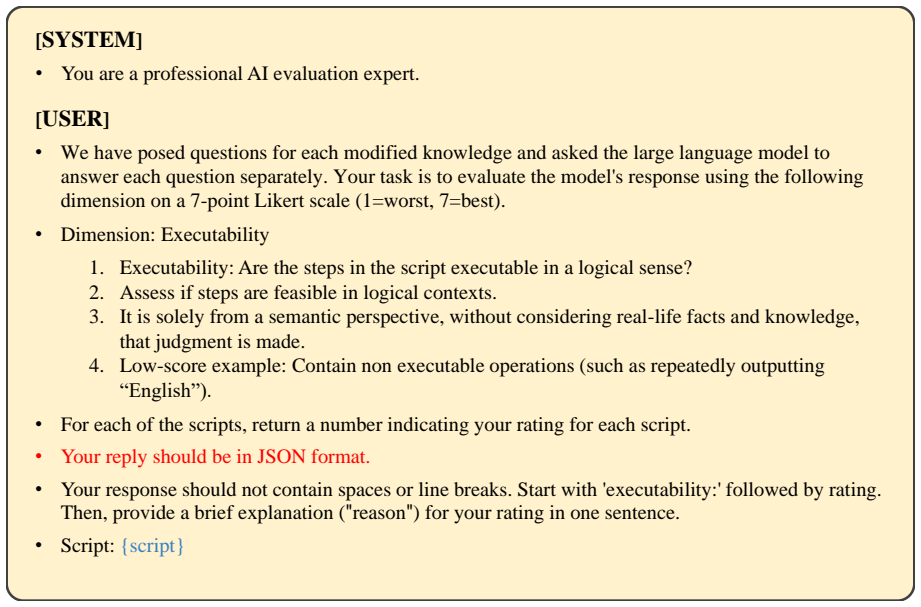
Executability: Are the steps in the script executable in a logical sense?
-
[2]
Assess if steps are feasible in logical contexts
-
[3]
EVEDIT: Event-based knowledge editing for deterministic knowledge propagation. In Proceed- ings of the 2024 Conference on Empirical Methods in Natural Language Processing, pages 4907–4926, Miami, Florida, USA. Association for Computational Linguistics. Yujie Lu, Weixi Feng, Wanrong Zhu, Wenda Xu, Xin Eric Wang, Miguel Eckstein, and William Yang Wang. 2023...
arXiv 2024
-
[4]
• For each of the scripts, return a number indicating your rating for each script
Low-score example: Contain non executable operations (such as repeatedly outputting “English”). • For each of the scripts, return a number indicating your rating for each script. • Your reply should be in JSON format. • Your response should not contain spaces or line breaks. Start with 'executability:' followed by rating. Then, provide a brief explanation...
work page 2024
-
[5]
If the script only has target new, or target true, or neither, give it 7 points
-
[6]
Note that we only compare whether specific words appear, such as whether Donald Trump appears. If the President of America appears, we do not consider it to be the word '"'''""""'" Donald Trump'. • For each of the scripts, return a number indicating your rating for each script. • Your reply should be in JSON format. • Start with “consistency:” followed by...
-
[8]
It is solely from a semantic perspective, without considering real-life facts and knowledge, that judgment is made
-
[10]
and MEMIT (Meng et al., 2023). We ad- ditionally incorporate the LLAMA3 covariance matrix provided by Fang et al. (2024), and adapt implementation details of the PROMPT method from Ammar Khodja et al. (2024). All experiments are conducted on a single A40 (48GB) GPU. The LLMs are loaded using Hug- gingFace Transformers (Wolf et al., 2020). In SCEDIT, each ...
work page 2024
Show all 26 references
-
[11]
Coherence: Are the script aligned with the newly updated fact?
-
[12]
Verify complete alignment with new updated knowledge
-
[13]
If the script has target true and target new, two points will be given, and only target true will receive one point
Low-score example: Generate a script based on the premise of using target true as the prompt answer or mixing old/new facts (e.g., saying 'France's capital is Marseille' then mentioning 'Eiffel Tower in Paris’). If the script has target true and target new, two points will be ...
-
[14]
• For each of the scripts, return a number indicating your rating for each script
If there is no target true or target new in the script, give 3 points. • For each of the scripts, return a number indicating your rating for each script. Figure 9: Prompts for evaluating Coherence. 16 [SYSTEM] • You are a professional AI evaluation expert. [USER] • We have con...
-
[15]
Consistency: Does the script remain free of internal contradictions?
-
[16]
Please disregard any knowledge you have about the prompt
-
[17]
Please ignore factual and logical errors
-
[18]
If and only if there are both target true and target new in the script and it cannot be determined which of them the script was generated based on as a fact, give 1 points
-
[21]
Completeness : Does the script adequately address all parts of the question, with sufficient procedural detail to be followed?
-
[22]
In this dimension, our main criterion for evaluation is the completeness of the script's response to the question
-
[23]
Please pay attention to the current factual knowledge:
-
[24]
If the tag is "pre," use target true as the basis for determining whether the script meets the target true criteria for scoring
-
[25]
If the tag is "post," use target new as the basis for determining whether the script meets the target new criteria for scoring
-
[26]
completeness:
Note that if neither of target true and target new is mentioned, no points will be deducted. Only score the completeness of the answer to the question based on the script. • For each of the scripts, return a number indicating your rating for each script. • Your reply should be...
2023
-
[2020]
headquartered in Stuttgart, Germany,
Modifying memories in transformer models. Preprint, arXiv:2012.00363. A Scripts Format Details In SCEDIT, we define the Script in a specific for- mat as follows: • A step-by-step guide for answering the Script Question. • Consists of brief events starting from Step 1, with a m...
2012 arXiv
-
[2022]
Junfeng Fang, Houcheng Jiang, Kun Wang, Yunshan Ma, Xiang Wang, Xiangnan He, and Tat seng Chua
What does it take to bake a cake? the reciperef corpus and anaphora resolution in procedural text. Junfeng Fang, Houcheng Jiang, Kun Wang, Yunshan Ma, Xiang Wang, Xiangnan He, and Tat seng Chua. 2024. Alphaedit: Null-space constrained knowledge editing for language models. Pre...
2024 arXiv
-
[2023]
Preprint, arXiv:2303.18223
A survey of large language models. Preprint, arXiv:2303.18223. Ce Zheng, Lei Li, Qingxiu Dong, Yuxuan Fan, Zhiyong Wu, Jingjing Xu, and Baobao Chang. 2023. Can we edit factual knowledge by in-context learning? CoRR, abs/2305.12740. Zexuan Zhong, Zhengxuan Wu, Christopher D. Ma...
2023 arXiv
-
[2024]
9 Roi Cohen, Eden Biran, Ori Yoran, Amir Globerson, and Mor Geva
Can we edit multimodal large language mod- els? Preprint, arXiv:2310.08475. 9 Roi Cohen, Eden Biran, Ori Yoran, Amir Globerson, and Mor Geva. 2023. Evaluating the ripple effects of knowledge editing in language models. Preprint, arXiv:2307.12976. Enjun Du, Xunkai Li, Tian Jin,...
2023 arXiv
Reviewed August 7, 2026 · model on record in the stance chip above.
Discussion (0). Sign in to comment.