REVIEW 4 major objections 4 minor 78 references
Adaptive Spatial Augmentation for Semi-supervised Semantic Segmentation
T0 review · 4 major / 4 minor · reviewed 2026-08-07 · deepseek-v4-flash
Pith's one-line read This paper claims that rotation and translation, normally avoided in semi-supervised segmentation because they move the mask, reliably improve accuracy when scaled by prediction entropy.
desk verdict ASAug is a solid empirical plug-in whose central claim isn't yet isolated—the gains could come from the simultaneous switch to an MSE consistency loss rather than from spatial augmentation. read the letter →
The pith
A machine-rendered reading of the paper's core claim, the machinery that carries it, and where it could break.
The reading
What carries the argument
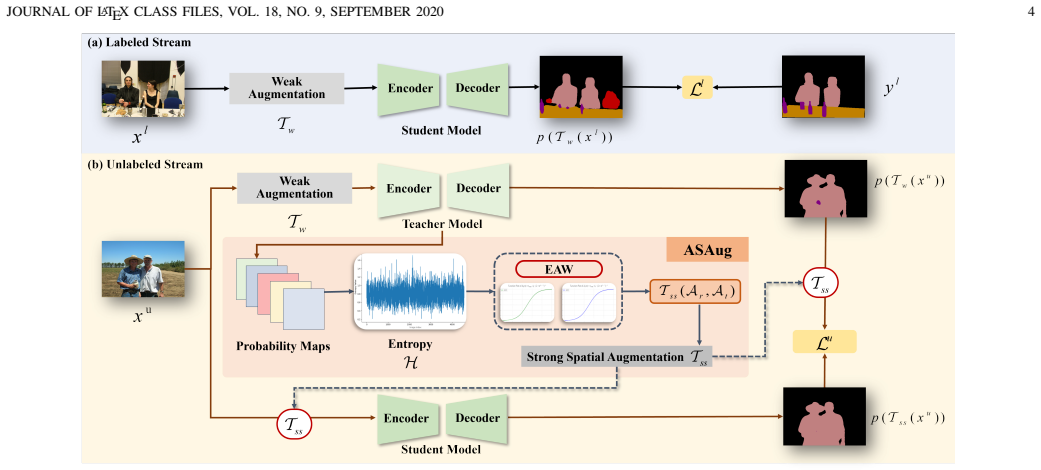
The load-bearing object is the entropy-based adaptive weight (EAW) inside ASAug. For an unlabeled image, the teacher's prediction on the weak view gives a per-pixel entropy $H$, and the rotation and translation magnitudes are set by $A_r(H)=r_{\max} k_r(1+e^{d_r-H})^{-1}$ and $A_t(H)=t_{\max} k_t(1+e^{d_t-H})^{-1}$, so distortion grows smoothly as the teacher becomes less certain. The same geometric transform is then applied to the teacher's predicted map, and a pixel-level MSE loss enforces consistency between the student's prediction on the transformed image and the transformed teacher map. This machinery is what lets the framework keep weak-to-strong consistency while using transformations that move the mask.
What would settle it
Run the identical adaptive pipeline with intensity perturbations (brightness, color jitter, contrast) in place of rotation and translation, keeping the same pixel-level MSE loss and the same entropy schedule; if mIoU gains match or exceed ASAug, spatial transforms are not the active ingredient.
Extended reading notes
Core claim
The paper's central claim is that spatial augmentation is a genuine source of generalization in semi-supervised semantic segmentation, not an obstacle to be avoided because it creates inconsistent masks. On the paper's telling, the discrepancy between the teacher's weak view and the student's rotated or translated view forces the model to locate and label objects under geometrically varied conditions, which is what improves robustness. ASAug operationalizes this by computing the entropy of the teacher's prediction on the weakly augmented image and using it to set a per-instance rotation angle and translation ratio through sigmoid-shaped functions; low-entropy confident images get small distortions and high-entropy uncertain images get large ones. The same transformation is applied to the teacher's probability map before computing a pixel-level mean-squared-error consistency loss, so the two views remain spatially aligned. On PASCAL VOC 2012, Cityscapes, and COCO, plugging ASAug into CorrMatch and Allspark raises mIoU across all label partitions.
Load-bearing premise
The improvement is credited to rotation and translation, but the experiments also switch the consistency objective to a pixel-level mean-squared error; if that switch alone creates the gains, the spatial-augmentation claim falls.
Editorial extensions
If this is right
- If ASAug is correct, attaching it to existing weak-to-strong methods should raise mIoU on PASCAL VOC 2012, Cityscapes, and COCO across every label partition, with the largest gains when labels are scarcer.
- Applying the same spatial transform to the teacher's prediction makes pixel-level MSE a valid consistency objective even when the mask changes, so geometric augmentations no longer need to be excluded from weak-to-strong training.
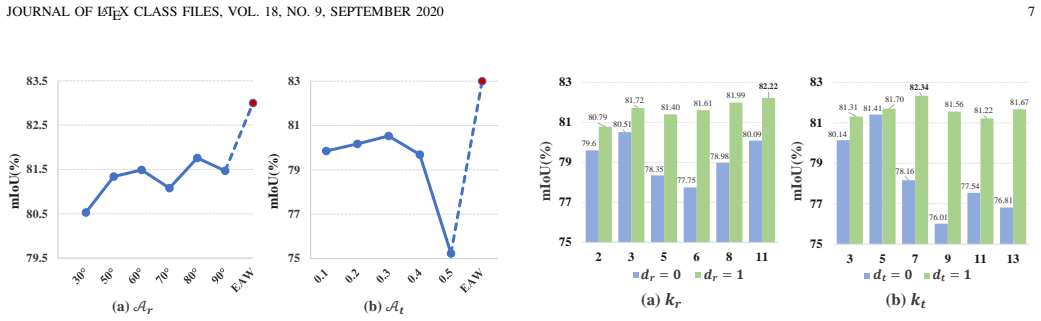
- The entropy-based adaptive schedule should beat any fixed rotation angle or fixed translation ratio, because it matches distortion strength to each instance's uncertainty.
- Deployment cost stays the same: training time rises modestly while inference is unchanged, since the module only affects the training pipeline.
- Combining spatial augmentations with existing intensity-based strong augmentations is a natural next step that the paper explicitly suggests.
Reading between the lines
- A testable extension is to hold the pixel-level MSE loss fixed and swap rotation and translation for intensity perturbations; if the gains persist, the active ingredient is the loss or gap size rather than the spatial transform itself.
- The same entropy-scaled geometric augmentation could transfer to other dense prediction tasks such as depth estimation and instance segmentation, where masks or target maps also transform geometrically.
- The adaptive schedule behaves like a curriculum over geometric difficulty, so combining it with confidence thresholds on pseudo-labels may yield further gains.
- One could measure the entropy distribution during training to check whether the adaptive schedule is tracking an optimal per-instance difficulty, which would sharpen the paper's explanation of why spatial augmentation helps.
Editorial analysis
A structured set of objections, weighed in public.
Referee Report
Summary. The paper proposes ASAug, a pluggable adaptive spatial augmentation module for semi-supervised semantic segmentation (SSSS). Instead of intensity-based strong augmentations, ASAug applies rotation and translation to unlabeled images, with the augmentation strength modulated per instance by the entropy of the teacher's weak-augmentation prediction. The student is trained with a pixel-level MSE consistency loss between the teacher's spatially warped soft prediction and the student's prediction on the spatially augmented image. Experiments on PASCAL VOC 2012, Cityscapes, and COCO, integrated with Allspark and CorrMatch, report consistent mIoU improvements, and ablations examine the rotation/translation components, the entropy-based weighting, and hyperparameters.
Significance. If the central attribution were cleanly established, the paper would be a useful empirical contribution: it identifies spatial augmentations as a complementary source of consistency signal in SSSS, and the proposed module is simple, pluggable, and evaluated across three benchmarks and two backbone families. The paper also provides component ablations and an efficiency study, which are valuable. However, the headline claim that spatial augmentation, rather than the accompanying change to a pixel-level MSE loss, drives the gains is not supported by the current experimental design. The novelty claim of being the first to show that spatial augmentations help SSSS is also weakened by the paper's own citations of prior geometric-warping methods. These issues must be resolved before the contribution can be assessed.
major comments (4)
- [Section III-C, Eq. (7), Tables II–VI, Table IV] The experimental comparisons confound the augmentation type with the consistency loss. In every comparison, ASAug changes two variables at once: the strong augmentation is switched from intensity-based to spatial rotation/translation, and the consistency loss is switched from the host method's original objective (cross-entropy in Eq. (3), or CorrMatch's correlation loss) to the pixel-level MSE of Eq. (7). Table IV compares the CorrMatch baseline against A_r/A_t variants, but the baseline row uses the original loss while the A_r/A_t rows use the ASAug pipeline including MSE; it never holds the loss fixed and reverts to intensity-based strong augmentation. Consequently, the reported mIoU gains could be entirely due to the smoother, label-free MSE objective rather than to spatial warping. The Section I claim that 'spatial augmentations ... can boost generalization' is therefore not yet demonstrated. Please add an ablation that keeps Eq. (7) and the teacher-student pipeline, then compares intensity-based strong augmentation against ASAug's spatial augmentation; ideally also test ASAug's spatial augmentation with the host method's original loss (e.g., cross-entropy on spatially aligned soft targets).
- [Section III-B, Eqs. (5)–(6), Section IV-A] The adaptive direction stated in the text contradicts the equations. The text says 'Samples with high entropy ... require more significant spatial transformations,' but Ar(H) = r_max * k_r * (1 + e^{d_r - H})^{-1} is decreasing in H, so high entropy actually yields smaller augmentation. The later sentence 'When H is relatively small, the mapping outcome is likewise reduced' also contradicts the earlier motivation. Moreover, with the reported hyperparameters r_max = 180, k_r = 11, and t_max = 0.5, k_t = 7, the maximum rotation is 180*11 = 1980 degrees and the maximum translation is 0.5*7 = 3.5 (350%), which is not the 'restricted angle' or 'shifting by a specified pixel count' described in Section III-B. Please clarify the intended direction of the entropy weighting, correct the formula if needed, and report the actual effective ranges of rotation angles and translation ratios used in the experiments.
- [Algorithm 1 and Eq. (7)] The pseudo-code and the formal loss definition do not match. In Algorithm 1, p_w = x_w_probmap.argmax(dim=1) produces hard pseudo-labels, which are then spatially warped and compared with the student prediction via MSELoss. In contrast, Eq. (7) computes the MSE between the spatially warped soft teacher probabilities T_ss(p(T_w(x))) and the student probabilities p(T_ss(x)). These are different training objectives, and the difference is material for reproducibility. Additionally, the function comp_entropy is not defined, and the pseudo-code does not indicate that the teacher's gradient is stopped or that the teacher is updated by EMA. Please align the algorithm with the equation and provide the missing implementation details.
- [Section I and Section II-C] The claim that this is 'the first study to demonstrate that spatial augmentations ... can boost generalization' is not consistent with the paper's own related-work discussion. Section II-C cites M3L [60], which 'introduces a robust perturbation model incorporating geometric warping and photometric variations,' and MR-PhTPS [61], which 'relies on nonlinear geometric and photometric perturbations,' as well as Cao et al. [50] with differentiable spatial warping. These are prior uses of spatial/geometric augmentations in semi-supervised segmentation. Please temper the novelty claim to what is actually new—for example, the specific adaptive entropy-based scheduling of rotation/translation within weak-to-strong consistency—and explicitly discuss the difference from these earlier geometric-warping methods.
minor comments (4)
- [Section IV-B, Cityscapes paragraph] The text states that ASAug improves Allspark by 4.16%, 2.45%, 2.85%, 1.55%, and 2.38% under the five partition protocols on Cityscapes, but Table V shows gains of only 0.58, 0.44, 0.50, and 0.56 for the four reported partitions. Those larger numbers appear to be the Pascal VOC 321x321 gains from Table II. Please correct the paragraph to report the Cityscapes numbers.
- [Section IV-A and Tables II–VI] No standard deviations or number of random seeds are reported for the main results and ablations. Given that several gains are around 0.4–0.6 mIoU, reporting variance or at least stating the number of runs would strengthen the claims.
- [Algorithm 1 and Section IV-A] The pseudo-code references 'comp_entropy' without defining whether it computes per-pixel entropy followed by mean reduction or a single global entropy. Also, the handling of pixels that fall outside the image after rotation/translation (padding or masking) is not specified; this can affect both the loss and the pseudo-labels.
- [Throughout] There are several typographical issues, for example 'Fourthmore' in Section III, 'Eary' at the start of Section II-B, and inconsistent use of 'blender' vs. 'blendersubset' in Table III and Section IV-A. A careful proofreading pass is needed.
Circularity Check
No significant circularity: ASAug is an empirical plug-in module validated on held-out benchmarks; no equation reduces the central claim to its inputs.
full rationale
The paper's central claim is that entropy-scaled spatial rotation/translation can be plugged into existing weak-to-strong SSSS methods and improve generalization. There is no derivation chain that starts from a fitted parameter and ends at the reported mIoU. The adaptive strength in Equations (5)-(6) is computed from the teacher's current entropy, which is a self-paced training signal common in SSL; it does not bake in the benchmark result or the improvement. The hyperparameters k_r, k_t, d_r, d_t are tuned per dataset and reported in Section IV-A, but this is conventional hyperparameter selection, not a prediction forced by construction, and the comparisons in Tables II-VI are against independently reported methods on external datasets. Self-citations [2], [4], [8], [39] appear in the introduction and related work and are not load-bearing for the empirical contribution. The paper's own protocol does leave an experimental confound: ASAug simultaneously switches the consistency loss to MSE (Equation 7) and changes the strong augmentation from intensity-based to spatial, and the Table IV ablation starts from the original CorrMatch baseline rather than from ASAug-minus-spatial-augmentation; but this is an identification/control issue about what causes the gain, not a circularity, because no equation defines the central claim as an input and the result is not equivalent to any fitted quantity by construction.
Assumptions & free parameters
free parameters (6)
- k_r =
11 (PASCAL), 5.5 (Cityscapes)
- k_t =
7 (PASCAL), 3 (Cityscapes)
- d_r =
1 (PASCAL), 0.5 (Cityscapes)
- d_t =
1 (PASCAL), 0.5 (Cityscapes)
- r_max =
180
- t_max =
0.5
assumptions (3)
- domain assumption Mean teacher EMA protocol provides reliable pseudo-labels
- ad hoc to paper Entropy of the teacher's soft prediction measures instance reliability
- domain assumption Applying the same spatial transform to teacher output and student input yields a valid consistency objective
Cite this review
Pith. "Pith review of Adaptive Spatial Augmentation for Semi-supervised Semantic Segmentation." pith.science (2026). https://pith.science/paper/SC5LDWBO
@misc{pith2026250523438,
  author       = {Pith},
  title        = {Pith review of: Adaptive Spatial Augmentation for Semi-supervised Semantic Segmentation},
  year         = {2026},
  howpublished = {\url{https://pith.science/paper/SC5LDWBO}},
  note         = {Machine review of arXiv:2505.23438}
}
read the original abstract
In semi-supervised semantic segmentation (SSSS), data augmentation plays a crucial role in the weak-to-strong consistency regularization framework, as it enhances diversity and improves model generalization. Recent strong augmentation methods have primarily focused on intensity-based perturbations, which have minimal impact on the semantic masks. In contrast, spatial augmentations like translation and rotation have long been acknowledged for their effectiveness in supervised semantic segmentation tasks, but they are often ignored in SSSS. In this work, we demonstrate that spatial augmentation can also contribute to model training in SSSS, despite generating inconsistent masks between the weak and strong augmentations. Furthermore, recognizing the variability among images, we propose an adaptive augmentation strategy that dynamically adjusts the augmentation for each instance based on entropy. Extensive experiments show that our proposed Adaptive Spatial Augmentation (\textbf{ASAug}) can be integrated as a pluggable module, consistently improving the performance of existing methods and achieving state-of-the-art results on benchmark datasets such as PASCAL VOC 2012, Cityscapes, and COCO.
Figures


Figures from the paper (4 more)


Reference graph
Works this paper leans on
-
[50]
C. Cao, T. Lin, D. He, F. Li, H. Yue, J. Yang, and E. Ding, “Adversarial dual-student with differentiable spatial warping for semi-supervised semantic segmentation,”TCSVT, 2022
work page 2022
-
[60]
Revisiting consistency for semi- supervised semantic segmentation,
I. Grubi ˇsi´c, M. Or ˇsi´c, and S. ˇSegvi´c, “Revisiting consistency for semi- supervised semantic segmentation,”Sensors, 2023
work page 2023
-
[61]
A baseline for semi-supervised learning of efficient semantic segmentation models,
——, “A baseline for semi-supervised learning of efficient semantic segmentation models,” inMVA, 2021
work page 2021
-
[1]
Dual-level masked semantic inference for semi-supervised semantic segmentation,
Q. Ma, Z. Zhang, P. Qiao, Y . Wang, R. Ji, C. Liu, and J. Chen, “Dual-level masked semantic inference for semi-supervised semantic segmentation,”TMM, 2025
work page 2025
-
[2]
Frequency-guided spatial adaptation for camouflaged object detection,
S. Zhang, D. Kong, Y . Xing, Y . Lu, L. Ran, G. Liang, H. Wang, and Y . Zhang, “Frequency-guided spatial adaptation for camouflaged object detection,”TMM, vol. 27, pp. 72–83, 2025
work page 2025
-
[3]
Clustering propagation for universal medical image segmentation,
Y . Ding, L. Li, W. Wang, and Y . Yang, “Clustering propagation for universal medical image segmentation,” inCVPR, 2024
work page 2024
-
[4]
L. Ran, L. Wang, T. Zhuo, Y . Xing, and Y . Zhang, “DDF: A novel dual-domain image fusion strategy for remote sensing image semantic segmentation with unsupervised domain adaptation,”TGRS, 2024
work page 2024
-
[5]
Vanishing- point-guided video semantic segmentation of driving scenes,
D. Guo, D.-P. Fan, T. Lu, C. Sakaridis, and L. Van Gool, “Vanishing- point-guided video semantic segmentation of driving scenes,” inCVPR, 2024
work page 2024
Show all 78 references
-
[6]
Towards robust semi-supervised distribution alignment against label distribution shift with noisy annotations,
B. Chen, Z. Ye, Y . Liu, X. Fang, G. Lu, S. Xie, and X. Li, “Towards robust semi-supervised distribution alignment against label distribution shift with noisy annotations,”TMM, 2025
2025
-
[7]
Uncertainty- aware semi-supervised learning segmentation for remote sensing im- ages,
X. Lu, L. Li, L. Jiao, X. Liu, F. Liu, W. Ma, and S. Yang, “Uncertainty- aware semi-supervised learning segmentation for remote sensing im- ages,”TMM, 2025
2025
-
[8]
Pseudo labeling methods for semi-supervised semantic segmentation: A review and future perspec- tives,
L. Ran, Y . Li, G. Liang, and Y . Zhang, “Pseudo labeling methods for semi-supervised semantic segmentation: A review and future perspec- tives,”TCSVT, vol. 35, no. 4, pp. 3054–3080, 2025
2025
-
[9]
Multi-perspective pseudo-label generation and confidence-weighted training for semi- supervised semantic segmentation,
K. Hu, X. Chen, Z. Chen, Y . Zhang, and X. Gao, “Multi-perspective pseudo-label generation and confidence-weighted training for semi- supervised semantic segmentation,”TMM, 2024
2024
-
[10]
Multi-level label correction by distilling proximate patterns for semi-supervised semantic segmentation,
H. Xiao, Y . Hong, L. Dong, D. Yan, J. Xiong, J. Zhuang, D. Liang, and C. Peng, “Multi-level label correction by distilling proximate patterns for semi-supervised semantic segmentation,”TMM, 2024
2024
-
[12]
Anti-adversarially manipulated attributions for weakly and semi-supervised semantic segmentation,
J. Lee, E. Kim, and S. Yoon, “Anti-adversarially manipulated attributions for weakly and semi-supervised semantic segmentation,” inCVPR, 2021
2021
-
[13]
Revisiting weak-to- strong consistency in semi-supervised semantic segmentation,
L. Yang, L. Qi, L. Feng, W. Zhang, and Y . Shi, “Revisiting weak-to- strong consistency in semi-supervised semantic segmentation,” inCVPR, 2023
2023
-
[14]
A simple baseline for semi-supervised semantic segmentation with strong data augmentation,
J. Yuan, Y . Liu, C. Shen, Z. Wang, and H. Li, “A simple baseline for semi-supervised semantic segmentation with strong data augmentation,” inICCV, 2021
2021
-
[15]
Augmentation matters: A simple-yet-effective approach to semi-supervised semantic segmentation,
Z. Zhao, L. Yang, S. Long, J. Pi, L. Zhou, and J. Wang, “Augmentation matters: A simple-yet-effective approach to semi-supervised semantic segmentation,” inCVPR, 2023
2023
-
[16]
AutoAug- ment: Learning augmentation strategies from data,
E. D. Cubuk, B. Zoph, D. Mane, V . Vasudevan, and Q. V . Le, “AutoAug- ment: Learning augmentation strategies from data,” inCVPR, Jun. 2019
2019
-
[17]
Randaugment: Practical automated data augmentation with a reduced search space,
E. D. Cubuk, B. Zoph, J. Shlens, and Q. V . Le, “Randaugment: Practical automated data augmentation with a reduced search space,” inCVPRW, 2020
2020
-
[18]
Trivialaugment: Tuning-free yet state-of- the-art data augmentation,
S. G. M ¨uller and F. Hutter, “Trivialaugment: Tuning-free yet state-of- the-art data augmentation,” inICCV, 2021
2021
-
[19]
Semi-supervised semantic segmen- tation with cross-consistency training,
Y . Ouali, C. Hudelot, and M. Tami, “Semi-supervised semantic segmen- tation with cross-consistency training,” inCVPR, 2020
2020
-
[20]
C3-semiseg: Contrastive semi-supervised segmentation via cross-set learning and dynamic class-balancing,
Y . Zhou, H. Xu, W. Zhang, B. Gao, and P.-A. Heng, “C3-semiseg: Contrastive semi-supervised segmentation via cross-set learning and dynamic class-balancing,” inICCV, 2021
2021
-
[21]
Dmt: Dynamic mutual training for semi-supervised learning,
Z. Feng, Q. Zhou, Q. Gu, X. Tan, G. Cheng, X. Lu, J. Shi, and L. Ma, “Dmt: Dynamic mutual training for semi-supervised learning,”PR, 2022. JOURNAL OF LATEX CLASS FILES, VOL. 18, NO. 9, SEPTEMBER 2020 10
2022
-
[22]
Bootstrapping semantic segmentation with regional contrast,
S. Liu, S. Zhi, E. Johns, and A. J. Davison, “Bootstrapping semantic segmentation with regional contrast,”ICLR, 2022
2022
-
[23]
Semi-supervised semantic segmentation with cross pseudo supervision,
X. Chen, Y . Yuan, G. Zeng, and J. Wang, “Semi-supervised semantic segmentation with cross pseudo supervision,” inCVPR, 2021
2021
-
[24]
St++: Make self-training work better for semi-supervised semantic segmentation,
L. Yang, W. Zhuo, L. Qi, Y . Shi, and Y . Gao, “St++: Make self-training work better for semi-supervised semantic segmentation,” inCVPR, 2022
2022
-
[25]
Semi-supervised semantic segmentation with error localization network,
D. Kwon and S. Kwak, “Semi-supervised semantic segmentation with error localization network,” inCVPR, 2022
2022
-
[26]
Perturbed and strict mean teachers for semi-supervised semantic seg- mentation,
Y . Liu, Y . Tian, Y . Chen, F. Liu, V . Belagiannis, and G. Carneiro, “Perturbed and strict mean teachers for semi-supervised semantic seg- mentation,” inCVPR, 2022
2022
-
[27]
Semi-supervised semantic segmentation using unreliable pseudo-labels,
Y . Wang, H. Wang, Y . Shen, J. Fei, W. Li, G. Jin, L. Wu, R. Zhao, and X. Le, “Semi-supervised semantic segmentation using unreliable pseudo-labels,” inCVPR, 2022
2022
-
[28]
Ucc: Uncertainty guided cross- head co-training for semi-supervised semantic segmentation,
J. Fan, B. Gao, H. Jin, and L. Jiang, “Ucc: Uncertainty guided cross- head co-training for semi-supervised semantic segmentation,” inCVPR, 2022
2022
-
[29]
Conflict- based cross-view consistency for semi-supervised semantic segmenta- tion,
Z. Wang, Z. Zhao, X. Xing, D. Xu, X. Kong, and L. Zhou, “Conflict- based cross-view consistency for semi-supervised semantic segmenta- tion,” inCVPR, 2023
2023
-
[30]
Instance-specific and model-adaptive supervision for semi-supervised semantic segmentation,
Z. Zhao, S. Long, J. Pi, J. Wang, and L. Zhou, “Instance-specific and model-adaptive supervision for semi-supervised semantic segmentation,” inCVPR, 2023
2023
-
[31]
Querying labeled for unlabeled: Cross-image semantic consistency guided semi-supervised semantic segmentation,
L. Wu, L. Fang, X. He, M. He, J. Ma, and Z. Zhong, “Querying labeled for unlabeled: Cross-image semantic consistency guided semi-supervised semantic segmentation,”TPAMI, 2023
2023
-
[32]
Corrmatch: Label propagation via correlation matching for semi-supervised semantic segmentation,
B. Sun, Y . Yang, L. Zhang, M.-M. Cheng, and Q. Hou, “Corrmatch: Label propagation via correlation matching for semi-supervised semantic segmentation,” inCVPR, 2024
2024
-
[33]
Allspark: Reborn labeled features from unlabeled in transformer for semi-supervised semantic segmentation,
H. Wang, Q. Zhang, Y . Li, and X. Li, “Allspark: Reborn labeled features from unlabeled in transformer for semi-supervised semantic segmentation,” inCVPR, 2024
2024
-
[34]
The pascal visual object classes (voc) challenge,
M. Everingham, L. Van Gool, C. K. Williams, J. Winn, and A. Zisser- man, “The pascal visual object classes (voc) challenge,”IJCV, 2010
2010
-
[35]
The cityscapes dataset for semantic urban scene understanding,
M. Cordts, M. Omran, S. Ramos, T. Rehfeld, M. Enzweiler, R. Benen- son, U. Franke, S. Roth, and B. Schiele, “The cityscapes dataset for semantic urban scene understanding,” inCVPR, 2016
2016
-
[36]
Microsoft coco: Common objects in context,
T.-Y . Lin, M. Maire, S. Belongie, J. Hays, P. Perona, D. Ramanan, P. Doll ´ar, and C. L. Zitnick, “Microsoft coco: Common objects in context,” inECCV. Springer, 2014, pp. 740–755
2014
-
[37]
Dash: Semi-supervised learning with dynamic thresholding,
Y . Xu, L. Shang, J. Ye, Q. Qian, Y .-F. Li, B. Sun, H. Li, and R. Jin, “Dash: Semi-supervised learning with dynamic thresholding,” inICLR, 2021
2021
-
[38]
Pseudo-label: The simple and efficient semi-supervised learning method for deep neural networks,
D.-H. Leeet al., “Pseudo-label: The simple and efficient semi-supervised learning method for deep neural networks,” inWorkshop on challenges in representation learning, ICML, 2013
2013
-
[39]
Adasemicd: An adaptive semi-supervised change detection method based on pseudo-label evaluation,
L. Ran, D. Wen, T. Zhuo, S. Zhang, X. Zhang, and Y . Zhang, “Adasemicd: An adaptive semi-supervised change detection method based on pseudo-label evaluation,”TGRS, vol. 63, pp. 1–14, 2025
2025
-
[40]
Fixmatch: Simplifying semi- supervised learning with consistency and confidence,
K. Sohn, D. Berthelot, N. Carlini, Z. Zhang, H. Zhang, C. A. Raffel, E. D. Cubuk, A. Kurakin, and C.-L. Li, “Fixmatch: Simplifying semi- supervised learning with consistency and confidence,”NeurIPS, 2020
2020
-
[41]
Flexmatch: Boosting semi-supervised learning with curriculum pseudo labeling,
B. Zhang, Y . Wang, W. Hou, H. Wu, J. Wang, M. Okumura, and T. Shi- nozaki, “Flexmatch: Boosting semi-supervised learning with curriculum pseudo labeling,” inNeurIPS, 2021
2021
-
[42]
A survey on semi- supervised semantic segmentation,
A. Pel ´aez-Vegas, P. Mesejo, and J. Luengo, “A survey on semi- supervised semantic segmentation,”arXiv:2302.09899, 2023
2023 arXiv
-
[43]
Learning with pseudo- ensembles,
P. Bachman, O. Alsharif, and D. Precup, “Learning with pseudo- ensembles,”NeurIPS, 2014
2014
-
[44]
Representation learning with contrastive predictive coding,
A. v. d. Oord, Y . Li, and O. Vinyals, “Representation learning with contrastive predictive coding,”arXiv:1807.03748, 2018
2018 arXiv
-
[45]
Generative adversarial nets,
I. Goodfellow, J. Pouget-Abadie, M. Mirza, B. Xu, D. Warde-Farley, S. Ozair, A. Courville, and Y . Bengio, “Generative adversarial nets,” NeurIPS, 2014
2014
-
[46]
Semi-supervised semantic segmen- tation of vessel images using leaking perturbations,
J. Hou, X. Ding, and J. D. Deng, “Semi-supervised semantic segmen- tation of vessel images using leaking perturbations,” inWACV, 2022
2022
-
[47]
Self-ensembling gan for cross-domain semantic segmentation,
Y . Xu, F. He, B. Du, D. Tao, and L. Zhang, “Self-ensembling gan for cross-domain semantic segmentation,”TMM, vol. 25, pp. 7837–7850, 2022
2022
-
[48]
Semi supervised semantic segmentation using generative adversarial network,
N. Souly, C. Spampinato, and M. Shah, “Semi supervised semantic segmentation using generative adversarial network,” inICCV, 2017
2017
-
[49]
Semantic seg- mentation with generative models: Semi-supervised learning and strong out-of-domain generalization,
D. Li, J. Yang, K. Kreis, A. Torralba, and S. Fidler, “Semantic seg- mentation with generative models: Semi-supervised learning and strong out-of-domain generalization,” inCVPR, 2021
2021
-
[51]
Adversarial network integrating dual attention and sparse representation for semi-supervised semantic seg- mentation,
G. Jin, C. Liu, and X. Chen, “Adversarial network integrating dual attention and sparse representation for semi-supervised semantic seg- mentation,”Inf. Process. Manag., 2021
2021
-
[52]
Boosting semi-supervised semantic segmentation with probabilistic representations,
H. Xie, C. Wang, M. Zheng, M. Dong, S. You, C. Fu, and C. Xu, “Boosting semi-supervised semantic segmentation with probabilistic representations,” inAAAI, 2023
2023
-
[53]
Pseudoseg: Designing pseudo labels for semantic segmentation,
Y . Zou, Z. Zhang, H. Zhang, C.-L. Li, X. Bian, J.-B. Huang, and T. Pfis- ter, “Pseudoseg: Designing pseudo labels for semantic segmentation,” in ICLR, 2021
2021
-
[54]
Hunting sparsity: Density- guided contrastive learning for semi-supervised semantic segmentation,
X. Wang, B. Zhang, L. Yu, and J. Xiao, “Hunting sparsity: Density- guided contrastive learning for semi-supervised semantic segmentation,” inCVPR, 2023
2023
-
[55]
Pixel contrastive-consistent semi-supervised semantic segmentation,
Y . Zhong, B. Yuan, H. Wu, Z. Yuan, J. Peng, and Y .-X. Wang, “Pixel contrastive-consistent semi-supervised semantic segmentation,” inICCV, 2021
2021
-
[56]
An overview of deep semi- supervised learning,
Y . Ouali, C. Hudelot, and M. Tami, “An overview of deep semi- supervised learning,”arXiv:2006.05278, 2020
2006 arXiv
-
[57]
Cutmix: Reg- ularization strategy to train strong classifiers with localizable features,
S. Yun, D. Han, S. J. Oh, S. Chun, J. Choe, and Y . Yoo, “Cutmix: Reg- ularization strategy to train strong classifiers with localizable features,” inICCV, 2019
2019
-
[58]
Classmix: Segmentation-based data augmentation for semi-supervised learning,
V . Olsson, W. Tranheden, J. Pinto, and L. Svensson, “Classmix: Segmentation-based data augmentation for semi-supervised learning,” inWACV, 2021
2021
-
[59]
Complexmix: Semi- supervised semantic segmentation via mask-based data augmentation,
Y . Chen, X. Ouyang, K. Zhu, and G. Agam, “Complexmix: Semi- supervised semantic segmentation via mask-based data augmentation,” inICIP, 2021
2021
-
[62]
Mean teachers are better role mod- els: Weight-averaged consistency targets improve semi-supervised deep learning results,
A. Tarvainen and H. Valpola, “Mean teachers are better role mod- els: Weight-averaged consistency targets improve semi-supervised deep learning results,”NeurIPS, 2017
2017
-
[63]
Semi-supervised semantic segmentation with directional context-aware consistency,
X. Lai, Z. Tian, L. Jiang, S. Liu, H. Zhao, L. Wang, and J. Jia, “Semi-supervised semantic segmentation with directional context-aware consistency,” inCVPR, 2021
2021
-
[64]
Pruning-guided curriculum learning for semi-supervised semantic segmentation,
H. Kong, G.-H. Lee, S. Kim, and S.-W. Lee, “Pruning-guided curriculum learning for semi-supervised semantic segmentation,” inWACV, 2023
2023
-
[65]
Semi- supervised semantic segmentation needs strong, varied perturbations,
G. French, S. Laine, T. Aila, M. Mackiewicz, and G. Finlayson, “Semi- supervised semantic segmentation needs strong, varied perturbations,” arXiv:1906.01916, 2019
1906 arXiv
-
[66]
Semi-supervised semantic segmentation via gentle teaching assistant,
Y . Jin, J. Wang, and D. Lin, “Semi-supervised semantic segmentation via gentle teaching assistant,”NeurIPS, 2022
2022
-
[67]
Enhanced soft label for semi-supervised semantic segmentation,
J. Ma, C. Wang, Y . Liu, L. Lin, and G. Li, “Enhanced soft label for semi-supervised semantic segmentation,” inICCV, 2023
2023
-
[68]
The pascal visual object classes challenge: A retrospective,
M. Everingham, S. A. Eslami, L. Van Gool, C. K. Williams, J. Winn, and A. Zisserman, “The pascal visual object classes challenge: A retrospective,”IJCV, 2015
2015
-
[69]
Semantic contours from inverse detectors,
B. Hariharan, P. Arbel ´aez, L. Bourdev, S. Maji, and J. Malik, “Semantic contours from inverse detectors,” inICCV, 2011
2011
-
[70]
Semi-supervised semantic segmentation via adaptive equalization learning,
H. Hu, F. Wei, H. Hu, Q. Ye, J. Cui, and L. Wang, “Semi-supervised semantic segmentation via adaptive equalization learning,”NeurIPS, 2021
2021
-
[71]
Cfcg: Semi-supervised semantic segmentation via cross-fusion and contour guidance supervision,
S. Li, Y . He, W. Zhang, W. Zhang, X. Tan, J. Han, E. Ding, and J. Wang, “Cfcg: Semi-supervised semantic segmentation via cross-fusion and contour guidance supervision,” inICCV, 2023
2023
-
[72]
Semi-supervised semantic segmentation with mutual knowledge distillation,
J. Yuan, J. Ge, Z. Wang, and Y . Liu, “Semi-supervised semantic segmentation with mutual knowledge distillation,” inACM MM, 2023
2023
-
[73]
Logic-induced diagnostic reasoning for semi-supervised semantic segmentation,
C. Liang, W. Wang, J. Miao, and Y . Yang, “Logic-induced diagnostic reasoning for semi-supervised semantic segmentation,” inICCV, 2023, pp. 16 197–16 208
2023
-
[74]
Training vision transformers for semi- supervised semantic segmentation,
X. Hu, L. Jiang, and B. Schiele, “Training vision transformers for semi- supervised semantic segmentation,” inCVPR, 2024
2024
-
[75]
Boundary- refined prototype generation: A general end-to-end paradigm for semi- supervised semantic segmentation,
J. Dong, Z. Meng, D. Liu, J. Liu, Z. Zhao, and F. Su, “Boundary- refined prototype generation: A general end-to-end paradigm for semi- supervised semantic segmentation,”EAAI, 2024
2024
-
[76]
Rethinking atrous convolution for semantic image segmentation,
L.-C. Chen, G. Papandreou, F. Schroff, and H. Adam, “Rethinking atrous convolution for semantic image segmentation,”arXiv:1706.05587, 2017
2017 arXiv
-
[77]
Deep residual learning for image recognition,
K. He, X. Zhang, S. Ren, and J. Sun, “Deep residual learning for image recognition,” inCVPR, 2016
2016
-
[78]
Imagenet: A large-scale hierarchical image database,
J. Deng, W. Dong, R. Socher, L.-J. Li, K. Li, and L. Fei-Fei, “Imagenet: A large-scale hierarchical image database,” inCVPR, 2009
2009
-
[79]
Segformer: Simple and efficient design for semantic segmentation with transformers,
E. Xie, W. Wang, Z. Yu, A. Anandkumar, J. M. Alvarez, and P. Luo, “Segformer: Simple and efficient design for semantic segmentation with transformers,”NeurIPS, 2021
2021
Reviewed August 7, 2026 · model on record in the stance chip above.
Discussion (0). Sign in to comment.