REVIEW 4 major objections 5 minor 86 references
Enhancing the sensitivity of quantum optomechanical gyroscope by optical Kerr effect
T0 review · 4 major / 5 minor · reviewed 2026-08-07 · deepseek-v4-flash
Pith's one-line read A Kerr nonlinearity inside a quantum optomechanical gyroscope can push rotation-rate precision beyond the Heisenberg limit, and a quadrature measurement reaches that bound.
desk verdict Real analytic QFI result, but the super-Heisenberg figures rely on unstated and likely unphysical coupling strengths. read the letter →
The pith
A machine-rendered reading of the paper's core claim, the machinery that carries it, and where it could break.
The reading
What carries the argument
The load-bearing object is the position-dependent Kerr coupling term in the Hamiltonian, specifically $\hbar G_{\rm NL}(a^\dagger a)^2(b+b^\dagger)$, which couples the square of the photon number to the mechanical displacement. Because the square of the photon number appears, the parameter-translation generator acquires terms of order $n^4$, $n^3$, and $n^2$ whose variances and covariances grow as high powers of the photon number, which is what pushes the quantum Fisher information above Heisenberg scaling. The QFI is computed from a standard generator expansion for pure-state parameter estimation, and the attainability claim is tested by computing the classical Fisher information for the quadrature POVM.
What would settle it
Compute the value of $\chi^{(3)}$ required to make $G_{\rm NL}=0.3\,g_0$ through $\eta_0=3\hbar\omega_c^2\,\mathrm{Re}\,\chi^{(3)}/(2\epsilon_0 V_0)$ with the paper's $\omega_c=10^{15}$ Hz, $L_0=10^{-4}$ m, $D=10^{-3}$ m, and $m=10^{-7}$ kg; if the required nonlinearity is not available in a low-loss medium, or if the QFI contrast between $G_{\rm NL}=0$ and $G_{\rm NL}=0.3g_0$ disappears when mechanical damping is included, the central enhancement claim is refuted.
Extended reading notes
Core claim
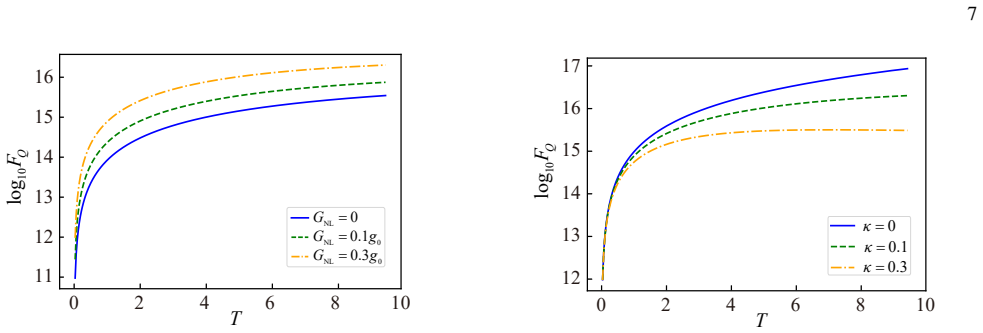
The central claim is that the optical Kerr interaction, modeled by the position-dependent term $\hbar \eta(q) a^{\dagger 2}a^2$ with $\eta(q)\simeq\eta_0+g_{\rm NL}q$, qualitatively improves a quantum optomechanical gyroscope. In the absence of driving, the Hamiltonian is exactly solvable, and the quantum Fisher information for the angular velocity $\Omega$ can be evaluated in closed form; numerically the Kerr terms $G_{\rm NL}=0.1\,g_0$ and $0.3\,g_0$ increase the QFI by roughly two orders of magnitude over the Kerr-free case, and the QFI grows with total photon-plus-phonon number faster than $N^2$, i.e. beyond the Heisenberg limit. The quadrature measurement of the cavity field gives a classical Fisher information that essentially coincides with the QFI, meaning this feasible measurement saturates the quantum Cramér-Rao bound. External driving produces an oscillatory modulation of the QFI, and optical cavity loss reduces it, but the reported sensitivity remains several orders of magnitude above the Heisenberg limit for $\kappa=0.1$ and $0.3$ in the parameters studied.
Load-bearing premise
The central premise is that a position-dependent Kerr coupling can reach $G_{\rm NL}=0.1\,g_0$ and $0.3\,g_0$ in a cavity with the listed $\omega_c$, $L_0$, $D$, and $m$; the size of every claimed sensitivity gain scales with these values, so if a real Kerr medium cannot produce them the enhancement is not physically available.
Editorial extensions
If this is right
- A Kerr-filled optomechanical cavity can estimate angular velocity with a precision that surpasses the standard quantum limit and the Heisenberg limit in the idealized no-driving regime.
- The quadrature measurement is the optimal practical readout: its classical Fisher information coincides with the QFI, so the quantum Cramér-Rao bound is saturated.
- Increasing the photon fraction of the input coherent state, e.g. from $u=0.1$ to $u=0.9$, can raise the sensitivity by over an order of magnitude at fixed total particle number.
- The driving amplitude and phase tune the QFI in an oscillatory way, providing a control knob for the gyroscope.
- At cavity decay rates $\kappa=0.1$ and $0.3$ the QFI is reduced but still sits several orders of magnitude above the Heisenberg limit, suggesting tolerance to optical loss.
Reading between the lines
- Beyond the paper: the super-Heisenberg scaling is demonstrated in a closed-system, pure-state model, so whether it survives mechanical thermal noise and mechanical damping, which the paper does not include, remains open.
- Beyond the paper: the nonlinear strengths $G_{\rm NL}=0.1g_0$ and $0.3g_0$ are not tied to a specific material, so realizing them at $\omega_c=10^{15}$ Hz requires a Kerr medium whose $\chi^{(3)}$ and absorption are compatible with the listed cavity geometry.
- Beyond the paper: a clean experiment would swap the Kerr medium in and out of the same cavity; the model predicts a QFI gap of about two orders of magnitude at $\Omega=2$ kHz, which a homodyne readout should reveal.
- Beyond the paper: the same position-dependent photon-number-squared coupling could be produced by a transmon or other engineered nonlinearity, so the enhancement mechanism may transfer to integrated photonic rotation sensors.
Editorial analysis
A structured set of objections, weighed in public.
Referee Report
Summary. The manuscript proposes a quantum optomechanical gyroscope (QOMG) whose cavity is filled with a Kerr medium, and studies how the Kerr nonlinearity affects the precision of angular-velocity estimation. In the absence of driving, the model is solved exactly: the authors derive a closed-form expression for the quantum Fisher information (QFI) of the rotation rate, assuming the optical and mechanical modes are initially in coherent states. They report that the Kerr interaction enhances the QFI by about two orders of magnitude, leads to 'super-Heisenberg' scaling beyond F ∝ N^2, and that a quadrature measurement of the cavity field saturates the quantum Cramér-Rao bound. Numerical simulations with QuTiP are used to include the effects of a coherent drive and optical dissipation, showing that driving can tune the QFI while dissipation reduces it.
Significance. If the quantitative claims are correct, the work would be a useful theoretical demonstration that photon-photon nonlinearities can enhance optomechanical rotation sensing, with an analytic QFI derivation that goes beyond the usual linearized treatments. The closed-form variances and covariances in Appendix A are a concrete strength, as is the direct CFI/QFI comparison for a realistic measurement scheme. However, the manuscript's central quantitative claims are not yet anchored to a physical parameter regime: the absolute optomechanical coupling g0 and Kerr coefficient η0 are never specified, and the comparison to the standard quantum and Heisenberg limits is schematic. These gaps currently prevent the results from being a prediction for a concrete QOMG implementation.
major comments (4)
- [Sec. II, Eq. (6); Sec. III, Figs. 2-4] The manuscript fixes only the ratios G_NL/g0 = 0.1 and 0.3, together with ωc, ωm, L0, D, and m, but never states the absolute values of g0 (or G) and η0. For the natural Fabry-Pérot identification G = ωc/L0, the choice G_NL = 0.3g0 implies η0 = 0.1ωc ≈ 10^14 Hz, an ultra-strong Kerr nonlinearity, and the listed m = 10^-7 kg, L0 = 10^-4 m give g0/ω̃m ≈ 0.09. Using the dominant QFI term H1 = R1 n^4 with R1 = 6G_NL^2 C1/ω̃m (Appendix A, Eq. (A10)), the QFI at N = 30 would be around log10 F ≈ 1-2, not the 14-16 plotted in Fig. 4. Thus the magnitude of the claimed enhancement is not a prediction of the proposed physical system. The authors must provide absolute coupling values, justify their realizability, or clearly present the plots as an abstract parameter study.
- [Sec. III, Fig. 4; Sec. V, Fig. 10] The 'SQL' and 'HL' curves in Figs. 4 and 10 are drawn as straight lines of slope 1 and 2, but their vertical positions are never defined. Since the QFI for the parameter Ω carries units of inverse Ω^2 and depends on the evolution time, initial state, and the optomechanical couplings, a comparison such as 'several orders of magnitude above the Heisenberg limit' is not quantitative unless the SQL/HL curves are derived from the same estimation problem (for example, the QFI of the same initial state and time with G_NL = 0). I recommend replacing the schematic lines with a properly computed baseline.
- [Sec. II, Eq. (6); Sec. V] Equation (6) presents the Hamiltonian in the rotating frame of the driving field as ℏ(ωc − η0)n + ℏη0 n^2 + ... . In a frame rotating at the drive frequency ωd, the linear cavity term should be ℏ(ωc − ωd)n; the drive frequency ωd is never specified. As written, the Hamiltonian is only valid if ωd = ωc − η0, which is not stated and would be a highly unusual choice given η0 ≈ 10^14 Hz. This affects the interpretation of the driving and dissipation results in Sec. V. The Hamiltonian and the numerical simulations should be corrected and the detuning specified.
- [Sec. IV, Eq. (22), Fig. 5] The classical Fisher information in the quadrature measurement depends on the quadrature angle φ through the factor e^{i(n−n′)φ} in Eq. (22). The text claims that the quadrature measurement saturates the QCRB but does not state which value of φ is used in Fig. 5 or whether φ is optimized. To support the optimality claim, the authors should report the CFI as a function of φ or specify the optimal angle.
minor comments (5)
- [Sec. IV, Eq. (22)] The phase factor in Eq. (22) appears as e^{i(n−n′)φ}, whereas the quadrature eigenstates in Eq. (20) contain e^{−imφ}; please check the sign convention.
- [Sec. IV and Appendix B] There are inconsistent equation references: Section IV refers to Eq. (17) when meaning the reduced density operator (Eq. (18)), and Appendix B refers to Eq. (14) when the Hamiltonian is Eq. (15) in the main text.
- [Abstract] The abstract contains typos: 'Hesenberg' should be 'Heisenberg' and 'Crmam\'er-Rao' should be 'Cramér-Rao'.
- [Figs. 2-10] The QFI has units of s^2 for the parameter Ω; the plots show log10 F without specifying units, which makes the vertical scale ambiguous. Please state the units or plot a dimensionless combination.
- [Sec. V] In the dimensionless units of Sec. V, the dissipation rate κ = 0.1 corresponds to κ = 0.1ωc ≈ 10^14 Hz, an extremely large cavity decay; please comment on the physical relevance of this regime.
Circularity Check
No circularity: the QFI and CFI results are computed from the stated Hamiltonian by exact algebra; no parameter is fitted to the target output.
full rationale
The derivation chain starts from the Hamiltonian in Eq. (6), obtained by quantizing the radiation-pressure and Kerr terms with standard optomechanical identifications. The QFI in Eqs. (12)-(13) is generated by the exact commutator expansion of the parameter translation generator (Appendix A), and the variances and covariances are evaluated directly on the assumed coherent product state. No free parameter is adjusted to reproduce a Fisher-information value, so the super-Heisenberg scaling and the numerically large QFI are mathematical consequences of the nonlinear n^2 (and hence n^4 generator) term, not fitted outputs. The Sec. IV claim that quadrature measurement saturates the quantum Cramer-Rao bound rests on an explicit calculation of P(x|Omega) and of the classical Fisher information integral (Eqs. 22-23); the near-overlap with QFI in Fig. 5 is an independent numerical result, not an identity built into the definitions. Self-citations (e.g., Refs. [23], [52], [65]) appear only in the background discussion and play no role in deriving the QFI or the Kerr-enhanced scaling. The main scientific weakness is that the absolute coupling constants (g0, eta0, and hence G_NL/omega_tilde) are never specified, so the plotted QFI magnitudes are not anchored to a concrete experimental realization; however, that is an under-specification of parameters, not circular reasoning. No step in the paper reduces, by construction or by self-citation, to its own input.
Assumptions & free parameters
free parameters (5)
- Nonlinear optomechanical coupling ratio G_NL/g0 =
0.1, 0.3
- Absolute linear optomechanical coupling g0 =
not specified
- Kerr coefficient eta0 (or chi^(3)) =
not specified
- Initial photon and phonon numbers N_c, N_m =
N_c=5, N_m=1; u swept 0.1-0.9
- Evolution time omega_m t =
2 pi
assumptions (6)
- domain assumption The rotating-frame Hamiltonian Eq. (6) with position-dependent Kerr coefficient and linearized centripetal force is the correct description of a QOMG.
- domain assumption Mirror displacement is small compared with cavity length, q << L0, so the Kerr coefficient linearizes as eta(q) approximately eta0 + g_NL q.
- domain assumption The optical and mechanical modes are initially in product coherent states |alpha>|beta>.
- domain assumption In the dissipative analysis, mechanical damping is negligible compared with optical cavity decay and only the Lindblad operator sqrt(kappa) a is included.
- standard math The pure-state QFI formula and the Pang-Brun generator expansion Eq. (10) apply to the closed-system evolution.
- standard math The commutator recurrence Eq. (A5) closes with period two, allowing the infinite generator series to be summed exactly.
Cite this review
Pith. "Pith review of Enhancing the sensitivity of quantum optomechanical gyroscope by optical Kerr effect." pith.science (2026). https://pith.science/paper/KLCEC26N
@misc{pith2026250523453,
  author       = {Pith},
  title        = {Pith review of: Enhancing the sensitivity of quantum optomechanical gyroscope by optical Kerr effect},
  year         = {2026},
  howpublished = {\url{https://pith.science/paper/KLCEC26N}},
  note         = {Machine review of arXiv:2505.23453}
}
read the original abstract
We propose a theoretical scheme to enhance the sensitivity of a quantum optomechanical gyroscope (QOMG) by optical Kerr effect. We utilize quantum Fisher information (QFI) to evaluate the metrological potential of the QOMG scheme. It is found that the Kerr interaction can significantly enhances the sensitivity of the QOMG. We observe the super-Hesenberg scaling of parameter estimation precision. Furthermore, we also evaluate the performance of QOMG for the quadrature measurement. It is indicated that the sensitivity in the quadrature measurement scheme can saturate the quantum Crmam\'{e}r-Rao bound. We study the effect of the driving and dissipation of the optical cavity on the QFI, and find that the sensitivity can be manipulated by changing the driving while dissipation decreases the sensitivity. The work shows that the photon nonlinear interaction can improve sensitivity of QOMG, and demonstrates a valuable quantum resource for the QOMG. These results could have a wide-ranging impact on developing high-performance QOMG in the future.
Figures


Figures from the paper (5 more)



Reference graph
Works this paper leans on
-
[1]
3 (g0−G NL)2 + 4 ˜ω2 m Ω2−6 ! χGNL # , R5 = (g0−G NL) [3C2−˜ωmt], R6 = (g0−G NL) 8 ˜ωm Ω2 − 12 ˜ωm ! χC1, R7 =2 ˜ωmt, R8 =
The evolution dimensionless timeT=2π gram (Grant No. 2023ZJ1010) and XJ-Lab key project (Grant No. 23XJ02001). Y .-F.J. is supported by the NSFC (Grant No. 12405029) and the Natural Science Foundation of Henan Province (Grant No. 252300421221). W.-J.L. is supported by the NSFC (Grant No. 12205092). Q.-S.T. is supported by the NSFC (Grant No. 12275077). Ap...
-
[2]
Aspelmeyer, T
M. Aspelmeyer, T. J. Kippenberg, and F. Marquardt, Cavity op- tomechanics, Rev. Mod. Phys.86, 1391 (2014)
2014
-
[3]
W. P. Bowen and G. J. Milburn,Quantum Optomechanics, (CRC Press, Boca Raton, FL, 2015)
2015
-
[4]
T. J. Kippenberg and K. J. Vahala, Cavity Optomechanics:Back- Action at the Mesoscale, Science321, 1172 (2008)
2008
-
[5]
Huang, A
G. Huang, A. Beccari, N. J. Engelsen, and T. J. Kippenberg, Room-temperature quantum optomechanics using an ultralow noise cavity, Nature626, 512 (2024)
2024
-
[6]
Mercier de L´epinay, C
L. Mercier de L´epinay, C. F. Ockeloen-Korppi, M. J. Woolley, and M. A. Sillanp ¨a¨a, Quantum mechanics-free subsystem with mechanical oscillators, Science372, 625 (2021)
2021
-
[7]
E. E.Wollman, C. U. Lei, A.J. Weinstein, and et al., Quantum squeezing of motion in a mechanical resonator, Science349, 952(2015)
work page 2015
-
[8]
T. P. Purdy, P. L. Yu, R. Peterson, N.S. Kampel, and C.A. Re- gal, Strong optomechanical squeezing of light, Phys. Rev. X,3, 031012(2013)
work page 2013
Show all 86 references
-
[9]
Chegnizadeh, M
M. Chegnizadeh, M. Scigliuzzo, A. Youssefi, S. Kono, E. Gu- zovskii, and T. J. Kippenberg, Quantum collective motion of macroscopic mechanical oscillators, Science386, 1383 (2024)
2024
-
[10]
Kiesewetter, R
S. Kiesewetter, R. Y . Teh, P. D. Drummond, and M. D. Reid, 11 Pulsed entanglement of two optomechanical oscillators and Furry’s hypothesis, Phys. Rev. Lett.119, 023601 (2017)
2017
-
[11]
Jiao, S.-D
Y .-F. Jiao, S.-D. Zhang, Y .-L. Zhang, A. Miranowicz, L-M. Kuang, and H. Jing, Nonreciprocal optomechanical entan- glement against backscattering Losses, Phys. Rev. Lett.125, 143605 (2020)
2020
-
[12]
Jiao, J.-X
Y .-F. Jiao, J.-X. Liu, Y . Li, R. Yang, L.-M. Kuang, and H. Jing, Nonreciprocal enhancement of remote entanglement be- tween nonidentical mechanical oscillators, Phys. Rev. Appl.18, 064008 (2022)
2022
-
[13]
B. B. Li, L. Ou, Y . Lei, and Y .-C. Liu, Cavity optomechanical sensing, Nanophotonics10, 2799 (2021)
2021
-
[14]
Forstner, S
S. Forstner, S. Prams, J.Knittel, and et al., Cavity optomechan- ical magnetometer, Phys. Rev. Lett.108, 120801 (2012)
2012
-
[15]
W. J. Westerveld, M. Mahmud- ˙Ul-Hasan, R. Shnaiderman, and et al., Sensitive, small, broadband and scalable optomechanical ultrasound sensor in silicon photonics, Nat. Photonics15, 341 (2021)
2021
-
[16]
Arcizet, P.F
O. Arcizet, P.F. Cohadon, T. Briant, and et al., High-sensitivity optical monitoring of a micromechanical resonator with a quantum-imited optomechanical sensor, Phys. Rev. Lett.97, 133601 (2006)
2006
-
[17]
Davuluri, Optomechanics for absolute rotation detection, Phys
S. Davuluri, Optomechanics for absolute rotation detection, Phys. Rev. A94, 013808 (2016)
2016
-
[18]
Davuluri, K
S. Davuluri, K. Li, and Y . Li, Gyroscope with two-dimensional optomechanical mirror, New J. Phys.19, 113004 (2017)
2017
-
[19]
K. Li, S. Davuluri, and Y . Li, Improving optomechanical gyro- scopes by coherent quantum noise cancellation processing, Sci. China-Phys. Mech. Astron.61, 090311 (2018)
2018
-
[20]
K. Li, S. Davuluri, and Y . Li, Three-mode optomechanical sys- tem for angular velocity detection, Chin. Phys. B27, 084203 (2018)
2018
-
[21]
Mahdavi, H
V . Mahdavi, H. Saghafifar, M. Davoud-Darareh, Improvement of rotation rate sensitivity in a double moving mirrors cavity of a quantum optomechanical gyroscope, Appl. Phys. B130, 99 (2024)
2024
-
[22]
Li and J
H. Li and J. Cheng, Quantum estimation of rotational speed in optomechanics. Chin. Phys. B32, 100602 (2023)
2023
-
[23]
G. Li, X. M. Lu, X. G. Wang, J. Xin, and X. Li, Optomechani- cal gyroscope simultaneously estimating the position of the ro- tation axis, J. Opt. Soc. Am. B39, 98 (2022)
2022
-
[24]
Q. S. Tan, Y . F. Jiao, L. Zuo, L. Xu, J. Q. Liao, and L. M. Kuang, Reinforcement learning assisted non-reciprocal optomechani- cal gyroscope, arXiv:2503.08319 (2025)(unpublished)
2025 arXiv
-
[25]
Giovannetti, S
V . Giovannetti, S. Lloyd, and L. Maccone, Advances in quan- tum metrology, Nat. Photon.5, 222 (2011)
2011
-
[26]
Giovannetti, S
V . Giovannetti, S. Lloyd, and L. Maccone, Quantum-enhanced measurements: Beating the standard quantum limit, Science 306, 1330 (2004)
2004
-
[27]
Giovannetti, S
V . Giovannetti, S. Lloyd, and L. Maccone, Quantum metrology, Phys. Rev. Lett.96, 010401 (2006)
2006
-
[28]
T ´oth and I
G. T ´oth and I. Apellaniz, Quantum metrology from a quantum information science perspective, J. Phys. A47, 424006 (2014)
2014
-
[29]
Barbieri, Optical quantum metrology, PRX Quantum3, 010202 (2022)
M. Barbieri, Optical quantum metrology, PRX Quantum3, 010202 (2022)
2022
-
[30]
C. L. Degen, F. Reinhard, and P. Cappellaro, Quantum sensing, Rev. Mod. Phys.89, 035002 (2017)
2017
-
[31]
Pirandola, B
S. Pirandola, B. R. Bardhan, T. Gehring, C. Weedbrook, and S. Lloyd, Advances in photonic quantum sensing, Nat. Photon. 12, 724 (2018)
2018
-
[32]
H. Kwon, K. C. Tan, T. V olkoff, and H. Jeong, Nonclassicality as a quantifiable resource for quantum metrology, Phys. Rev. Lett.122, 040503 (2019)
2019
-
[33]
C. M. Caves, Quantum-mechanical noise in an interferometer, Phys. Rev. D23, 1693 (1981)
1981
-
[34]
Phys.7, 962(2011)
The LIGO Scientific Collaboration, A gravitational wave ob- servatory operating beyond the quantum shot-noise limit, Nat. Phys.7, 962(2011)
2011
-
[35]
J. Aasi, J. Abadie, B. Abbottet al., Enhanced sensitivity of the LIGO gravitational wave detector by using squeezed states of light, Nat. Photon.7, 613(2013)
2013
-
[36]
LIGO Scientific Collaboration and Virgo Collaboration, Ob- servation of Gravitational Waves from a Binary Black Hole Merger, Phys. Rev. Lett.116, 061102 (2016)
2016
-
[37]
A. W. Goodwin-Jones, R. Cabrita, M. Korobko, M. Van Beuzekom, D. D. Brown, V . Fafone, J. Van Heijningen, A. Roc- chi, M. G. Schiworski, and M. Tacca, Transverse mode con- trol in quantum enhanced interferometers: A review and rec- ommendations for a new generation, Optica11, ...
2024
-
[38]
Ganapathyet al
D. Ganapathyet al. (LIGO O4 Detector Collaboration), Broad- band Quantum Enhancement of the LIGO Detectors with Frequency-Dependent Squeezing, Phys. Rev. X13, 041021 (2023)
2023
-
[39]
P. M. Anisimov, G. M. Raterman, A. Chiruvelli, W. N. Plick, S. D. Huver, H. Lee, and J. P. Dowling, Quantum metrology with two-mode squeezed vacuum: Parity detection beats the heisenberg limit, Phys. Rev. Lett.104, 103602 (2010)
2010
-
[40]
Schnabel, Squeezed states of light and their applications in laser interferometers, Phys
R. Schnabel, Squeezed states of light and their applications in laser interferometers, Phys. Rep.648, 1 (2017)
2017
-
[41]
X. Zuo, Z. Yan, Y . Feng, J. Ma, X. Jia, C. Xie, and K. Peng, Quantum interferometer combining squeezing and parametric amplification, Phys. Rev. Lett.124, 173602 (2020)
2020
-
[42]
Zhao, S.-D
W. Zhao, S.-D. Zhang, A. Miranowicz, and H. Jing, Weak-force sensing with squeezed optomechanics, Sci. China Phys. Mech. Astron.63, 224211 (2020)
2020
-
[43]
Pezz ´e and A
L. Pezz ´e and A. Smerzi, Ultrasensitive two-mode interferome- try with single-mode number squeezing, Phys. Rev. Lett.110, 163604 (2013)
2013
-
[44]
J. A. H. Nielsen, J. S. Neergaard-Nielsen, T. Gehring, and U. L. Andersen, Deterministic quantum phase estimation beyond N00N states, Phys. Rev. Lett.130, 123603 (2023)
2023
-
[45]
Zhang, C
Z. Zhang, C. You, O. S. Maga ˜na-Loaiza, R. Fickler, R. de J. Le´on-Montiel, J. P. Torres, T. S. Humble, S. Liu, Y . Xia, and Q. Zhuang, Entanglement-based quantum information technology: A tutorial, Adv. Opt. Photon.16, 60 (2024)
2024
-
[46]
Wasilewski, K
W. Wasilewski, K. Jensen, H. Krauter, J. J. Renema, M. V . Balabas, and E. S. Polzik, Quantum noise limited and entanglement-assisted magnetometry, Phys. Rev. Lett.104, 133601 (2010)
2010
-
[47]
W. Zhao, X. Tang, X. Guo, X. Li, and Z. Y . Ou, Quantum en- tangled sagnac interferometer, Appl. Phys. Lett.122, 064003 (2023)
2023
-
[48]
Belliardo and V
F. Belliardo and V . Giovannetti, Achieving Heisenberg scal- ing with maximally entangled states: An analytic upper bound for the attainable root-mean-square error, Phys. Rev. A102, 042613 (2020)
2020
-
[49]
S. Hao, H. Shi, C. N. Gagatsos, M. Mishra, B. Bash, I. Djord- jevic, S. Guha, Q. Zhuang, and Z. Zhang, Demonstration of entanglement-enhanced covert sensing, Phys. Rev. Lett.129, 010501 (2022)
2022
-
[50]
A. N. Boto, P. Kok, D. S. Abrams, S. L. Braunstein, C. P. Williams, and J. P. Dowling, Quantum Interferometric Opti- cal Lithography: exploiting entanglement to beat the diffraction limit, Phys. Rev. Lett.85, 2733 (2000)
2000
-
[51]
P. Kok, A. N. Boto, D. S. Abrams, C. P. Williams, S. L. Braunstein, and J. P. Dowling, Quantum-interferometric optical lithography: Towards arbitrary two-dimensional patterns, Phys. Rev. A63, 063407 (2001). 12
2001
-
[52]
J. Joo, W. J. Munro, and T. P. Spiller, Quantum metrology with entangled coherent states, Phys. Rev. Lett.107, 083601 (2011)
2011
-
[53]
X. T. Chen, R. Zhang, W. J. Lu, Y . L. Zuo, Y . F. Jiao, and L. M. Kuang, Asymmetry-enhanced phase sensing via asymmetric entangled coherent states, Phys. Rev. A109, 042609 (2024)
2024
-
[54]
Maccone and C
L. Maccone and C. Ren, Quantum radar, Phys. Rev. Lett.124, 200503 (2020)
2020
-
[55]
Li and C
Y . Li and C. Ren, Entanglement-enhanced quantum strate- gies for accurate estimation of multibody-group motion and moving-object characteristics, Phys. Rev. A108, 062605 (2023)
2023
-
[56]
Zhuang, Quantum ranging with gaussian entanglement, Phys
Q. Zhuang, Quantum ranging with gaussian entanglement, Phys. Rev. Lett.126, 240501 (2021)
2021
-
[57]
Lloyd, Enhanced sensitivity of photodetection via quantum illumination, Science321, 1463 (2008)
S. Lloyd, Enhanced sensitivity of photodetection via quantum illumination, Science321, 1463 (2008)
2008
-
[58]
S. H. Tan, B. I. Erkmen, V . Giovannetti, S. Guha, S. Lloyd, L. Maccone, P. Stefano, and J. H. Shapiro, Quantum Illumination with Gaussian States, Phys. Rev. Lett.101, 253601 (2008)
2008
-
[59]
R. G. Torrom `e, Quantum illumination with multiple entangled photons, Adv. Quantum Technol.4, 2100101 (2021)
2021
-
[60]
Giovannetti, S
V . Giovannetti, S. Lloyd, and L. Maccone, Quantum enhanced positioning and clock synchronization, Nature412, 417 (2001)
2001
-
[61]
S.-Y . Lee, Y . S. Ihn, and Z. Kim, Optimal entangled coherent states in lossy quantum-enhanced metrology, Phys. Rev. A101, 012332 (2020)
2020
-
[62]
J. Joo, K. Park, H. Jeong, W. J. Munro, K. Nemoto, and T. P. Spiller, Quantum metrology for nonlinear phase shifts with entangled coherent states, Phys. Rev. A86, 043828 (2012)
2012
-
[63]
J. P. Dowling, Quantum optical metrology - the lowdown on high-N00N states, Contemp. Phys.49, 125 (2008)
2008
-
[64]
C. Chen, P. Wang, and R.-B. Liu, Effects of local decoher- ence on quantum critical metrology, Phys. Rev. A104, L020601 (2021)
2021
-
[65]
Y . Chu, S. Zhang, B. Yu, and J. Cai, Dynamic framework for criticality-enhanced quantum sensing, Phys. Rev. Lett.126, 010502 (2021)
2021
-
[66]
Zhang, Y
J. Zhang, Y . L. Zhou, Y . Zuo, H. Zhang, P. X. Chen, H. Jing, and L. M. Kuang, Exceptional Entanglement and Quantum Sensing with a Parity-Time-Symmetric Two-Qubit System, Adv. Quan- tum Tech.7, 2300350 (2024)
2024
-
[67]
Y . Chu, Y . Liu, H. Liu, and J. Cai, Quantum Sensing with a single-qubit pseudo-Hermitian system, Phys. Rev. Lett.124, 020501 (2020)
2020
-
[68]
H. L ¨u, S. K. ¨Ozdemir, L. M. Kuang, F. Nori, and H. Jing, Ex- ceptional points in random-defect phonon lasers, Phys. Rev. Applied8, 044020 (2017)
2017
-
[69]
X. W. Xu, J. Q. Liao, H. Jing, and L. M. Kuang, Anti-parity- time symmetry hidden in a damping linear resonator, Sci. China-Phys. Mech. Astron.66, 100312 (2023)
2023
-
[70]
H. Jing, H. L ¨u, S ¸. K. ¨Ozdemir, T. Carmon, and F. Nori, Nanoparticle sensing with a spinning resonator, Optica5, 1424 (2018)
2018
-
[71]
Z. H. Peng, C. X.Jia, Y . Q. Zhang, Y . Yang, and L. M. Kuang, Single-lossy-nanoparticle sensor with a dissipatively coupled photonic molecule, Phys. Rev. A108, 033716 (2023)
2023
-
[72]
Boixo, A
S. Boixo, A. Datta, M. J. Davis, S. T. Flammia, A. Shaji, and C. M. Caves, Quantum metrology: dynamics versus entanglement, Phys. Rev. Lett.101, 040403 (2008)
2008
-
[73]
Beltr ´an and A
J. Beltr ´an and A. Luis, Breaking the Heisenberg limit with in- efficient detectors, Phys. Rev. A72, 045801 (2005)
2005
-
[74]
Napolitano, M
M. Napolitano, M. Koschorreck, B. Dubost, N. Behbood, R. J. Sewelh, and M.W . Mitchell, Interaction-based quantum metrology showing scaling beyond the Heisenberg limit, Na- ture471, 486 (2011)
2011
-
[75]
Choi and B
S. Choi and B. Sundaram, Bose-Einstein condensate as a non- linear Ramsey interferometer operating beyond the Heisenberg limit, Phys. Rev. A77, 053613 (2008)
2008
-
[76]
B. A. Chase, B. Q. Baragiola, H. L. Partner, B. D. Black, and J. M. Geremia, Magnetometry via a double-pass continuous quantum measurement of atomic spin, Phys. Rev. A79, 062107 (2009)
2009
-
[77]
M. J. Woolley, G. J. Milburn, C. M. Caves, Nonlinear quantum metrology using coupled nanomechanical resonators, New J. Phys.10, 125018 (2008)
2008
-
[78]
Kumar, A
T. Kumar, A. B. Bhattacherjee, and ManMohan, Dynamics of a movable micromirror in a nonlinear optical cavity, Phys. Rev. A81, 013835 (2010)
2010
-
[79]
Mikkelsen, T
M. Mikkelsen, T. Fogarty, J. Twamley, and T. Busch, Optome- chanics with a position-modulated Kerr-type nonlinear cou- pling, Phys. Rev. A96, 043832 (2017)
2017
-
[80]
C. W. Helstrom, Quantum detection and estimation theory, J. Stat. Phys.1, 231 (1969)
1969
-
[81]
C. W. Helstrom,Quantum detection and estimation theory, (Academic Press, New York 1976)
1976
-
[82]
B. M. Escher, R. L. de Matos Filho, and L. Davidovich, General framework for estimating the ultimate precision limit in noisy quantum-enhanced metrology, Nat. Phys.7, 406 (2011)
2011
-
[83]
J. R. Johansson, P. D. Nation, and F. Nori, Qutip: An open- source python framework for the dynamics of open quantum systems, Comput. Phys. Commun.183, 1760 (2012)
2012
-
[84]
Pang and T
S. Pang and T. A. Brun, Quantum metrology for a general Hamiltonian parameter, Phys. Rev. A90, 022117 (2014)
2014
-
[85]
Li, X.-M
G.-L. Li, X.-M. Lu, X.-G. Wang, J. Xin, and X. Li, Optome- chanical gyroscope simultaneously estimating the position of the rotation axis, J. Opt. Soc. Am. B39, 98 (2022)
2022
-
[86]
J. Liu, X. Jing, W. Zhong, and X.-G. Wang, Quantum Fisher information for density matrices with arbitrary ranks, Commun. Theor. Phys.61, 45 (2014)
2014
Reviewed August 7, 2026 · model on record in the stance chip above.
Discussion (0). Sign in to comment.