REVIEW 4 major objections 6 minor 69 references
Scalable decoding protocols for fast transversal logic in the surface code
T0 review · 4 major / 6 minor · reviewed 2026-08-07 · deepseek-v4-flash
Pith's one-line read Ghost decoding and patience make $O(1)$-round transversal logic in the surface code decodable at scale, restoring modularity and unlocking an order-of-magnitude speed-up over lattice surgery.
desk verdict Genuinely new decoding ideas for fast transversal logic, but the scalability claim rests on an empirically tuned pass count that grows with distance. read the letter →
The pith
A machine-rendered reading of the paper's core claim, the machinery that carries it, and where it could break.
The reading
What carries the argument
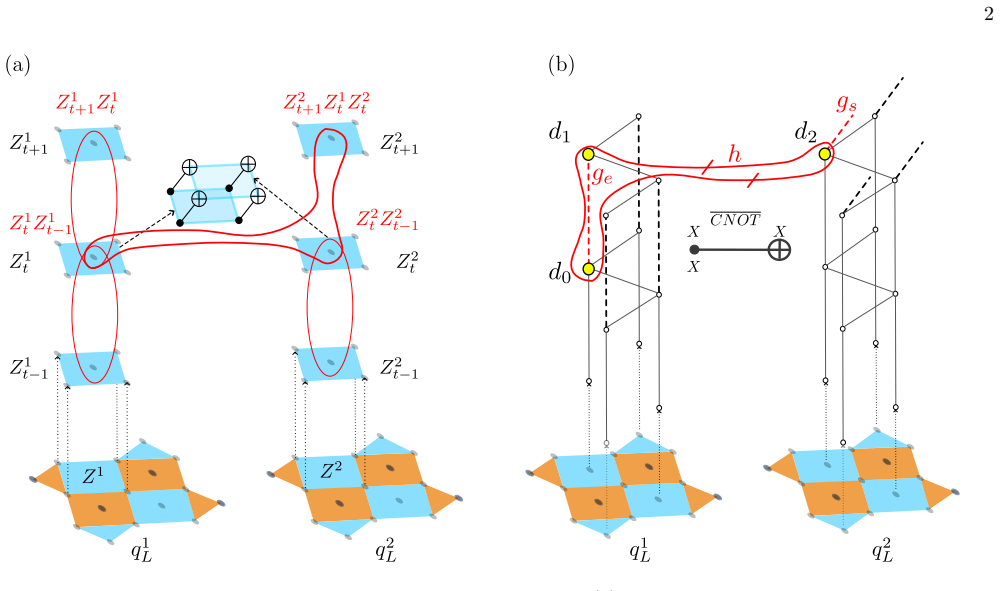
The central object is the ghost-edge decomposition of the detector error model — the representation of which physical errors flip which syndrome detectors. Transversal entangling gates create order-three hyperedges that span logical qubits; the protocol splits each into a time-like ghost edge confined to one logical qubit and a ghost singleton (an edge to the boundary) confined to the other, so that the spatially delocalised decoding problem becomes a sparse message-passing problem among single-qubit decoder cores. The companion patience mechanism is a heralding procedure: two inferences — growth in correction weight between decoding iterations, and a complementary matching on a closed temporal boundary — flag the rare distance-reducing failures identified by Eq. (1), and only then does the decoder postpone a conditional gate to collect further syndrome rounds. The paper also identifies the topological source of resilience that makes this work: error strings that pierce a transversal entangling gate fork in space, creating logically trivial loops that substitute for the buffer regions a windowed memory decoder would otherwise need.
What would settle it
Run the deep-Clifford benchmark circuit behind Fig. 3 at distances $d=15$ and $d=17$ with eight logical qubits and count how many ghost-decoding passes are needed to keep the logical error per layer falling exponentially with distance; if that count grows with distance or qubit count instead of staying constant, the per-window reconfiguration overhead grows with system size and the scalability claim fails.
Extended reading notes
Core claim
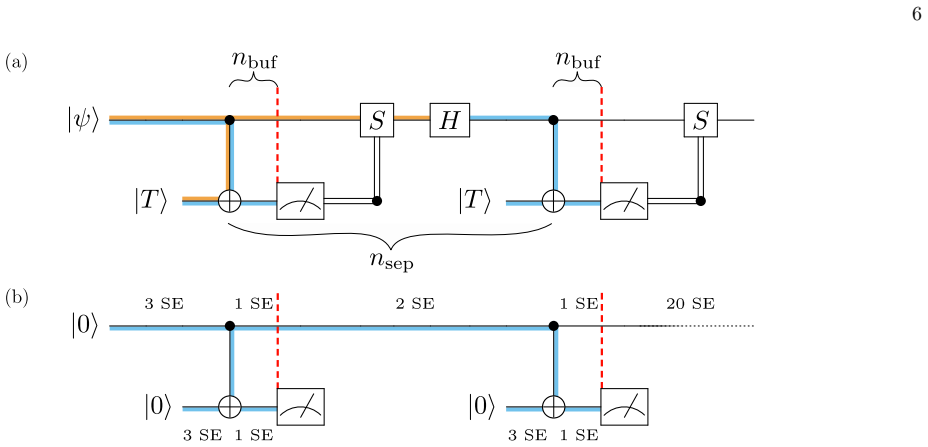
The central claim is that $O(1)$-round transversal Clifford+T logic in the rotated surface code can be decoded with fully windowed, scalable decoders — something prior work saw as blocked either by exponential decoding volume or by the need for global, non-windowed correlated decoding. The paper's key move is to decompose the order-three hyperedges created by transversal entangling gates into ghost edges: a time-like edge confined to one logical qubit plus a ghost singleton confined to the other, so that decoding factorises into sparse message passing between independent single-qubit decoders. Iterating this ghost protocol purges the inter-qubit hyperedges from the syndrome, and exposing ghost singletons only during carefully chosen passes keeps low-weight logical loops out of the final decoding problem. For teleportation-based $T$ gates the paper shows the time overhead is a buffering problem, that aggressive temporal windowing with $n_{\mathrm{buf}}=1$ still suppresses errors in the distance, and that the residual failure modes, bounded by $w \ge (n_{\mathrm{buf}} + 1 + \lceil d/2\rceil)/2$, halve the effective distance. The patience protocol heralds those rare failure modes and postpones only the affected conditional gate, recovering accuracy close to global decoding at negligible average cost and delivering the claimed order-of-magnitude speed-up with small space overhead.
Load-bearing premise
Everything rests on the assumption that a small, hand-chosen number of decoding passes will keep working for larger circuits and bigger code distances; the paper admits it currently picks these schedules by trial and error rather than by rule.
Editorial extensions
If this is right
- Fully windowed decoding of $O(1)$-round transversal Clifford+T logic becomes possible: each decoder core owns one logical qubit, and the per-core decoding problem looks like a single-qubit memory experiment regardless of the surrounding circuit.
- On slow-clock AMO hardware, Clifford+T circuits run at more than an order of magnitude higher logical clock rate than under lattice surgery, at a small space overhead instead of the large overhead of time-optimal lattice surgery.
- Fast $T$ gates survive aggressive temporal windowing: with $n_{\mathrm{buf}}=1$ errors are still suppressed in the distance (Eq. (1) predicts a halved effective distance of $\lceil d/4\rceil$ at larger $d$), and patience restores accuracy close to global decoding at an average cost below $3\times10^{-3}$ extra syndrome rounds per $T$ gate at $d=9$, $p=0.1\%$.
- Because the protocols do not depend on graph-based decoders, the ghost decomposition can be paired with fast hypergraph decoders, which the paper suggests as the route toward applying the approach beyond the surface code.
Reading between the lines
- The scalability claim currently hangs on pass-count tuning: Appendix B says parameters are found empirically per distance and round count, and a rule for setting them automatically would turn the scheme from a demonstrated benchmark into a generally testable one.
- The mechanism behind the resilience — error strings forking at transversal gates create extra syndrome information that substitutes for buffer regions — suggests a design principle for other $O(1)$-depth gadgets, potentially extensible to transversal $S$ gates, magic-state teleportation, and codes beyond the rotated surface code.
- Patience is effectively speculative execution — proceed at minimal buffer size, stall only on a herald — and the paper reports only the mean delay, so the natural follow-up is the delay tail that a real-time controller would actually schedule against.
- As the paper's own note-added records, closely related decoding schemes appeared while this work was being finalised; the decisive comparison will be whether windowed ghost decoding keeps its accuracy and bounded pass counts at larger distances and qubit counts where tuning is currently manual.
Editorial analysis
A structured set of objections, weighed in public.
Referee Report
Summary. The paper proposes two windowed decoding protocols, the ghost protocol and patience, to make real-time decoding of fast transversal logic in the surface code scalable. The ghost protocol decomposes order-three hyperedges that arise at transversal entangling gates into ghost edges and ghost singletons, allowing each logical qubit to be decoded independently with iterative message passing. Patience augments this by heralding distance-reducing failure modes and postponing conditional gates until more syndrome data are available. The authors report Stim simulations of deep Clifford circuits and a Clifford proxy for teleportation-based T gates, showing subthreshold error suppression and claiming that, with a very small space overhead, transversal Clifford+T logic can be executed in O(1) time per gate, giving an order-of-magnitude speed-up over lattice surgery.
Significance. If the central claims hold, the paper addresses an important bottleneck for AMO-based fault-tolerant computing: transversal logic can in principle provide a fast logical clock, but decoding was previously thought to require either global correlated decoding with untenable decoding volumes or O(d) syndrome-extraction rounds between gates. The ghost-protocol decomposition is a genuinely new idea, and the topological arguments in Sec. V for inherent resilience are plausible and thought-provoking. The paper ships reproducible Stim circuits, uses a realistic circuit-level noise model, and provides numerical evidence of subthreshold scaling for both Clifford and T-gate-proxy circuits. However, the significance depends on resolving the scalability of the empirically tuned decoding passes and on validating the T-gate proxy, so the contribution is promising but not yet fully established.
major comments (4)
- [Appendix B (Fig. 3)] Appendix B reports that the number of decoding passes is an empirically tuned parameter, with the default four passes used only for d ≤ 9; at d = 11 the deep Clifford circuits require six passes for nr = 2,3 and eight passes for nr = 1. Since each pass is a full independent decoding round over every logical qubit, the per-window decoding cost is not demonstrated to be constant or bounded as d grows; the statement that the pass count has not been seen to exceed the code distance actually allows growth with d. No deep-Clifford data are shown for d > 11. This is load-bearing for the abstract claim of very small space overhead and an order-of-magnitude speed-up, because the speed-up over lattice surgery assumes O(1) decoding overhead per logical gate. The authors should either prove or numerically demonstrate that the required pass count remains small with d, or substantially weaken the scalability claim.
- [Sec. IV (Fig. 4b)] The T-gate time-complexity analysis is based entirely on a proxy circuit that strips out the classically controlled S gates, the H gates between consecutive T gates, and the injected |T> magic states, replacing them with a Clifford circuit in which all qubits are prepared in |0>. The paper asserts that this proxy captures the structural properties of teleportation-based T gates, including severances, but provides no evidence that the decoder's behaviour on the proxy matches the real circuit. In particular, the classically controlled S gate changes the Pauli frame and can affect which corrections are logically trivial, so it is not obvious that the proxy's severance structure is representative. Since the central non-Clifford claim (O(1)-time T gates with small buffers) rests on this proxy, the authors should validate it against a full teleportation circuit at least at small distances, or provide a precise equivalence argument.
- [Sec. VI (Fig. 9, Table I)] Patience is introduced as the mechanism that restores near-global accuracy by heralding distance-reducing failures, but the two herald conditions are heuristic and no analysis is given of their false-negative rate. A false negative leads directly to a logical error, as the text concedes, so the claim that patience recovers the code distance requires either a proof that all failure modes of the form in Fig. 8b are heralded, or a numerical estimate of the false-negative rate and its contribution to the logical error rate. Table I also omits entries for p = 0.001 at d = 13 and d = 15, which are exactly the distances where the distance-halving effect of Eq. (1) should be most visible; these data should be reported.
- [Sec. II and Sec. III] The scalability argument for general fast transversal logic is benchmarked only on four-qubit random Clifford circuits and a single T-gate proxy. The worst-case binary-tree circuits considered by Sahay et al. [17] are dismissed as unrealistic, but the manuscript does not show that the ghost protocol's message-passing schedule remains efficient for arbitrary circuits with O(1) spacing; indeed App. B shows the schedule must be re-tuned with circuit structure, nr, and d. To support the claim of scalable decoding for transversal logic in general, the authors should either extend the numerical evidence to more adversarial connectivity patterns or state the class of circuits for which the protocol is intended.
minor comments (6)
- [Abstract and Sec. I] The abstract says 'O(1) time' while the introduction says 'O(1) rounds of syndrome extraction'; this should be made consistent and explicit about which resource is being held constant.
- [Fig. 5b] The 'TW error' is defined as the probability that the windowed decoder disagrees with the global decoder, which is not itself a logical error rate; the caption should make this distinction explicit to avoid over-interpretation.
- [Eq. (1)] Eq. (1) introduces w, c, and ch without a formal definition in the main text; define these quantities clearly before the inequality is used.
- [Table I] The dash entries in Table I are not explained; state whether the data are missing, not simulated, or statistically indistinguishable from zero, and report the number of samples used for the averages.
- [Appendix A] The statement that all error bars represent likelihoods within a factor of 1000 of the max likelihood hypothesis should be clarified, and the number of shots per data point should be stated.
- [Sec. V] The claim that avoiding a buffer of size nbuf ≈ d/2 leads to a fourfold space overhead in the number of qubits is not derived; provide the counting argument behind this factor.
Circularity Check
No significant circularity: the ghost protocol and patience are constructive protocols whose error rates are measured, not derived from the target claim; App. B pass-count tuning is a disclosed scalability caveat, not a fitted prediction.
full rationale
The derivation chain is self-contained. The ghost protocol is defined constructively: order-three hyperedges from transversal CNOTs are decomposed into ghost edges and ghost singletons, and decoding proceeds by iterative message passing and syndrome refinement (Sec. III). The reported logical-error rates in Figs. 3, 5 and 9 are simulated outcomes under a circuit-level depolarizing noise model; no plotted logical-error quantity is an input to the protocol or to Eq. (1). Eq. (1) is derived from the geometry of correction strings relative to the open temporal boundary and is then checked by exhaustive search, and the patience delay schedule in Table I follows from Eq. (1) rather than from fitting the logical-error data. The closest circularity-adjacent issue is Appendix B, where pass counts and ghost-singleton exposure are set empirically: 'We currently determine these parameters empirically and further study is needed to work out how to set these parameters automatically in regimes that are hard to simulate.' This is a genuine limitation on the strength of the scalability claim beyond the simulated distances, but it is a hyperparameter-dependence and a missing automatic-tuning result, not an equation-level reduction of the claimed prediction to the fit. The self-citations present in the paper, e.g. [16], [19], [33], and the Riverlane noise model [63], are background or engineering-comparison references and do not carry the central argument; the principal benchmarks are external ([12], global correlated decoding) and the results are measured against those baselines. No uniqueness theorem from the authors' prior work is invoked to force the protocol choice. Therefore no circular step can be exhibited from the paper's own equations or citations.
Assumptions & free parameters
free parameters (3)
- Decoding pass count and ghost-singleton exposure schedule =
Default 4 passes; for Fig. 3 at d=11, nr=2 or 3: 6 passes with singletons on passes 1 and 4; for d=11, nr=1: 8 passes…
- T-gate proxy operating points nbuf and nsep =
nbuf=1, nsep=3
- Patience delay (nbuf increase when heralded) =
Delay = 0,1,2,3,4,5,6 for d = 3,5,7,9,11,13,15 (Table I)
assumptions (5)
- domain assumption Circuit-level noise model with two-qubit depolarising error rate p, single-qubit and idle error rate p/10, and measurement error p (App. A)
- ad hoc to paper The T-gate proxy circuit (Fig. 4b) captures the structural decoding properties of full teleportation-based T gates, including severances, despite omitting classically controlled gates and non-stabiliser states
- domain assumption The decoder can postpone classically controlled S gates while additional syndrome rounds are collected (property 1 of patience)
- domain assumption Realistic algorithms such as Toffoli ladders keep the decoding volume growing linearly with window depth, not exponentially as in the binary-tree worst case of Sahay et al.
- domain assumption Each logical qubit is decoded on its own core with sparse messages, and distributed decoding can be reconfigured with minimal overhead between windows
invented entities (1)
-
Ghost edges and ghost singletons
Cite this review
Pith. "Pith review of Scalable decoding protocols for fast transversal logic in the surface code." pith.science (2026). https://pith.science/paper/RFRQJ6QM
@misc{pith2026250523567,
  author       = {Pith},
  title        = {Pith review of: Scalable decoding protocols for fast transversal logic in the surface code},
  year         = {2026},
  howpublished = {\url{https://pith.science/paper/RFRQJ6QM}},
  note         = {Machine review of arXiv:2505.23567}
}
read the original abstract
Atomic, molecular and optical (AMO) approaches to quantum computing are promising due to their increased connectivity, long coherence times and apparent scalability. However, they have a significantly reduced cadence of syndrome extraction compared to superconducting devices, a potentially crippling slow-down given the substantial logical gate counts required for quantum advantage. Transversal logic, which exploits higher connectivity, has the potential to significantly speed up the logical clock rate by reducing the number of syndrome extraction rounds required, but current decoders for fast transversal logic are not scalable. This is not just because existing decoders are too slow to handle the large decoding volumes resulting from fast logic; transversal logic breaks the key structural properties that make real-time decoding of lattice surgery efficient. We introduce two new, windowed decoding protocols for transversal logic in the surface code that restore modularity and locality to the decoding problem. Using our protocols, we show that, with a very small space overhead, our scalable decoders unlock an order of magnitude speed-up for transversal logic compared to lattice surgery. Taken together, our results provide key evidence for the viability of large-scale algorithms on AMO qubits.
Figures


Figures from the paper (6 more)


Reference graph
Works this paper leans on
-
[17]
H. Ali, J. Marques, O. Crawford, J. Majaniemi, M. Serra- Peralta, D. Byfield, B. Varbanov, B. M. Terhal, L. Di- Carlo, and E. T. Campbell, Reducing the error rate of a superconducting logical qubit using analog readout in- formation, Physical Review Applied22, 044031 (2024), publisher: American Physical Society
work page 2024
-
[1]
nbuf capturesthenumberofroundsofsyndromeex- traction between a transversal CNOT that creates the entanglement necessary for teleportation and the logical measurement that informs a classically controlled S gate
-
[2]
nsep defines the number of rounds that separate consecutive T gates. Notably, nbuf functions as a buffer region with respect to the decoding problem centred on the logical measure- ments in the circuit, presenting new structural challenges for decoding. This is because the logical measurement can be flipped by errors before the transversal CNOT on both qu...
-
[3]
The freedom to postpone the application of con- ditional logic during teleportation. That is, we are free to accumulate more syndrome informa- tion than originally planned for via further syn- drome extraction rounds before applying a condi- tional gate
-
[4]
The inherent rarity of the distance reducing failure modes described in Sec. V. This rarity is evident in the low TW error probability observed in Fig. 5b. Property (1) means nbuf can be a runtime parameter without changing the underlying logical operation (in the absence of error, aT gate remains aT gate regardless of how many rounds separate a CNOT from...
-
[5]
We run the ghost protocol as usual, but track whether the weight of the correction string in- creases between the first and final decoding iter- ations performed by the ghost protocol. This func- tions to detect most cases where aggressive tem- poral windowing spuriously triggers a syndrome refinement operation (of the form described in Sec. III) despite ...
-
[6]
Inspired by soft-output decoding constructions [48, 49], we perform a further complementary match- ing on a modified DEM, where the open temporal boundary is turned into a closed boundary, mean- ing error strings can no longer terminate at a tem- poral boundary. With this complementary match- ing, we can herald cases that yield a different cor- rection bi...
-
[7]
D. Bluvstein, S. J. Evered, A. A. Geim, S. H. Li, H. Zhou, T. Manovitz, S. Ebadi, M. Cain, M. Kali- nowski, D. Hangleiter, J. P. Bonilla Ataides, N. Maskara, I. Cong, X. Gao, P. Sales Rodriguez, T. Karolyshyn, G. Semeghini, M. J. Gullans, M. Greiner, V. Vuletić, and M. D. Lukin, Logical quantum processor based on recon- figurable atom arrays, Nature626, 5...
work page 2024
Show all 69 references
-
[8]
P. S. Rodriguez, J. M. Robinson, P. N. Jepsen, Z. He, C. Duckering, C. Zhao, K.-H. Wu, J. Campo, K. Bag- nall, M. Kwon, T. Karolyshyn, P. Weinberg, M. Cain, S. J. Evered, A. A. Geim, M. Kalinowski, S. H. Li, T. Manovitz, J. Amato-Grill, J. I. Basham, L. Bern- stein, B. Braverm...
2024
-
[9]
B. W. Reichardt, A. Paetznick, D. Aasen, I. Basov, J. M. Bello-Rivas, P. Bonderson, R. Chao, W. v. Dam, M. B. Hastings, A. Paz, M. P. d. Silva, A. Sundaram, K. M. Svore, A. Vaschillo, Z. Wang, M. Zanner, W. B. Cairncross, C.-A. Chen, D. Crow, H. Kim, J. M. Kin- dem, J. King, M...
2024 arXiv
-
[10]
Paetznick, M
A. Paetznick, M. P. d. Silva, C. Ryan-Anderson, J. M. Bello-Rivas, J. P. C. III, A. Chernoguzov, J. M. Dreil- ing, C. Foltz, F. Frachon, J. P. Gaebler, T. M. Gatter- man, L. Grans-Samuelsson, D. Gresh, D. Hayes, N. He- witt, C. Holliman, C. V. Horst, J. Johansen, D. Luc- chett...
2024 arXiv
-
[11]
Poole, T
C. Poole, T. M. Graham, M. A. Perlin, M. Otten, and M. Saffman, Architecture for fast implementation of quantum low-density parity-check codes with optimized Rydberg gates, Physical Review A111, 022433 (2025), publisher: American Physical Society
2025
-
[12]
F. A. An, A. Ransford, A. Schaffer, L. R. Sletten, J. Gae- bler, J. Hostetter, and G. Vittorini, High Fidelity State Preparation and Measurement of Ion Hyperfine Qubits with I > 1 2, Physical Review Letters129, 130501 (2022), publisher: American Physical Society
2022
-
[13]
Google Quantum AI and Collaborators, Quantum error correction below the surface code threshold, Nature638, 920 (2025), publisher: Nature Publishing Group
2025
-
[14]
Leroux, C
S.Krinner, N.Lacroix, A.Remm, A.DiPaolo, E.Genois, C. Leroux, C. Hellings, S. Lazar, F. Swiadek, J. Her- rmann, G.J.Norris, C.K.Andersen, M.Müller, A.Blais, C. Eichler, and A. Wallraff, Realizing repeated quantum error correction in a distance-three surface code, Nature 605, 6...
2022
-
[15]
Besedin, M
I. Besedin, M. Kerschbaum, J. Knoll, I. Hesner, L. Bödeker, L. Colmenarez, L. Hofele, N. Lacroix, C. Hellings, F. Swiadek, A. Flasby, M. B. Panah, D. C. Zanuz, M. Müller, and A. Wallraff, Realizing Lat- tice Surgery on Two Distance-Three Repetition Codes with Superconducting Q...
2025
-
[16]
Caune, L
L. Caune, L. Skoric, N. S. Blunt, A. Ruban, J. McDaniel, J. A. Valery, A. D. Patterson, A. V. Gramolin, J. Ma- janiemi, K. M. Barnes, T. Bialas, O. Buğdaycı, O. Craw- ford, G. P. Gehér, H. Krovi, E. Matekole, C. Topal, S. Po- letto, M. Bryant, K. Snyder, N. I. Gillespie, G. Jo...
2024 arXiv
-
[18]
M. Cain, C. Zhao, H. Zhou, N. Meister, J. P. B. Ataides, A. Jaffe, D. Bluvstein, and M. D. Lukin, Correlated De- coding of Logical Algorithms with Transversal Gates, Physical Review Letters133, 240602 (2024), publisher: American Physical Society
2024
-
[19]
Delfosse, V
N. Delfosse, V. Londe, and M. Beverland, Toward a Union-Find decoder for quantum LDPC codes (2021), arXiv:2103.08049 [quant-ph]
2021 arXiv
-
[20]
Horsman, A
D. Horsman, A. G. Fowler, S. Devitt, and R. V. Meter, Surface code quantum computing by lattice surgery, New Journal of Physics 14, 123011 (2012), publisher: IOP Publishing
2012
-
[21]
C.Gidney,Stim: afaststabilizercircuitsimulator,Quan- tum 5, 497 (2021), publisher: Verein zur Förderung des Open Access Publizierens in den Quantenwissenschaften
2021
-
[22]
Bombín, C
H. Bombín, C. Dawson, Y.-H. Liu, N. Nickerson, F. Pastawski, and S. Roberts, Modular decoding: par- allelizable real-time decoding for quantum computers (2023), arXiv:2303.04846 [quant-ph]
2023 arXiv
-
[23]
Sahay, Y
K. Sahay, Y. Lin, S. Huang, K. R. Brown, and S. Puri, ErrorCorrectionofTransversalCNOTGatesforScalable Surface-Code Computation, PRX Quantum 6, 020326 (2025), publisher: American Physical Society
2025
-
[24]
Bravyi and A
S. Bravyi and A. Kitaev, Universal quantum computa- tion with ideal Clifford gates and noisy ancillas, Physical Review A71, 022316 (2005), publisher: American Phys- ical Society
2005
-
[25]
Chamberland and E
C. Chamberland and E. T. Campbell, Universal Quan- tum Computing with Twist-Free and Temporally En- coded Lattice Surgery, PRX Quantum3, 010331 (2022), publisher: American Physical Society
2022
-
[26]
A. G. Fowler, Time-optimal quantum computation (2013), arXiv:1210.4626 [quant-ph]
2013 arXiv
-
[27]
Serra-Peralta, M
M. Serra-Peralta, M. H. Shaw, and B. M. Terhal, Decod- ing across transversal Clifford gates in the surface code (2025)
2025
-
[28]
M. Cain, D. Bluvstein, C. Zhao, S. Gu, N. Maskara, M. Kalinowski, A. A. Geim, A. Kubica, M. D. Lukin, and H. Zhou, Fast correlated decoding of transversal log- ical algorithms (2025)
2025
-
[29]
Dennis, A
E. Dennis, A. Kitaev, A. Landahl, and J. Preskill, Topological quantum memory, Journal of Mathematical Physics 43, 4452 (2002)
2002
-
[30]
Eastin and E
B. Eastin and E. Knill, Restrictions on Transversal En- coded Quantum Gate Sets, Physical Review Letters102, 110502 (2009), publisher: American Physical Society
2009
-
[31]
Jochym-O’Connor, A
T. Jochym-O’Connor, A. Kubica, and T. J. Yoder, Dis- jointness of Stabilizer Codes and Limitations on Fault- Tolerant Logical Gates, Physical Review X 8, 021047 (2018), publisher: American Physical Society
2018
-
[32]
Chen, M.-C
Z.-H. Chen, M.-C. Chen, C.-Y. Lu, and J.-W. Pan, Transversal Logical Clifford gates on rotated surface codes with reconfigurable neutral atom arrays (2024), arXiv:2412.01391 [quant-ph]
2024 arXiv
-
[33]
G. P. Gehér, C. McLauchlan, E. T. Campbell, A. E. Moylett, and O. Crawford, Error-corrected Hadamard gate simulated at the circuit level, Quantum 8, 1394 (2024), publisher: Verein zur Förderung des Open Ac- cess Publizierens in den Quantenwissenschaften
2024
-
[34]
Edmonds, Paths, Trees, and Flowers, Canadian Jour- nal of Mathematics17, 449 (1965)
J. Edmonds, Paths, Trees, and Flowers, Canadian Jour- nal of Mathematics17, 449 (1965)
1965
-
[35]
Delfosse and N
N. Delfosse and N. H. Nickerson, Almost-linear time de- coding algorithm for topological codes, Quantum5, 595 (2021), publisher: Verein zur Förderung des Open Access Publizierens in den Quantenwissenschaften
2021
-
[36]
A. B. Ziad, A. Zalawadiya, C. Topal, J. Camps, G. P. Gehér, M.P.Stafford,andM.L.Turner,LocalClustering Decoder: a fast and adaptive hardware decoder for the 14 surface code (2024), arXiv:2411.10343 [quant-ph]
2024
-
[37]
Liyanage, Y
N. Liyanage, Y. Wu, S. Tagare, and L. Zhong, FPGA- based Distributed Union-Find Decoder for Surface Codes, IEEE Transactions on Quantum Engineering5, 1 (2024), arXiv:2406.08491 [quant-ph]
2024 arXiv
-
[38]
B. M. Terhal, Quantum error correction for quantum memories, Reviews of Modern Physics 87, 307 (2015), publisher: American Physical Society
2015
-
[39]
Skoric, D
L. Skoric, D. E. Browne, K. M. Barnes, N. I. Gille- spie, and E. T. Campbell, Parallel window decoding en- ables scalable fault tolerant quantum computation, Na- ture Communications14, 7040 (2023), publisher: Nature Publishing Group
2023
-
[40]
Wu and L
Y. Wu and L. Zhong, Fusion Blossom: Fast MWPM De- coders for QEC
-
[41]
Gidney, Halving the cost of quantum addition, Quan- tum 2, 74 (2018), publisher: Verein zur Förderung des Open Access Publizierens in den Quantenwissenschaften
C. Gidney, Halving the cost of quantum addition, Quan- tum 2, 74 (2018), publisher: Verein zur Förderung des Open Access Publizierens in den Quantenwissenschaften
2018
-
[42]
K. H. Wan, M. Webber, A. G. Fowler, and W. K. Hensinger, An iterative transversal CNOT decoder (2024), arXiv:2407.20976 [quant-ph]
2024 arXiv
-
[43]
A. G. Fowler, Optimal complexity correction of corre- lated errors in the surface code (2013), arXiv:1310.0863 [quant-ph]
2013 arXiv
-
[44]
Higgott and C
O. Higgott and C. Gidney, Sparse Blossom: correcting a million errors per core second with minimum-weight matching,Quantum 9,1600(2025),publisher: Vereinzur Förderung des Open Access Publizierens in den Quanten- wissenschaften
2025
-
[45]
Guernut and C
A. Guernut and C. Vuillot, Fault-Tolerant Constant- Depth Clifford Gates on Toric Codes (2024), arXiv:2411.18287 [quant-ph]
2024 arXiv
-
[46]
Bravyi, M
S. Bravyi, M. B. Hastings, and F. Verstraete, Lieb- Robinson Bounds and the Generation of Correlations and TopologicalQuantumOrder,PhysicalReviewLetters 97, 050401 (2006), publisher: American Physical Society
2006
-
[47]
M. B. Hastings, Topological Order at Nonzero Tempera- ture, Physical Review Letters107, 210501 (2011), pub- lisher: American Physical Society
2011
-
[48]
Gidney, Inplace Access to the Surface Code Y Ba- sis, Quantum 8, 1310 (2024), publisher: Verein zur Förderung des Open Access Publizierens in den Quan- tenwissenschaften
C. Gidney, Inplace Access to the Surface Code Y Ba- sis, Quantum 8, 1310 (2024), publisher: Verein zur Förderung des Open Access Publizierens in den Quan- tenwissenschaften
2024
-
[49]
K.H.Wan,Constant-timemagicstatedistillation(2024), arXiv:2410.17992 [quant-ph]
2024
-
[50]
Litinski, Magic State Distillation: Not as Costly as YouThink,Quantum 3,205(2019),publisher: Vereinzur Förderung des Open Access Publizierens in den Quanten- wissenschaften
D. Litinski, Magic State Distillation: Not as Costly as YouThink,Quantum 3,205(2019),publisher: Vereinzur Förderung des Open Access Publizierens in den Quanten- wissenschaften
2019
-
[51]
Gidney and A
C. Gidney and A. G. Fowler, Efficient magic state fac- tories with a catalyzed $|CCZ\rangle$ to $2|T\rangle$ transformation, Quantum 3, 135 (2019), publisher: Verein zur Förderung des Open Access Publizierens in den Quantenwissenschaften
2019
-
[52]
Gidney, N
C. Gidney, N. Shutty, and C. Jones, Magic state cultiva- tion: growing T states as cheap as CNOT gates (2024), arXiv:2409.17595 [quant-ph]
2024 arXiv
-
[53]
H. Zhou, C. Zhao, M. Cain, D. Bluvstein, C. Duckering, H.-Y. Hu, S.-T. Wang, A. Kubica, and M. D. Lukin, Al- gorithmic Fault Tolerance for Fast Quantum Computing (2024), arXiv:2406.17653 [quant-ph]
2024
-
[54]
Gidney, M
C. Gidney, M. Newman, P. Brooks, and C. Jones, Yoked surface codes (2023), arXiv:2312.04522 [quant-ph]
2023 arXiv
-
[55]
Meister, C
N. Meister, C. A. Pattison, and J. Preskill, Effi- cient soft-output decoders for the surface code (2024), arXiv:2405.07433 [quant-ph]
2024 arXiv
-
[56]
D.Litinski,AGameofSurfaceCodes: Large-ScaleQuan- tum Computing with Lattice Surgery, Quantum3, 128 (2019), publisher: Verein zur Förderung des Open Access Publizierens in den Quantenwissenschaften
2019
-
[57]
Litinski and N
D. Litinski and N. Nickerson, Active volume: An architecture for efficient fault-tolerant quantum com- puters with limited non-local connections (2022), arXiv:2211.15465 [quant-ph]
2022 arXiv
-
[58]
Tillich and G
J.-P. Tillich and G. Zemor, Quantum LDPC codes with positive rate and minimum distance proportional ton1/2, in 2009 IEEE International Symposium on Information Theory (2009) pp. 799–803, iSSN: 2157-8117
2009
-
[59]
N. P. Breuckmann and J. N. Eberhardt, Quantum Low- Density Parity-Check Codes, PRX Quantum2, 040101 (2021), publisher: American Physical Society
2021
-
[60]
Panteleev and G
P. Panteleev and G. Kalachev, Degenerate Quantum LDPC Codes With Good Finite Length Performance, Quantum5, 585 (2021), publisher: Verein zur Förderung des Open Access Publizierens in den Quantenwis- senschaften
2021
-
[61]
Bravyi, A
S. Bravyi, A. W. Cross, J. M. Gambetta, D. Maslov, P. Rall, and T. J. Yoder, High-threshold and low- overhead fault-tolerant quantum memory, Nature627, 778 (2024), publisher: Nature Publishing Group
2024
-
[62]
M. H. Shaw and B. M. Terhal, Lowering Connectivity Requirements for Bivariate Bicycle Codes Using Morph- ingCircuits,PhysicalReviewLetters 134,090602(2025), publisher: American Physical Society
2025
-
[63]
Berthusen, D
N. Berthusen, D. Devulapalli, E. Schoute, A. M. Childs, M. J. Gullans, A. V. Gorshkov, and D. Gottesman, Toward a 2D Local Implementation of Quantum Low- Density Parity-Check Codes, PRX Quantum6, 010306 (2025), publisher: American Physical Society
2025
-
[64]
A. J. Malcolm, A. N. Glaudell, P. Fuentes, D. Chan- dra, A. Schotte, C. DeLisle, R. Haenel, A. Ebrahimi, J. Roffe, A. O. Quintavalle, S. J. Beale, N. R. Lee-Hone, andS.Simmons,ComputingEfficientlyinQLDPCCodes (2025), arXiv:2502.07150 [quant-ph]
2025
-
[65]
Q. Xu, J. P. Bonilla Ataides, C. A. Pattison, N. Raveen- dran, D. Bluvstein, J. Wurtz, B. Vasić, M. D. Lukin, L. Jiang, and H. Zhou, Constant-overhead fault-tolerant quantum computation with reconfigurable atom arrays, Nature Physics20, 1084 (2024), publisher: Nature Pub- lish...
2024
-
[66]
Wolanski and B
S. Wolanski and B. Barber, Ambiguity Clustering: an accurate and efficient decoder for qLDPC codes (2025), arXiv:2406.14527 [quant-ph]
2025 arXiv
-
[67]
Hillmann, L
T. Hillmann, L. Berent, A. O. Quintavalle, J. Eisert, R. Wille, and J. Roffe, Localized statistics decoding: A parallel decoding algorithm for quantum low-density parity-check codes (2024), arXiv:2406.18655 [quant-ph]
2024
-
[68]
K. Yin, X. Fang, J. Ruan, H. Zhang, D. Tullsen, A. Sornborger, C. Liu, A. Li, T. Humble, and Y. Ding, SymBreak: Mitigating Quantum Degeneracy Issues in QLDPC Code Decoders by Breaking Symmetry (2024), arXiv:2412.02885 [quant-ph]
2024 arXiv
-
[69]
Barber, K
B. Barber, K. M. Barnes, T. Bialas, O. Buğdaycı, E. T. Campbell, N. I. Gillespie, K. Johar, R. Rajan, A. W. Richardson, L. Skoric, C. Topal, M. L. Turner, and A. B. Ziad, A real-time, scalable, fast and resource-efficient de- 15 coder for a quantum computer, Nature Electronics...
2025
Reviewed August 7, 2026 · model on record in the stance chip above.
Discussion (0). Sign in to comment.