REVIEW 3 major objections 5 minor 2 cited by
Maximum Likelihood Learning of Latent Dynamics Without Reconstruction
T0 review · 3 major / 5 minor · reviewed 2026-08-07 · deepseek-v4-flash
Pith's one-line read A recognition network and a linear-Gaussian prior suffice to learn latent dynamics from high-dimensional observations without any decoder or reconstruction loss.
desk verdict A promising extension of RPM to SSMs with strong distractor-robustness results, but the maximum-likelihood and exact-inference claims are undercut by the unchecked F≈pη approximation and a q-dependent Γ term in the E-step. read the letter →
The pith
A machine-rendered reading of the paper's core claim, the machinery that carries it, and where it could break.
The reading
What carries the argument
The load-bearing object is the recognition-parametrized joint distribution of a state space model: $p_\eta(z_1)\prod_t p_\eta(z_{t+1}|z_t)\prod_t f_{\phi_t}(z_t|x_t)p_0(x_t)/F_{\phi_t}(z_t)$, with Gaussian recognition factors and a linear-Gaussian prior constrained to stationary $N(0,I)$ so that the process remains stationary at every time step. The tractability mechanism is the auxiliary free energy $G$ obtained from an interior variational bound with auxiliary factors $g_{tn}(z_t)=q_n(z_t)/p_\eta(z_t)$; this replaces the intractable expectation over the mixture $F_{\phi_t}$ with closed-form Gaussian integrals. With that choice, $G$ has exactly the form of the free energy of a linear-Gaussian model whose 'likelihood' is the recognition factor, so the E-step is exact Kalman smoothing and the M-step is exact gradient ascent on $G$. The assumption that $F_{\phi_t}(z_t)\approx p_\eta(z_t)$ is what makes the auxiliary choice valid and the bound tight.
What would settle it
Train an RP-GSSM on a synthetic video task and, during training, compute a standard distributional distance (for example, KL divergence) between the empirical mixture $F_{\phi_t}(z_t)$ and the learned prior $p_\eta(z_t)$; the maximum-likelihood account predicts the distance stays near zero whenever the auxiliary free energy rises. A second test: construct background distractors whose temporal autocorrelation matches that of the true latent signal; if the RP-GSSM then fails to separate signal from distractors, the robustness results are driven by the temporal-persistence assumption rather than by the likelihood structure.
Extended reading notes
Core claim
On its own terms, the paper's discovery is that a state space model can be fit by maximum likelihood without ever parametrizing the distribution of observations. The RP-GSSM builds a joint distribution over latents and observations by multiplying a Gaussian Markov prior with per-time recognition factors $f_{\phi_t}(z_t|x_t)$ and normalizing each factor by its empirical average $F_{\phi_t}(z_t)$ over the training set; the implied observational distribution is degenerate, but the posterior beliefs over latents are parametric and exact. The E-step is Kalman smoothing, and the M-step is gradient ascent on an auxiliary free energy whose variational gap is controlled by setting the auxiliary factors to $q_n(z_t)/p_\eta(z_t)$. The paper's positive thesis is that decoders are not merely wasteful for latent-state tasks but can be harmful: reconstruction pressure pushes latents to encode irrelevant or distractor features, while an objective built purely from conditional-independence structure learns the temporally persistent state.
Load-bearing premise
The load-bearing premise is that, at every time step, the average of the recognition distributions over the training inputs closely matches the latent prior distribution; if that match fails during finite training, the objective being maximized is not the model's true likelihood, and both the maximum-likelihood claim and the reported distractor robustness could rest on that approximation.
Editorial extensions
If this is right
- Because no decoder is learned, model capacity is spent on inference, so latent dynamics can be recovered from high-dimensional video without reconstructing pixels.
- Posterior beliefs over full latent trajectories are exact Gaussian, giving downstream planning or filtering tasks calibrated uncertainty without sampling or auxiliary losses.
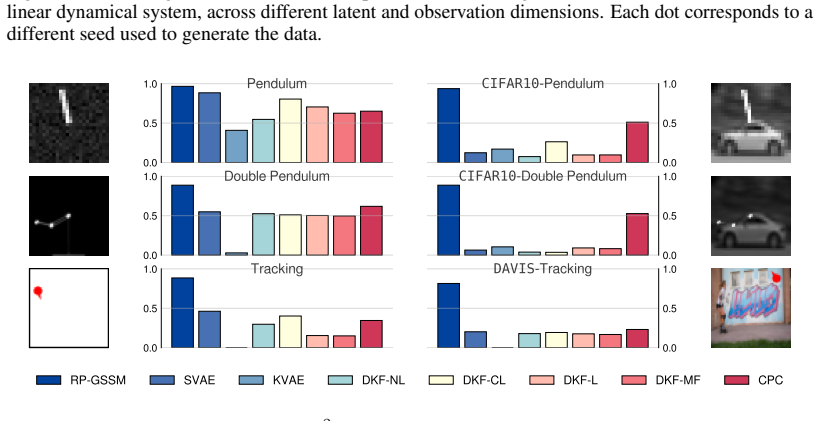
- Latents learned this way capture temporally persistent signal while ignoring distractors with unreliable temporal statistics, including natural images and videos used as backgrounds.
- Exact Gaussian inference scales more gracefully with latent dimension than sampling-based generative alternatives, as shown in higher-dimensional linear experiments.
- If the central claim holds, the RP-GSSM can serve as a latent-dynamics foundation module: training an auxiliary generative model on its inferred latents gives reconstructions that filter out the distractors that other methods cannot remove.
Reading between the lines
- An untested consequence: the advantage over reconstruction-based methods should shrink when distractors have temporal statistics as persistent and structured as the true signal; this can be tested directly by varying background autocorrelation.
- The same recognition-parametrization recipe should transfer to other graphical models in which conditional independences supply the learning signal, such as switching state space models or multimodal time series, wherever reconstruction is not the goal.
- A direct probe of the likelihood claim is to monitor $F_{\phi_t}$ against $p_\eta$; if the gap stays large while $G$ increases, the model is optimizing a looser bound than the paper's maximum-likelihood framing suggests.
- The small-data result on 64 pendulum sequences is the clearest place to stress-test the method: if the auxiliary approximation is only valid at large sample sizes, performance on tiny datasets may come from the variational gap rather than from the model's structure.
Editorial analysis
A structured set of objections, weighed in public.
Referee Report
Summary. The paper introduces the recognition-parametrized Gaussian state space model (RP-GSSM), an unsupervised method for learning latent dynamical structure from time series without an explicit generative decoder. The model combines a linear-Gaussian Markov prior over latents with arbitrarily nonlinear recognition factors that map observations to Gaussian distributions on latents, following the recognition-parametrized model (RPM) framework. The authors derive a free-energy objective, apply an interior variational bound with auxiliary factors, and assume that the empirical average of recognition factors F_phi_t(z_t) is approximately equal to the prior p_eta(z_t), which allows them to replace the intractable log F term and to claim that the E-step reduces to exact Kalman smoothing. Experiments on linear dynamical systems, pendulum and double-pendulum videos, and object tracking, with and without background distractors, show that RP-GSSM recovers latent variables more accurately than several VAE-based and contrastive baselines. The paper also demonstrates that an auxiliary generative model trained on RP-GSSM latents can ignore distractors and that future latent states can be predicted without auxiliary objectives.
Significance. If the central approximation is valid or adequately controlled, the RP-GSSM is a conceptually interesting contribution: it offers a principled probabilistic objective for learning latent dynamics without reconstruction, with tractable Gaussian inference via Kalman smoothing. The empirical results are broad, covering several dynamical systems and distractor conditions, and the paper compares against multiple strong baselines. The paper also ships useful details on implementation, hyperparameters, and runtime. However, the significance is conditional on an unverified approximation, F_phi_t(z_t) ≈ p_eta(z_t), which is load-bearing for both the maximum-likelihood claim and the exact-inference claim. The manuscript would benefit from either empirical validation of this approximation or a revised, more modest statement of what is being optimized and what inference is exact.
major comments (3)
- [Section 3, after Eq. (6); Appendix B.2] The approximation F_phi_t(z_t) ≈ p_eta(z_t) is load-bearing for the claim that the E-step is exact Kalman smoothing, but the paper does not verify it. The expression for log Gamma-tilde_tn in Appendix B.2 contains the natural parameters eta^n_q_t of the variational distribution q_n, so when F differs from p_eta, Gamma is not 1 and the objective is not the linear-Gaussian free energy with q-independent constants that the main text describes. In that case the 'E-step' would require solving a coupled fixed-point problem in q_n and Gamma-tilde, and the coordinate-ascent claim is not established. The paper asserts F → p_eta as a large-data in-model limit (citing Walker et al., 2023) but reports no finite-sample diagnostic of this convergence, such as a KL divergence or the size of log Gamma. Without such evidence, the central claim that the method performs maximum-likelihood learning with exact inference is unsupported.
- [Abstract; Section 3, paragraphs on exact inference] The claim of exact inference is overstated. Under the RPM joint, the posterior is proportional to p_eta(z) * product_t f_phi_t(z_t|x_t) / F_phi_t(z_t), which is in general a ratio of a Gaussian to a mixture of Gaussians and is not Gaussian. Standard Kalman smoothing returns the q_n that maximizes the auxiliary free energy G, which is a variational quantity, not the exact posterior. Exactness holds only when F_phi_t ≈ p_eta, the same unquantified assumption identified above. The paper should either provide evidence for this condition or revise the inference claim to describe variational inference within a Gaussian family that is exact only under the stated approximation.
- [Section 3, Lemma 2.1 usage] The parametrization p(z_1)=N(0,I) and transition covariance I-AA^T is motivated by Lemma 2.1, but the lemma only guarantees the existence of an equivalent model whose stationary distribution is N(0,I), not that the process starts in that distribution. The transformed initial distribution in Eq. (7) is N(Gm_1+c, GQ_1G^T), which is generally not N(0,I). Thus the paper's stationary-from-time-0 choice is an additional modeling restriction, and the statement that 'no generality is lost' (Section 3) is too strong for finite-horizon sequences. This does not invalidate the method, but the framing should be qualified.
minor comments (5)
- [Appendix B.2] The displayed formula for log Gamma-tilde_tn appears to be missing a logarithm on the sum over n' after '- log N'; as written, the expression would scale linearly rather than logarithmically with the number of training points N.
- [Section 3] The sentence 'qn(zt) can be computed exactly via standard Kalman smoothing' is only true for the variational distribution under the F ≈ p_eta approximation; please make the conditional nature of this statement explicit in the main text.
- [Figure 2 caption] The axis label '( , )' appears to be a placeholder for the latent and observation dimensions and should be replaced with the actual variables (e.g., D_Z, D_X).
- [Section 5.2] The transition matrix is denoted B in the data-generating process but A elsewhere in the paper; please unify the notation to avoid confusion.
- [Appendix F] The word 'unkown' in the CPC model license entry should be 'unknown'.
Circularity Check
No constructional circularity; the RP-GSSM derivation is self-contained apart from an explicit F≈pη approximation imported from the authors' RPM line, which is a verification gap rather than an equation-level reduction.
full rationale
Walking the derivation chain: the RPM joint (1), the SSM free energy (5), the interior variational bound (6), and the auxiliary free energy (10) are all derived in-paper, with Lemma 2.1 proved in Appendix A. No fitted value is relabeled as a prediction: the future-state predictions use the learned transition A, and posterior means are evaluated against ground truth by regression. The main load-bearing assumption is the Section 3 statement 'we assume Fϕt(zt) ≈ pη(zt) and set gtn(zt) = qn(zt)/pη(zt)', justified by a citation to Walker et al. (2023) from the same group. This is an asymptotic in-model approximation, not a definitional identity; even when it fails, Appendix B.1 shows G remains a lower bound to the RPM log-likelihood, so the objective is still a valid variational bound. The unresolved correctness risk is in Appendix B.2: the final log Γ̃tn contains the qn natural parameters, so the 'additive constant independent of qn' used to justify exact Kalman smoothing holds only if F≈pη makes Γ≈1. That is an unverified assumption and an omitted diagnostic, but it does not make the paper's central claims equivalent to their inputs by construction. The self-citation to RPM is real prior work with independent content; the SSM-specific algorithm and experiments are new. Score 2 reflects the minor, non-constructional circularity concern of importing the key convergence assumption from the authors' own RPM paper without finite-sample verification.
Assumptions & free parameters
free parameters (3)
- Latent transition matrix A =
learned; singular values clipped to (0, 1 - 1e-3)
- Recognition network parameters (mu_phi, Sigma_phi) =
learned
- Latent dimensionality D_Z =
swept: 4/8 pendulum, 8/16 double pendulum, 16/32 tracking
assumptions (5)
- domain assumption The SSM conditional independence structure: observations at different times are independent given the latent state (Figure 1e, Eq. (3)).
- domain assumption The latent process is linear-Gaussian with stationary marginal N(0,I): p(z1)=N(0,I), p(z_t|z_{t-1})=N(A z_{t-1}, I - A A^T).
- ad hoc to paper The large-data in-model limit approximation F_phi_t(z_t) is approximately p_eta(z_t), used to set g_tn = q_n/p_eta.
- ad hoc to paper Recognition factor reparametrization f_phi_t(z_t|x_t) is proportional to p_eta(z_t) f_delta_phi(z_t|x_t) with time-invariant f_delta.
- standard math Jensen's inequality and closed-form Gaussian and Kalman identities.
Cite this review
Pith. "Pith review of Maximum Likelihood Learning of Latent Dynamics Without Reconstruction." pith.science (2026). https://pith.science/paper/JHV4FR22
@misc{pith2026250523569,
  author       = {Pith},
  title        = {Pith review of: Maximum Likelihood Learning of Latent Dynamics Without Reconstruction},
  year         = {2026},
  howpublished = {\url{https://pith.science/paper/JHV4FR22}},
  note         = {Machine review of arXiv:2505.23569}
}
read the original abstract
We introduce a novel unsupervised learning method for time series data with latent dynamical structure: the recognition-parametrized Gaussian state space model (RP-GSSM). The RP-GSSM is a probabilistic model that learns Markovian Gaussian latents explaining statistical dependence between observations at different time steps, combining the intuition of contrastive methods with the flexible tools of probabilistic generative models. Unlike contrastive approaches, the RP-GSSM is a valid probabilistic model learned via maximum likelihood. Unlike generative approaches, the RP-GSSM has no need for an explicit network mapping from latents to observations, allowing it to focus model capacity on inference of latents. The model is both tractable and expressive: it admits exact inference thanks to its jointly Gaussian latent prior, while maintaining expressivity with an arbitrarily nonlinear neural network link between observations and latents. These qualities allow the RP-GSSM to learn task-relevant latents without ad-hoc regularization, auxiliary losses, or optimizer scheduling. We show how this approach outperforms alternatives on problems that include learning nonlinear stochastic dynamics from video, with or without background distractors. Our results position the RP-GSSM as a useful foundation model for a variety of downstream applications.
Figures


Figures from the paper (8 more)


Forward citations
Cited by 2 Pith papers
-
RAMP: Recognition parametrisation by Amortised Message Passing
RAMP defines latent-variable models through learned amortised message passing and optimises summed nodewise recognition-model free energies, recovering latent posteriors in nonlinear tree models.
-
Understanding Self-Supervised Learning via Latent Distribution Matching
Self-supervised learning is recast as latent distribution matching that unifies multiple SSL families and yields a sampling-free Kalman-based predictor plus an identifiability proof for predictive variants under mild ...
Reference graph
Works this paper leans on
-
[1]
Asseman, A., Kornuta, T., and Ozcan, A. (2018). Learning beyond simulated physics. Conference on Neural Information Processing Systems 2018 Spatiotemporal Workshop
work page 2018
-
[2]
Baum, L. E. and Petrie, T. (1966). Statistical Inference for Probabilistic Functions of Finite State Markov Chains . The Annals of Mathematical Statistics , 37(6):1554 -- 1563
work page 1966
-
[3]
Becker, P., Pandya, H., Gebhardt, G., Zhao, C., Taylor, C. J., and Neumann, G. (2019). Recurrent kalman networks: Factorized inference in high-dimensional deep feature spaces. In International conference on machine learning , pages 544--552. PMLR
work page 2019
-
[4]
J., Leary, C., Maclaurin, D., Necula, G., Paszke, A., Vander P las, J., Wanderman- M ilne, S., and Zhang, Q
Bradbury, J., Frostig, R., Hawkins, P., Johnson, M. J., Leary, C., Maclaurin, D., Necula, G., Paszke, A., Vander P las, J., Wanderman- M ilne, S., and Zhang, Q. (2018). JAX : composable transformations of P ython+ N um P y programs
2018
-
[5]
Buesing, L., Macke, J. H., and Sahani, M. (2012). Learning stable, regularised latent models of neural population dynamics. Network: Computation in Neural Systems , 23(1-2):24--47. PMID: 22663075
work page 2012
-
[6]
C atal, O., Jansen, W., Verbelen, T., Dhoedt, B., and Steckel, J. (2021). Latentslam: unsupervised multi-sensor representation learning for localization and mapping. In IEEE International Conference on Robotics and Automation, ICRA 2021, Xi'an, China, May 30 - June 5, 2021 , pages 6739--6745. IEEE
work page 2021
-
[7]
Chang, P., Harper-Donnelly, G., Kara, A., Li, X., Linderman, S., and Murphy, K. (2024). DYNAMAX : State space models library in jax
work page 2024
-
[8]
Cremer, C., Li, X., and Duvenaud, D. (2018). Inference suboptimality in variational autoencoders. In Dy, J. and Krause, A., editors, Proceedings of the 35th International Conference on Machine Learning , volume 80 of Proceedings of Machine Learning Research , pages 1078--1086. PMLR
work page 2018
Show all 37 references
-
[9]
P., Laird, N
Dempster, A. P., Laird, N. M., and Rubin, D. B. (1977). Maximum likelihood from incomplete data via the EM algorithm. Journal of the Royal Statistical Society: Series B , 39:1--38
1977
-
[10]
Dogra, A. S. and Redman, W. (2020). Optimizing neural networks via koopman operator theory. In Larochelle, H., Ranzato, M., Hadsell, R., Balcan, M., and Lin, H., editors, Advances in Neural Information Processing Systems , volume 33, pages 2087--2097. Curran Associates, Inc
2020
-
[11]
A., Murphy, K., and Bui, H
Dong, Z., Seybold, B. A., Murphy, K., and Bui, H. H. (2020). Collapsed amortized variational inference for switching nonlinear dynamical systems. In Proceedings of the 37th International Conference on Machine Learning, ICML 2020, 13-18 July 2020, Virtual Event , volume 119 of ...
2020
-
[12]
Fraccaro, M., Kamronn, S., Paquet, U., and Winther, O. (2017). A disentangled recognition and nonlinear dynamics model for unsupervised learning. In Guyon, I., von Luxburg, U., Bengio, S., Wallach, H. M., Fergus, R., Vishwanathan, S. V. N., and Garnett, R., editors, Advances i...
2017
-
[13]
J., Nagai, Y., Taniguchi, T., Gomi, H., and Tenenbaum, J
Friston, K., Moran, R. J., Nagai, Y., Taniguchi, T., Gomi, H., and Tenenbaum, J. (2021). World model learning and inference. Neural Networks , 144:573--590
2021
-
[14]
M., Rastogi, M., de Cothi, W., Clopath, C., Stachenfeld, K., and Barry, C
George, T. M., Rastogi, M., de Cothi, W., Clopath, C., Stachenfeld, K., and Barry, C. (2024). Ratinabox, a toolkit for modelling locomotion and neuronal activity in continuous environments. eLife , 13
2024
-
[15]
and Hinton, G
Ghahramani, Z. and Hinton, G. E. (1996). Parameter estimation for linear dynamical systems. Technical report, Department of Computer Science, University of Toronto
1996
-
[16]
Gregor, K., Danihelka, I., Graves, A., Rezende, D., and Wierstra, D. (2015). Draw: A recurrent neural network for image generation. In Bach, F. and Blei, D., editors, Proceedings of the 32nd International Conference on Machine Learning , volume 37 of Proceedings of Machine Lea...
2015
-
[17]
and Dao, T
Gu, A. and Dao, T. (2024). Mamba: Linear-time sequence modeling with selective state spaces. In First Conference on Language Modeling
2024
-
[18]
Jazwinski, A. H. (1970). Stochastic processes and filtering theory. In Stochastic Processes and Filtering Theory , volume 64 of Mathematics in Science and Engineering . Elsevier
1970
-
[19]
J., Duvenaud, D
Johnson, M. J., Duvenaud, D. K., Wiltschko, A., Adams, R. P., and Datta, S. R. (2016). Composing graphical models with neural networks for structured representations and fast inference. In Lee, D., Sugiyama, M., Luxburg, U., Guyon, I., and Garnett, R., editors, Advances in Neu...
2016
-
[20]
Kalman, R. E. (1960). A new approach to linear filtering and prediction problems. Transactions of the ASME--Journal of Basic Engineering , 82(Series D):35--45
1960
-
[21]
Kirchhof, M., Kasneci, E., and Oh, S. J. (2023). Probabilistic contrastive learning recovers the correct aleatoric uncertainty of ambiguous inputs. In Krause, A., Brunskill, E., Cho, K., Engelhardt, B., Sabato, S., and Scarlett, J., editors, Proceedings of the 40th Internation...
2023
-
[22]
G., Shalit, U., and Sontag, D
Krishnan, R. G., Shalit, U., and Sontag, D. (2015). Deep kalman filters
2015
-
[23]
and Hinton, G
Krizhevsky, A. and Hinton, G. (2009). Learning multiple layers of features from tiny images. Technical report, University of Toronto, Toronto, Ontario
2009
-
[24]
G., Schmidt, T., and Schneider, S
Laiz, R. G., Schmidt, T., and Schneider, S. (2025). Self-supervised contrastive learning performs non-linear system identification. In The Thirteenth International Conference on Learning Representations
2025
-
[25]
Levine, S. (2018). Reinforcement learning and control as probabilistic inference: Tutorial and review. CoRR , abs/1805.00909
2018 arXiv
-
[26]
N., and Lengyel, M
Orbán, G., Fiser, J., Aslin, R. N., and Lengyel, M. (2008). Bayesian learning of visual chunks by human observers. Proceedings of the National Academy of Sciences , 105(7):2745--2750
2008
-
[27]
Perazzi, F., Pont-Tuset, J., McWilliams, B., Van Gool, L., Gross, M., and Sorkine-Hornung, A. (2016). A benchmark dataset and evaluation methodology for video object segmentation. In Proceedings of the IEEE conference on computer vision and pattern recognition , pages 724--732
2016
-
[28]
Pont-Tuset, J., Perazzi, F., Caelles, S., Arbel\'aez, P., Sorkine-Hornung, A., and Van Gool , L. (2017). The 2017 davis challenge on video object segmentation. arXiv:1704.00675
2017 arXiv
-
[29]
Turner, R. E. and Sahani, M. (2011). Two problems with variational expectation maximisation for time series models , page 104–124. Cambridge University Press
2011
-
[30]
van den Oord, A., Li, Y., and Vinyals, O. (2018). Representation learning with contrastive predictive coding. ArXiv , abs/1807.03748
2018 arXiv
-
[31]
I., Soulat, H., Yu, C., and Sahani, M
Walker, W. I., Soulat, H., Yu, C., and Sahani, M. (2023). Unsupervised representation learning with recognition-parametrised probabilistic models. In Ruiz, F., Dy, J., and van de Meent, J.-W., editors, Proceedings of The 26th International Conference on Artificial Intelligence...
2023
-
[32]
and Van Der Merwe, R
Wan, E. and Van Der Merwe, R. (2000). The unscented kalman filter for nonlinear estimation. In Proceedings of the IEEE 2000 Adaptive Systems for Signal Processing, Communications, and Control Symposium (Cat. No.00EX373) , pages 153--158
2000
-
[33]
Watson, J., Abdulsamad, H., and Peters, J. (2019). Stochastic optimal control as approximate input inference. In Kaelbling, L. P., Kragic, D., and Sugiura, K., editors, 3rd Annual Conference on Robot Learning, CoRL 2019, Osaka, Japan, October 30 - November 1, 2019, Proceedings...
2019
-
[34]
You, B., Arenz, O., Chen, Y., and Peters, J. (2022). Integrating contrastive learning with dynamic models for reinforcement learning from images. Neurocomputing , 476:102--114
2022
-
[35]
T., Calandra, R., Gal, Y., and Levine, S
Zhang, A., McAllister, R. T., Calandra, R., Gal, Y., and Levine, S. (2021). Learning invariant representations for reinforcement learning without reconstruction. In 9th International Conference on Learning Representations, ICLR 2021, Virtual Event, Austria, May 3-7, 2021 . Ope...
2021
-
[36]
M., Abbeel, P., Johnson, M
Zhang, M., Vikram, S., Smith, L. M., Abbeel, P., Johnson, M. J., and Levine, S. (2019). SOLAR: deep structured representations for model-based reinforcement learning. In Chaudhuri, K. and Salakhutdinov, R., editors, Proceedings of the 36th International Conference on Machine L...
2019
-
[37]
and Linderman, S
Zhao, Y. and Linderman, S. (2023). Revisiting structured variational autoencoders. In International Conference on Machine Learning , pages 42046--42057. PMLR
2023
Reviewed August 7, 2026 · model on record in the stance chip above.
Discussion (0). Sign in to comment.