REVIEW 5 major objections 5 minor 55 references
Engineering Serendipity through Recommendations of Items with Atypical Aspects
T0 review · 5 major / 5 minor · reviewed 2026-08-07 · deepseek-v4-flash
Pith's one-line read Serendipity in recommendations can be engineered: ranking items by the summed usefulness of their category-atypical aspects matches human-annotated serendipity ground truth far better than star ratings do.
desk verdict Solid new task and dataset paper with a credible end-to-end evaluation of ranking agreement, but the synthetic-profile construction needs a clearer separation from the evaluation pool before the serendipity claim is sold as more than internal consistency. read the letter →
The pith
A machine-rendered reading of the paper's core claim, the machinery that carries it, and where it could break.
The reading
What carries the argument
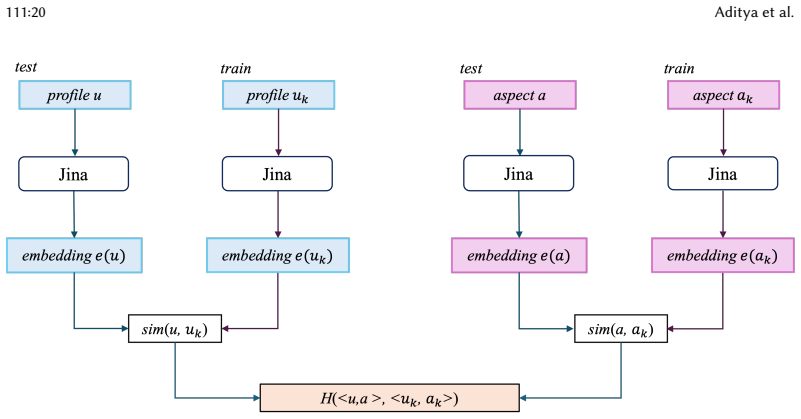
The load-bearing object is the serendipity score of Equation 3: $$serendipity(u,i) = \sum_{a\in AtA(i)} \frac{utility(u,a)}{\sum_{\hat a \in AtA(i)} sim(a,\hat a)}.$$ The equation encodes the paper's two-component definition of serendipity—surprise through atypical aspects, relevance through user utility—and its similarity denominator interpolates between a mean utility (when all aspects are identical) and a sum of utilities (when all are distinct), so repeated or near-duplicate mentions do not dominate the score. Two LLM components feed this score: a two-step GPT-4 extraction pipeline that first rewrites a review into aspect sentences, then classifies each sentence as containing an atypical aspect and extracts the aspect, and a four-level utility classifier (None, Low, Medium, High) that judges an atypical aspect against a user profile. Both components use dynamic in-context learning, retrieving the most similar labeled examples by JINA embedding cosine similarity—nearest review sentences for extraction, and a harmonic mean of profile and aspect similarity for utility—rather than fixed prompt examples.
What would settle it
A field study in which users actually visit or consume ATARS-promoted items and report their experienced surprise and satisfaction would settle the claim: it fails if those reports do not track the predicted serendipity scores, or if users given the star-based list report equal or greater surprise. A cheaper offline check is to recompute the ground-truth rankings with every utility set to a constant; if surprise-only rankings match or beat the serendipity rankings, the user-utility component adds nothing measurable.
Extended reading notes
Core claim
On its own terms, the paper claims that serendipity is a computable, user-specific property of an item and that ranking by it improves on ranking by quality alone. The definition is concrete: the serendipity of item $i$ for user $u$ sums, over every atypical aspect $a$ extracted from the item's reviews, the utility $utility(u,a)$ of that aspect for the user, with each term divided by the total similarity of $a$ to all other atypical aspects of the item so that near-duplicate aspects do not inflate the score. On 150 simulated user-query runs across restaurants, hotels, and hair salons, the fully automatic system rankings achieve mean Kendall tau correlations of roughly 0.63–0.65 with the manually annotated serendipity ground truth when used alone, and 0.68–0.84 when combined with star ratings, while the original star ranking scores near zero or negative. The authors further report that their two-step GPT-4 extraction pipeline with dynamically retrieved in-context examples outperforms the earlier fine-tuned Flan-T5 baseline, and that replacing user-specific utility with a constant surprise score lowers correlation, showing that both surprise and relevance are needed.
Load-bearing premise
The paper's load-bearing premise is that serendipity is faithfully captured by 'atypical aspect plus user utility,' and that utility judgments made by crowdworkers on synthetic user profiles stand in for what real users would actually find surprising and enjoyable.
Editorial extensions
If this is right
- Serendipity becomes a first-class ranking signal: content that would be buried by average star ratings—a cafe with a collection of vintage Batman comics, a hotel with a telescope-and-stargazing night—can be promoted to the top of a list.
- Star ratings carry too little surprise signal to support serendipitous recommendations, so systems that want the satisfaction benefits of serendipity must model surprise and relevance explicitly rather than relying on implicit signals.
- The modular pipeline means the extraction and utility components can be improved or replaced independently, with gains expected to transfer directly to the final ranking correlation.
- Sustained serendipity requires managing habituation: repeated use of a deterministic serendipity re-ranking will make users "expect the unexpected," so the authors propose injecting randomness, such as alternating between user-dependent serendipity and user-independent surprise re-ranking across sessions.
- The same recipe transfers across domains—restaurants, hotels, and hair salons all show positive mean correlation with the serendipity ground truth—so the approach is not tied to one item category.
Reading between the lines
- The paper validates its rankings against crowdworkers judging synthetic profiles rather than against real experiences; the natural next test is a deployment study where users actually visit the promoted venues and self-report surprise, satisfaction, and return intent.
- Because the serendipity score is a sum of interpretable aspect-utility terms, the same computation could double as an explainability layer: after the surprise has been experienced, the system could reveal which atypical aspects were matched to which profile interests.
- The similarity denominator in the score is a delicate assumption: if embedding-based similarity misjudges two aspects as identical, the score silently behaves like a mean and flattens the contribution of genuinely distinct surprises—stress-testing the ranking under different embedding models would show how sensitive the headline correlation is to this choice.
- Acknowledging habituation implies that serendipity is a depletable resource; an implicit design consequence is that user history of exposed atypical aspects should become an input to future ranking, turning the static profile into a dynamic model of what still has the power to surprise.
Editorial analysis
A structured set of objections, weighed in public.
Referee Report
Summary. The paper introduces ATARS, a three-stage LLM-based pipeline for serendipitous recommendation. Stage 1 extracts atypical aspects from item reviews (GPT-4 with a two-step decomposition and dynamic in-context example selection). Stage 2 estimates user-dependent utility of each atypical aspect relative to a user profile, again using GPT-4 with dynamic ICL. Stage 3 reranks candidate items by a serendipity score that aggregates utilities over an item's atypical aspects, optionally blending star ratings. The authors release the ExtrAtA dataset of manually annotated atypical reviews, LLM-generated synthetic user profiles, crowdsourced utility annotations, and code. The main claim is that system-generated serendipity rankings correlate highly with ground-truth rankings computed from manual annotations, with mean Kendall tau values of 0.63--0.84 depending on whether star ratings are blended. The paper also shows that dynamic ICL selection improves both atypical aspect extraction and utility classification over fixed or zero-shot prompting.
Significance. If the reported evaluation were valid, the paper would make a useful contribution by operationalizing serendipity as a combination of atypical aspects and user-specific utility, and by providing a reproducible LLM pipeline plus datasets. The dynamic retrieval of in-context examples is a practical contribution that could transfer to other LLM-based annotation tasks. The availability of code and data is a genuine strength. However, the central evaluation is weakened by a data-generation circularity, an undefined similarity function in the core scoring equation, and a selection-biased ranking protocol. These issues are load-bearing for the headline correlation claim, so the current evidence does not establish that ATARS produces serendipitous rankings in a realistic setting.
major comments (5)
- [Sec. 5.1 and Sec. 6.1] The end-to-end evaluation is circular with respect to the synthetic user profiles. Section 5.1 states that each synthetic profile is generated by sampling n atypical aspects from AtA(I), the union of atypical aspects across all items in the ExtrAtA dataset, and instructing GPT-4 to align the profile with those aspects. Section 6.1 then computes ground-truth rankings using manual atypical aspects and manual utility scores for exactly these profile-aspect pairs, and the system rankings are evaluated over items from the same ExtrAtA item pool. Because the profiles were engineered from the very items being ranked, a utility classifier can achieve high agreement merely by exploiting the obvious semantic overlap that the profile generator was explicitly told to encode. The MTurk utility annotations inherit the same construction bias. The paper never states that the re-ranking item pool is disjoint from the profile-generation item set, and Section 6.1's requirement that 'at least 3 items i had a positive serendipity score' strongly suggests the pool is the ExtrAtA items themselves. The headline Kendall tau values in Tables 13 and 14 are therefore consistent with leakage rather than with genuine serendipity ranking quality. A concrete fix is to generate profiles from one subset of items and evaluate rankings on a disjoint subset, or to use real user profiles with observed interactions.
- [Eq. (3)] The serendipity score in Equation (3) depends on an aspect-to-aspect similarity measure sim(a, â), but the measure is never defined. The text only asserts that it is normalized to [0,1] and equals 1 iff â = a. No specification is given for how sim is computed (e.g., JINA embedding cosine, string overlap, WordNet similarity), whether it is symmetric, or how it is tuned. This makes the central scoring function irreproducible and leaves the qualitative behavior of the score unspecified: if distinct aspects have zero similarity, the score is a sum of utilities; if they have high similarity, it approaches a mean. The choice materially affects the resulting rankings and hence the reported Kendall tau values. The authors should specify the exact similarity function, provide the implementation used in the experiments, and report sensitivity to this choice.
- [Sec. 6.1] The ranking evaluation is restricted to item lists for which 'at least 3 items i had a positive user-dependent serendipity score serendipity(u,i) > 0'. This condition excludes the common scenario in which most candidate items have no atypical aspects or the system fails to detect any, and it ensures that every evaluated ranking contains several items that the ground truth regards as serendipitous. As a result, the reported Kendall tau values characterize performance on artificially enriched lists, not the system's actual output over a full query result set. The paper should report how many candidate lists were discarded under this filter, evaluate over complete item pools, and use ranking metrics that penalize non-serendipitous items at the top (e.g., nDCG with zero-valued items).
- [Sec. 4.1 and Table 2] The ExtrAtA datasets are balanced, containing about equal numbers of atypical and typical reviews, while the paper itself notes that atypical reviews occur at a rate of roughly 1 in 50 (Section 4.1). All module and end-to-end evaluations are conducted on this balanced distribution, which overstates the practical precision and recall of the system and makes the ranking pools unrealistically dense in atypical items. Consequently, the F1 scores in Tables 5--6 and the ranking correlations in Tables 13--14 do not transfer to the natural base rate. The authors should report performance when typical reviews are sampled at the natural frequency, e.g., by adding random typical reviews from the Yelp dataset to the evaluation pool.
- [Sec. 6.1 and Tables 13--14] The Kendall tau values are reported as means over 10 users per query with no variance, confidence intervals, or significance tests. Given the small item pools per query (the ExtrAtA items in a Yelp category number only in the dozens), the observed differences between system variants (e.g., Sys◦Seren vs. Sys◦Sur, or Sys★Seren vs. Sys★Sur) could be within noise for several query rows (e.g., Hotels q3 in Table 14). The authors should report per-user Kendall tau distributions and perform paired significance tests (e.g., Wilcoxon signed-rank) for the key comparisons that support the paper's central claim.
minor comments (5)
- [Sec. 6.1] The phrase 'at list 3 items' should be 'at least 3 items'.
- [Sec. 5.1] 'Given the overall set if items' should be 'Given the overall set of items'.
- [Sec. 5.4] The error analysis paragraph refers to 'GPT-4 (Dynamic 8-shot)' as the best-performing utility classification method, but the utility classification experiments in Table 11 use 4-shot ICL; the reference should be to Dynamic 4-shot.
- [Eq. (1)] The standard deviation formula in Equation (1) has a rendering issue ('vut' appears before the square root); the formula should be typeset cleanly.
- [Sec. 4.2] The claim that GPT-4 has 'about 10 times the number of parameters of GPT-3.5' is not verifiable, since the parameter count of GPT-4 is not publicly disclosed; consider omitting the estimate or citing a source.
Circularity Check
No significant circularity: system rankings are compared against independent human-annotated ground truth, and no system parameter is fitted to the target rankings.
full rationale
The paper's central evaluation compares system rankings (predicted atypical aspects and predicted utility values) against ground-truth rankings computed from human annotations of the same two quantities (Sections 5.2 and 6.1). This is a standard supervised end-to-end benchmark: the ground truth is produced by manual annotation and MTurk workers, not by the ATARS pipeline, and no parameter of Eq. (3) is fitted to the target rankings. The dynamic ICL selection procedures use leave-one-out and leave-one-group-out splits (Sections 4.2 and 5.3), so test users and items are excluded from example selection. The fact that synthetic profiles are generated from aspects sampled from AtA(I) (Section 5.1) makes the utility-classification sub-task easier, but it does not by construction force the reported Kendall tau values, which are imperfect (0.63–0.84) and vary across queries and domains; the ranking correlation still depends on the GPT-4 aspect extractor and utility classifier reproducing human judgments. The self-citation to [33] for the ExtrAtA dataset is not load-bearing in a circular sense: the dataset consists of manual annotations, is re-described with statistics and inter-annotator agreement in Section 4.1, and is used as external ground truth. No equation in the paper is equivalent to its own input, and no fitted parameter is renamed as a prediction. The profile-seeding design is a construct-validity and data-bias limitation, not a circularity.
Assumptions & free parameters
free parameters (5)
- Utility value mapping =
None=0.0, Low=0.5, Medium=0.75, High=1.0
- Number of in-context examples =
8 for aspect extraction, 4 for utility classification
- Aspect-count distribution for synthetic profiles =
p(1)=0.1, p(2)=0.3, p(3)=0.3, p(4)=0.2, p(5)=0.1
- Star-rating bins for combined rankings =
[4.0,5.0], [3.0,4.0), [2.0,3.0), [1.0,2.0)
- Crowd agreement threshold =
at least 2 of 3 annotators agree
assumptions (4)
- domain assumption An aspect is atypical if it is not related to the core business of the domain, and atypical aspects can trigger surprise through schema discrepancy.
- domain assumption User interests and utility can be represented by a short text profile and four utility labels assigned by crowdworkers.
- ad hoc to paper Kendall tau against author-constructed ground truth rankings is a valid measure of recommendation quality.
- domain assumption GPT-4 responses are used as model outputs without formal verification or reproducibility guarantees.
invented entities (1)
-
Attractor
Cite this review
Pith. "Pith review of Engineering Serendipity through Recommendations of Items with Atypical Aspects." pith.science (2026). https://pith.science/paper/5WXQRDLU
@misc{pith2026250523580,
  author       = {Pith},
  title        = {Pith review of: Engineering Serendipity through Recommendations of Items with Atypical Aspects},
  year         = {2026},
  howpublished = {\url{https://pith.science/paper/5WXQRDLU}},
  note         = {Machine review of arXiv:2505.23580}
}
read the original abstract
A restaurant dinner or a hotel stay may lead to memorable experiences when guests encounter unexpected aspects that also match their interests. For example, an origami-making station in the waiting area of a restaurant may be both surprising and enjoyable for a customer who is passionate about paper crafts. Similarly, an exhibit of 18th century harpsichords would be atypical for a hotel lobby and likely pique the interest of a guest who has a passion for Baroque music. Motivated by this insight, in this paper we introduce the new task of engineering serendipity through recommendations of items with atypical aspects. We describe an LLM-based system pipeline that extracts atypical aspects from item reviews, then estimates and aggregates their user-specific utility in a measure of serendipity potential that is used to rerank a list of items recommended to the user. To facilitate system development and evaluation, we introduce a dataset of Yelp reviews that are manually annotated with atypical aspects and a dataset of artificially generated user profiles, together with crowdsourced annotations of user-aspect utility values. Furthermore, we introduce a custom procedure for dynamic selection of in-context learning examples, which is shown to improve LLM-based judgments of atypicality and utility. Experimental evaluations show that serendipity-based rankings generated by the system are highly correlated with ground truth rankings for which serendipity scores are computed from manual annotations of atypical aspects and their user-dependent utility. Overall, we hope that the new recommendation task and the associated system presented in this paper catalyze further research into recommendation approaches that go beyond accuracy in their pursuit of enhanced user satisfaction. The datasets and the code are made publicly available at https://github.com/ramituncc49er/ATARS .
Figures


Figures from the paper (7 more)




Reference graph
Works this paper leans on
-
[1]
Daniel E Berlyne. 1973. Aesthetics and psychobiology. Journal of Aesthetics and Art Criticism 31, 4 (1973)
work page 1973
-
[2]
Dirk Bollen, Bart P. Knijnenburg, Martijn C. Willemsen, and Mark Graus. 2010. Understanding Choice Overload in Recommender Systems. In Proceedings of the Fourth ACM Conference on Recommender Systems (Barcelona, Spain) (RecSys ’10). Association for Computing Machinery, New York, NY, USA, 63–70. doi:10.1145/1864708.1864724
arXiv 2010
-
[3]
G.N. Carlson and F.J. Pelletier. 1995. The Generic Book. University of Chicago Press
work page 1995
-
[4]
Alexander Chernev, Ulf Bockenholt, and Joseph Goodman. 2015. Choice overload: A conceptual review and meta- analysis. Journal of Consumer Psychology 25, 2 (2015), 333–358. doi:10.1016/j.jcps.2014.08.002
-
[5]
Chi, Jeff Dean, Jacob Devlin, Adam Roberts, Denny Zhou, Quoc V
Hyung Won Chung, Le Hou, Shayne Longpre, Barret Zoph, Yi Tay, William Fedus, Yunxuan Li, Xuezhi Wang, Mostafa Dehghani, Siddhartha Brahma, Albert Webson, Shixiang Shane Gu, Zhuyun Dai, Mirac Suzgun, Xinyun Chen, Aakanksha Chowdhery, Alex Castro-Ros, Marie Pellat, Kevin Robinson, Dasha Valter, Sharan Narang, Gaurav Mishra, Adams Yu, Vincent Zhao, Yanping H...
arXiv 2022
-
[6]
Kevin Crowston. 2012. Amazon Mechanical Turk: A Research Tool for Organizations and Information Systems Scholars. In Shaping the Future of ICT Research. Methods and Approaches , Anol Bhattacherjee and Brian Fitzgerald (Eds.). Springer Berlin Heidelberg, Berlin, Heidelberg, 210–221
work page 2012
-
[7]
Xiangyu Fan and Xi Niu. 2018. Implementing and Evaluating Serendipity in Delivering Personalized Health Information. ACM Trans. Manage. Inf. Syst. 9, 2, Article 7 (aug 2018), 19 pages. doi:10.1145/3205849
-
[8]
Zhe Fu and Xi Niu. 2024. The Art of Asking: Prompting Large Language Models for Serendipity Recommendations. In Proceedings of the 2024 ACM SIGIR International Conference on Theory of Information Retrieval (Washington DC, USA) (ICTIR ’24). Association for Computing Machinery, New York, NY, USA, 157–166. doi:10.1145/3664190.3672521
arXiv 2024
Show all 55 references
-
[9]
Zhe Fu, Xi Niu, and Li Yu. 2023. Wisdom of Crowds and Fine-Grained Learning for Serendipity Recommendations. In Proceedings of the 46th International ACM SIGIR Conference on Research and Development in Information Retrieval (Taipei, Taiwan) (SIGIR ’23). Association for Computi...
2023
-
[10]
Michael Günther, Louis Milliken, Jonathan Geuter, Georgios Mastrapas, Bo Wang, and Han Xiao. 2023. Jina Embeddings: A Novel Set of High-Performance Sentence Embedding Models. InProceedings of the 3rd Workshop for Natural Language Processing Open Source Software (NLP-OSS 2023) ...
2023 doi
-
[11]
Tonmoy Hasan and Razvan Bunescu. 2023. Topic-Level Bayesian Surprise and Serendipity for Recommender Systems. In Proceedings of the 17th ACM Conference on Recommender Systems (Singapore, Singapore) (RecSys ’23). Association for Computing Machinery, New York, NY, USA, 933–939. ...
2023
-
[12]
Gernot Horstmann. 2015. The surprise–attention link: a review. Annals of the New York Academy of Sciences 1339, 1 (2015), 106–115. doi:10.1111/nyas.12679 _eprint: https://onlinelibrary.wiley.com/doi/pdf/10.1111/nyas.12679
2015 doi
-
[13]
Joel Huber and Noreen M Klein. 1991. Adapting Cutoffs to the Choice Environment: The Effects of Attribute Correlation and Reliability. Journal of Consumer Research 18, 3 (1991), 346–357. doi:10.1086/209264 J. ACM, Vol. 37, No. 4, Article 111. Publication date: August 2025. 111...
1991 doi
-
[14]
Yoel Inbar, Simona Botti, and Karlene Hanko. 2011. Decision speed and choice regret: When haste feels like waste. Journal of Experimental Social Psychology 47, 3 (2011), 533–540. doi:10.1016/j.jesp.2011.01.011
2011 doi
-
[15]
Sheena Iyengar and Mark Lepper. 2001. When Choice is Demotivating: Can One Desire Too Much of a Good Thing? Journal of personality and social psychology 79 (01 2001), 995–1006. doi:10.1037/0022-3514.79.6.995
2001 doi
-
[16]
Niklas Jakob, Stefan Hagen Weber, Mark Christoph Müller, and Iryna Gurevych. 2009. Beyond the Stars: Exploiting Free-Text User Reviews to Improve the Accuracy of Movie Recommendations. InProceedings of the 1st International CIKM Workshop on Topic-Sentiment Analysis for Mass Op...
2009
-
[17]
Hongyan Jing. 2002. Using Hidden Markov Modeling to Decompose Human-Written Summaries. Computational Linguistics 28, 4 (2002), 527–543. doi:10.1162/089120102762671972
2002 doi
-
[18]
Hongyan Jing and Kathleen R. McKeown. 1999. The Decomposition of Human-Written Summary Sentences. In Proceedings of the 22nd Annual International ACM SIGIR Conference on Research and Development in Information Retrieval (Berkeley, California, USA) (SIGIR ’99). Association for ...
1999
-
[19]
Daniel Kaimann, Nadja Stroh-Maraun, and Joe Cox. 2018. Variety in the video game industry: An empirical study of the Wundt curve. Managerial and Decision Economics 39, 3 (2018), 354–362. doi:10.1002/mde.2909
2018 doi
-
[20]
Affonso, Juliano Laran, and Kristina M
Aekyoung Kim, Felipe M. Affonso, Juliano Laran, and Kristina M. Durante. 2021. Serendipity: Chance Encounters in the Marketplace Enhance Consumer Satisfaction. Journal of Marketing 85, 4 (July 2021), 141–157. doi:10.1177/ 00222429211000344 Publisher: SAGE Publications Inc
2021
-
[21]
Kevin Knight and Daniel Marcu. 2002. Summarization beyond sentence extraction: A probabilistic approach to sentence compression. Artificial Intelligence 139, 1 (2002), 91–107. doi:10.1016/S0004-3702(02)00222-9
2002 doi
-
[22]
Laura Kornish and John Lynch. 2003. Smart Agents: When Lower Search Costs for Quality Information Increase Price Sensitivity. Journal of Consumer Research 30 (06 2003), 56–71. doi:10.2139/ssrn.340040
2003 doi
-
[23]
Konstan, Qian Zhao, and Jari Veijalainen
Denis Kotkov, Joseph A. Konstan, Qian Zhao, and Jari Veijalainen. 2018. Investigating Serendipity in Recommender Systems Based on Real User Feedback. In Proceedings of the 33rd Annual ACM Symposium on Applied Computing (Pau, France) (SAC ’18). Association for Computing Machine...
2018
-
[24]
Denis Kotkov, Shuaiqiang Wang, and Jari Veijalainen. 2016. A survey of serendipity in recommender systems. Know.-Based Syst. 111, C (Nov. 2016), 180–192. doi:10.1016/j.knosys.2016.08.014
2016 doi
-
[25]
Pan Li, Maofei Que, Zhichao Jiang, Yao Hu, and Alexander Tuzhilin. 2020. PURS: Personalized Unexpected Recommender System for Improving User Satisfaction. In Proceedings of the 14th ACM Conference on Recommender Systems (Virtual Event, Brazil) (RecSys ’20). Association for Com...
2020 doi
-
[26]
Pan Li and Alexander Tuzhilin. 2022. Learning Latent Multi-Criteria Ratings From User Reviews for Recommendations. IEEE Transactions on Knowledge and Data Engineering 34, 8 (2022), 3854–3866. doi:10.1109/TKDE.2020.3030623
2022
-
[27]
Xueqi Li, Wenjun Jiang, Weiguang Chen, Jie Wu, and Guojun Wang. 2019. HAES: A New Hybrid Approach for Movie Recommendation with Elastic Serendipity. 1503–1512. doi:10.1145/3357384.3357868
2019
-
[28]
Xueqi Li, Wenjun Jiang, Weiguang Chen, Jie Wu, Guojun Wang, and Kenli Li. 2020. Directional and Explainable Serendipity Recommendation. In Proceedings of The Web Conference 2020 (Taipei, Taiwan) (WWW ’20). Association for Computing Machinery, New York, NY, USA, 122–132. doi:10...
2020
-
[29]
Weiwen Liu, Yunjia Xi, Jiarui Qin, Xinyi Dai, Ruiming Tang, Shuai Li, Weinan Zhang, and Rui Zhang. 2023. Personalized Diversification for Neural Re-ranking in Recommendation. 802–815. doi:10.1109/ICDE55515.2023.00067
2023
-
[30]
Making my own luck
Stephann Makri, Ann Blandford, Mel Woods, Sarah Sharples, and Deborah Maxwell. 2014. “Making my own luck”: Serendipity strategies and how to support them in digital information environments. Journal of the Association for Information Science and Technology 65, 11 (2014), 2179–...
2014 doi
-
[31]
Jean B. McGrew. 1970. Future Shock. Alvin Toffler. New York: Random House, 1970. 505 pp. $7.95. The bulletin of the National Association of Secondary School Principals 54, 349 (1970), 123–129. doi:10.1177/019263657005434912 arXiv:https://doi.org/10.1177/019263657005434912
1970 doi
-
[32]
Cataldo Musto, Marco de Gemmis, Giovanni Semeraro, and Pasquale Lops. 2017. A Multi-Criteria Recommender System Exploiting Aspect-Based Sentiment Analysis of Users’ Reviews. In Proceedings of the Eleventh ACM Conference on Recommender Systems (Como, Italy) (RecSys ’17). Associ...
2017
-
[33]
Smita Nannaware, Erfan Al-Hossami, and Razvan Bunescu. 2023. Extraction of Atypical Aspects from Customer Reviews: Datasets and Experiments with Language Models. arXiv:2311.02702 [cs.CL]
2023 arXiv
-
[34]
Xi Niu, Fakhri Abbas, Mary Lou Maher, and Kazjon Grace. 2018. Surprise Me If You Can: Serendipity in Health Information. In Proceedings of the 2018 CHI Conference on Human Factors in Computing Systems (Montreal QC, Canada) (CHI ’18). Association for Computing Machinery, New Yo...
2018
-
[35]
OpenAI. 2022. Introducing ChatGPT. https://openai.com/blog/chatgpt
2022
-
[36]
Colin Raffel, Noam Shazeer, Adam Roberts, Katherine Lee, Sharan Narang, Michael Matena, Yanqi Zhou, Wei Li, and Peter J Liu. 2020. Exploring the limits of transfer learning with a unified text-to-text transformer. The Journal of Machine Learning Research 21, 1 (2020), 5485–5551
2020
-
[37]
Rainer Reisenzein, Gernot Horstmann, and Achim Schützwohl. 2019. The Cognitive-Evolutionary Model of Sur- prise: A Review of the Evidence. Topics in Cognitive Science 11, 1 (2019), 50–74. doi:10.1111/tops.12292 _eprint: https://onlinelibrary.wiley.com/doi/pdf/10.1111/tops.12292
2019 doi
-
[38]
Rush, Sumit Chopra, and Jason Weston
Alexander M. Rush, Sumit Chopra, and Jason Weston. 2015. A Neural Attention Model for Abstractive Sentence Summarization. In Proceedings of the 2015 Conference on Empirical Methods in Natural Language Processing . Association for Computational Linguistics, Lisbon, Portugal, 37...
2015 doi
-
[39]
Benjamin Scheibehenne, Rainer Greifeneder, and Peter M. Todd. 2010. Can There Ever Be Too Many Options? A Meta-Analytic Review of Choice Overload. Journal of Consumer Research 37, 3 (Feb. 2010), 409–425. doi:10.1086/651235 _eprint: https://academic.oup.com/jcr/article-pdf/37/3...
2010 doi
-
[40]
Klaus R Scherer. 2005. What are emotions? And how can they be measured? Social science information 44, 4 (2005), 695–729
2005
-
[41]
Barry Schwartz. 2004. The paradox of choice: Why more is less . Harper Perennial, New York
2004
-
[42]
Safa Selmene and Zahra Kodia. 2020. Recommender System Based on User’s Tweets Sentiment Analysis. InProceedings of the 4th International Conference on E-Commerce, E-Business and E-Government (Arenthon, France) (ICEEG ’20). Association for Computing Machinery, New York, NY, USA...
2020
-
[43]
SemEval. 2014. Task Description: Aspect Based Sentiment Analysis (ABSA) < SemEval-2014 Task 4. https://alt.qcri.org/ semeval2014/task4/
2014
-
[44]
Avni M Shah and George L. Wolford. 2007. Buying Behavior as a Function of Parametric Variation of Number of Choices. Psychological Science 18 (2007), 369 – 370
2007
-
[45]
spaCy. 2023. Industrial-Strength Natural Language Processing. https://spacy.io/
2023
-
[46]
Yu Tokutake and Kazushi Okamoto. 2024. Can Large Language Models Assess Serendipity in Recommender Systems? Journal of Advanced Computational Intelligence and Intelligent Informatics 28 (11 2024), 1263–1272. doi:10.20965/jaciii. 2024.p1263
2024 doi
-
[47]
Kathleen Vohs, Roy Baumeister, Brandon Schmeichel, Jean Twenge, Noelle Nelson, and Dianne Tice. 2008. Making Choices Impairs Subsequent Self-Control: A Limited-Resource Account of Decision Making, Self-Regulation, and Active Initiative. Journal of personality and social psycho...
2008 doi
-
[48]
Zongyi Wang, Yanyan Zou, Anyu Dai, Linfang Hou, Nan Qiao, Luobao Zou, Mian Ma, Zhuoye Ding, and Sulong Xu
-
[49]
Dai, and Quoc V Le
Jason Wei, Maarten Bosma, Vincent Zhao, Kelvin Guu, Adams Wei Yu, Brian Lester, Nan Du, Andrew M. Dai, and Quoc V Le. 2022. Finetuned Language Models are Zero-Shot Learners. In International Conference on Learning Representations . https://openreview.net/forum?id=gEZrGCozdqR
2022
- [50]
-
[51]
Yelp. 2023. The Yelp Dataset. https://www.yelp.com/dataset
2023
-
[52]
Mingwei Zhang, Yang Yang, Rizwan Abbas, Ke Deng, Jianxin Li, and Bin Zhang. 2021. SNPR: A Serendipity-Oriented Next POI Recommendation Model. In Proceedings of the 30th ACM International Conference on Information & Knowledge Management (Virtual Event, Queensland, Australia) (C...
2021
-
[53]
Yongfeng Zhang, Guokun Lai, Min Zhang, Yi Zhang, Yiqun Liu, and Shaoping Ma. 2014. Explicit Factor Models for Explainable Recommendation Based on Phrase-Level Sentiment Analysis. In Proceedings of the 37th International ACM SIGIR Conference on Research & Development in Informa...
2014
-
[54]
resort fee
Reza Ziarani and Reza Ravanmehr. 2021. Serendipity in Recommender Systems: A Systematic Literature Review. Journal of Computer Science and Technology 36 (04 2021), 375–396. doi:10.1007/s11390-020-0135-9 A Examples of Extractive and Abstractive Atypical Aspect Annotations In ad...
2021 doi
-
[2023]
In Proceedings of the 17th ACM Conference on Recommender Systems (Singapore, Singapore) (RecSys ’23)
An Industrial Framework for Personalized Serendipitous Recommendation in E-commerce. In Proceedings of the 17th ACM Conference on Recommender Systems (Singapore, Singapore) (RecSys ’23). Association for Computing Machinery, New York, NY, USA, 1015–1018. doi:10.1145/3604915.3610234
Reviewed August 7, 2026 · model on record in the stance chip above.
Discussion (0). Sign in to comment.