REVIEW 4 major objections 4 minor 122 references
Fast-tracking and disentangling of qubit noise fluctuations using minimal-data averaging and hierarchical discrete fluctuation auto-segmentation
T0 review · 4 major / 4 minor · reviewed 2026-08-07 · deepseek-v4-flash
Pith's one-line read A measurement-plus-segmentation framework tracks qubit frequency fluctuations at tens-of-millisecond resolution over hours and attributes them to overlapping charge-parity switching and two-level-system defects.
desk verdict A genuinely new segmentation method for qubit frequency noise with a credible but incompletely validated experimental demonstration; the CP/TLS attributions are plausible, not proven. read the letter →
The pith
A machine-rendered reading of the paper's core claim, the machinery that carries it, and where it could break.
The reading
What carries the argument
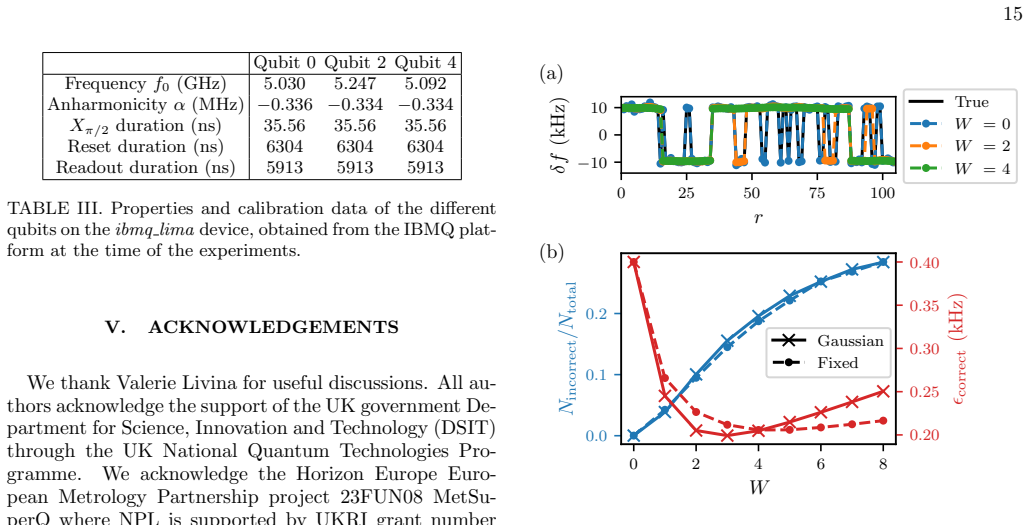
The load-bearing object is the hierarchical discrete fluctuation auto-segmentation (HDFA) algorithm, built on hidden Markov models and time-series segmentation. It models each fluctuation level as a random telegraph $f^{(n)}(t) = f_c^{(n)}(t) + s^{(n)}(t) f_\Delta^{(n)}(t)/2$ and then recursively strips off the fastest level: after fitting an HMM with Baum-Welch and decoding states with Viterbi, it segments the series by growing each segment until a mean-log-likelihood threshold flags a change in the centre or magnitude, then feeds the centre $f_c^{(n)}$ into the next level. The measurement side is the few-repetition Gaussian averaging protocol, which weights binary measurement outcomes by $w(i,r) = \exp[-(i-r)^2/(2 W_G^2)]$ with $W_G = 2$ to $4$, giving tens-of-millisecond resolution while still allowing a Markovian single-frequency noise model to be fitted at each time step. Together these parts turn raw single-shot outcomes into a time-ordered stack of disentangled fluctuation processes with rates, magnitudes, and uncertainties.
What would settle it
A supervised emulation with known fast and slow random-telegraph ground truth, run at jump durations near the detection limit, would falsify the disentanglement claim if HDFA fails to recover the known rates and magnitudes within the quoted uncertainties.
Extended reading notes
Core claim
The paper claims that qubit frequency noise, which usually appears as a messy mixture of overlapping stochastic processes, can be resolved into a clean hierarchy of independent random-telegraph fluctuations if one combines few-repetition Gaussian averaging with recursive auto-segmentation. At each hierarchy level the frequency obeys $f^{(n)}(t) = f_c^{(n)}(t) + s^{(n)}(t) f_\Delta^{(n)}(t)/2$, with the centre of the fast random telegraph becoming the input to the next slower level, $f^{(n+1)} = f_c^{(n)}$. On the transmon data, the fastest level switches at a few times per second with roughly symmetric rates and a fluctuation magnitude whose maximum matches the device's predicted charge dispersion, identifying it as charge-parity switching; the next level switches much more slowly and asymmetrically, and each switch is accompanied by a small measurable jump in the qubit charge offset, matching an off-resonant charge-dipole two-level-system model. The paper presents this as a demonstration that concurrent fluctuations can be disentangled automatically and attributed to physical origins without assuming that one source dominates.
Load-bearing premise
The method assumes that at most time points the qubit's noise parameters are constant inside the short Gaussian averaging window, so each fitted frequency value is the true instantaneous frequency; a frequency jump inside the window breaks this assumption and shows up as a pure-dephasing spike that the analysis excludes rather than models.
Editorial extensions
If this is right
- Qubit frequency noise can be tracked at tens-of-millisecond resolution for hours, revealing concurrent random-telegraph fluctuations whose rates span more than three orders of magnitude.
- The fastest fluctuations were attributed to charge-parity switching because their symmetric rates (about 3–5 s$^{-1}$) and maximum magnitudes match the device charge dispersion; if this attribution is right, charge-parity noise is present and dominant at sub-second timescales on these qubits.
- The slower fluctuations were attributed to an off-resonant charge-dipole two-level system because each slow frequency jump coincides with a charge-offset jump, and the extracted two-level-system parameters fall in ranges reported for such defects.
- The disentangled fluctuation information can be used to update qubit calibration on the fly, mitigate errors, and inform error-correction scheduling, since the discrete noise state at the time of an algorithm run becomes knowable.
- The framework generalizes to other qubit platforms and to fluctuations in parameters other than frequency, provided the noise can be approximated as piecewise-constant within the averaging window.
Reading between the lines
- A direct hardware test of the charge-parity assignment would be simultaneous parity-sensitive readout on the same qubit: the fastest HDFA state switches should coincide with independently observed parity flips, which would also reveal how often the assignment misses very short parity dwells.
- Because the averaging window is optimized for frequency, the same protocol could be re-optimized for relaxation or pure-dephasing fluctuations; the paper's emulations suggest fast relaxation fluctuations are mostly statistical, but a window optimized for that parameter would settle whether true fast relaxation fluctuations exist.
- The HDFA hierarchy treats each level as a two-state random telegraph, so continuous drifts are approximated by nesting many small segments; a testable extension is to compare HDFA output against a multi-state or continuous-state model on simulated drifts to quantify the residual approximation error.
- The observed correlation between two-level-system frequency shifts and charge-offset jumps suggests that monitoring the charge offset alone could act as a cheap early-warning signal for impending TLS switching, potentially enabling pre-emptive recalibration.
Editorial analysis
A structured set of objections, weighed in public.
Referee Report
Summary. This manuscript develops and demonstrates a two-stage framework for characterizing time-dependent qubit frequency fluctuations. Stage one uses repeated idle-circuit tomography with Gaussian-weighted few-repetition averaging to estimate time-dependent parameters δf(t), Γ1(t), Γϕ(t) by fitting a Markovian Lindblad model (Eq. (3)). Stage two, HDFA, recursively segments the δf(t) series into a hierarchy of random-telegraph-noise components, each described by a state, center, and magnitude, with the hierarchy relation f^{(n+1)} = f_c^{(n)}; switching rates and magnitudes are then extracted. On three transmon qubits of the IBM Lima device, the authors report fast RTN fluctuations at rates of 3–5 s^{-1} whose maximum amplitudes roughly match independently computed charge dispersion, and slower asymmetric RTN fluctuations attributed to charge-dipole TLSs, with correlated charge-offset jumps |δng| of order 0.001–0.011. The paper claims temporal resolution of tens of milliseconds over hours and positions the framework as a tool for calibration, error mitigation, and physical diagnostics.
Significance. If the physical attributions hold, the framework is a useful addition to qubit-noise characterisation: the minimal-data Gaussian averaging is tested on simulated data (Appendices B and D), the bootstrap uncertainty propagation in Appendix C is carefully specified, and the comparison of fΔmax with independent charge-dispersion calculations in Table I is a falsifiable check rather than a circular fit. The authors also acknowledge several limitations in the text, including HDFA misclassification when fΔ is small and Γϕ artifacts near jumps. However, the central novelty is the hierarchical auto-segmentation, and the manuscript does not yet provide a synthetic benchmark with known multi-level fluctuation structure; the physical attributions are consistency arguments rather than unique identifications. The value of the paper therefore depends on closing that validation gap.
major comments (4)
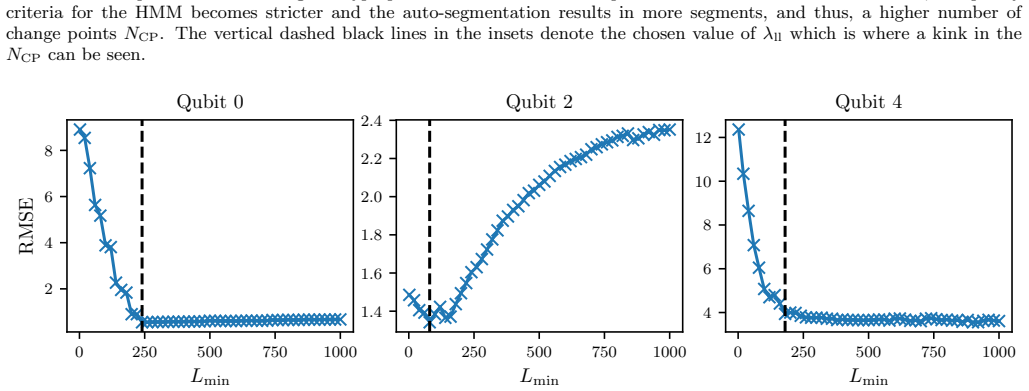
- [Secs. II.D and III.D; Appendices B and F] The HDFA disentanglement is not tested on synthetic data with known hierarchical fluctuation structure. Appendix B validates only a single-level RTN with constant f_c and f_Δ, and Appendix D tests the noise-model fitting chain rather than the multi-level segmentation. The hyperparameters λll and Lmin are chosen by elbow and RMSE heuristics on the experimental data (Figs. 10 and 11), and because any noisy time series can be segmented into piecewise-constant RTN pieces, the visual agreement in Fig. 4 does not by itself demonstrate that recovered f_c^{(n)}, f_Δ^{(n)}, s^{(n)}, and rates are the true generators. Please add emulations with known two-level (and, if possible, continuously drifting f_c or f_Δ) hierarchies, and report state-assignment error, rate bias, and bias in the f_Δ distribution as functions of λll and Lmin. This is load-bearing because Table I and Appendix G2 derive physical attributions directly from HDFA outputs.
- [Sec. II.C and Fig. 2(c)] The Markovian-constant-within-window assumption used to fit Eq. (3) is violated whenever a frequency jump falls inside the Gaussian averaging window, and the resulting artifact is explicitly visible as sharp Γϕ peaks in Fig. 2(c). These jump-adjacent δf(t) estimates are fed into HDFA without exclusion or refitting with the two-frequency model of Ref. [25]. The statement in Sec. II.C that 'for the majority of times' a Markovian model is adequate is not quantified on the experimental data. Please estimate the fraction of time steps whose windows contain a jump (from the fitted s^{(1)}(t) and WG), and show that removing or refitting those points does not materially alter f_c^{(1)}, f_Δ^{(1)}, the level-1 rates, or the level-2 outputs. Without such a check, the bias near jumps is an uncontrolled systematic in the input to the central algorithm.
- [Table I and Eq. (G2)] Using the maximum observed HDFA amplitude fΔmax as the estimate of the charge dispersion ΔCP is subject to unquantified sampling and noise biases: maximization over noisy segment estimates tends to be upward-biased, while finite observation time may also under-sample ng values near the dispersion maximum. The quoted uncertainties reflect segmentation and fitting noise only, not the bias of the maximum statistic, so the agreement in Table I is not yet a quantitative consistency test. The same fΔmax enters Eq. (G2) to convert fΔ(t) into ng(t), so any bias propagates directly into the charge-offset jumps |δng| of Table II. Please calibrate this using synthetic data with known ΔCP and finite observation length, or replace fΔmax by a robust estimator with known sampling distribution, and propagate that uncertainty through the |δng| extraction.
- [Sec. III.E and Appendix G2, Fig. 12] The charge-dipole TLS attribution rests on the claim that the distribution of |δng| across level-2 switching events is peaked away from zero. The statistical significance of this peak is not quantified, and for qubit 0 the counts in Fig. 12 are very small. In addition, the calculation uses ng values obtained from HDFA-segmented fΔ(t) via Eq. (G2), so segmentation errors near fΔ minima or near f_c^{(2)} jumps could produce an apparent δng correlation. Please provide a null distribution from randomized jump positions (or from emulations with known TLS-free noise), state the number of events and significance for both qubits, and either add a direct experimental check of the TLS (e.g., avoided crossings or frequency-tuned spectroscopy) or soften the abstract and Sec. III.E from 'identify the origins' to 'consistent with' a charge-dipole TLS origin.
minor comments (4)
- [Sec. III.A] The statement that crosstalk across the three parallel qubits was verified to be negligible is asserted without data, a metric, or a description of the verification; please add this evidence or an explicit caveat.
- [General] The manuscript does not provide raw data or code; given the algorithmic nature of HDFA and the hyperparameter choices, a data/code availability statement or repository would materially aid reproducibility.
- [Fig. 12 caption and Appendix G3] There are several typographical errors that should be corrected: 'shaded greed region' should be 'shaded green region' in the Fig. 12 caption, Appendix G3 contains an unfinished sentence beginning 'The TLS is Since', and Sec. III.D contains 'is applied to to the results'.
- [Eq. (F4)] The missed-jump correction in Eq. (F4) assumes that jumps shorter than τmin are completely missed while all longer jumps are detected, but Appendix B shows partial detection and temporal smearing for finite WG; please test this rate correction on simulated hierarchical data or state its assumptions more carefully.
Circularity Check
No significant circularity: the extracted fluctuation parameters are compared against independent theoretical predictions, and the attribution tests have falsifiable content.
full rationale
The paper's central derivation chain is not circular. The noise model in Eq. (3) is stated explicitly as a Markovian single-qubit model with parameters δf, Γ1, and Γϕ; these parameters are extracted by fitting the same equation to averaged data, and are then used as inputs to HDFA. HDFA's segmentation is validated on emulated data with known ground truth in Appendix B (single-level RTN recovery) and Appendix D (noise-model parameter recovery), even though multi-level disentanglement is not benchmarked against synthetic multi-level ground truth—that is a correctness/validation gap, not a definitional circularity. The CP attribution compares the HDFA-extracted maximum fΔmax against independent theoretical charge-dispersions ΔCP computed from device calibration parameters via analytic and numerical transmon Hamiltonians in Appendix G1; fΔmax is not defined to equal ΔCP, and the measured values differ from both predictions (e.g., 50.6 kHz vs 39.8/48.7 kHz for qubit 0), so the comparison is not forced. The TLS attribution in Appendix G2 uses Eq. (G2) to convert the measured fΔ(t) into a charge-offset ng and then tests whether S(2) frequency jumps coincide with nonzero |δng|; this is a consistency test with falsifiable content, since fΔ(t) being constant across S(2) jumps would give δng=0. The self-citation to Ref. [25] for the noise model is not load-bearing in a circular sense: the relevant model is reproduced explicitly and is a standard Lindblad-plus-detuning model, not an unexamined uniqueness theorem. The main limitations—unvalidated multi-level HDFA on synthetic data, upward bias in using a maximum as an estimate, and the Markovian-assumption violations at jump times—are external-validity or statistical concerns, not cases where a prediction reduces by construction to its own input.
Assumptions & free parameters
free parameters (3)
- Gaussian averaging window width WG =
2, 2, 4 for qubits 0, 2, 4
- HDFA log-likelihood threshold λll =
not tabulated; chosen from elbow plots per qubit and level
- HDFA minimum segment length Lmin =
not tabulated; chosen from RMSE curves per qubit and level
assumptions (7)
- domain assumption Lindblad noise model with relaxation, pure dephasing and detuning describes idle transmon dynamics
- ad hoc to paper Noise parameters are constant within each Gaussian averaging window
- ad hoc to paper Frequency fluctuations are a hierarchy of two-state random telegraph processes, with slower processes acting only on the center f_c and f_Δ piecewise constant
- domain assumption Switching jumps are Poissonian and jumps shorter than τ_min are wholly undetected
- domain assumption The qubit-TLS interaction is via an off-resonant charge dipole in the junction barrier with the standard tunnelling model Hamiltonian
- domain assumption The TLS is in thermal equilibrium with an environment at 10-100 mK
- domain assumption Junction thickness x lies between 1 and 2 nm
invented entities (1)
-
Specific off-resonant charge-dipole TLS defects assigned to qubits 0 and 2
Cite this review
Pith. "Pith review of Fast-tracking and disentangling of qubit noise fluctuations using minimal-data averaging and hierarchical discrete fluctuation auto-segmentation." pith.science (2026). https://pith.science/paper/YHN53PW3
@misc{pith2026250523622,
  author       = {Pith},
  title        = {Pith review of: Fast-tracking and disentangling of qubit noise fluctuations using minimal-data averaging and hierarchical discrete fluctuation auto-segmentation},
  year         = {2026},
  howpublished = {\url{https://pith.science/paper/YHN53PW3}},
  note         = {Machine review of arXiv:2505.23622}
}
read the original abstract
Qubit noise and fluctuations of the noise over time are key factors limiting the performance of quantum computers. Characterising them with high temporal resolution is challenging due to multiple overlapping stochastic processes such as discrete jumps and continuous drifts. Hence, experiments typically probe individual sources of fluctuations rather than concurrent fluctuations caused by multiple sources. To overcome this limitation we develop a framework comprising a noise characterisation method with minimal measurements allowing high temporal resolution, combined with a hierarchical discrete fluctuation auto-segmentation tool to disentangle the overlapping fluctuations without human intervention, enabling their characterisation and tracking over long times. We show that on transmon qubits the method can track and disentangle qubit frequency fluctuations with temporal resolution of a few tens of milliseconds over hours. This enables us to identify the origins of the fluctuations as overlapping charge parity and two-level-systems switching. Beyond insights into the fluctuation origins, our method also provides information that can be used to improve qubit calibration, error mitigation and error correction.
Figures


Figures from the paper (9 more)




Reference graph
Works this paper leans on
-
[25]
McEwen, K
M. McEwen, K. C. Miao, J. Atalaya, A. Bilmes, A. Crook, J. Bovaird, J. M. Kreikebaum, N. Zo- brist, E. Jeffrey, B. Ying, A. Bengtsson, H.-S. Chang, A. Dunsworth, J. Kelly, Y. Zhang, E. Forati, R. Acharya, J. Iveland, W. Liu, S. Kim, B. Burkett, A. Megrant, Y. Chen, C. Neill, D. Sank, M. Devoret, and A. Opremcak, Resisting high-energy impact events through...
2024
-
[1]
The device consists of 5 qubits, with the topology as shown in Fig
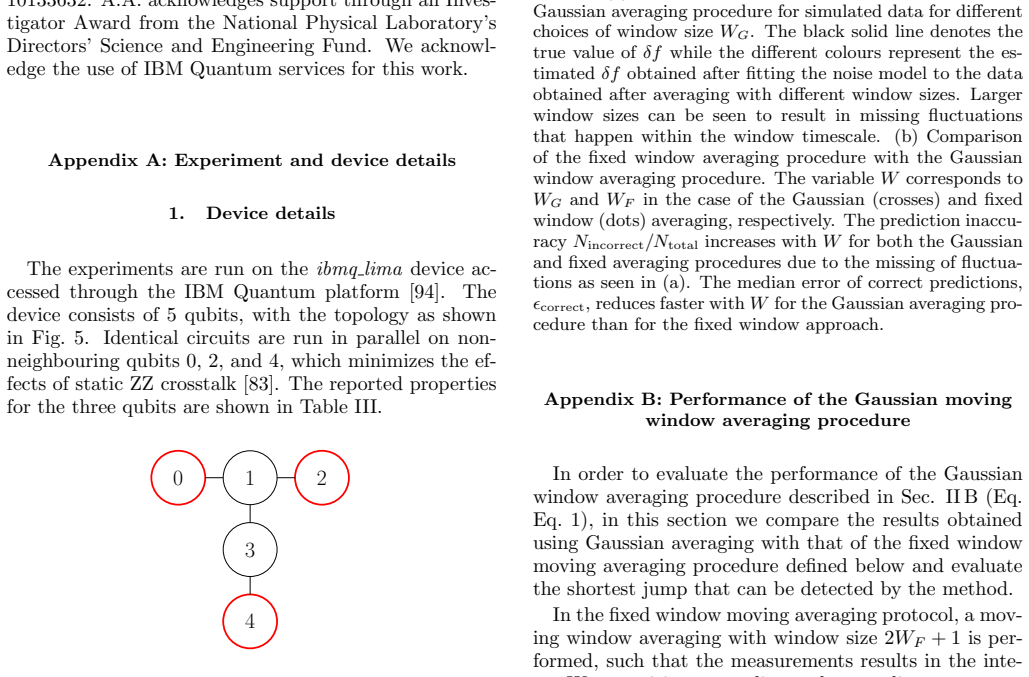
Device details The experiments are run on the ibmq lima device ac- cessed through the IBM Quantum platform [94]. The device consists of 5 qubits, with the topology as shown in Fig. 5. Identical circuits are run in parallel on non- neighbouring qubits 0, 2, and 4, which minimizes the ef- fects of static ZZ crosstalk [83]. The reported properties for the th...
-
[2]
The switching of these RTN is also significantly asymmetric for 1 → 0 and 0 → 1 tran- sitions ( ν(1) 1→0(t) ≫ ν(1) 0→1(t)), unlike what was found for the fastest fluctuations
Thus, these RTN occur at a timescale of 1-2 orders of magnitude slower than the RTN at the first level of the fluctuation hierarchy. The switching of these RTN is also significantly asymmetric for 1 → 0 and 0 → 1 tran- sitions ( ν(1) 1→0(t) ≫ ν(1) 0→1(t)), unlike what was found for the fastest fluctuations. The extracted fluctuation am- plitude of this RT...
-
[3]
In this section we present our 19 □4.0 □3.5 □3.0 □2.5 □2.0 λll 102 103 104 105 NCP Qubit 0 □4.0 □3.5 □3.0 □2.5 □2.0 λll Qubit 2 □4.0 □3.5 □3.0 □2.5 □2.0 λll Qubit 4 FIG
Automated hyperparameter evaluation of HDF A algorithm The auto-segmentation algorithm has two hyperpa- rameters: λll and Lmin. In this section we present our 19 □4.0 □3.5 □3.0 □2.5 □2.0 λll 102 103 104 105 NCP Qubit 0 □4.0 □3.5 □3.0 □2.5 □2.0 λll Qubit 2 □4.0 □3.5 □3.0 □2.5 □2.0 λll Qubit 4 FIG. 10. Elbow plots for determining the hyperparameter λll for ...
-
[4]
( n)” in the discussion below. Let T correspond to a single segment predicted by the auto-segmentation algorithm. Then, f (tr ∈ T) denotes the “true
Computing properties from HDF A results a. Extracting uncertainties in HDF A results In order to estimate the total uncertainties in param- eters f (n) c and f (n) ∆ resulting from the auto-segmentation algorithm, we consider two different sources of errors. The first error corresponds to the fitting quality of each segment resulting from the segmentation...
-
[5]
Theoretical prediction of ∆CP due to charge parity switching We can obtain the value of f (n) ∆max for a fluctuation source corresponding to charge parity switching by us- ing the properties of the qubit. This value is computed both using an analytic approximation of the Transmon Hamiltonian, resulting in ∆ analytical CP , as well as a numer- ical simulat...
-
[6]
(G2) To evaluate whether the TLS switching leads to a jump in the charge offset, we compare the values of ng at the time of TLS fluctuations
Charge offset shift extraction In order to evaluate the charge offset ng, we first use the relation f∆(t) = f∆max|cos(2πng)|. (G2) To evaluate whether the TLS switching leads to a jump in the charge offset, we compare the values of ng at the time of TLS fluctuations. In Fig. 12, we plot the distri- bution of the absolute value of the difference in charge ...
-
[7]
d∥ 2ex p EChf0 #2 ∆TLS hfTLS 2 ⟨0| ˆn |1⟩2 h(f0 + α − fTLS) =
Derivation of TLS induced charge offset and frequency fluctuations In this section, we describe the qubit-TLS Hamiltonian and derive the effects on the qubit for the case where the TLS is a defect residing in the barrier which couples to the electric field of the qubit junction [96, 99]. The total Hamiltonian of a qubit interacting with a TLS can be writt...
Show all 122 references
-
[8]
Bluvstein, S
D. Bluvstein, S. J. Evered, A. A. Geim, S. H. Li, H. Zhou, T. Manovitz, S. Ebadi, M. Cain, M. Kalinowski, D. Hangleiter, J. P. Bonilla Ataides, N. Maskara, I. Cong, X. Gao, P. Sales Ro- driguez, T. Karolyshyn, G. Semeghini, M. J. Gullans, M. Greiner, V. Vuleti´ c, and M. D. Lu...
2024
-
[9]
Google Quantum AI and Collaborators, Quantum er- ror correction below the surface code threshold, Nature 638, 920 (2024)
2024
-
[10]
B. W. Reichardt, D. Aasen, R. Chao, A. Chernoguzov, W. van Dam, J. P. Gaebler, D. Gresh, D. Lucchetti, M. Mills, S. A. Moses, B. Neyenhuis, A. Paetznick, A. Paz, P. E. Siegfried, M. P. da Silva, K. M. Svore, Z. Wang, and M. Zanner, Demonstration of quantum computation and erro...
2024 arXiv
-
[11]
Slussarenko and G
S. Slussarenko and G. J. Pryde, Photonic quantum in- formation processing: A concise review, Appl. Phys. Rev. 6 (2019)
2019
-
[12]
Burkard, T
G. Burkard, T. D. Ladd, A. Pan, J. M. Nichol, and J. R. Petta, Semiconductor spin qubits, Rev. Mod. Phys. 95, 025003 (2023)
2023
-
[13]
Kjaergaard, M
M. Kjaergaard, M. E. Schwartz, J. Braum¨ uller, P. Krantz, J. I.-J. Wang, S. Gustavsson, and W. D. Oliver, Superconducting qubits: Current state of play, Annu. Rev. Condens. Matter Phys. 11, 369 (2020)
2020
-
[14]
Krantz, M
P. Krantz, M. Kjaergaard, F. Yan, T. P. Orlando, S. Gustavsson, and W. D. Oliver, A Quantum Engi- neer’s Guide to Superconducting Qubits, Appl. Phys. Rev. 6, 021318 (2019)
2019
-
[15]
Siddiqi, Engineering high-coherence superconducting qubits, Nat
I. Siddiqi, Engineering high-coherence superconducting qubits, Nat. Rev. Mater. 6, 875 (2021)
2021
-
[16]
Y. Kim, A. Eddins, S. Anand, K. X. Wei, E. van den Berg, S. Rosenblatt, H. Nayfeh, Y. Wu, M. Zaletel, K. Temme, and A. Kandala, Evidence for the utility of quantum computing before fault tolerance, Nature 618, 500 (2023)
2023
-
[17]
Ganjam, Y
S. Ganjam, Y. Wang, Y. Lu, A. Banerjee, C. U. Lei, L. Krayzman, K. Kisslinger, C. Zhou, R. Li, Y. Jia, M. Liu, L. Frunzio, and R. J. Schoelkopf, Surpassing millisecond coherence in on chip superconducting quan- tum memories by optimizing materials and circuit de- sign, Nat. Co...
2024
-
[18]
Somoroff, Q
A. Somoroff, Q. Ficheux, R. A. Mencia, H. Xiong, R. Kuzmin, and V. E. Manucharyan, Millisecond Co- herence in a Superconducting Qubit, Phys. Rev. Lett. 130, 267001 (2023)
2023
-
[19]
B. L. Brock, S. Singh, A. Eickbusch, V. V. Sivak, A. Z. Ding, L. Frunzio, S. M. Girvin, and M. H. Devoret, Quantum error correction of qudits beyond break-even, arXiv:2409.15065 (2024)
2024 arXiv
-
[20]
L. B. Nguyen, Y.-H. Lin, A. Somoroff, R. Mencia, N. Grabon, and V. E. Manucharyan, High-coherence fluxonium qubit, Phys. Rev. X 9, 041041 (2019)
2019
-
[21]
C. E. Murray, Material matters in superconducting qubits, Materials Science and Engineering: R: Reports 146, 100646 (2021)
2021
-
[22]
R. C. J.K., V. Lordi, S. Misra, and J. Shabani, Materials science for quantum information science and technology, MRS Bull. 45, 485–497 (2020)
2020
-
[23]
W. D. Oliver and P. B. Welander, Materials in supercon- ducting quantum bits, MRS Bull. 38, 816–825 (2013)
2013
-
[24]
Chistolini, K
T. Chistolini, K. Lee, A. Banerjee, M. Alghadeer, C. J¨ unger, M. V. P. Alto´ e, C. Song, S. Chen, F. Wang, D. I. Santiago, and I. Siddiqi, Performance of supercon- ducting resonators suspended on sin membranes, Appl. Phys. Lett. 125, 204001 (2024)
2024
-
[26]
M. Chen, J. C. Owens, H. Putterman, M. Sch¨ afer, and O. Painter, Phonon engineering of atomic-scale defects in superconducting quantum circuits, Science Advances 10, eado6240 (2024)
2024
-
[27]
Bargerbos, L
A. Bargerbos, L. J. Splitthoff, M. Pita-Vidal, J. J. Wes- dorp, Y. Liu, P. Krogstrup, L. P. Kouwenhoven, C. K. Andersen, and L. Gr¨ unhaupt, Mitigation of quasiparti- cle loss in superconducting qubits by phonon scattering, 24 Phys. Rev. Appl. 19, 024014 (2023)
2023
-
[28]
D. Lall, A. Agarwal, W. Zhang, L. Lindoy, T. Lind- str¨ om, S. Webster, S. Hall, N. Chancellor, P. Wallden, R. Garcia-Patron, E. Kashefi, V. Kendon, J. Pritchard, A. Rossi, A. Datta, T. Kapourniotis, K. Georgopou- los, and I. Rungger, A review and collection of metrics and ben...
2025 arXiv
-
[29]
Veps¨ al¨ ainen, R
A. Veps¨ al¨ ainen, R. Winik, A. H. Karamlou, J. Braum¨ uller, A. D. Paolo, Y. Sung, B. Kannan, M. Kjaergaard, D. K. Kim, A. J. Melville, B. M. Niedzielski, J. L. Yoder, S. Gustavsson, and W. D. Oliver, Improving qubit coherence using closed-loop feedback, Nat. Commun. 13, 1932 (2022)
2022
-
[30]
Lucero, J
E. Lucero, J. Kelly, R. C. Bialczak, M. Lenander, M. Mariantoni, M. Neeley, A. D. O’Connell, D. Sank, H. Wang, M. Weides, J. Wenner, T. Yamamoto, A. N. Cleland, and J. M. Martinis, Reduced phase error through optimized control of a superconducting qubit, Phys. Rev. A 82, 042339 (2010)
2010
-
[31]
Blume-Kohout, J
R. Blume-Kohout, J. K. Gamble, E. Nielsen, K. Rudinger, J. Mizrahi, K. Fortier, and P. Maunz, Demonstration of qubit operations below a rigorous fault tolerance threshold with gate set tomography, Nat. Commun. 8, 14485 (2017)
2017
-
[32]
Agarwal, L
A. Agarwal, L. P. Lindoy, D. Lall, F. Jamet, and I. Rungger, Modelling non-markovian noise in driven su- perconducting qubits, Quantum Sci. Technol. 9, 035017 (2024)
2024
-
[33]
Young, S
K. Young, S. Bartlett, R. Blume-Kohout, J. Gam- ble, D. Lobser, P. Maunz, E. Nielsen, T. Proctor, M. Revelle, and K. Rudinger, Diagnosing and Destroy- ing Non-Markovian Noise , Tech. Rep. SAND–2020- 10396, 1671379, 691214 (Sandia National Lab. (SNL- CA), Livermore, CA (United ...
2020
-
[34]
Shirizly, G
L. Shirizly, G. Misguich, and H. Landa, Dissipative dy- namics of graph-state stabilizers with superconducting qubits, Phys. Rev. Lett. 132, 010601 (2024)
2024
-
[35]
Prakash and B
A. Prakash and B. Hebbe Madhusudhana, Characteriz- ing non-markovian and coherent errors in quantum sim- ulation, Phys. Rev. Res. 6, 043127 (2024)
2024
- [36]
-
[37]
Zhang, B
H. Zhang, B. Pokharel, E. Levenson-Falk, and D. Li- dar, Predicting non-markovian superconducting-qubit dynamics from tomographic reconstruction, Phys. Rev. Appl. 17, 054018 (2022)
2022
-
[38]
M¨ uller, J
C. M¨ uller, J. H. Cole, and J. Lisenfeld, Towards un- derstanding two-level-systems in amorphous solids: in- sights from quantum circuits, Rep. Prog. Phys. 82, 124501 (2019)
2019
-
[39]
Dasgupta and T
S. Dasgupta and T. S. Humble, Stability of noisy quan- tum computing devices, arXiv:2105.09472 (2021)
2021 arXiv
-
[40]
Proctor, M
T. Proctor, M. Revelle, E. Nielsen, K. Rudinger, D. Lob- ser, P. Maunz, R. Blume-Kohout, and K. Young, De- tecting and tracking drift in quantum information pro- cessors, Nat. Commun. 11, 5396 (2020)
2020
-
[41]
Dasgupta and T
S. Dasgupta and T. S. Humble, Characterizing the Sta- bility of NISQ Devices, in2020 IEEE Int Conf Quantum Comput Eng QCE(2020) p. 419
2020
-
[42]
Yeter-Aydeniz, Z
K. Yeter-Aydeniz, Z. Parks, A. Nair, E. Gustafson, A. F. Kemper, R. C. Pooser, Y. Meurice, and P. Dreher, Mea- suring NISQ gate-based qubit stability using a 1+ 1 field theory and cycle benchmarking, arXiv:2201.02899 (2022)
2022 arXiv
-
[43]
van der Schoot, R
W. van der Schoot, R. Wezeman, P. T. Eendebak, N. M. Neumann, and F. Phillipson, Evaluating three levels of quantum metrics on quantum-inspire hardware, Quan- tum Inf. Process. 22, 451 (2023)
2023
-
[44]
Dasgupta, Stability of Quantum Computers, arXiv:2404.19082 (2024)
S. Dasgupta, Stability of Quantum Computers, arXiv:2404.19082 (2024)
2024 arXiv
-
[45]
M. Alam, A. Ash-Saki, and S. Ghosh, Addressing Tem- poral Variations in Qubit Quality Metrics for Parame- terized Quantum Circuits, in 2019 IEEEACM Int Symp Low Power Electron ISLPED(2019) p. 1
2019
-
[46]
Carroll, S
M. Carroll, S. Rosenblatt, P. Jurcevic, I. Lauer, and A. Kandala, Dynamics of superconducting qubit relax- ation times, npj Quantum Inf. 8, 132 (2022)
2022
-
[47]
Y. Wan, D. Kienzler, S. D. Erickson, K. H. Mayer, T. R. Tan, J. J. Wu, H. M. Vasconcelos, S. Glancy, E. Knill, D. J. Wineland, A. C. Wilson, and D. Leibfried, Quan- tum gate teleportation between separated qubits in a trapped-ion processor, Science 364, 875 (2019)
2019
-
[48]
Merkel, K
B. Merkel, K. Thirumalai, g.-i. family=Tarlton, given=JE, g.-i. family=Sch¨ afer, given=VM, g.-i. fam- ily=Ballance, given=CJ, g.-i. family=Harty, given=TP, and g.-i. family=Lucas, given=DM, Magnetic field sta- bilization system for atomic physics experiments, Rev. Sci. Instru...
2019
-
[49]
Schl¨ or, J
S. Schl¨ or, J. Lisenfeld, C. M¨ uller, A. Bilmes, A. Schnei- der, D. P. Pappas, A. V. Ustinov, and M. Weides, Cor- relating Decoherence in Transmon Qubits: Low Fre- quency Noise by Single Fluctuators, Phys. Rev. Lett. 123, 190502 (2019)
2019
-
[50]
S. E. de Graaf, S. Mahashabde, S. E. Kubatkin, A. Y. Tzalenchuk, and A. V. Danilov, Quantifying dynamics and interactions of individual spurious low-energy fluc- tuators in superconducting circuits, Phys. Rev. B 103, 174103 (2021)
2021
-
[51]
W. Wei, P. Hao, Z. Ma, H. Zhang, L. Pang, F. Wu, K. Deng, J. Zhang, and Z. Lu, Measurement and sup- pression of magnetic field noise of trapped ion qubit, J. Phys. B: At. Mol. Opt. Phys. 55, 075001 (2022)
2022
-
[52]
J. J. Burnett, A. Bengtsson, M. Scigliuzzo, D. Niepce, M. Kudra, P. Delsing, and J. Bylander, Decoherence benchmarking of superconducting qubits, npj Quantum Inf. 5, 54 (2019)
2019
-
[53]
P. V. Klimov, J. Kelly, Z. Chen, M. Neeley, A. Megrant, B. Burkett, R. Barends, K. Arya, B. Chiaro, Y. Chen, A. Dunsworth, A. Fowler, B. Foxen, C. Gidney, M. Giustina, R. Graff, T. Huang, E. Jeffrey, E. Lucero, J. Y. Mutus, O. Naaman, C. Neill, C. Quintana, P. Roushan, D. Sank...
2018 doi
-
[54]
M¨ uller, J
C. M¨ uller, J. Lisenfeld, A. Shnirman, and S. Poletto, Interacting two-level defects as sources of fluctuating high-frequency noise in superconducting circuits, Phys. Rev. B 92, 035442 (2015)
2015
-
[55]
Yang, X.-Y
X.-X. Yang, X.-Y. Yang, L.-L. Guo, L. Du, P. Duan, 25 Z.-L. Jia, H.-O. Li, and G.-P. Guo, Locating Two-Level Systems in a Superconducting Xmon Qubit, Applied Sciences 13, 6672 (2023), number: 11 Publisher: Mul- tidisciplinary Digital Publishing Institute
2023
-
[56]
S. Kono, J. Pan, M. Chegnizadeh, X. Wang, A. Youssefi, M. Scigliuzzo, and T. J. Kippenberg, Mechanically in- duced correlated errors on superconducting qubits with relaxation times exceeding 0.4ms, Nat Commun 15, 3950 (2024)
2024
-
[57]
Rist` e, C
D. Rist` e, C. C. Bultink, M. J. Tiggelman, R. N. Schouten, K. W. Lehnert, and L. DiCarlo, Millisecond charge-parity fluctuations and induced decoherence in a superconducting transmon qubit, Nat. Commun. 4, 1913 (2013), number: 1 Publisher: Nature Publishing Group
2013
-
[58]
Catelani, R
G. Catelani, R. J. Schoelkopf, M. H. Devoret, and L. I. Glazman, Relaxation and frequency shifts induced by quasiparticles in superconducting qubits, Phys. Rev. B 84, 064517 (2011)
2011
-
[59]
J. Koch, T. M. Yu, J. Gambetta, A. A. Houck, D. I. Schuster, J. Majer, A. Blais, M. H. Devoret, S. M. Girvin, and R. J. Schoelkopf, Charge-insensitive qubit design derived from the Cooper pair box, Phys. Rev. A 76, 042319 (2007)
2007
-
[60]
B. G. Christensen, C. D. Wilen, A. Opremcak, J. Nel- son, F. Schlenker, C. H. Zimonick, L. Faoro, L. B. Ioffe, Y. J. Rosen, J. L. DuBois, B. L. T. Plourde, and R. Mc- Dermott, Anomalous charge noise in superconducting qubits, Phys. Rev. B 100, 140503 (2019)
2019
-
[61]
Serniak, S
K. Serniak, S. Diamond, M. Hays, V. Fatemi, S. Shankar, L. Frunzio, R. Schoelkopf, and M. Devoret, Direct Dispersive Monitoring of Charge Parity in Offset- Charge-Sensitive Transmons, Phys. Rev. Applied 12, 014052 (2019)
2019
-
[62]
Serniak, M
K. Serniak, M. Hays, G. De Lange, S. Diamond, S. Shankar, L. Burkhart, L. Frunzio, M. Houzet, and M. Devoret, Hot Nonequilibrium Quasiparticles in Transmon Qubits, Phys. Rev. Lett. 121, 157701 (2018)
2018
-
[63]
L. A. Martinez, Z. Peng, D. Appel¨ o, D. M. Tennant, N. A. Petersson, J. L. DuBois, and Y. J. Rosen, Noise- specific beating in the higher-level Ramsey curves of a transmon qubit, Appl. Phys. Lett. 122, 114002 (2023)
2023
-
[64]
Diamond, V
S. Diamond, V. Fatemi, M. Hays, H. Nho, P. D. Kurilovich, T. Connolly, V. R. Joshi, K. Serniak, L. Frunzio, L. I. Glazman, and M. H. Devoret, Distin- guishing Parity-Switching Mechanisms in a Supercon- ducting Qubit, PRX Quantum 3, 040304 (2022)
2022
-
[65]
X. Pan, Y. Zhou, H. Yuan, L. Nie, W. Wei, L. Zhang, J. Li, S. Liu, Z. H. Jiang, G. Catelani, L. Hu, F. Yan, and D. Yu, Engineering superconducting qubits to re- duce quasiparticles and charge noise, Nat Commun 13, 7196 (2022), number: 1 Publisher: Nature Publishing Group
2022
-
[66]
Liu, Y.-Y
B.-J. Liu, Y.-Y. Wang, T. Sheffer, and C. Wang, Obser- vation of discrete charge states of a coherent two-level system in a superconducting qubit, Phys. Rev. Lett. 133, 160602 (2024)
2024
-
[67]
Papiˇ c, J
M. Papiˇ c, J. Tuorila, A. Auer, I. de Vega, and A. Hos- seinkhani, Charge-parity switching effects and optimi- sation of transmon-qubit design parameters (2024)
2024
-
[68]
E. T. Mannila, P. Samuelsson, S. Simbierowicz, J. T. Peltonen, V. Vesterinen, L. Gr¨ onberg, J. Hassel, V. F. Maisi, and J. P. Pekola, A superconductor free of quasi- particles for seconds, Nat. Phys. 18, 145 (2022), pub- lisher: Nature Publishing Group
2022
-
[69]
C. Liu, D. Harrison, S. Patel, C. Wilen, O. Rafferty, A. Shearrow, A. Ballard, V. Iaia, J. Ku, B. Plourde, and R. McDermott, Quasiparticle Poisoning of Super- conducting Qubits from Resonant Absorption of Pair- Breaking Photons, Phys. Rev. Lett. 132, 017001 (2024)
2024
-
[70]
D. M. Tennant, L. A. Martinez, K. M. Beck, S. R. O’Kelley, C. D. Wilen, R. McDermott, J. L. DuBois, and Y. J. Rosen, Low-Frequency Correlated Charge- Noise Measurements Across Multiple Energy Transi- tions in a Tantalum Transmon, PRX Quantum 3, 030307 (2022)
2022
-
[71]
R. T. Gordon, C. E. Murray, C. Kurter, M. Sandberg, S. A. Hall, K. Balakrishnan, R. Shelby, B. Wacaser, A. A. Stabile, J. W. Sleight, M. Brink, M. B. Rothwell, K. P. Rodbell, O. Dial, and M. Steffen, Environmental radiation impact on lifetimes and quasiparticle tunnel- ing rat...
2022
-
[72]
Erlandsson, D
O. Erlandsson, D. Sabonis, A. Kringhøj, T. W. Larsen, P. Krogstrup, K. D. Petersson, and C. M. Mar- cus, Parity switching in a full-shell superconductor- semiconductor nanowire qubit, Phys. Rev. B 108, L121406 (2023)
2023
-
[73]
Thorbeck, A
T. Thorbeck, A. Eddins, I. Lauer, D. T. McClure, and M. Carroll, Two-level-system dynamics in a super- conducting qubit due to background ionizing radiation (2023)
2023
-
[74]
C. D. Wilen, S. Abdullah, N. A. Kurinsky, C. Stanford, L. Cardani, G. D’Imperio, C. Tomei, L. Faoro, L. B. Ioffe, C. H. Liu, A. Opremcak, B. G. Christensen, J. L. DuBois, and R. McDermott, Correlated charge noise and relaxation errors in superconducting qubits, Nature 594, 369 (2021)
2021
-
[75]
Tomonaga, H
A. Tomonaga, H. Mukai, F. Yoshihara, and J. S. Tsai, Quasiparticle tunneling and $1/f$ charge noise in ultra- strongly coupled superconducting qubit and resonator, Phys. Rev. B 104, 224509 (2021), publisher: American Physical Society
2021
-
[76]
S. E. De Graaf, L. Faoro, L. B. Ioffe, S. Mahashabde, J. J. Burnett, T. Lindstr¨ om, S. E. Kubatkin, A. V. Danilov, and A. Y. Tzalenchuk, Two-level systems in superconducting quantum devices due to trapped quasi- particles, Sci. Adv. 6, eabc5055 (2020)
2020
-
[77]
H. Paik, D. I. Schuster, L. S. Bishop, G. Kirchmair, G. Catelani, A. P. Sears, B. R. Johnson, M. J. Reagor, L. Frunzio, L. I. Glazman, S. M. Girvin, M. H. De- voret, and R. J. Schoelkopf, Observation of High Co- herence in Josephson Junction Qubits Measured in a Three-Dimensio...
2011
-
[78]
Levine, A
H. Levine, A. Haim, J. Hung, N. Alidoust, M. Kalaee, L. DeLorenzo, E. Wollack, P. Arrangoiz- Arriola, A. Khalajhedayati, R. Sanil, H. Moradinejad, Y. Vaknin, A. Kubica, D. Hover, S. Aghaeimeibodi, J. Alcid, C. Baek, J. Barnett, K. Bawdekar, P. Bi- enias, H. Carson, C. Chen, L....
2024
-
[79]
M. P. V. Stenberg, Y. R. Sanders, and F. K. Wilhelm, Efficient estimation of resonant coupling between quan- tum systems, Phys. Rev. Lett. 113, 210404 (2014)
2014
-
[80]
M. P. V. Stenberg and F. K. Wilhelm, Simultaneous model selection and parameter estimation: A supercon- ducting qubit coupled to a bath of incoherent two-level systems, Phys. Rev. A 94, 052119 (2016)
2016
-
[81]
B´ ejanin, C
J. B´ ejanin, C. Earnest, Y. Sanders, and M. Mariantoni, Resonant coupling parameter estimation with supercon- ducting qubits, PRX Quantum 2, 040343 (2021)
2021
-
[82]
McEwen, L
M. McEwen, L. Faoro, K. Arya, A. Dunsworth, T. Huang, S. Kim, B. Burkett, A. Fowler, F. Arute, J. C. Bardin, A. Bengtsson, A. Bilmes, B. B. Buck- ley, N. Bushnell, Z. Chen, R. Collins, S. Demura, A. R. Derk, C. Erickson, M. Giustina, S. D. Har- rington, S. Hong, E. Jeffrey, J....
2022
-
[83]
F. D. Dominicis, T. Roy, A. Mariani, M. Bal, N. Casali, I. Colantoni, F. Crisa, A. Cruciani, F. Ferroni, D. L. He- lis, L. Pagnanini, V. Pettinacci, R. Pilipenko, S. Pirro, A. Puiu, A. Romanenko, M. Vignati, D. v Zanten, S. Zhu, A. Grassellino, and L. Cardani, Evaluating ra- d...
2024 arXiv
-
[84]
Rabiner and B
L. Rabiner and B. Juang, An introduction to hidden markov models, IEEE ASSP Mag. 3, 4 (1986)
1986
-
[85]
S. Fine, Y. Singer, and N. Tishby, The hierarchical hid- den markov model: Analysis and applications, Mach. Learn. 32, 41 (1998)
1998
-
[86]
F. M. Puglisi and P. Pavan, Factorial hidden markov model analysis of random telegraph noise in resistive random access memories, ECTI Trans. Electr. Eng. Electron. Commun. 12, 24–29 (2014)
2014
-
[87]
Aminikhanghahi and D
S. Aminikhanghahi and D. J. Cook, A survey of meth- ods for time series change point detection, Knowl. Inf. Syst. 51, 339 (2017)
2017
-
[88]
Truong, L
C. Truong, L. Oudre, and N. Vayatis, Selective review of offline change point detection methods, Signal Process. 167, 107299 (2020)
2020
-
[89]
Blume-Kohout and K
R. Blume-Kohout and K. C. Young, A Volumetric Framework for Quantum Computer Benchmarks, Quan- tum 4, 362 (2020)
2020
-
[90]
Tripathi, H
V. Tripathi, H. Chen, M. Khezri, K.-W. Yip, E. Levenson-Falk, and D. A. Lidar, Suppression of Crosstalk in Superconducting Qubits Using Dynamical Decoupling, Phys. Rev. Appl. 18, 024068 (2022)
2022
-
[91]
Nielsen, J
E. Nielsen, J. K. Gamble, K. Rudinger, T. Scholten, K. Young, and R. Blume-Kohout, Gate Set Tomogra- phy, Quantum 5, 557 (2021)
2021
-
[92]
Leibfried, D
D. Leibfried, D. M. Meekhof, B. E. King, C. Monroe, W. M. Itano, and D. J. Wineland, Experimental Deter- mination of the Motional Quantum State of a Trapped Atom, Phys. Rev. Lett. 77, 4281 (1996)
1996
-
[93]
Banaszek, M
K. Banaszek, M. Cramer, and D. Gross, Focus on quan- tum tomography, New J. Phys 15, 125020 (2013)
2013
-
[94]
Blume-Kohout, Optimal, reliable estimation of quan- tum states, New J
R. Blume-Kohout, Optimal, reliable estimation of quan- tum states, New J. Phys. 12, 043034 (2010)
2010
-
[95]
S. W. Smith et al., The scientist and engineer’s guide to digital signal processing(California Technical Pub. San Diego, 1997)
1997
-
[96]
Giovannetti, S
V. Giovannetti, S. Lloyd, and L. Maccone, Quantum- enhanced measurements: Beating the standard quan- tum limit, Science 306, 1330 (2004)
2004
-
[97]
Storn and K
R. Storn and K. Price, Differential evolution–a simple and efficient heuristic for global optimization over con- tinuous spaces, J. Global. Optim. 11, 341 (1997)
1997
-
[98]
Virtanen, R
P. Virtanen, R. Gommers, T. E. Oliphant, M. Haber- land, T. Reddy, D. Cournapeau, E. Burovski, P. Pe- terson, W. Weckesser, J. Bright, S. J. van der Walt, M. Brett, J. Wilson, K. J. Millman, N. Mayorov, A. R. J. Nelson, E. Jones, R. Kern, E. Larson, C. J. Carey, ˙I. Polat, Y. ...
2020
-
[99]
Paladino, Y
E. Paladino, Y. M. Galperin, G. Falci, and B. L. Alt- shuler, 1/f noise: implications for solid-state quantum information, Rev. Mod. Phys. 86, 361 (2014), arXiv: 1304.7925
2014 arXiv
-
[100]
Haynes, P
K. Haynes, P. Fearnhead, and I. A. Eckley, A compu- tationally efficient nonparametric approach for change- point detection, Stat. Comput. 27, 1293 (2017)
2017
-
[101]
IBM Quantum, https://quantum.ibm.com/ (2023)
2023
-
[102]
E. L. Hahn, Spin echoes, Phys. Rev. 80, 580 (1950)
1950
-
[103]
J. M. Martinis, K. B. Cooper, R. McDermott, M. Stef- fen, M. Ansmann, K. D. Osborn, K. Cicak, S. Oh, D. P. Pappas, R. W. Simmonds, and C. C. Yu, Decoherence in josephson qubits from dielectric loss, Phys. Rev. Lett. 95, 210503 (2005)
2005
-
[104]
L. V. Abdurakhimov, I. Mahboob, H. Toida, K. Kakuyanagi, Y. Matsuzaki, and S. Saito, Identifi- cation of different types of high-frequency defects in su- perconducting qubits, PRX Quantum 3, 040332 (2022)
2022
-
[105]
Lisenfeld, A
J. Lisenfeld, A. Bilmes, A. Megrant, R. Barends, J. Kelly, P. Klimov, G. Weiss, J. M. Martinis, and A. V. Ustinov, Electric field spectroscopy of material defects in transmon qubits, npj Quantum Inf. 5, 1 (2019), num- ber: 1 Publisher: Nature Publishing Group
2019
-
[106]
J. H. Cole, C. M¨ uller, P. Bushev, G. J. Grabovskij, J. Lisenfeld, A. Lukashenko, A. V. Ustinov, and 27 A. Shnirman, Quantitative evaluation of defect-models in superconducting phase qubits, Appl. Phys. Lett. 97, 252501 (2010)
2010
-
[107]
Lucas, A
M. Lucas, A. V. Danilov, L. V. Levitin, A. Jayaraman, A. J. Casey, L. Faoro, A. Y. Tzalenchuk, S. E. Ku- batkin, J. Saunders, and S. E. de Graaf, Quantum bath suppression in a superconducting circuit by immersion cooling, Nat. Commun. 3522, 2447 (2023)
2023
-
[108]
C.-C. Hung, L. Yu, N. Foroozani, S. Fritz, D. Gerthsen, and K. D. Osborn, Probing hundreds of individual quan- tum defects in polycrystalline and amorphous alumina, Phys. Rev. Appl. 17, 034025 (2022)
2022
-
[109]
Kehrer, T
T. Kehrer, T. Nadolny, and C. Bruder, Improving trans- mon qudit measurement on IBM Quantum hardware, Phys. Rev. Research 6, 013050 (2024)
2024
-
[110]
M. G. Peters, J. I. Dijkhuis, and L. W. Molenkamp, Random telegraph signals and 1/f noise in a silicon quantum dot, J. Appl. Phys. 86, 1523 (1999)
1999
-
[111]
Echternach, B
P. Echternach, B. Pepper, T. Reck, and C. Brad- ford, Single photon detection of 1.5 thz radiation with the quantum capacitance detector, Nat. Astron. 2, 90 (2018)
2018
-
[112]
A. V. Dixit, S. Chakram, K. He, A. Agrawal, R. K. Naik, D. I. Schuster, and A. Chou, Searching for dark matter with a superconducting qubit, Phys. Rev. Lett. 126, 141302 (2021)
2021
-
[113]
Chen, K.-H
L. Chen, K.-H. Lee, C.-H. Liu, B. Marinelli, R. K. Naik, Z. Kang, N. Goss, H. Kim, D. I. Santiago, and I. Sid- diqi, Scalable and site-specific frequency tuning of two- level system defects in superconducting qubit arrays, arXiv:2503.04702 (2025)
2025 arXiv
-
[114]
A. Dane, K. Balakrishnan, B. Wacaser, L.-W. Hung, H. J. Mamin, D. Rugar, R. M. Shelby, C. Mur- ray, K. Rodbell, and J. Sleight, Performance sta- bilization of high-coherence superconducting qubits, arXiv:2503.12514 (2025)
2025 arXiv
-
[115]
Efron and R
B. Efron and R. J. Tibshirani, An introduction to the bootstrap (Chapman and Hall/CRC, 1994)
1994
-
[116]
Hesterberg, Bootstrap, WIREs Comput
T. Hesterberg, Bootstrap, WIREs Comput. Stat. 3, 497 (2011)
2011
-
[117]
Welch, The use of fast fourier transform for the esti- mation of power spectra: A method based on time aver- aging over short, modified periodograms, IEEE Trans
P. Welch, The use of fast fourier transform for the esti- mation of power spectra: A method based on time aver- aging over short, modified periodograms, IEEE Trans. Audio Electroacoust. 15, 70 (2003)
2003
-
[118]
Faoro and L
L. Faoro and L. B. Ioffe, Interacting tunneling model for two-level systems in amorphous materials and its predic- tions for their dephasing and noise in superconducting microresonators, Phys. Rev. B 91, 014201 (2015)
2015
-
[119]
P. W. Anderson, B. I. Halperin, and C. M. Varma, Anomalous low-temperature thermal properties of glasses and spin glasses, Philos. Mag.-J. Theor. Exp. Appl. Phys. 25, 1 (1972)
1972
-
[120]
W. A. Phillips, Two-level states in glasses, Rep. Prog. Phys. 50, 1657 (1987)
1987
-
[121]
M¨ uller,Coherent defects in superconducting circuits, Ph.D
C. M¨ uller,Coherent defects in superconducting circuits, Ph.D. thesis, Karlsruher Inst. f¨ ur Technologie, Diss., 2011 (2011)
2011
-
[122]
L. J. Zeng, S. Nik, T. Greibe, P. Krantz, C. M. Wil- son, P. Delsing, and E. Olsson, Direct observation of the thickness distribution of ultra thin alox barriers in al/alox/al josephson junctions, J. Phys. D: Appl. Phys. 48, 395308 (2015)
2015
Reviewed August 7, 2026 · model on record in the stance chip above.
Discussion (0). Sign in to comment.