REVIEW 4 major objections 5 minor 27 references
Initial Luminally Deposited FGF4 Critically Influences Blastocyst Patterning
T0 review · 4 major / 5 minor · reviewed 2026-08-07 · deepseek-v4-flash
Pith's one-line read The authors claim that correct blastocyst patterning requires a substantial initial deposit of FGF4 in the blastocoel, independent of ICM size or shape.
desk verdict Competent extension of the authors' own ITWT model, but the 'critical' role claimed for initial luminal FGF4 is undercut by the paper's own low conditional sensitivity and an in-sample fit. read the letter →
The pith
A machine-rendered reading of the paper's core claim, the machinery that carries it, and where it could break.
The reading
What carries the argument
The load-bearing mechanism is a compartmentalized stochastic FGF4 transport model with three constituents: ICM (EPI plus PRE), blastocoel, and TE. FGF4 is produced only by the EPI-progenitor population and can jump between neighboring constituents, degrade anywhere, or be initially present as a Poissonian-binomial sampled deposit in the lumen (FGF4-LUMEN). A time-varying pattern score quantifies deviation from the ideal layout—100% PRE in the lower layer and 100% EPI in upper layers—and a meta score condenses the 25th, 50th, and 75th percentile trajectories of an ensemble of pattern scores into a single scalar. The paper's simulation-based inference workflow fits 26 free parameters separately for eight ICM geometries, and the strongest sensitivities concentrate on FGF4 repression by GATA6 and FGF4 turnover rates.
What would settle it
Run the extended model with zero initial luminal FGF4 but continuous vesicle secretion into the blastocoel: if the ideal PRE/EPI pattern still emerges, the paper's central claim fails. Alternatively, measure luminal FGF4 concentration in mouse blastocysts across E3.0–E4.5; if it rises after cavitation or tracks vesicle secretion events rather than decaying from an initial peak, the one-time-deposit premise is contradicted.
Extended reading notes
Core claim
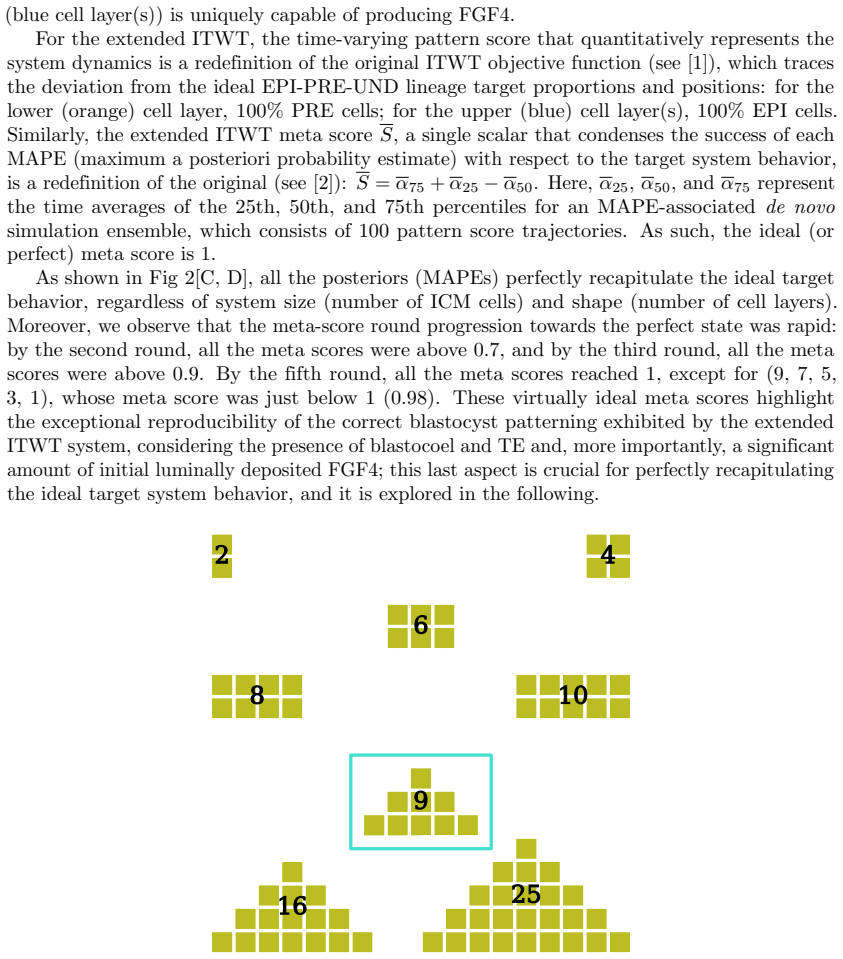
The extended Inferred-Theoretical Wild-Type (ITWT) system—a spatial-stochastic simulator of gene regulation and intercellular signaling—achieves a perfect meta score of 1 for the target blastocyst pattern across all tested ICM sizes and shapes when the blastocoel initially receives a substantial FGF4 deposit. On average 9,547 copies (IQR 7,838–10,687) are required, making the initial-condition parameter FGF4-LUMEN a critical determinant. The inference also yields systematic parameter relationships: the TE-associated FGF4 lifetime is consistently shorter than the blastocoel-associated one, while the TE escape time is consistently longer, so relative to one another the blastocoel releases FGF4 toward the ICM and TE and the TE traps and degrades it. The authors interpret this as evidence that the blastocoel acts as a localized signaling source and the TE as an embryo-wide signaling sink that canalizes and maintains the correct spatial pattern.
Load-bearing premise
The model treats luminal FGF4 as a one-time initial deposit sampled at the start of each simulation, whereas the motivating experiments describe ongoing embryo-wide vesicle secretion of FGF4 around E3.0; if continuous secretion rather than a single bolus is the actual delivery mechanism, the inferred critical amount and the source/sink roles could be artifacts of this static-initial-condition abstraction.
Editorial extensions
If this is right
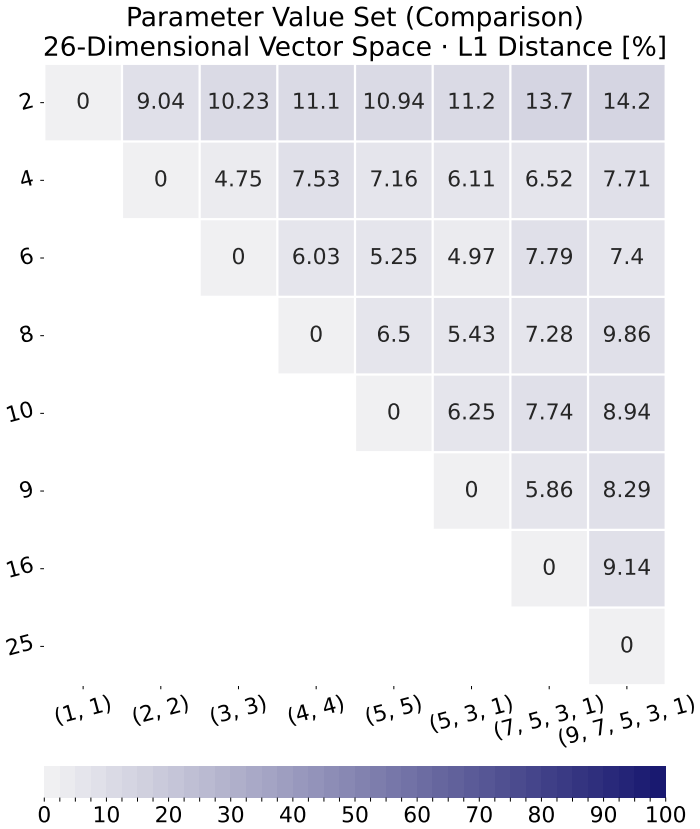
- The ideal blastocyst pattern is reproducible: all eight inferred parameter sets reach near-perfect meta scores by the fifth inference round.
- The required initial luminal FGF4 amount does not scale with ICM cell number or layer count, implying the mechanism is robust to variation in embryo architecture.
- The blastocoel and TE have complementary roles: the blastocoel holds and releases FGF4 with a longer degradation lifetime and faster escape, while the TE degrades FGF4 faster and escapes from it slower.
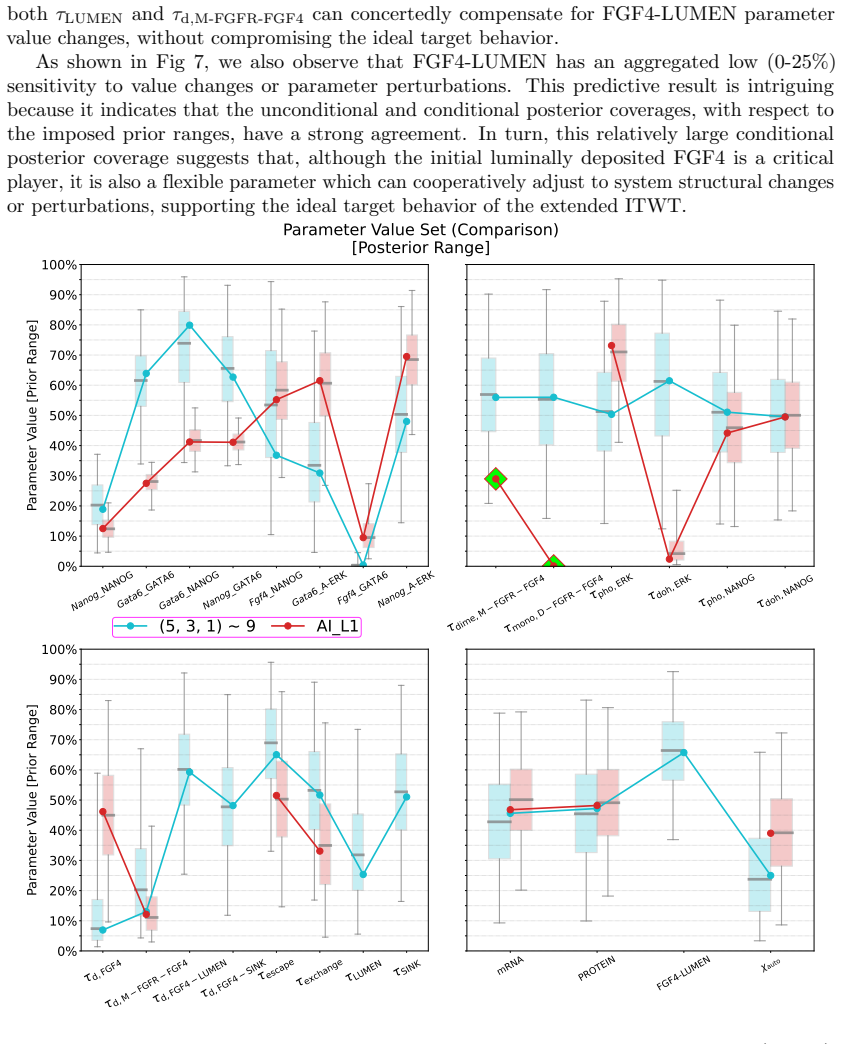
- FGF4-LUMEN is critical yet flexible: it correlates positively with lumen escape time and negatively with the FGFR1-FGF4 complex-monomer lifetime, allowing compensatory adjustments without breaking the target pattern.
- Most parameters tolerate broad perturbations, but strong sensitivity for Fgf4 repression by GATA6, FGF4 degradation, and the FGFR1-FGF4 complex lifetime identifies those points as where patterning would most likely fail.
Reading between the lines
- If ongoing vesicular secretion rather than a one-time bolus is the real delivery mechanism, the critical ~9,500-copy initial deposit might correspond to a sustained luminal concentration; direct time-resolved measurement of luminal FGF4 would discriminate between these interpretations.
- The apparent size-independence of the copy-number requirement suggests the effective variable might be concentration-like rather than total-amount-like, since a larger blastocoel volume would dilute the same number of molecules; tests varying lumen volume rather than ICM geometry could settle this.
- Because the original ITWT model showed exogenous FGF4 controls cell-fate proportions, while the extended model assigns luminal FGF4 a spatial patterning role, a plausible synthesis is that two distinct FGF4 routes—local luminal signaling and cell-produced paracrine signaling—serve different developmental functions.
Editorial analysis
A structured set of objections, weighed in public.
Referee Report
Summary. The paper extends the authors' previously inferred stochastic ICM model (ITWT) by adding the blastocoel and trophectoderm as FGF4 reservoirs, parameterizes the extension with simulation-based inference for eight ICM geometries, and reports that all inferred MAPEs reproduce the idealized spatial pattern (lower layer PRE, upper layers EPI). The central claim is that a substantial initial luminally deposited FGF4 amount (posterior IQR 7838-10687 copies) is required for this pattern, that the requirement is independent of ICM size and shape, and that the inferred parameter relationships identify the blastocoel as a localized FGF4 source and the TE as an embryo-wide sink.
Significance. If the central claim were supported, the paper would be a valuable step: it couples a spatial-stochastic gene-regulatory model to tissue-level compartments, uses SBI to infer 26 parameters, and generates a concrete, falsifiable prediction about luminal FGF4 copy numbers. The systematic posterior differences between lumen and TE lifetimes are an interesting hypothesis-generating result. However, the load-bearing claim of criticality is not yet established, because the pattern used as the inference objective is also the evidence for 'perfect recapitulation,' and the paper's own sensitivity analysis reports low sensitivity for the parameter called critical.
major comments (4)
- [Model parameter posterior distributions perfectly recapitulate ideal target system behavior, Fig 2] The ideal spatial pattern (lower layer PRE, upper layers EPI) is the objective function used in the AI-MAPE inference, so the reported meta scores S near 1 are an in-sample fit rather than an independent confirmation. Calling this 'perfect recapitulation' overstates the evidence; an independent posterior predictive check (e.g., on a geometry or target not used in fitting, or against the experimentally observed salt-and-pepper dynamics) would be needed to support the term.
- [Initial luminally deposited FGF4 is critical for supporting the ideal target behavior, Fig 7] The paper's sensitivity definition says that 0% sensitivity means any value within the prior can recover the ideal behavior while holding all other parameters fixed. The text reports aggregated low (0-25%) sensitivity for FGF4-LUMEN, yet simultaneously calls it critical and 'requires a significant amount.' These statements are in direct tension: if most values in the prior can recover the target, the posterior IQR (55-75% of the prior range) cannot be read as a requirement without explaining why the posterior is not nearly the prior. No ablation with FGF4-LUMEN set to zero or low values is reported. Please add explicit ablation or perturbation results and reconcile the sensitivity evidence with the criticality claim.
- [Methods, Inventory of model parameter values; Results] FGF4-LUMEN is defined as a one-time initial deposit sampled at the beginning of every simulation, whereas the motivating experiments (ref [4]) describe extensive embryo-wide vesicle secretion of FGF4 around E3.0. If ongoing secretion is the actual delivery mechanism, the inferred 'critical' initial amount and the source/sink roles could be artifacts of the static-initial-condition abstraction. The manuscript does not test a continuous-secretion alternative or otherwise justify that a single initial deposit is sufficient to represent the dynamic process; this structural assumption directly affects the central claim.
- [Abstract and Results, Comparison of all eight optimal parameter sets] The claim that the required FGF4-LUMEN is independent of ICM population size and shape is based on only eight geometries and no formal statistical comparison. The Results section itself notes that a considerably larger ICM population cannot be excluded due to computational restrictions, yet the abstract states the independence without this caveat. The claim should either be softened in the abstract or supported by a formal comparison of the posterior distributions across geometries.
minor comments (5)
- [Fig 3 caption] The caption says 'for each (5, 3, 2, 1) one-dimensional marginal posterior distribution,' but the representative reference is (5, 3, 1); this appears to be a typo.
- [Fig 5 text] The phrases 'lower/stronger' and 'higher/weaker' (e.g., 'Nanog self-activation is lower/stronger than Gata6 self-activation') are contradictory as written; please specify the direction of each effect unambiguously.
- [Data Availability] The Data Availability statement says code and posterior distributions 'will be available' without repository URLs; providing the actual links (the Methods already mentions a GitHub organization) would improve reproducibility.
- [Results, Initial luminally deposited FGF4] The terms 'unconditional posterior' and 'conditional posterior' are used without a definition; a one-sentence explanation for readers not familiar with references [1] and [2] would be helpful.
- [Fig 3 bottom-right panel] The axis label 'mRNA PROTEIN' is unclear; please clarify which symbols correspond to mRNA and which to protein copy numbers.
Circularity Check
In-sample MAPE fit to the target pattern score is presented as perfect recapitulation, and the fitted FGF4-LUMEN parameter is renamed a critical requirement despite the paper's own low-sensitivity result.
-
fitted input called prediction
[Results: Model parameter posterior distributions perfectly recapitulate ideal target system behavior]
"For the extended ITWT, the time-varying pattern score that quantitatively represents the system dynamics is a redefinition of the original ITWT objective function (see [1]), which traces the deviation from the ideal EPI-PRE-UND lineage target proportions and positions: for the lower (orange) cell layer, 100% PRE cells; for the upper (blue) cell layer(s), 100% EPI cells. ... the ideal (or perfect) meta score is 1."
The pattern score is the objective function used by the AI-MAPE inference to select each MAPE. A perfect score is therefore the fitted target, not an independent prediction. The section title and text present this in-sample agreement as a result, but it reduces by construction: the MAPE is, by definition, the parameter choice that maximizes the pattern score. No held-out or de novo sample with parameters not optimized for this score is used to establish 'perfect recapitulation.'
-
fitted input called prediction
[Results: Initial luminally deposited FGF4 is critical for supporting the ideal target behavior]
"the amount of initial luminally deposited FGF4 is a critical player in achieving and sustaining the ideal target system behavior of the extended ITWT. ... the extended ITWT system requires a significant amount of initial luminally deposited FGF4 for correctly progressing towards the ideal target behavior: its unconditional posterior interquartile range covers 20% of its prior range, between 55% and 75%, which converts to 7838-10687 FGF4 copies. ... As shown in Fig 7, we also observe that FGF4-LUMEN has an aggregated low (0-25%) sensitivity to value changes or parameter perturbations."
FGF4-LUMEN is one of the 26 free parameters fitted by the same pattern-score objective; its posterior is conditioned on achieving the target. Reporting the posterior's location as a 'requirement' mistakes an inferred compatible range for a demonstrated necessity. The paper's own sensitivity analysis places FGF4-LUMEN in the 0-25% sensitivity class, meaning most prior values still recover the ideal behavior when other parameters are fixed, and no ablation with FGF4-LUMEN set to zero or low is reported. Thus the criticality claim is a fitted input renamed as a prediction, not a tested consequence.
full rationale
The paper is not globally circular: the ideal EPI-PRE spatial pattern is prescribed from external experimental literature, and the extended model is a genuine spatial-stochastic extension of the authors' prior ITWT framework. Self-citations to [1] and [2] are methodological and, by themselves, not load-bearing circularity. However, the two central results do reduce to the fitting procedure. First, the 'perfect recapitulation' of the ideal target behavior is measured by the same pattern score that serves as the AI-MAPE objective; the MAPE is selected to maximize that score, so the reported perfect scores are in-sample fit quality, not independent predictions. Second, the paper's headline claim that a substantial initial luminally deposited FGF4 amount is 'critical' is drawn from the posterior location of FGF4-LUMEN, a fitted parameter conditioned on the target, while the paper's own sensitivity analysis assigns FGF4-LUMEN only 0-25% sensitivity. That is an internal tension and, more importantly for circularity, the 'requirement' is not established by an ablation or by any independent test; it is a fitted parameter renamed as a critical determinant. The static initial-condition abstraction versus ongoing vesicular secretion noted in the Discussion is a modeling-limitation concern, not a circularity concern. On balance, two load-bearing 'results' reduce by construction, so a partial circularity score of 6 is warranted.
Assumptions & free parameters
free parameters (8)
- FGF4-LUMEN =
posterior IQR 7838 to 10687 copies; mean 9547 copies
- tau_LUMEN =
not reported numerically; inferred
- tau_SINK =
not reported numerically; inferred
- tau_d,FGF4-LUMEN =
not reported numerically; inferred
- tau_d,FGF4-SINK =
not reported numerically; inferred
- tau_dime,M-FGFR-FGF4 =
not reported numerically; inferred
- tau_mono,D-FGFR-FGF4 =
not reported numerically; inferred
- Original ITWT parameters (19 total, from ref [1]) =
posteriors inferred; see refs [1] and [2]
assumptions (7)
- domain assumption Static compartment geometry for blastocoel and TE
- domain assumption FGF4 transport as Markovian jumps between discrete constituents with mean escape times tau_LUMEN and tau_SINK
- domain assumption Initial luminal FGF4 as a one-time Poissonian-binomial sampled deposit
- ad hoc to paper Target ideal pattern (lower layer PRE, upper layers EPI) is the correct biological outcome
- domain assumption SBI surrogate (ANN) accurately approximates simulator posteriors
- domain assumption Prior ranges for the 7 new parameters reflect biological estimates
- domain assumption EPI progenitors are the only FGF4 source
Cite this review
Pith. "Pith review of Initial Luminally Deposited FGF4 Critically Influences Blastocyst Patterning." pith.science (2026). https://pith.science/paper/CSFFCI2Q
@misc{pith2026250523650,
  author       = {Pith},
  title        = {Pith review of: Initial Luminally Deposited FGF4 Critically Influences Blastocyst Patterning},
  year         = {2026},
  howpublished = {\url{https://pith.science/paper/CSFFCI2Q}},
  note         = {Machine review of arXiv:2505.23650}
}
read the original abstract
Luminogenesis, the formation of a fluid-filled cavity (lumen), is an essential process in early mammalian embryonic development, coinciding with the second cell-fate decision that differentiates the inner-cell-mass (ICM) into epiblast (EPI) and primitive endoderm (PRE) tissues. Based on experiments, the blastocyst lumen is hypothesized to influence EPI-PRE tissue specification, but its particular functional role remains theoretically underexplored. In this study, we extended our stochastic ICM differentiation model to incorporate both the blastocyst lumen (blastocoel) and the trophectoderm (TE) as adjacent compartments where the primary signaling protein (FGF4) for EPI-PRE differentiation can diffuse, degrade, or accumulate. This extended ICM model allows for a spatially resolved analysis of EPI-PRE lineage proportioning under the influence of luminally deposited FGF4 molecules. Our results reveal that the blastocoel acts as a localized signaling source, while the TE functions as an embryo-wide signaling sink, guiding cell-fate decisions within the ICM. A critical determinant of the ideal target system behavior is the initial amount of luminally deposited FGF4, which is required to recapitulate the correct spatio-temporal patterning of EPI and PRE (blastocyst) cell lineages. Notably, this requirement is independent of ICM population size and shape, highlighting the robustness of the FGF4 signaling process. Our study also underscores the potential of integrating single-cell gene expression and cell-cell communication dynamics simulations with tissue-level morphogenesis representations. By combining spatial-stochastic modeling with agent-based frameworks, we could enhance the exploration of the intricate interplay between gene regulation, signaling, and morphogenetic processes that govern early embryonic development.
Figures


Figures from the paper (4 more)


Reference graph
Works this paper leans on
-
[4]
Ryan AQ, Chan CJ, Graner F, Hiiragi T. Lumen Expansion Facilitates Epiblast-Primitive Endoderm Fate Specification during Mouse Blastocyst Formation. Developmental Cell. 2019;51(6):684–697.e4. doi:10.1016/j.devcel.2019.10.011
-
[1]
Ramirez Sierra MA, Sokolowski TR. AI-powered simulation-based inference of a gen- uinely spatial-stochastic gene regulation model of early mouse embryogenesis. PLOS Computational Biology. 2024;20(11):e1012473. doi:10.1371/journal.pcbi.1012473
-
[2]
Ramirez Sierra MA, Sokolowski TR. Comparing AI versus optimization workflows for simulation-based inference of spatial-stochastic systems. Machine Learning: Science and Technology. 2025;6(1):010502. doi:10.1088/2632-2153/ada0a3
-
[3]
Hydraulic fracturing and active coarsening position the lumen of the mouse blastocyst
Dumortier JG, Le Verge-Serandour M, Tortorelli AF, Mielke A, de Plater L, Turlier H, et al. Hydraulic fracturing and active coarsening position the lumen of the mouse blastocyst. Science. 2019;365(6452):465–468. doi:10.1126/science.aaw7709
-
[5]
Integration of luminal pressure and signalling in tissue self-organization
Chan CJ, Hiiragi T. Integration of luminal pressure and signalling in tissue self-organization. Development. 2020;147(5):dev181297. doi:10.1242/dev.181297
-
[6]
Mechanisms of human embryo development: from cell fate to tissue shape and back
Shahbazi MN. Mechanisms of human embryo development: from cell fate to tissue shape and back. Development. 2020;147(14):dev190629. doi:10.1242/dev.190629
-
[7]
Kim YS, Fan R, Kremer L, Kuempel-Rink N, Mildner K, Zeuschner D, et al. Deciphering epiblast lumenogenesis reveals proamniotic cavity control of embryo growth and patterning. Science Advances. 2021;7(11):eabe1640. doi:10.1126/sciadv.abe1640
-
[8]
Cell surface fluctuations regulate early embryonic lineage sorting
Yanagida A, Corujo-Simon E, Revell CK, Sahu P, Stirparo GG, Aspalter IM, et al. Cell surface fluctuations regulate early embryonic lineage sorting. Cell. 2022;185(5):777–793.e20. doi:10.1016/j.cell.2022.01.022
Show all 27 references
-
[9]
Blastocoel morphogenesis: A biophysics perspective
Le Verge-Serandour M, Turlier H. Blastocoel morphogenesis: A biophysics perspective. Sem- inars in Cell & Developmental Biology. 2022;130:12–23. doi:10.1016/j.semcdb.2021.10.005
2022 doi
-
[10]
Computational approaches for simulating luminogenesis
Fuji K, Tanida S, Sano M, Nonomura M, Riveline D, Honda H, et al. Computational approaches for simulating luminogenesis. Seminars in Cell & Developmental Biology. 2022;131:173–185. doi:10.1016/j.semcdb.2022.05.021
2022 doi
-
[11]
Common principles of early mammalian embryo self-organisation
P lusa B, Piliszek A. Common principles of early mammalian embryo self-organisation. Development. 2020;147(dev183079). doi:10.1242/dev.183079
2020 doi
-
[12]
Journey of the mouse primitive endoderm: from specification to maturation
Chowdhary S, Hadjantonakis AK. Journey of the mouse primitive endoderm: from specification to maturation. Philosophical Transactions of the Royal Society B: Biological Sciences. 2022;377(1865):20210252. doi:10.1098/rstb.2021.0252
2022
-
[13]
Cell-cell communica- tion through FGF4 generates and maintains robust proportions of differentiated cell types in embryonic stem cells
Raina D, Bahadori A, Stanoev A, Protzek M, Koseska A, Schr¨ oter C. Cell-cell communica- tion through FGF4 generates and maintains robust proportions of differentiated cell types in embryonic stem cells. Development. 2021;148(21):dev199926. doi:10.1242/dev.199926
2021 doi
-
[14]
Asym- metric division of contractile domains couples cell positioning and fate specification
Ma ˆ ıtre JL, Turlier H, Illukkumbura R, Eismann B, Niwayama R, N´ ed´ elec F, et al. Asym- metric division of contractile domains couples cell positioning and fate specification. Nature. 2016;536(7616):344–348. doi:10.1038/nature18958. September 25, 2025 16/18
2016 doi
-
[15]
Growth- factor-mediated coupling between lineage size and cell fate choice underlies robustness of mammalian development
Saiz N, Mora-Bitria L, Rahman S, George H, Herder JP, Garcia-Ojalvo J, et al. Growth- factor-mediated coupling between lineage size and cell fate choice underlies robustness of mammalian development. eLife. 2020;9. doi:10.7554/eLife.56079
2020 doi
-
[16]
The salt-and-pepper pattern in mouse blastocysts is compatible with signaling beyond the nearest neighbors
Fischer SC, Schardt S, Lilao-Garz´ on J, Mu˜ noz-Descalzo S. The salt-and-pepper pattern in mouse blastocysts is compatible with signaling beyond the nearest neighbors. iScience. 2023;26(11). doi:10.1016/j.isci.2023.108106
2023
-
[17]
Computational models for the dynamics of early mouse embryogenesis
Tosenberger A, Gonze D, Chazaud C, Dupont G. Computational models for the dynamics of early mouse embryogenesis. International Journal of Developmental Biology. 2019;63(3- 4-5):131–142. doi:10.1387/ijdb.180418gd
2019 doi
-
[18]
A multiscale model via single-cell transcriptomics reveals robust patterning mechanisms during early mam- malian embryo development
Cang Z, Wang Y, Wang Q, Cho KWY, Holmes W, Nie Q. A multiscale model via single-cell transcriptomics reveals robust patterning mechanisms during early mam- malian embryo development. PLOS Computational Biology. 2021;17(3):e1008571. doi:10.1371/journal.pcbi.1008571
2021 doi
-
[19]
Functional roles for noise in genetic circuits
Eldar A, Elowitz MB. Functional roles for noise in genetic circuits. Nature. 2010;467(7312):167–173. doi:10.1038/nature09326
2010 doi
-
[20]
Using Gene Expression Noise to Understand Gene Regulation
Munsky B, Neuert G, van Oudenaarden A. Using Gene Expression Noise to Understand Gene Regulation. Science. 2012;336(6078):183–187. doi:10.1126/science.1216379
2012 doi
-
[21]
ICM conversion to epiblast by FGF/ERK inhibition is limited in time and requires tran- scription and protein degradation
Bessonnard S, Coqueran S, Vandormael-Pournin S, Dufour A, Artus J, Cohen-Tannoudji M. ICM conversion to epiblast by FGF/ERK inhibition is limited in time and requires tran- scription and protein degradation. Scientific Reports. 2017;7(1):12285. doi:10.1038/s41598- 017-12120-0
2017 doi
-
[22]
Epiblast Formation by TEAD-YAP-Dependent Expression of Pluripotency Factors and Competitive Elimination of Unspecified Cells
Hashimoto M, Sasaki H. Epiblast Formation by TEAD-YAP-Dependent Expression of Pluripotency Factors and Competitive Elimination of Unspecified Cells. Developmental Cell. 2019;50(2):139–154.e5. doi:10.1016/j.devcel.2019.05.024
2019 doi
-
[23]
NANOG initiates epiblast fate through the coordination of pluripotency genes expression
All` egre N, Chauveau S, Dennis C, Renaud Y, Meistermann D, Estrella L V, et al. NANOG initiates epiblast fate through the coordination of pluripotency genes expression. Nature Communications. 2022;13(1):3550. doi:10.1038/s41467-022-30858-8
2022 doi
-
[24]
Sourcerer: Sample-based Maximum Entropy Source Distribution Estimation; 2024
Vetter J, Moss G, Schr¨ oder C, Gao R, Macke JH. Sourcerer: Sample-based Maximum Entropy Source Distribution Estimation; 2024. Available from: http://arxiv.org/abs/ 2402.07808
2024 arXiv
-
[25]
All-in-one simulation-based inference; 2024
Gloeckler M, Deistler M, Weilbach C, Wood F, Macke JH. All-in-one simulation-based inference; 2024. Available from: http://arxiv.org/abs/2404.09636
2024 arXiv
-
[26]
Shape Homeostasis in Virtual Embryos
Andersen T, Newman R, Otter T. Shape Homeostasis in Virtual Embryos. Artificial Life. 2009;15(2):161–183. doi:10.1162/artl.2009.15.2.15201
2009 doi
-
[27]
Center for Multiscale Modelling in Life Sciences
Liebisch T, Drusko A, Mathew B, Stelzer EHK, Fischer SC, Matth¨ aus F. Cell fate clusters in ICM organoids arise from cell fate heredity and division: a modelling approach. Scientific Reports. 2020;10(1):22405. doi:10.1038/s41598-020-80141-3. September 25, 2025 17/18 Acknowled...
2020 doi
Reviewed August 7, 2026 · model on record in the stance chip above.
Discussion (0). Sign in to comment.