Group Convolutional Neural Network for the Low-Energy Spectrum in the Quantum Dimer Model
Pith reviewed 2026-05-19 13:20 UTC · model grok-4.3
The pith
Group convolutional neural networks applied to each symmetry sector of the quantum dimer model indicate a four-fold degenerate ground state for V up to 0.4.
A machine-rendered reading of the paper's core claim, the machinery that carries it, and where it could break.
Core claim
We obtain p4m-symmetric Group Convolutional Neural Network representations of the lowest energy eigenstate in each of the (L² + 18L + 72)/8 irreducible representations of the lattice space group. Optimizing these networks by energy minimization with directed-loop sampling yields accurate energies, order parameters, and correlations that match exact diagonalization and quantum Monte Carlo. Gap scaling analysis up to L=32 suggests a 4-fold degenerate ground state for V ≤ 0.4, narrowing possible mixed or plaquette phases to 0.4 < V < 1.
What carries the argument
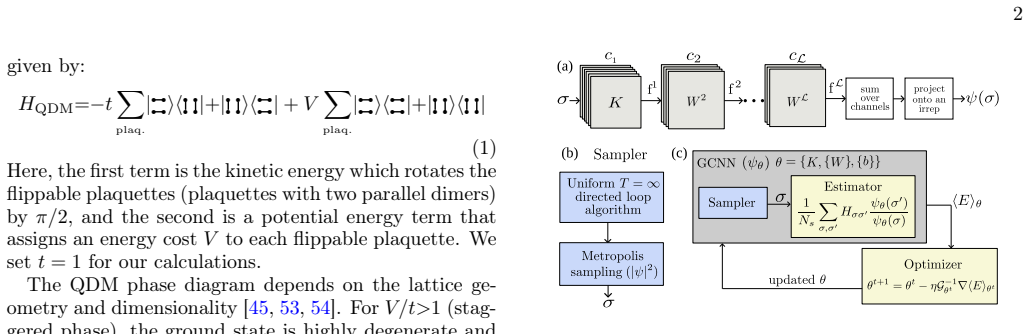
The p4m-symmetric GCNN ansatz, optimized separately within each irreducible representation of the space group by minimizing the variational energy estimated via directed-loop sampling.
If this is right
- The method achieves excellent agreement with exact diagonalization and quantum Monte Carlo for energies, order parameters, and correlation functions on lattices from 8 to 32.
- Gap scaling indicates four degenerate ground states for V ≤ 0.4.
- The possible regime for mixed or plaquette phases is narrowed to 0.4 < V < 1.
- GCNNs serve as a powerful tool for mapping ground state phase diagrams of quantum lattice models.
- Ideas are presented for combining GCNN ansatzes with projection Monte Carlo methods for further improvements.
Where Pith is reading between the lines
- Similar symmetry-adapted neural network approaches could resolve phase boundaries in other frustrated spin or dimer models where exact methods fail at large sizes.
- The ability to target specific irreps might help identify topological order or anyonic excitations in related quantum spin liquid candidates.
- Extending this to three dimensions or other lattice geometries would test whether the degeneracy pattern persists beyond the square lattice.
- Projection Monte Carlo on top of these ansatzes could yield even more accurate estimates of gaps and correlation lengths.
Load-bearing premise
The GCNN ansatz, when optimized inside each irrep by energy minimization, accurately represents the true lowest eigenstate or a close enough proxy for reliable finite-size gap scaling.
What would settle it
Exact diagonalization or more accurate quantum Monte Carlo calculations on L=16 or larger systems showing that the gap to the first excited state in the relevant sectors does not close or scale differently than predicted for V=0.4.
Figures


read the original abstract
We obtain the $\rm{p4m}$-symmetric Group Convolutional Neural Network (GCNN) representations of the lowest energy eigenstate of the quantum dimer model on $L{\times} L$ square-lattice in each of the ${(L^2+18L+72)}/{8}$ irreducible representations (irreps) of the lattice space group and use these to investigate the competition between columnar, plaquette and mixed phases. The networks are optimized within each irrep by minimizing the energy, which is estimated from samples obtained via a directed loop sampler. In extensive benchmarks, we show excellent agreement in energy estimates, order parameters and correlation functions with exact diagonalization or quantum Monte Carlo in systems of sizes $8\leq L\leq 32$. Analysis of the scaling of the gaps in different representation sectors with systems of sizes up to $L=32$ suggest a $4$-fold degenerate ground state for $V\leq 0.4$ narrowing the regime of possible mixed/plaquette phases to $0.4 < V< 1$. Our results show that GCNN is a powerful tool to investigate ground state phase diagrams. We also present ideas for significant further improvements via projection Monte Carlo methods assisted by the GCNN ansatzes.
Editorial analysis
A structured set of objections, weighed in public.
Referee Report
Summary. The manuscript introduces p4m-symmetric Group Convolutional Neural Network (GCNN) ansatzes to represent the lowest-energy eigenstates of the quantum dimer model on L×L square lattices in each of the (L²+18L+72)/8 irreducible representations of the space group. Networks are optimized within each irrep via energy minimization, with energies estimated from a directed-loop sampler. Extensive benchmarks demonstrate good agreement with exact diagonalization and quantum Monte Carlo for energies, order parameters, and correlations on systems with 8≤L≤32. Finite-size scaling of gaps between irrep sectors up to L=32 is used to argue for a 4-fold degenerate ground state when V≤0.4, narrowing the possible mixed/plaquette phase regime to 0.4<V<1. Ideas for projection Monte Carlo improvements are outlined.
Significance. If the variational states remain faithful proxies for the true lowest eigenstates at larger sizes, the work would refine the quantum dimer model phase diagram by extending the columnar regime and constraining the parameter window for plaquette or mixed order. It demonstrates the utility of group-equivariant neural-network variational methods for accessing symmetry-resolved low-energy spectra in models with sign-problem-free but still challenging Hilbert spaces. A notable strength is the systematic, multi-observable benchmarking against independent ED and QMC data across the full range of system sizes studied, which lends concrete support to the ansatz for the reported sizes.
major comments (1)
- [Gap scaling analysis and phase-boundary discussion] The claim of a 4-fold degenerate ground state for V≤0.4 (and the consequent narrowing of the mixed/plaquette regime) is load-bearing on the gap-scaling analysis. The manuscript states that GCNN states are obtained by energy minimization within each irrep using the directed-loop sampler, yet no convergence thresholds, variance estimates on the sampled energies, or diagnostics for local minima in the irrep-specific optimizations are reported for L=32. Without these, small systematic biases in the larger-system energies could alter the apparent gap ordering and the extrapolated degeneracy pattern.
minor comments (2)
- [Introduction / Methods] The formula for the number of p4m irreps, (L²+18L+72)/8, is stated without a short derivation or reference to the character table; adding this would improve accessibility for readers unfamiliar with the group.
- [Conclusions] The final paragraph outlines ideas for projection Monte Carlo assisted by GCNN ansatzes but provides neither algorithmic details nor any preliminary numerical tests; a brief sketch or one illustrative result would strengthen the forward-looking claim.
Simulated Author's Rebuttal
We thank the referee for their careful reading of the manuscript and for the constructive feedback on the gap-scaling analysis. We address the major comment in detail below and will incorporate additional diagnostics in the revised version to strengthen the presentation of the L=32 results.
read point-by-point responses
-
Referee: The claim of a 4-fold degenerate ground state for V≤0.4 (and the consequent narrowing of the mixed/plaquette regime) is load-bearing on the gap-scaling analysis. The manuscript states that GCNN states are obtained by energy minimization within each irrep using the directed-loop sampler, yet no convergence thresholds, variance estimates on the sampled energies, or diagnostics for local minima in the irrep-specific optimizations are reported for L=32. Without these, small systematic biases in the larger-system energies could alter the apparent gap ordering and the extrapolated degeneracy pattern.
Authors: We agree that explicit reporting of these optimization diagnostics for the largest systems is valuable for readers to assess the robustness of the gap ordering. In the revised manuscript we will add a dedicated subsection (or appendix) detailing the following: (i) the convergence criterion used during energy minimization (relative energy change below 5×10^{-6} sustained over 2000 directed-loop sweeps), (ii) the statistical variance of the sampled energies at L=32 obtained from the directed-loop estimator (typically < 0.001 per dimer for the ground-state sectors), and (iii) results from at least three independent random initializations per irrep, confirming that the lowest energies are reproducible to within the reported variance and that no lower-lying local minima were encountered. These additions directly address the possibility of systematic bias and will be cross-referenced to the existing benchmarks against ED and QMC, which already show consistent ordering for smaller sizes where exact data are available. We believe this will solidify the support for the extrapolated 4-fold degeneracy at V≤0.4. revision: yes
Circularity Check
No circularity: GCNN energies and gap scaling are independent variational outputs
full rationale
The paper optimizes a GCNN ansatz separately in each p4m irrep by minimizing variational energy estimated via an external directed-loop sampler. Resulting energies and order parameters are benchmarked against independent ED/QMC data for 8≤L≤32; the central claim of 4-fold degeneracy for V≤0.4 follows from direct finite-size scaling analysis of the computed gaps between irreps. No load-bearing step reduces to a self-definition, a fitted parameter renamed as prediction, or a self-citation chain; the derivation remains self-contained against external numerical benchmarks.
Axiom & Free-Parameter Ledger
free parameters (1)
- V
axioms (2)
- domain assumption The quantum dimer model on the square lattice with nearest-neighbor resonance and V-term interactions is the correct microscopic Hamiltonian for the system under study.
- domain assumption The directed-loop algorithm generates samples whose expectation values converge to the true variational energy of the GCNN ansatz.
Lean theorems connected to this paper
-
IndisputableMonolith/Foundation/AlexanderDuality.leanalexander_duality_circle_linking unclear?
unclearRelation between the paper passage and the cited Recognition theorem.
Analysis of the scaling of the gaps in different representation sectors with systems of sizes up to L=32 suggest a 4-fold degenerate ground state for V≤0.4
What do these tags mean?
- matches
- The paper's claim is directly supported by a theorem in the formal canon.
- supports
- The theorem supports part of the paper's argument, but the paper may add assumptions or extra steps.
- extends
- The paper goes beyond the formal theorem; the theorem is a base layer rather than the whole result.
- uses
- The paper appears to rely on the theorem as machinery.
- contradicts
- The paper's claim conflicts with a theorem or certificate in the canon.
- unclear
- Pith found a possible connection, but the passage is too broad, indirect, or ambiguous to say the theorem truly supports the claim.
Reference graph
Works this paper leans on
-
[1]
S. R. White, Density matrix formulation for quantum renormalization groups, Physical Review Letters69, 2863 (1992)
work page 1992
-
[2]
A. W. Sandvik, Computational Studies of Quantum Spin Systems, AIP Conference Proceedings1297, 135 (2010)
work page 2010
-
[3]
Aaronson, Shadow Tomography of Quantum States, SIAM Journal on Computing49, STOC18 (2020)
S. Aaronson, Shadow Tomography of Quantum States, SIAM Journal on Computing49, STOC18 (2020)
work page 2020
-
[4]
E. Y. Loh, J. E. Gubernatis, R. T. Scalettar, S. R. White, D. J. Scalapino, and R. L. Sugar, Sign problem in the numerical simulation of many-electron systems, Physical Review B41, 9301 (1990)
work page 1990
-
[5]
P. Henelius and A. W. Sandvik, Sign problem in Monte Carlo simulations of frustrated quantum spin systems, Physical Review B62, 1102 (2000)
work page 2000
- [6]
-
[7]
L. Tagliacozzo, G. Evenbly, and G. Vidal, Simulation of two-dimensional quantum systems using a tree ten- sor network that exploits the entropic area law, Physical Review B80, 235127 (2009)
work page 2009
-
[8]
G. Carleo and M. Troyer, Solving the quantum many- body problem with artificial neural networks, Science 355, 602 (2017)
work page 2017
-
[9]
X. Gao and L.-M. Duan, Efficient representation of quan- tummany-bodystateswithdeepneuralnetworks,Nature Communications8, 662 (2017)
work page 2017
- [10]
- [11]
-
[12]
Y. Nomura, Helping restricted Boltzmann machines with quantum-state representation by restoring symmetry, JournalofPhysics: CondensedMatter33,174003(2021)
work page 2021
-
[13]
D.-L. Deng, X. Li, and S. Das Sarma, Quantum Entan- glement in Neural Network States, Physical Review X7, 021021 (2017)
work page 2017
- [14]
- [15]
-
[16]
Y. Huang and J. E. Moore, Neural Network Representa- tion of Tensor Network and Chiral States, Physical Re- view Letters127, 170601 (2021)
work page 2021
-
[17]
D. Wu, R. Rossi, F. Vicentini, and G. Carleo, From tensor-network quantum states to tensorial recurrent neural networks, Physical Review Research5, L032001 (2023)
work page 2023
-
[18]
L. L. Viteritti, F. Ferrari, and F. Becca, Accuracy of restricted Boltzmann machines for the one-dimensional J1−J2 Heisenbergmodel,SciPostPhysics12,166(2022)
work page 2022
-
[19]
M. Machaczek, L. Pollet, and K. Liu, Neural quantum state study of fracton models, SciPost Physics18, 112 (2025)
work page 2025
-
[20]
T. Vieijra, C. Casert, J. Nys, W. De Neve, J. Haegeman, J. Ryckebusch, and F. Verstraete, Restricted Boltzmann Machines for Quantum States with Non-Abelian or Any- onic Symmetries, Physical Review Letters124, 097201 (2020)
work page 2020
- [21]
-
[22]
Y. Teng, D. D. Dai, and L. Fu, Solving the fractional quantum Hall problem with self-attention neural net- work, Physical Review B111, 205117 (2025)
work page 2025
- [23]
- [24]
-
[25]
A. Chen, Z.-Q. Wan, A. Sengupta, A. Georges, and 6 C. Roth, Neural network-augmented pfaffian wave- functions for scalable simulations of interacting fermions (2025), arXiv:2507.10705 [cond-mat.str-el]
- [26]
-
[27]
K. Nazaryan, F. Gaggioli, Y. Teng, and L. Fu, Artificial intelligence for quantum matter: Finding a needle in a haystack (2026), arXiv:2507.13322 [cond-mat.str-el]
-
[28]
Y. Qian, T. Zhao, J. Zhang, T.Xiang, X.Li, and J.Chen, Describing Landau Level Mixing in Fractional Quantum Hall States with Deep Learning, Physical Review Letters 134, 176503 (2025)
work page 2025
-
[29]
Y. Fan and G.-W. Chern, Equivariant neural net- works for force-field models of lattice systems (2026), arXiv:2601.04104 [cond-mat.str-el]
- [30]
-
[31]
L.L.Viteritti, R.Rende,andF.Becca,TransformerVari- ational Wave Functions for Frustrated Quantum Spin Systems, Physical Review Letters130, 236401 (2023)
work page 2023
- [32]
-
[33]
An exact mapping between the Variational Renormalization Group and Deep Learning
P. Mehta and D. J. Schwab, An exact mapping between the variational renormalization group and deep learning (2014), arXiv:1410.3831 [stat.ML]
work page internal anchor Pith review Pith/arXiv arXiv 2014
-
[34]
K. Choo, T. Neupert, and G. Carleo, Two-dimensional frustrated J 1 – J 2 model studied with neural network quantum states, Physical Review B100, 125124 (2019)
work page 2019
-
[35]
X. Liang, W.-Y. Liu, P.-Z. Lin, G.-C. Guo, Y.-S. Zhang, and L. He, Solving frustrated quantum many-particle models with convolutional neural networks, Physical Re- view B98, 104426 (2018)
work page 2018
-
[36]
T. Cohen and M. Welling, Group equivariant convolutional networks, in International conference on machine learning (PMLR,
-
[37]
C. Roth and A. H. MacDonald, Group convolutional neu- ral networks improve quantum state accuracy (2021), arXiv:2104.05085 [quant-ph]
-
[38]
C. Roth, A. Szabó, and A. H. MacDonald, High-accuracy variational Monte Carlo for frustrated magnets with deep neural networks, Physical Review B108, 054410 (2023)
work page 2023
- [39]
-
[40]
K. Choo, G. Carleo, N. Regnault, and T. Neupert, Sym- metries and many-body excitations with neural-network quantum states, Phys. Rev. Lett.121, 167204 (2018)
work page 2018
-
[41]
O. F. Syljuåsen, Plaquette phase of the square-lattice quantum dimer model: Quantum Monte Carlo calcula- tions, Physical Review B73, 245105 (2006)
work page 2006
-
[42]
D. S. Rokhsar and S. A. Kivelson, Superconductivity and the Quantum Hard-Core Dimer Gas, Physical Review Letters61, 2376 (1988)
work page 1988
-
[43]
R. Moessner and S. L. Sondhi, Resonating Valence Bond Phase in the Triangular Lattice Quantum Dimer Model, Physical Review Letters86, 1881 (2001)
work page 2001
-
[44]
B. Sutherland, Systems with resonating-valence-bond ground states: Correlations and excitations, Physical Re- view B37, 3786 (1988)
work page 1988
-
[45]
R. Moessner and K. S. Raman, Quantum dimer models (2008), arXiv:0809.3051 [cond-mat.str-el]
work page internal anchor Pith review Pith/arXiv arXiv 2008
-
[46]
N. Allegra, Exact solution of the 2d dimer model: Cor- ner free energy, correlation functions and combinatorics, Nuclear Physics B894, 685 (2015)
work page 2015
-
[47]
R. Kenyon and R. Pemantle, Double-dimers, the Ising model and the hexahedron recurrence, Journal of Com- binatorial Theory, Series A137, 27 (2016)
work page 2016
-
[48]
Jenne, Combinatorics of the double-dimer model, Ad- vances in Mathematics392, 107952 (2021)
H. Jenne, Combinatorics of the double-dimer model, Ad- vances in Mathematics392, 107952 (2021)
work page 2021
-
[49]
R. Kenyon, Lectures on dimers (2009), arXiv:0910.3129 [math.PR]
work page internal anchor Pith review Pith/arXiv arXiv 2009
-
[50]
P. W. Kasteleyn, The statistics of dimers on a lattice: I. The number of dimer arrangements on a quadratic lat- tice, Physica27, 1209 (1961)
work page 1961
-
[51]
R. Moessner, S. L. Sondhi, and E. Fradkin, Short-ranged resonating valence bond physics, quantum dimer models, and Ising gauge theories, Physical Review B65, 024504 (2001)
work page 2001
-
[52]
B. Nienhuis, H. J. Hilhorst, and H. W. J. Blote, Trian- gular SOS models and cubic-crystal shapes, Journal of Physics A: Mathematical and General17, 3559 (1984)
work page 1984
-
[53]
B. Dabholkar, G. J. Sreejith, and F. Alet, Reentrance effect in the high-temperature critical phase of the quan- tum dimer model on the square lattice, Physical Review B106, 205121 (2022)
work page 2022
-
[54]
Z. Yan, Y. Wu, C. Liu, O. F. Syljuåsen, J. Lou, and Y. Chen, Sweeping cluster algorithm for quantum spin systems with strong geometric restrictions, Physical Re- view B99, 165135 (2019)
work page 2019
-
[55]
O. F. Syljuåsen, Continuous-time diffusion Monte Carlo method applied to the quantum dimer model, Physical Review B71, 020401 (2005)
work page 2005
- [56]
-
[57]
D. Banerjee, M. Bögli, C. P. Hofmann, F.-J. Jiang, P. Widmer, and U.-J. Wiese, Interfaces, strings, and a soft mode in the square lattice quantum dimer model, Physical Review B90, 245143 (2014)
work page 2014
-
[58]
D. Banerjee, M. Bögli, C. P. Hofmann, F.-J. Jiang, P. Widmer, and U.-J. Wiese, Finite-volume energy spec- trum, fractionalized strings, and low-energy effective field theory for the quantum dimer model on the square lat- tice, Physical Review B94, 115120 (2016)
work page 2016
-
[59]
Z. Yan, Z. Zhou, O. F. Syljuåsen, J. Zhang, T. Yuan, J. Lou, and Y. Chen, Widely existing mixed phase struc- ture of the quantum dimer model on a square lattice, Physical Review B103, 094421 (2021)
work page 2021
-
[60]
S. d’Ascoli, L. Sagun, J. Bruna, and G. Biroli, Finding the needle in the haystack with convolutions: on the benefits of architectural bias (2020), arXiv:1906.06766 [cs.LG]
-
[61]
G. Klambauer, T. Unterthiner, A. Mayr, and S. Hochreiter, Self-Normalizing Neural Networks, in Advances in Neural Information Processing Systems, Vol. 30 (Curran Associates, Inc., 2017)
work page 2017
-
[62]
G. Carleo, K. Choo, D. Hofmann, J. E. Smith, T. West- erhout, F. Alet, E. J. Davis, S. Efthymiou, I. Glasser, 7 S.-H. Lin, M. Mauri, G. Mazzola, C. B. Mendl, E. Van Nieuwenburg, O. O’Reilly, H. Théveniaut, G.Tor- lai, F. Vicentini, and A. Wietek, NetKet: A machine learning toolkit for many-body quantum systems, Soft- wareX10, 100311 (2019)
work page 2019
-
[63]
F. Vicentini, D. Hofmann, A. Szabó, D. Wu, C. Roth, C. Giuliani, G. Pescia, J. Nys, V. Vargas-Calderón, N. Astrakhantsev, and G. Carleo, NetKet 3: Machine LearningToolboxforMany-BodyQuantumSystems,Sci- Post Physics Codebases , 7 (2022). 1 Appendix A: p4m irreps and characters via induction from the little groups In this section, we will consider the actio...
work page 2022
-
[64]
There are(L−2)(L−4)/8such momenta moduloD4
Generic momentak= (k x, ky)withk x, ky ̸∈ {0, π}. There are(L−2)(L−4)/8such momenta moduloD4. D4 acts freely on suchkvalues, generating an orbit of size 8. The little group is trivial and thep4mirrep is 8-dimensional, spanned by{Φβ(k) , β∈D 4}. The characters are given by χ(a,α) = ( 0α̸=eP β∈D4 e−iβ(k)·a α=e (A1)
-
[65]
There are(L−2)/2such momenta modD 4
Points on the high-symmetry coordinate lines{(±k,0),(0,±k)}wherek̸={0, π}. There are(L−2)/2such momenta modD 4. The little groupGL⊂D4 of(k,0)and(0, k)are⟨m x⟩and⟨m y⟩respectively. There are two four-dimensional irrepsA ± ofp4m(±associated with the eigenvalues of theG L generators) spanned by {Ψgσ g(k,0) ±Ψ gmxσ g(k,0) whereg∈D 4/⟨mx⟩}(A2) where action of ...
-
[66]
There areL−2such momenta modulo D4
High-symmetry diagonal lines{(±k,±k),(±k,∓k)}wherek̸={0, π}. There areL−2such momenta modulo D4. The little groupsG L ⊂D 4 of(k, k)and(k,−k)are⟨m diag⟩and⟨m antidiag⟩respectively. There are two four-dimensional irrepsA ± (determined by the eigenvalue of the little group generator) spanned by {Ψgσ g(k,k) ±Ψ gmdiagσ g(k,k) whereg∈D 4/⟨mdiag⟩}(A4) 2 The char...
-
[67]
The little group is now the fullD 4 group
High-symmmetry pointk= (0,0). The little group is now the fullD 4 group. Translation acts trivially on the basis statesΦ σ (0,0).D 4 acts as a permutation of the eight states {Φgσ (0,0) whereg∈D 4}. The irreps ofp4marise directly from irreps ofD 4 (four 1D irreps and one 2D irrep). The characters are given by χ(a,α) =χ D4 α (A6) whereχ D4 α is the charact...
-
[68]
High-symmetry pointk= (π, π). Translations act as sublattice parity measurements, in other words, (a, e)Φσ (π,π) = (−1) ax+ayΦσ (π,π). Note that in our convention, where the origin(0,0)about which theD 4 ele- ments act is a lattice point (not a plaquette center),D4 elements do not change the sublattice parity. Therefore (a, α)Φσ (π,π) = (−1)ax+ay Φασ (π,π...
-
[69]
There is only one such momentum moduloD4
High-symmetry pointsk={(π,0),(0, π)}. There is only one such momentum moduloD4. The little group now is the order4groupG L=D2=⟨mx, my⟩={e, m x, my, mxmy=r2}. There are4distinct irreps ofp4m. All are 2D irreps. They are labeled by the eigenvaluessx, sy =±1of the generatorsm x, my. The 4-dimensional irrep spaces for givensx, sy are spanned by n Φgσ g(π,0) +...
-
[70]
There are(L−2)/2such momenta moduloD 4
Coordinate axes{(π,±k),(π,±k)}. There are(L−2)/2such momenta moduloD 4. The irreps are analogous to the coordinate axes case.D4 orbit is4dimensional and the little groups at(π,±k)and(π,±k)are⟨m y⟩and ⟨mx⟩. 3 Appendix B: Ordered states and symmetries Columnar ordered states: The set of the four columnar-ordered states forms the following irreps A1, k= (0,0...
discussion (0)
Sign in with ORCID, Apple, or X to comment. Anyone can read and Pith papers without signing in.