REVIEW 4 major objections 6 minor 52 references
LoRAShop: Training-Free Multi-Concept Image Generation and Editing with Rectified Flow Transformers
T0 review · 4 major / 6 minor · reviewed 2026-08-07 · deepseek-v4-flash
Pith's one-line read LoRAShop lets multiple LoRA models edit one image without any training.
desk verdict A genuinely useful training-free LoRA-composition trick, clearly presented and well tested for identity LoRAs — but the 'styles' promise is unsupported by the evidence. read the letter →
The pith
A machine-rendered reading of the paper's core claim, the machinery that carries it, and where it could break.
The reading
What carries the argument
The central object is the subject prior: a binary, non-overlapping mask per concept extracted from the softmax cross-attention map $\mathbf{M}_{c'}$ of the last double-stream block (Block 19) of FLUX.1-dev, after iterative Gaussian blurring, thresholding at the $\tau$ posterior quantile, and one-hot resolution of overlaps via $\arg\max$ over smoothed maps. The second half of the machinery is prior-guided residual blending: at every transformer block, for every image token $p$, the residual feature fed to the skip connection is replaced by $\sum_k \alpha_{c'}(p)\,F^{(k)}_{\ell,r}(p)$, where $\alpha$ is the normalized mask weight, so each LoRA adapter's features appear only where its subject is claimed, while prompt tokens and background tokens keep the frozen backbone's residuals.
What would settle it
Run LoRAShop with a LoRA for a concept that FLUX is known to localize poorly (for example a rare object in an unusual viewpoint or a concept underrepresented in pretraining) and inspect Block 19's attention map: if the extracted mask does not overlap the region where the generated concept actually appears, or if two masks assigned to distinct subjects converge on the same region so that the arg-max partition carves one subject's area from another, the identity-preservation claim fails on that input. A quantitative version would compare identity-similarity scores across a set of well-localized versus deliberately poorly-localized concepts and check whether the gap is systematic.
Extended reading notes
Core claim
The paper's central claim is that the 'LoRA crosstalk' problem—independent adapters corrupting or absorbing each other when applied together—can be solved entirely at inference time by spatial gating. In a short pseudodenoising run the method reads the cross-attention map of the last double-stream block (Block 19) for each subject token, blurs and binarizes it into a subject prior, and resolves overlaps by assigning every latent position to the subject with the strongest response, yielding a partition of the canvas. During actual generation or editing, the frozen backbone runs normally, but at each transformer block the residual features produced by each LoRA are blended, per token, according to that partition, with the base model's residual kept wherever no subject is claimed. Because the intervention is local and linear, the global denoising trajectory and hence scene layout stay intact, and the same mechanism extends to real images via inversion. The authors report that this achieves higher identity-similarity scores than DreamBooth, IP-Adapter, InfiniteYou, OmniGen, UNO, MS-Diffusion, MIP-Adapter, OMG, and ReFace on single- and multi-subject generation and face-swap benchmarks, while keeping prompt alignment and visual quality competitive.
Load-bearing premise
Everything depends on the assumption that cross-attention maps from the last double-stream block of FLUX reliably mark where each concept will appear in the image; if a map is wrong, the mask is wrong and the edit fails, and the authors themselves note that masks can mislocate or underrepresent concepts underrepresented in pretraining data.
Editorial extensions
If this is right
- Off-the-shelf community LoRAs of different ranks, trigger words, and fine-tuned parameter sets can be composed in one denoising pass without any training step, since only output-space residual features are mixed.
- Multi-concept editing of real photographs becomes possible with the same machinery used for generation, by inverting the image with RF-Solver and then applying masked residual blending along the reverse path.
- The number of concepts that can be composed is not limited by memory that would be needed to jointly fine-tune adapters; concepts can be applied sequentially, one mask at a time.
- Because adaptation operates on the full representation space, non-human concepts such as objects, clothing, and styles can compose with human identities in a single edit.
Reading between the lines
- A stress test the paper does not run would isolate failure cases: using LoRAs for concepts that FLUX localizes poorly (unusual views, atypical poses, small objects, or out-of-distribution subjects) and checking whether the extracted mask still overlaps where the concept actually appears.
- The mask's dependence on how the concept is named in the prompt suggests a systematic study of token selection could make the method more robust, since a poorly chosen token would shift the attention map and the derived prior.
- Because priors are extracted in one forward pass and reused across all blocks, the computational overhead should stay nearly constant as more adapters are added, matching the paper's reported ~50 seconds for two concepts versus ~30 seconds for the base model.
Editorial analysis
A structured set of objections, weighed in public.
Referee Report
Summary. The paper proposes LoRAShop, a training-free method for multi-concept image generation and editing with FLUX.1-dev. The method has two stages: (i) subject-prior extraction, which computes cross-attention maps for the concept token in the last double-stream transformer block (Block 19), smooths them with a Gaussian, thresholds to obtain a connected mask, and resolves overlaps by an argmax over concepts (Sec. 3.2); and (ii) prior-guided residual blending, in which the residual feature tensors of each LoRA adapter are mixed linearly at image-token positions claimed by the subject masks, while prompt tokens and background tokens keep the backbone residuals (Sec. 3.3). The same mechanism is applied to editing by using RF-Solver inversion (Sec. 3.4). Experiments cover single-subject generation, multi-subject generation, and face swapping, with quantitative metrics (ArcFace ID similarity, CLIP, HPS, aesthetics, DINO, LPIPS) and a 50-participant user study, all on human-identity LoRAs plus a small set of object LoRAs shown qualitatively. The paper claims better identity preservation than DreamBooth, IP-Adapter, InfiniteYou, OmniGen, UNO, MS-Diffusion, MIP-Adapter, OMG, and ReFace.
Significance. If the method's scope were confirmed, LoRAShop would be a practically valuable contribution: it is training-free, requires no external segmenters or pose inputs, composes existing community LoRAs at inference time, and is evaluated with externally defined identity, alignment, and quality metrics (ArcFace, CLIP, HPS, aesthetics, DINO, LPIPS) plus a user study. The paper also reports ablations over transformer blocks and editing hyperparameters and openly records limitations. However, the validation domain is much narrower than the described scope: the quantitative evidence is essentially limited to human-face identities, and the central localization assumption is tested only on those identities and a handful of objects. As presented, the significance is demonstrated for identity/subject LoRAs of a particular type rather than for the advertised general class of off-the-shelf LoRAs, including styles.
major comments (4)
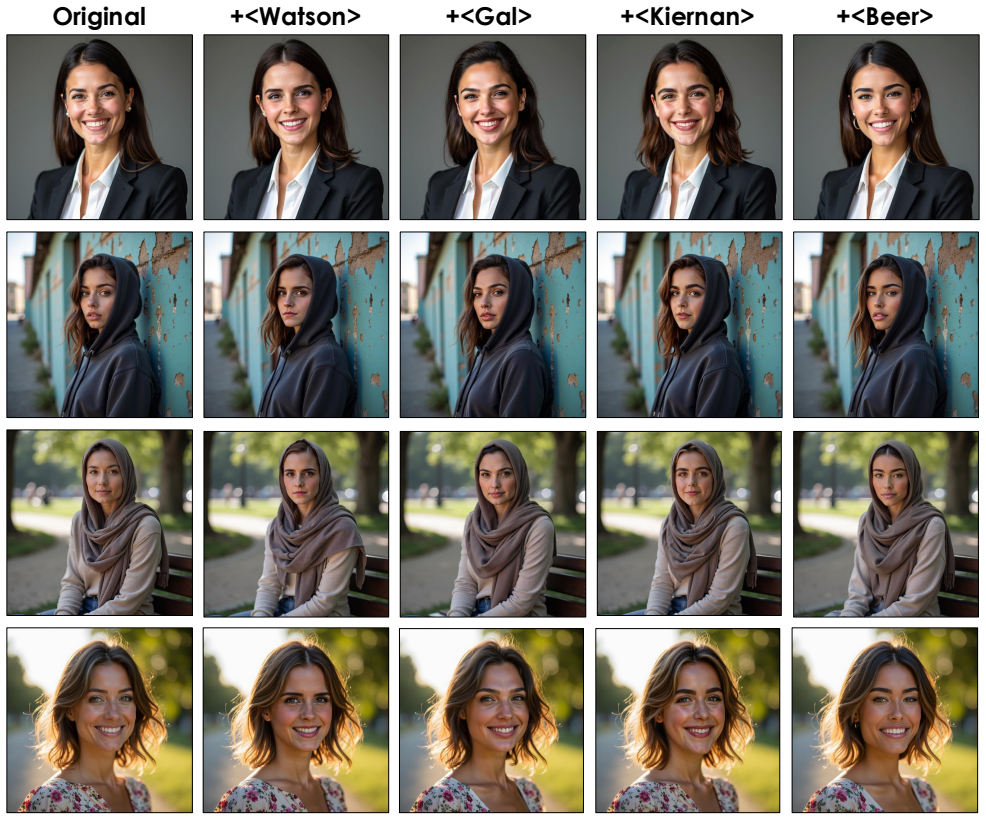
- [Sec. 3.2-3.3, Limitations] The central mechanism — extracting subject priors from Block-19 cross-attention and using them to gate all residual blending — is load-bearing for every claim in the paper, but the paper only demonstrates that this localization works for human-identity LoRAs and a few object LoRAs with standard viewpoints. The abstract and conclusion explicitly mention 'subjects or styles', yet no style LoRA is tested anywhere; a style LoRA such as 'watercolor' would be expected to have diffuse or non-spatially-localized cross-attention, so the thresholding and connected-component procedure in Sec. 3.2 would produce either an arbitrary blob or a near-full-canvas mask. The Limitations section itself concedes that masks 'can sometimes mislocate or underrepresent certain regions, particularly for concepts underrepresented in the model's pretraining data.' Because a wrong mask propagates to every blended residual, this gap directly undermines the advertised general multi-concept claim. I ask for either (a) a quantitative and qualitative evaluation on style LoRAs and unusual object viewpoints, including a mask-quality analysis (e.g., intersection over union against a reference segmentation, or success-rate statistics), or (b) a deliberate and explicit narrowing of the paper's claims to localized subject/identity LoRAs.
- [Sec. 4.2, Tables 1-4] The quantitative evaluation is restricted to human identities: the single-subject benchmark uses 15 identity LoRAs, the multi-subject benchmark uses pairs drawn from those same identities, and the face-swapping benchmark uses identity LoRAs. The non-human adapters listed in Table 7 appear only in qualitative figures (e.g., Fig. 12). Consequently, the reported ID similarity numbers cannot establish disentanglement of different object types or of a subject with a style. The paper should either add quantitative multi-class benchmarks (object+object, subject+object, subject+style) or explicitly restrict the claimed scope to identity/person LoRAs.
- [Appendix C, Fig. 7 and Fig. 15] The comparison against the most directly relevant LoRA-composition baselines (Mix-of-Show, LoRACLR, Orthogonal Adaptation, Prompt+) is only qualitative, and the supplementary text states that no quantitative comparison was possible because public implementations are unavailable. Given that the paper's headline is 'better identity preservation compared to baselines' and that the LoRA-composition setting is exactly where the cross-talk claim lives, the absence of any quantitative evidence for this subset leaves the comparative claim unsupported for those methods. At minimum, the comparative claims should be scoped to the methods that were actually quantified (DreamBooth, IP-Adapter, InfiniteYou, OmniGen, UNO, MS-Diffusion, MIP-Adapter, OMG, ReFace).
- [Table 4] The face-swapping section states that LoRAShop 'achieves competitive performance in terms of input preservation' and the table caption says 'on-par', but the raw numbers show the opposite direction on all three preservation metrics: DINO 0.970 vs. 0.982, CLIP-I 0.926 vs. 0.940, and LPIPS 0.050 vs. 0.031 (lower is better for LPIPS). Without significance tests, the honest statement is that LoRAShop improves identity at a measurable cost in input preservation; the current wording overstates the trade-off and should be corrected.
minor comments (6)
- [Sec. 3.2, Eq. (2)] The notation \tilde{M}_u is used in Eq. (2) before it is defined; please state explicitly that it denotes the smoothed and renormalized soft mask obtained from the iterative Gaussian procedure described in the text.
- [Sec. 3.3, Eq. (4)] The weight \alpha_{c'}(p) is written as a function of the subject c', but the formula uses \hat{M}_k(p) with an index k; please clarify the mapping between the concept label c' and the adapter index k in the notation.
- [Sec. 3.3] The sentence 'Blending is disabled during the first until timestep t' is grammatically incomplete; it should read 'during the first phase, until timestep t'.
- [Sec. 4.3, Fig. 4] Fig. 4 labels blocks as 'Block 20' and 'Block 58', but the text describes double-stream blocks 0-19 and then single-stream blocks; please harmonize the figure axis labels with the textual description of block numbering.
- [Appendix F, Tables 5-7] The captions for Tables 5, 6, and 7 all say 'Image-and-text comparison table', which does not describe the content; these tables list the LoRA adapters and their sources, and the captions should say so.
- [Fig. 12] The caption for Fig. 12 reads 'a man/woman and a cat', which is ambiguous about whether the concept set includes a man, a woman, and a cat; please make the caption consistent with the actual adapter set used in that figure.
Circularity Check
No significant circularity: the subject masks are inference-time attention maps, the residual blending is a feature-space intervention, and the reported metrics are external.
full rationale
LoRAShop's derivation chain is not circular. The subject priors (Sec. 3.2, Eq. 1) are extracted from the frozen FLUX backbone's cross-attention maps at inference time; they are not fitted to the evaluation identities or to the benchmark prompts. The blending rule (Sec. 3.3, Eqs. 4 and 5) is a linear feature-space intervention: each LoRA adapter's residual is applied only at token positions selected by the masks, while background tokens keep the backbone residuals. Nothing in Eqs. 1-5 assumes the identity-similarity or prompt-alignment scores reported later; those scores are computed with external models (ArcFace, CLIP, HPS, aesthetics, DINO, LPIPS) and a human user study. The central empirical premise that Block 19 cross-attention localizes subjects is supported in-paper by the block ablation in Fig. 4, so the same-group citations [5, 11] are not load-bearing. The limitations statement that masks 'can sometimes mislocate or underrepresent certain regions' is a scope and correctness caveat, not evidence that a fitted parameter was renamed a prediction. No step in the paper makes its output equal to its input by construction, and the method is evaluated against external benchmarks and user judgments rather than against the values used to construct the masks or set the hyperparameters.
Assumptions & free parameters
free parameters (4)
- editing timestep t =
0.90
- subject prior extraction step gamma =
0.94
- posterior threshold tau =
0.7
- Gaussian kernel size and variance (k, sigma) =
3x3
assumptions (3)
- domain assumption Cross-attention maps from the last double-stream block of FLUX.1-dev localize concepts spatially early in denoising.
- domain assumption LoRA adapters can be run in parallel and their residual outputs can be linearly blended in feature space without breaking the denoising trajectory.
- domain assumption The pixel-to-token correspondence is such that attention-mask boundaries in latent space are semantically meaningful for editing, and the learned masks are appropriate for the given prompts.
invented entities (1)
-
Subject prior mask M_c'
Cite this review
Pith. "Pith review of LoRAShop: Training-Free Multi-Concept Image Generation and Editing with Rectified Flow Transformers." pith.science (2026). https://pith.science/paper/5OXVYGBA
@misc{pith2026250523758,
  author       = {Pith},
  title        = {Pith review of: LoRAShop: Training-Free Multi-Concept Image Generation and Editing with Rectified Flow Transformers},
  year         = {2026},
  howpublished = {\url{https://pith.science/paper/5OXVYGBA}},
  note         = {Machine review of arXiv:2505.23758}
}
read the original abstract
We introduce LoRAShop, the first framework for multi-concept image editing with LoRA models. LoRAShop builds on a key observation about the feature interaction patterns inside Flux-style diffusion transformers: concept-specific transformer features activate spatially coherent regions early in the denoising process. We harness this observation to derive a disentangled latent mask for each concept in a prior forward pass and blend the corresponding LoRA weights only within regions bounding the concepts to be personalized. The resulting edits seamlessly integrate multiple subjects or styles into the original scene while preserving global context, lighting, and fine details. Our experiments demonstrate that LoRAShop delivers better identity preservation compared to baselines. By eliminating retraining and external constraints, LoRAShop turns personalized diffusion models into a practical `photoshop-with-LoRAs' tool and opens new avenues for compositional visual storytelling and rapid creative iteration.
Figures


Figures from the paper (12 more)



Reference graph
Works this paper leans on
-
[1]
Realistic and efficient face swapping: A unified approach with diffusion models
Sanoojan Baliah, Qinliang Lin, Shengcai Liao, Xiaodan Liang, and Muhammad Haris Khan. Realistic and efficient face swapping: A unified approach with diffusion models. In 2025 IEEE/CVF Winter Conference on Applications of Com- puter Vision (WACV), pages 1062–1071. IEEE, 2025. 7, 8, 9
work page 2025
- [2]
-
[3]
Yusuf Dalva and Pinar Yanardag. Noiseclr: A con- trastive learning approach for unsupervised discovery of in- terpretable directions in diffusion models.arXiv preprint arXiv:2312.05390, 2023. 2
work page Pith review arXiv 2023
-
[4]
Yusuf Dalva, Yijun Li, Qing Liu, Nanxuan Zhao, Jianming Zhang, Zhe Lin, and Pinar Yanardag. Layerfusion: Harmo- nized multi-layer text-to-image generation with generative priors.arXiv preprint arXiv:2412.04460, 2024. 2
arXiv 2024
-
[5]
Fluxs- pace: Disentangled semantic editing in rectified flow trans- formers, 2024
Yusuf Dalva, Kavana Venkatesh, and Pinar Yanardag. Fluxs- pace: Disentangled semantic editing in rectified flow trans- formers, 2024. 2, 4 10
work page 2024
-
[6]
Yusuf Dalva, Hidir Yesiltepe, and Pinar Yanardag. Gantastic: Gan-based transfer of interpretable directions for disentan- gled image editing in text-to-image diffusion models.arXiv preprint arXiv:2403.19645, 2024. 2
arXiv 2024
-
[7]
Arcface: Additive angular margin loss for deep face recognition
Jiankang Deng, Jia Guo, Niannan Xue, and Stefanos Zafeiriou. Arcface: Additive angular margin loss for deep face recognition. InCVPR, pages 4690–4699, 2019. 8, 15
work page 2019
-
[8]
Scaling recti- fied flow transformers for high-resolution image synthesis
Patrick Esser, Sumith Kulal, Andreas Blattmann, Rahim Entezari, Jonas M ¨uller, Harry Saini, Yam Levi, Dominik Lorenz, Axel Sauer, Frederic Boesel, et al. Scaling recti- fied flow transformers for high-resolution image synthesis. InForty-first international conference on machine learning,
Show all 52 references
-
[9]
An image is worth one word: Personalizing text-to- image generation using textual inversion.arXiv preprint arXiv:2208.01618, 2022
Rinon Gal, Yuval Alaluf, Yuval Atzmon, Or Patash- nik, Amit H Bermano, Gal Chechik, and Daniel Cohen- Or. An image is worth one word: Personalizing text-to- image generation using textual inversion.arXiv preprint arXiv:2208.01618, 2022. 3
2022 arXiv
-
[10]
Mix-of-show: Decentralized low- rank adaptation for multi-concept customization of diffusion models.arXiv preprint arXiv:2305.18292, 2023
Yuchao Gu, Xintao Wang, Jay Zhangjie Wu, Yujun Shi, Yun- peng Chen, Zihan Fan, Wuyou Xiao, Rui Zhao, Shuning Chang, Weijia Wu, et al. Mix-of-show: Decentralized low- rank adaptation for multi-concept customization of diffusion models.arXiv preprint arXiv:2305.18292, 2023. 2, 3, 13
2023 arXiv
-
[11]
Conceptattention: Diffu- sion transformers learn highly interpretable features.arXiv preprint arXiv:2502.04320, 2025
Alec Helbling, Tuna Han Salih Meral, Ben Hoover, Pinar Yanardag, and Duen Horng Chau. Conceptattention: Diffu- sion transformers learn highly interpretable features.arXiv preprint arXiv:2502.04320, 2025. 4
2025 arXiv
-
[12]
Lora: Low-rank adaptation of large language models.arXiv preprint arXiv:2106.09685, 2021
Edward J Hu, Yelong Shen, Phillip Wallis, Zeyuan Allen- Zhu, Yuanzhi Li, Shean Wang, Lu Wang, and Weizhu Chen. Lora: Low-rank adaptation of large language models.arXiv preprint arXiv:2106.09685, 2021. 2, 3, 4
2021 arXiv
-
[13]
Resolving multi-condition confusion for finetuning-free personalized image generation
Qihan Huang, Siming Fu, Jinlong Liu, Hao Jiang, Yipeng Yu, and Jie Song. Resolving multi-condition confusion for finetuning-free personalized image generation. InProceed- ings of the AAAI Conference on Artificial Intelligence, pages 3707–3714, 2025. 3, 7, 8
2025
-
[14]
Gpt-4o system card
Aaron Hurst, Adam Lerer, Adam P Goucher, Adam Perel- man, Aditya Ramesh, Aidan Clark, AJ Ostrow, Akila Weli- hinda, Alan Hayes, Alec Radford, et al. Gpt-4o system card. arXiv preprint arXiv:2410.21276, 2024. 15
2024 arXiv
-
[15]
Taming encoder for zero fine-tuning image customization with text-to-image diffusion models.arXiv preprint arXiv:2304.02642, 2023
Xuhui Jia, Yang Zhao, Kelvin CK Chan, Yandong Li, Han Zhang, Boqing Gong, Tingbo Hou, Huisheng Wang, and Yu-Chuan Su. Taming encoder for zero fine-tuning image customization with text-to-image diffusion models.arXiv preprint arXiv:2304.02642, 2023. 3
2023 arXiv
-
[16]
InfiniteYou: Flexible photo recrafting while preserving your identity.arXiv preprint, arXiv:2503.16418,
Liming Jiang, Qing Yan, Yumin Jia, Zichuan Liu, Hao Kang, and Xin Lu. InfiniteYou: Flexible photo recrafting while preserving your identity.arXiv preprint, arXiv:2503.16418,
-
[17]
Explain- ing in diffusion: Explaining a classifier through hierarchi- cal semantics with text-to-image diffusion models.arXiv preprint arXiv:2412.18604, 2024
Tahira Kazimi, Ritika Allada, and Pinar Yanardag. Explain- ing in diffusion: Explaining a classifier through hierarchi- cal semantics with text-to-image diffusion models.arXiv preprint arXiv:2412.18604, 2024. 10
2024 arXiv
-
[18]
Omg: Occlusion-friendly personalized multi- concept generation in diffusion models.arXiv preprint arXiv:2403.10983, 2024
Zhe Kong, Yong Zhang, Tianyu Yang, Tao Wang, Kaihao Zhang, Bizhu Wu, Guanying Chen, Wei Liu, and Wen- han Luo. Omg: Occlusion-friendly personalized multi- concept generation in diffusion models.arXiv preprint arXiv:2403.10983, 2024. 3, 8
2024 arXiv
-
[19]
Multi-concept customization of text-to-image diffusion
Nupur Kumari, Bingliang Zhang, Richard Zhang, Eli Shechtman, and Jun-Yan Zhu. Multi-concept customization of text-to-image diffusion. InProceedings of the IEEE/CVF Conference on Computer Vision and Pattern Recognition, pages 1931–1941, 2023. 3
1931
-
[20]
Clora: A contrastive approach to com- pose multiple lora models.arXiv preprint arXiv:2403.19776,
Tuna Han Salih Meral, Enis Simsar, Federico Tombari, and Pinar Yanardag. Clora: A contrastive approach to com- pose multiple lora models.arXiv preprint arXiv:2403.19776,
-
[21]
Conform: Contrast is all you need for high- fidelity text-to-image diffusion models
Tuna Han Salih Meral, Enis Simsar, Federico Tombari, and Pinar Yanardag. Conform: Contrast is all you need for high- fidelity text-to-image diffusion models. InProceedings of the IEEE/CVF Conference on Computer Vision and Pattern Recognition, pages 9005–9014, 2024. 2
2024
-
[22]
Motionflow: Attention-driven mo- tion transfer in video diffusion models.arXiv preprint arXiv:2412.05275, 2024
Tuna Han Salih Meral, Hidir Yesiltepe, Connor Dunlop, and Pinar Yanardag. Motionflow: Attention-driven mo- tion transfer in video diffusion models.arXiv preprint arXiv:2412.05275, 2024. 2
2024 arXiv
-
[23]
Dinov2: Learning robust visual features without supervision
Maxime Oquab, Timoth ´ee Darcet, Th ´eo Moutakanni, Huy V o, Marc Szafraniec, Vasil Khalidov, Pierre Fernandez, Daniel Haziza, Francisco Massa, Alaaeldin El-Nouby, et al. Dinov2: Learning robust visual features without supervision. arXiv preprint arXiv:2304.07193, 2023. 9
2023 arXiv
-
[24]
Orthogonal adaptation for modular customization of diffusion models
Ryan Po, Guandao Yang, Kfir Aberman, and Gordon Wet- zstein. Orthogonal adaptation for modular customization of diffusion models. InProceedings of the IEEE/CVF Con- ference on Computer Vision and Pattern Recognition, pages 7964–7973, 2024. 2, 3, 13
2024
-
[25]
Sdxl: Improving latent diffusion mod- els for high-resolution image synthesis.arXiv preprint arXiv:2307.01952, 2023
Dustin Podell, Zion English, Kyle Lacey, Andreas Blattmann, Tim Dockhorn, Jonas M ¨uller, Joe Penna, and Robin Rombach. Sdxl: Improving latent diffusion mod- els for high-resolution image synthesis.arXiv preprint arXiv:2307.01952, 2023. 7
2023 arXiv
-
[26]
Learning transferable visual models from natural language supervi- sion
Alec Radford, Jong Wook Kim, Chris Hallacy, Aditya Ramesh, Gabriel Goh, Sandhini Agarwal, Girish Sastry, Amanda Askell, Pamela Mishkin, Jack Clark, et al. Learning transferable visual models from natural language supervi- sion. InInternational conference on machine learning, p...
2021
-
[27]
Hierarchical text-conditional image gen- eration with clip latents.arXiv preprint arXiv:2204.06125,
Aditya Ramesh, Prafulla Dhariwal, Alex Nichol, Casey Chu, and Mark Chen. Hierarchical text-conditional image gen- eration with clip latents.arXiv preprint arXiv:2204.06125,
-
[28]
High-resolution image synthesis with latent diffusion models
Robin Rombach, Andreas Blattmann, Dominik Lorenz, Patrick Esser, and Bj ¨orn Ommer. High-resolution image synthesis with latent diffusion models. InProceedings of the IEEE/CVF conference on computer vision and pattern recognition, pages 10684–10695, 2022. 2
2022
-
[29]
Dreambooth: Fine tuning text-to-image diffusion models for subject-driven generation
Nataniel Ruiz, Yuanzhen Li, Varun Jampani, Yael Pritch, Michael Rubinstein, and Kfir Aberman. Dreambooth: Fine tuning text-to-image diffusion models for subject-driven generation. InProceedings of the IEEE/CVF Conference on Computer Vision and Pattern Recognition, pages 22500–...
2023
-
[30]
Hyperdreambooth: Hypernetworks for 11 fast personalization of text-to-image models
Nataniel Ruiz, Yuanzhen Li, Varun Jampani, Wei Wei, Tingbo Hou, Yael Pritch, Neal Wadhwa, Michael Rubinstein, and Kfir Aberman. Hyperdreambooth: Hypernetworks for 11 fast personalization of text-to-image models. InProceedings of the IEEE/CVF Conference on Computer Vision and P...
2024
-
[31]
Low-rank adaptation for fast text-to-image diffu- sion fine-tuning, 2023
Simo Ryu. Low-rank adaptation for fast text-to-image diffu- sion fine-tuning, 2023. 3
2023
-
[32]
Photorealistic text-to-image diffusion models with deep language understanding.arXiv preprint arXiv:2205.11487, 2022
Chitwan Saharia, William Chan, Saurabh Saxena, Lala Li, Jay Whang, Emily Denton, Seyed Kamyar Seyed Ghasemipour, Burcu Karagol Ayan, S Sara Mahdavi, Rapha Gontijo Lopes, et al. Photorealistic text-to-image diffusion models with deep language understanding.arXiv preprint arXiv:...
2022 arXiv
-
[33]
Ziplora: Any subject in any style by effectively merging loras.arXiv preprint arXiv:2311.13600, 2023
Viraj Shah, Nataniel Ruiz, Forrester Cole, Erika Lu, Svet- lana Lazebnik, Yuanzhen Li, and Varun Jampani. Ziplora: Any subject in any style by effectively merging loras.arXiv preprint arXiv:2311.13600, 2023. 3
2023
-
[34]
Very deep convo- lutional networks for large-scale image recognition.arXiv preprint arXiv:1409.1556, 2014
Karen Simonyan and Andrew Zisserman. Very deep convo- lutional networks for large-scale image recognition.arXiv preprint arXiv:1409.1556, 2014. 15
2014 arXiv
-
[35]
Loraclr: Contrastive adaptation for customization of diffusion models, 2024
Enis Simsar, Thomas Hofmann, Federico Tombari, and Pinar Yanardag. Loraclr: Contrastive adaptation for customization of diffusion models, 2024. 2, 13
2024
-
[36]
Styledrop: Text-to-image generation in any style.arXiv preprint arXiv:2306.00983,
Kihyuk Sohn, Nataniel Ruiz, Kimin Lee, Daniel Castro Chin, Irina Blok, Huiwen Chang, Jarred Barber, Lu Jiang, Glenn Entis, Yuanzhen Li, et al. Styledrop: Text-to-image generation in any style.arXiv preprint arXiv:2306.00983,
-
[37]
Context canvas: Enhancing text-to-image diffusion models with knowledge graph-based rag.arXiv preprint arXiv:2412.09614, 2024
Kavana Venkatesh, Yusuf Dalva, Ismini Lourentzou, and Pinar Yanardag. Context canvas: Enhancing text-to-image diffusion models with knowledge graph-based rag.arXiv preprint arXiv:2412.09614, 2024. 2
2024
-
[38]
Crea: A collaborative multi-agent framework for creative content generation with diffusion models.arXiv preprint arXiv:2504.05306, 2025
Kavana Venkatesh, Connor Dunlop, and Pinar Yanardag. Crea: A collaborative multi-agent framework for creative content generation with diffusion models.arXiv preprint arXiv:2504.05306, 2025. 2
2025
-
[39]
Diffusers: State-of-the-art diffu- sion models.https://github.com/huggingface/ diffusers, 2022
Patrick von Platen, Suraj Patil, Anton Lozhkov, Pedro Cuenca, Nathan Lambert, Kashif Rasul, Mishig Davaadorj, Dhruv Nair, Sayak Paul, William Berman, Yiyi Xu, Steven Liu, and Thomas Wolf. Diffusers: State-of-the-art diffu- sion models.https://github.com/huggingface/ diffusers, 2022. 6
2022
-
[40]
p+: Extended textual conditioning in text-to- image generation.arXiv preprint arXiv:2303.09522, 2023
Andrey V oynov, Qinghao Chu, Daniel Cohen-Or, and Kfir Aberman. p+: Extended textual conditioning in text-to- image generation.arXiv preprint arXiv:2303.09522, 2023. 3, 13
2023 arXiv
-
[41]
Tam- ing rectified flow for inversion and editing.arXiv preprint arXiv:2411.04746, 2024
Jiangshan Wang, Junfu Pu, Zhongang Qi, Jiayi Guo, Yue Ma, Nisha Huang, Yuxin Chen, Xiu Li, and Ying Shan. Tam- ing rectified flow for inversion and editing.arXiv preprint arXiv:2411.04746, 2024. 5
2024 arXiv
-
[42]
MS-diffusion: Multi-subject zero-shot image per- sonalization with layout guidance
Xierui Wang, Siming Fu, Qihan Huang, Wanggui He, and Hao Jiang. MS-diffusion: Multi-subject zero-shot image per- sonalization with layout guidance. InThe Thirteenth Inter- national Conference on Learning Representations, 2025. 3, 7, 8
2025
-
[43]
Less-to-more generalization: Unlocking more controllability by in-context generation.arXiv preprint arXiv:2504.02160, 2025
Shaojin Wu, Mengqi Huang, Wenxu Wu, Yufeng Cheng, Fei Ding, and Qian He. Less-to-more generalization: Unlocking more controllability by in-context generation.arXiv preprint arXiv:2504.02160, 2025. 3, 7, 8
2025 arXiv
-
[44]
Human preference score v2: A solid benchmark for evaluating human preferences of text-to-image synthesis.arXiv preprint arXiv:2306.09341,
Xiaoshi Wu, Yiming Hao, Keqiang Sun, Yixiong Chen, Feng Zhu, Rui Zhao, and Hongsheng Li. Human preference score v2: A solid benchmark for evaluating human preferences of text-to-image synthesis.arXiv preprint arXiv:2306.09341,
-
[45]
Omnigen: Unified image generation.arXiv preprint arXiv:2409.11340, 2024
Shitao Xiao, Yueze Wang, Junjie Zhou, Huaying Yuan, Xin- grun Xing, Ruiran Yan, Shuting Wang, Tiejun Huang, and Zheng Liu. Omnigen: Unified image generation.arXiv preprint arXiv:2409.11340, 2024. 3, 7, 8
2024 arXiv
-
[46]
Ip- adapter: Text compatible image prompt adapter for text-to- image diffusion models.arXiv preprint arXiv:2308.06721,
Hu Ye, Jun Zhang, Sibo Liu, Xiao Han, and Wei Yang. Ip- adapter: Text compatible image prompt adapter for text-to- image diffusion models.arXiv preprint arXiv:2308.06721,
-
[47]
Mist: Mitigating intersectional bias with disentangled cross- attention editing in text-to-image diffusion models.arXiv preprint arXiv:2403.19738, 2024
Hidir Yesiltepe, Kiymet Akdemir, and Pinar Yanardag. Mist: Mitigating intersectional bias with disentangled cross- attention editing in text-to-image diffusion models.arXiv preprint arXiv:2403.19738, 2024. 10
2024 arXiv
-
[48]
The curi- ous case of end token: A zero-shot disentangled image edit- ing using clip.arXiv preprint arXiv:2406.00457, 2024
Hidir Yesiltepe, Yusuf Dalva, and Pinar Yanardag. The curi- ous case of end token: A zero-shot disentangled image edit- ing using clip.arXiv preprint arXiv:2406.00457, 2024. 2
2024 arXiv
-
[49]
Motionshop: Zero-shot motion transfer in video diffusion models with mixture of score guidance
Hidir Yesiltepe, Tuna Han Salih Meral, Connor Dunlop, and Pinar Yanardag. Motionshop: Zero-shot motion transfer in video diffusion models with mixture of score guidance. arXiv preprint arXiv:2412.05355, 2024. 2
2024 arXiv
-
[50]
The unreasonable effectiveness of deep features as a perceptual metric
Richard Zhang, Phillip Isola, Alexei A Efros, Eli Shechtman, and Oliver Wang. The unreasonable effectiveness of deep features as a perceptual metric. InCVPR, 2018. 9, 15
2018
-
[51]
Style- breeder: Exploring and democratizing artistic styles through text-to-image models.Advances in Neural Information Pro- cessing Systems, 37:34098–34122, 2024
Matthew Zheng, Enis Simsar, Hidir Yesiltepe, Federico Tombari, Joel Simon, and Pinar Yanardag Delul. Style- breeder: Exploring and democratizing artistic styles through text-to-image models.Advances in Neural Information Pro- cessing Systems, 37:34098–34122, 2024. 2 12 LoRASho...
2024
-
[52]
woman) and different type of entities (e.g
As we demonstrate qualitatively, our approach can both handle multiple instances of the same type of entities (e.g. woman) and different type of entities (e.g. man, sunglasses, clothing). C. Additional Comparisons We compare our method against multi-concept LoRA com- position ...
Reviewed August 7, 2026 · model on record in the stance chip above.
Discussion (0). Sign in to comment.