REVIEW 4 major objections 7 minor 30 references
Benchmarking Abstract and Reasoning Abilities Through A Theoretical Perspective
T0 review · 4 major / 7 minor · reviewed 2026-08-07 · deepseek-v4-flash
Pith's one-line read Current large language models, including 70B-scale models and agent frameworks, lack genuine abstract reasoning: they collapse on non-decimal arithmetic and depend heavily on memorized symbols when tasks are remapped.
desk verdict Useful remapping benchmark with an empirical finding worth replicating, wrapped in a theory section that asserts rather than proves its central claim. read the letter →
The pith
A machine-rendered reading of the paper's core claim, the machinery that carries it, and where it could break.
The reading
What carries the argument
The load-bearing mechanism is the symbol-remapping protocol feeding the paired metrics: the Abstract Reasoning Score $\Gamma$ is accuracy on the original task, the remapped score $\Gamma_M$ is accuracy after a bijective symbol mapping swaps surface tokens (for instance binary '0' and '1' become 'A' and 'B'), and the Memory Dependence Score $\Delta = \Gamma - \Gamma_M$ measures the gap. Because remapping preserves the abstract structure of the task while changing its tokens, a model that reasons about the rule should be invariant to the relabeling, whereas a model that memorized token associations should degrade; comparing operand remapping against operator remapping then isolates which kind of token the model depends on.
What would settle it
Run the paper's released generation scripts with a deliberately non-abstracting system—for example a retrieval model that answers by matching the nearest few-shot example—and check whether it attains near-zero $\Delta$ on the remapped tasks. If such a system satisfies the paper's criterion of small $\Delta$ with large $\Gamma$ on the seen mapping while failing every genuinely novel rule, the claimed equivalence between low memory dependence and rule-inductive abstraction is refuted.
Extended reading notes
Core claim
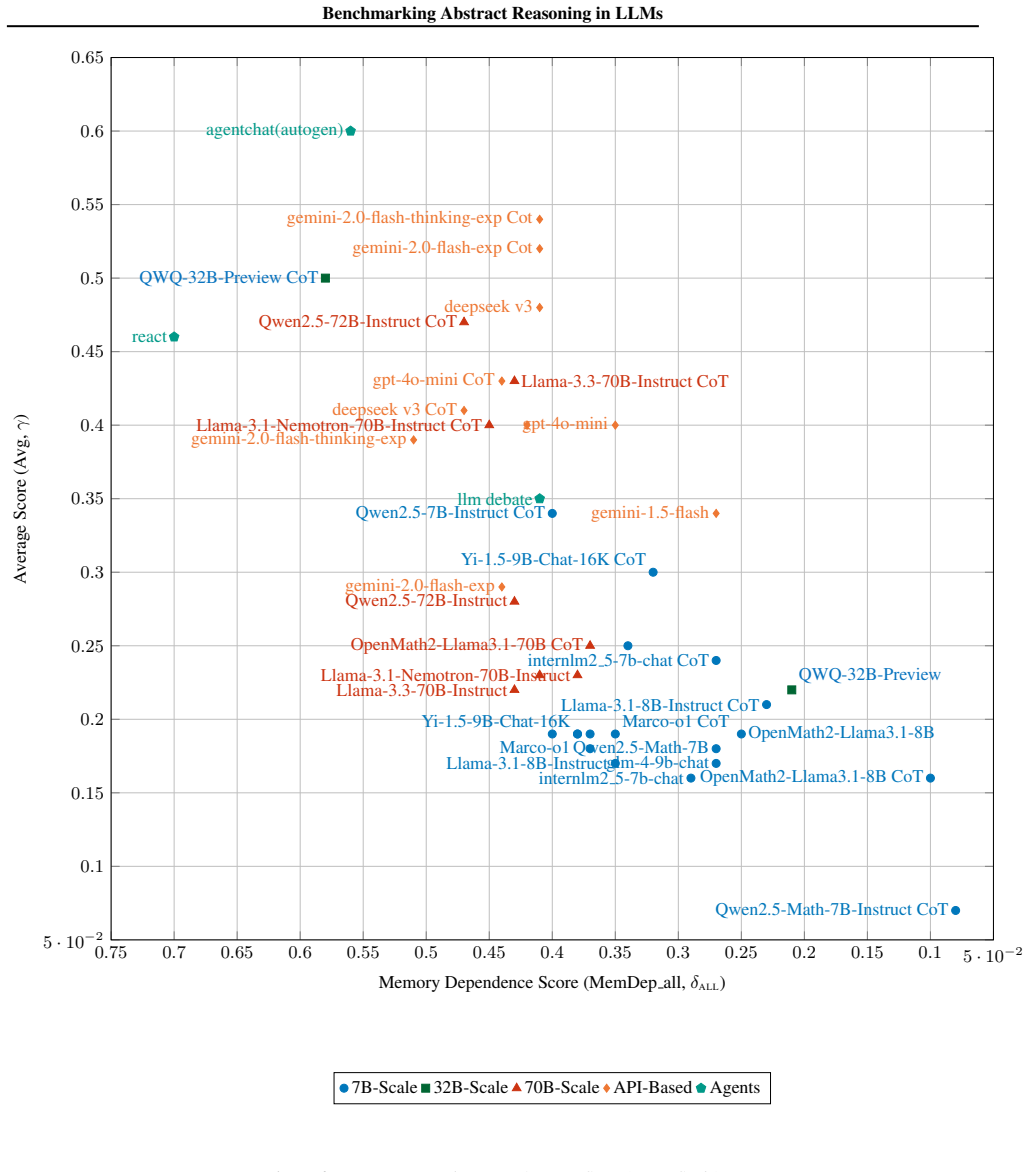
The paper's central claim is that genuine abstract reasoning decomposes into two measurable components, and that the second—symbol independence—is what separates reasoning from memorization. Formally, abstraction is a mapping $f: C \to A$ from concrete instance strings to abstract features, reasoning is a function $\mathrm{Re}: A \times R \to Q$ that applies a rule to an abstract feature, and the composite $H = \mathrm{Re} \circ f$ is the object under evaluation. The Abstract Reasoning Score $\Gamma$ is accuracy on the original test set, and the Memory Dependence Score $\Delta = \Gamma - \Gamma_M$ is the accuracy loss when a bijective symbol mapping $M$ relabels the instances while preserving task structure. Theorem 3.8 asserts that small $\Delta$ together with large $\Gamma$ certifies rule-inductive abstraction—the model's abstraction mapping is invariant under remapping—and the benchmark this motivates applies operand-only, operator-only, and full remappings across 82 sub-datasets in six task categories. The empirical corollary is that current LLMs sit firmly on the memorization side of this divide, with operand-specific memory dependence exceeding operator dependence for nearly every model tested.
Load-bearing premise
The whole diagnostic rests on an assumption asserted rather than proved in Step 4 of the proof of Theorem 3.8 in Appendix A.2.2: a model whose accuracy barely drops under symbol remapping is presumed to be operating on a symbol-invariant abstraction, when it could equally have learned the new symbols from the few-shot examples inside the prompt.
Editorial extensions
If this is right
- Accuracy on familiar benchmarks is not evidence of abstraction: the same models that score well on decimal arithmetic collapse to near zero on the same operations in other number bases.
- Chain-of-thought prompting raises accuracy on familiar multi-step problems but does not close the abstraction gap, and in several models it increases $\Delta$, suggesting procedural guidance can deepen token dependence.
- Multi-agent frameworks reach the highest raw scores on some tasks while showing the highest memory dependence of any group evaluated, so more interaction does not by itself produce symbol-invariant reasoning.
- Operand-specific memorization dominates across every model class: remapping numbers hurts more than remapping operators, pointing to where training-data reliance is strongest.
- Fine-tuning on remapped symbols improves accuracy for the same remapping structure but not for an unseen one, so exposure to mapped data teaches the specific mapping rather than a generalizable rule.
Reading between the lines
- A direct test the paper leaves open is training against $\Delta$ itself: using the accuracy drop under random remappings as a reward signal would show whether the metric can be gamed or whether it tracks genuine abstraction.
- Because the remappings are character-level, $\Delta$ likely underestimates dependence on subword and multi-token patterns; a remapping that operates on words or morphemes might expose even larger abstraction gaps.
- The paper's fine-tuning result implies that low $\Delta$ on a single remapping is fragile evidence: a stronger criterion would require robustness across several independent remappings of the same task, which the released generation scripts make directly testable.
- Models pretrained on tokenizers or corpora with more symbol diversity might show systematically lower $\Delta$, a prediction that would connect this benchmark to questions about how training distribution shapes abstraction.
Editorial analysis
A structured set of objections, weighed in public.
Referee Report
Summary. The paper proposes a theoretical framework for measuring abstract reasoning in LLMs, formalizing abstraction as a mapping f and reasoning as a rule application Re, and introducing two metrics: Gamma, the accuracy on original symbols, and Delta, the accuracy drop after systematic symbol remapping. The authors state three theorems claiming that Gamma measures rule-given reasoning potential, that low Delta combined with high Gamma indicates rule-inductive abstraction, and that a weighted combination of the two metrics yields a valid score. They build a benchmark of 82 symbolic sub-datasets across six categories, evaluate 7B-70B open models, API models, and agent frameworks under direct and chain-of-thought prompting, and report that LLMs perform poorly on non-decimal arithmetic, that operand remapping causes larger drops than operator remapping, and that fine-tuning and human baselines confirm a large abstraction gap. The central claim is that Delta robustly measures memory dependence and that its combination with Gamma diagnoses true abstraction versus memorization.
Significance. If the theoretical claims were established, the proposed benchmark would provide a principled diagnostic for abstraction in LLMs, and the empirical pattern—near-zero non-decimal arithmetic performance, high operand-specific memory dependence, and limited gains from chain-of-thought and multi-agent frameworks—would be a valuable and timely stress test for the field. The paper ships a substantial evaluation: many models, a human baseline, a fine-tuning control, and a public code release commitment, all of which strengthen the empirical contribution. However, the theoretical validation is the central advertised contribution, and it is not actually established: the proofs in Appendix A.2 largely restate definitions, and the key step in the proof of Theorem 3.8 is a non-sequitur. The benchmark's empirical findings are suggestive, but they cannot be interpreted through the proposed Delta metric without a valid theory or additional controls, so the main claim currently overreaches the evidence.
major comments (4)
- [Appendix A.2.2, Theorem 3.8, Step 4] The proof of Theorem 3.8 asserts the key implication rather than deriving it: from |P(Ĥ(c,r)=q) − P(Ĥ(M(c),r)=M(q))| ≤ δ, Step 4 immediately concludes f(c) ≈ f(M(c)) and then Re(f(c),r) ≈ Re(f(M(c)),r). This does not follow. Equality of output distributions under two input encodings does not imply that the model's internal abstraction mapping f is invariant to M; a model could achieve low Delta by memorizing the remapped symbols from the few-shot examples in the prompt, by exploiting cues that M preserves (string length, position, operator tokens, or the structure of the examples), or by applying a token-level nearest-neighbor rule. None of these is the invariant rule-based reasoning the theorem claims to certify. Since Theorem 3.8 is the load-bearing justification for interpreting Delta as a memory-dependence measure, this gap invalidates the central theoretical claim. The authors either need to add an explicit axiom connecting output invariance to f-invariance and justify it, or provide independent evidence—e.g., testing with multiple disjoint mappings per instance, removing remapped examples from the prompt, or controlling for cue preservation—that low Delta cannot be explained by these alternative mechanisms.
- [Section 3.5 and Appendix A.2.1/A.2.3] Theorems 3.7 and 3.9 are restatements of the definitions rather than substantive validation. Theorem 3.7's proof is: Gamma ≥ γ by definition, then by the law of large numbers the empirical proportion approximates the probability; this does not establish that high Gamma indicates 'Rule-Given potential' beyond the definitional statement that the model answers correctly with high probability. Theorem 3.9 defines F as a weighted sum and then verifies three algebraic cases; calling this a theorem adds no mathematical content. The paper repeatedly advertises a 'rigorous theoretical foundation' and 'foundational theorems that validate our approach,' but the appendix shows that the theorems reduce to definitions and the single non-definitional step (Theorem 3.8) is unjustified. The authors should either substantially strengthen the theory or explicitly reframe the contribution as an empirical benchmark with a stated, unproven interpretive assumption.
- [Definition 3.6 and Section 5.1, Table 3] Delta is confounded by floor and ceiling effects and by the model's ability to adapt in-context. If baseline accuracy Gamma is near zero (as in NBR for most models), the accuracy on the remapped set cannot drop much, so Delta can be small or even negative for reasons unrelated to abstraction. The theorem's condition Gamma ≥ γ is intended to mitigate this, but the paper reports and interprets Delta values for many configurations with low Gamma (e.g., NBR rows in Table 3). Conversely, when Gamma is high, a large Delta may reflect task difficulty under novel symbols or the model's use of short in-context examples to relearn the mapping, not necessarily 'memory dependence' on the original symbols. The paper should report Delta only for configurations where the floor/ceiling constraints are checked, or should normalize Delta relative to chance or to a control condition with an equally novel but structurally different task, before drawing conclusions such as 'operand-specific memorization.' As written, the empirical Delta values in Table 2 and Figure 4 cannot be uniquely attributed to memory dependence.
- [Definition 3.6 vs. Appendix A.5] There is an inconsistency between the formal definition of Delta and its implementation. Definition 3.6 keeps the rule string r_i in the original symbolic space and only remaps the concrete instances and answers, whereas Appendix A.5 describes an operator-specific remapping (M_operator) applied to the operator symbols, and Table 2 reports 'MemDep op' computed from such remapping. The theorem in Section 3.5 is about the definition with fixed r_i; the benchmark's operator-remapping variant is not covered by the theorem. The paper should clarify which operationalization is used for each reported number, and whether the theorem is intended to cover remapping of the rule tokens. If it is, the proof needs to be extended; if not, the claim that Delta measures memory dependence for the operator-remapping results is not theoretically backed.
minor comments (7)
- [Abstract] The abstract contains a typo: 'mathematic framework' should be 'mathematical framework'.
- [Section 1] The phrase 'Llama seris' should be 'Llama series'.
- [Section 3.5 / Appendix A.2] Theorems 3.7, 3.8, and 3.9 are presented in the main text without proofs, with proofs deferred to the appendix; since the theorems are not substantive, the paper should consider demoting them to 'propositions' or explicitly labeling which parts are assumptions.
- [Section 4.1] The abbreviation 'BC-SR' is introduced without a clear definition; it appears to refer to the task category range from Basic Computation to Symbolic Reasoning, and should be spelled out at first use.
- [Appendix A.6] The text claims the benchmark comprises 82 sub-datasets, but summing the named datasets in Appendix A.6 (4 BC + 16 EC + 1 MA + 12 NBR + 7 SMA + 43 SR) gives 83 entries, with at least one duplicate name; the count should be reconciled or the list corrected.
- [Appendix A.5] The candidate symbol pool is curated from the Llama-2 7B tokenizer vocabulary, but the same remapped strings are used for all evaluated models; the paper should note that tokenization differences across models may affect how 'novel' the remapped symbols are for each model.
- [Section 3.5 and Section 5] The composite score F(Γ,Δ) defined in Theorem 3.9 is not used in any experiment or analysis; the paper should either use it or state explicitly that it is only a formal construct.
Circularity Check
Theorem 3.8's proof assumes the invariance it is supposed to establish: low Δ is equated with f(c)≈f(M(c)) without derivation.
-
self definitional
[Appendix A.2.2 (Proof of Theorem 3.8), Step 4; theorem stated in Section 3.5]
"Step 4: Let f be the abstraction mapping. For small δ: f(c)≈f(M(c)) =⇒ Re(f(c), r)≈ Re(f(M(c)), r)(16) This invariance to symbol mapping demonstrates Rule-Inductive abstraction."
The proof establishes only |P(Ĥ(c,r)=q)−P(Ĥ(M(c),r)=M(q))|≤δ (Steps 1–3), a statement about output distributions. Step 4 then asserts f(c)≈f(M(c)), which is precisely the abstraction-invariance property that defines Rule-Inductive abstraction. No argument connects the Δ bound to invariance of the model's internal abstraction mapping; a model could satisfy the Δ bound by prompt-level memorization of the remapped symbols or by exploiting cues preserved by M (length, positions, unremapped tokens). The theorem's conclusion is therefore imported as the proof's assumption, not derived.
-
self definitional
[Section 3.5, Theorem 3.9 and Appendix A.2.3]
"This theorem establishes a continuous mapping F: [0,1]×[0,1]→[0,1] that provides a valid measure of abstract reasoning ability by combining both metrics."
F is defined directly as w1Γ+w2(1−Δ); the proof only checks two extreme cases and monotonicity. The statement that F is a 'valid measure of abstract reasoning ability' is the definition of F plus an interpretive assertion; the metric combination is not derived from the framework. It is a naming choice presented as a theorem.
1 more flagged steps
-
self definitional
[Appendix A.2.1, Proof of Theorem 3.7]
"Step 3: Let f be the abstraction mapping and Re the reasoning function. For high γ: P(Re(f(c), r)=q)≥γ Therefore, high accuracy on original symbolic representations implies Rule-Given proficiency."
Rule-Given proficiency is defined as applying the known rule to abstract features with high accuracy; the proof rewrites Γ≥γ as P(Ĥ(c,r)=q)≥γ and then relabels this as Rule-Given proficiency. The theorem is a restatement of Definition 3.3 plus the law of large numbers, not an independent validity result.
full rationale
The benchmark itself and its empirical sweep are self-contained and not circular, and no load-bearing self-citation chain appears. The circularity is concentrated in the theoretical validation. The load-bearing assertion that Δ measures abstraction rather than memorization is not derived: Step 4 of the proof of Theorem 3.8 asserts f(c)≈f(M(c)) from the output-distribution bound, which is the target conclusion. Since the paper's central diagnostic claim—low Δ plus high Γ indicates Rule-Inductive abstraction—rests entirely on this step, and since Theorem 3.9 similarly declares a weighted average to be a 'valid measure', the derivation chain reduces to definitions and assertions. Score 8 reflects that the central theoretical result is forced by an unproved equivalence embedded in the proof.
Assumptions & free parameters
free parameters (2)
- weights w1, w2 in composite score F =
unspecified; w1 + w2 = 1
- thresholds gamma and delta in Theorems 3.7 and 3.8 =
unspecified
assumptions (4)
- standard math Law of Large Numbers
- domain assumption Symbol remapping preserves abstract task structure
- ad hoc to paper Small Delta implies f(c) is approximately f(M(c))
- domain assumption Few-shot examples in prompts are sufficient for rule induction
Cite this review
Pith. "Pith review of Benchmarking Abstract and Reasoning Abilities Through A Theoretical Perspective." pith.science (2026). https://pith.science/paper/OLMIE34H
@misc{pith2026250523833,
  author       = {Pith},
  title        = {Pith review of: Benchmarking Abstract and Reasoning Abilities Through A Theoretical Perspective},
  year         = {2026},
  howpublished = {\url{https://pith.science/paper/OLMIE34H}},
  note         = {Machine review of arXiv:2505.23833}
}
abstract
In this paper, we aim to establish a simple, effective, and theoretically grounded benchmark for rigorously probing abstract reasoning in Large Language Models (LLMs). To achieve this, we first develop a mathematic framework that defines abstract reasoning as the ability to: (i) extract essential patterns independent of surface representations, and (ii) apply consistent rules to these abstract patterns. Based on this framework, we introduce two novel complementary metrics: \(\scoreGamma\) measures basic reasoning accuracy, while \(\scoreDelta\) quantifies a model's reliance on specific symbols rather than underlying patterns - a key indicator of true abstraction versus mere memorization. To implement this measurement, we design a benchmark: systematic symbol remapping in rule-based tasks, which forces models to demonstrate genuine pattern recognition beyond superficial token matching. Extensive LLM evaluations using this benchmark (commercial API models, 7B-70B, multi-agent) reveal:1) critical limitations in non-decimal arithmetic and symbolic reasoning; 2) persistent abstraction gaps despite chain-of-thought prompting; and 3) \(\scoreDelta\)'s effectiveness in robustly measuring memory dependence by quantifying performance degradation under symbol remapping, particularly highlighting operand-specific memorization. These findings underscore that current LLMs, despite domain-specific strengths, still lack robust abstract reasoning, highlighting key areas for future improvement.
Figures


Figures from the paper (3 more)


Reference graph
Works this paper leans on
-
[1]
For abstract reasoning, however, we require a more nuanced form of invariance:symbolic invariance
Symbolic Invariance:Traditional machine learning data augmentation techniques, like image rotation or cropping, aim to improve robustness to variations in input data. For abstract reasoning, however, we require a more nuanced form of invariance:symbolic invariance. This means that a truly abstractly reasoning model should be invariant to symbolic transfor...
-
[2]
In abstract reasoning, however, the emphasis is on learning acomposite process H=Re◦f
Composite Learning:In many traditional machine learning tasks, feature extraction and decision-making might be implicitly learned or treated as separate stages. In abstract reasoning, however, the emphasis is on learning acomposite process H=Re◦f . This means that the model must learn to seamlessly integrate the abstraction mapping f and the reasoning fun...
-
[3]
Information Compression through Abstraction:Beyond standard generalization metrics like accuracy, abstract reasoning highlights the critical role ofinformation compression through abstraction. A hallmark of abstract reasoning is the ability to distill complex, concrete instances into concise, abstract features. This compression is not merely about reducin...
-
[4]
Rule Availability during Training (Rule-Given vs. Rule-Inductive):The nature of abstract reasoning tasks, in relation to an LLM’s training data, significantly impacts the difficulty and the type of reasoning required.Rule-given abstract reasoningtasks are those where the underlying rules or patterns are likely to have been encountered, implicitly or expli...
-
[5]
URL https://openreview.net/forum? id=3rGT5OkzpC. Morris, M. R., Sohl-Dickstein, J., Fiedel, N., Warkentin, T., Dafoe, A., Faust, A., Farabet, C., and Legg, S. Levels of agi: Operationalizing progress on the path to agi.arXiv preprint arXiv:2311.02462, 2023. Murphy, G.The big book of concepts. MIT press, 2004. Penn, D. C., Holyoak, K. J., and Povinelli, D....
arXiv 2023
-
[6]
**Next column (three thousand one hundred twenty-fives place): ** \( 4 + 0 = 4 \). Write down **4**
-
[7]
URL https://openreview.net/forum? id=WE_vluYUL-X. Young, A., Chen, B., Li, C., Huang, C., Zhang, G., Zhang, G., Wang, G., Li, H., Zhu, J., Chen, J., et al. Yi: Open foundation models by 01. ai.arXiv preprint arXiv:2403.04652, 2024. Yuan, Z., Yuan, H., Li, C., Dong, G., Lu, K., Tan, C., Zhou, C., and Zhou, J. Scaling relationship on learning math- ematical...
arXiv 2024
-
[12]
Candidate Symbol Pool Generation:A pool of candidate symbols for remapping is curated from the Llama-2 7B tokenizer’s vocabulary. This vocabulary is filtered to retain only single-character alphanumeric tokens (e.g., ‘a’-‘z’, ‘A’-‘Z’, ‘0’-‘9’ that are treated as individual tokens). This ensures that the new symbols are basic, unlikely to carry strong pre-...
work page 2024
Show all 30 references
-
[13]
Identification of Original Symbols for a Task Instance:For each original task instance, consisting of few-shot examples and a question-answer pair, we first identify the set of all unique non-whitespace characters, Uorig, present in its textual representation (both questions a...
-
[14]
Here, S′ cand is a randomly selected subset of Scand such that |S′ cand|=|U orig|
Random Bijective Symbol Mapping Establishment:A random bijective (one-to-one and onto) mapping function, Msym :U orig →S ′ cand, is established. Here, S′ cand is a randomly selected subset of Scand such that |S′ cand|=|U orig|. This ensures that each unique original symbol is ...
-
[15]
Untrained
Generation of Remapped Task Instances under Different Strategies:The original task instances are then trans- formed by applying character-wise substitution based on specific mapping strategies to produce remapped instances. The core strategies are: 17 Benchmarking Abstract Rea...
-
[16]
Answer: The answer is{your answer}
Dataset Assembly:By applying these strategies, we generate multiple versions of each sub-dataset: a raw version, a fully remapped version, an operand-remapped version, and an operator-remapped version. These variants allow for the calculation of Γ (from raw performance) and di...
-
[17]
Write down **1**
**Rightmost column (units place): ** \( 0 + 1 = 1 \). Write down **1**
-
[18]
Write down **1**
**Next column (fives place): ** \( 0 + 1 = 1 \). Write down **1**
-
[19]
Since 6 is greater than or equal to 5, we subtract 5 and carry over 1 to the next column
**Next column (twenty-fives place): ** \( 2 + 4 = 6 \). Since 6 is greater than or equal to 5, we subtract 5 and carry over 1 to the next column. Write down **1** and carry over **1**
-
[20]
Write down **2**
**Next column (one hundred twenty-fives place): ** \( 1 + 0 = 1 \), plus the carry-over of 1 gives \( 1 + 1 = 2 \). Write down **2**
-
[21]
Write down **2**
**Next column (six hundred twenty-fives place): ** \( 2 + 0 = 2 \). Write down **2**
-
[23]
Step 2, part 3,
**Leftmost column (fifteen thousand six hundred twenty-fives place): ** \( 4 + 0 = 4 \). Write down **4**. ### Step 3: Write the final result Combining all the digits from left to right, the result is: **422211**. ### Final Answer: The answer is **422211**. Analysis of Model’s...
-
[24]
- First string: ZZ333ZZ3 becomes 00111001
**Convert ’Z’ and ’3’ to binary digits: ** Treat ’Z’ as 0 and ’3’ as 1. - First string: ZZ333ZZ3 becomes 00111001. - Third string: ZZZ3ZZ3Z becomes 00010010
-
[25]
**Perform bitwise AND operation: ** Apply the bitwise AND operation to each corresponding bit of the binary representations of the first and third strings. 00111001 (First string) AND 00010010 (Third string) --------- 00010000 (Result) - Position 1: 0 AND 0 = 0 - Position 2: 0...
-
[26]
- 00010000 becomes ZZZ3ZZZZ
**Convert the binary result back to ’Z’ and ’3’: ** Convert the binary result 00010000 back to a string of ’Z’s and ’3’s, where 0 is ’Z’ and 1 is ’3’. - 00010000 becomes ZZZ3ZZZZ
-
[27]
Final Answer: The final answer is $\boxed{ZZZ3ZZZZ}$ Analysis of Model’s Reasoning:The model’s ‘raw output’ clearly articulates a successful multi-step abstract reasoning process:
**Compare with the provided answer: ** The derived answer ZZZ3ZZZZ matches the provided answer for the question ZZ333ZZ3 LHWFRwgFWr ZZZ3ZZ3Z G. Final Answer: The final answer is $\boxed{ZZZ3ZZZZ}$ Analysis of Model’s Reasoning:The model’s ‘raw output’ clearly articulates a suc...
-
[28]
Symbolic Abstraction:In “Step 1,” the model correctly infers the semantic mapping of the novel symbols: ‘Z’ to binary ‘0’ and ‘3’ to binary ‘1’. It then accurately converts the two relevant input strings (‘ZZ333ZZ3’ and ‘ZZZ3ZZ3Z’) into 25 Benchmarking Abstract Reasoning in LL...
-
[29]
It then performs this operation flawlessly, yielding the binary result ‘00010000’
Operational Inference and Execution:In “Step 2,” the model correctly identifies the underlying operation as a bitwise AND applied to the two abstracted binary strings. It then performs this operation flawlessly, yielding the binary result ‘00010000’
-
[30]
meta- llama/Llama-3.1-8B-Instruct
Reverse Symbolic Mapping:In “Step 3,” the model converts the binary result back to the original symbolic domain, correctly translating ‘00010000’ to ‘ZZZ3ZZZZ’. This case exemplifies successful abstract reasoning. The model was not merely pattern matching surface tokens but de...
-
[67]
findings-acl.67/
URL https://aclanthology.org/2023. findings-acl.67/. Jiang, B., Xie, Y ., Hao, Z., Wang, X., Mallick, T., Su, W. J., Taylor, C. J., and Roth, D. A peek into token bias: Large language models are not yet genuine reasoners.arXiv preprint arXiv:2406.11050, 2024. 10 Benchmarking A...
2023 arXiv
-
[102]
naacl-long.102/
URL https://aclanthology.org/2024. naacl-long.102/. Xiong, K., Ding, X., Liu, T., Qin, B., Xu, D., Yang, Q., Liu, H., and Cao, Y . Meaningful learning: Enhancing abstract reasoning in large language models via generic fact guid- ance. InThe Thirty-eighth Annual Conference on N...
2024 arXiv
-
[520]
Besold, T
PMLR, 2018. Besold, T. R., Bader, S., Bowman, H., Domingos, P., Hit- zler, P., K¨uhnberger, K.-U., Lamb, L. C., Lima, P. M. V ., de Penning, L., Pinkas, G., et al. Neural-symbolic learn- ing and reasoning: A survey and interpretation 1. In Neuro-symbolic artificial intelligenc...
2018 arXiv
-
[2021]
Holland, J.Induction: Processes of inference, learning, and discovery, volume 292
URL https://openreview.net/forum? id=7Bywt2mQsCe. Holland, J.Induction: Processes of inference, learning, and discovery, volume 292. MIT Press, 1986. Holyoak, K. J. Analogy and relational reasoning.The Oxford handbook of thinking and reasoning, pp. 234–259, 2012. Holyoak, K. J...
1986
-
[2023]
Mirzadeh, I., Alizadeh, K., Shahrokhi, H., Tuzel, O., Bengio, S., and Farajtabar, M
URL https://openreview.net/forum? id=RcZMI8MSyE. Mirzadeh, I., Alizadeh, K., Shahrokhi, H., Tuzel, O., Bengio, S., and Farajtabar, M. Gsm-symbolic: Understanding the limitations of mathematical reasoning in large language models.arXiv preprint arXiv:2410.05229, 2024. Mitchell,...
Reviewed August 7, 2026 · model on record in the stance chip above.
Discussion (0). Sign in to comment.