REVIEW 4 major objections 5 minor 17 references
Parameter-Free Bio-Inspired Channel Attention for Enhanced Cardiac MRI Reconstruction
T0 review · 4 major / 5 minor · reviewed 2026-08-07 · deepseek-v4-flash
Pith's one-line read A zero-parameter channel attention module built from a single-species population growth equation beats other parameter-free attention blocks on cardiac MRI reconstruction.
desk verdict Plausible new zero-parameter attention module, but single-run evidence with no code means the headline gain is preliminary. read the letter →
The pith
A machine-rendered reading of the paper's core claim, the machinery that carries it, and where it could break.
The reading
What carries the argument
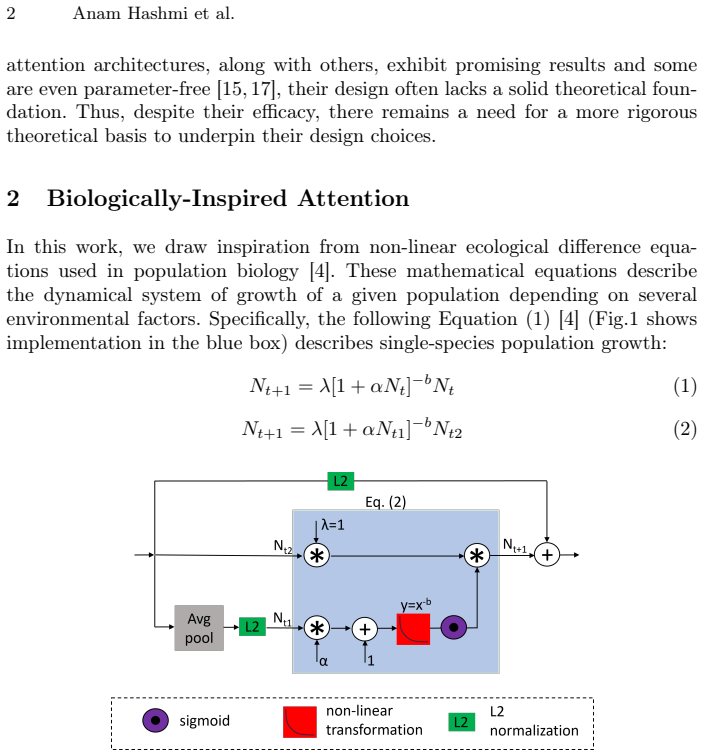
The load-bearing object is the ecological difference equation $N_{t+1}=\lambda[1+\alpha N_t]^{-b}N_t$, originally used to model single-species population growth. The block applies it to average-pooled channel statistics, with two branches as in Eq. (2), then passes the result through a sigmoid and L2-normalization to form per-channel weights with zero learned parameters. Its job is to compute a channel weighting that amplifies relevant features and suppresses irrelevant ones during reconstruction.
What would settle it
Run the CMRxRecon experiment again with the attention block's internal update rule replaced by another fixed, parameter-free nonlinearity (for example, a logistic map with the same two branches and $\alpha=b=2$) while keeping everything else identical; if PSNR and SSIM stay at or above the reported 37.7724 and 0.9496, then the specific ecological equation is not what carries the improvement.
Extended reading notes
Core claim
The central discovery claimed is that a fixed, parameter-free nonlinear map can serve as an effective channel attention mechanism: the single-species population update $N_{t+1}=\lambda[1+\alpha N_t]^{-b}N_t$, run as two branches $N_t^1$ and $N_t^2$ with $\alpha=b=2$ and followed by average pooling, a sigmoid, and L2-normalization, produces channel weights that improve cardiac MRI reconstruction. Reported results on CMRxRecon put the proposed block at PSNR 37.7724 and SSIM 0.9496, above SimAM (37.0492, 0.9443) and GCT (36.5874, 0.9408), both of which also have zero parameters. The claim is specific to parameter-free attention: the 90-parameter ECA module still scores higher (PSNR 37.9982, SSIM 0.9527).
Load-bearing premise
The load-bearing premise is that a single-species population growth equation is a meaningful model for channel attention, but the paper asserts this analogy rather than deriving it from an optimality or information criterion.
Editorial extensions
If this is right
- A zero-parameter attention module can improve over two established zero-parameter modules on cardiac MRI reconstruction, raising PSNR from 37.0492 to 37.7724 and SSIM from 0.9443 to 0.9496 on CMRxRecon.
- Because the block adds zero parameters, it can strengthen a reconstruction network without increasing model size or attention memory overhead.
- The two-branch ecological map with $\alpha=b=2$ is a complete recipe, so if it transfers, practitioners gain a drop-in replacement for SimAM or GCT in other reconstruction pipelines.
- The reported gap to the 90-parameter ECA module (PSNR 37.9982) narrows but does not close, so the claim is about the parameter-free class rather than about all channel attention designs.
Reading between the lines
- The ecological framing is an analogy rather than a derivation, so a natural test is whether other fixed two-branch nonlinearities with the same cost perform equally; if they do, the specific equation is not what carries the improvement.
- A small grid search over $\alpha$ and $b$ would show whether the hand-set values are essential; the paper explicitly leaves that optimization out of scope.
- Whether the module's advantage persists across other undersampling rates, contrasts, or imaging organs is an open extension, since attention modules are often task- and distribution-sensitive.
Editorial analysis
A structured set of objections, weighed in public.
Referee Report
Summary. The paper proposes a channel attention module for cardiac MRI reconstruction inspired by May's single-species population-growth difference equation. The module uses Eq. (2) with average pooling, a sigmoid activation, and L2 normalization, setting alpha=2 and b=2 and leaving lambda unspecified. It is inserted into a prior CMR reconstruction network from the authors' earlier work, and evaluated on the CMRxRecon dataset. Table 1 reports PSNR, MSE, and SSIM for the baseline and for SE, LCT, AB, ECA, SimAM, GCT, and the proposed module, with the proposed module at PSNR 37.7724 and SSIM 0.9496, above the zero-parameter SimAM and GCT baselines. A Wilcoxon signed-rank test on per-case SSIM against SimAM is reported as p<0.001. The conclusion claims that the approach outperforms existing parameter-free methods.
Significance. If the empirical claim is confirmed with repeated-seed evidence and code, the paper would contribute a simple, zero-learned-parameter attention module that improves cardiac MRI reconstruction quality without adding parameters, and it would add an ecological-dynamics-inspired design to the attention literature. The main strengths are the clear plug-and-play nature of the module, the inclusion of several attention baselines, and a statistical test on per-case SSIM. However, the evidence is currently thin: one dataset, single-run point estimates, no code or checkpoints, hand-set constants, and an analogical rather than derived theoretical motivation. The result is potentially useful but is not yet established at the level claimed.
major comments (4)
- [Section 3, Table 1] The headline claim that the proposed method outperforms existing parameter-free methods rests on single-run PSNR and SSIM values with no standard deviations, no number of random seeds, and no statement that all methods were trained under identical initializations and schedules. The reported gaps over SimAM (0.72 dB) and GCT (1.19 dB) could plausibly lie within run-to-run variation for MRI reconstruction. The Wilcoxon signed-rank test is computed on per-case SSIM within one run and is reported only against SimAM, not against GCT and not on PSNR, so it does not support all parts of the conclusion. Please provide repeated-seed experiments (at least 3-5 seeds) with mean and standard deviation, or release code and trained checkpoints so that the comparison can be reproduced.
- [Section 2, Eq. (2)] The constants alpha=2 and b=2 are hand-selected and lambda is left unspecified, so 'parameter-free' means only 'no learned parameters' rather than 'no tuned design choices.' The manuscript should report the value of lambda used and analyze sensitivity to alpha and b, for example by varying them over a grid and reporting the resulting PSNR and SSIM. Without such an analysis, the result may be an artifact of the chosen constants, and the parameter-free claim is overstated.
- [Section 2, Eqs. (1)-(2), Fig. 1] The paper asserts that ecological population dynamics 'provide a framework for capturing the complex dynamic interactions between different visual features,' but it does not derive why Eq. (2) should produce an effective attention map, what N_t represents, or why the two branches N_t1 and N_t2 arise. The connection is analogical rather than formal. Please state explicitly the mapping from channel statistics to N_t and provide a justification, or at least a falsifiable prediction, for why this particular non-linear equation is preferable to other hand-designed modules.
- [Section 3, experimental setup] The experimental section says that 'preprocessing and training details mirror those in [5]' and 'Our methodology follows [2,5],' but the paper does not report the number of training and test cases, the data split, the acceleration factors used for evaluation, the optimizer, loss function, number of epochs, batch size, or hardware. These details are needed for reproducibility, especially since references [2,5] are the authors' own prior works rather than a standard benchmark specification.
minor comments (5)
- [Throughout] There are several typos and spacing errors, for example 'T able 1' and 'such asP SN R, M SEand SSIM'; these should be corrected.
- [Section 2, Eq. (2)] The notation N_t1 and N_t2 in Eq. (2) is undefined; the figure caption suggests two separate branches, but the equations should state what N_t1 and N_t2 denote in terms of network activations.
- [Abstract and Conclusion] The claim of surpassing 'current state-of-the-art parameter-free methods' is stronger than what Table 1 supports, since only SimAM and GCT are included among parameter-free methods. The wording should be softened to 'the compared parameter-free methods' or additional parameter-free baselines should be evaluated.
- [References] References [1] and [3] appear in the reference list but are not cited in the body of the paper; either cite them where relevant or remove them.
- [Figure 2] Figure 2 shows reconstruction results for one long-axis cine image (case P1) at x10 acceleration; it would be helpful to state how many cases were evaluated and whether the qualitative improvement is representative across the test set.
Circularity Check
No circularity: the proposed attention module is evaluated against external baselines on a public benchmark, and the ecological equation is presented as a hypothesis rather than a derivation that contains its own conclusion.
full rationale
The paper's central claim is empirical: the proposed zero-learned-parameter attention module achieves higher PSNR/SSIM than SimAM and GCT on the public CMRxRecon dataset. This claim is supported by Table 1, which compares against external attention modules (SE, LCT, AB, ECA, SimAM, GCT) under a common reconstruction backbone. Eq. (1) is quoted from May [4], an external source, and Eq. (2) is an implementation variant with alpha=2 and b=2; the authors explicitly label the ecological motivation as a hypothesis ('we hypothesize that non-linear ecological equations provide a framework'), so no first-principles result is asserted and no derivation reduces to its own inputs. The only self-citations are to the authors' prior reconstruction network and training pipeline ([2,5]); these are used as the controlled experimental setup, not as evidence for the proposed module's advantage. The comparison against external methods keeps the central claim independent of those self-citations. The hand-selected alpha=2 and b=2 are acknowledged hyperparameters ('Optimizing the hyperparameter values could yield better results, but is beyond the scope of this work') and are not renamed predictions. No equation is shown to be equivalent to another by construction, no fitted parameter is presented as a prediction, and no uniqueness theorem is imported from the authors' prior work. Concerns about single-run variance, missing code, or hyperparameter sensitivity are empirical rigor issues, not circularity. Therefore no circular step is exhibited.
Assumptions & free parameters
free parameters (3)
- alpha =
2
- b =
2
- lambda =
not stated (assumed 1)
assumptions (3)
- ad hoc to paper The single-species population-growth equation from May (1975) is a suitable model for channel attention dynamics.
- ad hoc to paper Average pooling, sigmoid, L2 normalization, and Eq. (2) together produce effective channel attention.
- domain assumption The CMR reconstruction network and training pipeline from the authors' prior work [5] provide a valid baseline for comparison.
Cite this review
Pith. "Pith review of Parameter-Free Bio-Inspired Channel Attention for Enhanced Cardiac MRI Reconstruction." pith.science (2026). https://pith.science/paper/ZNIF7QYQ
@misc{pith2026250523872,
  author       = {Pith},
  title        = {Pith review of: Parameter-Free Bio-Inspired Channel Attention for Enhanced Cardiac MRI Reconstruction},
  year         = {2026},
  howpublished = {\url{https://pith.science/paper/ZNIF7QYQ}},
  note         = {Machine review of arXiv:2505.23872}
}
read the original abstract
Attention is a fundamental component of the human visual recognition system. The inclusion of attention in a convolutional neural network amplifies relevant visual features and suppresses the less important ones. Integrating attention mechanisms into convolutional neural networks enhances model performance and interpretability. Spatial and channel attention mechanisms have shown significant advantages across many downstream tasks in medical imaging. While existing attention modules have proven to be effective, their design often lacks a robust theoretical underpinning. In this study, we address this gap by proposing a non-linear attention architecture for cardiac MRI reconstruction and hypothesize that insights from ecological principles can guide the development of effective and efficient attention mechanisms. Specifically, we investigate a non-linear ecological difference equation that describes single-species population growth to devise a parameter-free attention module surpassing current state-of-the-art parameter-free methods.
Figures

Reference graph
Works this paper leans on
-
[5]
Accelerating Cardiac MRI Reconstruction with CMRatt: An Attention-Driven Approach
Hashmi, A., Dietlmeier, J., Curran, K. M., O’Connor, N. E.: Car- diac MRI Reconstruction with CMRatt: An Attention-Driven Approach. https://arxiv.org/abs/2404.06941 (2024)
work page Pith review arXiv 2024
-
[1]
Lyu, J. et al.: The state-of-the-art in Cardiac MRI Reconstruction: Results of the CMRxRecon Challenge in MICCAI 2023. https://arxiv.org/pdf/2404.01082.pdf (2024)
work page Pith review arXiv 2024
-
[2]
Dietlmeier, J., Garcia-Cabrera, C., Hashmi, A., Curran, K.M., O’Connor, N.E.: Car- diac MRI Reconstruction from Undersampled K-Space Using Double-Stream IFFT and a Denoising GNA-UNET Pipeline. In: Camara, O., et al. Statistical Atlases and Computational Models of the Heart. Regular and CMRxRecon Challenge Pa- pers, Lecture Notes in Computer Science, vol 1...
-
[3]
Xin,B., Ye,M., Axel,L., Metaxas,D.N.: Fill the K-Space and Refine the Image: Prompting for Dynamic and Multi-Contrast MRI Reconstruction. In: Camara, O., et al. Statistical Atlases and Computational Models of the Heart. Regular and CM- RxRecon Challenge Papers, Lecture Notes in Computer Science, vol 14507, pp. 261–273. Springer, Cham. (2023). https://doi....
-
[4]
Journal of Theoretical Biology51, 511–524 (1975)
May, R.M.: Biological Populations Obeying Difference Equations : Stable Points, Stable Cycles, and Chaos. Journal of Theoretical Biology51, 511–524 (1975)
work page 1975
-
[6]
Wang, C. et al.: CMR×Recon: An open cardiac MRI dataset for the competition of accelerated image reconstruction. https://arxiv.org/pdf/2309.10836.pdf (2023)
arXiv 2023
-
[7]
Journal of Computer and Communications 7(3), (2019)
Sara,U., Akter,M., Uddin, M.S.: Image quality assessment through FSIM, SSIM, MSE and PSNR — a comparative study. Journal of Computer and Communications 7(3), (2019)
work page 2019
-
[8]
International Journal of Imaging Systems and Technology32(2), 528–543 (2022)
Fang,Y., Huang,He., Yang,W., Xu,X., Jiang,W., Lai,X.: Nonlocal convolutional block attention module VNet for gliomas automatic segmentation. International Journal of Imaging Systems and Technology32(2), 528–543 (2022)
work page 2022
Show all 17 references
-
[9]
Signal, Image and Video Processing16, 817–824 (2022)
Shaik,N.S., Cherukuri,T.K.: Multi-level attention network: application to brain tu- mor classification. Signal, Image and Video Processing16, 817–824 (2022)
2022
-
[10]
Nature npj digital medicine5(156), (2022)
Chen,H., Gomez,C., Huang,C.-M., Unberath,M.: Explainable medical imaging AI needs human-centered design: guidelines and evidence from a systematic review. Nature npj digital medicine5(156), (2022)
2022
-
[11]
CVPR (2018)
Hu,J., Shen,L., Sun,G.: Squeeze-and-Excitation Networks. CVPR (2018)
2018
-
[12]
AAAI (2020)
Ruan,D., Wen,J., Zheng,N., Zheng,M.: Linear Context Transform Block. AAAI (2020)
2020
-
[13]
ECCV (2018)
Woo,S., Park,J., Lee,J.-Y., Kweon,I.S.: CBAM: Convolutional Block Attention Module. ECCV (2018)
2018
-
[14]
Neural Processing Letters 55, 6797—6813 (2023)
Klomp,S.R., Wijnhoven,R.G.J., de With,P.H.N.: Performance-Efficiency Compar- isons of Channel Attention Modules for ResNets. Neural Processing Letters 55, 6797—6813 (2023)
2023
-
[15]
et al.: SimAM: A simple, parameter-free attention module for convolu- tional neural networks
Yang,L. et al.: SimAM: A simple, parameter-free attention module for convolu- tional neural networks. ICML, 11863—11874 (2021)
2021
-
[16]
CVPR (2020)
Wang,Q., Wu,B., Zhu,P., Li,P., Zuo,W., Hu,Q.: ECA-Net: Efficient channel atten- tion for deep convolutional neural networks. CVPR (2020)
2020
-
[17]
et al.: Gaussian context transformer
Ruan,D. et al.: Gaussian context transformer. CVPR (2021)
2021
Reviewed August 7, 2026 · model on record in the stance chip above.
Discussion (0). Continue with ORCID to comment.