REVIEW 2 major objections 5 minor 112 references
Synopsis: Secure and private trend inference from encrypted semantic embeddings
T0 review · 2 major / 5 minor · reviewed 2026-08-07 · deepseek-v4-flash
Pith's one-line read The paper claims that a system called Synopsis can produce differentially private semantic trend counts and threshold alerts over consensually donated end-to-end encrypted messages, with no party able to view the underlying embeddings…
desk verdict A well-built system with a real privacy bug in the coarse-grained regime; the paper deserves a serious review but needs a corrected sensitivity analysis before its headline claim can stand. read the letter →
The pith
A machine-rendered reading of the paper's core claim, the machinery that carries it, and where it could break.
The reading
What carries the argument
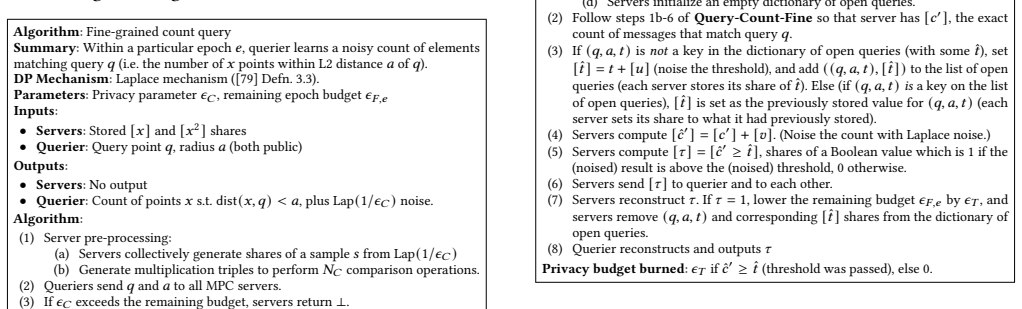
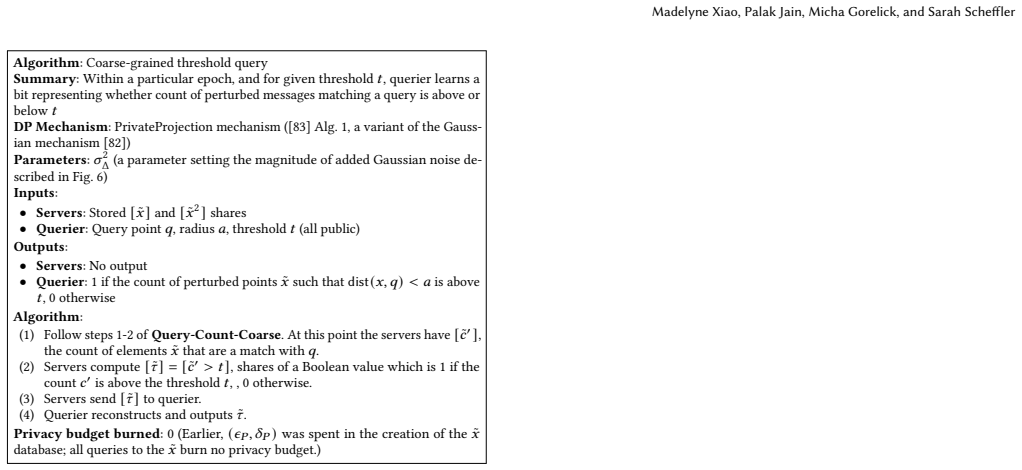
The load-bearing object is the two-database query architecture: a fine-grained store of exact message embeddings and a coarse-grained store of perturbed embeddings, each accessed only through MPC secret-shared computations. The fine-grained queries use the Laplace mechanism for noised counts and the Sparse Vector mechanism for threshold alerts whose privacy cost is paid only when the threshold is crossed. The coarse-grained store is built by the PrivateProjection mechanism, which applies a dimension-reducing random projection that roughly preserves pairwise distances and then adds Gaussian noise whose scale is set by Eq. (1); because differential privacy is closed under post-processing, the perturbed store can be queried without further budget. A per-epoch budget tracks fine-grained spending, and when it is exhausted the fine-grained data for that epoch is permanently deleted, leaving only the coarse-grained copy. The security claim is carried by executing every count, comparison, and noise draw inside malicious-secure MPC, so that servers see only shares and any deviation from the specified query interface is detectable.
What would settle it
Compute the spectral norm (ℓ2 sensitivity) of the actual random projection matrix P used in the implementation and compare it against the value assumed in Eq. (1). If there is a non-negligible chance that a drawn P has sensitivity exceeding the calibrated bound — which can be tested by sampling many P matrices and measuring max_{e_i} ||e_i P|| — then two corpora differing in one message can be exhibited whose projected outputs differ by more than the noise scale, directly violating the (ε,δ)-DP guarantee for the coarse-grained database. A reader could run this check on the released open-source code and settle the privacy claim independently of any utility measurements.
Extended reading notes
Core claim
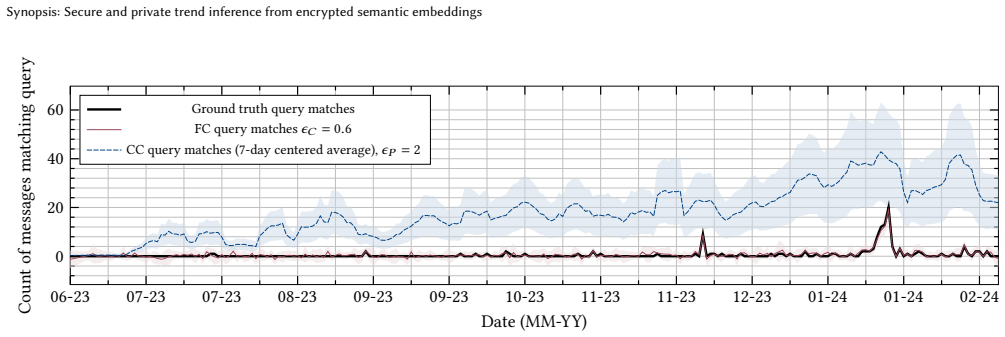
On its own terms, Synopsis claims to be the first system that simultaneously gives authorized queriers count and trend outputs over semantically embedded text, supports both retrospective and prospective queries, keeps the underlying data secret even from the servers that store it, tolerates malicious (not just honest-but-curious) adversaries, and releases differentially private outputs. The central design move is to store two copies of the donated corpus: a fine-grained database of exact embeddings queried through the Laplace and Sparse Vector mechanisms, which answer accurately but spend a per-epoch privacy budget; and a coarse-grained database of embeddings that have been randomly projected and Gaussian-perturbed once, which can then be queried any number of times at zero additional budget but with lower accuracy. Multi-party computation wraps both copies so the only observable output of the system is the noised count or threshold bit. The paper further argues that the trend-level outputs are sufficient for the journalistic use cases it targets, and that the system is practical at the scale tested.
Load-bearing premise
The load-bearing premise is that the Gaussian noise added to the projected embeddings is calibrated to the true sensitivity of the specific random projection matrix that was drawn, whereas the paper only shows the expected sensitivity is concentrated near 1 and does not establish a worst-case bound for the realized matrix; if a particular draw's sensitivity is higher than the calibration assumes, the claimed (ε,δ)-differential privacy for the coarse-grained database does not hold.
Editorial extensions
If this is right
- Journalists can first explore a corpus with unlimited zero-budget coarse queries and then switch to budgeted fine-grained queries to confirm and measure specific trends, as in the Ram Temple case study where fine-grained queries identified January 22, 2024 as the peak day.
- No party in the system — not even the data stewards who run the servers — can directly read stored message embeddings; the differentially private query interface is the only access path.
- Per-epoch fine-grained budgets enforce a hard limit on how much accurate information can be extracted about any epoch, after which the precise data is deleted.
- The tested performance (about 30 seconds for a 34,024-message corpus, with fine-grained accuracy above 94 percent on benchmark tasks) makes the approach usable in time-sensitive journalism workflows.
- The architecture offers an alternative to publishing scraped plaintext group data by giving researchers trend statistics without releasing raw messages.
Reading between the lines
- The explore-then-confirm split between coarse and fine regimes is a general recipe: any sensitive dataset with a high-volume exploration need and a low-volume verification need could use the same two-store pattern, not just message corpora.
- Because the coarse-grained differential-privacy guarantee depends on the realized projection's sensitivity, a production deployment should either prove a worst-case bound for the chosen projection or calibrate noise to the actual spectral norm; this is a testable correctness condition the paper does not fully discharge.
- Queries are visible to the servers in the current design; the authors note that hiding queries as secret MPC inputs would be possible but slower, so deployments with sensitive investigation topics would face a latency tradeoff.
- The privacy guarantee is message-level, not user-level, so a user who sends many matching messages is more visible; a user-level guarantee would require substantially more noise and is a neighbouring design choice the paper does not implement.
Editorial analysis
A structured set of objections, weighed in public.
Referee Report
Summary. The paper presents Synopsis, a system for privacy-preserving trend analysis over consensually donated end-to-end encrypted message embeddings. It maintains two databases: a fine-grained database of exact projected embeddings, queried under central differential privacy via Laplace and sparse-vector mechanisms, and a coarse-grained database of locally perturbed embeddings produced by random projection followed by Gaussian noise, which can be queried without further privacy cost. All query processing is implemented in malicious-secure multi-party computation to ensure that only the DP query interface can access the data. The authors evaluate on a 34,024-message Hindi WhatsApp corpus, reporting roughly 1 ms per database element and fine-grained accuracy above 94% on benchmark tasks, and they demonstrate a Ram Temple investigation. The paper also includes a stakeholder analysis and a detailed discussion of design tradeoffs. The central claimed contributions are the hybrid central/local DP model, the four query types, and the claim that Synopsis is the first system to simultaneously support counts, retrospective arbitrary queries, data privacy from the querier, non-exact semantic matching, malicious security, and DP outputs.
Significance. If the privacy guarantees hold, Synopsis is a valuable applied contribution: it addresses a real use case (investigative journalism over E2EE data donations), provides an open-source prototype, and reports credible latency numbers. The stakeholder-driven design discussion is thoughtful and unusually candid about limitations (e.g., queries are visible to servers, donors have only semi-honest security). The accuracy and latency benchmarks are concrete and reproducible from the provided repository. The main reason for not accepting the paper in its current form is that the formal privacy guarantee for the coarse-grained database—the basis for unbounded exploratory queries—rests on a sensitivity calibration that is not justified in the manuscript.
major comments (2)
- [Sec. 5.3.3, Eq. (1), Def. 3.6] The DP calibration for the coarse-grained database is not justified. The sensitivity of the map X -> XP for neighboring databases differing in one unit-norm row is 2||P||_2 (the spectral norm), not max_i ||e_i P||_2 as used in Eq. (1). For a Gaussian matrix P with entries N(0,1/k) and dimensions 500 x 300, the spectral norm is typically around sqrt(500/300)+1 ≈ 2.3, so the true sensitivity is roughly 4.6, whereas the row-norm quantity is close to 1. If Eq. (1) is implemented with omega_2(P) as the maximum row norm, the Gaussian noise is too small and the (epsilon_P, delta_P)-DP claim for the coarse-grained database does not follow. In addition, the text states that P is chosen so that the expected l2 sensitivity is 'tightly concentrated around 1' but does not state that the realized worst-case sensitivity (or a high-probability bound explicitly charged to delta) is used for the specific P in the implementation. Differential privacy requires noise calibrated to the sensitivity of the realized mechanism; calibrating to the expectation is insufficient unless the bad-P probability is included in delta. This gap is load-bearing because the unlimited coarse-grained query regime is the basis for the paper's exploratory-analysis privacy claim.
- [Sec. 5.2 and Fig. 12] The malicious-security claim is not fully specified. The text says security holds 'as long as one server remains uncorrupted' and that the proof is obtained 'for free' from MP-SPDZ, but it does not state the MPC protocol, the number of servers, the corruption threshold, or whether the guarantee is with abort or with fairness. Without these details, a reader cannot verify the claimed malicious-security level or reproduce the experimental setup. This should be stated explicitly.
minor comments (5)
- [Fig. 6] The dimension of the noise matrix Delta is inconsistent: the text says Delta is an l x k matrix, but the output X~ = XP + Delta is n x k; Delta should be n x k (or each row should be generated independently, as described in Fig. 13).
- [Fig. 8 and Def. 3.4] The FT algorithm in Fig. 8 deviates from the Sparse Vector Mechanism in Def. 3.4, which exits after a True answer, by allowing additional queries after a positive response; please state explicitly that the overall privacy guarantee follows by composition over the epsilon_T charged for each threshold crossing.
- [Sec. 6.3 and Tables 2-3] The abstract's claim that 'the accuracy of the fine-grained interface exceeds 94% on benchmark tasks' is supported by a single topic/event (Ram Temple) on one corpus; the claim should be scoped to the reported benchmark rather than stated as a general property of the system.
- [Sec. 5.3.3, Eq. (1)] The definition of omega_2(P) as max_i ||e_i P||_2 is followed by the phrase 'the greatest L2 distance between two embedding vectors,' which is ambiguous and appears to describe a different quantity; the definition should be made precise and connected to the sensitivity calculation.
- [Sec. 6.3, Table 2] The error metrics 'Error (/ epoch)' and 'Error (cumul.)' are described only informally; the exact formulas (including the weighting) should be given so that the reported numbers are reproducible.
Circularity Check
No circular derivation; the central privacy and security claims rest on external mechanisms and measured accuracy, with only minor non-load-bearing self-citations.
full rationale
The paper's derivation chain is not circular. Fine-grained queries use the standard Laplace and Sparse Vector mechanisms with textbook DP theorems (citations [23,79,80,81]); coarse-grained queries use the PrivateProjection mechanism imported from Kenthapadi et al. [83], an independent external source, and the paper's Eq. (1) and DP claim are attributed to that same work. Accuracy figures (Tables 2-3) are measured against ground-truth counts on a real corpus rather than derived from fitted parameters, so no fitted-input-is-called-prediction step appears. The 'first to achieve all goals' statement is a novelty comparison based on the authors' own table rather than a technical derivation, and the Digital Witness Lab references ([36,37]) and WhatsAppWatch deployment context are background material, not load-bearing support for the privacy or security theorems. The concern that the implemented noise in Eq. (1) may be calibrated to the wrong sensitivity (expected vs. realized worst-case) is a correctness or parameterization question about whether the cited external theorem is instantiated faithfully; it is not circularity because the paper does not define its privacy claim in terms of its own measured outputs. Overall, there is no equation-level reduction of predicted results back to inputs.
Assumptions & free parameters
free parameters (7)
- epsilon_C =
0.2-4 (0.6 in Fig. 1)
- epsilon_T =
0.2-4
- epsilon_P / delta_P =
epsilon_P 0.2-4 (2 in Fig. 11); delta_P unspecified
- Projection dimension k (via alpha_JL) =
218-555 (500 in exemplar)
- Query radius a =
not reported
- Threshold t =
not reported
- Scaling factors b and b' =
unspecified
assumptions (7)
- standard math Standard differential privacy definitions and mechanisms (Laplace, Gaussian, Sparse Vector) are valid.
- standard math The JL transform preserves pairwise L2 distances within a factor (1 +/- alpha_JL) with high probability, and the final noise calibration uses this bound.
- domain assumption Cosine distance in the BERT/SBERT embedding space correlates with the semantic similarity journalists need for trend queries.
- domain assumption At least one MPC server remains uncorrupted, and MP-SPDZ's malicious-secure protocols realize the ideal functionality.
- domain assumption Message-level neighboring definition provides sufficient protection for donors and non-consenting chat participants.
- ad hoc to paper The Gaussian noise in Eq. (1) is calibrated to a worst-case (or high-probability upper bound) on the spectral norm of the realized projection matrix P.
- domain assumption Re-normalization of the noised vectors (b' in Fig. 13) is DP post-processing.
Cite this review
Pith. "Pith review of Synopsis: Secure and private trend inference from encrypted semantic embeddings." pith.science (2026). https://pith.science/paper/R7IZST7V
@misc{pith2026250523880,
  author       = {Pith},
  title        = {Pith review of: Synopsis: Secure and private trend inference from encrypted semantic embeddings},
  year         = {2026},
  howpublished = {\url{https://pith.science/paper/R7IZST7V}},
  note         = {Machine review of arXiv:2505.23880}
}
read the original abstract
WhatsApp and many other commonly used communication platforms guarantee end-to-end encryption (E2EE), which requires that service providers lack the cryptographic keys to read communications on their own platforms. WhatsApp's privacy-preserving design makes it difficult to study important phenomena like the spread of misinformation or political messaging, as users have a clear expectation and desire for privacy and little incentive to forfeit that privacy in the process of handing over raw data to researchers, journalists, or other parties. We introduce Synopsis, a secure architecture for analyzing messaging trends in consensually-donated E2EE messages using message embeddings. Since the goal of this system is investigative journalism workflows, Synopsis must facilitate both exploratory and targeted analyses -- a challenge for systems using differential privacy (DP), and, for different reasons, a challenge for private computation approaches based on cryptography. To meet these challenges, we combine techniques from the local and central DP models and wrap the system in malicious-secure multi-party computation to ensure the DP query architecture is the only way to access messages, preventing any party from directly viewing stored message embeddings. Evaluations on a dataset of Hindi-language WhatsApp messages (34,024 messages represented as 500-dimensional embeddings) demonstrate the efficiency and accuracy of our approach. Queries on this data run in about 30 seconds, and the accuracy of the fine-grained interface exceeds 94% on benchmark tasks.
Figures


Figures from the paper (12 more)




Reference graph
Works this paper leans on
-
[1]
Advancing differential privacy: Where we are now and future directions for real-world deployment.Harvard data science review, 6(1), 2024
Rachel Cummings, Damien Desfontaines, David Evans, Roxana Geambasu, Yangsibo Huang, Matthew Jagielski, Peter Kairouz, Gautam Kamath, Sewoong Oh, Olga Ohrimenko, et al. Advancing differential privacy: Where we are now and future directions for real-world deployment.Harvard data science review, 6(1), 2024
2024
-
[2]
Measure-observe-remeasure: An inter- active paradigm for differentially-private exploratory analysis
Priyanka Nanayakkara, Hyeok Kim, Yifan Wu, Ali Sarvghad, Narges Mahyar, Gerome Miklau, and Jessica Hullman. Measure-observe-remeasure: An inter- active paradigm for differentially-private exploratory analysis. In2024 IEEE Symposium on Security and Privacy (SP), pages 1047–1064. IEEE, 2024
2024
-
[3]
Whatsapp penetration rate among global messaging app users as of april 2022, by country, September 2023
Statista. Whatsapp penetration rate among global messaging app users as of april 2022, by country, September 2023
2022
-
[4]
About end-to-end encryption, 2024
WhatsApp Help Center. About end-to-end encryption, 2024. https://faq. whatsapp.com/820124435853543
arXiv 2024
-
[5]
The double ratchet algorithm, 11 2016
Moxie Marlinspike Trevor Perrin. The double ratchet algorithm, 11 2016. https: //signal.org/docs/specifications/doubleratchet/
2016
-
[6]
India cracks down on ai misinformation, whatsapp may be required to display first message source.Tech Times
Aldohn Domingo. India cracks down on ai misinformation, whatsapp may be required to display first message source.Tech Times. https: //www.techtimes.com/articles/297566/20231016/india-ai-misinformation- whatsapp-first-source.htm
-
[7]
Inside the vast digital campaign by hindu nationalists to inflame india.The Washington Post
Gerry Shih. Inside the vast digital campaign by hindu nationalists to inflame india.The Washington Post. https://www.washingtonpost.com/world/2023/09/ 26/hindu-nationalist-social-media-hate-campaign/
2023
-
[8]
Generative ai may change elections this year
Kate Lamb, Fanny Potkin, and Ananda Teresia. Generative ai may change elections this year. indonesia shows how.Reuters. https://www.reuters.com/technology/generative-ai-faces-major-test- indonesia-holds-largest-election-since-boom-2024-02-08/
2024
Show all 112 references
-
[9]
Hate speech is likely to intensify on social media ahead of indonesia’s election.The Conversation
Jati Savitri Sekargati. Hate speech is likely to intensify on social media ahead of indonesia’s election.The Conversation. https://theconversation.com/hate- speech-is-likely-to-intensify-on-social-media-ahead-of-indonesias-election- 211896
-
[10]
Bursztyn and Larry Birnbaum
Victor S. Bursztyn and Larry Birnbaum. Thousands of small, constant rallies: a large-scale analysis of partisan whatsapp groups. InProceedings of the 2019 IEEE/ACM International Conference on Advances in Social Networks Analysis and Mining, ASONAM ’19, page 484–488, New York, ...
2019
-
[11]
Digital lighthouse: A platform for monitoring public groups in whatsapp
Ivandro Claudino de Sá, José Maria Monteiro, José Wellington Franco da Silva, Leonardo Monteiro Medeiros, Pedro Jorge Chaves Mourao, and Lucas Cabral Carneiro da Cunha. Digital lighthouse: A platform for monitoring public groups in whatsapp. InICEIS (1), pages 297–304, 2021
2021
-
[12]
Jettisoning junk messaging in the era of end-to-end encryption: A case study of whatsapp
Pushkal Agarwal, Aravindh Raman, Damiola Ibosiola, Nishanth Sastry, Gareth Tyson, and Kiran Garimella. Jettisoning junk messaging in the era of end-to-end encryption: A case study of whatsapp. InProceedings of the ACM Web Conference 2022, WWW ’22, page 2582–2591, New York, NY,...
2022
-
[13]
A study of whatsapp usage patterns and prediction models without message content, 2018
Avi Rosenfeld, Sigal Sina, David Sarne, Or Avidov, and Sarit Kraus. A study of whatsapp usage patterns and prediction models without message content, 2018. https://arxiv.org/abs/1802.03393
2018 arXiv
-
[14]
Analysis of group-based communication in whatsapp
Michael Seufert, Anika Schwind, Tobias Hoßfeld, and Phuoc Tran-Gia. Analysis of group-based communication in whatsapp. InMobile Networks and Manage- ment: 7th International Conference, MONAMI 2015, Santander, Spain, September 16-18, 2015, Revised Selected Papers 7, pages 225–2...
2015
-
[15]
A Kazemi, K Garimella, GK Shahi, D Gaffney, and SA Hale. Research note: Tiplines to uncover misinformation on encrypted platforms: a case study of the 2019 indian general election on whatsapp.Harvard Kennedy School Misinfor- mation Review, 3(1), 2022
2019
-
[16]
On whatsapp, rumours, lynchings, and the indian government
Chinmayi Arun. On whatsapp, rumours, lynchings, and the indian government. Economic & Political Weekly, 54(6), 2019
2019
-
[17]
How We Built a Facebook Inspector – The Markup — themarkup.org, 2021
Surya Mattu, Leon Yin, Angie Waller, and Jon Keegan. How We Built a Facebook Inspector – The Markup — themarkup.org, 2021. [Accessed 07-02-2024]
2021
-
[18]
Whatsapp explorer: A data donation tool to facilitate research on whatsapp, 2024
Kiran Garimella and Simon Chauchard. Whatsapp explorer: A data donation tool to facilitate research on whatsapp, 2024. https://arxiv.org/abs/2404.01328
2024 arXiv
-
[19]
Collecting whatsapp data for social science research: Challenges and a proposed solution., 9 2023
Simon Chauchard and Kiran Garimella. Collecting whatsapp data for social science research: Challenges and a proposed solution., 9 2023. https://gvrkiran. github.io/content/WhatsApp_Chauchard_Garimella_AUGUST2023_V3.pdf
2023
-
[20]
National internet obser- vatory, 2024
David Lazer, David Choffnes, and Christopher Wilson. National internet obser- vatory, 2024. https://nationalinternetobservatory.org
2024
-
[21]
Introduction to national internet observatory
Alvaro Feal, Jeffrey Gleason, Pranav Goel, Jason Radford, Kai-Cheng Yang, John Basl, Michelle Meyer, David Choffnes, Christo Wilson, and David Lazer. Introduction to national internet observatory. 2024
2024
-
[22]
Take charge of your sensitive data with the cloud data loss prevention (dlp) api, 3 2018
Scott Ellis. Take charge of your sensitive data with the cloud data loss prevention (dlp) api, 3 2018. https://cloud.google.com/blog/products/gcp/take-charge-of- your-sensitive-data-with-the-cloud-dlp-api/
2018
-
[23]
Calibrating noise to sensitivity in private data analysis
Cynthia Dwork, Frank McSherry, Kobbi Nissim, and Adam Smith. Calibrating noise to sensitivity in private data analysis. InProceedings of the Third Conference on Theory of Cryptography, TCC’06, page 265–284, Berlin, Heidelberg, 2006. Springer-Verlag
2006
-
[24]
Broken promises of privacy: Responding to the surprising failure of anonymization.UCLA l
Paul Ohm. Broken promises of privacy: Responding to the surprising failure of anonymization.UCLA l. Rev., 57:1701, 2009
2009
-
[25]
Information leakage in embedding models
Congzheng Song and Ananth Raghunathan. Information leakage in embedding models. InProceedings of the 2020 ACM SIGSAC conference on computer and communications security, pages 377–390, 2020. Madelyne Xiao, Palak Jain, Micha Gorelick, and Sarah Scheffler
2020
-
[26]
Morris, Volodymyr Kuleshov, Vitaly Shmatikov, and Alexander M
John X. Morris, Volodymyr Kuleshov, Vitaly Shmatikov, and Alexander M. Rush. Text embeddings reveal (almost) as much as text, 2023
2023
-
[27]
Morris, Wenting Zhao, Justin T
John X. Morris, Wenting Zhao, Justin T. Chiu, Vitaly Shmatikov, and Alexan- der M. Rush. Language model inversion, 2023
2023
-
[28]
Deep models under the GAN: Information leakage from collaborative deep learning
Briland Hitaj, Giuseppe Ateniese, and Fernando Perez-Cruz. Deep models under the GAN: Information leakage from collaborative deep learning. InProceedings of the 2017 ACM SIGSAC Conference on Computer and Communications Security, pages 603–618. ACM
2017
-
[29]
Towards robust and privacy- preserving text representations
Yitong Li, Timothy Baldwin, and Trevor Cohn. Towards robust and privacy- preserving text representations
-
[30]
May 20125
Researchers scrape 2 billion discord messages and publish them online. May 20125
-
[31]
Discord unveiled: A comprehensive dataset of public communication (2015-2024).arXiv preprint arXiv:2502.00627, 2025
Yan Aquino, Pedro Bento, Arthur Buzelin, Lucas Dayrell, Samira Malaquias, Caio Santana, Victoria Estanislau, Pedro Dutenhefner, Guilherme HG Evangelista, Luisa G Porfírio, et al. Discord unveiled: A comprehensive dataset of public communication (2015-2024).arXiv preprint arXiv...
2015 arXiv
-
[32]
Unveiling the dark trade: The rise of illicit weapons in india.The Times of India, 2024
Raj Shekhar. Unveiling the dark trade: The rise of illicit weapons in india.The Times of India, 2024
2024
-
[33]
Scam alert: These whatsapp messages on ayodhya ram mandir are fake and ‘dangerous’.Times of India, January 2024
TOI Tech Desk. Scam alert: These whatsapp messages on ayodhya ram mandir are fake and ‘dangerous’.Times of India, January 2024
2024
-
[34]
Whatsapp fake news during brazil election ‘favoured bolsonaro’
Daniel Avelar. Whatsapp fake news during brazil election ‘favoured bolsonaro’. The Guardian, October 2019
2019
-
[35]
Inside the bjp’s whatsapp machine.Rest of World, May 2024
Srishti Jaswal. Inside the bjp’s whatsapp machine.Rest of World, May 2024
2024
-
[36]
Making the political personal: How the bjp spread their message through whatsapp in an indian town.Digital Witness Lab Methodologies, May 2024
Surya Mattu, Jeremy Singer-Vine, Qazi Firas, and Pallab Deb. Making the political personal: How the bjp spread their message through whatsapp in an indian town.Digital Witness Lab Methodologies, May 2024
2024
-
[37]
A video helped incite the murder of a prominent bangalore journalist, we investigated its spread on social media.Digital Witness Lab
Surya Mattu and Micha Gorelick. A video helped incite the murder of a prominent bangalore journalist, we investigated its spread on social media.Digital Witness Lab. https://www.digitalwitnesslab.org/outputs/a- video-helped-incite-the-murder-of-a-prominent-bangalore-journalist...
-
[38]
In the age of false news: A journalist, a murder, and the pursuit of an unfinished investigation in india.Forbidden Stories
Phineas Rueckert. In the age of false news: A journalist, a murder, and the pursuit of an unfinished investigation in india.Forbidden Stories. https:// forbiddenstories.org/story-killers/gauri-lankesh-in-the-age-of-false-news/
-
[39]
Replacing personally-identifying information in medical records, the scrub system
Latanya Sweeney. Replacing personally-identifying information in medical records, the scrub system. InProceedings of the AMIA annual fall symposium, page 333. American Medical Informatics Association, 1996
1996
-
[40]
De-identification algorithm for free-text nursing notes
MM Douglass, GD Cliffford, Andrew Reisner, WJ Long, GB Moody, and RG Mark. De-identification algorithm for free-text nursing notes. InComputers in Cardi- ology, 2005, pages 331–334. IEEE, 2005
2005
-
[41]
Louise Deleger, Katalin Molnar, Guergana Savova, Fei Xia, Todd Lingren, Qi Li, Keith Marsolo, Anil Jegga, Megan Kaiser, Laura Stoutenborough, et al. Large- scale evaluation of automated clinical note de-identification and its impact on information extraction.Journal of the Ame...
2013
-
[42]
De- identification of patient notes with recurrent neural networks.Journal of the American Medical Informatics Association, 24(3):596–606, 2017
Franck Dernoncourt, Ji Young Lee, Ozlem Uzuner, and Peter Szolovits. De- identification of patient notes with recurrent neural networks.Journal of the American Medical Informatics Association, 24(3):596–606, 2017
2017
-
[43]
Deidentification of free-text medical records using pre-trained bidirectional transformers
Alistair EW Johnson, Lucas Bulgarelli, and Tom J Pollard. Deidentification of free-text medical records using pre-trained bidirectional transformers. In Proceedings of the ACM Conference on Health, Inference, and Learning, pages 214–221, 2020
2020
-
[44]
t-plausibility: Generalizing words to desensitize text.Trans
Balamurugan Anandan, Chris Clifton, Wei Jiang, Mummoorthy Murugesan, Pedro Pastrana-Camacho, and Luo Si. t-plausibility: Generalizing words to desensitize text.Trans. Data Priv., 5(3):505–534, 2012
2012
-
[45]
Efficient techniques for document sanitization
Venkatesan T Chakaravarthy, Himanshu Gupta, Prasan Roy, and Mukesh K Mohania. Efficient techniques for document sanitization. InProceedings of the 17th ACM conference on Information and knowledge management, pages 843–852, 2008
2008
-
[46]
C-sanitized: A privacy model for doc- ument redaction and sanitization.Journal of the Association for Information Science and Technology, 67(1):148–163, 2016
David Sánchez and Montserrat Batet. C-sanitized: A privacy model for doc- ument redaction and sanitization.Journal of the Association for Information Science and Technology, 67(1):148–163, 2016
2016
-
[47]
Privacy- and utility-preserving textual analysis via calibrated multivariate perturbations
Oluwaseyi Feyisetan, Borja Balle, Thomas Drake, and Tom Diethe. Privacy- and utility-preserving textual analysis via calibrated multivariate perturbations. In Proceedings of the 13th International Conference on Web Search and Data Mining, WSDM ’20, page 178–186, New York, NY, ...
2020
-
[48]
Density-aware differentially private textual perturbations using trun- cated gumbel noise
Nan Xu, Oluwaseyi Feyisetan, Abhinav Aggarwal, Zekun Xu, and Nathanael Teissier. Density-aware differentially private textual perturbations using trun- cated gumbel noise. 34(1)
-
[49]
On a utilitarian approach to privacy preserving text generation
Zekun Xu, Abhinav Aggarwal, Oluwaseyi Feyisetan, and Nathanael Teissier. On a utilitarian approach to privacy preserving text generation. InProceedings of the Third Workshop on Privacy in Natural Language Processing, pages 11–20. Association for Computational Linguistics
-
[50]
Xiang Yue, Minxin Du, Tianhao Wang, Yaliang Li, Huan Sun, and Sherman S. M. Chow. Differential privacy for text analytics via natural text sanitization
-
[51]
Natural language understanding with privacy-preserving BERT
Chen Qu, Weize Kong, Liu Yang, Mingyang Zhang, Michael Bendersky, and Marc Najork. Natural language understanding with privacy-preserving BERT. InProceedings of the 30th ACM International Conference on Information & Knowl- edge Management, pages 1488–1497. ACM
-
[52]
A customized text sanitization mechanism with differential privacy
Sai Chen, Fengran Mo, Yanhao Wang, Cen Chen, Jian-Yun Nie, Chengyu Wang, and Jamie Cui. A customized text sanitization mechanism with differential privacy. InFindings of the Association for Computational Linguistics: ACL 2023, pages 5747–5758. Association for Computational Linguistics
2023
-
[53]
Sentence-level privacy for document embeddings
Casey Meehan, Khalil Mrini, and Kamalika Chaudhuri. Sentence-level privacy for document embeddings
-
[54]
DP-VAE: Human-readable text anonymization for on- line reviews with differentially private variational autoencoders
Benjamin Weggenmann, Valentin Rublack, Michael Andrejczuk, Justus Mattern, and Florian Kerschbaum. DP-VAE: Human-readable text anonymization for on- line reviews with differentially private variational autoencoders. InProceedings of the ACM Web Conference 2022, pages 721–731. ACM
2022
-
[55]
ADePT: Auto-encoder based differentially private text transformation
Satyapriya Krishna, Rahul Gupta, and Christophe Dupuy. ADePT: Auto-encoder based differentially private text transformation. InProceedings of the 16th Con- ference of the European Chapter of the Association for Computational Linguistics: Main Volume, pages 2435–2439. Associati...
-
[56]
When differential privacy meets NLP: The devil is in the detail
Ivan Habernal. When differential privacy meets NLP: The devil is in the detail. InProceedings of the 2021 Conference on Empirical Methods in Natural Language Processing, pages 1522–1528. Association for Computational Linguistics
2021
-
[57]
The limits of word level differential privacy
Justus Mattern, Benjamin Weggenmann, and Florian Kerschbaum. The limits of word level differential privacy
-
[58]
Lee, Kobbi Nissim, Sofya Raskhod- nikova, and Adam D
Shiva Prasad Kasiviswanathan, Homin K. Lee, Kobbi Nissim, Sofya Raskhod- nikova, and Adam D. Smith. What can we learn privately?SIAM J. Comput., 40(3):793–826, 2011
2011
-
[59]
MP-SPDZ: A versatile framework for multi-party computation
Marcel Keller. MP-SPDZ: A versatile framework for multi-party computation. InProceedings of the 2020 ACM SIGSAC Conference on Computer and Communi- cations Security, 2020
2020
-
[60]
Efficient private statistics with succinct sketches.arXiv preprint arXiv:1508.06110, 2015
Luca Melis, George Danezis, and Emiliano De Cristofaro. Efficient private statistics with succinct sketches.arXiv preprint arXiv:1508.06110, 2015
2015 arXiv
-
[61]
P2kmv: A privacy- preserving counting sketch for efficient and accurate set intersection cardinality estimations.Cryptology ePrint Archive, 2018
Hagen Sparka, Florian Tschorsch, and Björn Scheuermann. P2kmv: A privacy- preserving counting sketch for efficient and accurate set intersection cardinality estimations.Cryptology ePrint Archive, 2018
2018
-
[62]
Lightweight techniques for private heavy hitters
Dan Boneh, Elette Boyle, Henry Corrigan-Gibbs, Niv Gilboa, and Yuval Ishai. Lightweight techniques for private heavy hitters. In2021 IEEE Symposium on Security and Privacy (SP), pages 762–776. IEEE, 2021
2021
-
[63]
Private analytics via streaming, sketching, and silently verifiable proofs
Mayank Rathee, Yuwen Zhang, Henry Corrigan-Gibbs, and Raluca Ada Popa. Private analytics via streaming, sketching, and silently verifiable proofs. InIEEE Symposium on Security and Privacy, SP 2024, San Francisco, CA, USA, May 19-23, 2024, pages 3072–3090. IEEE, 2024. https://d...
2024
-
[64]
Compass: En- crypted semantic search with high accuracy.IACR Cryptol
Jinhao Zhu, Liana Patel, Matei Zaharia, and Raluca Ada Popa. Compass: En- crypted semantic search with high accuracy.IACR Cryptol. ePrint Arch., page 1255, 2024. https://eprint.iacr.org/2024/1255
2024
-
[65]
Private web search with tiptoe
Alexandra Henzinger, Emma Dauterman, Henry Corrigan-Gibbs, and Nickolai Zeldovich. Private web search with tiptoe. InProceedings of the 29th Symposium on Operating Systems Principles, SOSP ’23, page 396–416, New York, NY, USA,
-
[67]
OBI: a multi-path oblivious RAM for forward-and-backward-secure searchable encryption
Zhiqiang Wu and Rui Li. OBI: a multi-path oblivious RAM for forward-and-backward-secure searchable encryption. In30th Annual Network and Distributed System Security Symposium, NDSS 2023, San Diego, California, USA, February 27 - March 3, 2023. The Internet Soci- ety, 2023. htt...
2023
-
[68]
DORY: an encrypted search system with distributed trust
Emma Dauterman, Eric Feng, Ellen Luo, Raluca Ada Popa, and Ion Stoica. DORY: an encrypted search system with distributed trust. In14th USENIX Symposium on Operating Systems Design and Implementation, OSDI 2020, Virtual Event, November 4-6, 2020, pages 1101–1119. USENIX Associa...
2020
-
[69]
Coeus: A system for oblivious document ranking and re- trieval
Ishtiyaque Ahmad, Laboni Sarker, Divyakant Agrawal, Amr El Abbadi, and Trinabh Gupta. Coeus: A system for oblivious document ranking and re- trieval. In Robbert van Renesse and Nickolai Zeldovich, editors,SOSP ’21: ACM SIGOPS 28th Symposium on Operating Systems Principles, Vir...
2021
-
[70]
Oblix: An efficient oblivious search index
Pratyush Mishra, Rishabh Poddar, Jerry Chen, Alessandro Chiesa, and Raluca Ada Popa. Oblix: An efficient oblivious search index. In2018 IEEE Symposium on Security and Privacy, SP 2018, Proceedings, 21-23 May 2018, San Francisco, California, USA, pages 279–296. IEEE Computer So...
2018
-
[71]
Prochlo: Strong privacy for analytics in the crowd
Andrea Bittau, Úlfar Erlingsson, Petros Maniatis, Ilya Mironov, Ananth Raghu- nathan, David Lie, Mitch Rudominer, Ushasree Kode, Julien Tinnes, and Bern- hard Seefeld. Prochlo: Strong privacy for analytics in the crowd. InProceedings of the 26th symposium on operating systems ...
2017
-
[72]
Encrypted databases for differential privacy.Proc
Archita Agarwal, Maurice Herlihy, Seny Kamara, and Tarik Moataz. Encrypted databases for differential privacy.Proc. Priv. Enhancing Technol., 2019(3):170–190,
2019
-
[73]
Hon- eycrisp: large-scale differentially private aggregation without a trusted core
Edo Roth, Daniel Noble, Brett Hemenway Falk, and Andreas Haeberlen. Hon- eycrisp: large-scale differentially private aggregation without a trusted core. In Proceedings of the 27th ACM Symposium on Operating Systems Principles, pages 196–210, 2019
2019
-
[74]
Razen- shteyn, and M
Hao Chen, Ilaria Chillotti, Yihe Dong, Oxana Poburinnaya, Ilya P. Razen- shteyn, and M. Sadegh Riazi. SANNS: scaling up secure approximate k-nearest neighbors search. In Srdjan Capkun and Franziska Roesner, editors,29th USENIX Security Symposium, USENIX Security 2020, August 1...
2020
-
[75]
Crypt 𝜖: Crypto-assisted differential privacy on untrusted servers
Amrita Roy Chowdhury, Chenghong Wang, Xi He, Ashwin Machanavajjhala, and Somesh Jha. Crypt 𝜖: Crypto-assisted differential privacy on untrusted servers. In David Maier, Rachel Pottinger, AnHai Doan, Wang-Chiew Tan, Abdussalam Alawini, and Hung Q. Ngo, editors,Proceedings of th...
2020
-
[76]
Waldo: A private time-series database from function secret sharing
Emma Dauterman, Mayank Rathee, Raluca Ada Popa, and Ion Stoica. Waldo: A private time-series database from function secret sharing. In43rd IEEE Symposium on Security and Privacy, SP 2022, San Francisco, CA, USA, May 22- 26, 2022, pages 2450–2468. IEEE, 2022. https://doi.org/10...
2022
-
[77]
Engelsma, Anil K
Joshua J. Engelsma, Anil K. Jain, and Vishnu Naresh Boddeti. HERS: homomor- phically encrypted representation search.IEEE Trans. Biom. Behav. Identity Sci., 4(3):349–360, 2022. https://doi.org/10.1109/TBIOM.2021.3139866
2022
-
[78]
Semantic similarity from natural language and ontology analysis
Deyi Xiong. Semantic similarity from natural language and ontology analysis. Comput. Linguistics, 42(4):829–831, 2016
2016
-
[79]
The algorithmic foundations of differential privacy
Cynthia Dwork and Aaron Roth. The algorithmic foundations of differential privacy. 9(3):211–407
-
[80]
The sparse vector technique
Adam Smith. The sparse vector technique. 11 2017. https://adaptivedataanalysis. com/wp-content/uploads/2017/11/lect12.pdf
2017
-
[81]
Rothblum, and Salil P
Cynthia Dwork, Moni Naor, Omer Reingold, Guy N. Rothblum, and Salil P. Vadhan. On the complexity of differentially private data release: efficient algorithms and hardness results. In Michael Mitzenmacher, editor,Proceedings of the 41st Annual ACM Symposium on Theory of Computi...
2009
-
[82]
Our data, ourselves: Privacy via distributed noise generation
Cynthia Dwork, Krishnaram Kenthapadi, Frank McSherry, Ilya Mironov, and Moni Naor. Our data, ourselves: Privacy via distributed noise generation. In Serge Vaudenay, editor,Advances in Cryptology - EUROCRYPT 2006, 25th Annual International Conference on the Theory and Applicati...
2006 doi
-
[83]
Privacy via the johnson-lindenstrauss transform.Journal of Privacy and Confi- dentiality, 5(1), aug 2013
Krishnaram Kenthapadi, Aleksandra Korolova, Ilya Mironov, and Nina Mishra. Privacy via the johnson-lindenstrauss transform.Journal of Privacy and Confi- dentiality, 5(1), aug 2013
2013
-
[84]
Extensions of lipschitz maps into a hilbert space
W Johnson J Lindenstrauss. Extensions of lipschitz maps into a hilbert space. Contemp. Math, 26(189-206):2, 1984
1984
-
[85]
A pragmatic introduction to secure multi-party computation.Foundations and Trends®in Privacy and Security, 2(2-3):70–246, 2018
David Evans, Vladimir Kolesnikov, Mike Rosulek, et al. A pragmatic introduction to secure multi-party computation.Foundations and Trends®in Privacy and Security, 2(2-3):70–246, 2018
2018
-
[86]
Unraveling whatsapp group dynamics to understand the threat of misinformation in messaging apps.New Media & Society, page 14614448231199247, 2023
Antonis Kalogeropoulos and Patrícia Rossini. Unraveling whatsapp group dynamics to understand the threat of misinformation in messaging apps.New Media & Society, page 14614448231199247, 2023
2023
-
[87]
Tracking private whatsapp discourse about covid-19 in singapore: longitudinal infodemiology study.Journal of Medical Internet Research, 23(12):e34218, 2021
Edina YQ Tan, Russell RE Wee, Young Ern Saw, Kylie JQ Heng, Joseph WE Chin, Eddie MW Tong, and Jean CJ Liu. Tracking private whatsapp discourse about covid-19 in singapore: longitudinal infodemiology study.Journal of Medical Internet Research, 23(12):e34218, 2021
2021
-
[88]
Sok: Secure messaging
Nik Unger, Sergej Dechand, Joseph Bonneau, Sascha Fahl, Henning Perl, Ian Goldberg, and Matthew Smith. Sok: Secure messaging. In2015 IEEE Symposium on Security and Privacy, SP 2015, San Jose, CA, USA, May 17-21, 2015, pages 232–249. IEEE Computer Society, 2015
2015
-
[89]
On the cryptographic deniability of the signal protocol
Nihal Vatandas, Rosario Gennaro, Bertrand Ithurburn, and Hugo Krawczyk. On the cryptographic deniability of the signal protocol. In Mauro Conti, Jianying Zhou, Emiliano Casalicchio, and Angelo Spognardi, editors,Applied Cryptog- raphy and Network Security - 18th International ...
2020
-
[90]
Practical considerations for differential privacy.CoRR, abs/2408.07614, 2024
Kareem Amin, Alex Kulesza, and Sergei Vassilvitskii. Practical considerations for differential privacy.CoRR, abs/2408.07614, 2024
2024 arXiv
-
[91]
Who shares news on mobile messaging applications, why and in what ways? a cross-national analysis.Mobile Media & Communica- tion, 9(2):336–352, 2021
Antonis Kalogeropoulos. Who shares news on mobile messaging applications, why and in what ways? a cross-national analysis.Mobile Media & Communica- tion, 9(2):336–352, 2021
2021
-
[92]
Fake news on twitter during the 2016 us presidential election
Nir Grinberg, Kenneth Joseph, Lisa Friedland, Briony Swire-Thompson, and David Lazer. Fake news on twitter during the 2016 us presidential election. Science, 363(6425):374–378, 2019
2016
-
[93]
Calibrating noise to sensitivity in private data analysis
Cynthia Dwork, Frank McSherry, Kobbi Nissim, and Adam Smith. Calibrating noise to sensitivity in private data analysis
-
[94]
Messenger secret conversations technical whitepaper, 5
Facebook. Messenger secret conversations technical whitepaper, 5
-
[95]
a stalker’s paradise
Diana Freed, Jackeline Palmer, Diana Elizabeth Minchala, Karen Levy, Thomas Ristenpart, and Nicola Dell. "a stalker’s paradise": How intimate partner abusers exploit technology. In Regan L. Mandryk, Mark Hancock, Mark Perry, and Anna L. Cox, editors,Proceedings of the 2018 CHI...
2018
-
[96]
Lee, Kobbi Nissim, Sofya Raskhod- nikova, and Adam Smith
Shiva Prasad Kasiviswanathan, Homin K. Lee, Kobbi Nissim, Sofya Raskhod- nikova, and Adam Smith. What can we learn privately? In2008 49th Annual IEEE Symposium on Foundations of Computer Science, pages 531–540, 2008
2008
-
[97]
Widespread underestimation of sensitivity in differentially private libraries and how to fix it
Sílvia Casacuberta, Michael Shoemate, Salil Vadhan, and Connor Wagaman. Widespread underestimation of sensitivity in differentially private libraries and how to fix it. InProceedings of the 2022 ACM SIGSAC Conference on Computer and Communications Security, pages 471–484, 2022
2022
-
[98]
Outside looking in: Approaches to content moderation in end-to-end encrypted systems.arXiv preprint arXiv:2202.04617, 2022
Seny Kamara, Mallory Knodel, Emma Llansó, Greg Nojeim, Lucy Qin, Dha- naraj Thakur, and Caitlin Vogus. Outside looking in: Approaches to content moderation in end-to-end encrypted systems.arXiv preprint arXiv:2202.04617, 2022
2022 arXiv
-
[99]
Sok: Content moderation for end-to-end encryption.Proceedings on Privacy Enhancing Technologies, 2:403–429, 2023
Sarah Scheffler and Jonathan Mayer. Sok: Content moderation for end-to-end encryption.Proceedings on Privacy Enhancing Technologies, 2:403–429, 2023
2023
-
[100]
Functional encryption: Definitions and challenges
Dan Boneh, Amit Sahai, and Brent Waters. Functional encryption: Definitions and challenges. In Yuval Ishai, editor,Theory of Cryptography - 8th Theory of Cryptography Conference, TCC 2011, Providence, RI, USA, March 28-30, 2011. Proceedings, volume 6597 ofLecture Notes in Comp...
2011
-
[101]
cufe: High performance privacy preserving support vector machine with inner-product functional encryption.IEEE Trans
Kyung Hyun Han, Wai-Kong Lee, Angshuman Karmakar, Jose Maria Bermudo Mera, and Seong Oun Hwang. cufe: High performance privacy preserving support vector machine with inner-product functional encryption.IEEE Trans. Emerg. Top. Comput., 12(1):328–343, 2024
2024
-
[102]
Simple functional encryption schemes for inner products
Michel Abdalla, Florian Bourse, Angelo De Caro, and David Pointcheval. Simple functional encryption schemes for inner products. In Jonathan Katz, editor, Public-Key Cryptography - PKC 2015 - 18th IACR International Conference on Practice and Theory in Public-Key Cryptography, ...
2015
-
[103]
A survey on functional encryption.Adv
Carla Mascia, Massimiliano Sala, and Irene Villa. A survey on functional encryption.Adv. Math. Commun., 17(5):1251–1289, 2023
2023
-
[104]
Fully secure functional encryption for inner products, from standard assumptions
Shweta Agrawal, Benoît Libert, and Damien Stehlé. Fully secure functional encryption for inner products, from standard assumptions. In Matthew Robshaw and Jonathan Katz, editors,Advances in Cryptology - CRYPTO 2016 - 36th Annual International Cryptology Conference, Santa Barba...
2016
-
[105]
Efficient lattice-based inner-product functional encryption
Jose Maria Bermudo Mera, Angshuman Karmakar, Tilen Marc, and Azam Solei- manian. Efficient lattice-based inner-product functional encryption. In Goichiro Hanaoka, Junji Shikata, and Yohei Watanabe, editors,Public-Key Cryptography - PKC 2022 - 25th IACR International Conference...
2022
-
[106]
Somewhat practical fully homomorphic encryption.IACR Cryptol
Junfeng Fan and Frederik Vercauteren. Somewhat practical fully homomorphic encryption.IACR Cryptol. ePrint Arch., page 144, 2012
2012
-
[107]
Fully homomorphic encryption without modulus switching from classical gapsvp
Zvika Brakerski. Fully homomorphic encryption without modulus switching from classical gapsvp. In Reihaneh Safavi-Naini and Ran Canetti, editors, Advances in Cryptology - CRYPTO 2012 - 32nd Annual Cryptology Conference, Santa Barbara, CA, USA, August 19-23, 2012. Proceedings, ...
2012
-
[108]
Fully homomorphic encryption from ring-lwe and security for key dependent messages
Zvika Brakerski and Vinod Vaikuntanathan. Fully homomorphic encryption from ring-lwe and security for key dependent messages. In Phillip Rogaway, editor,Advances in Cryptology - CRYPTO 2011 - 31st Annual Cryptology Confer- ence, Santa Barbara, CA, USA, August 14-18, 2011. Proc...
2011
-
[109]
vfhe: Verifiable fully homomorphic encryption
Christian Knabenhans, Alexander Viand, Antonio Merino-Gallardo, and Anwar Hithnawi. vfhe: Verifiable fully homomorphic encryption. In Flávio Bergam- aschi, Anamaria Costache, and Kurt Rohloff, editors,Proceedings of the 12th Workshop on Encrypted Computing & Applied Homomorphi...
2024
-
[110]
service provider
Ahmad Al Badawi, Jack Bates, Flavio Bergamaschi, David Bruce Cousins, Saroja Erabelli, Nicholas Genise, Shai Halevi, Hamish Hunt, Andrey Kim, Yongwoo Lee, Zeyu Liu, Daniele Micciancio, Ian Quah, Yuriy Polyakov, Saraswathy R.V., Kurt Rohloff, Jonathan Saylor, Dmitriy Suponitsky...
2022
-
[2017]
https://about.fb.com/wp-content/uploads/2016/07/messenger-secret- conversations-technical-whitepaper.pdf
2016
-
[2019]
https://doi.org/10.2478/popets-2019-0042
2019 doi
-
[2023]
Association for Computing Machinery
Reviewed August 7, 2026 · model on record in the stance chip above.
Discussion (0). Sign in to comment.