REVIEW 3 major objections 5 minor 54 references
Searching Neural Architectures for Sensor Nodes on IoT Gateways
T0 review · 3 major / 5 minor · reviewed 2026-08-07 · deepseek-v4-flash
Pith's one-line read This paper claims that hardware-aware neural architecture search can run entirely on an IoT gateway, designing and deploying custom neural networks for sensor nodes without sending data to the cloud.
desk verdict A credible gateway-NAS engineering recipe with an unvalidated 3-epoch ranking proxy and an overclaimed 'state-of-the-art' headline. read the letter →
The pith
A machine-rendered reading of the paper's core claim, the machinery that carries it, and where it could break.
The reading
What carries the argument
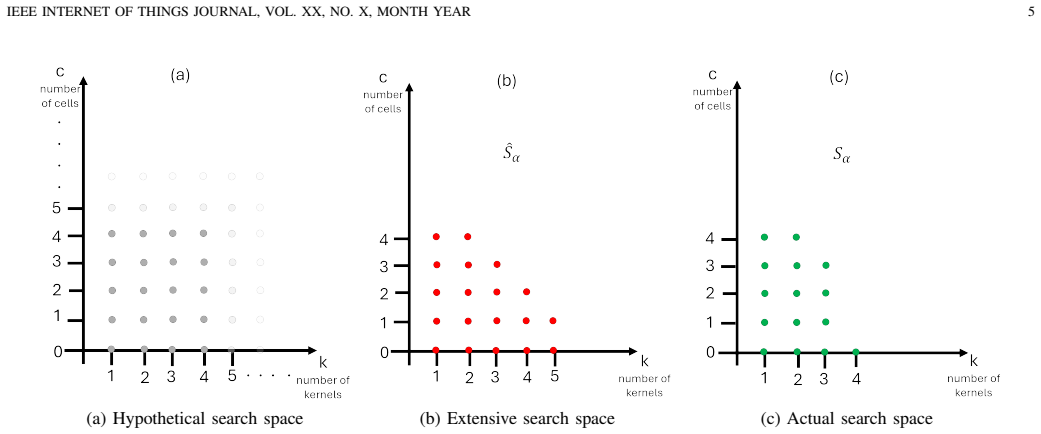
The load-bearing machinery is a derivative-free, bi-level search over a small regular cell-based search space. Architectures are convolutional networks described by the pair (k,c), where k is the number of kernels in a base convolutional layer and c is the number of building cells stacked on top of it; each building cell halves feature resolution, applies convolution, batch normalization, and a ReLU activation, and kernel counts grow by a gradually shrinking increment inspired by VGG16. The inner search loop fixes k and explores increasing c; the outer loop proposes the next k as a variable increment of the previously confirmed k, shrinking that increment whenever a candidate fails to improve validation accuracy, and stops when the increment reaches zero. Before searching, an admissible architecture set is built under the edge and gateway memory constraints, and that set is then cropped using empirically measured per-architecture evaluation time and peak power so that the whole search fits the gateway's time and energy budgets. A real-time monitor process halts the search if a bound is exceeded.
What would settle it
Re-run the search on Visual Wake Words once with the 3-epoch ranking and once with every candidate trained for the full 100 epochs, then compare the selected (k,c) pairs and their test accuracies; if the full-training winner differs from the short-ranking winner or achieves meaningfully higher accuracy, the ranking proxy is unreliable.
Extended reading notes
Core claim
The central claim is that the search procedure itself, not just the final inference, can be made to fit on commodity gateway hardware. The authors implement a hardware-aware neural architecture search that operates under six constraints: the target microcontroller must fit the candidate network's RAM, Flash, and multiply-accumulate usage, while the gateway must fit the search's own memory, time, and energy budgets. The search returns a tiny convolutional network parameterized by the number of kernels in a base layer and the number of stacked building cells. In the reported experiments the method adapts when the budget shrinks, returns different architectures for different target microcontrollers and different gateways, and matches or exceeds the accuracy of larger prior models while using far less memory.
Load-bearing premise
The search ranks candidate architectures using validation accuracy after only 3 epochs of training (50 for time series), and assumes this short-training ranking predicts which architecture will score highest after the full 100- or 500-epoch training.
Editorial extensions
If this is right
- If the claim holds, privacy-sensitive deployments can run the entire design loop on-premises, so neither raw sensor data nor trained models need to be exposed to cloud services.
- Reducing the available time or energy budget does not abort the search; it returns a smaller, less accurate but still deployable model, e.g., 66% accuracy at one-third of the full budget versus 77.8% at the full budget in the reported Raspberry Pi Zero 2 experiments.
- The same search procedure can target different microcontrollers, and the selected architecture scales with the target's RAM, Flash, and MAC budget, as shown by the three STM32 devices used in the experiments.
- When the same budget is given to different gateways, the search adapts by cropping the search space differently and still returns a usable architecture, as demonstrated on Raspberry Pi 3, Pi 4, and Pi Zero 2.
- On time-series data the approach produces a network that beats the compared reference on accuracy and latency while using about 5 times less RAM and about 13 times less Flash memory.
- If the claim holds, privacy-sensitive deployments can run the entire design loop on-premises, so neither raw sensor data nor trained models need to be exposed to cloud services.
- Reducing the available time or energy budget does not abort the search; it returns a smaller, less accurate but still deployable model, e.g., 66% accuracy at one-third of the full budget versus 77.8% at the full budget in the reported Raspberry Pi Zero 2 experiments.
- The same search procedure can target different microcontrollers, and the selected architecture scales with the target's RAM, Flash, and MAC budget, as shown by the three STM32 devices used in the experiments.
Reading between the lines
- The paper does not report a correlation study between the 3-epoch validation accuracy used during search and the final accuracy after the 100-epoch retraining; such a study would directly test whether the cheap ranking proxy selects the same architectures a full training would select.
- Because the search loop is lightweight and runs on the gateway, it could in principle be re-executed as new local data arrive, enabling continual personalization without cloud involvement; the paper does not discuss this extension.
- The cropping algorithm estimates the time upper bound from the largest architecture in the admissible set; a finer per-architecture cost model could keep more of the search space within a fixed budget than this conservative bound allows.
- Since the search space is convolutional and the time-series experiment already succeeds, the same gateway-centric design mechanism plausibly extends to other non-image sensor modalities, though the paper only demonstrates image and accelerometer data.
Editorial analysis
A structured set of objections, weighed in public.
Referee Report
Summary. The paper presents HW-NAS, a Hardware-Aware Neural Architecture Search method designed to run on IoT gateways (Raspberry Pi-class devices) and produce architectures for sensor nodes (STM32 microcontrollers) without transferring data off-site. The search space is a regular family of CNNs parameterized by (k, c); the search is a derivative-free bi-level procedure (Algorithm 3) with an adaptive cropping of the search space driven by time and energy budgets (Algorithms 1-2). Experiments on Visual Wake Words, CIFAR-10, a melanoma skin cancer dataset, and the CWRU bearing dataset report accuracy, RAM/Flash/MAC usage, and latency on three STM32 targets, with the search running in under 10 hours on a Raspberry Pi Zero 2 for VWW and under 2 hours on a Raspberry Pi 4 for CWRU. The paper claims state-of-the-art results on VWW and CWRU.
Significance. If the claims hold, this is a useful step toward privacy-preserving on-premise NAS for IoT. The paper contributes open-source code, uses external publicly available benchmarks, and measures real hardware constraints (RAM, Flash, MACs, latency, energy), which are all strengths. The adaptive budget mechanism that crops the search space based on time/energy constraints is a practical idea. However, the central empirical claims currently rest on an unvalidated short-training proxy and on comparisons that do not support the 'state-of-the-art' wording. The novelty over the authors' prior work [15],[26],[27],[28] is incremental, mostly in the cropping and gateway-execution aspects. With the suggested experiments (rank correlation, seeds, random-search baseline, and revised claims), the paper could become acceptable.
major comments (3)
- [V-d, Algorithm 3] The search ranks candidate architectures by validation accuracy computed after only 3 epochs (50 for time series) with a batch size of 16, learning rate 1e-3, 30% validation split, and no augmentation, while the final deployed network is trained for 100/500 epochs with batch size 128, learning rate 1e-2, 10% validation split, and randomized augmentation. No evidence is provided that the short-training ranking correlates with final test accuracy: there is no rank-correlation analysis, no repeated-seed stability check, and no comparison against random search on the same search space Sα. Since Algorithm 3's inner-loop and outer-loop decisions depend entirely on f(k,c), a misranking proxy could return a (k,c) that is not among the best deployable architectures. This is the load-bearing assumption for the claim that the gateway search automatically designs good NNs, and it needs direct validation.
- [Abstract, Section I, Table V] The abstract and Section I claim 'state-of-the-art results' on the Visual Wake Words dataset, but Table V shows the proposal reaching 78.3% accuracy while MCUNet reaches 87.4% on the same dataset. The text in Section VI-B itself states that 'MCUNet produces the network with the highest test accuracy' and that the proposal 'achieves the second-best test accuracy'. The state-of-the-art claim is therefore not supported by the presented comparison; it should be revised to 'competitive' or explicitly qualified to the class of methods whose search runs on edge devices under strict time/energy budgets.
- [Tables IV-VIII] All accuracy numbers are reported as single values from single runs, with no error bars, no number of seeds, and no statistical significance tests. This is especially problematic because the same target device and dataset can yield different resulting architectures and accuracies in different experiments (e.g., Table IV shows VWW accuracy 78.3% for STM32L412KBU3, while Table VI, first row, shows 77.8% for the same target under the full budget on a Raspberry Pi Zero 2). Without repeated-seed experiments, the reader cannot assess whether the observed differences are within noise or whether the search is stable. Please report mean±std over at least three seeds (or a clear explanation of deterministic behavior) for the key experiments.
minor comments (5)
- [VI-D] In the first paragraph of Section VI-D, 'Raspberry Pi 0' should be 'Raspberry Pi Zero 2'.
- [VI-C] The text says 'two-third of the best possible budget' and 'one-third of the best possible budget'; the grammatical singular 'two-third' should be 'two-thirds'.
- [Algorithm 2] In Algorithm 2, line 11, the notation '|Sα|¯t' and '|Sα|¯e' would benefit from an explicit multiplication operator (e.g., '|Sα| · ¯t') for clarity.
- [V-f] The description of the Visual Wake Words experiment uses 'one-tenth of the training split' only in the last sentence of Section V-f; it would be clearer to state this in the hyper-parameters subsection (V-d) where the search setup is described.
- [General] The open-source repository link is given in the contributions; the paper would be stronger with a brief note on the software dependencies and the exact versions of the libraries (e.g., TensorFlow Lite Micro, X-CUBE-AI) used for the measurements.
Circularity Check
No circular derivation; inherited search space from prior self-authored work is an input, not a prediction.
full rationale
The paper's central claims are empirical and benchmarked against external datasets (Visual Wake Words, CIFAR-10, Melanoma, CWRU) whose labels and test sets are not constructed by the authors. No equation in the paper reduces to a fitted result: the validation accuracy used in Algorithm 3 is computed on a held-out split after brief training, and the final test accuracy is measured after a separate, longer training run, so the reported accuracies are not forced by the search objective. The kernel-growth formula n_c = n_{c-1} + 2^{1-c} n_{c-1} is inherited from the authors' prior work [15] and is an explicit design choice, not a prediction derived from first principles; citing it is an ordinary acknowledgment of reused search-space components, not a load-bearing self-citation. The claimed uniqueness of running NAS on an embedded gateway is supported by the comparison tables against external methods, not by a self-cited uniqueness theorem. The paper's own limitation that candidate ranking uses only 3 epochs of training (50 for time series) while final models train for 100/500 epochs is a methodological validation risk, not a circularity: it does not define any output in terms of an input. All load-bearing experimental outcomes are externally falsifiable, and no fitted parameter is renamed as a prediction. The score of 2 reflects the presence of repeated self-citations for the search space and optimization lineage, but none of these citations is load-bearing in the sense of making the derivation equivalent to its inputs by construction.
Assumptions & free parameters
free parameters (4)
- search-phase training epochs =
3 for images, 50 for time series
- search-phase learning rate and batch size =
1e-3, batch 16, Adam
- final training recipe =
100 or 500 epochs, lr 1e-2, batch 128, rotation augmentation +-2pi/5
- input image resolutions =
50x50 for VWW and melanoma, 32x32 for CIFAR-10
assumptions (4)
- domain assumption Validation accuracy after 3 epochs (50 for time series) is a reliable proxy for final accuracy after 100 or 500 epochs of training.
- domain assumption The greedy outer-loop stopping rule of Algorithm 3 finds a near-optimal architecture in the search space.
- domain assumption Resource estimates from X-CUBE-AI and stm32tflm accurately represent Flash, RAM, and MAC usage on the three STM32 targets.
- domain assumption The worst-case power measured under stress-ng is a valid energy bound for planning the NAS budget.
Cite this review
Pith. "Pith review of Searching Neural Architectures for Sensor Nodes on IoT Gateways." pith.science (2026). https://pith.science/paper/RHPO6TKN
@misc{pith2026250523939,
  author       = {Pith},
  title        = {Pith review of: Searching Neural Architectures for Sensor Nodes on IoT Gateways},
  year         = {2026},
  howpublished = {\url{https://pith.science/paper/RHPO6TKN}},
  note         = {Machine review of arXiv:2505.23939}
}
read the original abstract
This paper presents an automatic method for the design of Neural Networks (NNs) at the edge, enabling Machine Learning (ML) access even in privacy-sensitive Internet of Things (IoT) applications. The proposed method runs on IoT gateways and designs NNs for connected sensor nodes without sharing the collected data outside the local network, keeping the data in the site of collection. This approach has the potential to enable ML for Healthcare Internet of Things (HIoT) and Industrial Internet of Things (IIoT), designing hardware-friendly and custom NNs at the edge for personalized healthcare and advanced industrial services such as quality control, predictive maintenance, or fault diagnosis. By preventing data from being disclosed to cloud services, this method safeguards sensitive information, including industrial secrets and personal data. The outcomes of a thorough experimental session confirm that -- on the Visual Wake Words dataset -- the proposed approach can achieve state-of-the-art results by exploiting a search procedure that runs in less than 10 hours on the Raspberry Pi Zero 2.
Figures


Reference graph
Works this paper leans on
-
[15]
Running hardware-aware neural architecture search on embedded devices under 512mb of ram,
A. M. Garavagno, E. Ragusa, A. Frisoli, and P. Gastaldo, “Running hardware-aware neural architecture search on embedded devices under 512mb of ram,” in2024 IEEE International Conference on Consumer Electronics (ICCE). IEEE, 2024, pp. 1–2
work page 2024
-
[26]
A. M. Garavagno, D. Leonardis, and A. Frisoli, “Colabnas: Obtaining lightweight task-specific convolutional neural networks following oc- cam’s razor,”Future Generation Computer Systems, vol. 152, pp. 152– 159, 2024
work page 2024
-
[27]
A hardware- aware neural architecture search algorithm targeting low-end microcon- trollers,
A. M. Garavagno, E. Ragusa, A. Frisoli, and P. Gastaldo, “A hardware- aware neural architecture search algorithm targeting low-end microcon- trollers,” in2023 18th Conference on Ph. D Research in Microelectronics and Electronics (PRIME). IEEE, 2023, pp. 281–284
work page 2023
-
[28]
——, “An affordable hardware-aware neural architecture search for deploying convolutional neural networks on ultra-low-power computing platforms,”IEEE Sensors Letters, 2024
work page 2024
-
[1]
Graph neural networks in iot: A survey,
G. Dong, M. Tang, Z. Wang, J. Gao, S. Guo, L. Cai, R. Gutierrez, B. Campbel, L. E. Barnes, and M. Boukhechba, “Graph neural networks in iot: A survey,”ACM Transactions on Sensor Networks, vol. 19, no. 2, pp. 1–50, 2023
work page 2023
-
[2]
M. N. Bhuiyan, M. M. Rahman, M. M. Billah, and D. Saha, “Internet of things (iot): A review of its enabling technologies in healthcare applications, standards protocols, security, and market opportunities,” IEEE Internet of Things Journal, vol. 8, no. 13, pp. 10 474–10 498, 2021
work page 2021
-
[3]
J. Chen, K. Wen, J. Xia, R. Huang, Z. Chen, and W. Li, “Knowledge embedded autoencoder network for harmonic drive fault diagnosis under few-shot industrial scenarios,”IEEE Internet of Things Journal, 2024
work page 2024
-
[4]
Ecg biometric recogni- tion: unlinkability, irreversibility, and security,
S.-C. Wu, P.-L. Hung, and A. L. Swindlehurst, “Ecg biometric recogni- tion: unlinkability, irreversibility, and security,”IEEE Internet of Things Journal, vol. 8, no. 1, pp. 487–500, 2020. IEEE INTERNET OF THINGS JOURNAL, VOL. XX, NO. X, MONTH YEAR 10
work page 2020
Show all 54 references
-
[5]
Privacy in internet of things: From principles to technologies,
C. Li and B. Palanisamy, “Privacy in internet of things: From principles to technologies,”IEEE Internet of Things Journal, vol. 6, no. 1, pp. 488–505, 2018
2018
-
[6]
A survey of healthcare internet of things (hiot): A clinical perspective,
H. Habibzadeh, K. Dinesh, O. R. Shishvan, A. Boggio-Dandry, G. Sharma, and T. Soyata, “A survey of healthcare internet of things (hiot): A clinical perspective,”IEEE Internet of Things Journal, vol. 7, no. 1, pp. 53–71, 2019
2019
-
[7]
Industry 4.0 and health: Internet of things, big data, and cloud computing for healthcare 4.0,
G. Aceto, V . Persico, and A. Pescap ´e, “Industry 4.0 and health: Internet of things, big data, and cloud computing for healthcare 4.0,”Journal of Industrial Information Integration, vol. 18, p. 100129, 2020
2020
-
[8]
Challenges and opportunities in securing the industrial internet of things,
M. Serror, S. Hack, M. Henze, M. Schuba, and K. Wehrle, “Challenges and opportunities in securing the industrial internet of things,”IEEE Transactions on Industrial Informatics, vol. 17, no. 5, pp. 2985–2996, 2020
2020
-
[9]
A comprehensive survey of neural architecture search: Challenges and solutions,
P. Ren, Y . Xiao, X. Chang, P.-Y . Huang, Z. Li, X. Chen, and X. Wang, “A comprehensive survey of neural architecture search: Challenges and solutions,”ACM Computing Surveys (CSUR), vol. 54, no. 4, pp. 1–34, 2021
2021
-
[10]
Toward tailored models on private aiot devices: Federated direct neural architecture search,
C. Zhang, X. Yuan, Q. Zhang, G. Zhu, L. Cheng, and N. Zhang, “Toward tailored models on private aiot devices: Federated direct neural architecture search,”IEEE Internet of Things Journal, vol. 9, no. 18, pp. 17 309–17 322, 2022
2022
-
[11]
Neural architecture search for robust networks in 6g-enabled massive iot domain,
K. Wang, P. Xu, C.-M. Chen, S. Kumari, M. Shojafar, and M. Alazab, “Neural architecture search for robust networks in 6g-enabled massive iot domain,”IEEE internet of things journal, vol. 8, no. 7, pp. 5332– 5339, 2020
2020
-
[12]
Neural architecture search survey: A hardware perspective,
K. T. Chitty-Venkata and A. K. Somani, “Neural architecture search survey: A hardware perspective,”ACM Computing Surveys, vol. 55, no. 4, pp. 1–36, 2022
2022
-
[13]
On internet-of- things (iot) gateway coverage expansion,
K. Adhinugraha, W. Rahayu, T. Hara, and D. Taniar, “On internet-of- things (iot) gateway coverage expansion,”Future Generation Computer Systems, vol. 107, pp. 578–587, 2020
2020
-
[14]
An adaptive neural architecture search design for collaborative edge-cloud computing,
H. Lu, M. Du, X. He, K. Qian, J. Chen, Y . Sun, and K. Wang, “An adaptive neural architecture search design for collaborative edge-cloud computing,”IEEE Network, vol. 35, no. 5, pp. 83–89, 2021
2021
-
[16]
Empowering things with intelligence: a survey of the progress, challenges, and opportunities in artificial intelligence of things,
J. Zhang and D. Tao, “Empowering things with intelligence: a survey of the progress, challenges, and opportunities in artificial intelligence of things,”IEEE Internet of Things Journal, vol. 8, no. 10, pp. 7789–7817, 2020
2020
-
[17]
Semantic- darts: Elevating semantic learning for mobile differentiable architecture search,
B. Guo, S. He, M. Shi, K. Yu, J. Chen, and X. Shen, “Semantic- darts: Elevating semantic learning for mobile differentiable architecture search,”IEEE Internet of Things Journal, 2024
2024
-
[18]
Multi-hardware adaptive latency prediction for neural architecture search,
C. Lin, P. Yang, Q. Wang, Y . Guo, and Z. Wang, “Multi-hardware adaptive latency prediction for neural architecture search,”IEEE Internet of Things Journal, 2024
2024
-
[19]
Bionetexplorer: Architecture-space exploration of biosignal processing deep neural networks for wearables,
B. S. Prabakaran, A. Akhtar, S. Rehman, O. Hasan, and M. Shafique, “Bionetexplorer: Architecture-space exploration of biosignal processing deep neural networks for wearables,”IEEE Internet of Things Journal, vol. 8, no. 17, pp. 13 251–13 265, 2021
2021
-
[20]
Ssvep-based emotion recognition for iot via multiobjective neural architecture search,
Y . Du, J. Liu, X. Wang, and P. Wang, “Ssvep-based emotion recognition for iot via multiobjective neural architecture search,”IEEE Internet of Things Journal, vol. 9, no. 21, pp. 21 432–21 443, 2022
2022
-
[21]
Neural architecture search for anomaly detection in time series data of smart buildings: A reinforce- ment learning approach for optimal autoencoder design,
M. Dissem, M. Amayri, and N. Bouguila, “Neural architecture search for anomaly detection in time series data of smart buildings: A reinforce- ment learning approach for optimal autoencoder design,”IEEE Internet of Things Journal, 2024
2024
-
[22]
Compres- sion–accuracy co-optimization through hardware-aware neural architec- ture search for vibration damage detection,
E. Ragusa, F. Zonzini, L. De Marchi, and R. Zunino, “Compres- sion–accuracy co-optimization through hardware-aware neural architec- ture search for vibration damage detection,”IEEE Internet of Things Journal, vol. 11, no. 19, pp. 31 745–31 757, 2024
2024
-
[23]
Mnasnet: Platform-aware neural architecture search for mobile,
M. Tan, B. Chen, R. Pang, V . Vasudevan, M. Sandler, A. Howard, and Q. V . Le, “Mnasnet: Platform-aware neural architecture search for mobile,” inProceedings of the IEEE/CVF conference on computer vision and pattern recognition, 2019, pp. 2820–2828
2019
-
[24]
Mcunet: Tiny deep learning on iot devices,
J. Lin, W.-M. Chen, Y . Lin, C. Gan, S. Hanet al., “Mcunet: Tiny deep learning on iot devices,”Advances in Neural Information Processing Systems, vol. 33, pp. 11 711–11 722, 2020
2020
-
[25]
Micronets: Neural network architectures for deploying tinyml applications on commodity microcontrollers,
C. Banbury, C. Zhou, I. Fedorov, R. Matas, U. Thakker, D. Gope, V . Janapa Reddi, M. Mattina, and P. Whatmough, “Micronets: Neural network architectures for deploying tinyml applications on commodity microcontrollers,”Proceedings of Machine Learning and Systems, vol. 3, pp. 51...
2021
-
[29]
Foundations and modeling of dynamic networks using dynamic graph neural networks: A survey,
J. Skarding, B. Gabrys, and K. Musial, “Foundations and modeling of dynamic networks using dynamic graph neural networks: A survey,” iEEE Access, vol. 9, pp. 79 143–79 168, 2021
2021
-
[30]
Dynamic neural networks: A survey,
Y . Han, G. Huang, S. Song, L. Yang, H. Wang, and Y . Wang, “Dynamic neural networks: A survey,”IEEE Transactions on Pattern Analysis and Machine Intelligence, vol. 44, no. 11, pp. 7436–7456, 2021
2021
-
[31]
A survey on transfer learning,
S. J. Pan and Q. Yang, “A survey on transfer learning,”IEEE Trans- actions on knowledge and data engineering, vol. 22, no. 10, pp. 1345– 1359, 2009
2009
-
[32]
Learning gestures from wifi: A siamese recurrent convolutional architecture,
J. Yang, H. Zou, Y . Zhou, and L. Xie, “Learning gestures from wifi: A siamese recurrent convolutional architecture,”IEEE Internet of Things Journal, vol. 6, no. 6, pp. 10 763–10 772, 2019
2019
-
[33]
Robust wifi- enabled device-free gesture recognition via unsupervised adversarial domain adaptation,
H. Zou, J. Yang, Y . Zhou, L. Xie, and C. J. Spanos, “Robust wifi- enabled device-free gesture recognition via unsupervised adversarial domain adaptation,” in2018 27th International Conference on Computer Communication and Networks (ICCCN). IEEE, 2018, pp. 1–8
2018
-
[34]
An intelligent fault diagnosis scheme for rotating machinery based on supervised domain adaptation with manifold embedding,
X. Yu, F. Dong, B. Xia, S. Yang, E. Ding, and W. Yu, “An intelligent fault diagnosis scheme for rotating machinery based on supervised domain adaptation with manifold embedding,”IEEE Internet of Things Journal, vol. 10, no. 1, pp. 953–972, 2022
2022
-
[35]
Leveraging systems’ non-linearity to tackle the scarcity of data in the design of intelligent fault diagnosis systems,
G. Santamato, A. M. Garavagno, M. Solazzi, and A. Frisoli, “Leveraging systems’ non-linearity to tackle the scarcity of data in the design of intelligent fault diagnosis systems,”Nonlinear Dynamics, vol. 112, no. 18, pp. 16 153–16 166, 2024
2024
-
[36]
A comprehensive survey on hardware-aware neural architecture search,
H. Benmeziane, K. E. Maghraoui, H. Ouarnoughi, S. Niar, M. Wistuba, and N. Wang, “A comprehensive survey on hardware-aware neural architecture search,”arXiv preprint arXiv:2101.09336, 2021
2021 arXiv
-
[37]
Once-for-all: Train one network and specialize it for efficient deployment,
H. Cai, C. Gan, T. Wang, Z. Zhang, and S. Han, “Once-for-all: Train one network and specialize it for efficient deployment,”arXiv preprint arXiv:1908.09791, 2019
1908 arXiv
-
[38]
Random search and reproducibility for neural architecture search,
L. Li and A. Talwalkar, “Random search and reproducibility for neural architecture search,” inUncertainty in artificial intelligence. PMLR, 2020, pp. 367–377
2020
-
[39]
Learning transferable architectures for scalable image recognition,
B. Zoph, V . Vasudevan, J. Shlens, and Q. V . Le, “Learning transferable architectures for scalable image recognition,” inProceedings of the IEEE conference on computer vision and pattern recognition, 2018, pp. 8697– 8710
2018
-
[40]
Darts: Differentiable architecture search,
H. Liu, K. Simonyan, and Y . Yang, “Darts: Differentiable architecture search,”arXiv preprint arXiv:1806.09055, 2018
2018 arXiv
-
[41]
Proxylessnas: Direct neural architecture search on target task and hardware,
H. Cai, L. Zhu, and S. Han, “Proxylessnas: Direct neural architecture search on target task and hardware,”arXiv preprint arXiv:1812.00332, 2018
2018 arXiv
-
[42]
Fbnet: Hardware-aware efficient convnet design via differentiable neural architecture search,
B. Wu, X. Dai, P. Zhang, Y . Wang, F. Sun, Y . Wu, Y . Tian, P. Vajda, Y . Jia, and K. Keutzer, “Fbnet: Hardware-aware efficient convnet design via differentiable neural architecture search,” inProceedings of the IEEE/CVF conference on computer vision and pattern recognition, ...
2019
-
[43]
Fast hardware- aware neural architecture search,
L. L. Zhang, Y . Yang, Y . Jiang, W. Zhu, and Y . Liu, “Fast hardware- aware neural architecture search,” inProceedings of the IEEE/CVF Conference on Computer Vision and Pattern Recognition Workshops, 2020, pp. 692–693
2020
-
[44]
Effect of data standardization on neural network training,
M. Shanker, M. Y . Hu, and M. S. Hung, “Effect of data standardization on neural network training,”Omega, vol. 24, no. 4, pp. 385–397, 1996
1996
-
[45]
Batch normalization: Accelerating deep network training by reducing internal covariate shift,
S. Ioffe and C. Szegedy, “Batch normalization: Accelerating deep network training by reducing internal covariate shift,” inInternational conference on machine learning. pmlr, 2015, pp. 448–456
2015
-
[46]
Very deep convolutional networks for large-scale image recognition,
K. Simonyan and A. Zisserman, “Very deep convolutional networks for large-scale image recognition,”arXiv preprint arXiv:1409.1556, 2014
2014 arXiv
-
[47]
Network in network,
M. Lin, Q. Chen, and S. Yan, “Network in network,”arXiv preprint arXiv:1312.4400, 2013
2013 arXiv
-
[48]
Adam: A method for stochastic optimization,
D. P. Kingma and J. Ba, “Adam: A method for stochastic optimization,” arXiv preprint arXiv:1412.6980, 2014
2014 arXiv
-
[49]
Visual wake words dataset,
A. Chowdhery, P. Warden, J. Shlens, A. Howard, and R. Rhodes, “Visual wake words dataset,”arXiv preprint arXiv:1906.05721, 2019. IEEE INTERNET OF THINGS JOURNAL, VOL. XX, NO. X, MONTH YEAR 11
1906 arXiv
-
[50]
Mlperf tiny bench- mark,
C. Banbury, V . J. Reddi, P. Torelli, J. Holleman, N. Jeffries, C. Kiraly, P. Montino, D. Kanter, S. Ahmed, D. Pauet al., “Mlperf tiny bench- mark,”arXiv preprint arXiv:2106.07597, 2021
2021 arXiv
-
[51]
[Online]
Melanoma skin cancer dataset. [Online]. Available: https://www.kaggle.com/datasets/hasnainjaved/ melanoma-skin-cancer-dataset-of-10000-images
-
[52]
Rolling element bearing diagnostics using the case western reserve university data: A benchmark study,
W. A. Smith and R. B. Randall, “Rolling element bearing diagnostics using the case western reserve university data: A benchmark study,” Mechanical systems and signal processing, vol. 64, pp. 100–131, 2015
2015
-
[53]
Bench- marking tinyml systems: Challenges and direction,
C. R. Banbury, V . J. Reddi, M. Lam, W. Fu, A. Fazel, J. Holleman, X. Huang, R. Hurtado, D. Kanter, A. Lokhmotovet al., “Bench- marking tinyml systems: Challenges and direction,”arXiv preprint arXiv:2003.04821, 2020
2003 arXiv
-
[54]
An improved fault diagnosis using 1d-convolutional neural network model,
C.-C. Chen, Z. Liu, G. Yang, C.-C. Wu, and Q. Ye, “An improved fault diagnosis using 1d-convolutional neural network model,”Electronics, vol. 10, no. 1, p. 59, 2020
2020
Reviewed August 7, 2026 · model on record in the stance chip above.
Discussion (0). Sign in to comment.