REVIEW 4 major objections 3 minor 2 references
Bridging the Gap: Enhancing Digital Accessibility for Medicaid Populations in Telehealth Adoption
T0 review · 4 major / 3 minor · reviewed 2026-08-07 · deepseek-v4-flash
Pith's one-line read The paper argues that telehealth's accessibility gap for Medicaid populations is caused by six interacting barriers—broadband, digital literacy, interface usability, assistive technology, cost, privacy, and policy—and proposes a framework…
desk verdict A readable but derivative narrative review whose headline statistics are misattributed to sources that do not support them; no new data or framework, and citation handling is poor enough to disqualify it from peer review. read the letter →
The pith
A machine-rendered reading of the paper's core claim, the machinery that carries it, and where it could break.
The reading
What carries the argument
The central object is the paper's 'Framework for Enhancing Digital Accessibility in Telehealth' (Figure 2), a multidimensional model that organizes the problem and the response into parallel tracks: expanding broadband and subsidized internet access, making platforms comply with WCAG 2.1 and Section 508 and adding AI-assisted accessibility features (screen readers, real-time captioning, voice navigation, keyboard support), running community digital literacy and training programs, integrating assistive technologies such as haptic and gesture controls, and aligning policy with Medicaid reimbursement and compliance audits. The framework does the argumentative work by ensuring that every identified barrier has a named counterpart solution, which is how the paper sustains its recommendation that accessibility is achievable through coordinated rather than piecemeal effort. The framework itself is supported by three anchor statistics—about 30% lacking broadband, about 57% WCAG compliance, about 43% needing app assistance—that quantify the barriers it is designed to remove.
What would settle it
A representative audit of a randomly sampled set of Medicaid-covered telehealth platforms, combined with a survey of a representative panel of Medicaid beneficiaries, would falsify the paper's framing if it found, for example, that more than 90% of platforms already pass WCAG 2.1 AA and that fewer than 10% of beneficiaries report broadband or usability barriers; those findings would show the accessibility gap the paper describes has already closed. A complementary test would be an implementation study in two matched Medicaid regions, one receiving the full framework (broadband subsidies, training, assistive features, policy alignment) and one receiving usual care, measuring whether telehealth visit completion and patient-reported accessibility improve substantially for the treated group.
Extended reading notes
Core claim
The paper's central discovery, on its own terms, is a systematic mapping of why Medicaid populations fall out of telehealth adoption and what would bring them back. Its literature review identifies six barrier classes—the digital divide in broadband, low digital literacy and complex interfaces, missing assistive features for people with disabilities, cost constraints for devices and data, data privacy and security vulnerabilities, and regulatory inconsistencies across states—and its proposed framework (Figure 2) attaches a remedy to each class. The 'discovery' is therefore the map itself: a structured account that converts scattered findings from prior reviews and platform audits into an actionable agenda for healthcare providers, technology developers, and policymakers. The paper does not test whether the remedies work; it asserts, with cited evidence for the size of each barrier, that these are the levers that matter.
Load-bearing premise
The recommendations stand or fall on whether the cited statistics—about 30% of Medicaid beneficiaries lacking broadband, about 57% of platforms meeting WCAG, about 43% needing assistance—are accurate and representative of today's Medicaid population.
Editorial extensions
If this is right
- If telehealth platforms adopt WCAG 2.1 and Section 508 compliance as the paper recommends, patients with visual, hearing, motor, and cognitive disabilities gain the ability to complete visits without third-party assistance.
- If AI-assisted accessibility features—real-time captioning, screen-reader compatibility, voice-activated navigation—are integrated into Medicaid-supported apps, the usability barriers for disabled and non-native-English-speaking patients shrink.
- If broadband expansion and subsidized internet programs like the Affordable Connectivity Program continue, video-based telehealth becomes reachable for the rural and low-income Medicaid enrollees who currently cannot connect.
- If community-based digital literacy training (for example, Digital Navigator programs at community health centers and libraries) is funded, adoption among older and less-educated beneficiaries rises.
- If Medicaid telehealth reimbursement rates and accessibility mandates are standardized across states, the paper predicts a measurable reduction in geographic disparities in telehealth availability.
Reading between the lines
- The paper implies that the six interventions are complementary and mutually reinforcing, but it never tests that synergy; an implementation study that varies the components independently could reveal whether broadband alone, or training alone, does most of the work.
- The review motivates a public accessibility scorecard: because the ~57% WCAG compliance figure comes from a single study, a systematic monthly or annual audit of Medicaid telehealth platforms would turn the paper's static statistic into an accountable, trackable quality metric.
- The argument suggests that AI-assisted accessibility tools could reduce reliance on human support staff, but it leaves open whether those tools perform adequately on low-cost devices and low-bandwidth connections; a focused usability test in offline or constrained-network conditions would extend the paper's claims.
- The paper's emphasis on policy standardization implies a federal role, yet it also notes state variation in reimbursement; a natural next step is a comparative policy analysis correlating state telehealth reimbursement rates with Medicaid beneficiary adoption rates, which the paper does not attempt.
Editorial analysis
A structured set of objections, weighed in public.
Referee Report
Summary. The manuscript is a narrative review and position paper addressing digital accessibility barriers faced by Medicaid beneficiaries in using telehealth. It identifies poor internet connectivity, low digital literacy, inaccessible platforms, lack of assistive technology, affordability, privacy concerns, and regulatory inconsistencies as key obstacles, and proposes solutions such as broadband expansion, WCAG-compliant design, AI-assisted accessibility tools, digital literacy programs, and policy reform. The paper makes several quantitative claims about the prevalence of these barriers and presents multiple figures that appear to display empirical data. However, the paper reports no original data, no described methodology, and no evaluation, and its quantitative claims are attributed to sources that do not appear to support them.
Significance. If the quantitative claims and recommendations were well-supported, the paper would address a genuinely important and policy-relevant topic: equitable telehealth access for Medicaid populations. The qualitative themes (broadband gaps, literacy barriers, WCAG compliance, cost and privacy concerns) are plausible and consistent with the existing literature. However, the manuscript's evidentiary base is unreliable: several specific statistics are misattributed to sources that do not contain them, and the figures appear to present unsourced quantitative summaries. The paper therefore does not, as it stands, provide a trustworthy synthesis of the problem or evidence-based recommendations. Its value as a substantive research contribution is minimal, though the topic itself is significant.
major comments (4)
- [Literature Review, 'Challenges in Telehealth Accessibility for Medicaid Populations' (p. 3)] The manuscript states that 'Zhou et al. (2019) in their research found that around 30% of Medicaid beneficiaries struggle to get broadband internet facilities' and cites Zhou and Parmanto (2019). That source is a systematic review titled 'Reaching People With Disabilities in Underserved Areas Through Digital Interventions'; it does not report a Medicaid-specific broadband prevalence rate. This statistic is load-bearing because it frames the scale of the connectivity barrier that motivates the paper's recommendations. The authors must either supply a verifiable primary source for this figure or remove the claim.
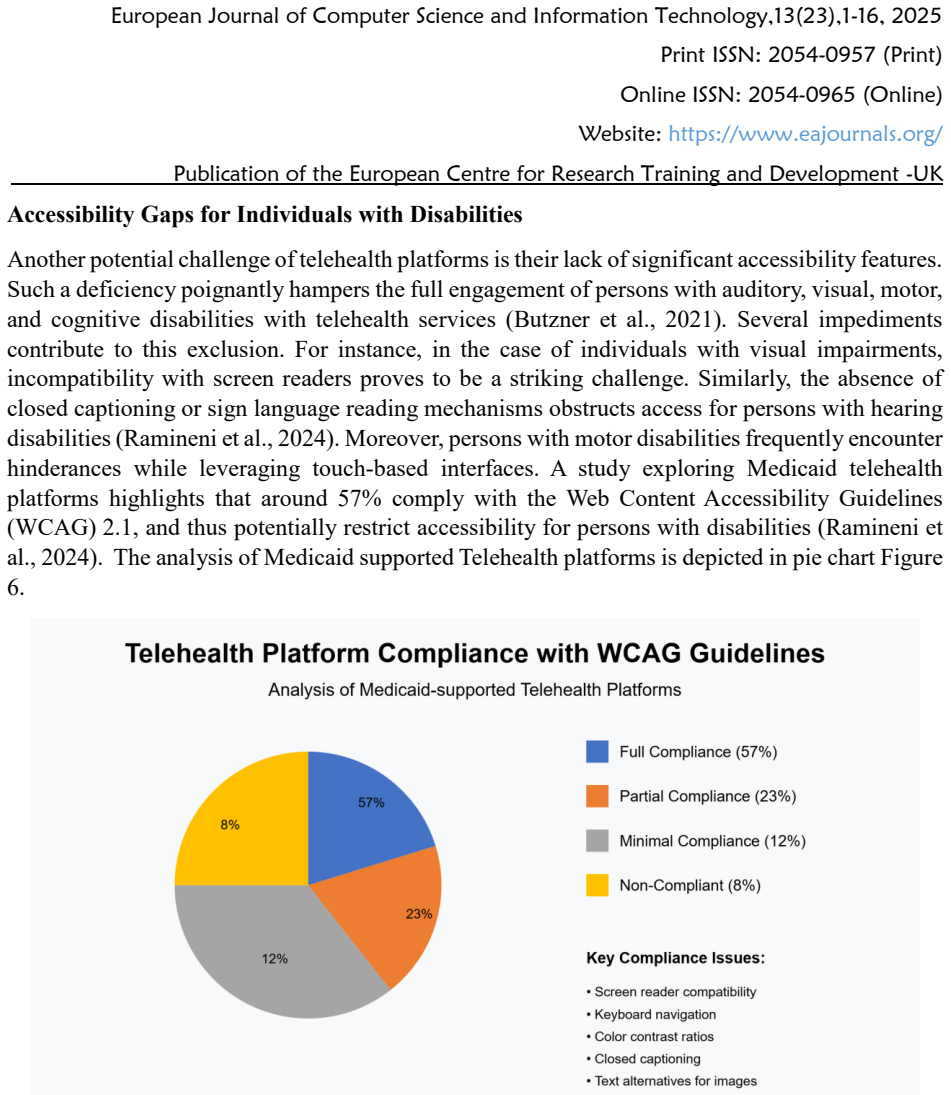
- [Challenges, 'Accessibility Gaps for Individuals with Disabilities' (p. 11)] The claim that 'around 57% comply with the Web Content Accessibility Guidelines (WCAG) 2.1' with respect to Medicaid telehealth platforms is cited to Ramineni et al. (2024). The cited paper (an IEEE MCSoC conference paper) concerns e-commerce accessibility through sign language integration, not an analysis of Medicaid telehealth platforms. No other source is provided for this percentage, so the claim is unsupported and cannot be verified from the reference list.
- [Challenges, 'Low Digital Literacy and Technological Barriers' (p. 10)] The statement that 'around 43% of Medicaid beneficiaries require assistance to utilize telehealth apps and tools' is attributed to K Vedith Reddy et al. (2025). The cited paper describes an AI-driven healthcare management platform and does not report a Medicaid-specific assistance statistic. This figure is used to justify the paper's digital-literacy recommendations, but it appears to be unverifiable from the cited source. The authors should either provide a correct source or delete the numeric claim.
- [Challenges, 'Data Privacy and Security Concerns' (p. 12)] The manuscript describes a 2021 data breach affecting over 500,000 patients and cites Zhou et al. (2019) for that event. Zhou and Parmanto (2019) is a systematic review published well before 2021, so the citation cannot support the claim. This is not an isolated slip; the same pattern of misattribution affects the broadband, WCAG compliance, and assistance statistics above. Moreover, Figures 5, 6, and 7 present what appear to be empirical summaries (percentages, compliance rates, and adoption trends) with no described data source, collection method, or analysis. Because the quantitative evidence base is unreliable and the figures are unsubstantiated, the paper's central problem framing is not supported.
minor comments (3)
- [Throughout the manuscript] The text contains frequent grammatical and usage errors (e.g., 'hinderances', 'outmoded mobile gadgets', 'the the' style repetitions) and would benefit from careful professional copyediting.
- [Figures 1-7] Several figures are not explicitly introduced or described in the running text, and none are accompanied by data sources. The captions should state the provenance of the data or indicate that the figures are illustrative schematics.
- [References] Some references are incomplete or inconsistently formatted (e.g., the K Vedith Reddy et al. entry lacks a complete author list format, and the journal name is rendered differently across entries). The Telehealth Modernization Act is mentioned repeatedly but is not cited to a specific legislative document.
Circularity Check
No circular derivation found; the paper is a narrative review whose recommendations do not reduce to its cited inputs, though some statistics are supported only by self-citations or mismatched references.
full rationale
This manuscript is a narrative review/position paper, not a derivation. It assembles qualitative barriers and recommendations for Medicaid telehealth accessibility from a literature review. There are no fitted parameters, no equations, and no quantity defined in terms of another quantity. The central claim—that Medicaid beneficiaries face broadband, digital-literacy, disability-access, cost, privacy, and policy barriers—is supported by multiple external sources (Zhou & Parmanto, Kleinman, Henni et al., Butzner & Cuffee, Jonsson et al.) and not by a self-referential construction. Some load-bearing statistics are attributed to sources that do not appear to report them: the '57% WCAG compliance' statistic is cited to Ramineni et al. (2024), a set of self-authored papers on e-commerce sign-language and ADA web accessibility, not a Medicaid telehealth platform audit; the '43% assistance' statistic is cited to K Vedith Reddy et al. (2025), an AI healthcare management platform paper; and the '30% broadband' statistic is cited to Zhou & Parmanto (2019), a systematic review of digital interventions for people with disabilities, not a Medicaid-specific broadband study. These are citation-integrity and evidentiary-support concerns rather than circularity: the paper does not derive those percentages from its own assumptions, and removing them would weaken but not collapse the qualitative argument, which also rests on policy documents and other external work. No step of the argument reduces to its own input by construction, so the circularity score is low.
Assumptions & free parameters
assumptions (2)
- domain assumption The cited statistics and examples are accurate and representative of U.S. Medicaid populations.
- domain assumption Interventions such as ACP, WCAG compliance, and AI accessibility tools are effective in real telehealth settings.
Cite this review
Pith. "Pith review of Bridging the Gap: Enhancing Digital Accessibility for Medicaid Populations in Telehealth Adoption." pith.science (2026). https://pith.science/paper/KJQMX2IG
@misc{pith2026250524035,
  author       = {Pith},
  title        = {Pith review of: Bridging the Gap: Enhancing Digital Accessibility for Medicaid Populations in Telehealth Adoption},
  year         = {2026},
  howpublished = {\url{https://pith.science/paper/KJQMX2IG}},
  note         = {Machine review of arXiv:2505.24035}
}
read the original abstract
The swift evolution of telehealth has revolutionized how medical professionals deliver healthcare services and boost convenience and accessibility. Yet, the Medicaid population encounters several impediments in utilizing facilities especially owing to poor internet connectivity, less awareness about digital platforms, and a shortage of assistive technologies. The paper aims to explicate key factors behind digital accessibility for Medicaid populations and expounds robust solutions to eradicate these challenges. Through inclusive design ideas, AI-assisted technologies, and all-encompassing policies by the concerned authorities, healthcare professionals can enhance usability and efficacy and thus better serve the needy. This revolution not only enhances convenience but also expands access, mainly for underserved groups such as rural populations or those with mobility issues, thereby ensuring inclusivity and flexibility in the healthcare domain. Besides, the paper highlights the vitality of collaboration between healthcare professionals, policymakers, and tech developers in unveiling the accessibility and usability impediments. What else helps in minimizing healthcare differences and enhancing patient outcomes is guaranteeing equitable access to telehealth for Medicaid beneficiaries. The paper systematically offers major recommendations to increase digital accessibility in telehealth, thereby creating a patient-oriented and all-encompassing healthcare system.
Figures


Figures from the paper (2 more)

Reference graph
Works this paper leans on
-
[1]
Impacts of Eliminating Audio-Only Care on Disparities in Telehealth Accessibility
Kleinman, R.A., Sanches, M. Impacts of Eliminating Audio-Only Care on Disparities in Telehealth Accessibility. J GEN INTERN MED 37, 4021–4023 (2022). https://doi.org/10.1007/s11606-022-07570-w Ramineni, V ., Ingole, B. S., Krishnappa, M. S., Nagpal, A., Jayaram, V ., Banarse, A. R., Bidkar, D. M., Pulipeta, N. K. (2024). AI -Driven Novel Approach for Enha...
-
[2019]
Henni, S.H., Maurud, S., Fuglerud, K.S
doi: 10.5772/intechopen.85869. Henni, S.H., Maurud, S., Fuglerud, K.S. et al. The experiences, needs and barriers of people with impairments related to usability and accessibility of digital health solutions, levels of involvement in the design process and strategies for participatory and universal design: a European Journal of Computer Science and Inform...
Reviewed August 7, 2026 · model on record in the stance chip above.
Discussion (0). Sign in to comment.