REVIEW 5 major objections 6 minor 23 references
GenIC: An LLM-Based Framework for Instance Completion in Knowledge Graphs
T0 review · 5 major / 6 minor · reviewed 2026-08-07 · deepseek-v4-flash
Pith's one-line read Instance completion in knowledge graphs can be solved by a two-step LLM pipeline that predicts relations first and then generates tail entities.
desk verdict Sensible incremental LLM pipeline for instance completion, but the central 'outperforms baselines' claim is not backed because RETA is missing and the data splits are custom. read the letter →
The pith
A machine-rendered reading of the paper's core claim, the machinery that carries it, and where it could break.
The reading
What carries the argument
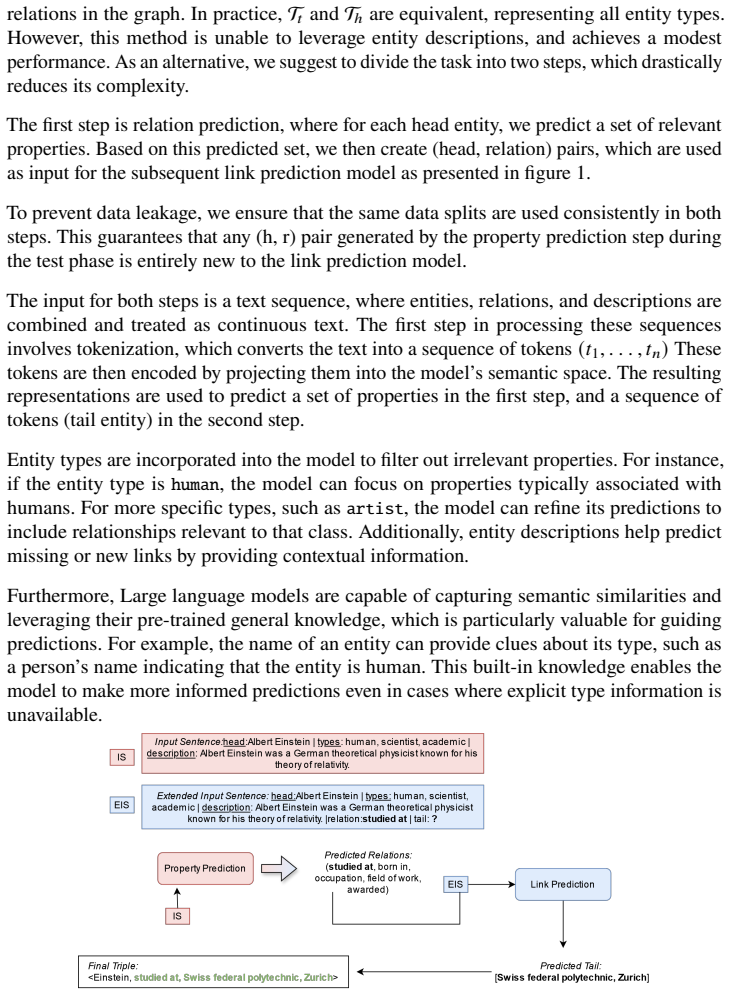
The machinery is the two-step generative pipeline with shared textual prompts. In step one, a Mistral model encodes the sequence 'head: h, types: c, description: d' and outputs a binary vector over all |R| relations using binary cross-entropy loss. In step two, a T5 model takes 'head: h, types: c, description: d, relation: r, tail: ...' and generates the tail token sequence with beam search. Entity types narrow the relation label space and guide tail type expectations; descriptions supply direct evidence or semantic hints; and both models are fine-tuned with parameter-efficient methods (0.19% and 0.64% of parameters, respectively), reducing compute while preserving the pretrained knowledge.
What would settle it
Take GenIC's top-10 tail predictions on the test split of a dataset like CoDEx, look up each novel triple in a later Wikidata dump that contains corrections and additions, and measure how many of the filtered 'false positives' are verified as true. If only a small fraction validate, the completeness assumption is not the main driver of the reported scores; if a large fraction validate, the reported Hits@k understate the method's real accuracy.
Extended reading notes
Core claim
The central claim is that instance completion in knowledge graphs can be reformulated as two coupled text-to-text tasks, and that a pipeline built from fine-tuned LLMs beats non-generative baselines. The property prediction step treats the set of relevant relations for a head entity as a binary label vector and learns it with binary cross-entropy; each (head, relation) pair from that step is then fed to the link predictor, which autoregressively generates the tail with beam search. The authors argue that entity types act as a schema-aware filter that narrows the candidate relations, while entity descriptions carry explicit facts or implicit contextual hints, letting the model make predictions even when one signal is absent. The ablation study on CoDEx supports this by showing that removing both types and descriptions drops link prediction Hits@1 by 27.5 percentage points.
Load-bearing premise
The evaluation treats each benchmark knowledge graph as complete, so every predicted triple that is not already in the dataset is discarded as a false positive even if it is actually a genuine missing fact.
Editorial extensions
If this is right
- Instance completion becomes a purely text-based task, so it can be applied to any knowledge graph that carries entity descriptions and types, including long-tail entities with few connections.
- The cost of link prediction drops from ranking all |E| entities to generating only the top-k candidates, because the property step shrinks the relation set per head.
- The outputs of the pipeline can serve as candidate generators for downstream fact verification or human curation, reducing manual knowledge graph enrichment effort.
- Because the pipeline is decomposed, errors can be localized: if the predicted relation set is imprecise, the tail generation step has no chance to recover, so improving property precision directly improves end-to-end instance completion.
Reading between the lines
- The completeness assumption in the evaluation likely makes the reported Hits@k conservative lower bounds: if the filtered-out 'false positives' were verified against an external source, the true performance could be higher than the tables show.
- The method could be extended to zero-shot or few-shot instance completion by prompting a modern instruction-tuned LLM directly with entity descriptions, bypassing fine-tuning; the paper's ablation suggests descriptions carry most of the predictive signal.
- Combining the generative link predictor with graph-structural embeddings might recover performance on relation-heavy datasets like WN18RR, where textual descriptions are less informative than structured relational patterns.
Editorial analysis
A structured set of objections, weighed in public.
Referee Report
Summary. The paper proposes GenIC, a two-stage LLM-based framework for instance completion in knowledge graphs. Given only a head entity, the first stage uses a fine-tuned Mistral-7B model to predict relevant relations as a multi-label classification problem, using the entity's type and description as context; the second stage uses a T5 model with beam search to generate the tail entity for each predicted (head, relation) pair. The authors evaluate GenIC on FB15k-237, WN18RR, and CoDEx, comparing against Recoin and a hybrid recommender for property prediction and against TransE and RotatE for link prediction, and they report improvements in property-prediction F1, link-prediction Hits@k, and end-to-end instance-completion Hits@k. The paper also includes an ablation study on CoDEx and a limitations section acknowledging that the completeness assumption in the evaluation is flawed.
Significance. If the empirical claims hold, GenIC is a practically relevant contribution: it is an end-to-end pipeline that predicts relation-tail pairs from only a head entity by exploiting textual descriptions and types, which most embedding-based methods ignore. The use of parameter-efficient fine-tuning (0.19% of Mistral-7B and 0.64% of T5 parameters) makes the approach feasible, and the public code release supports reproducibility. The two-step design also avoids data leakage by using identical splits in both stages. However, the current evidence is incomplete: the most relevant prior instance-completion system, RETA, is not evaluated, and the custom re-splitting of standard benchmarks makes the reported comparisons to published baselines difficult to interpret. These issues are fixable but are load-bearing for the paper's central claim.
major comments (5)
- [§2.1, §4 Results (Tables 2–4)] The only existing end-to-end instance-completion system discussed in the paper, RETA [Ro21], is never run as a baseline. Section 2.1 introduces RETA as "a notable approach" for instance completion, and Section 3.1 argues directly against its type-based candidate reduction, yet Tables 2–4 compare GenIC only with Recoin-based pipelines and TransE/RotatE. Consequently the abstract's claim that GenIC "outperforms existing baselines" on instance completion is not supported by the experiments; the paper needs a RETA comparison (or a clearly justified substitute) on the same data and splits.
- [§4 Pre-processing and Table 1] The datasets are re-split with a custom shuffled stratified split: for example, FB15k-237 is split into 217,081/46,517/46,517 rather than the standard FB15k-237 split. Because the paper does not state whether the TransE and RotatE baselines were retrained on these exact splits, the results in Tables 3 and 4 are not comparable to any published numbers for these datasets. The authors must either evaluate all baselines on the same custom splits and say so explicitly, or report results on the standard splits.
- [§3.3, §4 Evaluation metrics, Tables 3–4] The evaluation protocols for the generative and embedding baselines differ: GenIC-LP produces a top-k beam-search list, while TransE and RotatE rank all entities. Hits@k under these two protocols are not the same quantity, and the paper does not define a filtered/unfiltered ranking procedure that makes them commensurable. The reported gains, especially in Table 3, may reflect this protocol difference rather than a difference in model quality.
- [§5 Limitations] Section 5 explicitly acknowledges that the evaluation assumes completeness of the datasets and filters out any newly generated triple not present in the graph, which can misclassify true positives as false positives. This is a real limitation for the central claim because instance completion is intended to find genuinely missing facts; the paper should quantify the impact (e.g., by sampling and manually validating a subset of filtered-out predictions) or at least discuss how the measured gains would change under a more realistic evaluation.
- [§4 Results, Tables 3–5] No error bars, standard deviations, or significance tests are reported. On WN18RR the differences are small (e.g., Recoin + GenIC-LP Hits@5 = 0.429 vs. GenIC = 0.425 in Table 4), and the paper's own text notes that this comparison "isn't entirely valid"; without repeated runs or significance testing, the claim that GenIC outperforms the baselines on WN18RR is not established.
minor comments (6)
- [Table 4] The column heading "covergae" should be "coverage", and the coverage metric is not defined in Section 4 Evaluation metrics.
- [§4 Results] The text refers to "synthetic results in Table 4"; presumably this should be "synthetic" or "end-to-end" results, and the wording should be corrected.
- [Table 4] The row label "GenIC" is not explicitly defined as GenIC-PP + GenIC-LP, while other rows name both components; the caption or text should define it.
- [§4 Models and settings] The paper does not specify the beam width used for T5 decoding, the number of training epochs, or the hyperparameters for the TransE and RotatE baselines; adding these details would improve reproducibility.
- [§3.1] The candidate-count example says "with just 1,000 entities from the FB15k-237 dataset" but then writes 14.5×10^3 entities; the notation should be made consistent.
- [§2.1] The discussion of OKELE [Ca20] would benefit from stating explicitly why it is not included as a baseline (e.g., because it relies on external web data), since it is another instance-completion system.
Circularity Check
No circularity found: GenIC is an empirical two-stage pipeline whose claims are benchmark results, not consequences of fitted inputs or self-citation chains.
full rationale
The paper makes no formal derivation from premises; its contribution is a two-stage LLM pipeline (property prediction then link prediction) evaluated on standard KG completion datasets. The property prediction model is trained with binary cross-entropy on existing head-relation pairs, and the link prediction model is trained with cross-entropy on existing (h,r,t) triples. The test-phase generation of (h,r) pairs by step one and feeding them to step two is a pipeline design, not a mathematical reduction: the paper explicitly enforces identical splits to keep generated test (h,r) pairs unseen by the link predictor. No parameter is fitted to the target metric and then reported as a prediction; Hits@k scores are computed against held-out facts. The acknowledged completeness assumption in Section 5 (filtering out novel links) is a genuine evaluation limitation but conservative rather than circular, since it only restricts the candidate set to existing triples. The citations to [Xi22], [Su19], [BRN18], and [Ro21] are external prior work used for architectural inspiration or baseline comparison, not self-citations carrying the argument. The absence of RETA from Tables 2-4 is a baseline-comparison weakness, not a circularity. Therefore no circular step is exhibited, and the score is 0.
Assumptions & free parameters
assumptions (2)
- domain assumption Datasets are complete; missing facts are assumed absent.
- domain assumption Stratified split by head type yields a fair benchmark.
Cite this review
Pith. "Pith review of GenIC: An LLM-Based Framework for Instance Completion in Knowledge Graphs." pith.science (2026). https://pith.science/paper/QVA73GXG
@misc{pith2026250524036,
  author       = {Pith},
  title        = {Pith review of: GenIC: An LLM-Based Framework for Instance Completion in Knowledge Graphs},
  year         = {2026},
  howpublished = {\url{https://pith.science/paper/QVA73GXG}},
  note         = {Machine review of arXiv:2505.24036}
}
read the original abstract
Knowledge graph completion aims to address the gaps of knowledge bases by adding new triples that represent facts. The complexity of this task depends on how many parts of a triple are already known. Instance completion involves predicting the relation-tail pair when only the head is given (h, ?, ?). Notably, modern knowledge bases often contain entity descriptions and types, which can provide valuable context for inferring missing facts. By leveraging these textual descriptions and the ability of large language models to extract facts from them and recognize patterns within the knowledge graph schema, we propose an LLM-powered, end-to-end instance completion approach. Specifically, we introduce GenIC: a two-step Generative Instance Completion framework. The first step focuses on property prediction, treated as a multi-label classification task. The second step is link prediction, framed as a generative sequence-to-sequence task. Experimental results on three datasets show that our method outperforms existing baselines. Our code is available at https://github.com/amal-gader/genic.
Figures
Reference graph
Works this paper leans on
-
[1]
Advances in neural information processing systems, 26, 2013
Bordes, Antoine; Usunier, Nicolas; Garcia-Duran, Alberto; Weston, Jason; Yakhnenko, Oksana: Translating embeddings for modeling multi-relational data. Advances in neural information processing systems, 26, 2013
work page 2013
-
[2]
In: Companion Proceedings of the The Web Conference 2018
Balaraman, Vevake; Razniewski, Simon; Nutt, Werner: Recoin: relative completeness in Wikidata. In: Companion Proceedings of the The Web Conference 2018. pp. 1787--1792, 2018
work page 2018
-
[3]
In: Proceedings of The Web Conference 2020
Cao, Ermei; Wang, Difeng; Huang, Jiacheng; Hu, Wei: Open knowledge enrichment for long-tail entities. In: Proceedings of The Web Conference 2020. pp. 384--394, 2020
work page 2020
-
[4]
Wiley Interdisciplinary Reviews: Data Mining and Knowledge Discovery, 11(3):e1389, 2021
Chakraborty, Nilesh; Lukovnikov, Denis; Maheshwari, Gaurav; Trivedi, Priyansh; Lehmann, Jens; Fischer, Asja: Introduction to neural network-based question answering over knowledge graphs. Wiley Interdisciplinary Reviews: Data Mining and Knowledge Discovery, 11(3):e1389, 2021
work page 2021
-
[5]
In: Proceedings of the AAAI conference on artificial intelligence
Dettmers, Tim; Minervini, Pasquale; Stenetorp, Pontus; Riedel, Sebastian: Convolutional 2d knowledge graph embeddings. In: Proceedings of the AAAI conference on artificial intelligence. volume 32, 2018
work page 2018
-
[6]
IEEE Transactions on Knowledge and Data Engineering, 34(8):3549--3568, 2020
Guo, Qingyu; Zhuang, Fuzhen; Qin, Chuan; Zhu, Hengshu; Xie, Xing; Xiong, Hui; He, Qing: A survey on knowledge graph-based recommender systems. IEEE Transactions on Knowledge and Data Engineering, 34(8):3549--3568, 2020
work page 2020
-
[7]
arXiv preprint arXiv:2106.09685, 2021
Hu, Edward J; Shen, Yelong; Wallis, Phillip; Allen-Zhu, Zeyuan; Li, Yuanzhi; Wang, Shean; Wang, Lu; Chen, Weizhu: Lora: Low-rank adaptation of large language models. arXiv preprint arXiv:2106.09685, 2021
arXiv 2021
-
[8]
arXiv preprint arXiv:2310.06825, 2023
Jiang, Albert Q; Sablayrolles, Alexandre; Mensch, Arthur; Bamford, Chris; Chaplot, Devendra Singh; Casas, Diego de las; Bressand, Florian; Lengyel, Gianna; Lample, Guillaume; Saulnier, Lucile et al.: Mistral 7B. arXiv preprint arXiv:2310.06825, 2023
Show all 23 references
-
[9]
IEEE Transactions on Knowledge and Data Engineering, 2024
Pan, Shirui; Luo, Linhao; Wang, Yufei; Chen, Chen; Wang, Jiapu; Wu, Xindong: Unifying large language models and knowledge graphs: A roadmap. IEEE Transactions on Knowledge and Data Engineering, 2024
2024
-
[10]
Journal of machine learning research, 21(140):1--67, 2020
Raffel, Colin; Shazeer, Noam; Roberts, Adam; Lee, Katherine; Narang, Sharan; Matena, Michael; Zhou, Yanqi; Li, Wei; Liu, Peter J: Exploring the limits of transfer learning with a unified text-to-text transformer. Journal of machine learning research, 21(140):1--67, 2020
2020
-
[11]
In: Proceedings of the Web Conference 2021
Rosso, Paolo; Yang, Dingqi; Ostapuk, Natalia; Cudr \'e -Mauroux, Philippe: Reta: A schema-aware, end-to-end solution for instance completion in knowledge graphs. In: Proceedings of the Web Conference 2021. pp. 845--856, 2021
2021
-
[12]
In: Proceedings of the 10th international conference on World Wide Web
Sarwar, Badrul; Karypis, George; Konstan, Joseph; Riedl, John: Item-based collaborative filtering recommendation algorithms. In: Proceedings of the 10th international conference on World Wide Web. pp. 285--295, 2001
2001
-
[13]
arXiv preprint arXiv:2403.07311, 2024
Shu, Dong; Chen, Tianle; Jin, Mingyu; Zhang, Yiting; Du, Mengnan; Zhang, Yongfeng: Knowledge Graph Large Language Model (KG-LLM) for Link Prediction. arXiv preprint arXiv:2403.07311, 2024
2024 arXiv
-
[14]
In: Proceedings of the 2020 Conference on Empirical Methods in Natural Language Processing (EMNLP)
Safavi, Tara; Koutra, Danai: C o DE x: A C omprehensive K nowledge G raph C ompletion B enchmark. In: Proceedings of the 2020 Conference on Empirical Methods in Natural Language Processing (EMNLP). Association for Computational Linguistics, Online, pp. 8328--8350, November 2020
2020
-
[15]
In: Proceedings of the 58th annual meeting of the association for computational linguistics
Saxena, Apoorv; Tripathi, Aditay; Talukdar, Partha: Improving multi-hop question answering over knowledge graphs using knowledge base embeddings. In: Proceedings of the 58th annual meeting of the association for computational linguistics. pp. 4498--4507, 2020
2020
-
[16]
arXiv preprint arXiv:1902.10197, 2019
Sun, Zhiqing; Deng, Zhi-Hong; Nie, Jian-Yun; Tang, Jian: Rotate: Knowledge graph embedding by relational rotation in complex space. arXiv preprint arXiv:1902.10197, 2019
1902 arXiv
-
[17]
Toutanova, Kristina; Chen, Danqi: Observed versus latent features for knowledge base and text inference. In (Allauzen, Alexandre; Grefenstette, Edward; Hermann, Karl Moritz; Larochelle, Hugo; Yih, Scott Wen-tau, eds): Proceedings of the 3rd Workshop on Continuous Vector Space ...
2015
-
[18]
Transactions of the Association for Computational Linguistics, 9:176--194, 2021
Wang, Xiaozhi; Gao, Tianyu; Zhu, Zhaocheng; Zhang, Zhengyan; Liu, Zhiyuan; Li, Juanzi; Tang, Jian: KEPLER: A unified model for knowledge embedding and pre-trained language representation. Transactions of the Association for Computational Linguistics, 9:176--194, 2021
2021
-
[19]
In: Companion Proceedings of the Web Conference 2022
Xie, Xin; Zhang, Ningyu; Li, Zhoubo; Deng, Shumin; Chen, Hui; Xiong, Feiyu; Chen, Mosha; Chen, Huajun: From discrimination to generation: Knowledge graph completion with generative transformer. In: Companion Proceedings of the Web Conference 2022. pp. 162--165, 2022
2022
-
[20]
arXiv preprint arXiv:1909.03193, 2019
Yao, Liang; Mao, Chengsheng; Luo, Yuan: KG-BERT: BERT for knowledge graph completion. arXiv preprint arXiv:1909.03193, 2019
1909 arXiv
-
[21]
IEEE Transactions on Knowledge and Data Engineering, 2024
Zhang, Wen; Xu, Yajing; Ye, Peng; Huang, Zhiwei; Xu, Zezhong; Chen, Jiaoyan; Pan, Jeff Z; Chen, Huajun: Start From Zero: Triple Set Prediction for Automatic Knowledge Graph Completion. IEEE Transactions on Knowledge and Data Engineering, 2024
2024
-
[22]
write newline
" write newline "" before.all 'output.state := FUNCTION fin.entry add.period write newline FUNCTION new.block output.state before.all = 'skip after.block 'output.state := if FUNCTION new.sentence output.state after.block = 'skip output.state before.all = 'skip after.sentence '...
-
[23]
write newline
" write newline "" before.all 'output.state := FUNCTION fin.entry add.period write newline FUNCTION new.block output.state before.all = 'skip after.block 'output.state := if FUNCTION new.sentence output.state after.block = 'skip output.state before.all = 'skip after.sentence '...
Reviewed August 7, 2026 · model on record in the stance chip above.
Discussion (0). Continue with ORCID to comment.