REVIEW 3 major objections 5 minor 1 cited by
ComposeAnything: Composite Object Priors for Text-to-Image Generation
T0 review · 3 major / 5 minor · reviewed 2026-08-07 · deepseek-v4-flash
Pith's one-line read ComposeAnything claims that swapping a diffusion model's random noise for an LLM-planned composite object prior, with depth-aware layering and masked spatial attention, lets text-to-image models follow complex and surreal arrangements…
desk verdict The 2D and count gains are probably real; the big 3D number rests on a self-defined GPT-4.1 rubric that needs a human study before it can be believed. read the letter →
The pith
A machine-rendered reading of the paper's core claim, the machinery that carries it, and where it could break.
The reading
What carries the argument
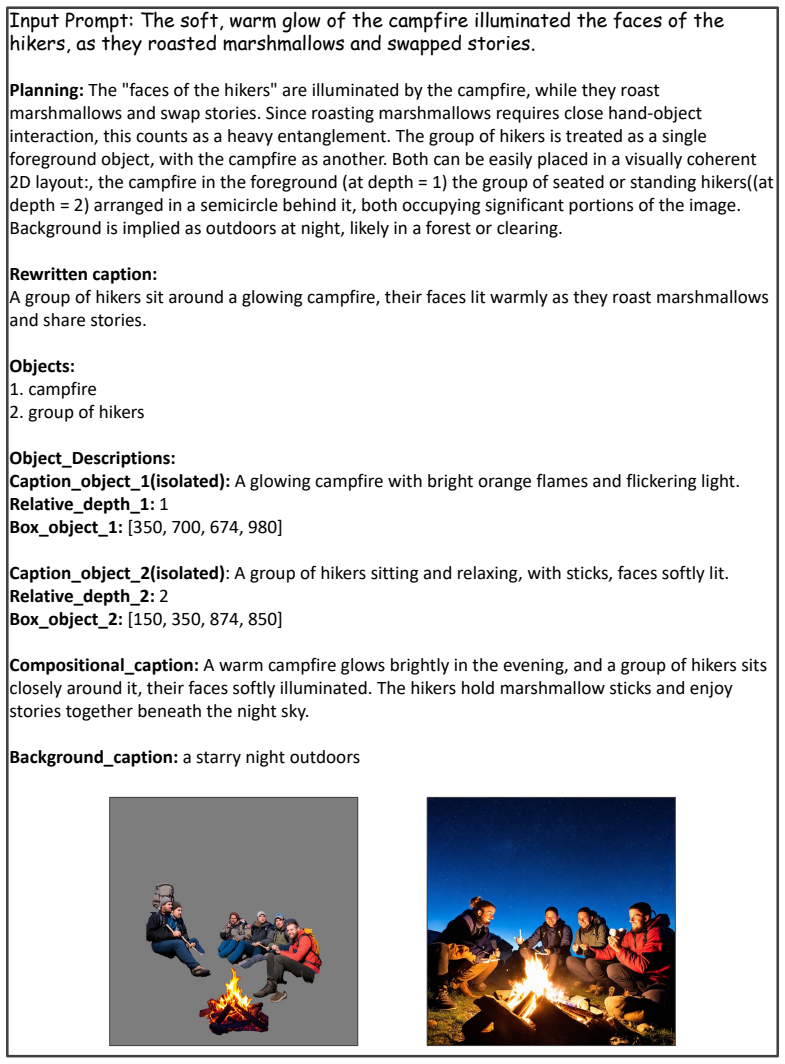
The load-bearing object is the 2.5D semantic layout together with the composite object prior built from it. From an input prompt, the LLM produces object captions, bounding boxes $box_i$, depth values $depth_i$, a background caption, and a compositional caption; individual object images are then generated, segmented, resized into the boxes, and layered by depth to form a composite image $o_p$ with mask $m_p$. This prior enters diffusion through two complementary mechanisms: object prior reinforcement, which overwrites the foreground latent with the noisy prior until time $t_p$, and spatial-controlled denoising, which partitions the latent by masks and runs joint self-attention between each image region and its own caption in early steps. Afterwards, standard diffusion refines the result, giving the framework its claimed balance between composition fidelity and image quality.
What would settle it
Take the 300 T2I-CompBench 3D-spatial prompts and have several independent human raters score ComposeAnything and SD3-M images using the paper's own 0-2 rubric, then compare human scores with the GPT-4.1 scores; if the human-measured gap is far below 27.7 points, or raters do not consistently prefer the method, the central 3D claim is a metric artifact.
Extended reading notes
Core claim
The central claim is that a composite object prior, a coarse RGB composite of the objects placed in their planned 2.5D positions, is a stronger starting point for diffusion-based text-to-image generation than pure Gaussian noise or attention-only layout guidance. Starting from a chain-of-thought LLM plan, the method generates each object separately with the base text-to-image model, extracts its mask with a referring-segmentation model, resizes and layers the objects depth-aware onto a canvas, and reinitializes the background region with pure noise. During denoising, the foreground prior is repeatedly re-injected until an intermediate timestep $t_p$, while a spatially controlled attention path aligns each object region with its own text embedding during the early steps. The paper argues that this preserves global structure where it matters and then releases control to standard diffusion, yielding both faithful composition and high visual fidelity.
Load-bearing premise
The headline 3D-spatial gain rests on a new GPT-4.1-based scoring rule that was not human-validated, and the same model family also writes the layouts being scored; if that rule is lenient toward the method, the 27.7-point improvement could be partly an artifact of grading rather than generation.
Editorial extensions
If this is right
- If the central claim holds, compositional control becomes an inference-time service for existing closed-weight diffusion models: no adapter training or fine-tuning is required.
- The paper reports the same framework also improves SDXL, so the mechanism is tied to generic denoising and flow-matching diffusion rather than to one architecture.
- Because the object prior itself already matches or beats many baselines on 2D-spatial and count categories, the pipeline offers an inexpensive, inspectable layout preview before the final render.
- Two hyper-parameters, $t_p$ and $N_{sc}$, let users dial between strict prompt faithfulness and generative freedom, which matters for surreal prompts where the two goals conflict.
- The ablation results show that prior reinforcement and spatial-controlled denoising add complementary gains, so both mechanisms are needed for the full reported effect.
Reading between the lines
- Editorial inference: the same LLM family that writes the layouts also grades the 3D results with a newly introduced rubric; until independent human or cross-model evaluation is published, the 27.7-point 3D margin should be treated as an upper bound.
- Editorial inference: a natural testable extension is to build the composite prior with a different text-to-image model than the base denoiser, which would isolate how much of the gain comes from planning and compositing versus the diffusion backbone.
- Editorial inference: because the prior is a visible RGB image, the pipeline doubles as an interpretable debugger, letting failures be traced to either the LLM layout or the diffusion refinement step.
- Editorial inference: combining this prior initialization with inference-time candidate search, rather than a single prior render, is a plausible next step that could address the remaining failures where a flawed initial composite is unrecoverable.
Editorial analysis
A structured set of objections, weighed in public.
Referee Report
Summary. The paper proposes ComposeAnything, a training-free framework for improving compositional text-to-image generation. It uses GPT-4.1 chain-of-thought planning to produce a 2.5D semantic layout (object captions, bounding boxes, relative depths), then composites individually generated and segmented object images into a coarse prior that replaces the stochastic noise initialization of a diffusion model such as SD3-M. The denoising process is guided by object prior reinforcement and spatial-controlled denoising for the first few steps, followed by standard denoising to refine quality. The method is evaluated on T2I-CompBench and NSR-1K, with reported gains over SD3-M and other baselines on 2D-Spatial, 3D-Spatial, Complexity, and Spatial categories, plus human evaluations against RPG and CreatiLayout.
Significance. If the reported results hold, the paper makes a useful contribution: it shows that structured LLM planning plus a coarse composite image prior can improve compositional fidelity of an off-the-shelf diffusion model without retraining, a practically appealing recipe. The 2D-Spatial and Count results are measured with established detector-based metrics and show clear gains, and the paper includes ablations, hyperparameter analysis, and qualitative failure-mode discussion. The main uncertainty is the headline 3D-Spatial gain, which depends on a bespoke GPT-4.1 evaluation rubric that has not been validated against human judgments and whose definition of 'hidden by' is relaxed relative to the standard interpretation. The paper also slightly overstates its benchmark claims in the abstract, since NSR-1K Count is worse than CreatiLayout.
major comments (3)
- [Sec. 4.1 and Appendix G] The 27.7-point 3D-Spatial gain over SD3-M rests on a new GPT-4.1-based metric whose rubric is not validated and is definitionally aligned with the method's design. Appendix G instructs the evaluator to 'Ignore visual occlusion' and to treat 'hidden by' as satisfied whenever the occluded object is 'clearly located behind it in 3D space, even if visible'; under the ordinary meaning of 'hidden by', an object that is visible is not hidden. Meanwhile, Appendix F, rule 6c requires that boxes 'must not fully occlude or obscure one another,' so ComposeAnything explicitly avoids occlusion in its constructed priors. The same GPT-4.1 model family performs the LLM planning and the grading, and no human validation of the new metric is provided. Table 2 compounds the concern: the composite object prior alone scores 86.71 on 3D-Spatial, higher than the final image's 77.16, even though the prior is a direct depth-ordered compositing of object crops. To support the headline claim, the authors should report the original T2I-CompBench depth-and-box metric for all methods, and/or carry out a human study on the 3D-Spatial set that validates the GPT-4.1 rubric and compares ComposeAnything against the baselines.
- [Abstract and Table 1] The abstract claims ComposeAnything 'outperforms state-of-the-art methods' on benchmarks for prompts with 'high object counts,' but Table 1 shows NSR-1K Count is 59.36 for ComposeAnything versus 63.40 for CreatiLayout, a result the paper itself acknowledges in Section 4.2. The abstract's blanket claim should be qualified to exclude the Count category, or the discrepancy should be explained, since it contradicts the stated central claim.
- [Sec. 4.2, Figure 6] The human evaluation only compares ComposeAnything against RPG and CreatiLayout on 30 prompts per category, and it is used to support overall quality claims but not to validate the automatic 3D metric. The paper reports average inter-annotator agreement around 80% but no per-category agreement, confidence intervals, or significance tests for the pairwise preferences. If the human study is intended to establish the 3D-Spatial advantage, it should cover that category explicitly and report the statistics; if it is not, the 3D metric remains the only evidence for the largest reported gain.
minor comments (5)
- [Sec. 4.2] The text reports 'absolute gains of 16.9% on 2D-Spatial, 7.9% on Count, 27.7% on 3D-Spatial, and 0.9% on Complex'; these are percentage-point differences (e.g., 48.24 vs 31.32 is 16.92 points), so the units should be stated as 'points' rather than '%'.
- [Eq. (15)] The hyperparameter ratiobase in the latent merge equation is never defined or given a value in Section 4.1 or the appendix; please state its setting and, ideally, its sensitivity.
- [Sec. 4.2] The list of compared methods mentions GLIGEN, but Table 1 does not report GLIGEN results; either add the missing entries or remove GLIGEN from the list of compared methods.
- [Appendix C] There is an incomplete sentence: 'For sample annotators perform a 4-way classification task...' — this should be rewritten to describe how annotators were sampled and instructed.
- [Figure 6] The bar chart would be more informative with error bars or per-category counts, and the number of raters per comparison should be stated clearly in the caption.
Circularity Check
The 27.7-point 3D-Spatial gain is measured by a bespoke GPT-4.1 rubric that redefines 'hidden by' to ignore occlusion, while the LLM planner is explicitly told to keep hidden objects visible; the 2D, Count, Complex, and NSR-1K results remain externally benchmarked.
-
self definitional
[Sec. 4.1 (Evaluation metrics); Appendix F rule 6c; Appendix G]
"For the 3D-spatial category, the original T2I-CompBench metric relies on depth estimation and bounding box detection, which we found inaccurate and overly punitive. To address this, we introduce an MLLM-based metric using GPT-4.1 [42]... 'Ignore visual occlusion —an object can still be considered "hidden by" another object if it is clearly located behind it in 3D space, even if visible.'"
The headline 27.7-point 3D-Spatial gain over SD3-M rests on this bespoke GPT-4.1 metric, not on the standard T2I-CompBench depth-and-box protocol. The rubric explicitly instructs the evaluator to ignore occlusion and to count a visible object as 'hidden by' the occluder whenever it is merely behind it. Meanwhile, the LLM planning prompt (Appendix F, rule 6c) requires that 'bounding boxes must be placed such that every object remains visibly distinct... Even when objects differ in depth, they must not fully occlude or obscure one another.' ComposeAnything is therefore constrained by construction to avoid true occlusion, and the new evaluator is defined to reward exactly the visible-behind configuration the planner is forced to produce.
full rationale
There is no equation-level circularity in the core pipeline: the composite prior construction (Eqs. 1-7), object prior reinforcement (Eq. 8), and spatial-controlled attention (Eqs. 9-15) are concrete mechanisms whose outputs are then compared against benchmarks; they are not derived from the benchmark numbers. Moreover, the 2D-Spatial, Count, Complex, and NSR-1K results are measured with external protocols (UniDet, GLIP, CLIP, BLIP-VQA) and therefore provide independent grounding for most of the paper's claims. The circularity is concentrated in the 3D-Spatial evaluation. The authors replaced the standard T2I-CompBench 3D metric with a GPT-4.1 prompt of their own design, and that prompt defines 'hidden by' as mere depth ordering while explicitly ignoring occlusion. The LLM planning prompt used by the method independently instructs that objects 'must not fully occlude or obscure one another,' so the generator is optimized to keep hidden objects visible. The evaluator then accepts visible objects as 'hidden by' the occluder. This is a definitional alignment between the method's optimization target and the scoring rubric, not an independent measurement. The same GPT-4.1 model family is used for both planning and evaluation, and the new metric has no human validation; Table 2 shows the raw prior scoring 86.71 on 3D-Spatial versus 77.16 for the final image, indicating that the metric rewards the direct depth-ordered composite rather than the diffusion model's 3D reasoning. Because the single largest reported advantage is affected but the majority of the benchmark results are externally measured, the overall circularity is partial: score 5.
Assumptions & free parameters
free parameters (3)
- tp (prior noise timestep) =
0.91 (high noise on Flow Matching schedule)
- Nsc (number of spatial-controlled denoising steps) =
3
- ratiobase (latent merge weight in Eq. 15) =
not reported
assumptions (5)
- standard math The reverse ODE of a diffusion or flow-matching model can be initialized from any intermediate timestep tp using a noisy image prior.
- domain assumption MM-DiT joint self-attention in SD3 can be faithfully partitioned into object and background latents, processed separately with paired text embeddings, and recomposed without drift.
- domain assumption GPT-4.1 chain-of-thought planning yields correct object decompositions, depths, and isolated captions for arbitrary prompts.
- domain assumption Hyperseg produces clean, accurate masks of generated objects that faithfully separate foreground from background.
- ad hoc to paper The new GPT-4.1 3D evaluation metric is a valid and comparable measure of 3D spatial correctness.
Cite this review
Pith. "Pith review of ComposeAnything: Composite Object Priors for Text-to-Image Generation." pith.science (2026). https://pith.science/paper/SEKCQF4X
@misc{pith2026250524086,
  author       = {Pith},
  title        = {Pith review of: ComposeAnything: Composite Object Priors for Text-to-Image Generation},
  year         = {2026},
  howpublished = {\url{https://pith.science/paper/SEKCQF4X}},
  note         = {Machine review of arXiv:2505.24086}
}
read the original abstract
Generating images from text involving complex and novel object arrangements remains a significant challenge for current text-to-image (T2I) models. Although prior layout-based methods improve object arrangements using spatial constraints with 2D layouts, they often struggle to capture 3D positioning and sacrifice quality and coherence. In this work, we introduce ComposeAnything, a novel framework for improving compositional image generation without retraining existing T2I models. Our approach first leverages the chain-of-thought reasoning abilities of LLMs to produce 2.5D semantic layouts from text, consisting of 2D object bounding boxes enriched with depth information and detailed captions. Based on this layout, we generate a spatial and depth aware coarse composite of objects that captures the intended composition, serving as a strong and interpretable prior that replaces stochastic noise initialization in diffusion-based T2I models. This prior guides the denoising process through object prior reinforcement and spatial-controlled denoising, enabling seamless generation of compositional objects and coherent backgrounds, while allowing refinement of inaccurate priors. ComposeAnything outperforms state-of-the-art methods on the T2I-CompBench and NSR-1K benchmarks for prompts with 2D/3D spatial arrangements, high object counts, and surreal compositions. Human evaluations further demonstrate that our model generates high-quality images with compositions that faithfully reflect the text.
Figures


Figures from the paper (19 more)



Forward citations
Cited by 1 Pith paper
-
ETPDesigner: Multi-Agent Orchestration for Interactive Multimodal Electronic Theater Program
ETPDesigner automatically generates multi-page electronic theater programs from scripts using a multi-agent LLM pipeline with a global style anchor and interactive character chat.
Reference graph
Works this paper leans on
-
[1]
A-star: Test-time attention segregation and retention for text-to-image synthesis
Aishwarya Agarwal, Srikrishna Karanam, K J Joseph, Apoorv Saxena, Koustava Goswami, and Bal- aji Vasan Srinivasan. A-star: Test-time attention segregation and retention for text-to-image synthesis. In Proceedings of the IEEE/CVF International Conference on Computer Vision (ICCV), pages 2283–2293, October 2023
work page 2023
-
[2]
Blended diffusion for text-driven editing of natural images
Omri Avrahami, Dani Lischinski, and Ohad Fried. Blended diffusion for text-driven editing of natural images. In Proceedings of the IEEE/CVF Conference on Computer Vision and Pattern Recognition (CVPR), 2022
work page 2022
-
[3]
Black Forest Labs. FLUX. https://blackforestlabs.ai, 2024
work page 2024
-
[4]
Attend-and-excite: Attention- based semantic guidance for text-to-image diffusion models
Hila Chefer, Yuval Alaluf, Yael Vinker, Lior Wolf, and Daniel Cohen-Or. Attend-and-excite: Attention- based semantic guidance for text-to-image diffusion models. ACM Trans. Graph., 2023
work page 2023
-
[5]
Pixart- α: Fast training of diffusion transformer for photorealistic text-to-image synthesis, 2023
Junsong Chen, Jincheng Yu, Chongjian Ge, Lewei Yao, Enze Xie, Yue Wu, Zhongdao Wang, James Kwok, Ping Luo, Huchuan Lu, and Zhenguo Li. Pixart- α: Fast training of diffusion transformer for photorealistic text-to-image synthesis, 2023. URL https://arxiv.org/abs/2310.00426
arXiv 2023
-
[6]
Pixart-δ: Fast and controllable image generation with latent consistency models, 2024
Junsong Chen, Yue Wu, Simian Luo, Enze Xie, Sayak Paul, Ping Luo, Hang Zhao, and Zhenguo Li. Pixart-δ: Fast and controllable image generation with latent consistency models, 2024. URL https: //arxiv.org/abs/2401.05252
arXiv 2024
-
[7]
Geodiffu- sion: Text-prompted geometric control for object detection data generation
Kai Chen, Enze Xie, Zhe Chen, Yibo Wang, Lanqing HONG, Zhenguo Li, and Dit-Yan Yeung. Geodiffu- sion: Text-prompted geometric control for object detection data generation. In The Twelfth International Conference on Learning Representations, 2024
work page 2024
-
[8]
Training-free layout control with cross-attention guidance
Minghao Chen, Iro Laina, and Andrea Vedaldi. Training-free layout control with cross-attention guidance. In Proceedings of the IEEE/CVF Winter Conference on Applications of Computer Vision (WACV), 2024
work page 2024
Show all 64 references
-
[9]
Zero- shot spatial layout conditioning for text-to-image diffusion models
Guillaume Couairon, Marlène Careil, Matthieu Cord, Stéphane Lathuilière, and Jakob Verbeek. Zero- shot spatial layout conditioning for text-to-image diffusion models. In Proceedings of the IEEE/CVF International Conference on Computer Vision (ICCV), 2023
2023
-
[10]
Be yourself: Bounded attention for multi-subject text-to-image generation
Omer Dahary, Or Patashnik, Kfir Aberman, and Daniel Cohen-Or. Be yourself: Bounded attention for multi-subject text-to-image generation. In European Conference on Computer Vision (ECCV), 2024
2024
-
[11]
Scaling rectified flow transformers for high-resolution image synthesis
Patrick Esser, Sumith Kulal, Andreas Blattmann, Rahim Entezari, Jonas Müller, Harry Saini, Yam Levi, Dominik Lorenz, Axel Sauer, Frederic Boesel, Dustin Podell, Tim Dockhorn, Zion English, and Robin Rombach. Scaling rectified flow transformers for high-resolution image synthes...
2024
-
[12]
Training-free structured diffusion guidance for composi- tional text-to-image synthesis
Weixi Feng, Xuehai He, Tsu-Jui Fu, Varun Jampani, Arjun Reddy Akula, Pradyumna Narayana, Sugato Basu, Xin Eric Wang, and William Yang Wang. Training-free structured diffusion guidance for composi- tional text-to-image synthesis. In The Eleventh International Conference on Lear...
2023
-
[13]
LayoutGPT: Compositional visual planning and generation with large language models
Weixi Feng, Wanrong Zhu, Tsu-Jui Fu, Varun Jampani, Arjun Reddy Akula, Xuehai He, S Basu, Xin Eric Wang, and William Yang Wang. LayoutGPT: Compositional visual planning and generation with large language models. In Thirty-seventh Conference on Neural Information Processing Sys...
2023
-
[14]
Ranni: Taming text-to-image diffusion for accurate instruction following
Yutong Feng, Biao Gong, Di Chen, Yujun Shen, Yu Liu, and Jingren Zhou. Ranni: Taming text-to-image diffusion for accurate instruction following. In Proceedings of the IEEE/CVF Conference on Computer Vision and Pattern Recognition (CVPR), 2024
2024
-
[15]
LLM blueprint: Enabling text-to-image generation with complex and detailed prompts
Hanan Gani, Shariq Farooq Bhat, Muzammal Naseer, Salman Khan, and Peter Wonka. LLM blueprint: Enabling text-to-image generation with complex and detailed prompts. In The Twelfth International Conference on Learning Representations, 2024
2024
-
[16]
Check locate rectify: A training-free layout calibration system for text-to-image generation
Biao Gong, Siteng Huang, Yutong Feng, Shiwei Zhang, Yuyuan Li, and Yu Liu. Check locate rectify: A training-free layout calibration system for text-to-image generation. In Proceedings of the IEEE/CVF Conference on Computer Vision and Pattern Recognition (CVPR), pages 6624–6634...
2024
-
[17]
Initno: Boosting text-to- image diffusion models via initial noise optimization
Xiefan Guo, Jinlin Liu, Miaomiao Cui, Jiankai Li, Hongyu Yang, and Di Huang. Initno: Boosting text-to- image diffusion models via initial noise optimization. In Proceedings of the IEEE/CVF Conference on Computer Vision and Pattern Recognition (CVPR), 2024
2024
-
[18]
Prompt-to- prompt image editing with cross-attention control
Amir Hertz, Ron Mokady, Jay Tenenbaum, Kfir Aberman, Yael Pritch, and Daniel Cohen-or. Prompt-to- prompt image editing with cross-attention control. In The Eleventh International Conference on Learning Representations, 2023
2023
-
[19]
Ella: Equip diffusion models with llm for enhanced semantic alignment
Xiwei Hu, Rui Wang, Yixiao Fang, Bin Fu, Pei Cheng, and Gang Yu. Ella: Equip diffusion models with llm for enhanced semantic alignment. CoRR, 2024
2024
-
[20]
Scenecraft: An LLM agent for synthesizing 3D scenes as blender code
Ziniu Hu, Ahmet Iscen, Aashi Jain, Thomas Kipf, Yisong Yue, David A Ross, Cordelia Schmid, and Alireza Fathi. Scenecraft: An LLM agent for synthesizing 3D scenes as blender code. In Forty-first International Conference on Machine Learning, 2024
2024
-
[21]
T2I-compBench: A comprehensive benchmark for open-world compositional text-to-image generation
Kaiyi Huang, Kaiyue Sun, Enze Xie, Zhenguo Li, and Xihui Liu. T2I-compBench: A comprehensive benchmark for open-world compositional text-to-image generation. Advances in Neural Information Processing Systems, 36:78723–78747, 2023
2023
-
[22]
Composite diffusion: whole >= sparts
Vikram Jamwal and Ramaneswaran S. Composite diffusion: whole >= sparts. In Proceedings of the IEEE/CVF Winter Conference on Applications of Computer Vision (WACV), 2024
2024
-
[23]
Comat: Aligning text-to-image diffusion model with image-to-text concept matching
Dongzhi Jiang, Guanglu Song, Xiaoshi Wu, Renrui Zhang, Dazhong Shen, Zhuofan Zong, Yu Liu, and Hongsheng Li. Comat: Aligning text-to-image diffusion model with image-to-text concept matching. In The Thirty-eighth Annual Conference on Neural Information Processing Systems, 2024
2024
-
[24]
Dense text-to-image generation with attention modulation
Yunji Kim, Jiyoung Lee, Jin-Hwa Kim, Jung-Woo Ha, and Jun-Yan Zhu. Dense text-to-image generation with attention modulation. In Proceedings of the IEEE/CVF International Conference on Computer Vision (ICCV), 2023
2023
-
[25]
Evaluating and improving compositional text-to-visual generation
Baiqi Li, Zhiqiu Lin, Deepak Pathak, Jiayao Li, Yixin Fei, Kewen Wu, Xide Xia, Pengchuan Zhang, Graham Neubig, and Deva Ramanan. Evaluating and improving compositional text-to-visual generation. In Proceedings of the IEEE/CVF Conference on Computer Vision and Pattern Recogniti...
2024
-
[26]
Grounded language- image pre-training
Liunian Harold Li, Pengchuan Zhang, Haotian Zhang, Jianwei Yang, Chunyuan Li, Yiwu Zhong, Lijuan Wang, Lu Yuan, Lei Zhang, Jenq-Neng Hwang, Kai-Wei Chang, and Jianfeng Gao. Grounded language- image pre-training. In Proceedings of the IEEE/CVF Conference on Computer Vision and ...
2022
-
[27]
Con- trolnet ++: Improving conditional controls with efficient consistency feedback
Ming Li, Taojiannan Yang, Huafeng Kuang, Jie Wu, Zhaoning Wang, Xuefeng Xiao, and Chen Chen. Con- trolnet ++: Improving conditional controls with efficient consistency feedback. In European Conference on Computer Vision (ECCV), 2024
2024
-
[28]
Mulan: Multimodal-llm agent for progressive multi-object diffusion
Sen Li, Ruochen Wang, Cho-Jui Hsieh, Minhao Cheng, and Tianyi Zhou. Mulan: Multimodal-llm agent for progressive multi-object diffusion. arXiv preprint arXiv:2402.12741, 2024
2024 arXiv
-
[29]
Gligen: Open-set grounded text-to-image generation
Yuheng Li, Haotian Liu, Qingyang Wu, Fangzhou Mu, Jianwei Yang, Jianfeng Gao, Chunyuan Li, and Yong Jae Lee. Gligen: Open-set grounded text-to-image generation. In Conference on Computer Vision and Pattern Recognition (CVPR), 2023
2023
-
[30]
Divide & bind your attention for improved generative semantic nursing
Yumeng Li, Margret Keuper, Dan Zhang, and Anna Khoreva. Divide & bind your attention for improved generative semantic nursing. In BMVC, 2023
2023
-
[31]
LLM-grounded diffusion: Enhancing prompt understanding of text-to-image diffusion models with large language models
Long Lian, Boyi Li, Adam Yala, and Trevor Darrell. LLM-grounded diffusion: Enhancing prompt understanding of text-to-image diffusion models with large language models. Transactions on Machine Learning Research, 2024. ISSN 2835-8856
2024
-
[32]
Ctrl-adapter: An efficient and versatile framework for adapting diverse controls to any diffusion model
Han Lin, Jaemin Cho, Abhay Zala, and Mohit Bansal. Ctrl-adapter: An efficient and versatile framework for adapting diverse controls to any diffusion model. In The Thirteenth International Conference on Learning Representations, 2025
2025
-
[33]
Flow matching for generative modeling
Yaron Lipman, Ricky TQ Chen, Heli Ben-Hamu, Maximilian Nickel, and Matt Le. Flow matching for generative modeling. arXiv preprint arXiv:2210.02747, 2022
2022 arXiv
-
[34]
Tenenbaum
Nan Liu, Shuang Li, Yilun Du, Antonio Torralba, and Joshua B. Tenenbaum. Compositional visual generation with composable diffusion models. In European Conference on Computer Vision (ECCV), 2022. 11
2022
-
[35]
Inference-time scaling for diffusion models beyond scaling denoising steps
Nanye Ma, Shangyuan Tong, Haolin Jia, Hexiang Hu, Yu-Chuan Su, Mingda Zhang, Xuan Yang, Yandong Li, Tommi Jaakkola, Xuhui Jia, and Saining Xie. Inference-time scaling for diffusion models beyond scaling denoising steps. arXiv preprint arXiv:2501.09732, 2025
2025 arXiv
-
[36]
Lewis, Thomas Leung, and W
Wan-Duo Kurt Ma, Avisek Lahiri, J.P. Lewis, Thomas Leung, and W. Bastiaan Kleijn. Directed diffusion: direct control of object placement through attention guidance. In Association for the Advancement of Artificial Intelligence (AAAI), 2024
2024
-
[37]
Guided image synthesis via initial image editing in diffusion model
Jiafeng Mao, Xueting Wang, and Kiyoharu Aizawa. Guided image synthesis via initial image editing in diffusion model. In Proceedings of the 31st ACM International Conference on Multimedia, 2023
2023
-
[38]
SDEdit: Guided image synthesis and editing with stochastic differential equations
Chenlin Meng, Yutong He, Yang Song, Jiaming Song, Jiajun Wu, Jun-Yan Zhu, and Stefano Ermon. SDEdit: Guided image synthesis and editing with stochastic differential equations. In International Conference on Learning Representations (ICLR), 2022
2022
-
[39]
Conform: Contrast is all you need for high-fidelity text-to-image diffusion models
Tuna Han Salih Meral, Enis Simsar, Federico Tombari, and Pinar Yanardag. Conform: Contrast is all you need for high-fidelity text-to-image diffusion models. In Proceedings of the IEEE/CVF Conference on Computer Vision and Pattern Recognition (CVPR), 2024
2024
-
[40]
T2i- adapter: learning adapters to dig out more controllable ability for text-to-image diffusion models
Chong Mou, Xintao Wang, Liangbin Xie, Yanze Wu, Jian Zhang, Zhongang Qi, and Ying Shan. T2i- adapter: learning adapters to dig out more controllable ability for text-to-image diffusion models. In Proceedings of the Thirty-Eighth AAAI Conference on Artificial Intelligence, 2024
2024
-
[41]
Compositional text-to-image generation with dense blob representations
Weili Nie, Sifei Liu, Morteza Mardani, Chao Liu, Benjamin Eckart, and Arash Vahdat. Compositional text-to-image generation with dense blob representations. In Forty-first International Conference on Machine Learning, 2024
2024
-
[42]
OpenAI. GPT-4.1. https://openai.com/index/gpt-4-1/ , 2025
2025
-
[43]
Richter, Christopher J
Pablo Pernias, Dominic Rampas, Mats L. Richter, Christopher J. Pal, and Marc Aubreville. Wuerstchen: An efficient architecture for large-scale text-to-image diffusion models, 2023. URL https://arxiv. org/abs/2306.00637
2023 arXiv
-
[44]
Grounded text-to-image synthesis with attention refocusing
Quynh Phung, Songwei Ge, and Jia-Bin Huang. Grounded text-to-image synthesis with attention refocusing. In Proceedings of the IEEE/CVF Conference on Computer Vision and Pattern Recognition (CVPR), 2024
2024
-
[45]
Sdxl: Improving latent diffusion models for high-resolution image synthesis, 2023
Dustin Podell, Zion English, Kyle Lacey, Andreas Blattmann, Tim Dockhorn, Jonas Müller, Joe Penna, and Robin Rombach. Sdxl: Improving latent diffusion models for high-resolution image synthesis, 2023. URL https://arxiv.org/abs/2307.01952
2023 arXiv
-
[46]
Linguistic binding in diffusion models: Enhancing attribute correspondence through attention map alignment
Royi Rassin, Eran Hirsch, Daniel Glickman, Shauli Ravfogel, Yoav Goldberg, and Gal Chechik. Linguistic binding in diffusion models: Enhancing attribute correspondence through attention map alignment. In Thirty-seventh Conference on Neural Information Processing Systems, 2023
2023
-
[47]
High-resolution image synthesis with latent diffusion models
Robin Rombach, Andreas Blattmann, Dominik Lorenz, Patrick Esser, and Björn Ommer. High-resolution image synthesis with latent diffusion models. In Conference on Computer Vision and Pattern Recognition (CVPR), 2022
2022
-
[48]
Denoising diffusion implicit models
Jiaming Song, Chenlin Meng, and Stefano Ermon. Denoising diffusion implicit models. In International Conference on Learning Representations (ICLR), 2021
2021
-
[49]
Object-attribute binding in text-to-image generation: Evaluation and control
Maria Mihaela Trusca, Wolf Nuyts, Jonathan Thomm, Robert Honig, Thomas Hofmann, Tinne Tuytelaars, and Marie-Francine Moens. Object-attribute binding in text-to-image generation: Evaluation and control. arXiv preprint arXiv:2404.13766, 2024
2024 arXiv
-
[50]
Plug-and-play diffusion features for text- driven image-to-image translation
Narek Tumanyan, Michal Geyer, Shai Bagon, and Tali Dekel. Plug-and-play diffusion features for text- driven image-to-image translation. In Proceedings of the IEEE/CVF Conference on Computer Vision and Pattern Recognition (CVPR), 2023
2023
-
[51]
Dynamic prompt learning: Addressing cross-attention leakage for text-based image editing
Kai Wang, Fei Yang, Shiqi Yang, Muhammad Atif Butt, and Joost van de Weijer. Dynamic prompt learning: Addressing cross-attention leakage for text-based image editing. In Thirty-seventh Conference on Neural Information Processing Systems, 2023
2023
-
[52]
Instancediffusion: Instance-level control for image generation
Xudong Wang, Trevor Darrell, Sai Saketh Rambhatla, Rohit Girdhar, and Ishan Misra. Instancediffusion: Instance-level control for image generation. In Proceedings of the IEEE/CVF Conference on Computer Vision and Pattern Recognition (CVPR), 2024
2024
-
[53]
Tokencompose: Text-to-image diffusion with token-level supervision
Zirui Wang, Zhizhou Sha, Zheng Ding, Yilin Wang, and Zhuowen Tu. Tokencompose: Text-to-image diffusion with token-level supervision. In Proceedings of the IEEE/CVF Conference on Computer Vision and Pattern Recognition (CVPR), 2024. 12
2024
-
[54]
Hyperseg: Towards universal visual segmentation with large language model, 2024
Cong Wei, Yujie Zhong, Haoxian Tan, Yong Liu, Zheng Zhao, Jie Hu, and Yujiu Yang. Hyperseg: Towards universal visual segmentation with large language model, 2024. URL https://arxiv.org/abs/2411. 17606
2024
-
[55]
Boxdiff: Text-to-image synthesis with training-free box-constrained diffusion
Jinheng Xie, Yuexiang Li, Yawen Huang, Haozhe Liu, Wentian Zhang, Yefeng Zheng, and Mike Zheng Shou. Boxdiff: Text-to-image synthesis with training-free box-constrained diffusion. In Proceedings of the IEEE/CVF International Conference on Computer Vision (ICCV), 2023
2023
-
[56]
Mastering text- to-image diffusion: Recaptioning, planning, and generating with multimodal LLMs
Ling Yang, Zhaochen Yu, Chenlin Meng, Minkai Xu, Stefano Ermon, and Bin CUI. Mastering text- to-image diffusion: Recaptioning, planning, and generating with multimodal LLMs. In International Conference on Machine Learning (ICML), 2024
2024
-
[57]
Reco: Region-controlled text-to-image generation
Zhengyuan Yang, Jianfeng Wang, Zhe Gan, Linjie Li, Kevin Lin, Chenfei Wu, Nan Duan, Zicheng Liu, Ce Liu, Michael Zeng, and Lijuan Wang. Reco: Region-controlled text-to-image generation. In Proceedings of the IEEE/CVF Conference on Computer Vision and Pattern Recognition (CVPR), 2023
2023
-
[58]
Creatilayout: Siamese multimodal diffusion transformer for creative layout-to-image generation
Hui Zhang, Dexiang Hong, Tingwei Gao, Yitong Wang, Jie Shao, Xinglong Wu, Zuxuan Wu, and Yu-Gang Jiang. Creatilayout: Siamese multimodal diffusion transformer for creative layout-to-image generation. arXiv preprint arXiv:2412.03859, 2024
2024 arXiv
-
[59]
Adding conditional control to text-to-image diffusion models
Lvmin Zhang, Anyi Rao, and Maneesh Agrawala. Adding conditional control to text-to-image diffusion models. In International Conference on Computer Vision (ICCV), 2023
2023
-
[60]
Realcompo: Balancing realism and compositionality improves text- to-image diffusion models
Xinchen Zhang, Ling Yang, YaQi Cai, Zhaochen Yu, Kai-Ni Wang, xie jiake, Ye Tian, Minkai Xu, Yong Tang, Yujiu Yang, and Bin CUI. Realcompo: Balancing realism and compositionality improves text- to-image diffusion models. In The Thirty-eighth Annual Conference on Neural Informa...
2024
-
[61]
Local conditional controlling for text-to-image diffusion models
Yibo Zhao, Liang Peng, Yang Yang, Zekai Luo, Hengjia Li, Yao Chen, Wei Zhao, Qinglin Lu, Wei Liu, and Boxi Wu. Local conditional controlling for text-to-image diffusion models. CoRR, abs/2312.08768, 2023
2023 arXiv
-
[62]
Layoutdiffusion: Controllable diffusion model for layout-to-image generation
Guangcong Zheng, Xianpan Zhou, Xuewei Li, Zhongang Qi, Ying Shan, and Xi Li. Layoutdiffusion: Controllable diffusion model for layout-to-image generation. In Proceedings of the IEEE/CVF Conference on Computer Vision and Pattern Recognition (CVPR), 2023
2023
-
[63]
= 3 𝑡!= 0.79 𝑁!
Xingyi Zhou, Vladlen Koltun, and Philipp Krähenbühl. Simple multi-dataset detection. In Proceedings of the IEEE/CVF Conference on Computer Vision and Pattern Recognition (CVPR), 2022. 13 Appendix In the appendix, we first discuss the broader impact of our work in Section A. Se...
2022
-
[64]
Objects:
Foreground object Extraction:a. Extract only foreground objects without severe entanglements as planned.b. Strictly keep the original counts, and enumerate every object one at a time. c. Make sure to extract the accurate counts and enumerate every object one at a time. 4. Obje...
Reviewed August 7, 2026 · model on record in the stance chip above.
Discussion (0). Sign in to comment.