REVIEW 3 major objections 6 minor 1 cited by
Weakly-Supervised Affordance Grounding Guided by Part-Level Semantic Priors
T0 review · 3 major / 6 minor · reviewed 2026-08-07 · deepseek-v4-flash
Pith's one-line read The paper claims that weakly supervised affordance grounding can be turned into pseudo-supervised segmentation by mapping every (object, affordance) pair to a part name that off-the-shelf part segmenters can localize, and that this recipe…
desk verdict A solid pseudo-supervised WSAG pipeline with large, reproducible-looking gains; the main caveat is that part of the win is inherited from the off-the-shelf segmenter, not the proposed modules. read the letter →
The pith
A machine-rendered reading of the paper's core claim, the machinery that carries it, and where it could break.
The reading
What carries the argument
The load-bearing mechanism is the (object, affordance) to part-name mapping P(o,a), a hand-authored table of about 100 entries that converts verb-like affordances into noun-like part queries such as ``handle of the knife'' or ``cap of the bottle''. Off-the-shelf VLPart detects that part's box and SAM segments it into a mask, which becomes the pseudo-label heatmap; three enhancement modules—a pretraining stage that refines labels via occlusion-aware similarity to interaction images, masked-pooled cross-view alignment using object masks, and an MLP reasoning module that predicts object and part features (plus a 2x2 stitching augmentation)—carry the rest of the training. The decoder is a SAM-style mask decoder driven by a CLIP text feature of the affordance query, keeping the architecture plain and putting the weight of the method on the supervision itself.
What would settle it
Run the same training recipe with pseudo labels replaced by whole-object masks (or by randomly permuted part labels): if the seen-split KLD stays near 0.890 instead of degrading toward the CAM baselines' ~1.18, the claimed gains are not actually coming from the part-level priors. A second check: apply the mapping P(o,a) to a category the authors cite as hard, e.g. 'hold' on a tennis racket, and verify whether the refinement stage systematically repairs the missing-handle labels; if the repaired labels are still wrong on a large share of images, the generalization claims for the reasoning module lose their foundation.
Extended reading notes
Core claim
The paper's central discovery is that action-related affordance grounding can be driven by noun-level semantic priors: for a given object o and affordance a, the affordance region is usually one named part of the object, so a mapping P(o, a) = p turns the verb-like affordance into a part query that open-vocabulary part segmentation models can execute. The authors show that training a heatmap-predicting network with Kullback–Leibler supervision against these VLPart+SAM pseudo labels—without any pixel-level human annotation—already outperforms all previous CAM-based weakly supervised methods on the seen split of AGD20K, and that their full model improves every metric on both splits. They further claim each enhancement contributes: the refinement stage exploits the fact that a human hand occludes the affordance region in interaction images to repair bad pseudo labels; masked pooling inside VLPart/SAM object masks aligns egocentric and exocentric features without background or human noise; and a small noun/part reasoning module with a stitching augmentation lets the model generalize to unseen object categories and even novel affordance words. Taken together, the paper positions affordance learning as a beneficiary of foundation-model part segmentation rather than a task that needs bespoke action supervision.
Load-bearing premise
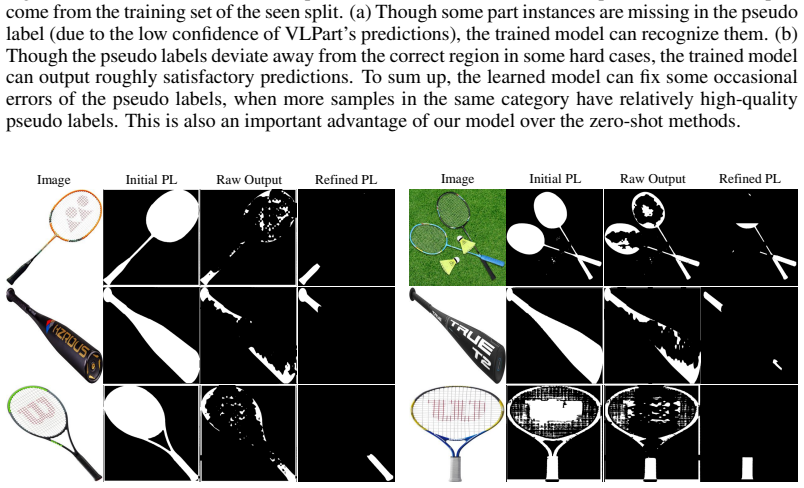
Everything rests on the hand-written table that maps each (object, affordance) pair to a part name being right and complete, and on the off-the-shelf detector and segmenter actually finding that part; the paper itself reports that the handle of a tennis racket is often missed, and the full table is not released.
Editorial extensions
If this is right
- A purely weakly supervised pipeline trained on part-prior pseudo labels can beat CAM-based WSAG by a wide margin on both seen and unseen object splits of AGD20K (KLD 0.890 vs. 1.176 seen; 1.153 vs. 1.335 unseen).
- The model accepts free-form text affordance queries at inference, so the same weights can respond to words never seen during training (e.g., 'grasp' with similar heatmaps to 'hold').
- Better off-the-shelf part segmenters translate directly into better affordance grounding: swapping VLPart for PartGLEE while keeping everything else fixed sets new state-of-the-art numbers on both splits.
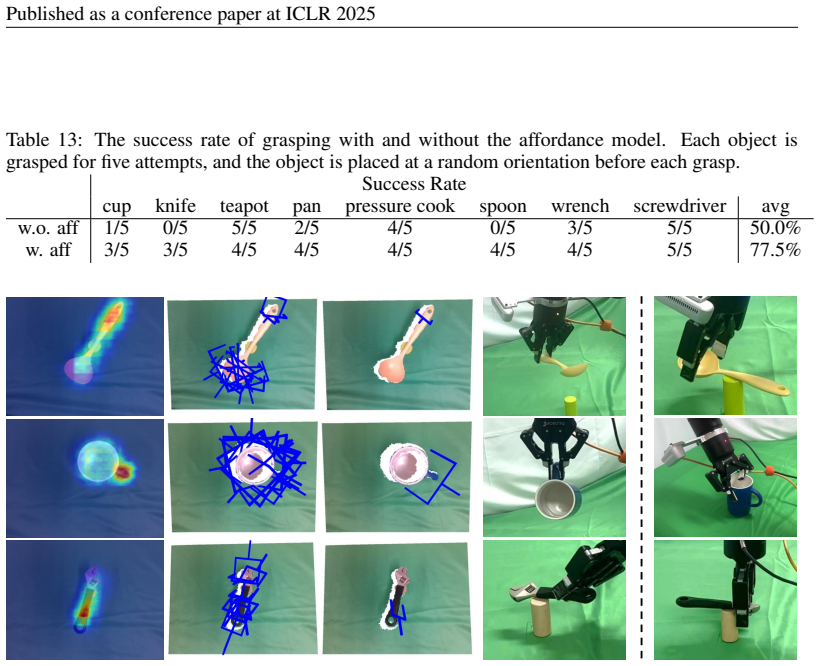
- Affordance heatmaps are usable as a prior for grasp planning: combining the heatmap with a 6-DoF grasp generator raises real-world grasp success on 8 objects from 50.0% to 77.5%, including objects and an affordance word absent from training.
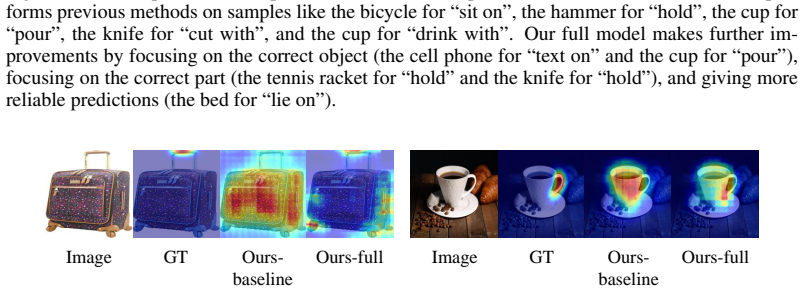
- The method's three modules each pull in the intended direction in the ablations: refinement helps the seen split, cross-view alignment helps both, and the reasoning module plus stitching augmentation matter most for the unseen split.
Reading between the lines
- A consequence the paper leaves implicit is that the pipeline's ceiling is set by the coverage of P(o,a): any pair whose part name is ambiguous, missing, or not segmentable becomes a noisy or empty label, so scaling to new objects means either standardizing the mapping table or letting an LLM generate and validate part queries.
- Because the method is agnostic to the specific part detector and segmenter, gains in generic part segmentation should transfer almost mechanically to affordance grounding; a testable prediction is that the next generation of open-vocabulary part models will push AGD20K numbers further without any architectural change to the grounding model.
- The same object-to-part translation could be applied to other verb-driven dense prediction tasks, such as 'wearable regions' on clothing or 'graspable handles' on tools in robot manipulation benchmarks, reusing the exact pseudo-label-and-align recipe.
- The empirical requirement that the stitching augmentation be needed suggests the model would otherwise shortcut the text query by memorizing object-affordance co-occurrence; one testable extension is to measure how much the KL gap between conditioning on the correct versus an incorrect affordance query widens after removing the stitching.
Editorial analysis
A structured set of objections, weighed in public.
Referee Report
Summary. The paper addresses weakly supervised affordance grounding (WSAG) on AGD20K. It replaces CAM-based training with supervised training on pseudo labels: for each (object, affordance) pair, a manually authored mapping P selects a part name, an off-the-shelf VLPart detector plus SAM produces a part mask, and the mask is used as a pseudo-heatmap. Three extensions are added to the baseline: a label-refinement stage based on occlusion cues and SAM post-processing, a masked exocentric feature alignment loss, and a lightweight noun/part reasoning module with a stitching augmentation. The full model reports large improvements over prior CAM-based methods on both seen and unseen splits (e.g., seen KLD 0.890 vs 1.176 for WSMA; unseen KLD 1.153 vs 1.335), with ablations, a hard-split evaluation, a study of alternative label generators, and a real-robot grasping deployment.
Significance. If the results are reproducible, the paper makes a strong case for pseudo-supervised training as an alternative to CAM-based WSAG and for using part-level semantics as a bridge between objects and actions. The empirical work is unusually complete: ablations for every module, an additional hard split, variation of the visual encoder and the pseudo-label generator, and a real-robot deployment. The authors are also candid about label-quality failures. The main caveat is that the headline gains are not solely due to the proposed learning modules: Table 12 shows that swapping VLPart for PartGLEE changes seen KLD from 0.890 to 0.863 and unseen KLD from 1.153 to 1.084, while the weaker VLPart+FastSAM still outperforms all CAM baselines. The contribution is therefore best understood as a pipeline whose performance scales with an external, rapidly evolving label generator; this is valuable engineering but weakens the "breakthrough" framing.
major comments (3)
- [§3.6, Eq. (7)] The reasoning loss as written appears to have its two cosine-similarity terms swapped: f_pred-part is compared with Enc_T(o) and f_pred-obj with Enc_T(p), while the text states that the first MLP predicts the object class and the second predicts the target part. Because this objective defines the reasoning module that drives the unseen-split gains in Tables 2 and 10, please correct the equation (or, if the equation is intentional, explain why part prediction is matched to the object embedding and vice versa). Also update the cross-reference in Appendix A.1, which cites Eq. (6) for this loss.
- [§4.2 / Tables 1, 2, 7, 8–12] All reported numbers are means over five seeds, but no standard deviations or confidence intervals are given. Without variance estimates, the reader cannot judge whether the margins between Ours-full and Ours-baseline, or among label-generator choices in Table 12, are statistically meaningful. Please report standard deviations for at least the main tables.
- [§3.3 / Appendix B] The pseudo-labeling pipeline is the load-bearing component of the method, yet the complete affordance-to-part mapping P is not released (Appendix B contains only five examples in Table 5), and none of the heuristic thresholds (box confidence 0.5, the mask-inversion perimeter rule, the SAM region-selection threshold max(0.1, 0.9·max-ratio), N_exo_pool=10, λ1, λ2) is sensitivity-analyzed. Please make the full mapping available with the code and add a sensitivity study for the most consequential thresholds, or explicitly argue that the reported results are insensitive to them.
minor comments (6)
- [Appendix A.1] The appendix cites Eq. (6) for f_pred-part; the reasoning loss is defined in Eq. (7).
- [Figure 2 caption] The caption uses 'VLpart' while the text uses 'VLPart'; please standardize the spelling.
- [Appendix D.2] The text says '8×8 gird points'; this should be 'grid points'.
- [§3.3] The phrase 'fully supervised training process' is imprecise because the supervision comes from pseudo labels; 'pseudo-supervised' would be more accurate.
- [Table 7] ManipVQA's NSS of 1.735 with KLD of 12.67 is surprising; please explain how such a high NSS coexists with a KLD an order of magnitude larger than other methods.
- [Table 13] The robot results are based on five attempts per object; please state explicitly that these are illustrative and not statistically powered.
Circularity Check
No significant circularity: pseudo labels come from external foundation models and evaluation uses external ground-truth heatmaps; the reported gains are not forced by construction.
full rationale
The derivation chain is not circular. Pseudo labels H_pl are generated from a manually authored mapping P and the external VLPart+SAM pipeline (Section 3.3), then the model is trained with L_KL plus auxiliary losses (Eqs. 2, 3, 6, 7 and Eq. 8). None of these training targets is the AGD20K ground-truth heatmap used for evaluation, and the trained model does not generate the pseudo labels that supervise it. The exocentric alignment and refinement stages use other images and external object masks, not the evaluation labels. The reasoning module explicitly learns to approximate the hand-written mapping P (Section 3.6); this is disclosed as a prior rather than presented as an independently derived result, and ablation Table 2 shows it is not the main source of the seen-split gain. The paper honestly reports sensitivity to the label generator (Table 12) and visual encoder (Table 11), making the external foundation-model dependence explicit. That dependence is a novelty and attribution caveat, not circularity. The only apparent self-citation is the use of Ma et al. (2024) in the robot deployment experiment, which is not load-bearing for the central benchmark claim. An apparent object/part swap in Eq. (7) is an internal typo or implementation concern, not a circular reduction. No step in the claimed pipeline reduces, by the paper's own equations, to its own input.
Assumptions & free parameters
free parameters (4)
- Affordance-to-part mapping P(o,a) =
hand-authored table for ~100 pairs; full table not in paper
- Exocentric candidate pool size N_exo_pool =
10
- Loss weights λ1 and λ2 =
10 and 1
- SAM label-refinement selection thresholds =
intersection ratio > max(0.1, 0.9*max_ratio); min region area 100
assumptions (3)
- domain assumption Off-the-shelf VLPart and SAM can segment object parts from part-name queries without finetuning
- domain assumption In exocentric interaction images, the region occluded by the human corresponds to the affordance region
- domain assumption CLIP text and image embeddings share a semantic space that supports object/part/action reasoning
Cite this review
Pith. "Pith review of Weakly-Supervised Affordance Grounding Guided by Part-Level Semantic Priors." pith.science (2026). https://pith.science/paper/YMZFKNAB
@misc{pith2026250524103,
  author       = {Pith},
  title        = {Pith review of: Weakly-Supervised Affordance Grounding Guided by Part-Level Semantic Priors},
  year         = {2026},
  howpublished = {\url{https://pith.science/paper/YMZFKNAB}},
  note         = {Machine review of arXiv:2505.24103}
}
read the original abstract
In this work, we focus on the task of weakly supervised affordance grounding, where a model is trained to identify affordance regions on objects using human-object interaction images and egocentric object images without dense labels. Previous works are mostly built upon class activation maps, which are effective for semantic segmentation but may not be suitable for locating actions and functions. Leveraging recent advanced foundation models, we develop a supervised training pipeline based on pseudo labels. The pseudo labels are generated from an off-the-shelf part segmentation model, guided by a mapping from affordance to part names. Furthermore, we introduce three key enhancements to the baseline model: a label refining stage, a fine-grained feature alignment process, and a lightweight reasoning module. These techniques harness the semantic knowledge of static objects embedded in off-the-shelf foundation models to improve affordance learning, effectively bridging the gap between objects and actions. Extensive experiments demonstrate that the performance of the proposed model has achieved a breakthrough improvement over existing methods. Our codes are available at https://github.com/woyut/WSAG-PLSP .
Figures


Figures from the paper (11 more)



Forward citations
Cited by 1 Pith paper
-
Token-Based Affordance Grounding with Large Vision-Language Models
TokAG selects the LVLM output token whose aggregated cross-attention is most concentrated on a CLIPSeg object mask, converting that map into a zero-shot affordance heatmap that outperforms weakly supervised baselines.
Reference graph
Works this paper leans on
-
[1]
Affordances from human videos as a versatile representation for robotics
Shikhar Bahl, Russell Mendonca, Lili Chen, Unnat Jain, and Deepak Pathak. Affordances from human videos as a versatile representation for robotics. In Proceedings of the IEEE/CVF Conference on Computer Vision and Pattern Recognition, pp.\ 13778--13790, 2023
2023
-
[2]
Qwen-vl: A versatile vision-language model for understanding, localization, text reading, and beyond
Jinze Bai, Shuai Bai, Shusheng Yang, Shijie Wang, Sinan Tan, Peng Wang, Junyang Lin, Chang Zhou, and Jingren Zhou. Qwen-vl: A versatile vision-language model for understanding, localization, text reading, and beyond. arXiv preprint arXiv:2308.12966, 2023
arXiv 2023
-
[3]
Do as i can, not as i say: Grounding language in robotic affordances
Anthony Brohan, Yevgen Chebotar, Chelsea Finn, Karol Hausman, Alexander Herzog, Daniel Ho, Julian Ibarz, Alex Irpan, Eric Jang, Ryan Julian, et al. Do as i can, not as i say: Grounding language in robotic affordances. In Conference on robot learning, pp.\ 287--318. PMLR, 2023
2023
-
[4]
Emerging properties in self-supervised vision transformers
Mathilde Caron, Hugo Touvron, Ishan Misra, Herv\'e J\'egou, Julien Mairal, Piotr Bojanowski, and Armand Joulin. Emerging properties in self-supervised vision transformers. In Proceedings of the International Conference on Computer Vision (ICCV), 2021
2021
-
[5]
Hugo Caselles-Dupr \'e , Michael Garcia-Ortiz, and David Filliat. Are standard object segmentation models sufficient for learning affordance segmentation? arXiv preprint arXiv:2107.02095, 2021
arXiv 2021
-
[6]
WorldAfford: Affordance Grounding based on Natural Language Instructions
Changmao Chen, Yuren Cong, and Zhen Kan. Worldafford: Affordance grounding based on natural language instructions. arXiv preprint arXiv:2405.12461, 2024 a
work page Pith review arXiv 2024
-
[7]
Affordance grounding from demonstration video to target image
Joya Chen, Difei Gao, Kevin Qinghong Lin, and Mike Zheng Shou. Affordance grounding from demonstration video to target image. In Proceedings of the IEEE/CVF Conference on Computer Vision and Pattern Recognition, pp.\ 6799--6808, 2023 a
2023
-
[8]
Minigpt-v2: large language model as a unified interface for vision-language multi-task learning
Jun Chen, Deyao Zhu, Xiaoqian Shen, Xiang Li, Zechun Liu, Pengchuan Zhang, Raghuraman Krishnamoorthi, Vikas Chandra, Yunyang Xiong, and Mohamed Elhoseiny. Minigpt-v2: large language model as a unified interface for vision-language multi-task learning. arXiv preprint arXiv:2310.09478, 2023 b
Show all 88 references
-
[9]
Towards label-free scene understanding by vision foundation models
Runnan Chen, Youquan Liu, Lingdong Kong, Nenglun Chen, Xinge Zhu, Yuexin Ma, Tongliang Liu, and Wenping Wang. Towards label-free scene understanding by vision foundation models. Advances in Neural Information Processing Systems, 36, 2024 b
2024
-
[10]
Segment anything model ( SAM ) enhances pseudo-labels for weakly supervised semantic segmentation
Tianle Chen, Zheda Mai, Ruiwen Li, and Wei-Lun Chao. Segment anything model ( SAM ) enhances pseudo-labels for weakly supervised semantic segmentation. In I Can't Believe It's Not Better Workshop: Failure Modes in the Age of Foundation Models, 2024 c . URL https://openreview.n...
2024
-
[11]
Sam-adapter: Adapting segment anything in underperformed scenes
Tianrun Chen, Lanyun Zhu, Chaotao Deng, Runlong Cao, Yan Wang, Shangzhan Zhang, Zejian Li, Lingyun Sun, Ying Zang, and Papa Mao. Sam-adapter: Adapting segment anything in underperformed scenes. In Proceedings of the IEEE/CVF International Conference on Computer Vision, pp.\ 33...
2023
-
[12]
Context autoencoder for self-supervised representation learning
Xiaokang Chen, Mingyu Ding, Xiaodi Wang, Ying Xin, Shentong Mo, Yunhao Wang, Shumin Han, Ping Luo, Gang Zeng, and Jingdong Wang. Context autoencoder for self-supervised representation learning. International Journal of Computer Vision, 132 0 (1): 0 208--223, 2024 d
2024
-
[13]
Cerberus transformer: Joint semantic, affordance and attribute parsing
Xiaoxue Chen, Tianyu Liu, Hao Zhao, Guyue Zhou, and Ya-Qin Zhang. Cerberus transformer: Joint semantic, affordance and attribute parsing. In Proceedings of the IEEE/CVF Conference on Computer Vision and Pattern Recognition, pp.\ 19649--19658, 2022
2022
-
[14]
Weakly-supervised semantic segmentation with image-level labels: from traditional models to foundation models
Zhaozheng Chen and Qianru Sun. Weakly-supervised semantic segmentation with image-level labels: from traditional models to foundation models. arXiv preprint arXiv:2310.13026, 2023
2023 arXiv
-
[15]
Ganhand: Predicting human grasp affordances in multi-object scenes
Enric Corona, Albert Pumarola, Guillem Alenya, Francesc Moreno-Noguer, and Gr \'e gory Rogez. Ganhand: Predicting human grasp affordances in multi-object scenes. In Proceedings of the IEEE/CVF conference on computer vision and pattern recognition, pp.\ 5031--5041, 2020
2020
-
[16]
What does clip know about peeling a banana? In Proceedings of the IEEE/CVF Conference on Computer Vision and Pattern Recognition, pp.\ 2238--2247, 2024
Claudia Cuttano, Gabriele Rosi, Gabriele Trivigno, and Giuseppe Averta. What does clip know about peeling a banana? In Proceedings of the IEEE/CVF Conference on Computer Vision and Pattern Recognition, pp.\ 2238--2247, 2024
2024
-
[17]
Scenefun3d: Fine-grained functionality and affordance understanding in 3d scenes
Alexandros Delitzas, Ayca Takmaz, Federico Tombari, Robert Sumner, Marc Pollefeys, and Francis Engelmann. Scenefun3d: Fine-grained functionality and affordance understanding in 3d scenes. In Proceedings of the IEEE/CVF Conference on Computer Vision and Pattern Recognition, pp....
2024
-
[18]
3d affordancenet: A benchmark for visual object affordance understanding
Shengheng Deng, Xun Xu, Chaozheng Wu, Ke Chen, and Kui Jia. 3d affordancenet: A benchmark for visual object affordance understanding. In proceedings of the IEEE/CVF conference on computer vision and pattern recognition, pp.\ 1778--1787, 2021
2021
-
[19]
Affordancenet: An end-to-end deep learning approach for object affordance detection
Thanh-Toan Do, Anh Nguyen, and Ian Reid. Affordancenet: An end-to-end deep learning approach for object affordance detection. In 2018 IEEE International Conference on Robotics and Automation (ICRA), pp.\ 5882--5889, 2018. doi:10.1109/ICRA.2018.8460902
2018
-
[20]
An image is worth 16x16 words: Transformers for image recognition at scale
Alexey Dosovitskiy, Lucas Beyer, Alexander Kolesnikov, Dirk Weissenborn, Xiaohua Zhai, Thomas Unterthiner, Mostafa Dehghani, Matthias Minderer, Georg Heigold, Sylvain Gelly, Jakob Uszkoreit, and Neil Houlsby. An image is worth 16x16 words: Transformers for image recognition at...
2021
-
[21]
Demo2vec: Reasoning object affordances from online videos
Kuan Fang, Te-Lin Wu, Daniel Yang, Silvio Savarese, and Joseph J Lim. Demo2vec: Reasoning object affordances from online videos. In Proceedings of the IEEE Conference on Computer Vision and Pattern Recognition, pp.\ 2139--2147, 2018
2018
-
[22]
The theory of affordances
James J Gibson. The theory of affordances. Hilldale, USA, 1 0 (2): 0 67--82, 1977
1977
-
[23]
Handal: A dataset of real-world manipulable object categories with pose annotations, affordances, and reconstructions
Andrew Guo, Bowen Wen, Jianhe Yuan, Jonathan Tremblay, Stephen Tyree, Jeffrey Smith, and Stan Birchfield. Handal: A dataset of real-world manipulable object categories with pose annotations, affordances, and reconstructions. In 2023 IEEE/RSJ International Conference on Intelli...
2023
-
[24]
One-shot transfer of affordance regions? affcorrs! In Conference on Robot Learning, pp.\ 550--560
Denis Hadjivelichkov, Sicelukwanda Zwane, Lourdes Agapito, Marc Peter Deisenroth, and Dimitrios Kanoulas. One-shot transfer of affordance regions? affcorrs! In Conference on Robot Learning, pp.\ 550--560. PMLR, 2023
2023
-
[25]
Manipvqa: Injecting robotic affordance and physically grounded information into multi-modal large language models
Siyuan Huang, Iaroslav Ponomarenko, Zhengkai Jiang, Xiaoqi Li, Xiaobin Hu, Peng Gao, Hongsheng Li, and Hao Dong. Manipvqa: Injecting robotic affordance and physically grounded information into multi-modal large language models. arXiv preprint arXiv:2403.11289, 2024
2024 arXiv
-
[26]
Segment anything is a good pseudo-label generator for weakly supervised semantic segmentation
Peng-Tao Jiang and Yuqi Yang. Segment anything is a good pseudo-label generator for weakly supervised semantic segmentation. arXiv preprint arXiv:2305.01275, 2023
2023 arXiv
-
[27]
Robo-abc: Affordance generalization beyond categories via semantic correspondence for robot manipulation
Yuanchen Ju, Kaizhe Hu, Guowei Zhang, Gu Zhang, Mingrun Jiang, and Huazhe Xu. Robo-abc: Affordance generalization beyond categories via semantic correspondence for robot manipulation. arXiv preprint arXiv:2401.07487, 2024
2024 arXiv
-
[28]
Beyond the contact: Discovering comprehensive affordance for 3d objects from pre-trained 2d diffusion models, 2024
Hyeonwoo Kim, Sookwan Han, Patrick Kwon, and Hanbyul Joo. Beyond the contact: Discovering comprehensive affordance for 3d objects from pre-trained 2d diffusion models, 2024. URL https://arxiv.org/abs/2401.12978
2024 arXiv
-
[29]
Segment anything
Alexander Kirillov, Eric Mintun, Nikhila Ravi, Hanzi Mao, Chloe Rolland, Laura Gustafson, Tete Xiao, Spencer Whitehead, Alexander C Berg, Wan-Yen Lo, et al. Segment anything. In Proceedings of the IEEE/CVF International Conference on Computer Vision, pp.\ 4015--4026, 2023
2023
-
[30]
From sam to cams: Exploring segment anything model for weakly supervised semantic segmentation
Hyeokjun Kweon and Kuk-Jin Yoon. From sam to cams: Exploring segment anything model for weakly supervised semantic segmentation. In Proceedings of the IEEE/CVF Conference on Computer Vision and Pattern Recognition, pp.\ 19499--19509, 2024
2024
-
[31]
Lisa: Reasoning segmentation via large language model
Xin Lai, Zhuotao Tian, Yukang Chen, Yanwei Li, Yuhui Yuan, Shu Liu, and Jiaya Jia. Lisa: Reasoning segmentation via large language model. In Proceedings of the IEEE/CVF Conference on Computer Vision and Pattern Recognition, pp.\ 9579--9589, 2024
2024
-
[32]
Locate: Localize and transfer object parts for weakly supervised affordance grounding
Gen Li, Varun Jampani, Deqing Sun, and Laura Sevilla-Lara. Locate: Localize and transfer object parts for weakly supervised affordance grounding. In Proceedings of the IEEE/CVF Conference on Computer Vision and Pattern Recognition, pp.\ 10922--10931, 2023
2023
-
[33]
One-shot open affordance learning with foundation models
Gen Li, Deqing Sun, Laura Sevilla-Lara, and Varun Jampani. One-shot open affordance learning with foundation models. In Proceedings of the IEEE/CVF Conference on Computer Vision and Pattern Recognition, pp.\ 3086--3096, 2024 a
2024
-
[34]
Partglee: A foundation model for recognizing and parsing any objects
Junyi Li, Junfeng Wu, Weizhi Zhao, Song Bai, and Xiang Bai. Partglee: A foundation model for recognizing and parsing any objects. In European Conference on Computer Vision, pp.\ 475--494. Springer, 2025
2025
-
[35]
Manipllm: Embodied multimodal large language model for object-centric robotic manipulation
Xiaoqi Li, Mingxu Zhang, Yiran Geng, Haoran Geng, Yuxing Long, Yan Shen, Renrui Zhang, Jiaming Liu, and Hao Dong. Manipllm: Embodied multimodal large language model for object-centric robotic manipulation. In Proceedings of the IEEE/CVF Conference on Computer Vision and Patter...
2024
-
[36]
Maal: Multimodality-aware autoencoder-based affordance learning for 3d articulated objects
Yuanzhi Liang, Xiaohan Wang, Linchao Zhu, and Yi Yang. Maal: Multimodality-aware autoencoder-based affordance learning for 3d articulated objects. In Proceedings of the IEEE/CVF International Conference on Computer Vision, pp.\ 217--227, 2023
2023
-
[37]
Clip is also an efficient segmenter: A text-driven approach for weakly supervised semantic segmentation
Yuqi Lin, Minghao Chen, Wenxiao Wang, Boxi Wu, Ke Li, Binbin Lin, Haifeng Liu, and Xiaofei He. Clip is also an efficient segmenter: A text-driven approach for weakly supervised semantic segmentation. In Proceedings of the IEEE/CVF Conference on Computer Vision and Pattern Reco...
2023
-
[38]
Visual instruction tuning
Haotian Liu, Chunyuan Li, Qingyang Wu, and Yong Jae Lee. Visual instruction tuning. Advances in neural information processing systems, 36, 2024
2024
-
[39]
Joint hand motion and interaction hotspots prediction from egocentric videos
Shaowei Liu, Subarna Tripathi, Somdeb Majumdar, and Xiaolong Wang. Joint hand motion and interaction hotspots prediction from egocentric videos. In Proceedings of the IEEE/CVF Conference on Computer Vision and Pattern Recognition, pp.\ 3282--3292, 2022
2022
-
[40]
Learning to segment affordances
Timo Luddecke and Florentin Worgotter. Learning to segment affordances. In Proceedings of the IEEE International Conference on Computer Vision Workshops, pp.\ 769--776, 2017
2017
-
[41]
One-shot affordance detection
Hongchen Luo, Wei Zhai, Jing Zhang, Yang Cao, and Dacheng Tao. One-shot affordance detection. In IJCAI, 2021
2021
-
[42]
Learning affordance grounding from exocentric images
Hongchen Luo, Wei Zhai, Jing Zhang, Yang Cao, and Dacheng Tao. Learning affordance grounding from exocentric images. In Proceedings of the IEEE/CVF conference on computer vision and pattern recognition, pp.\ 2252--2261, 2022
2022
-
[43]
Grounded affordance from exocentric view
Hongchen Luo, Wei Zhai, Jing Zhang, Yang Cao, and Dacheng Tao. Grounded affordance from exocentric view. International Journal of Computer Vision, pp.\ 1--25, 2023 a
2023
-
[44]
Leverage interactive affinity for affordance learning
Hongchen Luo, Wei Zhai, Jing Zhang, Yang Cao, and Dacheng Tao. Leverage interactive affinity for affordance learning. In Proceedings of the IEEE/CVF Conference on Computer Vision and Pattern Recognition, pp.\ 6809--6819, 2023 b
2023
-
[45]
Local occupancy-enhanced object grasping with multiple triplanar projection
Kangqi Ma, Hao Dong, and Yadong Mu. Local occupancy-enhanced object grasping with multiple triplanar projection. arXiv preprint arXiv:2407.15771, 2024
2024 arXiv
-
[46]
Simple open-vocabulary object detection
Matthias Minderer, Alexey Gritsenko, Austin Stone, Maxim Neumann, Dirk Weissenborn, Alexey Dosovitskiy, Aravindh Mahendran, Anurag Arnab, Mostafa Dehghani, Zhuoran Shen, et al. Simple open-vocabulary object detection. In European Conference on Computer Vision, pp.\ 728--755. S...
2022
-
[47]
Where2act: From pixels to actions for articulated 3d objects
Kaichun Mo, Leonidas J Guibas, Mustafa Mukadam, Abhinav Gupta, and Shubham Tulsiani. Where2act: From pixels to actions for articulated 3d objects. In Proceedings of the IEEE/CVF International Conference on Computer Vision, pp.\ 6813--6823, 2021
2021
-
[48]
Bayesian deep learning for affordance segmentation in images
Lorenzo Mur-Labadia, Ruben Martinez-Cantin, and Jose J Guerrero. Bayesian deep learning for affordance segmentation in images. In 2023 IEEE International Conference on Robotics and Automation (ICRA), pp.\ 6981--6987. IEEE, 2023
2023
-
[49]
Affordance detection of tool parts from geometric features
Austin Myers, Ching L Teo, Cornelia Ferm \"u ller, and Yiannis Aloimonos. Affordance detection of tool parts from geometric features. In 2015 IEEE International Conference on Robotics and Automation (ICRA), pp.\ 1374--1381. IEEE, 2015
2015
-
[50]
Learning affordance landscapes for interaction exploration in 3d environments
Tushar Nagarajan and Kristen Grauman. Learning affordance landscapes for interaction exploration in 3d environments. Advances in Neural Information Processing Systems, 33: 0 2005--2015, 2020
2005
-
[51]
Grounded human-object interaction hotspots from video
Tushar Nagarajan, Christoph Feichtenhofer, and Kristen Grauman. Grounded human-object interaction hotspots from video. In Proceedings of the IEEE/CVF International Conference on Computer Vision, pp.\ 8688--8697, 2019
2019
-
[52]
Detecting object affordances with convolutional neural networks
Anh Nguyen, Dimitrios Kanoulas, Darwin G Caldwell, and Nikos G Tsagarakis. Detecting object affordances with convolutional neural networks. In 2016 IEEE/RSJ International Conference on Intelligent Robots and Systems (IROS), pp.\ 2765--2770. IEEE, 2016
2016
-
[53]
Object-based affordances detection with convolutional neural networks and dense conditional random fields
Anh Nguyen, Dimitrios Kanoulas, Darwin G Caldwell, and Nikos G Tsagarakis. Object-based affordances detection with convolutional neural networks and dense conditional random fields. In 2017 IEEE/RSJ International Conference on Intelligent Robots and Systems (IROS), pp.\ 5908--...
2017
-
[54]
Open-vocabulary affordance detection in 3d point clouds
Toan Nguyen, Minh Nhat Vu, An Vuong, Dzung Nguyen, Thieu Vo, Ngan Le, and Anh Nguyen. Open-vocabulary affordance detection in 3d point clouds. In 2023 IEEE/RSJ International Conference on Intelligent Robots and Systems (IROS), pp.\ 5692--5698. IEEE, 2023
2023
-
[55]
Maxime Oquab, Timoth \'e e Darcet, Th \'e o Moutakanni, Huy V. Vo, Marc Szafraniec, Vasil Khalidov, Pierre Fernandez, Daniel HAZIZA, Francisco Massa, Alaaeldin El-Nouby, Mido Assran, Nicolas Ballas, Wojciech Galuba, Russell Howes, Po-Yao Huang, Shang-Wen Li, Ishan Misra, Micha...
2024
-
[56]
Peters, Asha Iyer, Laurent Itti, and Christof Koch
Robert J. Peters, Asha Iyer, Laurent Itti, and Christof Koch. Components of bottom-up gaze allocation in natural images. Vision Research, 45 0 (18): 0 2397--2416, 2005. ISSN 0042-6989. doi:https://doi.org/10.1016/j.visres.2005.03.019. URL https://www.sciencedirect.com/science/...
2005 doi
-
[57]
Understanding 3d object interaction from a single image
Shengyi Qian and David F Fouhey. Understanding 3d object interaction from a single image. In Proceedings of the IEEE/CVF International Conference on Computer Vision, pp.\ 21753--21763, 2023
2023
-
[58]
Affordancellm: Grounding affordance from vision language models
Shengyi Qian, Weifeng Chen, Min Bai, Xiong Zhou, Zhuowen Tu, and Li Erran Li. Affordancellm: Grounding affordance from vision language models. In Proceedings of the IEEE/CVF Conference on Computer Vision and Pattern Recognition, pp.\ 7587--7597, 2024
2024
-
[59]
Learning transferable visual models from natural language supervision
Alec Radford, Jong Wook Kim, Chris Hallacy, Aditya Ramesh, Gabriel Goh, Sandhini Agarwal, Girish Sastry, Amanda Askell, Pamela Mishkin, Jack Clark, et al. Learning transferable visual models from natural language supervision. In International conference on machine learning, pp...
2021
-
[60]
Strategies to leverage foundational model knowledge in object affordance grounding
Arushi Rai, Kyle Buettner, and Adriana Kovashka. Strategies to leverage foundational model knowledge in object affordance grounding. In Proceedings of the IEEE/CVF Conference on Computer Vision and Pattern Recognition, pp.\ 1714--1723, 2024
2024
-
[61]
Grounded sam: Assembling open-world models for diverse visual tasks
Tianhe Ren, Shilong Liu, Ailing Zeng, Jing Lin, Kunchang Li, He Cao, Jiayu Chen, Xinyu Huang, Yukang Chen, Feng Yan, et al. Grounded sam: Assembling open-world models for diverse visual tasks. arXiv preprint arXiv:2401.14159, 2024
2024 arXiv
-
[62]
A multi-scale cnn for affordance segmentation in rgb images
Anirban Roy and Sinisa Todorovic. A multi-scale cnn for affordance segmentation in rgb images. In Computer Vision--ECCV 2016: 14th European Conference, Amsterdam, The Netherlands, October 11--14, 2016, Proceedings, Part IV 14, pp.\ 186--201. Springer, 2016
2016
-
[63]
Weakly supervised affordance detection
Johann Sawatzky, Abhilash Srikantha, and Juergen Gall. Weakly supervised affordance detection. In Proceedings of the IEEE Conference on Computer Vision and Pattern Recognition, pp.\ 2795--2804, 2017
2017
-
[64]
Hierarchical transformer for visual affordance understanding using a large-scale dataset
Syed Afaq Ali Shah and Zeyad Khalifa. Hierarchical transformer for visual affordance understanding using a large-scale dataset. In 2023 IEEE/RSJ International Conference on Intelligent Robots and Systems (IROS), pp.\ 11371--11376. IEEE, 2023
2023
-
[65]
Grounded segment anything: From objects to parts
Peize Sun, Shoufa Chen, and Ping Luo. Grounded segment anything: From objects to parts. https://github.com/Cheems-Seminar/grounded-segment-any-parts, 2023 a
2023
-
[66]
Going denser with open-vocabulary part segmentation
Peize Sun, Shoufa Chen, Chenchen Zhu, Fanyi Xiao, Ping Luo, Saining Xie, and Zhicheng Yan. Going denser with open-vocabulary part segmentation. In Proceedings of the IEEE/CVF International Conference on Computer Vision, pp.\ 15453--15465, 2023 b
2023
-
[67]
An alternative to wsss? an empirical study of the segment anything model (sam) on weakly-supervised semantic segmentation problems
Weixuan Sun, Zheyuan Liu, Yanhao Zhang, Yiran Zhong, and Nick Barnes. An alternative to wsss? an empirical study of the segment anything model (sam) on weakly-supervised semantic segmentation problems. arXiv preprint arXiv:2305.01586, 2023 c
2023 arXiv
-
[68]
Oval-prompt: Open-vocabulary affordance localization for robot manipulation through llm affordance-grounding
Edmond Tong, Anthony Opipari, Stanley Robert Lewis, Zhen Zeng, and Odest Chadwicke Jenkins. Oval-prompt: Open-vocabulary affordance localization for robot manipulation through llm affordance-grounding. In First Workshop on Vision-Language Models for Navigation and Manipulation...
2024
-
[69]
An interactive navigation method with effect-oriented affordance
Xiaohan Wang, Yuehu Liu, Xinhang Song, Yuyi Liu, Sixian Zhang, and Shuqiang Jiang. An interactive navigation method with effect-oriented affordance. In Proceedings of the IEEE/CVF Conference on Computer Vision and Pattern Recognition, pp.\ 16446--16456, 2024 a
2024
-
[70]
Adaafford: Learning to adapt manipulation affordance for 3d articulated objects via few-shot interactions
Yian Wang, Ruihai Wu, Kaichun Mo, Jiaqi Ke, Qingnan Fan, Leonidas J Guibas, and Hao Dong. Adaafford: Learning to adapt manipulation affordance for 3d articulated objects via few-shot interactions. In European conference on computer vision, pp.\ 90--107. Springer, 2022
2022
-
[71]
Move as you say interact as you can: Language-guided human motion generation with scene affordance
Zan Wang, Yixin Chen, Baoxiong Jia, Puhao Li, Jinlu Zhang, Jingze Zhang, Tengyu Liu, Yixin Zhu, Wei Liang, and Siyuan Huang. Move as you say interact as you can: Language-guided human motion generation with scene affordance. In Proceedings of the IEEE/CVF Conference on Compute...
2024
-
[72]
VAT -mart: Learning visual action trajectory proposals for manipulating 3d ART iculated objects
Ruihai Wu, Yan Zhao, Kaichun Mo, Zizheng Guo, Yian Wang, Tianhao Wu, Qingnan Fan, Xuelin Chen, Leonidas Guibas, and Hao Dong. VAT -mart: Learning visual action trajectory proposals for manipulating 3d ART iculated objects. In International Conference on Learning Representation...
2022
-
[73]
Clims: Cross language image matching for weakly supervised semantic segmentation
Jinheng Xie, Xianxu Hou, Kai Ye, and Linlin Shen. Clims: Cross language image matching for weakly supervised semantic segmentation. In Proceedings of the IEEE/CVF conference on computer vision and pattern recognition, pp.\ 4483--4492, 2022
2022
-
[74]
Learning multi-modal class-specific tokens for weakly supervised dense object localization
Lian Xu, Wanli Ouyang, Mohammed Bennamoun, Farid Boussaid, and Dan Xu. Learning multi-modal class-specific tokens for weakly supervised dense object localization. In Proceedings of the IEEE/CVF Conference on Computer Vision and Pattern Recognition, pp.\ 19596--19605, 2023
2023
-
[75]
Weakly supervised multimodal affordance grounding for egocentric images
Lingjing Xu, Yang Gao, Wenfeng Song, and Aimin Hao. Weakly supervised multimodal affordance grounding for egocentric images. In Proceedings of the AAAI Conference on Artificial Intelligence, volume 38, pp.\ 6324--6332, 2024
2024
-
[76]
Foundation model assisted weakly supervised semantic segmentation
Xiaobo Yang and Xiaojin Gong. Foundation model assisted weakly supervised semantic segmentation. In Proceedings of the IEEE/CVF Winter Conference on Applications of Computer Vision, pp.\ 523--532, 2024
2024
-
[77]
Grounding 3d object affordance from 2d interactions in images
Yuhang Yang, Wei Zhai, Hongchen Luo, Yang Cao, Jiebo Luo, and Zheng-Jun Zha. Grounding 3d object affordance from 2d interactions in images. In Proceedings of the IEEE/CVF International Conference on Computer Vision, pp.\ 10905--10915, 2023
2023
-
[78]
Lemon: Learning 3d human-object interaction relation from 2d images
Yuhang Yang, Wei Zhai, Hongchen Luo, Yang Cao, and Zheng-Jun Zha. Lemon: Learning 3d human-object interaction relation from 2d images. In Proceedings of the IEEE/CVF Conference on Computer Vision and Pattern Recognition, pp.\ 16284--16295, 2024
2024
-
[79]
Affordance diffusion: Synthesizing hand-object interactions
Yufei Ye, Xueting Li, Abhinav Gupta, Shalini De Mello, Stan Birchfield, Jiaming Song, Shubham Tulsiani, and Sifei Liu. Affordance diffusion: Synthesizing hand-object interactions. In Proceedings of the IEEE/CVF Conference on Computer Vision and Pattern Recognition, pp.\ 22479-...
2023
-
[80]
Fine-grained affordance annotation for egocentric hand-object interaction videos
Zecheng Yu, Yifei Huang, Ryosuke Furuta, Takuma Yagi, Yusuke Goutsu, and Yoichi Sato. Fine-grained affordance annotation for egocentric hand-object interaction videos. In Proceedings of the IEEE/CVF Winter Conference on Applications of Computer Vision, pp.\ 2155--2163, 2023
2023
-
[81]
Frozen clip: A strong backbone for weakly supervised semantic segmentation
Bingfeng Zhang, Siyue Yu, Yunchao Wei, Yao Zhao, and Jimin Xiao. Frozen clip: A strong backbone for weakly supervised semantic segmentation. In Proceedings of the IEEE/CVF Conference on Computer Vision and Pattern Recognition, pp.\ 3796--3806, 2024 a
2024
-
[82]
Self-explainable affordance learning with embodied caption
Zhipeng Zhang, Zhimin Wei, Guolei Sun, Peng Wang, and Luc Van Gool. Self-explainable affordance learning with embodied caption. arXiv preprint arXiv:2404.05603, 2024 b
2024 arXiv
-
[83]
Fast segment anything
Xu Zhao, Wenchao Ding, Yongqi An, Yinglong Du, Tao Yu, Min Li, Ming Tang, and Jinqiao Wang. Fast segment anything. arXiv preprint arXiv:2306.12156, 2023
2023 arXiv
-
[84]
Learning deep features for discriminative localization
Bolei Zhou, Aditya Khosla, Agata Lapedriza, Aude Oliva, and Antonio Torralba. Learning deep features for discriminative localization. In Proceedings of the IEEE conference on computer vision and pattern recognition, pp.\ 2921--2929, 2016
2016
-
[85]
write newline
" write newline "" before.all 'output.state := FUNCTION n.dashify 't := "" t empty not t #1 #1 substring "-" = t #1 #2 substring "--" = not "--" * t #2 global.max substring 't := t #1 #1 substring "-" = "-" * t #2 global.max substring 't := while if t #1 #1 substring * t #2 gl...
-
[86]
@esa (Ref
\@ifxundefined[1] #1\@undefined \@firstoftwo \@secondoftwo \@ifnum[1] #1 \@firstoftwo \@secondoftwo \@ifx[1] #1 \@firstoftwo \@secondoftwo [2] @ #1 \@temptokena #2 #1 @ \@temptokena \@ifclassloaded agu2001 natbib The agu2001 class already includes natbib coding, so you should ...
-
[87]
\@lbibitem[] @bibitem@first@sw\@secondoftwo \@lbibitem[#1]#2 \@extra@b@citeb \@ifundefined br@#2\@extra@b@citeb \@namedef br@#2 \@nameuse br@#2\@extra@b@citeb \@ifundefined b@#2\@extra@b@citeb @num @parse #2 @tmp #1 NAT@b@open@#2 NAT@b@shut@#2 \@ifnum @merge>\@ne @bibitem@firs...
-
[88]
2yJ+q/0 Q(hAz lC6B wo^ n;e=ad E L D!ԝV
@open @close @open @close and [1] URL: #1 \@ifundefined chapter * \@mkboth \@ifxundefined @sectionbib * \@mkboth * \@mkboth\@gobbletwo \@ifclassloaded amsart * \@ifclassloaded amsbook * \@ifxundefined @heading @heading NAT@ctr thebibliography [1] @ \@biblabel @NAT@ctr \@bibset...
2021
Reviewed August 7, 2026 · model on record in the stance chip above.
Discussion (0). Sign in to comment.