REVIEW 2 major objections 3 minor 35 references
A Causation-Based Framework for Pricing and Cost Allocation of Energy, Reserves, and Transmission in Modern Power Systems
T0 review · 2 major / 3 minor · reviewed 2026-08-07 · deepseek-v4-flash
Pith's one-line read A security charge levied on the generators whose outages drive reserve needs makes consumer payments exactly match generation and transmission revenues in contingency-constrained electricity markets.
desk verdict A clean and correct dual-based extension of the Arroyo-Galiana pricing scheme; the security charge is new and the accounting is right, but the causal story needs a dual-selection rule and the efficiency claims outrun the proofs. read the letter →
The pith
A machine-rendered reading of the paper's core claim, the machinery that carries it, and where it could break.
The reading
What carries the argument
The load-bearing object is the Lagrangian dual function of the clearing LP. The authors build the dual by relaxing the power-balance constraints (and, in the network model, the line-flow limits) and then read each term as a settlement account: consumer payment, generator profit, consumer profit, and, for the network model, transmission congestion rent. The decisive algebraic step is rewriting the contingency-state revenue $\psi^g_{ik}(\pi_k, x_i) = \pi_k a^g_{ik}(g_{i0} + r_i^{up})$ as $\pi_k(g_{i0} + r_i^{up})$ over all states minus $\pi_k(g_{i0} + r_i^{up})$ over the states $k \in K^{OFF}_i$ in which the generator is unavailable; that subtracted term is the security charge. Strong duality then turns the equality between primal cost and dual value into the revenue-neutrality identity, and the fact that each agent's term in the dual is a linear program over non-negative variables gives non-negative profits. Splitting each contingency price as $\pi_{bk} = \pi^+_{bk} - \pi^-_{bk}$ yields separate up- and down-reserve prices, and the absolute values of the line-flow bound multipliers form the transmission price.
What would settle it
Take the paper's two-bus example and tighten the line so the line-outage contingency also binds, making a second flow multiplier nonzero at the same time as the generator-1 outage, then recompute the proposed settlement and check whether consumer payments still equal generation plus transmission revenue; alternatively, add a single binary unit-commitment variable with a startup cost and observe whether the balance fails, which would show the LP strong-duality premise is doing the work.
Extended reading notes
Core claim
The paper's central claim is that the dual of a contingency-constrained energy-and-reserve market-clearing LP contains a complete, self-balancing settlement, provided the revenue that each generator would collect in contingency states is first reduced by a security charge for the states in which that generator is out of service. In the single-bus model the charge is $C_i^s = \sum_{k \in K^{OFF}_i} \pi_k^*(g_{i0} + r_i^{up})$, the product of the contingency power-balance prices and the generator's pre-contingency output plus up-reserve. Because $\pi_k^*$ is positive only for the contingencies that actually constrain the system, the charge falls on the generator whose potential outage drives the reserve requirement, exactly implementing cost causation. The same rearrangement applied to the network model splits the contingency prices into positive and negative parts to price up- and down-spinning reserves separately, and adds a transmission price $p_l^f = |\pi^{f*}_{l0}| + \sum_k |\pi^{f*}_{lk}|$ per MW of line capacity. Theorems 1 and 2, with network extensions in Appendices D and E, prove via strong duality that generator and consumer profits stay non-negative and that consumer payments exactly equal generation revenue, or generation plus transmission revenue in the network case. The two worked examples show the previously reported scheme leaving shortfalls of $5,200 and $6,900 that the new settlement closes.
Load-bearing premise
The entire construction assumes the market-clearing problem is a linear program with continuous variables, so the primal and dual optima coincide; the revenue adequacy and neutrality guarantees can break down once binary unit-commitment decisions, startup costs, or other nonconvexities enter the model.
Editorial extensions
If this is right
- In the single-bus model the proposed settlement makes total generator revenue exactly equal the consumer payment, closing the $5,200 gap left by the Arroyo-Galiana pricing on the paper's example.
- In the network model consumer payments exactly match the sum of generation revenue and transmission revenue, closing the $6,900 gap and removing the need for out-of-market compensation.
- Generators whose outages bind the contingency constraints pay security charges while others pay nothing, so reserve costs follow the cost-causation principle while all profits remain non-negative.
- Up- and down-spinning reserves receive distinct nodal prices, so a unit that deploys downward reserve in a contingency with a negative price is paid according to that separate price rather than a blended security price.
- Transmission lines are remunerated for the capacity they dedicate to reserve deliverability across all contingency states, giving line owners an economic incentive tied to reserve provision.
Reading between the lines
- Because the neutrality identity is a bookkeeping consequence of strong duality, it should hold in every LP instance of the paper's class; a cheap stress test is to generate many random cost, capacity, and contingency instances and verify that consumer payment minus generation and transmission revenue is identically zero in each.
- The same dual-rearrangement logic should carry over to probabilistic security criteria, where each contingency's price would be weighted by its probability when computing the security charge, yielding causation-based charges under stochastic reserve requirements.
- The paper notes that over-frequency events are the demand-side mirror of generator outages; a symmetric construction would levy security charges on loads whose sudden disconnection forces downward-reserve purchases, completing the causation story on both sides of the market.
- If implemented, the security charge would give the paying generator a direct financial incentive to lower its forced-outage rate, turning what looks like a penalty into a reliability investment signal, a behavior the paper motivates but does not model.
Editorial analysis
A structured set of objections, weighed in public.
Referee Report
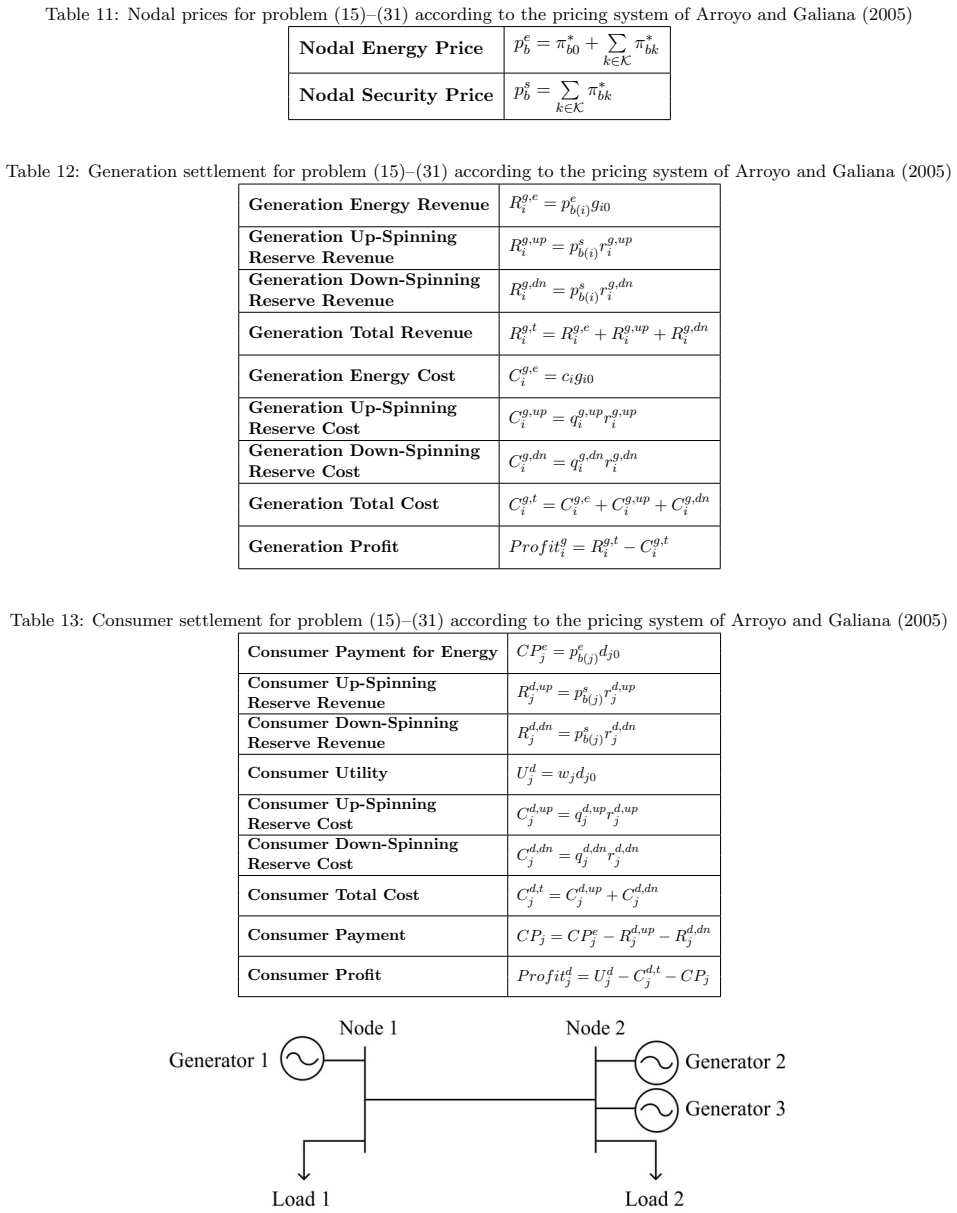
Summary. This paper proposes a pricing and cost-allocation framework for contingency-constrained, co-optimized energy and reserve markets. It introduces a security charge that is subtracted from each generator's revenue, defined from the Lagrangian dual of an LP market-clearing model, and it derives separate nodal prices for up-spinning reserves, down-spinning reserves, and transmission services. In a single-bus model and a two-bus network model, the paper compares its settlement with that of Arroyo and Galiana (2005), shows that the proposed scheme removes the revenue imbalance, and states two theorems: revenue adequacy (nonnegative profits for generators and consumers) and revenue neutrality (consumer payments equal generation plus transmission revenue). Proofs are given in Appendices B-E, and two numerical examples illustrate exact settlement balance.
Significance. If the results stand, the framework offers a clean, dual-based method to repair the revenue mismatch of a well-known pricing scheme while preserving nonnegative profits. The paper's strengths are its explicit, checkable price definitions, its complete proofs of revenue adequacy and neutrality for the stated LP models, and its exact numerical reconciliation in both examples. The separation of up- and down-reserve prices and the explicit transmission remuneration are useful contributions. However, the central 'causation-based' interpretation is not fully supported unless the optimal dual solution is unique or a selection rule is provided; the same physical dispatch can in principle support multiple dual-based settlements. The paper is also silent on the scope limitation that the guarantees rely on strong duality and therefore do not extend to nonconvex market-clearing models.
major comments (2)
- [Sections 2.3 and 3.3 (Eq. (46)-(47), Tables 22-27)] The security charge C_i^g, the up/down reserve prices, and the transmission price are all defined as functions of one optimal dual solution Pi*. The paper does not prove that the optimal dual solution of (1)-(6) or (15)-(31) is unique, and in LP degeneracy it generally is not. Different optimal dual extreme points can yield different security charges and different reserve/transmission prices while leaving the primal dispatch and the total settlement balance unchanged. The numerical results were obtained with CPLEX's simplex algorithm, which selects one basis without economic justification. Because the paper's central claim is that these charges 'reflect the different contributions of generators' and provide reliability incentives, the absence of a uniqueness result or a selection rule leaves the cost-causation attribution underdetermined. Theorems 1 and 2 remain correct for any optimal dual, but the causation narrative needs either a uniqueness argument, an explicit selection rule, or a reformulation of the result as a family of admissible revenue-neutral settlements.
- [Abstract and Appendix E (Eq. (E.1))] The abstract and conclusion state revenue neutrality and adequacy without qualification, but the proofs in Appendices B-E rely essentially on strong duality for the LP models (1)-(6) and (15)-(31). If the market-clearing model includes binary unit-commitment variables, startup costs, or other nonconvexities, the strong-duality identity can fail, and the neutrality and adequacy guarantees may fail as well. The paper does not mention this limitation in the conclusion or in the discussion of future work. Please add an explicit scope statement clarifying that the proposed settlement is guaranteed only for the continuous linear-programming formulation, and temper the unqualified 'no missing money' claim in the abstract.
minor comments (3)
- [Section 3.3, Eq. (32)-(34)] The sign convention for the line-flow multipliers is nonstandard: pi^{f-} is described as nonpositive even though it multiplies (F - H\theta). Since pi^{f-} is apparently the negative of the usual upper-bound multiplier, please state this explicitly to avoid confusion.
- [Section 2.2, Table 7] The term 'missing money' is used to describe a situation where generation revenue exceeds consumer payments by $5,200. That is a revenue surplus, not the usual meaning of 'missing money' (insufficient revenue). Please use a different term, such as 'settlement surplus' or 'revenue imbalance'.
- [Conclusion, Section 4] The future-work paragraph lists multi-period settings and renewable uncertainty but does not mention nonconvex market clearing (binary unit commitment, startup costs). Adding that direction would be a natural and relevant extension, given the LP-only scope of the current proofs.
Circularity Check
No significant circularity: the revenue-neutrality and revenue-adequacy theorems are explicit consequences of LP strong duality and the chosen settlement definitions, and the self-citations are not load-bearing.
full rationale
The paper's central theorems are not circular. Revenue neutrality is proven in Appendices C and E by writing the Lagrangian dual identity and then canceling identical terms; this is a direct consequence of strong duality for the stated linear programs, not a hidden restatement of an assumed conclusion. The security charge is introduced in Equation (14) as the negative dual term associated with generator outages, and the settlement definitions in Tables 8 and 22-24 are then shown to satisfy the balance identity. This is a mechanism-construction check rather than an empirical prediction, but the derivation is explicit, self-contained, and does not presuppose the theorem. The paper also relies on the pricing definitions of Arroyo and Galiana (2005), a work coauthored by one of the present authors, but it re-derives those price components from the same Lagrangian decomposition instead of importing them as an unverified premise, so the self-citation is not load-bearing. The dual-multiplier non-uniqueness raised in the skeptic brief is a legitimate robustness and interpretation concern for the cost-causation narrative, but it does not make the arguments circular: revenue adequacy and neutrality hold for any optimal dual solution. Overall, the mathematical derivation chain is sound and not equivalent to its inputs by definition.
Assumptions & free parameters
assumptions (5)
- standard math Strong duality holds for the market-clearing LP, with zero duality gap and existence of optimal dual prices.
- domain assumption DC load-flow approximation for the network.
- domain assumption Deterministic credible contingency set K with binary generator availability a_ik, without probabilistic outage modeling.
- domain assumption Offer-based linear cost functions and no nonconvexities such as startup costs or unit commitment.
- domain assumption Zero lower bounds and feasible zero-output choices for every generator and load.
invented entities (1)
-
Security charge C_i^g = sum_{k in K_OFF_i} pi_k^*(g_i0 + r_i^up)
Cite this review
Pith. "Pith review of A Causation-Based Framework for Pricing and Cost Allocation of Energy, Reserves, and Transmission in Modern Power Systems." pith.science (2026). https://pith.science/paper/OIIVQ2AB
@misc{pith2026250524159,
  author       = {Pith},
  title        = {Pith review of: A Causation-Based Framework for Pricing and Cost Allocation of Energy, Reserves, and Transmission in Modern Power Systems},
  year         = {2026},
  howpublished = {\url{https://pith.science/paper/OIIVQ2AB}},
  note         = {Machine review of arXiv:2505.24159}
}
read the original abstract
The increasing vulnerability of power systems has heightened the need for operating reserves to manage contingencies such as generator outages, line failures, and sudden load variations. Unlike energy costs, driven by consumer demand, operating reserve costs arise from addressing the most critical credible contingencies - prompting the question: how should these costs be allocated through efficient pricing mechanisms? As an alternative to previously reported schemes, this paper presents a new causation-based pricing framework for electricity markets based on contingency-constrained energy and reserve scheduling models. Major salient features include a novel security charge mechanism along with the explicit definition of prices for up-spinning reserves, down-spinning reserves, and transmission services. These features ensure more comprehensive and efficient cost-reflective market operations. Moreover, the proposed nodal pricing scheme yields revenue adequacy and neutrality while promoting reliability incentives for generators based on the cost-causation principle. An additional salient aspect of the proposed framework is the economic incentive for transmission assets, which are remunerated based on their use to deliver energy and reserves across all contingency states. Numerical results from two case studies illustrate the performance of the proposed pricing scheme.
Figures
Reference graph
Works this paper leans on
-
[1]
Aganagic, M., Abdul-Rahman, K. H., and Waight, J. G. (1998). Spot pricing of capacities for generation and transmission of reserve in an extended Poolco model . IEEE Transactions on Power Systems , 13(3):1128--1135
work page 1998
-
[2]
Arroyo, J. M. and Galiana, F. D. (2005). Energy and reserve pricing in security and network-constrained electricity markets. IEEE Transactions on Power Systems , 20(2):634--643
work page 2005
-
[3]
Wholesale electricity market design summary
Australian Energy Market Operator (AEMO) (2023). Wholesale electricity market design summary. https://aemo.com.au/-/media/files/initiatives/wem-reform-program/wem-reform-market-design-summary.pdf. 2025-01-20
work page 2023
-
[4]
Badesa, L., Matamala, C., and Strbac, G. (2025). Who should pay for frequency-containment ancillary services? Making responsible units bear the cost to shape investment in generation and loads . Energy Policy , 196(Article 114379)
work page 2025
-
[5]
Badesa, L., Matamala, C., Zhou, Y., and Strbac, G. (2023). Assigning shadow prices to synthetic inertia and frequency response reserves from renewable energy sources. IEEE Transactions on Sustainable Energy , 14(1):12--26
work page 2023
-
[6]
Bertsimas, D. and Tsitsiklis, J. N. (1997). Introduction to Linear Optimization . Athena Scientific, Belmont, MA, USA
work page 1997
-
[7]
Billimoria, F., Mancarella, P., and Poudineh, R. (2020). Market design for system security in low-carbon electricity grids: From the physics to the economics. The Oxford Institute for Energy Studies , (Article EL 41)
work page 2020
-
[8]
Bouffard, F., Galiana, F. D., and Conejo, A. J. (2005). Market-clearing with stochastic security--Part II: Case studies . IEEE Transactions on Power Systems , 20(4):1827--1835
work page 2005
Show all 35 references
-
[9]
and Hug, G
Byers, C. and Hug, G. (2023). Long-run optimal pricing in electricity markets with non-convex costs. European Journal of Operational Research , 307(1):351--363
2023
-
[10]
2019 annual report on market issues & performance
California ISO (2019). 2019 annual report on market issues & performance. http://www.caiso.com/Documents/2019AnnualReportonMarketIssuesandPerformance.pdf. 2025-01-21
2019
-
[11]
J., Arroyo, J
Conejo, A. J., Arroyo, J. M., Redondo, N. J., and Prieto, F. J. (1999). Lagrangian relaxation applications to electric power operations and planning problems. In Song, Y.-H., editor, Modern Optimisation Techniques in Power Systems , pages 173--203. Springer
1999
-
[12]
Capacity allocation and congestion management
European Union Agency for the Cooperation of Energy Regulators (ACER) (2025). Capacity allocation and congestion management. 2025-01-20
2025
-
[13]
D., Bouffard, F., Arroyo, J
Galiana, F. D., Bouffard, F., Arroyo, J. M., and Restrepo, J. F. (2005). Scheduling and pricing of coupled energy and primary, secondary, and tertiary reserves. Proceedings of the IEEE , 93(11):1970--1983
2005
-
[14]
and Litvinov, E
Gan, D. and Litvinov, E. (2003). Energy and reserve market designs with explicit consideration to lost opportunity costs. IEEE Transactions on Power Systems , 18(1):53--59
2003
-
[15]
and Bouffard, F
Karangelos, E. and Bouffard, F. (2012). Towards full integration of demand-side resources in joint forward energy/reserve electricity markets. IEEE Transactions on Power Systems , 27(1):280--289
2012
-
[16]
and Hirst, E
Kirby, B. and Hirst, E. (2003). Allocating the costs of contingency reserves. The Electricity Journal , 16(10):39--47
2003
-
[17]
Kirschen, D. S. and Strbac, G. (2019). Fundamentals of Power System Economics . John Wiley & Sons, Ltd, Chichester, UK, 2nd ed. edition
2019
-
[18]
Liu, S., Xiang, M., Yu, S., and Yang, Z. (2023). Cost allocation for frequency regulation mileage based on contributions to system power unbalance. In 2023 IEEE 6th International Electrical and Energy Conference (CIEEC) , pages 1703--1707, Hefei, China
2023
-
[19]
Martin, N. C. and Fanzeres, B. (2023). Stochastic risk-averse energy and reserve scheduling and pricing schemes with non-convexities and revenue caps. Electric Power Systems Research , 225(Article 109858)
2023
-
[20]
Matamala, C., Badesa, L., Moreno, R., and Strbac, G. (2024). Cost allocation for inertia and frequency response ancillary services. IEEE Transactions on Energy Markets, Policy, and Regulation , 2(3):328--338
2024
-
[21]
P., and O’Neill, R
Mays, J., Morton, D. P., and O’Neill, R. P. (2021). Investment effects of pricing schemes for non-convex markets. European Journal of Operational Research , 289(2):712--726
2021
-
[22]
M., Conejo, A
Morales, J. M., Conejo, A. J., Liu, K., and Zhong, J. (2012). Pricing electricity in pools with wind producers. IEEE Transactions on Power Systems , 27(3):1366--1376
2012
-
[23]
P., Sotkiewicz, P
O'Neill, R. P., Sotkiewicz, P. M., Hobbs, B. F., Rothkopf, M. H., and Stewart, Jr., W. R. (2005). Efficient market-clearing prices in markets with nonconvexities. European Journal of Operational Research , 164(1):269--285
2005
-
[24]
PJM manual 11: Energy & ancillary services market operations
PJM Interconnection (2024). PJM manual 11: Energy & ancillary services market operations . https://www.pjm.com/-/media/documents/manuals/m11.ashx. 2025-01-21
2024
-
[25]
C., and Barroso, L
Ribeiro, L., Street, A., Valladão, D., Freire, A. C., and Barroso, L. (2023). Technical and economical aspects of wholesale electricity markets: An international comparison and main contributions for improvements in Brazil . Electric Power Systems Research , 220(Article 109364)
2023
-
[26]
C., Caramanis, M
Schweppe, F. C., Caramanis, M. C., Tabors, R. D., and Bohn, R. E. (1988). Spot Pricing of Electricity . Kluwer Academic Publishers, Norwell, MA, USA
1988
-
[27]
Shi, J., Guo, Y., Tong, L., Wu, W., and Sun, H. (2023). A scenario-oriented approach to energy-reserve joint procurement and pricing. IEEE Transactions on Power Systems , 38(1):411--426
2023
-
[28]
and Kirschen, D
Strbac, G. and Kirschen, D. S. (2000). Who should pay for reserve? The Electricity Journal , 13(8):32--37
2000
-
[29]
M., Alguacil, N., and Barroso, L
Street, A., Moreira, A., Arroyo, J. M., Alguacil, N., and Barroso, L. (2025). Robustness: The missing ingredient in generation scheduling. IEEE Power and Energy Magazine , 23(3):31--43
2025
-
[30]
Wang, J., Shahidehpour, M., and Li, Z. (2009). Contingency-constrained reserve requirements in joint energy and ancillary services auction. IEEE Transactions on Power Systems , 24(3):1457--1468
2009
-
[31]
and Fuller, J
Wong, S. and Fuller, J. D. (2007). Pricing energy and reserves using stochastic optimization in an alternative electricity market. IEEE Transactions on Power Systems , 22(2):631--638
2007
-
[32]
J., Wollenberg, B
Wood, A. J., Wollenberg, B. F., and Sheblé, G. B. (2014). Power Generation, Operation, and Control . John Wiley & Sons, Inc., Hoboken, NJ, USA, 3rd ed. edition
2014
-
[33]
Wu, T., Rothleder, M., Alaywan, Z., and Papalexopoulos, A. D. (2004). Pricing energy and ancillary services in integrated market systems by an optimal power flow. IEEE Transactions on Power Systems , 19(1):339--347
2004
-
[34]
Xiang, M., Yang, Z., Yu, J., and Wang, G. (2023). Determination and cost allocation for regulation reserve with renewables: A data-driven assisted approach. IEEE Transactions on Sustainable Energy , 14(2):813--825
2023
-
[35]
Şeref Ahunbay, M., Bichler, M., Dobos, T., and Knörr, J. (2024). Solving large-scale electricity market pricing problems in polynomial time. European Journal of Operational Research , 318(2):605--617
2024
Reviewed August 7, 2026 · model on record in the stance chip above.
Discussion (0). Sign in to comment.