REVIEW 4 major objections 4 minor 52 references
A High-Performance Multilevel Framework for Quantum Layout Synthesis
T0 review · 4 major / 4 minor · reviewed 2026-08-07 · deepseek-v4-flash
Pith's one-line read ML-SABRE, a multilevel quantum layout compiler, claims to reduce SWAP count by over 60%, circuit depth by 17%, and compilation time by 60% compared with state-of-the-art solvers, while cutting the optimality gap by up to 82% on SWAPs and…
desk verdict Solid multilevel QLS paper with an overbroad abstract: the 60% SWAP claim is Eagle-only and single-seed, but the core result and ablation work deserve review. read the letter →
The pith
A machine-rendered reading of the paper's core claim, the machinery that carries it, and where it could break.
The reading
What carries the argument
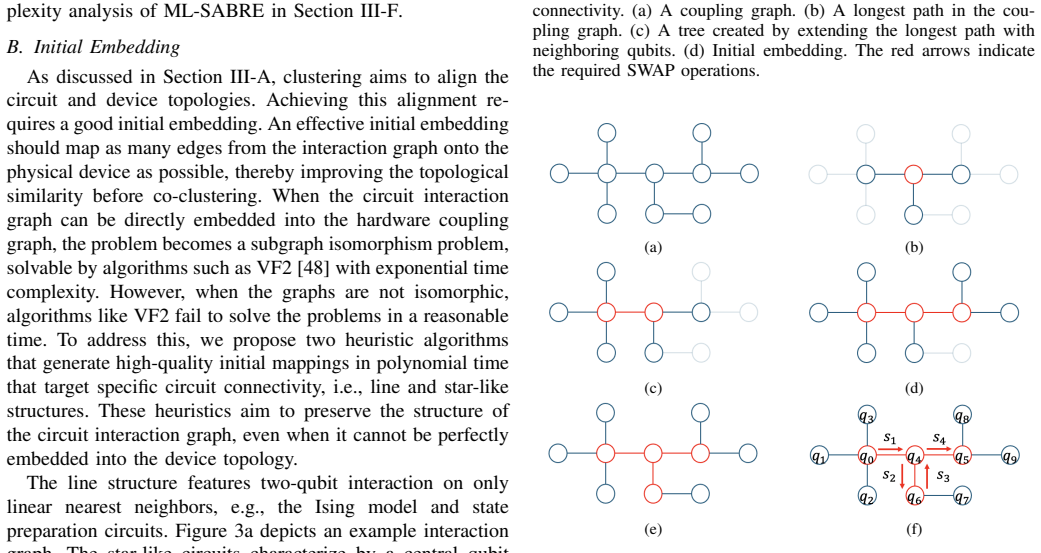
The load-bearing mechanism is the multilevel V-cycle, executed entirely with the LightSABRE heuristic as the engine at every level. The pipeline first builds a circuit-aware initial embedding that maps line-like and star-like circuit structures onto the device; then it co-clusters circuit qubits and physical qubits by maximum-cardinality maximum-weight matching, stopping just before the coarse mapping becomes trivially embeddable; solves the coarsest instance with randomized LightSABRE trials; projects the solution upward by solving a linear-assignment interpolation problem; and refines each projected mapping with LightSABRE. The V-cycle repeats, and if a cycle converges to an already-seen mapping, the search restarts from a new random mapping to escape the local minimum. This design is what carries the argument: the coarse levels are small enough for the heuristic to be near-optimal, and each refinement only needs local adjustments because the interpolated mapping is already globally informed.
What would settle it
Take a circuit family whose coarsened instances are known to be hard for LightSABRE, run ML-SABRE on small instances where exact optimal SWAP counts are computable, and check whether the final SWAP ratio tracks the coarsest-level gap; if a large coarse-level gap survives refinement, the claim that coarse-level near-optimality propagates is refuted. A cheap version is to compare ML-SABRE against an exact solver on all-to-all circuits such as the quantum Fourier transform at sizes where exact solving is still feasible.
Extended reading notes
Core claim
On its own terms, the paper's discovery is that the multilevel optimization recipe---cluster the circuit and coupling graph together until the instance is small, solve that coarse instance with the LightSABRE heuristic rather than an exact solver, then interpolate and refine the solution through every level---produces solutions that are dramatically closer to optimal than running the same heuristic directly on the original circuit. In the authors' experiments, ML-SABRE beats the strong SABRE baseline and the exact-based ML-QLS on average across standard benchmarks and two real hardware topologies, and it is usually orders of magnitude faster than the exact-based approach. The paper also reports that the remaining gap to known-optimal SWAP counts and depths shrinks substantially, which supports the central claim that coarse-level near-optimality propagates through interpolation and refinement.
Load-bearing premise
The load-bearing premise is that LightSABRE, when run on the small coarsened circuits, returns solutions close enough to optimal that the interpolated and refined finer-level solutions inherit that quality; if that near-optimality fails for some circuit family, the whole multilevel advantage can collapse.
Editorial extensions
If this is right
- If the central claim holds, compiling quantum programs for sparse superconducting chips becomes both faster and lower-overhead, so larger circuits can be executed before decoherence degrades them.
- Heuristic compilers can approach exact-solver quality on structured circuits without waiting hours, which makes exact solvers unnecessary except for the smallest verification cases.
- Because the framework is modular, any future improvement in the underlying routing heuristic can be dropped in to raise solution quality across all levels.
- On sparse heavy-hex-like devices the largest SWAP reductions are expected, while on dense grid devices the method mainly helps compress circuit depth.
- Circuits with repeated local interactions, such as adders, benefit most; globally connected circuits like the quantum Fourier transform show smaller gains and may need more random exploration.
Reading between the lines
- A natural extension is to apply the same coarsen-solve-refine loop to other constrained optimization stages in quantum compilation, such as gate scheduling, where small instances are also easier for heuristics.
- The paper's own ablation suggests that the optimal balance between interpolation-guided search and random trials depends on circuit locality; one could build a predictor that measures coarse-level alignment and sets that balance automatically.
- If LightSABRE's near-optimality on small instances fails for a particular circuit family, the multilevel results would degrade; adding a cheap coarse-gap estimate from the known-optimal benchmarks could flag when the framework should fall back to exact solving at the coarsest level.
- The same benchmarking methodology against known-optimal SWAP and depth circuits could be used to calibrate other compiler passes, not just layout synthesis.
Editorial analysis
A structured set of objections, weighed in public.
Referee Report
Summary. The paper proposes ML-SABRE, a multilevel quantum layout synthesis framework that coarsens a quantum circuit and its coupling graph through clustering, solves the coarsest instance with the LightSABRE heuristic, and refines the solution through interpolation, refinement, and multiple V-cycles. The authors report average SWAP-count reductions of 65% and 45% on IBM Eagle and Google Willow relative to SABRE, depth reductions of 17% and 2%, and compilation-time speedups of 2.5x and 3x; against ML-QLS, they report larger speedups and moderate quality gains. Optimality studies on QUEKO and QUBIKOS benchmark suites claim reductions of the SWAP-count optimality gap by up to 82.7% and of the depth gap by up to 49.8%. The paper also includes ablations of the initial embedding, clustering termination criterion, refinement configuration, and V-cycle count.
Significance. If the reported improvements are statistically robust, ML-SABRE is a substantial practical advance in quantum layout synthesis: it combines heuristic-level runtimes with multilevel global guidance, and the authors ship an open-source implementation. The use of known-optimal benchmark suites (QUEKO and QUBIKOS) and the detailed ablation study are notable strengths. However, the significance is currently conditional on the evaluation protocol, because the headline figures come from a single random seed and from the same benchmark family used to motivate the configuration choices.
major comments (4)
- [Section IV-A, Tables I-II; Abstract] The claim in the abstract of "over 60%" SWAP reduction and "17%" depth reduction is supported only by the IBM Eagle results: on Google Willow the geometric-mean SWAP reduction is 45% and the depth reduction is 2% (Table II). Moreover, Section IV-A states that all runs use "a fixed random seed of 0," and no variance, confidence interval, or worst-case result is reported for the main comparison. Since ML-SABRE is a randomized heuristic and the ablation study itself shows seed sensitivity, the unqualified headline claim is not established. The authors should report multi-seed summary statistics on both architectures or qualify the abstract to state that the figures refer to the Eagle configuration.
- [Section IV-C versus Section IV-A] The refinement configuration used in the main evaluation (10 V-cycles, 500 coarsest-level trials, 100 interpolations, one random trial per level) is studied in the ablation experiments of Section IV-C on a subset of QASMBench circuits on the Eagle architecture; the main results in Section IV-A are then reported on the same benchmark family and the same architecture. This creates a tuning-on-the-test-set risk: the reported gains may reflect configuration search rather than an intrinsic property of the multilevel method. A held-out benchmark set, or at least a cross-validation-style protocol, is needed to establish that the improvements generalize.
- [Section III-D] The multilevel framework relies on the premise that LightSABRE is near-optimal on the small coarsened instances, citing [32] for evidence. Reference [32] is the authors' own QUBIKOS benchmark study, and the paper offers no independent confirmation or sensitivity analysis. If this premise fails for a particular circuit family, the coarsest-level solution misleads all subsequent interpolation and refinement steps. I would like to see either a comparison of coarsest-level SABRE results against an exact solver on small instances from the benchmark families, or a sensitivity experiment in which the coarsest-level solution is perturbed and the effect on the final layout quality is measured.
- [Section IV-B] The optimality study reports only mean ratios over the 10 circuits for each optimal-depth and optimal-SWAP level, for example the SWAP ratio improvement from 195.4x to 33.76x on Eagle. No per-instance distribution, variance, or confidence interval is given. Because means can be dominated by a few outliers and SABRE is randomized, the paper should include scatter plots, box plots, or confidence intervals to verify that the reported gap reductions are not driven by a small number of extreme instances.
minor comments (4)
- [Throughout] The text typesets "SWAP" as "SW AP" in several places (for example in the abstract, Section I, and Tables I-II). This should be corrected for readability.
- [Section II-B] The sentence "The coarsest-level solving is expected to generate an optimal solution" conflicts with the actual design in Section III, where the coarsest level is solved by the heuristic LightSABRE. The word "optimal" should be replaced with "near-optimal" or the sentence should be rephrased.
- [Section IV-B] The text says "We generate QUEKO circuits," but QUEKO is an existing known-optimal-depth benchmark suite. The authors should clarify whether they reuse the published QUEKO instances or generate new instances with the QUEKO generator, and cite [31] at that point.
- [Figure 10] The heat maps in Figure 10 would be easier to read if the color scale were annotated with a colorbar and the axes were labeled consistently (the current labels place "Number of Random Trials" and "Number of Interpolations" in a way that may confuse readers).
Circularity Check
No significant circularity: ML-SABRE is an empirical systems paper whose performance claims rest on external benchmarks, not on a derivation that folds back into fitted parameters or self-referential definitions.
full rationale
This is an empirical systems paper, not a formal derivation, so the circularity patterns do not apply. The core claim is that a multilevel framework using LightSABRE as the underlying engine reduces SWAP count, depth, and compilation time compared with SABRE and ML-QLS. That claim is evaluated directly on QASMBench, QUEKO, and QUBIKOS benchmarks against external tools, and the results are reported as measured outcomes rather than as consequences of a fitted parameter or a definition. The use of SABRE at the coarsest level is justified by the authors' prior work [32], which is a benchmark study with known-optimal SWAP costs; this is independent, externally falsifiable evidence rather than a circular premise. The optimality studies use QUEKO and QUBIKOS ground-truth optimal values, so the reported gap reductions are computed against independently defined optima. The ablation and hyperparameter choices are evaluated on the same benchmark family, which is a robustness/generalization concern (e.g., possible tuning on the evaluation set, single-seed main results), but it is not circularity: no equation in the paper defines the predicted improvement in terms of the inputs, and no claim is forced by construction or by a self-citation chain. The paper is self-contained against external benchmarks, so the appropriate circularity score is 0.
Assumptions & free parameters
free parameters (6)
- number of V-cycles (d) =
10
- coarsest-level trials =
500
- number of interpolations =
100
- random trials per level =
1
- random seed =
0
- clustering compression rate =
2
assumptions (4)
- domain assumption QLS is NP-hard, so heuristics are needed.
- domain assumption SABRE is near-optimal on small problem instances.
- domain assumption Minimizing SWAP count is the primary objective of QLS.
- domain assumption The multilevel framework preserves enough structural information through clustering.
Cite this review
Pith. "Pith review of A High-Performance Multilevel Framework for Quantum Layout Synthesis." pith.science (2026). https://pith.science/paper/NI7P4YKO
@misc{pith2026250524169,
  author       = {Pith},
  title        = {Pith review of: A High-Performance Multilevel Framework for Quantum Layout Synthesis},
  year         = {2026},
  howpublished = {\url{https://pith.science/paper/NI7P4YKO}},
  note         = {Machine review of arXiv:2505.24169}
}
read the original abstract
Quantum Layout Synthesis (QLS) is a critical compilation stage that adapts quantum circuits to hardware constraints with an objective of minimizing the SWAP overhead. While heuristic tools demonstrate good efficiency, they often produce suboptimal solutions, and exact methods suffer from limited scalability. In this work, we propose ML-SABRE, a high-performance multilevel framework for QLS that improves both solution quality and compilation time through a hierarchical optimization approach. We employ the state-of-the-art heuristic method, LightSABRE, at all levels to ensure both efficiency and performance. Our evaluation on real benchmarks and hardware architectures shows that ML-SABRE decreases SWAP count by over 60%, circuit depth by 17%, and delivers a 60% compilation time reduction compared to state-of-the-art solvers. Further optimality studies reveal that ML-SABRE can significantly reduce the optimality gap by up to 82% for SWAP count and 49% for circuit depth, making it well-suited for emerging quantum devices with increasing size and architectural complexity.
Figures


Figures from the paper (7 more)


Reference graph
Works this paper leans on
-
[32]
Assessing quantum layout synthesis tools via known optimal-swap cost benchmarks,
S. Ping, W.-H. Lin, D. B. Tan, and J. Cong, “Assessing quantum layout synthesis tools via known optimal-swap cost benchmarks,” 2025. [Online]. Available: https://arxiv.org/abs/2502.08839
arXiv 2025
- [1]
-
[2]
IBM quantum breaks the 100-qubit processor barrier,
J. Chow, O. Dial, and J. Gambetta, “IBM quantum breaks the 100-qubit processor barrier,” IBM Research Blog , 2021
work page 2021
-
[3]
Meet Willow, our state-of-the-art quantum chip,
Google, “Meet Willow, our state-of-the-art quantum chip,” 2024, accessed: 2025-04-12. [Online]. Available: https://blog.google/ technology/research/google-willow-quantum-chip/
work page 2024
-
[4]
M. Y . Siraichi et al. , “Qubit allocation.” New York, NY , USA: Association for Computing Machinery, Feb. 2018, pp. 113–125
work page 2018
-
[5]
Optimal SW AP gate insertion for nearest neighbor quantum circuits,
R. Wille, A. Lye, and R. Drechsler, “Optimal SW AP gate insertion for nearest neighbor quantum circuits,” in 2014 19th Asia and South Pacific Design Automation Conference (ASP-DAC). IEEE, 2014, pp. 489–494
work page 2014
-
[6]
MUQUT: Multi-constraint quantum circuit mapping on NISQ comput- ers,
D. Bhattacharjee, A. A. Saki, M. Alam, A. Chattopadhyay, and S. Ghosh, “MUQUT: Multi-constraint quantum circuit mapping on NISQ comput- ers,” in 2019 IEEE/ACM International Conference on Computer-Aided Design. IEEE, 2019, pp. 1–7
work page 2019
-
[7]
Mapping quantum circuits to IBM QX architectures using the minimal number of SW AP and H operations,
R. Wille et al. , “Mapping quantum circuits to IBM QX architectures using the minimal number of SW AP and H operations,” in Proceedings of the 56th Annual Design Automation Conference 2019 , 2019, pp. 1–6
work page 2019
Show all 52 references
-
[8]
Optimal layout synthesis for quantum computing,
B. Tan and J. Cong, “Optimal layout synthesis for quantum computing,” in Proceedings of the 39th International Conference on Computer-Aided Design. ACM, Nov. 2020, pp. 1–9
2020
-
[9]
Optimal qubit mapping with simultaneous gate absorption,
——, “Optimal qubit mapping with simultaneous gate absorption,” in 2021 IEEE/ACM International Conference on Computer Aided Design . IEEE, 2021, pp. 1–8
2021
-
[10]
Time-optimal Qubit mapping
C. Zhang et al., “Time-optimal Qubit mapping.” New York, NY , USA: Association for Computing Machinery, Apr. 2021, pp. 360–374
2021
-
[11]
Qubit mapping and routing via MaxSAT,
A. Molavi et al. , “Qubit mapping and routing via MaxSAT,” in 2022 55th IEEE/ACM International Symposium on Microarchitecture. IEEE, 2022, pp. 1078–1091
2022
-
[12]
Optimal qubit assignment and routing via integer programming,
G. Nannicini et al., “Optimal qubit assignment and routing via integer programming,” ACM Transactions on Quantum Computing, vol. 4, no. 1, pp. 1–31, 2022
2022
-
[13]
Scalable optimal layout synthesis for NISQ quantum processors,
W.-H. Lin et al., “Scalable optimal layout synthesis for NISQ quantum processors,” in 2023 60th ACM/IEEE Design Automation Conference . IEEE, 2023, pp. 1–6
2023
-
[14]
Announcing Cirq: an open source framework for NISQ algorithms,
A. Ho and D. Bacon, “Announcing Cirq: an open source framework for NISQ algorithms,” Google AI Blog , vol. 18, 2018
2018
-
[15]
An efficient methodology for mapping quantum circuits to the IBM QX architectures,
A. Zulehner et al. , “An efficient methodology for mapping quantum circuits to the IBM QX architectures,” IEEE Transactions on Computer- Aided Design of Integrated Circuits and Systems , vol. 38, no. 7, pp. 1226–1236, 2018
2018
-
[16]
(2018) Qiskit
IBM. (2018) Qiskit. [Online]. Available: https://qiskit.org/
2018
-
[17]
An Efficient Methodology for Mapping Quan- tum Circuits to the IBM QX Architectures,
A. Zulehner et al. , “An Efficient Methodology for Mapping Quan- tum Circuits to the IBM QX Architectures,” IEEE Transactions on Computer-Aided Design of Integrated Circuits and Systems , vol. 38, no. 7, pp. 1226–1236, Jul. 2019
2019
-
[18]
Qubit allocation as a combination of subgraph isomorphism and token swapping,
M. Y . Siraichi et al. , “Qubit allocation as a combination of subgraph isomorphism and token swapping,” Proceedings of the ACM on Pro- gramming Languages , vol. 3, no. OOPSLA, pp. 120:1–120:29, Oct. 2019
2019
-
[19]
Tackling the qubit mapping problem for NISQ-era quantum devices
G. Li et al., “Tackling the qubit mapping problem for NISQ-era quantum devices.” New York, NY , USA: Association for Computing Machinery, Apr. 2019, pp. 1001–1014
2019
-
[20]
Formal constraint-based compilation for noisy intermediate-scale quantum systems,
P. Murali et al. , “Formal constraint-based compilation for noisy intermediate-scale quantum systems,” Microprocessors & Microsystems, vol. 66, no. C, pp. 102–112, Apr. 2019
2019
-
[21]
t |ket⟩: a retargetable compiler for NISQ devices,
S. Sivarajah et al. , “t |ket⟩: a retargetable compiler for NISQ devices,” Quantum Science and Technology , vol. 6, no. 1, p. 014003, Nov. 2020
2020
-
[22]
Improved Mapping of Quantum Circuits to IBM QX Architectures,
A. Kole et al. , “Improved Mapping of Quantum Circuits to IBM QX Architectures,” IEEE Transactions on Computer-Aided Design of Integrated Circuits and Systems , vol. 39, no. 10, pp. 2375–2383, Oct. 2020
2020
-
[23]
Not all SW APs have the same cost: a case for optimization- aware qubit routing,
J. Liu et al., “Not all SW APs have the same cost: a case for optimization- aware qubit routing,” in 2022 IEEE International Symposium on High- Performance Computer Architecture , Apr. 2022, pp. 709–725, ISSN: 2378-203X
2022
-
[24]
A robust quantum layout synthesis algorithm with a qubit mapping checker,
T.-A. Wu et al. , “A robust quantum layout synthesis algorithm with a qubit mapping checker,” in Proceedings of the 41st IEEE/ACM International Conference on Computer-Aided Design , ser. ICCAD ’22. New York, NY , USA: Association for Computing Machinery, 2022
2022
-
[25]
Optimizing quantum circuit placement via machine learning,
H. Fan et al. , “Optimizing quantum circuit placement via machine learning,” in Proceedings of the 59th ACM/IEEE Design Automation Conference, ser. DAC ’22. New York, NY , USA: Association for Computing Machinery, 2022, p. 19–24
2022
-
[26]
Reinforcement learning and dear framework for solving the qubit mapping problem,
C.-Y . Huang et al. , “Reinforcement learning and dear framework for solving the qubit mapping problem,” in Proceedings of the 41st IEEE/ACM International Conference on Computer-Aided Design , 2022, pp. 1–9
2022
-
[27]
A fast and scalable qubit-mapping method for noisy intermediate-scale quantum computers,
S. Park et al. , “A fast and scalable qubit-mapping method for noisy intermediate-scale quantum computers,” in Proceedings of the 59th ACM/IEEE Design Automation Conference, New York, NY , USA, 2022, p. 13–18
2022
-
[28]
CTQr: Control and timing-aware qubit routing,
C.-Y . Huang and W.-K. Mak, “CTQr: Control and timing-aware qubit routing,” in 2024 29th Asia and South Pacific Design Automation Conference (ASP-DAC). IEEE, 2024, pp. 140–145
2024
-
[29]
Efficient qubit routing using a dynamically-extract-and-route framework,
——, “Efficient qubit routing using a dynamically-extract-and-route framework,” IEEE Transactions on Computer-Aided Design of Inte- grated Circuits and Systems , 2024
2024
-
[30]
ML-QLS: Multilevel quantum layout synthe- sis,
W.-H. Lin and J. Cong, “ML-QLS: Multilevel quantum layout synthe- sis,” arXiv preprint arXiv:2405.18371 , 2024
2024 arXiv
-
[31]
Optimality study of existing quantum computing layout synthesis tools,
B. Tan and J. Cong, “Optimality study of existing quantum computing layout synthesis tools,” IEEE Transactions on Computers, vol. 70, no. 9, pp. 1363–1373, 2020
2020
-
[33]
Multilevel circuit partitioning,
C. J. Alpert et al. , “Multilevel circuit partitioning,” in Proceedings of the 34th annual Design Automation Conference , 1997, pp. 530–533
1997
-
[34]
Edge separability-based circuit clustering with application to multilevel circuit partitioning,
J. Cong and S. K. Lim, “Edge separability-based circuit clustering with application to multilevel circuit partitioning,” IEEE Transactions on Computer-Aided Design of Integrated Circuits and Systems , vol. 23, no. 3, pp. 346–357, 2004
2004
-
[35]
An enhanced multilevel algorithm for circuit placement,
T. Chan et al., “An enhanced multilevel algorithm for circuit placement,” in ICCAD-2003. International Conference on Computer Aided Design (IEEE Cat. No.03CH37486) , Nov. 2003, pp. 299–306
2003
-
[36]
NTUplace: A ratio partitioning based placement algorithm for large-scale mixed-size designs,
T.-C. Chen et al. , “NTUplace: A ratio partitioning based placement algorithm for large-scale mixed-size designs,” inProceedings of the 2005 International Symposium on Physical Design , 2005, pp. 236–238
2005
-
[37]
Multilevel generalized force-directed method for circuit placement,
T. Chan, J. Cong, and K. Sze, “Multilevel generalized force-directed method for circuit placement,” in Proceedings of the 2005 International Symposium on Physical Design , 2005, pp. 185–192
2005
-
[38]
RePlAce: Advancing solution quality and routability validation in global placement,
C.-K. Cheng et al., “RePlAce: Advancing solution quality and routability validation in global placement,” IEEE Transactions on Computer-Aided Design of Integrated Circuits and Systems, vol. 38, no. 9, pp. 1717–1730, 2018
2018
-
[39]
Replace: An incremental placement algorithm for field programmable gate arrays,
D. Leong and G. G. Lemieux, “Replace: An incremental placement algorithm for field programmable gate arrays,” in 2009 International Conference on Field Programmable Logic and Applications . IEEE, 2009, pp. 154–161
2009
-
[40]
Multilevel optimization for large-scale circuit place- ment,
T. F. Chan et al., “Multilevel optimization for large-scale circuit place- ment,” in IEEE/ACM International Conference on Computer Aided Design. ICCAD-2000. IEEE/ACM Digest of Technical Papers (Cat. No. 00CH37140). IEEE, 2000, pp. 171–176
2000
-
[41]
mPL6: A robust multilevel mixed-size placement engine,
——, “mPL6: A robust multilevel mixed-size placement engine,” in Proceedings of the 2005 International Symposium on Physical Design , 2005, pp. 227–229
2005
-
[42]
Multilevel hypergraph partitioning: Application in VLSI domain,
G. Karypis, R. Aggarwal, V . Kumar, and S. Shekhar, “Multilevel hypergraph partitioning: Application in VLSI domain,” in Proceedings of the 34th annual Design Automation Conference , 1997, pp. 526–529
1997
-
[43]
Thermal-driven multilevel routing for 3-D ICs,
J. Cong and Y . Zhang, “Thermal-driven multilevel routing for 3-D ICs,” in Proceedings of the 2005 Asia and South Pacific Design Automation Conference, 2005, pp. 121–126
2005
-
[44]
Non-uniform multilevel analog routing with matching constraints,
H.-C. Ou et al., “Non-uniform multilevel analog routing with matching constraints,” in Proceedings of the 49th Annual Design Automation Conference, 2012, pp. 549–554
2012
-
[45]
A novel framework for multilevel routing considering routability and performance,
S.-P. Lin and Y .-W. Chang, “A novel framework for multilevel routing considering routability and performance,” in Proceedings of the 2002 IEEE/ACM International Conference on Computer-Aided Design , 2002, pp. 44–50
2002
-
[46]
CUGR: Detailed-routability-driven 3D global routing with probabilistic resource model,
J. Liu et al. , “CUGR: Detailed-routability-driven 3D global routing with probabilistic resource model,” in 2020 57th ACM/IEEE Design Automation Conference (DAC). IEEE, 2020, pp. 1–6
2020
-
[47]
LightSABRE: A lightweight and enhanced SABRE algorithm,
H. Zou, M. Treinish, K. Hartman, A. Ivrii, and J. Lishman, “LightSABRE: A lightweight and enhanced SABRE algorithm,” arXiv preprint arXiv:2409.08368, 2024
2024 arXiv
-
[48]
A (sub)graph isomorphism algorithm for matching large graphs,
L. Cordella, P. Foggia, C. Sansone, and M. Vento, “A (sub)graph isomorphism algorithm for matching large graphs,” IEEE Transactions on Pattern Analysis and Machine Intelligence, vol. 26, no. 10, pp. 1367– 1372, 2004
2004
-
[49]
Quantum complexity theory,
E. Bernstein and U. Vazirani, “Quantum complexity theory,” SIAM Journal on Computing , vol. 26, no. 5, pp. 1411–1473, 1997. [Online]. Available: https://doi.org/10.1137/S0097539796300921
1997 doi
-
[50]
Efficient algorithms for finding maximum matching in graphs,
Z. Galil, “Efficient algorithms for finding maximum matching in graphs,” ACM Comput. Surv. , vol. 18, no. 1, p. 23–38, Mar. 1986. [Online]. Available: https://doi.org/10.1145/6462.6502
1986
-
[51]
D. F. Crouse, “On implementing 2D rectangular assignment algorithms, year=2016, volume=52, number=4, pages=1679- 1696, keywords=Two dimensional displays;Approximation algorithms;Complexity theory;Minimization;MATLAB;Cost function, doi=10.1109/TAES.2016.140952,” IEEE Transactio...
2016
-
[52]
QASMBench: A Low-Level Quantum Benchmark Suite for NISQ Evaluation and Simulation,
A. Li, S. Stein, S. Krishnamoorthy, and J. Ang, “QASMBench: A Low-Level Quantum Benchmark Suite for NISQ Evaluation and Simulation,” ACM Transactions on Quantum Computing , vol. 4, no. 2, Feb. 2023. [Online]. Available: https://doi.org/10.1145/3550488
2023 doi
Reviewed August 7, 2026 · model on record in the stance chip above.
Discussion (0). Sign in to comment.