REVIEW 4 major objections 4 minor 1 cited by
Boosting All-in-One Image Restoration via Self-Improved Privilege Learning
T0 review · 4 major / 4 minor · reviewed 2026-08-07 · deepseek-v4-flash
Pith's one-line read An all-in-one image restoration model can improve its own output at test time by using its first restoration as pseudo-privileged information and refining it through a learned dictionary of clean-image priors, with reported gains up to…
desk verdict SIPL has a genuinely new idea and strong reported gains, but the paper's own ablations undermine the clean attribution of those gains to the inference-time self-refinement mechanism. read the letter →
The pith
A machine-rendered reading of the paper's core claim, the machinery that carries it, and where it could break.
The reading
What carries the argument
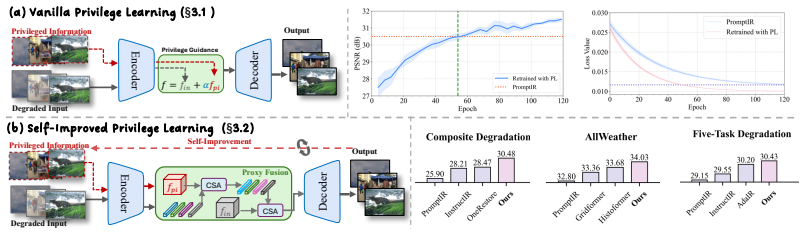
The central mechanism is Proxy Fusion, built on a learnable Privileged Dictionary $D_p \in R^{N \times C}$. During training, $D_p$ acts as the query in a cross-attention operation over ground-truth privileged features $F_{PI}$, distilling the high-frequency and structural statistics of clean images into a compact repository; the distilled features then serve as key and value for attending to the degraded-input features $F_d$. At inference the same dictionary remains, and features extracted from the model's first restoration $I^{(0)}_{restored}$ play the role of pseudo-privileged information, producing a refined output $F(I_d, I^{(0)}_{restored})$ that can be fed back again in a loop $I^{(t)}_{restored} = F(I_d, I^{(t-1)}_{restored})$. The dictionary is the persistent object that carries privileged knowledge across the train/test boundary.
What would settle it
Run the iterative refinement loop on a corruption type never seen in training, such as JPEG compression artifacts or blur combined with low light, and record PSNR after each iteration; the claim collapses if the curve is non-monotonic or if the second iteration falls below the first.
Extended reading notes
Core claim
The central discovery, stated on the paper's own terms, is that privileged information does not have to end at training: a model's own imperfect reconstruction can stand in for the ground-truth privileged signal at inference, as long as a learned dictionary of clean-image priors mediates the interaction. The Privileged Dictionary is trained by cross-attention from ground-truth features so that it internalizes the high-frequency and structural statistics of clean images; at test time, features of the initial output are fed through the same learned attention, and the refined output is produced by the model conditioned on both the degraded input and that first output. The authors argue that each feedback step brings the internal features closer to the clean-image manifold, which is why iterative refinement yields additional gains. Their ablation attributes the gain to the dictionary plus the feedback loop rather than to the backbone, and the out-of-distribution experiment in Appendix A.2 shows the largest iterative gains exactly where the training objective gives no direct supervision.
Load-bearing premise
The load-bearing premise is that features extracted from the model's own initial restoration stay close enough to the ground-truth features used to train the Privileged Dictionary for the learned cross-attention to transfer; the paper itself concedes in its limitation section that pseudo-privileged information 'may not fully align with true privileged priors,' and if first-pass outputs drift too far on out-of-distribution inputs, the self-correction loop could amplify errors instead of fixing them.
Editorial extensions
If this is right
- Any restoration backbone can be upgraded by adding SIPL without redesigning the network; the paper demonstrates this on PromptIR, Restormer, NAFNet, and AdaIR.
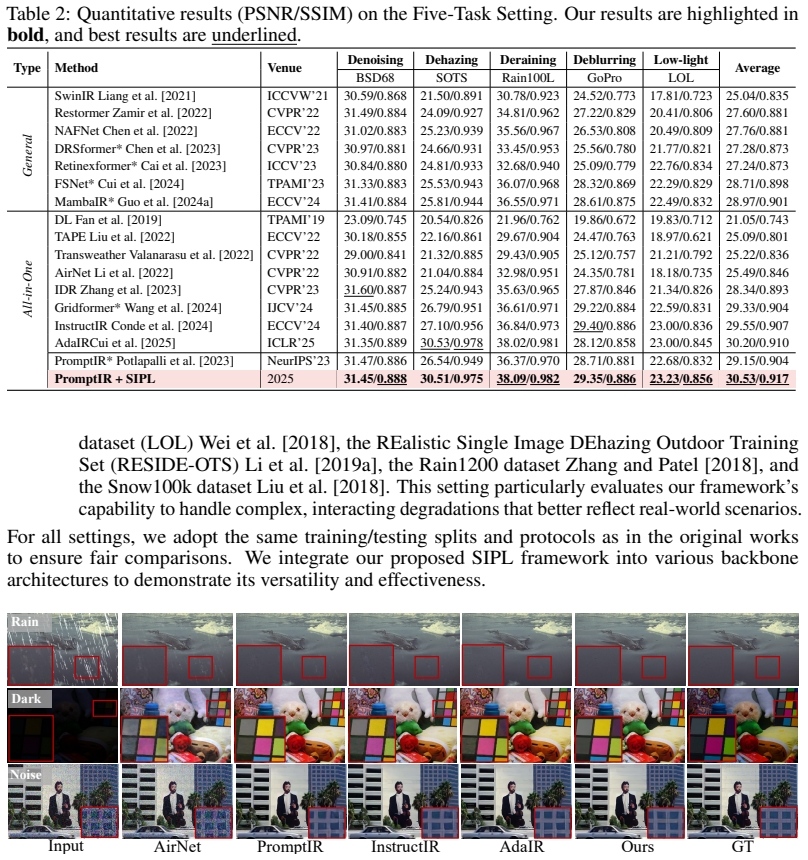
- Iterative inference adds quality on top of an already improved single pass: on the five-task benchmark the single-pass model reaches 30.17 dB and the first feedback iteration reaches 30.53 dB.
- The largest reported gains are on composite and out-of-distribution degradations, with +4.58 dB on CDD-11 and a jump from 24.46 dB to 29.23 dB on unseen rain-plus-noise, where the self-correction loop has the most room to work.
- Privilege learning alone already improves training—adding it to PromptIR raises the five-task average from 29.15 dB to 30.05 dB with no extra inference cost—and SIPL builds on top of that base.
- The measured gap between the pseudo-privileged iteration (38.43 dB) and the ground-truth-guided upper bound (38.79 dB) gives a concrete target for improving the fidelity of pseudo-privileged features.
Reading between the lines
- The Privileged Dictionary functions as a learned, persistent clean-image prior; a natural extension is to train it on multiple datasets or corruption families so the same dictionary can guide self-refinement on arbitrary real-world degradations.
- The paper does not test training-time stability of the feedback loop; adding a consistency regularizer between the first and second outputs could make the iteration contractive and reduce the risk of error amplification out of distribution.
- The same output-as-pseudo-ground-truth loop could transfer to other inverse problems, such as super-resolution, blind face restoration, or language-conditioned editing, wherever the model's initial prediction is closer to the target than the input is.
- The OOD result is not explained by the training objective, which suggests the dictionary may store generic statistics of high-quality images; a direct test would be to train the dictionary with features from unrelated clean images and see whether the self-improvement gain persists.
Editorial analysis
A structured set of objections, weighed in public.
Referee Report
Summary. The paper proposes Self-Improved Privilege Learning (SIPL), a training and inference paradigm for all-in-one image restoration. SIPL extends privileged learning by retaining a learnable Privileged Dictionary after training and, at test time, feeding the model's own initial output back as pseudo-privileged information through a Proxy Fusion module. The authors report large PSNR gains over the PromptIR baseline on several benchmarks, including +4.58 dB on the Composite Degradation Dataset, +1.38 dB on the five-task benchmark, and +1.23 dB on AllWeather, with consistent improvements across other backbones such as Restormer, NAFNet, and AdaIR. The paper also presents ablations separating the effect of privileged learning from the inference-time self-improvement loop, and includes an out-of-distribution analysis on Rain100L with added Gaussian noise.
Significance. If the central claim holds, SIPL offers a broadly applicable, plug-and-play mechanism for inference-time self-refinement in all-in-one restoration, extending the classical privileged-learning paradigm beyond training. The paper's strengths include systematic integration with multiple backbones, a component-wise ablation that separates PL training from the Proxy Fusion module, and a public code release. However, the specific mechanism attributed for the gains—the transfer of a Privileged Dictionary trained on ground-truth features to the model's own imperfect outputs—is not directly validated, and the most dramatic OOD result is not explained by the training objective. The reported numbers are internally consistent across tables, but the central attribution requires additional controls and analysis before the claims can be accepted.
major comments (4)
- [§4.2, Table 4] The headline +4.58 dB improvement on CDD-11 is reported against the original PromptIR baseline, but no control is given for 'PromptIR + PL' or 'PromptIR + SIPL (Iter-0)' on this dataset. Since Table 9 shows that PL training alone yields +0.9 dB on the five-task benchmark, the large CDD-11 gain could be substantially due to retraining with the privileged-learning objective rather than to the inference-time self-improvement mechanism. Please add these controls to Table 4, or otherwise decompose the gain into training-time and inference-time contributions.
- [§3.2, Eqs. (3) and (6)] The Privileged Dictionary is trained by cross-attention with K = V = F_PI, where F_PI are features of the ground-truth image, but at inference Eq. (6) substitutes features of the model's own initial output I^(0)_restored. This is an unverified distribution-match assumption: the cross-attention never sees K,V drawn from the model's possibly flawed outputs during training. The paper's own OOD results in Appendix A.2 (Table 8) show a +4.77 dB jump after two iterations on an unseen composite degradation, a regime where the assumption is least plausible and where no mechanism in the training objective explains such a gain. Please provide a feature-space analysis (e.g., statistics of the alignment between F_PI and pseudo-PI features) or an ablation that removes or randomizes the dictionary while keeping the iterative loop.
- [Appendix A.2, Table 8] The out-of-distribution experiment is a single synthetic setting (Rain100L + Gaussian noise), and it lacks a control in which the baseline PromptIR or AdaIR is iteratively re-fed its own output without the Proxy Fusion module. Without such a control, the large gains after Iter-1 and Iter-2 cannot be attributed to the privileged dictionary; they could arise from test-time adaptation through repeated forward passes alone. Please report iterative baselines for PromptIR and AdaIR, and ideally evaluate on more than one OOD construction.
- [§4.3, Figure 7] The text says the ablation is performed 'on a five degradation tasks,' but the numbers reported (baseline 36.37, +PL 37.49, +SIPL 37.91, +SIPL-Iter1 38.43, GT-guided 38.79) exactly match the deraining PSNR values in Table 1, not an average over five tasks. This inconsistency makes it difficult to assess the contribution of each component. Please clarify the benchmark used in Figure 7 and, if the figure is intended to show only deraining, say so explicitly and consider adding the full five-task table.
minor comments (4)
- [Abstract and §4.2] The abstract reports '+1.28 dB' on the five-task benchmark, while Table 2 and the text report '+1.38 dB' (30.53 vs. 29.15 dB); please reconcile the numbers.
- [Table 4] The header 'PromptIR + SIPL)' contains an unbalanced parenthesis; also, the entry for 'PromptIR + SIPL' in the row appears as '(2025)' without a venue, which should be formatted consistently with other rows.
- [Eq. (1)] The alpha schedule for privileged feature blending is not specified beyond 'typically follows a decreasing schedule'; please provide the schedule used in the experiments or cite a reference, since the schedule is a free parameter.
- [Figure 1 caption] The caption says 'Retrained PromptIR with the proposed SIPL achieves significant improvement,' but the term 'retrained' is not defined; please clarify what is retrained relative to the original PromptIR.
Circularity Check
No significant circularity: the reported gains are empirical, held-out benchmark results, and the privileged dictionary is a learned model component rather than a fitted version of the predicted quantity.
full rationale
The paper's central claim is an empirical one: adding SIPL to a backbone improves restoration accuracy on standard benchmarks. The privileged dictionary PD is trained by Eq. 3 on ground-truth-derived features from training data, and the test-time substitution in Eq. 6 uses features of the model's own initial output. This is a train/test distribution-matching assumption, not an identity enforced by construction: nothing in the equations forces the final output to equal the fitted dictionary or the training targets. The reported PSNR gains are measured on held-out test sets and compared against external baselines, so they are not predictions of fitted quantities. The ablation in Figure 7 includes both the iterative self-refinement stages and a GT-guided upper bound, which further separates the learned mechanism from the fitted target. The paper's self-citations (e.g., Wu et al. 2024) are used to motivate the existence of inter-task conflicts in all-in-one restoration, and that claim is also supported by external citations such as Kong et al. 2024; these citations are not load-bearing for the central result. No uniqueness theorem, ansatz, or prior derivation is imported from the authors' own work to force the method's form. The main scientific weakness, namely that pseudo-privileged features may not align with true privileged priors, is explicitly acknowledged in Section 4.4 and is an empirical assumption rather than a circular reduction. The absence of a control that removes or randomizes PD is an experimental gap, not a circularity, and would belong in a correctness-risk discussion rather than this circularity pass.
Assumptions & free parameters
free parameters (3)
- alpha schedule in Eq. (1) =
not reported (decreasing from 1 to 0)
- Number of Privileged Dictionary entries N =
not reported
- Number of self-refinement iterations t =
1 for main results; 2 for OOD experiments
assumptions (4)
- domain assumption Privileged information derived from ground-truth features improves training of all-in-one restoration models
- ad hoc to paper At inference, features of the model's own initial output approximate GT-derived privileged features closely enough for the learned dictionary to transfer
- domain assumption The training protocols and splits from 'original works' are sufficient and comparable
- standard math Standard cross-attention and backpropagation machinery works as expected
Cite this review
Pith. "Pith review of Boosting All-in-One Image Restoration via Self-Improved Privilege Learning." pith.science (2026). https://pith.science/paper/V7BGQ6RY
@misc{pith2026250524207,
  author       = {Pith},
  title        = {Pith review of: Boosting All-in-One Image Restoration via Self-Improved Privilege Learning},
  year         = {2026},
  howpublished = {\url{https://pith.science/paper/V7BGQ6RY}},
  note         = {Machine review of arXiv:2505.24207}
}
read the original abstract
Unified image restoration models for diverse and mixed degradations often suffer from unstable optimization dynamics and inter-task conflicts. This paper introduces Self-Improved Privilege Learning (SIPL), a novel paradigm that overcomes these limitations by innovatively extending the utility of privileged information (PI) beyond training into the inference stage. Unlike conventional Privilege Learning, where ground-truth-derived guidance is typically discarded after training, SIPL empowers the model to leverage its own preliminary outputs as pseudo-privileged signals for iterative self-refinement at test time. Central to SIPL is Proxy Fusion, a lightweight module incorporating a learnable Privileged Dictionary. During training, this dictionary distills essential high-frequency and structural priors from privileged feature representations. Critically, at inference, the same learned dictionary then interacts with features derived from the model's initial restoration, facilitating a self-correction loop. SIPL can be seamlessly integrated into various backbone architectures, offering substantial performance improvements with minimal computational overhead. Extensive experiments demonstrate that SIPL significantly advances the state-of-the-art on diverse all-in-one image restoration benchmarks. For instance, when integrated with the PromptIR model, SIPL achieves remarkable PSNR improvements of +4.58 dB on composite degradation tasks and +1.28 dB on diverse five-task benchmarks, underscoring its effectiveness and broad applicability. Codes are available at our project page https://github.com/Aitical/SIPL.
Figures

Figures from the paper (5 more)


Forward citations
Cited by 1 Pith paper
-
IRPO: Boosting Image Restoration via Post-training GRPO
GRPO post-training on the worst 30% of samples with a mixed fidelity/perceptual reward improves AdaIR by 0.83 dB in-domain and 3.43 dB on out-of-domain benchmarks.
Reference graph
Works this paper leans on
-
[1]
M.R. Banham and A.K. Katsaggelos. Digital image restoration. IEEE Signal Processing Magazine, 14 0 (2): 0 24--41, 1997
work page 1997
-
[2]
A survey of deep learning approaches to image restoration
Jingwen Su, Boyan Xu, and Hujun Yin. A survey of deep learning approaches to image restoration. Neurocomput., 487: 0 46--65, 2022-05. ISSN 0925-2312
work page 2022
-
[3]
A survey on all-in-one image restoration: Taxonomy, evaluation and future trends
Junjun Jiang, Zengyuan Zuo, Gang Wu, Kui Jiang, and Xianming Liu. A survey on all-in-one image restoration: Taxonomy, evaluation and future trends. CoRR, abs/2410.15067, 2024
arXiv 2024
-
[4]
Towards effective multiple-in-one image restoration: A sequential and prompt learning strategy
Xiangtao Kong, Chao Dong, and Lei Zhang. Towards effective multiple-in-one image restoration: A sequential and prompt learning strategy. CoRR, abs/2401.03379, 2024
arXiv 2024
-
[5]
Harmony in diversity: Improving all-in-one image restoration via multi-task collaboration
Gang Wu, Junjun Jiang, Kui Jiang, and Xianming Liu. Harmony in diversity: Improving all-in-one image restoration via multi-task collaboration. In ACM Multimedia , pages 6015--6023, 2024
work page 2024
-
[6]
A new learning paradigm: Learning using privileged information
Vladimir Vapnik and Akshay Vashist. A new learning paradigm: Learning using privileged information. Neural networks, 22 0 (5-6): 0 544--557, 2009
work page 2009
-
[7]
Learning using privileged information: similarity control and knowledge transfer
Vladimir Vapnik, Rauf Izmailov, et al. Learning using privileged information: similarity control and knowledge transfer. J. Mach. Learn. Res., 16 0 (1): 0 2023--2049, 2015
work page 2023
-
[8]
Restormer: Efficient transformer for high-resolution image restoration
Syed Waqas Zamir, Aditya Arora, Salman Khan, Munawar Hayat, Fahad Shahbaz Khan, and Ming-Hsuan Yang. Restormer: Efficient transformer for high-resolution image restoration. In IEEE conference on computer vision and pattern recognition ( CVPR ) , pages 5718--5729, 2022
work page 2022
Show all 58 references
-
[9]
Memory uncertainty learning for real-world single image deraining
Huaibo Huang, Mandi Luo, and Ran He. Memory uncertainty learning for real-world single image deraining. IEEE Transactions on Pattern Analysis and Machine Intelligence, 45 0 (3): 0 3446--3460, 2023
2023
-
[10]
Retinexformer: One-stage retinex-based transformer for low-light image enhancement
Yuanhao Cai, Hao Bian, Jing Lin, Haoqian Wang, Radu Timofte, and Yulun Zhang. Retinexformer: One-stage retinex-based transformer for low-light image enhancement. In Proceedings of the IEEE / CVF international conference on computer vision ( ICCV ) , pages 12470--12479, 2023
2023
-
[11]
Simple baselines for image restoration
Liangyu Chen, Xiaojie Chu, Xiangyu Zhang, and Jian Sun. Simple baselines for image restoration. In Proceedings of the european conference on computer vision ( ECCV ) , volume 13667, pages 17--33, 2022
2022
-
[12]
Pre-trained image processing transformer
Hanting Chen, Yunhe Wang, Tianyu Guo, Chang Xu, Yiping Deng, Zhenhua Liu, Siwei Ma, Chunjing Xu, Chao Xu, and Wen Gao. Pre-trained image processing transformer. In Proceedings of the IEEE / CVF conference on computer vision and pattern recognition ( CVPR ) , pages 12299--12310, 2021
2021
-
[13]
Uformer: A general u-shaped transformer for image restoration
Zhendong Wang, Xiaodong Cun, Jianmin Bao, Wengang Zhou, Jianzhuang Liu, and Houqiang Li. Uformer: A general u-shaped transformer for image restoration. In Proceedings of the IEEE conference on computer vision and pattern recognition ( CVPR ) , pages 17662--17672, 2022
2022
-
[14]
Gridformer: Residual dense transformer with grid structure for image restoration in adverse weather conditions
Tao Wang, Kaihao Zhang, Ziqian Shao, Wenhan Luo, Bj \" o rn Stenger, Tong Lu, Tae - Kyun Kim, Wei Liu, and Hongdong Li. Gridformer: Residual dense transformer with grid structure for image restoration in adverse weather conditions. Int. J. Comput. Vis., 132 0 (10): 0 4541--4563, 2024
2024
-
[15]
Mambair: A simple baseline for image restoration with state-space model
Hang Guo, Jinmin Li, Tao Dai, Zhihao Ouyang, Xudong Ren, and Shu - Tao Xia. Mambair: A simple baseline for image restoration with state-space model. In Proceedings of the european conference on computer vision ( ECCV ) , volume 15076, pages 222--241, 2024 a
2024
-
[16]
Principal uncertainty quantification with spatial correlation for image restoration problems
Omer Belhasin, Yaniv Romano, Daniel Freedman, Ehud Rivlin, and Michael Elad. Principal uncertainty quantification with spatial correlation for image restoration problems. IEEE Transactions on Pattern Analysis and Machine Intelligence, 46 0 (5): 0 3321--3333, 2024
2024
-
[17]
Difface: Blind face restoration with diffused error contraction
Zongsheng Yue and Chen Change Loy. Difface: Blind face restoration with diffused error contraction. IEEE Transactions on Pattern Analysis and Machine Intelligence, 46 0 (12): 0 9991--10004, 2024
2024
-
[18]
Latent diffusion enhanced rectangle transformer for hyperspectral image restoration
Miaoyu Li, Ying Fu, Tao Zhang, Ji Liu, Dejing Dou, Chenggang Yan, and Yulun Zhang. Latent diffusion enhanced rectangle transformer for hyperspectral image restoration. IEEE Transactions on Pattern Analysis and Machine Intelligence, 47 0 (1): 0 549--564, 2025
2025
-
[19]
Efficient diffusion model for image restoration by residual shifting
Zongsheng Yue, Jianyi Wang, and Chen Change Loy. Efficient diffusion model for image restoration by residual shifting. IEEE Transactions on Pattern Analysis and Machine Intelligence, 47 0 (1): 0 116--130, 2025
2025
-
[20]
All-in-one image restoration for unknown corruption
Boyun Li, Xiao Liu, Peng Hu, Zhongqin Wu, Jiancheng Lv, and Xi Peng. All-in-one image restoration for unknown corruption. In Proceedings of the IEEE / CVF conference on computer vision and pattern recognition ( CVPR ) , pages 17431--17441, 2022
2022
-
[21]
Khan, and Fahad Shahbaz Khan
Vaishnav Potlapalli, Syed Waqas Zamir, Salman H. Khan, and Fahad Shahbaz Khan. Promptir: Prompting for all-in-one image restoration. In Advances in neural information processing systems ( NeurIPS ) , 2023
2023
-
[22]
Khan, Alois Knoll, Mubarak Shah, and Fahad Shahbaz Khan
Yuning Cui, Syed Waqas Zamir, Salman H. Khan, Alois Knoll, Mubarak Shah, and Fahad Shahbaz Khan. Adair: Adaptive all-in-one image restoration via frequency mining and modulation. In International conference on learning representations (ICLR), 2025
2025
-
[23]
Ingredient-oriented multi-degradation learning for image restoration
Jinghao Zhang, Jie Huang, Mingde Yao, Zizheng Yang, Hu Yu, Man Zhou, and Feng Zhao. Ingredient-oriented multi-degradation learning for image restoration. In IEEE/CVF Conference on Computer Vision and Pattern Recognition (CVPR), pages 5825--5835, 2023
2023
-
[24]
o lund, and Thomas B. Sch \
Ziwei Luo, Fredrik K. Gustafsson, Zheng Zhao, Jens Sj \" o lund, and Thomas B. Sch \" o n. Controlling vision-language models for multi-task image restoration. In International conference on learning representations (ICLR), 2024
2024
-
[25]
Improving image restoration through removing degradations in textual representations
Jingbo Lin, Zhilu Zhang, Yuxiang Wei, Dongwei Ren, Dongsheng Jiang, Qi Tian, and Wangmeng Zuo. Improving image restoration through removing degradations in textual representations. In IEEE/CVF Conference on Computer Vision and Pattern Recognition (CVPR), pages 2866--2878, 2024
2024
-
[26]
Debiased all-in-one image restoration with task uncertainty regularization
Gang Wu, Junjun Jiang, Yijun Wang, Kui Jiang, and Xianming Liu. Debiased all-in-one image restoration with task uncertainty regularization. In Proceedings of the AAAI Conference on Artificial Intelligence, 2025
2025
-
[27]
Restore anything with masks: Leveraging mask image modeling for blind all-in-one image restoration
Chu - Jie Qin, Ruiqi Wu, Zikun Liu, Xin Lin, Chun - Le Guo, Hyun Hee Park, and Chongyi Li. Restore anything with masks: Leveraging mask image modeling for blind all-in-one image restoration. In Proceedings of the european conference on computer vision ( ECCV ) , volume 15103, ...
2024
-
[28]
Khan, Munawar Hayat, Fahad Shahbaz Khan, Ming - Hsuan Yang, and Ling Shao
Syed Waqas Zamir, Aditya Arora, Salman H. Khan, Munawar Hayat, Fahad Shahbaz Khan, Ming - Hsuan Yang, and Ling Shao. Multi-stage progressive image restoration. In Proceedings of the IEEE/CVF Conference on Computer Vision and Pattern Recognition (CVPR), pages 14821--14831, 2021
2021
-
[29]
Selective frequency network for image restoration
Yuning Cui, Yi Tao, Zhenshan Bing, Wenqi Ren, Xinwei Gao, Xiaochun Cao, Kai Huang, and Alois Knoll. Selective frequency network for image restoration. In International conference on learning representations (ICLR), 2022
2022
-
[30]
Learning A sparse transformer network for effective image deraining
Xiang Chen, Hao Li, Mingqiang Li, and Jinshan Pan. Learning A sparse transformer network for effective image deraining. In Proceedings of the IEEE/CVF Conference on Computer Vision and Pattern Recognition (CVPR), pages 5896--5905, 2023
2023
-
[31]
A general decoupled learning framework for parameterized image operators
Qingnan Fan, Dongdong Chen, Lu Yuan, Gang Hua, Nenghai Yu, and Baoquan Chen. A general decoupled learning framework for parameterized image operators. IEEE Transactions on Pattern Analysis and Machine Intelligence , 2019
2019
-
[32]
Neural degradation representation learning for all-in-one image restoration
Mingde Yao, Ruikang Xu, Yuanshen Guan, Jie Huang, and Zhiwei Xiong. Neural degradation representation learning for all-in-one image restoration. IEEE Trans. Image Process. , 33: 0 5408--5423, 2024
2024
-
[33]
High-quality image restoration following human instructions
Marcos V Conde, Gregor Geigle, and Radu Timofte. High-quality image restoration following human instructions. In European Conference on Computer Vision (ECCV), pages 1--12, 2024
2024
-
[34]
Contour detection and hierarchical image segmentation
Pablo Arbeláez, Michael Maire, Charless Fowlkes, and Jitendra Malik. Contour detection and hierarchical image segmentation. IEEE Trans. Pattern Anal. Mach. Intell. , 33 0 (5): 0 898--916, 2011
2011
-
[35]
Waterloo Exploration Database : New challenges for image quality assessment models
Kede Ma, Zhengfang Duanmu, Qingbo Wu, Zhou Wang, Hongwei Yong, Hongliang Li, and Lei Zhang. Waterloo Exploration Database : New challenges for image quality assessment models. IEEE Trans. Image Process., 26 0 (2): 0 1004--1016, Feb. 2017
2017
-
[36]
Tan, Jiashi Feng, Jiaying Liu, Zongming Guo, and Shuicheng Yan
Wenhan Yang, Robby T. Tan, Jiashi Feng, Jiaying Liu, Zongming Guo, and Shuicheng Yan. Deep joint rain detection and removal from a single image. In Proceedings of the IEEE Conference on Computer Vision and Pattern Recognition (CVPR), pages 1685--1694, 2017
2017
-
[37]
Benchmarking single-image dehazing and beyond
Boyi Li, Wenqi Ren, Dengpan Fu, Dacheng Tao, Dan Feng, Wenjun Zeng, and Zhangyang Wang. Benchmarking single-image dehazing and beyond. IEEE Trans. Image Process., 28 0 (1): 0 492--505, 2019 a
2019
-
[38]
Deep multi-scale convolutional neural network for dynamic scene deblurring
Seungjun Nah, Tae Hyun Kim, and Kyoung Mu Lee. Deep multi-scale convolutional neural network for dynamic scene deblurring. In Proceedings of the IEEE Conference on Computer Vision and Pattern Recognition (CVPR), pages 257--265, July 2017
2017
-
[39]
Deep retinex decomposition for low-light enhancement
Chen Wei, Wenjing Wang, Wenhan Yang, and Jiaying Liu. Deep retinex decomposition for low-light enhancement. In Proceedings of the british machine vision conference ( BMVC ) , page 155, 2018
2018
-
[40]
Jeya Maria Jose Valanarasu, Rajeev Yasarla, and Vishal M. Patel. TransWeather : Transformer-based restoration of images degraded by adverse weather conditions. In Proceedings of the IEEE conference on computer vision and pattern recognition ( CVPR ) , pages 2343--2353, 2022
2022
-
[41]
Tan, Wenhan Yang, Jiajun Su, and Jiaying Liu
Rui Qian, Robby T. Tan, Wenhan Yang, Jiajun Su, and Jiaying Liu. Attentive generative adversarial network for raindrop removal from a single image. In Proceedings of the IEEE Conference on Computer Vision and Pattern Recognition (CVPR), pages 2482--2491, 2018
2018
-
[42]
Ruoteng Li, Loong - Fah Cheong, and Robby T. Tan. Heavy rain image restoration: Integrating physics model and conditional adversarial learning. In Proceedings of the IEEE Conference on Computer Vision and Pattern Recognition (CVPR), pages 1633--1642, 2019 b
2019
-
[43]
Desnownet: Context-aware deep network for snow removal
Yun - Fu Liu, Da - Wei Jaw, Shih - Chia Huang, and Jenq - Neng Hwang. Desnownet: Context-aware deep network for snow removal. IEEE Trans. Image Process. , 27 0 (6): 0 3064--3073, 2018
2018
-
[44]
Onerestore: A universal restoration framework for composite degradation
Yu Guo, Yuan Gao, Yuxu Lu, Ryan Wen Liu, and Shengfeng He. Onerestore: A universal restoration framework for composite degradation. In Proceedings of the european conference on computer vision ( ECCV ) , pages 255--272, 2024 b
2024
-
[45]
He Zhang and Vishal M. Patel. Density-aware single image de-raining using a multi-stream dense network. In Proceedings of the IEEE Conference on Computer Vision and Pattern Recognition (CVPR), pages 695--704, 2018
2018
-
[46]
SwinIR : Image restoration using swin transformer
Jingyun Liang, Jiezhang Cao, Guolei Sun, Kai Zhang, Luc Van Gool, and Radu Timofte. SwinIR : Image restoration using swin transformer. In ICCVW, pages 1833--1844, 2021
2021
-
[47]
Image restoration via frequency selection
Yuning Cui, Wenqi Ren, Xiaochun Cao, and Alois Knoll. Image restoration via frequency selection. IEEE Trans. Pattern Anal. Mach. Intell. , 46 0 (2): 0 1093--1108, 2024
2024
-
[48]
TAPE: task-agnostic prior embedding for image restoration
Lin Liu, Lingxi Xie, Xiaopeng Zhang, Shanxin Yuan, Xiangyu Chen, Wengang Zhou, Houqiang Li, and Qi Tian. TAPE: task-agnostic prior embedding for image restoration. In Proceedings of the european conference on computer vision ( ECCV ) , volume 13678, pages 447--464, 2022
2022
-
[49]
All in one bad weather removal using architectural search
Ruoteng Li, Robby T Tan, and Loong-Fah Cheong. All in one bad weather removal using architectural search. In IEEE/CVF Conference on Computer Vision and Pattern Recognition (CVPR), pages 3175--3185, 2020
2020
-
[50]
Learning weather-general and weather-specific features for image restoration under multiple adverse weather conditions
Yurui Zhu, Tianyu Wang, Xueyang Fu, Xuanyu Yang, Xin Guo, Jifeng Dai, Yu Qiao, and Xiaowei Hu. Learning weather-general and weather-specific features for image restoration under multiple adverse weather conditions. In Proceedings of the IEEE/CVF Conference on Computer Vision a...
2023
-
[51]
Restoring vision in adverse weather conditions with patch-based denoising diffusion models
Ozan \" O zdenizci and Robert Legenstein. Restoring vision in adverse weather conditions with patch-based denoising diffusion models. IEEE Trans. Pattern Anal. Mach. Intell. , 45 0 (8): 0 10346--10357, 2023
2023
-
[52]
Adverse weather removal with codebook priors
Tian Ye, Sixiang Chen, Jinbin Bai, Jun Shi, Chenghao Xue, Jingxia Jiang, Junjie Yin, Erkang Chen, and Yun Liu. Adverse weather removal with codebook priors. In IEEE/CVF International Conference on Computer Vision (ICCV), pages 12619--12630, 2023
2023
-
[53]
Multimodal prompt perceiver: Empower adaptiveness, generalizability and fidelity for all-in-one image restoration
Yuang Ai, Huaibo Huang, Xiaoqiang Zhou, Jiexiang Wang, and Ran He. Multimodal prompt perceiver: Empower adaptiveness, generalizability and fidelity for all-in-one image restoration. In IEEE/CVF Conference on Computer Vision and Pattern Recognition (CVPR) , pages 25432--25444, 2024
2024
-
[54]
Learning diffusion texture priors for image restoration
Tian Ye, Sixiang Chen, Wenhao Chai, Zhaohu Xing, Jing Qin, Ge Lin, and Lei Zhu. Learning diffusion texture priors for image restoration. In IEEE/CVF Conference on Computer Vision and Pattern Recognition (CVPR) , pages 2524--2534, 2024
2024
-
[55]
Restoring images in adverse weather conditions via histogram transformer
Shangquan Sun, Wenqi Ren, Xinwei Gao, Rui Wang, and Xiaochun Cao. Restoring images in adverse weather conditions via histogram transformer. In European Conference on Computer Vision (ECCV), volume 15080, pages 111--129, 2024
2024
-
[56]
Single image super-resolution from transformed self-exemplars
Jia-Bin Huang, Abhishek Singh, and Narendra Ahuja. Single image super-resolution from transformed self-exemplars. In CVPR, 2015
2015
-
[57]
Kodak lossless true color image suite
Rich Franzen. Kodak lossless true color image suite. http://r0k.us/graphics/kodak/, 1999. Online accessed 24 Oct 2021
1999
-
[58]
A database of human segmented natural images and its application to evaluating segmentation algorithms and measuring ecological statistics
David Martin, Charless Fowlkes, Doron Tal, and Jitendra Malik. A database of human segmented natural images and its application to evaluating segmentation algorithms and measuring ecological statistics. In ICCV, 2001
2001
Reviewed August 7, 2026 · model on record in the stance chip above.
Discussion (0). Sign in to comment.