REVIEW 4 major objections 6 minor 1 cited by
Proactive Guidance of Multi-Turn Conversation in Industrial Search
T0 review · 4 major / 6 minor · reviewed 2026-08-07 · deepseek-v4-flash
Pith's one-line read A two-phase training loop lifts proactive search guidance to 86% accuracy and 25% click-through.
desk verdict A real industrial pipeline for proactive guidance with a persuasive story, but the click-based RL loop and thin statistical reporting make the headline CTR gains less certain than they look. read the letter →
The pith
A machine-rendered reading of the paper's core claim, the machinery that carries it, and where it could break.
The reading
What carries the argument
The framework hinges on two mechanisms. The Goal Adaptation Agent (GAA) is a context condenser: for each turn it outputs an explicit goal analysis, a goal-shift detection signal, and a concise goal-relevant summary, so the generator sees only the information that bears on the current intent instead of the full chat history. The generate-rank pipeline is the click-learning mechanism: it uses diverse beam search to expand suggestions from a model trained on single-click preference pairs, a 12-layer ERNIE click estimator to score each candidate, and maximum marginal relevance sampling with a diversity-aware group strategy to build k-pair DPO training data from sparse one-click feedback.
What would settle it
Run an A/B test that randomizes the display order of the three guidance options (or moves the top-ranked option to a different slot), and check whether the 25.28% CTR of the C-RL model survives position scrambling; if CTR collapses when position is controlled, the gain is interface exploitation rather than better guidance.
Extended reading notes
Core claim
The central claim is that combining goal-adaptive supervised fine-tuning with click-oriented reinforcement learning produces proactive guidance that tracks shifting user goals and attracts more clicks without sacrificing response speed. G-SFT replaces raw conversation history with compact context produced by a Goal Adaptation Agent—an explicit goal analysis, a reset signal when the goal changes, and a summary of what remains relevant—so the guidance model stops being anchored to outdated topics. C-RL then constructs k-way preference pairs from single-click signals: an augmentation model trained on one-click pairs generates diverse candidates via diverse beam search, a click estimator scores them, and diversity-aware group sampling assembles the chosen and rejected sets for DPO fine-tuning. The authors report that this framework reaches 86.10% offline accuracy (+23.95 points over baseline), 25.28% online CTR (a 149.06% relative improvement), and 69.55% lower inference latency, with a Spearman correlation of 0.986 between offline and online metrics.
Load-bearing premise
The framework's online reward and its headline success metric are both user clicks, so the reported CTR gains assume that clicks reflect the usefulness of the guidance rather than position, novelty, or interface layout.
Editorial extensions
If this is right
- With the GAA supplying condensed context instead of raw history, guidance generation latency drops by 65.5% in later turns, and the full pipeline runs end-to-end in roughly one second.
- The generate-rank paradigm turns single-click feedback into k-pair training data, so the system can optimize k suggestions even when a user only clicks one.
- The C-RL phase adds +3.47% offline accuracy and +4.47% online CTR over the G-SFT model, indicating that click signals encode implicit user preferences beyond goal tracking.
- The strong offline-online correlation (Spearman's rho = 0.986) suggests that the offline accuracy metric is a reliable predictor of online click engagement.
Reading between the lines
- Because the C-RL reward is the same click signal used for evaluation, position bias could inflate the reported CTR gain; a display-randomization A/B test would separate guidance quality from interface prominence.
- The GAA resets its summary whenever a goal shift is detected, which the authors acknowledge discards context for temporary shifts; a state-tracking variant that preserves old summaries could make the assistant recover more gracefully when users return to earlier topics.
- The generate-rank recipe is task-agnostic: any multi-output generation setting with single-item user feedback, such as recommendation explanations or product suggestion lists, could reuse the DBS-plus-click-estimator-plus-MMR sampling pipeline.
Editorial analysis
A structured set of objections, weighed in public.
Referee Report
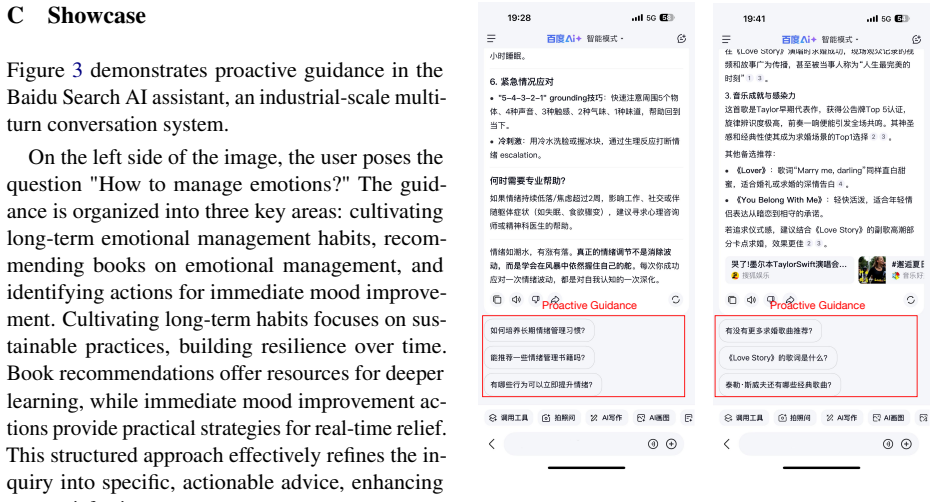
Summary. The paper proposes a two-phase framework for proactive guidance in multi-turn conversation within the Baidu Search AI assistant. The first phase, G-SFT, introduces a Goal Adaptation Agent that produces explicit goal analysis, goal-relevant summaries, and shift detection signals, and uses scalable knowledge transfer from a teacher LLM to a lightweight model. The second phase, C-RL, constructs preference pairs from user click signals through a generate-rank paradigm with diverse beam search and a click estimator, then applies DPO. The paper reports offline accuracy gains (86.10% vs. 62.15% baseline), online CTR gains (25.28% vs. 10.15%), and large latency reductions (69.55%). The framework is plausible and the industrial deployment is a strength, but several experimental and statistical issues weaken the evidence for the headline claims.
Significance. If the results are valid, the paper demonstrates a practical recipe for deploying proactive guidance in a large-scale industrial search assistant: a compact model that tracks user goal shifts and aligns with click preferences, achieving order-of-magnitude latency reductions versus LLM inference. The offline ACC is an independent human-rated signal, and the ablations in Table 2 are informative. However, the online CTR metric is optimized and evaluated on the same click signal without controls for position or novelty, and the statistical claims (e.g., Spearman p-value) are unsound. The paper is a meaningful industrial case study, but the strength of its causal and quantitative claims is currently limited.
major comments (4)
- [Section 3.3] The Consistency Analysis reports Spearman's ρ = 0.986 with p < 0.01 computed on the four data points in Table 1 (Baseline, SKD, G-SFT, C-RL). With n = 4, the smallest possible two-sided p-value for Spearman's rank correlation is 2/4! = 0.083, so p < 0.01 is impossible. This claim of a strong offline-online correlation is not statistically supported. Please recompute on a larger sample of model configurations or remove the p-value and explicitly note the limited sample size.
- [Section 3.1, Datasets] No held-out test set or train/test split is described for the offline evaluation. The paper reports ACC and ΔGSB on QA pairs from the industrial system but does not state whether the 6,072 G-SFT training pairs or the 12,000 C-RL preference pairs overlap with the evaluation data. Without a clear split, evaluation set size, annotator counts, and inter-annotator agreement, the 86.10% ACC and ΔGSB results cannot be assessed for overfitting or selection bias. Please specify the evaluation protocol in detail.
- [Section 2.3 and Section 3.3] The C-RL phase trains on preference pairs derived from user clicks and is evaluated by click-through rate on the same surface, yet the online experiment reports no position randomization, order analysis, or novelty-decay check. The k guidance items are shown together (Figure 1), so the headline CTR gain may reflect position bias, curiosity-driven clicking, or clickbait-style phrasing rather than improved guidance quality. The offline ACC does improve with C-RL (+3.47%, an independent human-rated signal), but the paper does not use this to validate the online CTR gain. Please add a position-bucket analysis, an A/B test with randomized display order, or a novelty-decay analysis to disentangle these effects.
- [Section 3.1, Baselines] Only a single baseline (ERNIE Speed) is used for the headline comparisons. Since the teacher LLM (GPT-4o) is available for offline distillation, the paper could also compare against a strong inference-time baseline (e.g., GPT-4o with prompt-based guidance) or an SFT model using full conversation history, to calibrate the claimed improvements. The manuscript itself lists 'exploring more diverse baseline models' as future work (Section 5), which confirms this limitation. Please add at least one additional strong baseline to support the significance of the reported gains.
minor comments (6)
- [Section 2.3.2] The final model is referred to as the 'C-LR model' in this section, but the correct name elsewhere is 'C-RL model'.
- [Section 2.2.1 and Section 3.3] The ACC gain attributed to the GAA is reported as 10.18% in the introduction and in Section 3.3, but Table 2 shows a gain of 10.81 percentage points (from 71.82% to 82.63%). Please reconcile these numbers.
- [Abstract and Table 1] The phrase '+23.95% over baseline' is ambiguous; it should be expressed as '+23.95 percentage points' to distinguish it from relative improvement, which is used for the CTR gain.
- [Table 3] The G-SFT model row shows ACC 82.60%, while Table 1 shows 82.63%. Please align the numbers between tables.
- [Section 3.3, Latency Analysis] The latency reduction percentages (69.55% and 65.5%) are reported without specifying the measurement protocol, such as hardware, batch size, or whether the comparison is end-to-end or model-inference-only. Please clarify to allow reproducibility.
- [Appendix A] There is a typo 'Y ou' in the prompt text; this should be corrected.
Circularity Check
No significant circularity: the C-RL phase is trained on click signals but the reported CTR is measured in live deployment, and offline ACC is an independent human-rated metric.
full rationale
The paper's derivation chain is self-contained against external measurements. G-SFT is trained on human-filtered LLM outputs and evaluated by human-rated ACC, which is independent of the training objective's fitted parameters. C-RL uses user click signals to construct DPO preference pairs via a click estimator and diversity-aware sampling, then reports CTR from an online deployment; the CTR is a new behavioral measurement, not a re-derivation of the model's own training labels. The click estimator is an internal ranking component and is not used as the final evaluation metric. DBS, MMR, and DPO are standard external algorithms, and no load-bearing claim is justified by a self-citation. The only weakness is that CTR may be influenced by position or novelty effects, but that is an experimental-validity concern rather than a definitional circularity; the offline ACC provides an independent human-judged check. Therefore no step reduces to its own inputs by construction.
Assumptions & free parameters
free parameters (3)
- k (number of guidance per turn) =
3
- lambda (MMR diversity trade-off) =
0.5
- BEAM_GROUP_NUM B =
4
assumptions (5)
- standard math DPO loss (Eq. 4) is a valid alignment objective
- domain assumption Diverse Beam Search improves diversity without harming quality
- domain assumption User click behavior is a reliable reward signal for guidance quality
- domain assumption GPT-4o is a sufficiently strong teacher for knowledge distillation
- domain assumption The GAA's summary preserves all information needed for high-quality guidance
invented entities (2)
-
Goal Adaptation Agent (GAA)
-
Click Estimator
Cite this review
Pith. "Pith review of Proactive Guidance of Multi-Turn Conversation in Industrial Search." pith.science (2026). https://pith.science/paper/GGAA57NH
@misc{pith2026250524251,
  author       = {Pith},
  title        = {Pith review of: Proactive Guidance of Multi-Turn Conversation in Industrial Search},
  year         = {2026},
  howpublished = {\url{https://pith.science/paper/GGAA57NH}},
  note         = {Machine review of arXiv:2505.24251}
}
read the original abstract
The evolution of Large Language Models (LLMs) has significantly advanced multi-turn conversation systems, emphasizing the need for proactive guidance to enhance users' interactions. However, these systems face challenges in dynamically adapting to shifts in users' goals and maintaining low latency for real-time interactions. In the Baidu Search AI assistant, an industrial-scale multi-turn search system, we propose a novel two-phase framework to provide proactive guidance. The first phase, Goal-adaptive Supervised Fine-Tuning (G-SFT), employs a goal adaptation agent that dynamically adapts to user goal shifts and provides goal-relevant contextual information. G-SFT also incorporates scalable knowledge transfer to distill insights from LLMs into a lightweight model for real-time interaction. The second phase, Click-oriented Reinforcement Learning (C-RL), adopts a generate-rank paradigm, systematically constructs preference pairs from user click signals, and proactively improves click-through rates through more engaging guidance. This dual-phase architecture achieves complementary objectives: G-SFT ensures accurate goal tracking, while C-RL optimizes interaction quality through click signal-driven reinforcement learning. Extensive experiments demonstrate that our framework achieves 86.10% accuracy in offline evaluation (+23.95% over baseline) and 25.28% CTR in online deployment (149.06% relative improvement), while reducing inference latency by 69.55% through scalable knowledge distillation.
Figures


Forward citations
Cited by 1 Pith paper
-
ASARL: Autonomous Social-Aware Relevance Learning for QQ Search
An agent-loop data-curation pipeline with social-aware chain-of-thought, preference, and distillation training improves QQ group/channel search relevance in offline and online evaluation.
Reference graph
Works this paper leans on
-
[1]
Josh Achiam, Steven Adler, Sandhini Agarwal, Lama Ahmad, Ilge Akkaya, Florencia Leoni Aleman, Diogo Almeida, Janko Altenschmidt, Sam Altman, Shyamal Anadkat, et al. 2023. Gpt-4 technical report. arXiv preprint arXiv:2303.08774
arXiv 2023
-
[2]
Mohammad Aliannejadi, Manajit Chakraborty, Esteban Andr \'e s R \' ssola, and Fabio Crestani. 2020. Harnessing evolution of multi-turn conversations for effective answer retrieval. In Proceedings of the 2020 conference on human information interaction and retrieval, pages 33--42
work page 2020
-
[3]
Afra Amini, Tim Vieira, and Ryan Cotterell. 2024. Direct preference optimization with an offset. arXiv preprint arXiv:2402.10571
arXiv 2024
-
[4]
Antoine Bordes, Y-Lan Boureau, and Jason Weston. 2016. Learning end-to-end goal-oriented dialog. arXiv preprint arXiv:1605.07683
arXiv 2016
-
[5]
Yang Deng, Wenxuan Zhang, Weiwen Xu, Wenqiang Lei, Tat-Seng Chua, and Wai Lam. 2023. A unified multi-task learning framework for multi-goal conversational recommender systems. ACM Transactions on Information Systems, 41(3):1--25
work page 2023
-
[6]
Jinhao Duan, Xinyu Zhao, Zhuoxuan Zhang, Eunhye Ko, Lily Boddy, Chenan Wang, Tianhao Li, Alexander Rasgon, Junyuan Hong, Min Kyung Lee, et al. 2025. Guidellm: Exploring llm-guided conversation with applications in autobiography interviewing. arXiv preprint arXiv:2502.06494
work page Pith review arXiv 2025
-
[7]
Kawin Ethayarajh, Winnie Xu, Niklas Muennighoff, Dan Jurafsky, and Douwe Kiela. 2024. Kto: Model alignment as prospect theoretic optimization. arXiv preprint arXiv:2402.01306
arXiv 2024
-
[8]
Jiabao Fang, Shen Gao, Pengjie Ren, Xiuying Chen, Suzan Verberne, and Zhaochun Ren. 2024. A multi-agent conversational recommender system. arXiv preprint arXiv:2402.01135
arXiv 2024
Show all 29 references
-
[9]
Yue Feng, Shuchang Liu, Zhenghai Xue, Qingpeng Cai, Lantao Hu, Peng Jiang, Kun Gai, and Fei Sun. 2023. A large language model enhanced conversational recommender system. arXiv preprint arXiv:2308.06212
2023 arXiv
-
[10]
Chongming Gao, Wenqiang Lei, Xiangnan He, Maarten De Rijke, and Tat-Seng Chua. 2021. Advances and challenges in conversational recommender systems: A survey. AI open, 2:100--126
2021
-
[11]
Aaron Grattafiori, Abhimanyu Dubey, Abhinav Jauhri, Abhinav Pandey, Abhishek Kadian, Ahmad Al-Dahle, Aiesha Letman, Akhil Mathur, Alan Schelten, Alex Vaughan, et al. 2024. The llama 3 herd of models. arXiv preprint arXiv:2407.21783
2024 arXiv
-
[12]
Daya Guo, Dejian Yang, Haowei Zhang, Junxiao Song, Ruoyu Zhang, Runxin Xu, Qihao Zhu, Shirong Ma, Peiyi Wang, Xiao Bi, et al. 2025. Deepseek-r1: Incentivizing reasoning capability in llms via reinforcement learning. arXiv preprint arXiv:2501.12948
2025 arXiv
-
[13]
Shengbo Guo and Scott Sanner. 2010. Probabilistic latent maximal marginal relevance. In Proceedings of the 33rd international ACM SIGIR conference on Research and development in information retrieval, pages 833--834
2010
-
[14]
Aaron Hurst, Adam Lerer, Adam P Goucher, Adam Perelman, Aditya Ramesh, Aidan Clark, AJ Ostrow, Akila Welihinda, Alan Hayes, Alec Radford, et al. 2024. Gpt-4o system card. arXiv preprint arXiv:2410.21276
2024 arXiv
-
[15]
Leslie Pack Kaelbling, Michael L Littman, and Andrew W Moore. 1996. Reinforcement learning: A survey. Journal of artificial intelligence research, 4:237--285
1996
-
[16]
Viktor Lapov, Nicholas Laurent, Lawrence Araya, Gabriel Ortiz, and Samuel Albrecht. 2024. Dynamic context integration in large language models using a novel progressive layering framework
2024
-
[17]
Chuang Li, Yang Deng, Hengchang Hu, Min-Yen Kan, and Haizhou Li. 2024. Incorporating external knowledge and goal guidance for llm-based conversational recommender systems. arXiv preprint arXiv:2405.01868
2024 arXiv
-
[18]
Rafael Rafailov, Archit Sharma, Eric Mitchell, Christopher D Manning, Stefano Ermon, and Chelsea Finn. 2023. Direct preference optimization: Your language model is secretly a reward model. Advances in Neural Information Processing Systems, 36:53728--53741
2023
-
[19]
John Schulman, Filip Wolski, Prafulla Dhariwal, Alec Radford, and Oleg Klimov. 2017. Proximal policy optimization algorithms. arXiv preprint arXiv:1707.06347
2017 arXiv
-
[20]
Yu Sun, Shuohuan Wang, Shikun Feng, Siyu Ding, Chao Pang, Junyuan Shang, Jiaxiang Liu, Xuyi Chen, Yanbin Zhao, Yuxiang Lu, et al. 2021. Ernie 3.0: Large-scale knowledge enhanced pre-training for language understanding and generation. arXiv preprint arXiv:2107.02137
2021 arXiv
-
[21]
Yu Sun, Shuohuan Wang, Yukun Li, Shikun Feng, Hao Tian, Hua Wu, and Haifeng Wang. 2020. Ernie 2.0: A continual pre-training framework for language understanding. In Proceedings of the AAAI conference on artificial intelligence, volume 34, pages 8968--8975
2020
-
[22]
Vaishali Vadhavana, Krishna Patel, Brinda Patel, Bansari Patel, Naina Parmar, and Vaibhavi Patel. 2024. Conversational question answering systems: A comprehensive literature review. In 2024 International Conference on Inventive Computation Technologies (ICICT), pages 1088--1095. IEEE
2024
-
[23]
Ashwin K Vijayakumar, Michael Cogswell, Ramprasath R Selvaraju, Qing Sun, Stefan Lee, David Crandall, and Dhruv Batra. 2016. Diverse beam search: Decoding diverse solutions from neural sequence models. arXiv preprint arXiv:1610.02424
2016 arXiv
-
[24]
An Yang, Baosong Yang, Beichen Zhang, Binyuan Hui, Bo Zheng, Bowen Yu, Chengyuan Li, Dayiheng Liu, Fei Huang, Haoran Wei, et al. 2024. Qwen2. 5 technical report. arXiv preprint arXiv:2412.15115
2024 arXiv
-
[25]
Zihao Yi, Jiarui Ouyang, Yuwen Liu, Tianhao Liao, Zhe Xu, and Ying Shen. 2024. A survey on recent advances in llm-based multi-turn dialogue systems. arXiv preprint arXiv:2402.18013
2024 arXiv
-
[26]
Chen Zhang, Xinyi Dai, Yaxiong Wu, Qu Yang, Yasheng Wang, Ruiming Tang, and Yong Liu. 2025. A survey on multi-turn interaction capabilities of large language models. arXiv preprint arXiv:2501.09959
2025 arXiv
-
[27]
Yongfeng Zhang, Xu Chen, Qingyao Ai, Liu Yang, and W Bruce Croft. 2018. Towards conversational search and recommendation: System ask, user respond. In Proceedings of the 27th acm international conference on information and knowledge management, pages 177--186
2018
-
[28]
online" 'onlinestring :=
ENTRY address archivePrefix author booktitle chapter edition editor eid eprint eprinttype howpublished institution journal key month note number organization pages publisher school series title type volume year doi pubmed url lastchecked label extra.label sort.label short.list...
-
[29]
write newline
" write newline "" before.all 'output.state := FUNCTION n.dashify 't := "" t empty not t #1 #1 substring "-" = t #1 #2 substring "--" = not "--" * t #2 global.max substring 't := t #1 #1 substring "-" = "-" * t #2 global.max substring 't := while if t #1 #1 substring * t #2 gl...
Reviewed August 7, 2026 · model on record in the stance chip above.
Discussion (0). Sign in to comment.