REVIEW 3 major objections 6 minor 30 references
FABLE: A Novel Data-Flow Analysis Benchmark on Procedural Text for Large Language Model Evaluation
T0 review · 3 major / 6 minor · reviewed 2026-08-07 · deepseek-v4-flash
Pith's one-line read FABLE is a 2,400-question benchmark that adapts eight software data-flow analyses to procedural text; its evaluation shows a reasoning-focused 8B model far outperforms general-purpose and code-specific models, which stay near random chance.
desk verdict A genuinely useful new benchmark, but the evaluation's constant-answer cells and uniform-random baseline make the central claims about model reasoning unreadable. read the letter →
The pith
A machine-rendered reading of the paper's core claim, the machinery that carries it, and where it could break.
The reading
What carries the argument
The carrying mechanism is the pair of graphs extracted by the domain-dependent parser: a step-dependency graph $G_S = (S, E_S)$ encoding ordering constraints between steps, and an entity-flow graph $G_E = (V, E_E)$ recording creation, modification, and consumption of entities. These graphs let each of the eight classical data-flow analyses be re-expressed as natural-language template questions whose answers are formally determined, rather than manually annotated. The template generator samples a balanced 2,400 question-answer pairs from a larger automatically generated pool of 13,424 candidates, with 100 pairs for each domain-analysis combination.
What would settle it
Generate a matched set of FABLE-style questions in which entity names are replaced by random tokens and step order is randomly permuted while keeping the graph-derived answers consistent; if a model's accuracy does not drop substantially, the benchmark is answerable from template surface form rather than from data-flow structure.
Extended reading notes
Core claim
The central claim is that data-flow reasoning over procedural text is a distinct, diagnosable capability, and that FABLE is the first benchmark to measure it systematically by adapting eight classical data-flow analyses from software engineering. Each procedure is parsed into a step-dependency graph and an entity-flow graph, and template questions are generated with answers formally determined by those graphs. The evaluation shows a reasoning-focused 8B model exceeding the random baseline by 31 to 37 percentage points across domains, while a general-purpose model and a code-specific model stay within a few points of chance. The authors also find that interval analysis is the hardest analysis for all models, and that no model shows statistically robust domain-specific strength, with the diagnostic signal living in variation across analysis types rather than across domains.
Load-bearing premise
The load-bearing premise, acknowledged in the appendix, is that the template-generated questions and their graph-computed answers actually measure data-flow reasoning rather than surface-level pattern matching; if the parser or templates let models answer from wording alone, the rankings would not reflect procedural understanding.
Editorial extensions
If this is right
- FABLE scores can be decomposed by analysis type and domain, so a model's specific weakness, such as interval analysis or taint analysis, can be isolated instead of averaged into a single number.
- Because answers are computed from explicit graphs, new procedural domains can be added by writing a parser and reusing the same eight templates, making the benchmark extensible beyond recipes, routes, and plans.
- The reported accuracy-inference trade-off means that deploying a reasoning-focused model in real-time procedural decision-making carries a more than 20x latency cost that must be weighed against its accuracy gain.
- Performance near random chance for general-purpose and code-specific models suggests that broad pretraining over natural and programming language does not by itself confer data-flow reasoning.
Reading between the lines
- A direct stress test would be to shuffle the order of steps or replace entity names with random tokens while recomputing graph-derived answers; if accuracy does not drop sharply, the benchmark would be answerable from superficial wording rather than data-flow structure.
- The same parser-template pipeline could be applied to the future domains the authors list, such as conversational dialogs and scientific protocols, making the eight analyses a reusable evaluation scaffold rather than a one-time dataset.
- The absence of statistically significant domain-level differences suggests that FABLE's value is diagnostic at the analysis level, which implies that reporting only aggregate benchmark scores would hide the reasoning failures the benchmark is designed to expose.
- If the graph-computed answers are valid, FABLE could serve as a fine-tuning signal: training on its 2,400 pairs and testing on newly generated procedures would show whether models learn general data-flow tracking or memorize question templates.
Editorial analysis
A structured set of objections, weighed in public.
Referee Report
Summary. The paper introduces FABLE, a benchmark of 2,400 question-answer pairs that adapt eight classical data-flow analyses from software engineering to procedural text in three domains (recipes, travel routes, automated plans). Ground-truth answers are computed from entity-flow graphs derived by domain-specific parsers. The authors evaluate three 8-billion-parameter LLMs (DeepSeek-R1 8B, LLaMA 3.1 8B, Granite Code 8B) using majority voting over five completions, and report that the reasoning-focused model achieves substantially higher accuracy than the other two, which perform near a uniform random baseline. The paper claims to provide the first diagnostic benchmark for data-flow reasoning in LLMs.
Significance. If the validity concerns raised below are resolved, FABLE could be a useful diagnostic resource: it is extensible, openly released with code and data, and it operationalizes several distinct reasoning types in a structured way. The construction pipeline is transparent, with template-based question generation, no fitted parameters, and the ground-truth answers are derived deterministically from the underlying graphs, which is a normal and acceptable benchmark-construction strategy. However, the central empirical claim—that DeepSeek-R1 demonstrates data-flow reasoning while the other models are near chance—currently rests on an inappropriate baseline and on constant-answer cells that provide no discriminative signal. The paper also lacks a quantitative validation of the parser that underlies all ground-truth labels.
major comments (3)
- [Section 3.4 and Section 4 (random baseline), Table 6, Figure 2] The evaluation uses a uniform Yes/No random baseline, but Section 3.4 states that at least 10 of the 24 domain-analysis cells (1,000 of 2,400 QA pairs) have constant answers: in travel routes, Available Expressions and Taint always answer Yes while Concurrency, Type-State, and Very Busy Expressions always answer No; in recipes, Reaching Definitions, Available Expressions, and Taint always answer Yes while Type-State and Concurrency always answer No. For these cells a trivial baseline that always predicts the majority class achieves 100% accuracy, not 50%. Consequently, the reported 'gains over random' in Figure 2 are inflated for any model that reproduces these constants; for example, deepseek-r1:8b scores 100% on Travel Concurrency, Travel Type-State, and Travel Very Busy Expressions, and granite-code:8b scores 85% on Travel Available Expressions. The central claim that deepseek-r1:8b demonstrates data-flow reasoning while the other models are near chance cannot be read off the current numbers, because the benchmark does not discriminate target reasoning from answer priors on a large slice of its items. The authors should re-analyze the results with a per-cell majority-class baseline, report accuracy separately for constant vs. non-constant cells, and state which conclusions survive when constant cells are excluded.
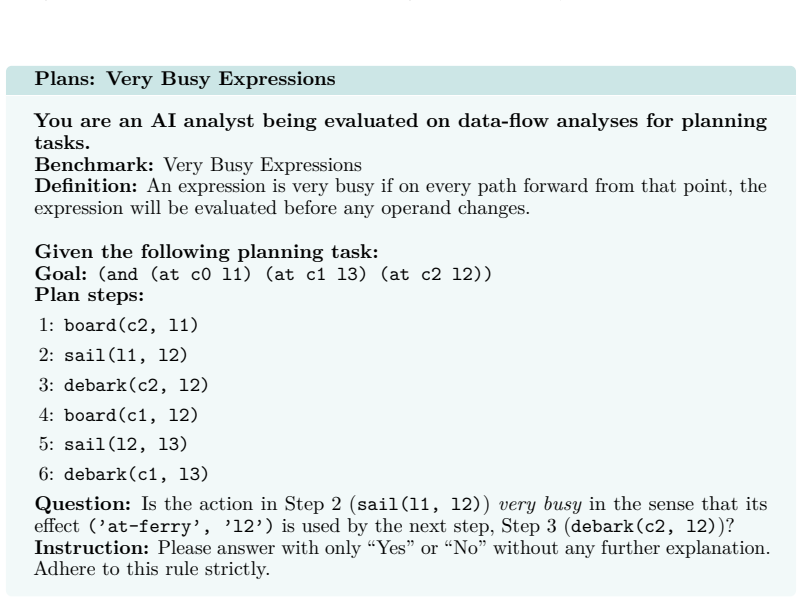
- [Section 4 (Interval Analysis scoring) and Appendix A.4, Figures 9, 16, 24] The scoring rule for Interval Analysis is not well specified. The text says a prediction is correct if 'the extracted value lies within the expected numerical range or correctly identifies the relevant step interval,' but the prompts shown in the appendix are heterogeneous: the recipes prompt asks for the last time interval exactly as it appears (a pure extraction task), the plans prompt asks for a before/after/between answer, and the travel prompt asks for a numeric interval. Mixing extraction and reasoning under a single accuracy measure makes the reported per-analysis scores—and the conclusion that Interval Analysis is the hardest—difficult to interpret. The authors should define a single, principled scoring criterion per question type, report separate results for each prompt format, and consider whether the extraction-style items belong in a data-flow reasoning benchmark.
- [Section 3.2 and Appendix A.3.1 (parser validity)] The ground-truth answers are computed from entity-flow graphs and step-dependency graphs that are produced by domain-specific parsers. For recipes, the parser uses spaCy heuristics and a manually curated entity vocabulary; for travel routes, the authors report manually checking only 2% of routes; for plans, parsing relies on the formal PDDL structure. There is no quantitative evaluation of parser accuracy against human-annotated graphs, and the recipe QA pair review described in A.3.1 checks consistency with the same underlying representation rather than against an independent ground truth. If the parser misidentifies entities, dependencies, or step order, the computed answers are wrong and the resulting model rankings may reflect parser artifacts. The authors should provide a human-annotated sample of entity-flow graphs with parser agreement rates, or release the graphs so that errors can be audited.
minor comments (6)
- [Section 3.4] The sentence 'These outcomes are a direct consequence of deterministic semantics in entity flow and step ordering within these procedural domains, not of annotation bias or trivial task construction' is not persuasive as written; constant-answer cells are by definition trivial for a benchmark, regardless of how they arise. The authors should acknowledge this and adjust the framing.
- [Section 4, Evaluation Setup] The description 'five independent completions using greedy decoding, with sampling seeds randomized' is internally inconsistent: greedy decoding is deterministic. If sampling is used, the temperature and sampling parameters should be stated; if not, the phrase about randomized seeds should be removed.
- [Figure 2] The error bars are described as 'standard deviation' but it is not clear whether they are computed across the eight analyses, across the five sampled completions, or across items within an analysis. This should be clarified in the caption.
- [Abstract and Section 1] The claim 'first diagnostic benchmark to systematically evaluate data-flow reasoning' is strong and should be qualified with respect to prior benchmarks such as ProPara, OpenPI, and CREPE, which also track entity states and causal structure; the novelty should be positioned as the specific data-flow-analysis framing rather than the first evaluation of procedural reasoning.
- [Table 3] The table lists 'Total QA Pairs Generated' as 13,424 but the paper does not explain why only 2,400 are used beyond 'balanced subset'; a brief explanation of the selection criteria (e.g., how 800 per domain were chosen from the larger pools) would improve reproducibility.
- [Appendix A.5, Table 8] The Welch t-test compares domain means per model, but with only eight data points per domain (one per analysis) the test has extremely low power; the authors acknowledge this, but the sentence 'These statistical results support the claim that LLMs tested on FABLE do not exhibit domain-specific reasoning strength' overstates what a null result from such a small sample can support.
Circularity Check
No significant circularity: FABLE's QA labels are computed from the same graphs used for question generation, which is standard benchmark construction, not a circular derivation.
full rationale
The paper's derivation chain is self-contained: FABLE's question–answer pairs are generated by applying template-based question templates to the same entity-flow and step-dependency graphs that also determine the formally computed answers (Section 3.4). This is normal benchmark construction rather than a circular prediction—no model output is fed back into the label-generation process, and no parameter is fitted to the evaluated models. There are no load-bearing self-citations, no 'uniqueness' argument imported from the authors' prior work, and no ansatz smuggled in via citation. The closest concern is Section 3.4's admission that ten of twenty-four domain-analysis cells always answer Yes or No; that weakens the benchmark's discriminative power and makes the uniform random baseline uninformative for those cells, but it is a validity and triviality issue, not a case where a derived result reduces to its own inputs. Appendix A.1's caveat that each data-flow adaptation reflects only one formal interpretation similarly limits construct validity without creating circularity. The empirical rankings may be confounded by constant-answer priors, but that is a correctness-risk concern rather than circular reasoning. Therefore the paper exhibits no significant circularity.
Assumptions & free parameters
assumptions (4)
- domain assumption Procedural text can be represented as a triple (G, S, preceq) with a goal, steps, and order.
- ad hoc to paper Classical data-flow analyses can be faithfully adapted to natural-language procedural text using the one interpretation per analysis chosen in Table 2.
- domain assumption The domain-dependent parsers correctly extract step-dependency and entity-flow graphs from raw text.
- ad hoc to paper Template-generated answers computed from the graphs are valid ground-truth labels for the questions.
Cite this review
Pith. "Pith review of FABLE: A Novel Data-Flow Analysis Benchmark on Procedural Text for Large Language Model Evaluation." pith.science (2026). https://pith.science/paper/7Y2XWQQU
@misc{pith2026250524258,
  author       = {Pith},
  title        = {Pith review of: FABLE: A Novel Data-Flow Analysis Benchmark on Procedural Text for Large Language Model Evaluation},
  year         = {2026},
  howpublished = {\url{https://pith.science/paper/7Y2XWQQU}},
  note         = {Machine review of arXiv:2505.24258}
}
read the original abstract
Understanding how data moves, transforms, and persists, known as data flow, is fundamental to reasoning in procedural tasks. Despite their fluency in natural and programming languages, large language models (LLMs), although increasingly being applied to decisions with procedural tasks, have not been systematically evaluated for their ability to perform data-flow reasoning. We introduce FABLE, an extensible benchmark designed to assess LLMs' understanding of data flow using structured, procedural text. FABLE adapts eight classical data-flow analyses from software engineering: reaching definitions, very busy expressions, available expressions, live variable analysis, interval analysis, type-state analysis, taint analysis, and concurrency analysis. These analyses are instantiated across three real-world domains: cooking recipes, travel routes, and automated plans. The benchmark includes 2,400 question-answer pairs, with 100 examples for each domain-analysis combination. We evaluate three types of LLMs: a reasoning-focused model (DeepSeek-R1 8B), a general-purpose model (LLaMA 3.1 8B), and a code-specific model (Granite Code 8B). Each model is tested using majority voting over five sampled completions per prompt. Results show that the reasoning model achieves higher accuracy, but at the cost of over 20 times slower inference compared to the other models. In contrast, the general-purpose and code-specific models perform close to random chance. FABLE provides the first diagnostic benchmark to systematically evaluate data-flow reasoning and offers insights for developing models with stronger procedural understanding.
Figures


Figures from the paper (27 more)




Reference graph
Works this paper leans on
-
[1]
Major State Government Buildings,
California Office of Emergency Services (Cal OES). Major State Government Buildings,
-
[2]
pddl-generators: A collection of pddl problem generators
AI-Planning Community. pddl-generators: A collection of pddl problem generators. https://github.com/AI-Planning/pddl-generators. Accessed: 2025-05-11
work page 2025
-
[3]
Matthew B Dwyer and Lori A Clarke. Data flow analysis for verifying properties of concurrent programs.ACM SIGSOFT Software Engineering Notes, 19(5):62–75, 1994
work page 1994
-
[4]
Data flow analysis in software reliability.ACM Computing Surveys (CSUR), 8(3):305–330, 1976
Lloyd D Fosdick and Leon J Osterweil. Data flow analysis in software reliability.ACM Computing Surveys (CSUR), 8(3):305–330, 1976. 10
work page 1976
-
[5]
Elsevier, 2004
Malik Ghallab, Dana Nau, and Paolo Traverso.Automated Planning: theory and practice. Elsevier, 2004
2004
-
[6]
The fast downward planning system.Journal of Artificial Intelligence Research, 26:191–246, 2006
Malte Helmert. The fast downward planning system.Journal of Artificial Intelligence Research, 26:191–246, 2006
2006
-
[7]
Homeland Infrastructure Foundation-Level Data (HIFLD). USA Hospitals, 2019. Ac- cessed: 2025-03-20
work page 2019
-
[8]
spaCy: Industrial-strength Natural Language Processing in Python
Matthew Honnibal, Ines Montani, Sofie Van Landeghem, and Adriane Boyd. spaCy: Industrial-strength Natural Language Processing in Python. 2020
work page 2020
Show all 30 references
-
[9]
International planning competitions at international conference on automated planning and scheduling (icaps)
ICAPS. International planning competitions at international conference on automated planning and scheduling (icaps). Inhttps://www.icaps-conference.org/competitions/, 2022
2022
-
[10]
IBM Thomas J
Ken Kennedy.A survey of data flow analysis techniques. IBM Thomas J. Watson Research Division, 1979
1979
-
[11]
Using ollama
Francisco S Marcondes, Adelino Gala, Renata Magalhães, Fernando Perez de Britto, Dalila Durães, and Paulo Novais. Using ollama. InNatural Language Analytics with Generative Large-Language Models: A Practical Approach with Ollama and Open-Source LLMs, pages 23–35. Springer, 2025
2025
-
[12]
Pddl-the planning domain definition language
Drew McDermott, Malik Ghallab, Adele Howe, Craig Knoblock, Ashwin Ram, Manuela Veloso, Daniel Weld, and David Wilkins. Pddl-the planning domain definition language. 1998
1998
-
[13]
National Register of Historic Places, 2025
National Park Service. National Register of Historic Places, 2025. Accessed: 2025-03-20
2025
-
[14]
TORQUE: A reading comprehension dataset of temporal ordering questions
Qiang Ning, Hao Wu, Rujun Han, Nanyun Peng, Matt Gardner, and Dan Roth. TORQUE: A reading comprehension dataset of temporal ordering questions. In Bonnie Webber, Trevor Cohn, Yulan He, and Yang Liu, editors,Proceedings of the 2020 Conference on Empirical Methods in Natural Lan...
2020
-
[15]
OpenStreetMap US Extract
OpenStreetMap contributors. OpenStreetMap US Extract. https://www. openstreetmap.org, 2025. Data retrieved from https://www.geofabrik.de/
2025
-
[16]
OurAirports USA, 2025
OurAirports. OurAirports USA, 2025. Accessed: 2025-03-20
2025
-
[17]
An incremental version of iterative data flow analysis.IEEE Transactions on Software Engineering, 15(12):1537–1549, 2002
Lori L Pollock and Mary Lou Soffa. An incremental version of iterative data flow analysis.IEEE Transactions on Software Engineering, 15(12):1537–1549, 2002
2002
-
[18]
Ai a modern approach.Learning, 2(3):4, 2005
Stuart Russell and Peter Norvig. Ai a modern approach.Learning, 2(3):4, 2005
2005
-
[19]
Autoplanbench: Automatically generating benchmarks for llm planners from pddl.arXiv preprint arXiv:2311.09830, 2023
Katharina Stein, Daniel Fišer, Jörg Hoffmann, and Alexander Koller. Autoplanbench: Automatically generating benchmarks for llm planners from pddl.arXiv preprint arXiv:2311.09830, 2023
2023 arXiv
-
[20]
Reasoning about actions and state changes by injecting commonsense knowledge
Niket Tandon, Bhavana Dalvi, Joel Grus, Wen-tau Yih, Antoine Bosselut, and Peter Clark. Reasoning about actions and state changes by injecting commonsense knowledge. InEllenRiloff, DavidChiang, JuliaHockenmaier, andJun’ichiTsujii, editors,Proceedings of the 2018 Conference on ...
2018
-
[21]
Reasoning about actions and state changes by injecting commonsense knowledge.arXiv preprint arXiv:1808.10012, 2018
Niket Tandon, Bhavana Dalvi Mishra, Joel Grus, Wen-tau Yih, Antoine Bosselut, and Peter Clark. Reasoning about actions and state changes by injecting commonsense knowledge.arXiv preprint arXiv:1808.10012, 2018
2018 arXiv
-
[22]
what if
Niket Tandon, Bhavana Dalvi Mishra, Keisuke Sakaguchi, Antoine Bosselut, and Peter Clark. Wiqa: A dataset for" what if..." reasoning over procedural text.arXiv preprint arXiv:1909.04739, 2019. 11
1909 arXiv
-
[23]
A dataset for tracking entities in open domain procedural text
Niket Tandon, Keisuke Sakaguchi, Bhavana Dalvi, Dheeraj Rajagopal, Peter Clark, Michal Guerquin, Kyle Richardson, and Eduard Hovy. A dataset for tracking entities in open domain procedural text. In Bonnie Webber, Trevor Cohn, Yulan He, and Yang Liu, editors,Proceedings of the ...
2020
-
[24]
Bureau of Transportation Statistics
U.S. Bureau of Transportation Statistics. Airports – Citizen Connect, 2025. Accessed: 2025-03-20
2025
-
[25]
Open source routing engine for openstreetmap
Valhalla Valhalla. Open source routing engine for openstreetmap
-
[26]
140,000 english recipes in computer-readable form with photos and crawl, Jul 2017
Zachary Vance. 140,000 english recipes in computer-readable form with photos and crawl, Jul 2017
2017
-
[27]
Causal reasoning of entities and events in procedural texts
Li Zhang, Hainiu Xu, Yue Yang, Shuyan Zhou, Weiqiu You, Manni Arora, and Chris Callison-Burch. Causal reasoning of entities and events in procedural texts. In Andreas Vlachos and Isabelle Augenstein, editors,Findings of the Association for Computational Linguistics: EACL 2023,...
2023
-
[28]
Temporal reasoning on implicit events from distant supervision
Ben Zhou, Kyle Richardson, Qiang Ning, Tushar Khot, Ashish Sabharwal, and Dan Roth. Temporal reasoning on implicit events from distant supervision. In Kristina Toutanova, Anna Rumshisky, Luke Zettlemoyer, Dilek Hakkani-Tur, Iz Beltagy, Steven Bethard, Ryan Cotterell, Tanmoy Ch...
2021
-
[30]
USA Hospitals
Institutional review board (IRB) approvals or equivalent for research with human subjects Question: Does the paper describe potential risks incurred by study participants, whether such risks were disclosed to the subjects, and whether Institutional Review Board (IRB) approvals...
2017
-
[2021]
Accessed: 2025-03-20
2025
Reviewed August 7, 2026 · model on record in the stance chip above.
Discussion (0). Sign in to comment.