A double selection entanglement distillation-based state estimator
Pith reviewed 2026-05-19 13:34 UTC · model grok-4.3
The pith
Measurement statistics from double selection distillation suffice to estimate Bell-diagonal parameters of input and output states
A machine-rendered reading of the paper's core claim, the machinery that carries it, and where it could break.
Core claim
The measurement statistics of a double selection distillation protocol alone can be used to efficiently estimate the Bell-diagonal parameters of the undistilled states, as well as the resulting distilled states after additional post-processing, and this novel estimator outperforms the previously proposed distillation-based estimator in terms of resource complexity.
What carries the argument
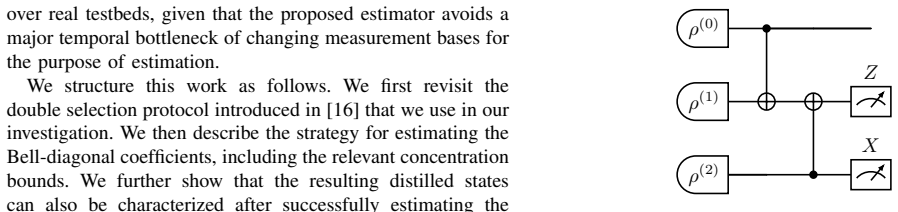
The double selection entanglement distillation protocol, whose pass and fail probabilities depend on the four Bell-diagonal coefficients in a manner that permits direct inversion to recover those coefficients from observed statistics.
If this is right
- The estimator can be embedded into existing quantum network tasks that already perform double selection distillation.
- Both pre-distillation and post-distillation Bell-diagonal parameters become available from the same run without extra measurements.
- Total entangled-pair consumption is lower than that required by the earlier distillation-based estimator.
Where Pith is reading between the lines
- Continuous monitoring of entanglement quality could occur in real time during network operation with negligible added cost.
- Similar statistical mappings might be derived for other distillation protocols to handle different noise models.
- Hardware implementations could quantify the actual reduction in calibration overhead on deployed quantum links.
Load-bearing premise
The input states are exactly Bell-diagonal, with all noise captured by the four standard parameters and no other unmodeled noise sources present.
What would settle it
Compare the four Bell-diagonal parameters recovered from distillation pass/fail counts against the same parameters obtained by full quantum state tomography performed on identical input states; significant disagreement beyond sampling error would falsify the direct mapping.
Figures


read the original abstract
With the advent of practical quantum communication networks drawing closer, there is a growing need for reliable estimation protocols that can efficiently characterize quantum resources with minimum resource overhead requirement. A novel approach to this problem is to integrate an estimator into an existing network task, thereby removing the need for an additional characterization protocol. In this work, we show that the measurement statistics of a double selection distillation protocol alone can be used to efficiently estimate the Bell-diagonal parameters of the undistilled states, as well as the resulting distilled states after additional post-processing. We also demonstrate that this novel estimator outperforms the previously proposed distillation-based estimator in terms of resource complexity.
Editorial analysis
A structured set of objections, weighed in public.
Referee Report
Summary. The manuscript proposes a state estimator for Bell-diagonal quantum states that extracts the three independent parameters directly from the measurement statistics (pass/fail rates and conditional outcomes) of a double-selection entanglement distillation protocol. The estimator is applied both to the input undistilled states and to the output states after post-processing, and is claimed to require fewer resources than the previously proposed distillation-based estimator.
Significance. If the claimed invertible mapping from protocol statistics to Bell-diagonal parameters holds and is free of post-hoc fitting, the work would allow state characterization to be performed as a byproduct of an existing network task, reducing overhead in quantum communication protocols. The explicit comparison of resource complexity to prior methods is a concrete strength.
major comments (2)
- [§4] §4 (Estimator Derivation): The central claim requires an invertible mapping from the double-selection pass/fail statistics (and any conditional observables) to the three independent Bell-diagonal probabilities. A single scalar success probability supplies only one constraint; the manuscript must explicitly list all independent observables supplied by the protocol and demonstrate that the resulting system of equations is full rank and uniquely solvable for the three parameters without additional assumptions.
- [§6] §6 (Numerical Validation): The reported outperformance in resource complexity is load-bearing for the practical claim. The simulations must include direct, quantitative comparisons (e.g., number of input pairs required to reach a target estimation variance) against the baseline distillation-based estimator, together with statistical error bars or confidence intervals on the reported resource savings.
minor comments (2)
- Notation for the four Bell-diagonal probabilities should be introduced once and used consistently; the current alternation between p_{00}, p_{01}, etc., and the vector notation is occasionally ambiguous.
- Figure 3 (resource scaling plot): the x-axis label should explicitly state whether the plotted quantity is the number of raw pairs or the number of successful distillations.
Simulated Author's Rebuttal
We thank the referee for their thorough review and valuable feedback on our manuscript. We address the major comments point by point below and outline the revisions we will make to improve the clarity and rigor of the presentation.
read point-by-point responses
-
Referee: [§4] §4 (Estimator Derivation): The central claim requires an invertible mapping from the double-selection pass/fail statistics (and any conditional observables) to the three independent Bell-diagonal probabilities. A single scalar success probability supplies only one constraint; the manuscript must explicitly list all independent observables supplied by the protocol and demonstrate that the resulting system of equations is full rank and uniquely solvable for the three parameters without additional assumptions.
Authors: We thank the referee for this important observation. The double-selection protocol indeed provides more than just the success probability; it supplies the pass/fail rates as well as conditional outcome probabilities from the measurements performed during the distillation process. In the revised version of the manuscript, we will expand §4 to explicitly list all independent observables (including the success probability, the probability of specific conditional measurement results on the kept pair, and failure statistics), present the full system of equations, and demonstrate that it is full rank by computing the rank of the coefficient matrix or by showing the mapping is bijective for the relevant parameter space. This will be done without additional assumptions beyond the states being Bell-diagonal. revision: yes
-
Referee: [§6] §6 (Numerical Validation): The reported outperformance in resource complexity is load-bearing for the practical claim. The simulations must include direct, quantitative comparisons (e.g., number of input pairs required to reach a target estimation variance) against the baseline distillation-based estimator, together with statistical error bars or confidence intervals on the reported resource savings.
Authors: We agree with the referee that direct comparisons with statistical rigor are essential. We will revise §6 to include explicit numerical simulations that compare the resource requirements (number of input pairs) of our estimator against the prior distillation-based estimator for achieving specific target estimation variances. These comparisons will be based on Monte Carlo simulations with a sufficient number of trials, and we will report the results with error bars or confidence intervals to indicate the variability and statistical significance of the observed resource savings. revision: yes
Circularity Check
No significant circularity; derivation is self-contained
full rationale
The paper derives its estimator by mapping the observed pass/fail statistics of the double-selection distillation protocol onto the Bell-diagonal parameters via the standard analytical expressions for that protocol. This mapping is obtained from the known quantum channel model of the distillation process rather than by fitting parameters to the target data or by redefining the outputs in terms of the inputs. No load-bearing step reduces to a self-citation chain, an ansatz smuggled from prior work by the same authors, or a renaming of an existing empirical pattern. The central claim therefore remains independent of the estimator's own outputs and is externally falsifiable against the established distillation theory.
Axiom & Free-Parameter Ledger
axioms (2)
- domain assumption Input states are Bell-diagonal or can be reduced to Bell-diagonal form by local operations
- domain assumption Measurement outcomes of the double-selection protocol depend only on the Bell-diagonal coefficients
Reference graph
Works this paper leans on
-
[1]
H. J. Kimble, “The quantum internet,” Nature, vol. 453, no. 7198, pp. 1023–1030, 2008
work page 2008
-
[2]
Quantum internet: A vision for the road ahead,
S. Wehner, D. Elkouss, and R. Hanson, “Quantum internet: A vision for the road ahead,” Science, vol. 362, no. 6412, p. eaam9288, 2018. [Online]. Available: https://www.science.org/doi/abs/10.1126/science.aam9288
-
[3]
A quantum inter- net architecture,
R. Van Meter, R. Satoh, N. Benchasattabuse, K. Teramoto, T. Matsuo, M. Hajduˇsek, T. Satoh, S. Nagayama, and S. Suzuki, “A quantum inter- net architecture,” in 2022 IEEE International Conference on Quantum Computing and Engineering (QCE) , 2022, pp. 341–352
work page 2022
-
[4]
Quantum certification and benchmarking,
J. Eisert, D. Hangleiter, N. Walk, I. Roth, D. Markham, R. Parekh, U. Chabaud, and E. Kashefi, “Quantum certification and benchmarking,” Nature Reviews Physics, vol. 2, no. 7, pp. 382–390, Jun. 2020. [Online]. Available: https://doi.org/10.1038/s42254-020-0186-4
-
[5]
Quantum state tomography via compressed sensing,
D. Gross, Y .-K. Liu, S. T. Flammia, S. Becker, and J. Eisert, “Quantum state tomography via compressed sensing,” Phys. Rev. Lett., vol. 105, p. 150401, Oct 2010. [Online]. Available: https://link.aps.org/doi/10.1103/PhysRevLett.105.150401
-
[6]
Adaptive quantum state tomography via linear regression estimation: Theory and two-qubit experiment,
B. Qi, Z. Hou, Y . Wang, D. Dong, H.-S. Zhong, L. Li, G.-Y . Xiang, H. M. Wiseman, C.-F. Li, and G.-C. Guo, “Adaptive quantum state tomography via linear regression estimation: Theory and two-qubit experiment,” npj Quantum Information , vol. 3, no. 1, p. 19, 2017
work page 2017
-
[7]
Fast state tomography with optimal error bounds,
M. Gut ¸˘a, J. Kahn, R. Kueng, and J. A. Tropp, “Fast state tomography with optimal error bounds,” Journal of Physics A: Mathematical and Theoretical, vol. 53, no. 20, p. 204001, 2020
work page 2020
-
[8]
Direct fidelity estimation from few Pauli measurements,
S. T. Flammia and Y .-K. Liu, “Direct fidelity estimation from few Pauli measurements,” Phys. Rev. Lett., vol. 106, p. 230501, Jun 2011. [Online]. Available: https://link.aps.org/doi/10.1103/PhysRevLett.106.230501
-
[9]
Randomized benchmarking of quantum gates,
E. Knill, D. Leibfried, R. Reichle, J. Britton, R. B. Blakestad, J. D. Jost, C. Langer, R. Ozeri, S. Seidelin, and D. J. Wineland, “Randomized benchmarking of quantum gates,” Phys. Rev. A , vol. 77, p. 012307, Jan 2008. [Online]. Available: https://link.aps.org/doi/10.1103/PhysRevA.77.012307 8
-
[10]
General framework for randomized benchmarking,
J. Helsen, I. Roth, E. Onorati, A. Werner, and J. Eisert, “General framework for randomized benchmarking,” PRX Quantum, vol. 3, p. 020357, Jun 2022. [Online]. Available: https://link.aps.org/doi/10.1103/PRXQuantum.3.020357
-
[11]
A benchmarking procedure for quantum networks,
J. Helsen and S. Wehner, “A benchmarking procedure for quantum networks,” npj Quantum Information , vol. 9, no. 1, p. 17, 2023
work page 2023
-
[12]
Optimal noise estimation from syndrome statistics of quantum codes,
T. Wagner, H. Kampermann, D. Bruß, and M. Kliesch, “Optimal noise estimation from syndrome statistics of quantum codes,” Phys. Rev. Res. , vol. 3, p. 013292, Mar 2021. [Online]. Available: https://link.aps.org/doi/10.1103/PhysRevResearch.3.013292
-
[13]
Pauli channels can be estimated from syndrome measurements in quantum error correction,
T. Wagner, H. Kampermann, D. Bruß, and M. Kliesch, “Pauli channels can be estimated from syndrome measurements in quantum error correction,” Quantum, vol. 6, p. 809, Sep. 2022. [Online]. Available: https://doi.org/10.22331/q-2022-09-19-809
-
[14]
Noise estimation in an entanglement distillation protocol,
A. G. Maity, J. C. A. Casapao, N. Benchasattabuse, M. Hajdusek, R. Van Meter, and D. Elkouss, “Noise estimation in an entanglement distillation protocol,” SIGMETRICS Perform. Eval. Rev. , vol. 51, no. 2, p. 66–68, oct 2023. [Online]. Available: https://doi.org/10.1145/3626570.3626594
-
[15]
Disti-Mator: an entanglement distillation-based state estimator,
J. C. A. Casapao, A. G. Maity, N. Benchasattabuse, M. Hajdu ˇsek, R. Van Meter, and D. Elkouss, “Disti-Mator: an entanglement distillation-based state estimator,” 2024. [Online]. Available: https://arxiv.org/abs/2406.13937
-
[16]
Entanglement purification with double selection,
K. Fujii and K. Yamamoto, “Entanglement purification with double selection,” Phys. Rev. A , vol. 80, p. 042308, Oct 2009. [Online]. Available: https://link.aps.org/doi/10.1103/PhysRevA.80.042308
-
[17]
Mixed-state entanglement and quantum error correction,
C. H. Bennett, D. P. DiVincenzo, J. A. Smolin, and W. K. Wootters, “Mixed-state entanglement and quantum error correction,” Phys. Rev. A , vol. 54, pp. 3824–3851, Nov 1996. [Online]. Available: https://link.aps.org/doi/10.1103/PhysRevA.54.3824
-
[18]
Quantum privacy amplification and the security of quantum cryptography over noisy channels,
D. Deutsch, A. Ekert, R. Jozsa, C. Macchiavello, S. Popescu, and A. Sanpera, “Quantum privacy amplification and the security of quantum cryptography over noisy channels,” Phys. Rev. Lett., vol. 77, pp. 2818–2821, Sep 1996. [Online]. Available: https://link.aps.org/doi/10.1103/PhysRevLett.77.2818
-
[19]
M. M. Wilde, Quantum information theory . Cambridge University Press, 2013
work page 2013
-
[20]
An optical interconnect for modular quantum computers,
D. Sakuma, A. Taherkhani, T. Tsuno, T. Sasaki, H. Shimizu, K. Teramoto, A. Todd, Y . Ueno, M. Hajdu ˇsek, R. Ikuta, R. Van Meter, and S. Nagayama, “An optical interconnect for modular quantum computers,” 2024. [Online]. Available: https://arxiv.org/abs/2412.09299
-
[21]
Entanglement of trapped-ion qubits separated by 230 meters,
V . Krutyanskiy, M. Galli, V . Krcmarsky, S. Baier, D. A. Fioretto, Y . Pu, A. Mazloom, P. Sekatski, M. Canteri, M. Teller, J. Schupp, J. Bate, M. Meraner, N. Sangouard, B. P. Lanyon, and T. E. Northup, “Entanglement of trapped-ion qubits separated by 230 meters,” Phys. Rev. Lett. , vol. 130, p. 050803, Feb 2023. [Online]. Available: https://link.aps.org/...
-
[22]
Entanglement of nanophotonic quantum memory nodes in a telecom network,
C. M. Knaut, A. Suleymanzade, Y .-C. Wei, D. R. Assumpcao, P.-J. Stas, Y . Q. Huan, B. Machielse, E. N. Knall, M. Sutula, G. Baranes, N. Sinclair, C. De-Eknamkul, D. S. Levonian, M. K. Bhaskar, H. Park, M. Lon ˇcar, and M. D. Lukin, “Entanglement of nanophotonic quantum memory nodes in a telecom network,” Nature, vol. 629, no. 8012, p. 573–578, May 2024. ...
-
[23]
Optimized entanglement purification,
S. Krastanov, V . V . Albert, and L. Jiang, “Optimized entanglement purification,” Quantum, vol. 3, p. 123, 2019
work page 2019
-
[24]
Near-term n to k distillation protocols using graph codes,
K. Goodenough, S. De Bone, V . Addala, S. Krastanov, S. Jansen, D. Gijswijt, and D. Elkouss, “Near-term n to k distillation protocols using graph codes,” IEEE Journal on Selected Areas in Communications , 2024
work page 2024
-
[25]
Improving entanglement purification through coherent superposition of roles,
J. Miguel-Ramiro, A. Pirker, and W. D ¨ur, “Improving entanglement purification through coherent superposition of roles,” 2024. [Online]. Available: https://arxiv.org/abs/2408.00844
-
[26]
Probability inequalities for sums of bounded random variables,
W. Hoeffding, “Probability inequalities for sums of bounded random variables,” Journal of the American Statistical Association , vol. 58, no. 301, pp. 13–30, 1963. 9
work page 1963
discussion (0)
Sign in with ORCID, Apple, or X to comment. Anyone can read and Pith papers without signing in.