REVIEW 2 major objections 4 minor 34 references
Characterizing the limiting critical Potts measures on locally regular-tree-like expander graphs
T0 review · 2 major / 4 minor · reviewed 2026-08-07 · deepseek-v4-flash
Pith's one-line read For any integers d,q≥3, the critical Potts measures on locally tree-like expander graphs have local weak limits that are exactly mixtures of the free and wired Potts Gibbs measures on the d-regular tree, and every mixture weight can be…
desk verdict Genuine new results, but the proof of the main classification theorems has a load-bearing gap in Lemma 3.11(iii). read the letter →
The pith
A machine-rendered reading of the paper's core claim, the machinery that carries it, and where it could break.
The reading
What carries the argument
The argument runs through the Edwards-Sokal coupling, which identifies the Potts measure as the spin marginal of a coupled random-cluster measure. A rank-2 approximation reduces the random cluster partition function on G_n to the partition function of a zero-field Ising model on the same graph; on the critical line the external-field term cancels, and the candidate mixture weights ψ_f and ψ_w are identified with the two possible Ising magnetizations ±m(β*). Exponential deviation estimates for large FK-Ising percolation clusters on expanders, obtained by a sprinkling argument, then force the component containing the ghost vertex to have size close to either ψ_f|V_n| or ψ_w|V_n|, which pins the local weak limit to the family M or N. For Theorem 1.6, small-subgraph conditioning gives sharp asymptotics of the free and wired partial Potts partition functions on random d-regular graphs in terms of short-cycle counts, and a cavity-method calculation shows that deleting m edges and adding p vertices of degree d−1 or d+1 multiplies the ratio of free to wired partition functions by a power of Δ_{d⋆,f}/Δ_{d⋆,w}. The two strict inequalities Δ_{d−1,f} > Δ_{d−1,w} and Δ_{d+1,f} < Δ_{d+1,w} ensure the two operations push the ratio in opposite directions, so any target ratio can be attained.
What would settle it
Evaluate the four quantities Δ_{d−1,f}, Δ_{d−1,w}, Δ_{d+1,f}, and Δ_{d+1,w} defined in Appendix B.6 at small parameters such as d=q=3 on the critical line; if Δ_{d−1,f} ≤ Δ_{d−1,w} or Δ_{d+1,f} ≥ Δ_{d+1,w}, the arbitrary-mixture-weight conclusion of Theorem 1.6 fails for the constructed graphs.
Extended reading notes
Core claim
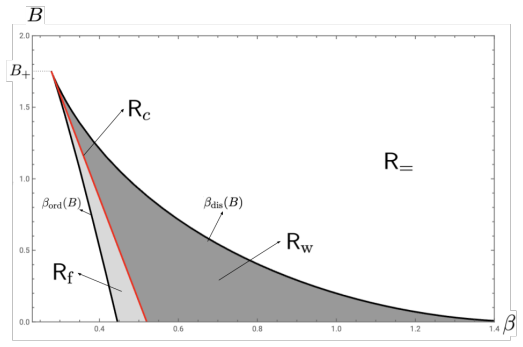
On the paper's own terms, the central discovery is Theorem 1.4: if G_n are uniform edge-expander graphs converging locally to the d-regular tree T_d, then for any (β,B) on the critical line R_c, any convergent subsequence of the Potts measures $μ_n^{{β,B}}$ converges locally weakly in probability to a single measure in the family M = {α $μ^{{f,β,B}}$ + (1−α) $μ^{{w,β,B}}$ : α ∈ [0,1]}. There are no limiting mixtures with more than two components, and no non-tree-like limit points. Theorem 1.6 sharpens this by showing the whole interval of mixture weights is realized: for every α ∈ [0,1] there exist uniform edge-expander graphs G_n with girth tending to infinity such that $μ_n^{{β,B}}$ converges locally weakly in probability to α $μ^{{f,β,B}}$ + (1−α) $μ^{{w,β,B}}$. The analogous statement for random cluster measures, Theorem 1.5, holds for every real q>2, not just integer q.
Load-bearing premise
The construction of all mixture weights in Theorem 1.6 rests on the two strict inequalities Δ_{d−1,f} > Δ_{d−1,w} and Δ_{d+1,f} < Δ_{d+1,w}; if either failed for some d and q, deleting or adding edges would push the free-to-wired ratio in the wrong direction and the proof would not realize arbitrary α.
Editorial extensions
If this is right
- On every uniform edge-expander graph sequence with G_n converging locally to T_d, the critical Potts measures have no exotic local limits: the only possible limits are free-wired mixtures, and convergence occurs in probability rather than only along subsequences.
- Strong phase coexistence is real for all d,q≥3: at criticality the disordered and ordered phases can coexist with any prescribed weight α and 1−α.
- The mixture weight is determined by the ratio of the free to wired partial Potts partition functions, which on random d-regular graphs is expressed through short-cycle counts.
- The same mixture description holds for random cluster measures with real cluster parameter q>2, so the result is not an artifact of integer spin states.
- These results cover the full parameter range d,q≥3, extending earlier treatments that required either zero field with very large q or even d.
Reading between the lines
- Editorial extension: the mechanism suggests a general principle that on expanders with locally tree-like geometry, whenever two Bethe-optimal fixed points coexist, the limiting Gibbs measure should be a mixture of the corresponding tree Gibbs measures; one could test this on other models with first-order transitions, such as the hard-core model at its uniqueness threshold.
- Editorial extension: because arbitrary α is obtained by deleting and adding O(1) edges per graph, the local weak limit is not determined by the local graph structure alone; global expansion plus sparse microscopic modifications control the mixture weight, which may matter for algorithms that estimate partition functions from local statistics.
- Editorial extension: the inequalities in Lemma 4.10 are the only numerical input deferred to the appendix; checking them by exact computation for small d and q would either confirm the tuning construction or reveal a new regime.
- Proposal: simulate the critical Potts measure on the modified random d-regular graphs constructed in the paper and measure the fraction of vertices whose local statistics match the ordered phase; it should converge to the chosen α.
Editorial analysis
A structured set of objections, weighed in public.
Referee Report
Summary. The manuscript studies the q-state ferromagnetic Potts model with external field and the associated random cluster model on expander graph sequences converging locally to the d-regular tree T_d. Its first main result (Theorems 1.4 and 1.5) claims that on the critical line every subsequential local weak limit is supported on a single mixture of the free and wired tree Gibbs measures, for all integers d,q at least 3 and for all real q>2 in the random cluster case. Its second main result (Theorem 1.6) claims that for every mixture weight alpha in [0,1] there exist locally T_d-like expander graphs whose critical Potts measures converge in probability to alpha times the free measure plus (1-alpha) times the wired measure. The proof strategy combines the Edwards-Sokal coupling, a rank-2 reduction to a zero-field Ising model, exponential deviation estimates on expanders, small-subgraph-conditioning asymptotics for random d-regular graphs, and a graph-modification procedure. The paper is clearly organized and contains substantial appendix calculations, but two load-bearing points in the written proofs are not currently justified.
Significance. If the gaps described below are repaired, the paper would resolve a question left open by BDS23 and HJP23 and would provide the first construction of arbitrary phase-coexistence mixtures on locally tree-like expander graphs. The manuscript makes non-black-box use of external results such as CvdH25, BDS23, GvVY16, MMS12, and KLS20, and the candidate free and wired measures come from independent characterizations; there is no indication of circular reasoning. The appendix contains detailed moment and small-subgraph-conditioning calculations, and the paper is honest about which estimates are imported. Strengths include the explicit description of the limit set, the explicit graph construction for arbitrary mixture weights, and the substantial technical apparatus. No machine-checked proofs or reproducible code are provided, and the numerical evidence in Section 4.1 is informal.
major comments (2)
- [Section 3.2, Lemma 3.11(iii)] The claimed contradiction with [MMS12, Theorem 2.5] does not follow from the inequalities written. The proof chooses beta-prime > beta with m(beta-prime) < m(beta)+delta/100 and derives, via psi^{w-prime}, an event of probability at least 1/2 - o(1) on which |<sigma,1>|/|V_n| is at least m(beta)+delta/40. But [MMS12] for beta-prime only gives |<sigma,1>|/|V_n| in (m(beta-prime)-delta/40, m(beta-prime)+delta/40) with probability 1-o(1). Since m(beta-prime) > m(beta), the threshold m(beta)+delta/40 is strictly less than the upper endpoint m(beta-prime)+delta/40, so the event is compatible with the concentration interval. Thus no contradiction is obtained. Consequently Lemma 3.11(iii) is unproved, and with it the upper-bound half of Proposition 3.8 and the exponential deviation estimate Proposition 3.7, on which both Theorems 1.4 and 1.5 rest. A different argument, for example a direct upper-deviation estimate at beta itself, is needed.
- [Section 4.3, proof of Theorem 1.6] The case split in the construction is internally inconsistent. The proof announces that it treats only the case star = w, which by definition means delta^w_k > delta^f_k for all large k. Immediately afterward it chooses K satisfying 1 < (1+delta^f_K)/(1+delta^w_K) < 1+n^{-1}, which requires delta^f_K > delta^w_K and is impossible when star = w. Moreover, for star = w both the factor (Delta_{d+1,f}/Delta_{d+1,w})^p and the cycle factor ((1+delta^f_K)/(1+delta^w_K))^x are below 1, so the construction cannot increase the prefactor to the target gamma as claimed. The argument as written can only work for star = f, in which case the modification should use Delta_{d-1} rather than Delta_{d+1}. The arbitrary-alpha conclusion of Theorem 1.6 is therefore not established by the present text.
minor comments (4)
- [Equation (17) and Proposition 3.4 display] In the display for phi^{w,B}_{G^*_n}[|C^*| approx psi |V_n|], the denominator should be Z^{RC,w,B}_{G^*_n}, not Z^{RC,w,B}_{G_n}; the notation in (28) is correct and should be used consistently.
- [Section 3.2, proof of Lemma 3.11(ii)] The expression 'm(delta) - delta/40' in the displayed inequality should be 'm(beta) - delta/40'; this is clearly a typo but it appears in a load-bearing argument.
- [Section 3.2, proof of Proposition 3.7] The phrase 'if eta is (beta, eta, R)-good' should read '(beta, delta, R)-good', matching the definition of good configurations in Proposition 3.8.
- [Appendix B.6, proof of Lemma 4.10] The inequality S^d < Q^d is asserted without proof in the chain S^d < Q^d < T/(C1+C2) < P^d < R^d; it follows from nu^f(1)<nu^w(1) and the monotonicity of the overlap denominators, but a one-line justification would help the reader.
Circularity Check
No significant circularity: the load-bearing inputs are external prior results and Theorem 1.6 is an explicit construction rather than a fitted prediction.
full rationale
I find no circular step that makes a claimed derivation equivalent to its inputs. The candidate limiting measures mu^{f,beta,B}, mu^{w,beta,B}, phi^{f,w,B}, phi^{w,w,B}, the critical line R_c, and the Bethe fixed points are imported from independent prior works [MMS12, BDS23, CvdH25, GvVY16, DMSS14, HJP23], none of which are authored by Du or Zhou. There is no self-citation chain that is load-bearing. The main characterization Theorems 1.4 and 1.5 rest on Proposition 3.2 and Proposition 3.7; the latter invokes [MMS12, Theorem 2.5] as an external, stated concentration theorem for the Ising model on expanders, and the rank-2 approximation invokes [CvdH25, Lemma 2.3] and [BBC23] as external results. These are used as assumptions, not as consequences of the present paper, so the derivation does not reduce to its own conclusion. Theorem 1.6 is a construction: the desired alpha is fixed in advance, and the proof chooses modified graphs with specified cycle counts (via Gamma, the delta_k^dagger, and Lemma 4.10) so that the ratio Z^f/Z^w tends to alpha/(1-alpha). The mixture weight is not fitted to the same data that is then 'predicted'; it is achieved by explicit graph modification. Lemma 4.10 and Appendix B.6 prove the needed inequalities from the Bethe fixed-point equations and the critical-line identity Delta_{d,f} = Delta_{d,w}, rather than assuming the conclusion. Even if some proof step, such as the contradiction in Lemma 3.11(iii), is questionable as a mathematical argument, that would concern correctness or rigor, not circularity. I therefore assign score 0.
Assumptions & free parameters
assumptions (5)
- domain assumption Bethe prediction and rank-2 approximation for random cluster partition functions on locally T_d-like graphs, in particular Z_RC >= tilde Z_RC from CvdH25 Lemma 2.3.
- domain assumption Weak limit classification and monotonicity of random cluster measures with boundary conditions from BDS23.
- domain assumption Concentration of magnetization for zero-field Ising models on locally tree-like expander graphs, MMS12 Theorem 2.5.
- domain assumption First and second moment saddle-point formulas for Potts partition functions on random d-regular graphs from GvVY16 equations (74) and (75).
- standard math Small subgraph conditioning theorem of Jan95 and Wormald, together with Poisson convergence of cycle counts in random regular graphs from Bollobas.
Cite this review
Pith. "Pith review of Characterizing the limiting critical Potts measures on locally regular-tree-like expander graphs." pith.science (2026). https://pith.science/paper/N3NGQGN7
@misc{pith2026250524283,
  author       = {Pith},
  title        = {Pith review of: Characterizing the limiting critical Potts measures on locally regular-tree-like expander graphs},
  year         = {2026},
  howpublished = {\url{https://pith.science/paper/N3NGQGN7}},
  note         = {Machine review of arXiv:2505.24283}
}
abstract
For any integers $d,q\ge 3$, we consider the $q$-state ferromagnetic Potts model with an external field on a sequence of expander graphs that converges to the $d$-regular tree $\mathtt{T}_d$ in the Benjamini-Schramm sense. We show that along the critical line, any subsequential local weak limit of the Potts measures is a mixture of the free and wired Potts Gibbs measures on $\mathtt{T}_d$. Furthermore, we show the possibility of an arbitrary extent of strong phase coexistence: for any $\alpha\in [0,1]$, there exists a sequence of locally $\mathtt{T}_d$-like expander graphs $\{G_n\}$, such that the Potts measures on $\{G_n\}$ locally weakly converges to the $(\alpha,1-\alpha)$-mixture of the free and wired Potts Gibbs measures. Our result extends results of \cite{HJP23} which restrict to the zero-field case and also require $q$ to be sufficiently large relative to $d$, and results of \cite{BDS23} which restrict to the even $d$ case. We also confirm the phase coexistence prediction of \cite{BDS23}, asserting that the Potts local weak limit is a genuine mixture of the free and wired states in a generic setting. We further characterize the subsequential local weak limits of random cluster measures on such graph sequences, for any cluster parameter $q>2$ (not necessarily integer).
Figures
Reference graph
Works this paper leans on
-
[1]
Ragi Abou-Chacra, David J. Thouless, and Phlip W. Anderson. A selfconsistent theory of localization. Journal of Physics C: Solid State Physics , 6(10):1734, 1973
work page 1973
-
[2]
Random cluster model on regular graphs
Ferenc Bencs, M \'a rton Borb \'e nyi, and P \'e ter Csikv \'a ri. Random cluster model on regular graphs. Communications in Mathematical Physics , 399:203--248, 2023
work page 2023
-
[3]
Ferromagnetic Ising measures on large locally tree-like graphs
Anirban Basak and Amir Dembo. Ferromagnetic Ising measures on large locally tree-like graphs. Annals of Probability , 45(2):1111--1151, 2017
work page 2017
-
[4]
Potts and random cluster measures on locally regular-tree-like graphs
Anirban Basak, Amir Dembo, and Allan Sly. Potts and random cluster measures on locally regular-tree-like graphs. Preprint, arXiv:2312.16008 , 2023
work page Pith review arXiv 2023
-
[5]
A probabilistic proof of an asymptotic formula for the number of labelled regular graphs
B \'e la Bollob \'a s. A probabilistic proof of an asymptotic formula for the number of labelled regular graphs. European Journal of Combinatorics , 1(4):311--316, 1980
work page 1980
-
[6]
Critical behavior of the annealed Ising model on random regular graphs
Van Hao Can. Critical behavior of the annealed Ising model on random regular graphs. Journal of Statistical Physics , 168(2):331--347, 2017
work page 2017
-
[7]
Annealed limit theorems for the Ising model on random regular graphs
Van Hao Can. Annealed limit theorems for the Ising model on random regular graphs. Annals of Applied Probability , 29(3):1398--1445, 2019
work page 2019
-
[8]
Bootstrap percolation on a bethe lattice
John Chalupa, Paul L Leath, and Gary R Reich. Bootstrap percolation on a bethe lattice. Journal of Physics C: Solid State Physics , 12(1):L31, 1979
work page 1979
Show all 34 references
-
[9]
Metastability of the Potts ferromagnet on random regular graphs
Amin Coja-Oghlan, Andreas Galanis, Leslie Ann Goldberg, Jean Bernoulli Ravelomanana, Daniel S tefankovi c , and Eric Vigoda. Metastability of the Potts ferromagnet on random regular graphs. Communications in Mathematical Physics , 401(1):185--225, 2023
2023
-
[10]
Random cluster models on random graphs
Van Hao Can and Remco van der Hofstad. Random cluster models on random graphs. arXiv preprint, arXiv:2503.17636 , 2025
2025 arXiv
-
[11]
Lectures on the Ising and Potts models on the hypercubic lattice
Hugo Duminil-Copin. Lectures on the Ising and Potts models on the hypercubic lattice. In PIMS-CRM Summer School in Probability , pages 35--161. Springer, 2017
2017
-
[12]
Ising critical exponents on random trees and graphs
Sander Dommers, Cristian Giardin\`a, and Remco van der Hofstad. Ising critical exponents on random trees and graphs. Communications in Mathematical Physics , 328(1):355--395, 2014
2014
-
[13]
Gibbs measures and phase transitions on sparse random graphs
Amir Dembo and Andrea Montanari. Gibbs measures and phase transitions on sparse random graphs. Brazilian Journal of Probability and Statistics , 24(2):137--211, 2010
2010
-
[14]
Ising models on locally tree-like graphs
Amir Dembo and Andrea Montanari. Ising models on locally tree-like graphs. The Annals of Applied Probability , 20(2):565--592, 2010
2010
-
[15]
Factor models on locally tree-like graphs
Amir Dembo, Andrea Montanari, and Nike Sun. Factor models on locally tree-like graphs. Annals of Probability , 41(6):4162--4213, 2013
2013
-
[16]
The replica symmetric solution for Potts models on d-regular graphs
Amir Dembo, Andrea Montanari, Allan Sly, and Nike Sun. The replica symmetric solution for Potts models on d-regular graphs. Communications in Mathematical Physics , 327(2):551--575, 2014
2014
-
[17]
A Proof of Alon's Second Eigenvalue Conjecture and Related Problems , volume 195 of Memoirs of the American Mathematical Society
Joel Friedman. A Proof of Alon's Second Eigenvalue Conjecture and Related Problems , volume 195 of Memoirs of the American Mathematical Society . American Mathematical Society, 2008
2008
-
[18]
Annealed Potts models on rank-1 inhomogeneous random graphs
Cristian Giardin\`a, Claudio Giberti, Remco van der Hofstad, Guido Janssen, and Neeladri Maitra. Annealed Potts models on rank-1 inhomogeneous random graphs. arXiv preprint, arXiv:2502.10553 , 2025
2025 arXiv
-
[19]
Grimmett
Geoffrey R. Grimmett. The Random-Cluster Model , volume 333 of Grundlehren der mathematischen Wissenschaften . Springer, Berlin, 2006
2006
-
[20]
Rapid phase ordering for Ising and Potts dynamics on random regular graphs
Reza Gheissari, Allan Sly, and Youngtak Sohn. Rapid phase ordering for Ising and Potts dynamics on random regular graphs. arXiv preprint, arXiv:2505.15783 , 2025
2025 arXiv
-
[21]
Ferromagnetic Potts model: Refined \#bis-hardness and related results
Andreas Galanis, Daniel S tefankovi c , Eric Vigoda, and Linji Yang. Ferromagnetic Potts model: Refined \#bis-hardness and related results. SIAM Journal on Computing , 45(6):2004--2065, 2016
2004
-
[22]
Finite-size scaling, phase coexistence, and algorithms for the random cluster model on random graphs
Tyler Helmuth, Matthew Jenssen, and Will Perkins. Finite-size scaling, phase coexistence, and algorithms for the random cluster model on random graphs. Annales de l'Institut Henri Poincare (B) Probabilites et statistiques , 59(2):817--848, 2023
2023
-
[23]
Random regular graphs: asymptotic distributions and contiguity
Svante Janson. Random regular graphs: asymptotic distributions and contiguity. Combinatorics, Probability and Computing , 4(4):369--405, 1995
1995
-
[24]
Random graphs
Svante Janson, Tomasz Luczak, and Andrzej Rucinski. Random graphs . John Wiley & Sons, 2011
2011
-
[25]
Asymptotics in percolation on high-girth expanders
Michael Krivelevich, Eyal Lubetzky, and Benny Sudakov. Asymptotics in percolation on high-girth expanders. Random Structures & Algorithms , 56(4):927--947, 2020
2020
-
[26]
Ross A. Maller. A local limit theorem for independent random variables. Stochastic Processes and their Applications , 7(1):101--111, 1978
1978
-
[27]
Information, Physics, and Computation
Marc M \'e zard and Andrea Montanari. Information, Physics, and Computation . Oxford Graduate Texts. Oxford University Press, 2009
2009
-
[28]
The weak limit of Ising models on locally tree-like graphs
Andrea Montanari, Elchanan Mossel, and Allan Sly. The weak limit of Ising models on locally tree-like graphs. Probability Theory and Related Fields , 152(1--2):31--51, 2012
2012
-
[29]
Typical sofic entropy and local limits for free group shift systems
Christopher Shriver. Typical sofic entropy and local limits for free group shift systems. arXiv preprint, arXiv:2308.08041 , 2023
2023 arXiv
-
[30]
Computational transition at the uniqueness threshold
Allan Sly. Computational transition at the uniqueness threshold. In Proceedings of the 51st Annual IEEE Symposium on Foundations of Computer Science (FOCS) , pages 287--296. IEEE, 2010
2010
-
[31]
Counting in two-spin models on d-regular graphs
Allan Sly and Nike Sun. Counting in two-spin models on d-regular graphs. Annals of Probability , 42(6):2383--2416, 2014
2014
-
[32]
Spin-glass on a Bethe lattice
DJ Thouless. Spin-glass on a Bethe lattice. Physical review letters , 56(10):1082, 1986
1986
-
[33]
Models of random regular graphs
Nicholas C Wormald et al. Models of random regular graphs. London mathematical society lecture note series , pages 239--298, 1999
1999
-
[34]
Ising model on locally tree-like graphs: Uniqueness of solutions to cavity equations
Qian Yu and Yury Polyanskiy. Ising model on locally tree-like graphs: Uniqueness of solutions to cavity equations. IEEE Transactions on Information Theory , 70(3):1913--1938, 2024
1913
Reviewed August 7, 2026 · model on record in the stance chip above.
Discussion (0). Sign in to comment.