REVIEW 4 major objections 5 minor 38 references
A Perception-Based L2 Speech Intelligibility Indicator: Leveraging a Rater's Shadowing and Sequence-to-sequence Voice Conversion
T0 review · 4 major / 5 minor · reviewed 2026-08-07 · deepseek-v4-flash
Pith's one-line read The paper claims that a multi-task sequence-to-sequence voice-conversion model, trained on a native rater's shadowing of L2 speech, identifies unintelligible segments more closely matching that rater's judgment than an ASR-based metric…
desk verdict Clever idea, thin evidence: the multi-task VC model beats ASR on only one of three human rater groups, and the gain is 2.7 points of precision with no significance test. read the letter →
The pith
A machine-rendered reading of the paper's core claim, the machinery that carries it, and where it could break.
The reading
What carries the argument
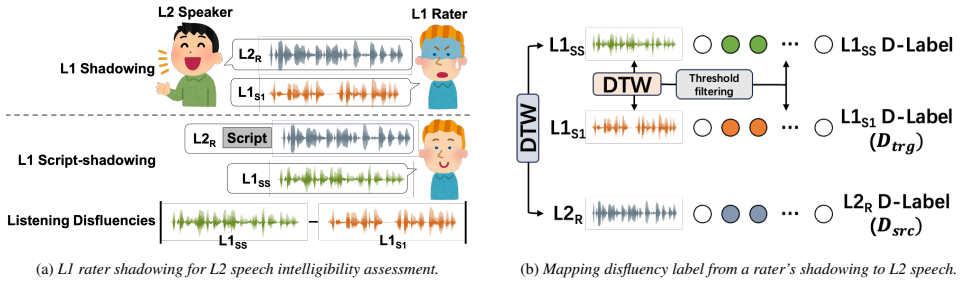
The central machinery is the two-stage reverse shadowing label and its embedding into a sequence-to-sequence voice converter. First, dynamic time warping between the rater's unscripted shadowing and script-shadowing yields a frame-level disfluency label via edit-distance thresholding, and a second alignment maps that label onto the learner's reading. The model then treats the learner's speech as source and the rater's shadowing as target, using a monotonic-alignment-search-based voice converter with a length regulator, and adds two 5-layer CNN disfluency-label predictors, one after the encoder and one after the decoder, with focal loss. An inverse length regulation projects the predicted disfluency labels back to the source side, so the model learns to point at the learner-side frames that caused the rater's breakdown.
What would settle it
Re-run the subjective annotation experiment with several native English raters who were not involved in generating the shadowing labels, and compare mean precision; the central claim fails if the multi-task model's mean precision does not exceed the ASR baseline's, since the paper's reported advantage rests on a single native rater (EN-A).
Extended reading notes
Core claim
On the paper's own terms, the discovery is that a perception-based intelligibility indicator can be encoded as a voice-conversion task: the model is asked to convert L2 read speech into the native rater's first shadowing, and the mismatches and disfluencies the model must handle reveal where comprehension breaks down. The full multi-task model, trained with both reconstruction losses and two CNN-based disfluency predictors driven by focal loss, reaches a word-level F1 of 30.3 against 28.0 for an ASR-based mispronunciation baseline on the same test set. In subjective evaluation with manual annotations, it reaches precision 43.2 against the native rater EN-A, above the ASR baseline's 40.5; against the non-native annotator groups EN-J and EN-O the ASR baseline scores higher. The paper interprets this as evidence that the method captures the specific native rater's auditory perception better than ASR does, while remaining less aligned with how other listeners perceive the same utterances.
Load-bearing premise
The argument rests on the assumption that the two-stage shadowing pipeline with dynamic time warping produces accurate frame-level disfluency labels on the learners' recordings; those DTW-derived labels are used both as training targets for the proposed model and as the ground-truth reference in part of the evaluation, yet the pipeline itself achieves only 45.9 precision against the native rater's manual annotations.
Editorial extensions
If this is right
- If the method is right, CALL systems can point learners to the specific words or frames a listener is likely to miss, instead of giving only a holistic score.
- If the method is right, feedback can be tied to a particular rater's perceptual profile, because the model trained on one rater's shadowing aligns better with that rater's annotations.
- If the method is right, the technique could generalize to other languages and accents, since voice conversion and shadowing do not require pronunciation-error lexicons or expert phonetic annotation.
- If the method is right, the sequence-to-sequence framework gives a single model that both reconstructs the rater's shadowing and emits disfluency labels, combining perceptual simulation with interpretable localization.
Reading between the lines
- A testable extension the paper leaves implicit is whether training on multiple raters' shadowings would produce a consensus intelligibility map that outperforms ASR for all listener groups, not only for the shadowing rater.
- The rater-specific nature of the result suggests a CALL deployment could let learners choose the listener profile they want to be understood by, such as a native or another non-native speaker, and receive feedback optimized for that audience.
- The alignment-failure variant underperforms on precision, which suggests a broader design principle: letting the alignment module fail and reading off the failures is less effective than explicitly supervising disfluency detection through auxiliary losses.
- One consequence worth testing is whether the 45.9 precision of the DTW-derived label itself is close to human inter-rater agreement; if it is, the label-generation step may already be near the practical ceiling for this task.
Editorial analysis
A structured set of objections, weighed in public.
Referee Report
Summary. The paper proposes a perception-based L2 speech intelligibility indicator that uses a native rater's shadowing data within a sequence-to-sequence voice conversion framework. A two-stage reverse-shadowing procedure (Sec. 2.1) generates frame-wise disfluency labels by DTW alignment, and these labels are used both as training targets for a multi-task seq2seq VC model (Sec. 3.2) and as a comparison point in the subjective evaluation. Two methods are presented: an alignment-failure-based method (Sec. 3.1) and a multi-task learning method with disfluency label predictors. Evaluations include word-level F1 against automatic D-labels (Table 1) and precision against manual annotations from three rater groups (Table 2). The central claim is that the proposed approach aligns more closely with native judgments than traditional ASR-based metrics.
Significance. The idea of leveraging a rater's shadowing and a seq2seq VC model to predict perception-based unintelligibility is creative and potentially useful for CALL systems, moving beyond native-likeness measures. The paper provides an ablation study, multiple rater groups, and a public demo, which are strengths. However, the current evidence is insufficient: the only human-judgment comparison that favors the proposed method is precision on a single native rater, with no recall, F1, or significance testing, and the method underperforms the ASR baseline on the other two rater groups. If the evaluation were strengthened, this could be a valuable contribution, but as it stands the central claim is not yet supported.
major comments (4)
- [Sec. 5.2, Table 2] The subjective evaluation reports only precision. A method can achieve high precision by predicting very few segments, so precision alone is insufficient to support the claim of closer alignment with native judgments. Please report recall and F1 for each method and rater, together with confidence intervals or significance tests. The current numbers show that the multi-task model is worse than the ASR baseline on EN-J (28.1 vs 32.8) and EN-O (31.7 vs 37.6), so the claimed advantage is at best rater-dependent and not statistically demonstrated.
- [Sec. 5.2, Table 2] The row labeled "Ground Truth" is not a human ground truth but the 2-stage shadowing + DTW pipeline described in Sec. 2.1, which is the same procedure used to generate the D-labels that train the multi-task model (Eq. 10). The multi-task model's precision on EN-A (43.2) is close to the precision of its own training-label generator (45.9), and EN-A is the rater whose shadowing produced those training labels. Consequently, the EN-A comparison does not independently validate perception alignment; the EN-J and EN-O results, which come from raters not involved in label generation, show the multi-task model underperforming the ASR baseline. This undermines the abstract's general claim that the method aligns more closely with native judgments.
- [Sec. 5.2] The precision computation lacks a defined matching criterion between predicted and manually annotated unintelligible segments. Without specifying the overlap rule (e.g., frame-level intersection-over-union, word-level match with tolerance, or a required temporal overlap), the reported precision values are not reproducible and the comparison across methods is not well defined. Please provide the exact matching procedure used to compute the precision scores in Table 2.
- [Sec. 5.1, Table 1] The objective evaluation uses D-labels as ground truth, which are generated by the same Sec. 2.1 procedure that provides the training targets for the multi-task model. This evaluation therefore measures agreement with the automatic labeling procedure rather than with human perception, and the 30.3 vs 28.0 word-level F1 difference is not tested for significance. The central claim should be based on the perception-based evaluation, or the objective result should be framed only as a proxy agreement with the automatic labeler.
minor comments (5)
- [Sec. 3.1, Eq. (3)] The threshold tau in Eq. (3) is never specified, and no sensitivity analysis is provided. Please report the chosen value and, ideally, show how the alignment-based method's performance varies with tau.
- [Sec. 3.2, Eq. (10)] The loss weight lambda is set to 10 without any ablation. A brief study of lambda would strengthen the multi-task learning results.
- [Sec. 4.2] The feature selection (HuBERT 9th layer for source, PPG-BNF for target) is justified only by the statement that alignment did not converge with HuBERT on both sides. Please give more detail or a quantitative comparison to support this choice.
- [Abstract and Conclusion] The phrase "global, multilingual contexts" overstates the experimental scope, which covers only Japanese learners of English and a small set of raters. Consider tempering this claim.
- [Throughout] There are minor typographical issues: "Session" should be "Section" in Sec. 5.1 and Sec. 5.2, and the phrase "detailed in Session 3.2" should be corrected.
Circularity Check
No significant circularity: the subjective evaluation uses independent manual annotations, and the objective evaluation is a standard held-out supervised evaluation.
full rationale
The paper's derivation is not circular by construction. The multi-task model is trained with a loss (Eq. 10) that includes D-label prediction terms, where the D-labels come from the two-stage shadowing + DTW procedure of Sec. 2.1. The objective evaluation (Table 1) measures word-level F1 against held-out D-labels; this is a normal supervised evaluation of the model's ability to reproduce the annotation procedure, not a prediction forced by fitting the same data points. The central claim of alignment with native judgments is tested in the subjective evaluation (Sec. 5.2, Table 2) against manual annotations collected four years after the shadowing experiment, from the same rater and from other listeners; these manual annotations are independent of the training targets, so the comparison does not reduce to the model's own training signal. Although Table 2 labels the DTW pipeline row as 'Ground Truth,' the caption states the comparison is to manual annotation, and that row is a method being evaluated, not the reference standard. The self-citations [7-9] that introduce the shadowing pipeline are to prior published work by overlapping authors, but the current paper independently checks that pipeline against manual annotation (Table 2, '2-Stage Shadowing + DTW' precision 45.9 against EN-A), so the premise is not an unverified self-citation. No equation is defined in terms of the quantity it purports to predict, and no fitted parameter is renamed as a prediction.
Assumptions & free parameters
free parameters (3)
- threshold tau
- loss weight lambda =
10
- source and target feature choices =
HuBERT layer 9 and PPG-BNF
assumptions (3)
- domain assumption The two-stage reverse shadowing pipeline with DTW produces valid frame-wise unintelligibility labels on L2R.
- domain assumption Alignment failures in a seq2seq VC model trained on semi-parallel shadowing data correspond to perception breakdowns in the native rater.
- domain assumption The selected self-supervised features (HuBERT layer 9 for source, PPG-BNF for target) preserve enough phonetic and disfluency information for meaningful alignment and prediction.
Cite this review
Pith. "Pith review of A Perception-Based L2 Speech Intelligibility Indicator: Leveraging a Rater's Shadowing and Sequence-to-sequence Voice Conversion." pith.science (2026). https://pith.science/paper/Z3H7OL2C
@misc{pith2026250524304,
  author       = {Pith},
  title        = {Pith review of: A Perception-Based L2 Speech Intelligibility Indicator: Leveraging a Rater's Shadowing and Sequence-to-sequence Voice Conversion},
  year         = {2026},
  howpublished = {\url{https://pith.science/paper/Z3H7OL2C}},
  note         = {Machine review of arXiv:2505.24304}
}
read the original abstract
Evaluating L2 speech intelligibility is crucial for effective computer-assisted language learning (CALL). Conventional ASR-based methods often focus on native-likeness, which may fail to capture the actual intelligibility perceived by human listeners. In contrast, our work introduces a novel, perception based L2 speech intelligibility indicator that leverages a native rater's shadowing data within a sequence-to-sequence (seq2seq) voice conversion framework. By integrating an alignment mechanism and acoustic feature reconstruction, our approach simulates the auditory perception of native listeners, identifying segments in L2 speech that are likely to cause comprehension difficulties. Both objective and subjective evaluations indicate that our method aligns more closely with native judgments than traditional ASR-based metrics, offering a promising new direction for CALL systems in a global, multilingual contexts.
Figures


Reference graph
Works this paper leans on
-
[1]
Introduction Non-native speakers are often encouraged to emulate native-like pronunciation; however, achieving a native-like accent can be time-consuming and may not efficiently improve speech intel- ligibility. Many studies indicate that mispronunciations or ac- cents do not necessarily result in unintelligible speech. For ex- ample, [1] found that only ...
-
[2]
We propose a customized speech unintelligibility indicator that leverages native rater’s shadowing data. Unlike conven- tional methods that focus solely on native-like pronunciation, our approach aims to capture the perceptual cues that native listeners actually use to assess intelligibility1
-
[3]
Our method incorporates a state-of-the-art sequence-to- sequence (seq2seq) voice conversion framework, utilizing its alignment mechanism and acoustic feature reconstruction module to simulate the cognitive process of native listeners in identifying unintelligible segments
-
[4]
We introduce a multi-task learning strategy that jointly op- timizes speech reconstruction and disfluency detection using auxiliary loss functions. Experimental evaluations demon- strate that our approach aligns more closely with native raters’ perceptions than mainstream ASR, revealing the po- tential for delivering personalized feedback in CALL sys- tems
-
[5]
Research background 2.1. L1 rater’s shadowing Assessing L2 speech intelligibility requires fine-grained anno- tation, yet this process is challenging due to the need for expert- level phonetic knowledge for phoneme-level labeling. To ad- dress this challenge, [7] proposed a two-stage reverse shad- owing approach to identify unintelligible segments in L2 u...
work page Pith review arXiv 2025
-
[6]
Proposed Methods In this section, we present two approaches for evaluating L2 speech intelligibility based on seq2seq VC. The first approach leverages alignment failure to mimic rater perception break- downs, thereby identifying segments of unintelligibility. The second approach employs a multi-task learning strategy in a Seq2Seq VC model, where additiona...
-
[7]
Dataset We utilized the shadowing dataset described in [8, 9]
Experimental Settings 4.1. Dataset We utilized the shadowing dataset described in [8, 9]. Reading- aloud utterances were collected from 225 Japanese learners of English (L2R) with varying degrees of Japanese accents. An American male English speaker (EN-A) then shadowed and script-shadowed these recordings, producing L1S1 and L1SS , respectively. In total...
-
[8]
Objective evaluation We present our objective evaluation results in Table 1
Experimental Evaluation 5.1. Objective evaluation We present our objective evaluation results in Table 1. Both frame-level and word-level metrics are considered, with the word-level evaluation computed as an F1-score based on the positional detection of unintelligible words in L2R. The con- ventional approach—relying on an ASR system trained on lib- rispe...
Show all 38 references
-
[9]
Conclusions and Future Work In this study, we present a perception-based L2 speech intelligi- bility indicator that leverages native rater shadowing data within a sequence-to-sequence voice conversion framework. Our ex- periments show that this approach provides effective feed...
-
[10]
Pronunciation accuracy and intelligibil- ity of non-native speech,
A. Loukina, M. Lopez, K. Evanini, D. Suendermann-Oeft, A. V . Ivanov, and K. Zechner, “Pronunciation accuracy and intelligibil- ity of non-native speech,” in Proc. Interspeech 2015 , 2015, pp. 1917–1921
2015
-
[11]
Evaluating openai’s whisper asr: Perfor- mance analysis across diverse accents and speaker traits,
C. Graham and N. Roll, “Evaluating openai’s whisper asr: Perfor- mance analysis across diverse accents and speaker traits,” JASA Express Letters, vol. 4, no. 2, 2024
2024
-
[12]
The most spoken languages in the world,
Ethnologue, “The most spoken languages in the world,” https: //www.ethnologue.com/insights/most-spoken-language/, 2023
2023
-
[13]
Accent, intelligibility, and com- prehensibility: Evidence from four l1s,
T. M. Derwing and M. J. Munro, “Accent, intelligibility, and com- prehensibility: Evidence from four l1s,” Studies in Second Lan- guage Acquisition, vol. 19, no. 1, p. 1–16, 1997
1997
-
[14]
Foreign accent, comprehensi- bility, and intelligibility in the speech of second language learn- ers,
M. J. Munro and T. M. Derwing, “Foreign accent, comprehensi- bility, and intelligibility in the speech of second language learn- ers,” Language learning, vol. 45, no. 1, pp. 73–97, 1995
1995
-
[15]
A Study of Objective Measurement of Com- prehensibility through Native Speakers’ Shadowing of Learners’ Utterances,
Y . Inoue, S. Kabashima, D. Saito, N. Minematsu, K. Kanamura, and Y . Yamauchi, “A Study of Objective Measurement of Com- prehensibility through Native Speakers’ Shadowing of Learners’ Utterances,” in Proc. Interspeech, 2018, pp. 1651–1655
2018
-
[16]
Shadowability annotation with fine granularity on l2 utterances and its improvement with native listeners’ script-shadowing
Z. Lin, R. Takashima, D. Saito, N. Minematsu, and N. Nakanishi, “Shadowability annotation with fine granularity on l2 utterances and its improvement with native listeners’ script-shadowing.” in Proc. Interspeech, 2020, pp. 3865–3869
2020
-
[17]
Multi-granularity annotation of instantaneous intelligibility of learners’ utterances based on shadowing tech- niques,
C. Zhu, R. Hakoda, D. Saito, N. Minematsu, N. Nakanishi, and T. Nishimura, “Multi-granularity annotation of instantaneous intelligibility of learners’ utterances based on shadowing tech- niques,” in Proc. ASRU, 2021, pp. 1071–1078
2021
-
[18]
Automatic Scoring of Shadowing Speech Based on DNN Posteriors and Their DTW,
J. Yue, F. Shiozawa, S. Toyama, Y . Yamauchi, K. Ito, D. Saito, and N. Minematsu, “Automatic Scoring of Shadowing Speech Based on DNN Posteriors and Their DTW,” in Proc. Interspeech, 2017, pp. 1422–1426
2017
-
[19]
V oice Transformer Network: Sequence-to-Sequence V oice Con- version Using Transformer with Text-to-Speech Pretraining,
W.-C. Huang, T. Hayashi, Y .-C. Wu, H. Kameoka, and T. Toda, “V oice Transformer Network: Sequence-to-Sequence V oice Con- version Using Transformer with Text-to-Speech Pretraining,” in Proc. Interspeech, 2020, pp. 4676–4680
2020
-
[20]
Non- autoregressive sequence-to-sequence voice conversion,
T. Hayashi, W.-C. Huang, K. Kobayashi, and T. Toda, “Non- autoregressive sequence-to-sequence voice conversion,” in Proc. ICASSP, 2021, pp. 7068–7072
2021
-
[21]
E2e-s2s-vc: End-to-end sequence-to-sequence voice conversion,
T. Okamoto, T. Toda, and H. Kawai, “E2e-s2s-vc: End-to-end sequence-to-sequence voice conversion,” in Proc. Interspeech , 2023, pp. 2043–2047
2023
-
[22]
Aas-vc: On the generalization ability of automatic alignment search based non- autoregressive sequence-to-sequence voice conversion,
W.-C. Huang, K. Kobayashi, and T. Toda, “Aas-vc: On the generalization ability of automatic alignment search based non- autoregressive sequence-to-sequence voice conversion,” arXiv preprint arXiv:2309.07598, 2023
2023 arXiv
-
[23]
wav2vec 2.0: a framework for self-supervised learning of speech representa- tions,
A. Baevski, H. Zhou, A. Mohamed, and M. Auli, “wav2vec 2.0: a framework for self-supervised learning of speech representa- tions,” in Proc. NeurIPS, 2020
2020
-
[24]
Hubert: Self-supervised speech represen- tation learning by masked prediction of hidden units,
W.-N. Hsu, B. Bolte, Y .-H. H. Tsai, K. Lakhotia, R. Salakhutdi- nov, and A. Mohamed, “Hubert: Self-supervised speech represen- tation learning by masked prediction of hidden units,”IEEE/ACM TASLP, vol. 29, pp. 3451–3460, 2021
2021
-
[25]
Wavlm: Large-scale self- supervised pre-training for full stack speech processing,
S. Chen, C. Wang, Z. Chen, Y . Wu, S. Liu, Z. Chen, J. Li, N. Kanda, T. Yoshioka, X. Xiaoet al., “Wavlm: Large-scale self- supervised pre-training for full stack speech processing,” IEEE JSTSP, vol. 16, no. 6, pp. 1505–1518, 2022
2022
-
[26]
A large-scale evaluation of speech foundation models,
S.-w. Yang, H.-J. Chang, Z. Huang, A. T. Liu, C.-I. Lai, H. Wu, J. Shi, X. Chang, H.-S. Tsai, W.-C. Huang, T.-h. Feng, P.-H. Chi, Y . Y . Lin, Y .-S. Chuang, T.-H. Huang, W.-C. Tseng, K. Lakho- tia, S.-W. Li, A. Mohamed, S. Watanabe, and H.-y. Lee, “A large-scale evaluation of...
2024
-
[27]
Pretraining and adaptation techniques for electrolaryngeal speech recognition,
L. P. Violeta, D. Ma, W.-C. Huang, and T. Toda, “Pretraining and adaptation techniques for electrolaryngeal speech recognition,” IEEE/ACM TASLP, vol. 32, pp. 2777–2789, 2024
2024
-
[28]
Electrolaryngeal speech intelligibility enhancement through robust linguistic encoders,
L. P. Violeta, W.-C. Huang, D. Ma, R. Yamamoto, K. Kobayashi, and T. Toda, “Electrolaryngeal speech intelligibility enhancement through robust linguistic encoders,” in Proc. ICASSP, 2024, pp. 10 961–10 965
2024
-
[29]
A pilot study of applying sequence-to-sequence voice conversion to evaluate the intelligi- bility of l2 speech using a native speaker’s shadowings,
H. Geng, D. Saito, and N. Minematsu, “A pilot study of applying sequence-to-sequence voice conversion to evaluate the intelligi- bility of l2 speech using a native speaker’s shadowings,” in Proc. APSIPA ASC, 2024, pp. 1–6
2024
-
[30]
Rad-tts: Parallel flow-based TTS with robust alignment learning and diverse synthesis,
K. J. Shih, R. Valle, R. Badlani, A. Lancucki, W. Ping, and B. Catanzaro, “Rad-tts: Parallel flow-based TTS with robust alignment learning and diverse synthesis,” in Proc. ICML, 2021
2021
-
[31]
One tts alignment to rule them all,
R. Badlani, A. Ła ´ncucki, K. J. Shih, R. Valle, W. Ping, and B. Catanzaro, “One tts alignment to rule them all,” in ICASSP 2022, 2022, pp. 6092–6096
2022
-
[32]
Focal loss for dense object detection,
T.-Y . Lin, P. Goyal, R. Girshick, K. He, and P. Doll´ar, “Focal loss for dense object detection,” in 2017 ICCV, 2017, pp. 2999–3007
2017
-
[33]
Any-to-many voice conversion with location-relative sequence- to-sequence modeling,
S. Liu, Y . Cao, D. Wang, X. Wu, X. Liu, and H. Meng, “Any-to-many voice conversion with location-relative sequence- to-sequence modeling,” IEEE/ACM TASLP, vol. 29, pp. 1717– 1728, 2021
2021
-
[34]
Lib- rispeech: An asr corpus based on public domain audio books,
V . Panayotov, G. Chen, D. Povey, and S. Khudanpur, “Lib- rispeech: An asr corpus based on public domain audio books,” in 2015 ICASSP, 2015, pp. 5206–5210
2015
-
[35]
Exploring impact of pausing and lexical stress patterns on l2 english com- prehensibility in real time,
S. Coulange, T. Kato, S. Rossato, and M. Masperi, “Exploring impact of pausing and lexical stress patterns on l2 english com- prehensibility in real time,” in Proc. Interspeech 2024, 2024, pp. 1030–1034
2024
-
[36]
Utmos: Utokyo-sarulab system for voicemos challenge 2022,
T. Saeki, D. Xin, W. Nakata, T. Koriyama, S. Takamichi, and H. Saruwatari, “Utmos: Utokyo-sarulab system for voicemos challenge 2022,” Proc. Interspeech, pp. 4521–4525, 2022
2022
-
[37]
The voicemos challenge 2024: Beyond speech quality prediction,
W.-C. Huang, S.-W. Fu, E. Cooper, R. E. Zezario, T. Toda, H.- M. Wang, J. Yamagishi, and Y . Tsao, “The voicemos challenge 2024: Beyond speech quality prediction,” in SLT 2024, 2024, pp. 803–810
2024
-
[38]
Versa: A versatile evaluation toolkit for speech, audio, and music,
J. Shi, H.-j. Shim, J. Tian, S. Arora, H. Wu, D. Petermann, J. Q. Yip, Y . Zhang, Y . Tang, W. Zhang et al. , “Versa: A versatile evaluation toolkit for speech, audio, and music,” arXiv preprint arXiv:2412.17667, 2024
2024 arXiv
Reviewed August 7, 2026 · model on record in the stance chip above.
Discussion (0). Sign in to comment.