REVIEW 5 major objections 5 minor 9 references
Supporting Long-term Transactions in Smart Contracts Generated from Business Process Model and Notation (BPMN) Models
T0 review · 5 major / 5 minor · reviewed 2026-08-07 · deepseek-v4-flash
Pith's one-line read This thesis claims BPMN business-process diagrams can be transformed automatically into blockchain smart contracts whose transaction mechanism enforces ACID, access control, and privacy for long-term, possibly nested, trade transactions.
desk verdict A consolidated restatement of the TABS/TABS+ pipeline with a real proof-of-concept, but the inclusive-converging-gateway simplification silently breaks the process semantics that the transactional ACID promise depends on. read the letter →
The pith
A machine-rendered reading of the paper's core claim, the machinery that carries it, and where it could break.
The reading
What carries the argument
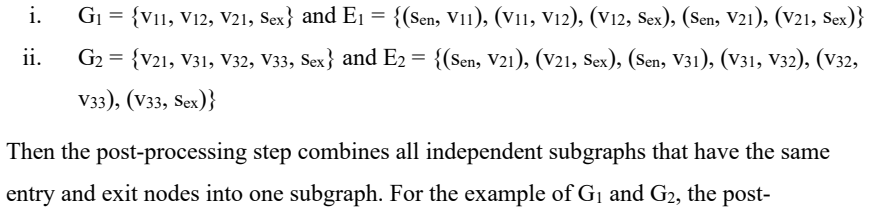
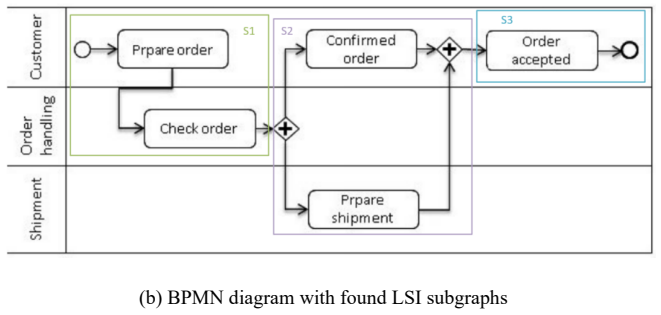
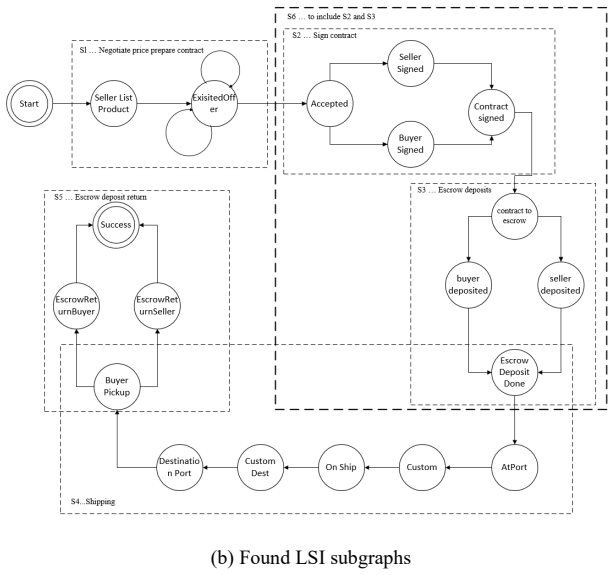
The carrying object is the DE-HSM multi-modal model: a hierarchical state machine combined with discrete-event queues to represent concurrency, into which the BPMN diagram is first translated as a directed acyclic graph. The argument then runs on two further constructs. The first is the LSI (Largest Smallest Independent) subgraph, a single-entry/single-exit region of the process graph whose localization property guarantees that computation stays inside the region until it exits; each selected LSI subgraph becomes one smart contract method, and the developer picks which of them are collaborative transactions. The second is pattern augmentation: a preprocessor rewrites the transaction methods to route all ledger reads and writes through a private workspace or cache, inserts begin and end transaction methods, and enforces actor access control, with three hosting options for the cache — a native private data structure, hidden ledger locations, or a slave smart contract on the same chain or on a sidechain. Nested transactions are handled by augmenting the parent method with a two-phase-commit coordinator pattern and each child with a participant pattern.
What would settle it
Feed the TABS+ tool a BPMN diagram containing an irreducible cycle — for instance a negotiation step that sends control back from a later participant to an earlier one, outside any self-contained repeating subprocess — and check whether the tool either refuses to transform it or produces a contract whose execution no longer matches the diagram. Independently, abort a parent transaction after one nested child has answered 'ready' in the two-phase commit, and inspect the ledger: if any child's partial writes survive, the claimed atomicity of nested transactions is refuted.
Extended reading notes
Core claim
The central claim is that a BPMN model of a collaborative application can be transformed, through an intermediate Discrete Event Hierarchical State Machine (DE-HSM) multi-modal model, into the methods of one or more smart contracts, and that the transformation can be extended so that selected parts of the BPMN graph become collaborative transactions with enforced transactional properties. The thesis defines a Long-term Blockchain (LtB) transaction as a subset of smart contract methods that share a private transaction state and are bracketed by begin and end methods, and a multi-method (mm) transaction as such a subset with an independence property that keeps its effects local. It then argues that the Single-Entry/Single-Exit (SESE) subgraphs of the BPMN graph — refined to Largest Smallest Independent (LSI) subgraphs — are exactly the localized regions that can safely be declared transactions, because control entering such a region cannot leak outside it until it exits. For nested choices, the thesis uses a two-phase commit protocol in which a parent transaction coordinates its child sub-transactions, and it claims the generated mechanisms uphold ACID properties, access control, and privacy on both Ethereum and Hyperledger Fabric, with the option of running selected sub-models on a sidechain.
Load-bearing premise
The load-bearing premise is that the business process can be redrawn with no feedback loops — every cycle must be expressible as a self-contained repeating subprocess — because the discrete-event semantics that carry the transformation are only valid on loop-free graphs.
Editorial extensions
If this is right
- Writing smart contracts for multi-party, long-running processes reduces to drawing the BPMN diagram and supplying task code, because the transaction scaffolding is generated rather than hand-written.
- Collaborative transactions defined at the BPMN level can span several actors and outlive many individual blockchain transactions while still behaving atomically.
- Nested trade transactions commit as a unit: a parent transaction cannot commit unless every child sub-transaction prepares to commit, via the two-phase commit protocol.
- Selected sub-processes can be pushed to a sidechain to gain privacy or cut cost, with results attested by participants before being written to the mainchain.
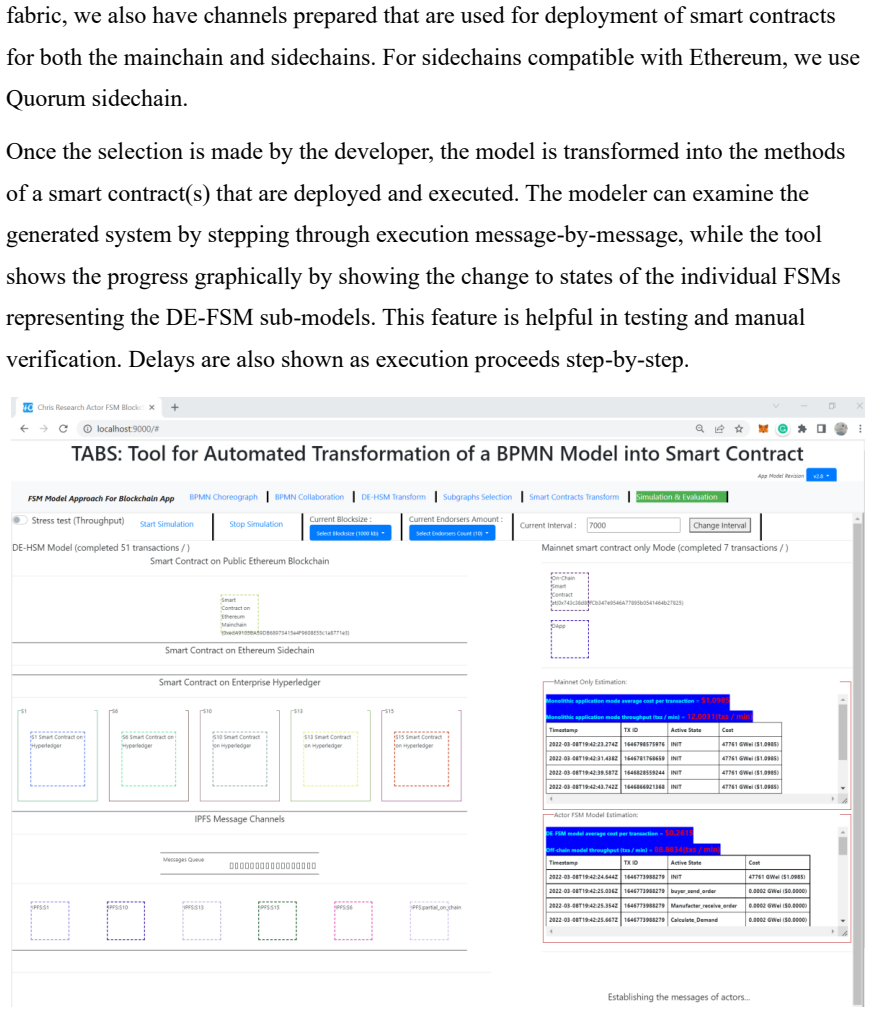
- The same transformation pipeline targets both Ethereum/EVM and Hyperledger Fabric, and it shows the developer the cost and latency trade-off between mainchain-only and sidechain deployment.
Reading between the lines
- A natural next step the thesis leaves implicit: if irreducible feedback loops were mapped to explicit iteration state instead of being excluded, the same DE-HSM pipeline could cover negotiation-heavy trade processes with rework and re-negotiation.
- The LSI-subgraph decomposition could double as a static analyzer for hand-written smart contracts, since any method extracted from such a subgraph automatically inherits the independence property that multi-method atomicity requires.
- The 2PC nesting design predicts a testable overhead profile: coordinator events grow linearly with the number of child sub-transactions, so measuring gas per added child on a public testnet would quantify the price of nesting depth.
Editorial analysis
A structured set of objections, weighed in public.
Referee Report
Summary. This manuscript, a PhD thesis submission, proposes an automated transformation pipeline from BPMN business-process models to blockchain smart contracts. The pipeline first converts a BPMN model into a DAG, then into a Discrete Event Hierarchical State Machine (DE-HSM) multi-modal model, and subsequently into smart-contract methods. The central claim is that this transformation can support long-term collaborative trade transactions, including nested transactions, with ACID properties, access control, and privacy. The authors introduce two concepts: Long-term Blockchain (LtB) transactions and multi-method (mm) transactions, enforced via pattern augmentation and private workspaces. Nested collaborative transactions are supported using a 2-phase-commit protocol. A proof-of-concept tool, TABS+, is described and evaluated on three self-chosen use cases (order processing, supply chain management, and a multi-faceted trade case) on Ethereum and Hyperledger Fabric, including sidechain processing for cost and privacy. The thesis also reports latency and gas cost measurements, though without raw data. The manuscript is largely a consolidation of the author's prior publications and relies on the author's master's thesis for key proofs.
Significance. If the central claims are substantiated, the work would be a meaningful step toward model-driven engineering of smart contracts for multi-party, long-running business processes. The paper's conceptual contributions are the definition of LtB and mm transactions, the use of SESE/LSI subgraphs to identify transaction boundaries, and the systematic transformation via DE-HSM models. The proof-of-concept TABS+ tool demonstrates an end-to-end pipeline, which is a notable engineering effort. However, the paper's validity rests on several assumptions and simplifications that are explicitly acknowledged but not resolved, and the evaluation is not sufficiently independent or detailed to establish the claimed level of coverage and feasibility. The work is best viewed as a promising proposal that needs further formalization and broader empirical validation.
major comments (5)
- [§4.1.1, Fig. 4.1, Table 1.1]
- [§4.1.3.1, §4.1.1]
- [§4.1.3.4, Theorem 1]
- [§6.3, §6.4, Tables 6.1-6.4]
- [§4.1.3.3, §6.1]
minor comments (5)
- [§4.1.1]
- [Fig. 5.4 caption]
- [§4.1.3.4]
- [§2.6]
- [§6.1]
Circularity Check
No circular derivation chain: the BPMN-to-smart-contract transformation is an implemented construction, and the self-citations used for ACID and graph-theory results are to prior, independent papers rather than to the conclusion of this thesis.
full rationale
No place in the thesis was found where a claimed prediction is algebraically identical to a fitted input or where a first-principles result is defined in terms of the target conclusion. The central contribution is an implemented transformation tool (TABS+) demonstrated on three use cases, with latency and cost measurements; those are engineering evaluations, not predictions forced by a fitted parameter. The definitions of LtB and mm transactions are stipulated requirements, and the SESE-subgraph selection is a design choice: the thesis proposes that collaborative transactions be localized and then builds mechanisms for that construct, which is a modeling decision rather than a circular reduction. The proof of Theorem 1 is deferred to the author's earlier work (Liu, 2021), and the ACID-support claim for the mm-transaction cache options is cited to (Liu et al., 2023a); both are same-author prior publications, but they are parameter-free and do not assume the present thesis's BPMN-transformation conclusion, so they function as ordinary citations rather than self-referential support. The cost tables adopted from prior papers are self-benchmarking but are not fitted outputs renamed as predictions. The explicitly disclosed assumptions about loop elimination and the inclusive converging gateway simplification are scope and correctness limitations, not circularity. Overall, the manuscript contains minor self-citation that is not load-bearing, hence a score of 2.
Assumptions & free parameters
assumptions (6)
- ad hoc to paper BPMN model is acyclic after loop elimination; loops are represented by looping subprocesses.
- domain assumption Zero-delay DE-HSM semantics from Yannakakis (2000) apply, requiring no feedback loops.
- domain assumption Task code must be supplied by the developer; the transformation generates only method skeletons.
- domain assumption SESE subgraphs have the localization property: execution stays inside until the exit node.
- standard math The two-phase commit protocol guarantees atomicity of nested transactions.
- standard math Theorem 1 on independent subgraphs is taken from Liu (2021) without proof in this thesis.
invented entities (4)
-
LtB transaction (long-term blockchain transaction)
-
Multi-method (mm) transaction with private workspace
-
DE-HSM multi-modal model
-
Pattern augmentation technique
Cite this review
Pith. "Pith review of Supporting Long-term Transactions in Smart Contracts Generated from Business Process Model and Notation (BPMN) Models." pith.science (2026). https://pith.science/paper/IGYFUFB5
@misc{pith2026250524309,
  author       = {Pith},
  title        = {Pith review of: Supporting Long-term Transactions in Smart Contracts Generated from Business Process Model and Notation (BPMN) Models},
  year         = {2026},
  howpublished = {\url{https://pith.science/paper/IGYFUFB5}},
  note         = {Machine review of arXiv:2505.24309}
}
read the original abstract
To alleviate difficulties in writing smart contracts for distributed blockchain applications, as other research, we propose transformation of Business Process Model and Notation (BPMN) models into blockchain smart contracts. Unlike other research, we use Discrete Event Hierarchical State Machine (DE-HSM) multi-modal modeling to identify collaborative trade transactions that need to be supported by the smart contract and describe how the trade transactions, that may be nested, are supported by a transaction mechanism. We describe algorithms to (i) identify the nested trade transactions and to (ii) transform the BPMN model into blockchains smart contracts that include a transaction mechanism to enforce the transactional properties for the identified trade transactions. The developed proof of concept shows that our approach to automated transformation of BPMN models into smart contracts with the support of privacy and cross-chain interoperability is feasible. The thesis examines and evaluates automatically generated alternative transaction mechanisms to support such transactions using three use cases of varying degree of complexity, namely order processing, supply chain management, and a multi-faceted trade use case. The research enriches the academic dialogue on blockchain technology and smart contracts and proposes potential avenues for future research.
Figures


Figures from the paper (30 more)








Reference graph
Works this paper leans on
-
[1]
Proceedings ACM ICBCT 2021: Bodorik, P ., Liu, C., Jutla, D. Using FSMs to Find Patterns for Off-Chain Computing: Finding Patterns for Off-Chain Computing with FSMs In: Bodorik, P., Liu, C., Jutla, D. (2021). Using FSMs to Find Patterns for Off-Chain Computing: Finding Patterns for Off-Chain Computing with FSMs. In 2021 The 3rd International Conference on...
arXiv 2021
-
[2]
A Tool for Moving Blockchain Computations Off-Chain In: Liu, C., Bodorik, P., Jutla, D
Proceedings ACM BSCI 2021: Liu, C., Bodorik, P ., Jutla, D. A Tool for Moving Blockchain Computations Off-Chain In: Liu, C., Bodorik, P., Jutla, D. (2021). A Tool for Moving Blockchain Computations Off-Chain. In Proceedings of 2021 3rd ACM International Symposium on Blockchain and Secure Critical Infrastructure (BSCI'21), June 3-7, 2021. ACM, New York, NY...
arXiv 2021
-
[3]
Journal of Advances in Information Technology (JAIT) 2021: Liu, C., Bodorik, P ., Jutla, D. Automating Smart Contract Generation on Blockchains Using Multi-Modal Modeling In: Liu, C., Bodorik, P., Jutla, D. (2021). Automating Smart Contract Generation on Blockchains Using Multi-modal Modeling. Journal of Advances in Information Technology (JAIT). 10.12720...
-
[4]
Proceedings IEEE ICEET 2021: Liu, C., Bodorik, P ., Jutla, D. From BPMN to Smart Contracts on Blockchains: Transforming BPMN to DE-FSM Multi-Modal Model In: Liu, C., Bodorik, P., Jutla, D. (2021). From BPMN to smart contracts on blockchains: Transforming BPMN to DE-HSM multi-modal model. 2021 IEEE International Conference on Engineering and Emerging Techn...
arXiv 2021
-
[5]
Supporting Long-Term Transactions in Smart Contracts In: Liu, C., Bodorik, P., Jutla, D
Proceedings IEEE BCCA 2022: Liu, C., Bodorik, P ., Jutla, D. Supporting Long-Term Transactions in Smart Contracts In: Liu, C., Bodorik, P., Jutla, D. (2022). Supporting Long-term Transactions in Smart Contracts. 2022 IEEE Fourth International Conference on Blockchain Computing and Applications (BCCA), 11–19. https://doi.org/10.1109/BCCA55292.2022.9922193 133
arXiv 2022
-
[6]
Patent Application Submission USPTO 2022: Bodorik, P ., Liu, C., Jutla, D. System and Methods for Automated Generation of Smart Contracts from BPMN Models Using DE-HSM Multi-Modal Models Executed by Smart Contracts with Sidechain Processing In: Bodorik, P., Liu, C., Jutla, D. (2022). System and Methods for Automated Generation of Smart Contracts from BPMN...
work page 2022
-
[7]
ELSEVIER Journal Blockchain: Research and Applications (BCRA) 2023: Bodorik, P ., Liu, C., Jutla, D. TABS: Transforming Automatically BPMN Models into Blockchain Smart Contracts In: Bodorik, P., Liu, C., Jutla, D. (2023). TABS: Transforming automatically BPMN models into blockchain smart contracts. Blockchain: Research and Applications (Elsevier), 100115....
arXiv 2023
-
[8]
Proceedings SPRINGER BLOCKSYS 2023: Liu, C. G., Bodorik, P ., Jutla, D. Long-Term Blockchain Transactions Spanning Multiplicity of Smart Contract Methods In: Liu, C. G., Bodorik, P., Jutla, D. (2023). Long-Term Blockchain Transactions Spanning Multiplicity of Smart Contract Methods. In Springer BlockSys: Blockchain and Trustworthy Systems. https://doi.org...
Show all 9 references
-
[9]
TABS+: Transforming Automatically BPMN Models to Smart Contracts with Nested Collaborative Transactions In: Liu, C., Bodorik, P., Jutla, D
Submitted Manuscript (Under Review) ACM DLT 2023: Liu, C., Bodorik, P ., Jutla, D. TABS+: Transforming Automatically BPMN Models to Smart Contracts with Nested Collaborative Transactions In: Liu, C., Bodorik, P., Jutla, D. (2023). Tabs+: Transforming Automatically BPMN Models ...
2023
Reviewed August 7, 2026 · model on record in the stance chip above.
Discussion (0). Sign in to comment.