REVIEW 2 major objections 4 minor 51 references
Thinning algorithms for the Monte Carlo simulation of kinetic Ising models
T0 review · 2 major / 4 minor · reviewed 2026-08-07 · deepseek-v4-flash
Pith's one-line read Thinning Poisson process arrivals lets kinetic Ising simulations reach low frequencies and long lifetimes previously out of reach.
desk verdict Useful thinning-based KMC accelerations with impressive validation, but the formal GTA statement is wrong for time-dependent majorants and must be corrected. read the letter →
The pith
A machine-rendered reading of the paper's core claim, the machinery that carries it, and where it could break.
The reading
What carries the argument
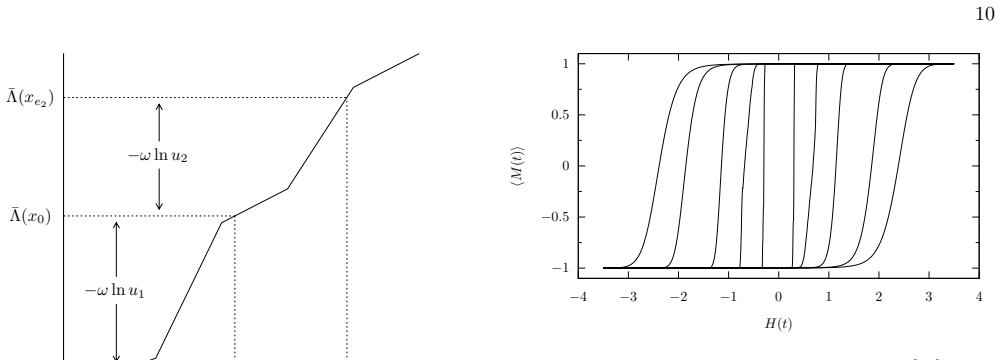
The central machinery is thinning of a nonhomogeneous Poisson process: instead of solving the integral equation for the next spin-flip time, one generates arrival times from a majorizing rate λ̄(t) ≥ λ(t) and accepts them with probability λ(t)/λ̄(t). The paper builds two algorithms on this: TBKLA, which adapts the Bortz-Kalos-Lebowitz algorithm to time-dependent Hamiltonians using constant majorization, and TNA, which coarse-grains the rapid fluctuations between the fully ordered state e0 and the one-reversed-spin state e1 into a 2×2 rate matrix, computes the one-reversed-spin probability p1 from the transition matrix, and treats escape via the rate λ(t)=p1(t)r_{1→2}(t). For periodic fields, a piecewise-constant cumulative majorizing function plus binary search makes arrival generation fast and accurate at low frequencies.
What would settle it
Run the same low-temperature hysteresis or metastable-decay simulation with an s=3 or s=4 absorbing-state extension of TNA, or with exact integration of Eq. (6) over a limited time window, and compare average loop areas or nucleation times; if they shift by more than the statistical error, the two-state assumption used to derive the TNA rate Eq. (20) is not adequate at those parameters.
Extended reading notes
Core claim
The paper claims that nonhomogeneous Poisson process thinning can be applied to two existing accelerated kinetic Monte Carlo schemes, the Bortz-Kalos-Lebowitz algorithm and the absorbing-Markov-chain Novotny algorithm, producing TBKLA and TNA. These algorithms simulate Glauber kinetic Ising dynamics on the same physical clock as a conventional Metropolis run while reaching parameter regimes previously closed off. In tests on 2D and 3D ferromagnetic Ising models, TBKLA is orders of magnitude faster than Metropolis at low temperature, and TNA reproduces the low-temperature analytic barrier behavior for metastable decay and the adiabatic nucleation theory for low-frequency hysteresis loop areas. At T=0.5J the simulations reached ν/ν0=$10^{{-16.5}}$, corresponding to about 30 nHz for ν0=1 GHz, with loop areas matching the low-frequency adiabatic theory; the paper interprets the apparent power-law loop-area data as a transient and confirms the inverse-logarithm asymptotic behavior.
Load-bearing premise
The load-bearing assumption is that, between rare escapes from the ordered state, the system only ever fluctuates between the fully ordered state and a state with exactly one reversed spin, so fluctuations involving two or more reversed spins can be ignored.
Editorial extensions
If this is right
- Hysteresis loop areas in 2D and 3D kinetic Ising models can be computed at oscillation frequencies down to tens of nanohertz, covering the lower end of experimentally relevant and hyperthermia frequency ranges.
- Metastable-state decay can be simulated to much longer lifetimes than previous absorbing-Markov-chain runs; in one 3D case TNA reached T=0.01J with an extracted zero-temperature barrier consistent with the theoretical value.
- Because the conventional Metropolis algorithm is shown to be a thinning algorithm with a constant majorizing rate, comparisons between earlier Metropolis-based simulations and the new algorithms are on the same physical clock.
- At low frequencies, the loop area follows the adiabatic nucleation-theory prediction, and the observed power-law fits are transient; the true asymptotic behavior is proportional to 1/ln ν.
- The speed advantage grows as temperature decreases, making the thinned algorithms most useful in the low-temperature regime where Metropolis acceptance is poor.
- The algorithm acceleration increases as temperature is lowered, with hysteresis simulated at moderately low temperatures of practical interest and metastable decay reaching many orders of magnitude longer lifetimes than previous simulations.
Reading between the lines
- Editorial inference: because only periodicity of the driving field enters the Floquet-based storage scheme, the same piecewise-constant thinning should apply to pulsed, biased, or non-sinusoidal periodic fields, which the paper does not simulate.
- Editorial inference: the two-state truncation (e0, e1) is exact only if simultaneous multi-spin fluctuations are negligible; a natural next test is comparing TNA with an s=3 variant at temperatures above about one quarter of the critical temperature, where the paper expects low-temperature analytic formulas to fail.
- Editorial inference: the thinning-plus-transition-matrix idea might accelerate kinetic Monte Carlo for other slow-dynamics problems, such as alloy ordering or protein models, wherever the slow evolution is dominated by repeated excursions between a small set of metastable configurations.
- Editorial inference: the reported agreement between TNA and pure TBKLA at high frequencies suggests the s=2 approximation could be validated at lower frequencies by direct comparison with a rejectionless run in a regime where both algorithms are still feasible.
Editorial analysis
A structured set of objections, weighed in public.
Referee Report
Summary. The paper proposes acceleration of kinetic Monte Carlo simulations of two- and three-dimensional kinetic Ising models under Glauber dynamics by using Lewis-Shedler thinning of nonhomogeneous Poisson processes. A general thinning algorithm (GTA) is stated, together with two implementations: TBKLA, obtained by applying a constant majorant to the Bortz-Kalos-Lebowitz algorithm, and TNA, a thinned version of the Novotny absorbing-Markov-chain algorithm truncated to two states (fully ordered state and one reversed spin). The authors argue that Metropolis dynamics is statistically equivalent to a thinning procedure, test TBKLA on high-frequency hysteresis, extend TNA to stationary metastable decay and to low-frequency hysteresis under periodic fields using a piecewise-constant majorant, and compare results with analytic nucleation theory. They report simulations down to a dimensionless frequency of about 10^-16.5 (about 30 nHz for a prefactor of 1 GHz) and metastable lifetimes far beyond previous work.
Significance. If the algorithm statement is corrected, the paper delivers a useful and well-validated acceleration technique. The constant-majorization TBKLA is simple and, when thinning is implemented with the correct lower limit, statistically exact. The agreement of TNA with independent analytic theories in Figs. 5, 6, and 11 is strong evidence that the low-temperature approximations are quantitatively useful over many decades. The cross-check of TNA against TBKLA in Fig. 9, the parameter-free nature of the comparisons to Eqs. (42)-(45) and (51), and the practical warning about the double-precision limit at about ν/ν0 = 10^-17 are all valuable. However, the formal GTA contains a load-bearing error for time-dependent rates, and the exactness claim for TNA is overstated; both require revision before the paper can be accepted.
major comments (2)
- [III, Steps 1-3; VI, Eq. (39)] The formal statement of the GTA in Sec. III, Steps 1-3 (and its use in Sec. VI around Eq. (39)) is incorrect for time-dependent rates. Step 1 sets t0=te at the start of every candidate draw, so after a candidate t is rejected in Step 2, the next candidate is drawn from the last accepted time te rather than from the rejected time t. In Lewis-Shedler thinning the candidates must form a realization of a Poisson process with rate λbar(t) on (te,∞); the lower limit of Eq. (8) must therefore be the previous candidate time, not te. Resetting to te removes the survival factor exp(-∫_{te}^t λ) of Eq. (A4) and does not reproduce the NHPP first-arrival distribution. This affects TBKLA as well as TNA, because even a constant majorant does not restore correctness when λ(t) itself depends on time through the external field. The same resetting invalidates the claimed equivalence of MA to GTA in Sec. III.A, since standard MA advances the clock by the trial increment even when the proposed flip is rejected. Please rewrite Steps 1-3, the description of Fig. 8, and the MA-equivalence argument so that rejected trials advance the lower integration limit.
- [IV, Eqs. (16)-(21); VIII] TNA as presented is an approximation, and the Summary's statement that 'NA and TNA remain exact in systems of any sizes' is too strong. The NHPP rate λ(t)=p1(t,t_e) r_{1->2}(t) is derived by computing p1 from the two-state generator (19), which contains only the rates e0→e1 and e1→e0. The loss channel e1→e2 is not included in that generator, and the survival probability of the first e2 event is not exp(-∫λ). The exact first-passage hazard in the three-state chain is r_{1->2}(t) p1(t)/[1-F(t)], not r_{1->2}(t) p1(t). The approximation is controlled at low temperatures, where the integrated probability of reaching e2 is small, but the paper should state this explicitly and give the small parameter (for example, the size of the neglected e1→e2 loss relative to the e1→e0 return rate) rather than asserting exactness. The numerical validations in Figs. 5-6 and 11 are encouraging, but they do not remove the need to qualify the algorithm's domain of validity.
minor comments (4)
- [Abstract; VII] The statement 'tens nanohertz' should be tied to the assumed prefactor ν0=1 GHz; with ν0=1 THz the same dimensionless frequency gives tens of microhertz.
- [VI, Eqs. (29)-(31)] The reuse of symbols ω, t, and λ for dimensionless variables is confusing; please use distinct notation such as tildes or subscripts.
- [III.B; VIII] There are typos that should be fixed: 'no do difference' in Sec. III.B should be 'no difference', and 'fore Monte Carlo simulations' in Sec. VIII should be 'for Monte Carlo simulations'.
- [VII, Figs. 10-11] The power-law fits with exponents γ are descriptive; since the text later shows the asymptotic behavior is 1/ln ω, consider stating this caveat where the fits are introduced.
Circularity Check
No significant circularity: the algorithms and rates are derived from external thinning theory and microscopic Glauber rates, with validation against independent analytic theories and benchmark simulations.
full rationale
The central derivation chain is not circular. The algorithms are built on the external Lewis–Shedler thinning theorem (Ref. 27) and standard NHPP inversion equations (Eqs. (6), (8), (A2)–(A4)); the majorizing functions (Eqs. (10), (13), (24), (37)) are explicit expressions in the Glauber rates or transition-matrix probabilities, not fitted quantities. The TNA rate Eq. (20) is an analytic s=2 approximation, not a fitted input: its ingredients r0, r1, rq are microscopic Glauber rates, and TNA is cross-checked against full TBKLA (Fig. 9) and against independent low-temperature droplet-nucleation theories (Eqs. (25), (42)–(51)) and prior MCAMC simulations (Ref. 33). The only fitted parameters, the power-law exponents γ≈0.07 and ≈0.037 in Figs. 10–11, are descriptive fits to the simulated loop areas and are not used to derive the algorithms or the physical conclusions; the paper explicitly attributes the true asymptotic behavior to the inverse-logarithm law from Ref. 19. The sole self-citation (Ref. 15, Tokar & Dreyssé 2008) appears only in the Summary as a possible box-decomposition extension and is not load-bearing. I therefore find no circular step. A separate formal concern—that GTA's Step 1 ('Set t0 = te') may need to continue from the last rejected candidate for time-dependent majorants—is an algorithm-correctness issue, not a circularity: even if the stated pseudo-code is inaccurate, no predicted result is forced to equal its input by construction.
Assumptions & free parameters
free parameters (3)
- power-law exponent gamma (T=J) =
approximately 0.07
- power-law exponent gamma (T=0.5J) =
approximately 0.037
- number of piecewise-constant intervals 2^n =
not specified
assumptions (6)
- standard math Lewis-Shedler thinning theorem
- domain assumption Glauber dynamics spin-flip rate ri(t) = nu0/(1+exp(beta Delta_i H))
- domain assumption Low-temperature nucleation theory Eqs. (25), (42)-(45)
- standard math Laplace asymptotics for small-omega approximation Eq. (36)
- ad hoc to paper Saturated magnetization during e0-e1 fluctuations
- ad hoc to paper s=2 truncation of transient state space
Cite this review
Pith. "Pith review of Thinning algorithms for the Monte Carlo simulation of kinetic Ising models." pith.science (2026). https://pith.science/paper/MP7PXSDS
@misc{pith2026250524414,
  author       = {Pith},
  title        = {Pith review of: Thinning algorithms for the Monte Carlo simulation of kinetic Ising models},
  year         = {2026},
  howpublished = {\url{https://pith.science/paper/MP7PXSDS}},
  note         = {Machine review of arXiv:2505.24414}
}
read the original abstract
The thinning method for numerical generation of the nonhomogeneous Poisson process (NHPP) arrival times has been adapted to accelerate Monte Carlo simulations of the kinetic Ising models (KIMs) with the Glauber spin-flip dynamics. The performance of the suggested algorithms has been illustrated by simulation of the decay of metastable states in stationary KIMs and of hysteresis in KIMs in a periodic external field. The thinning has been implemented by means of piecewise constant majorizing functions which exceed or are equal to NHPP rate. It has been shown that in favorable cases the use of thinning makes possible the simulations of hysteresis at frequencies in tens nanohertz and the decay of metastable states with lifetimes by many orders exceeding those in previous simulations. Good agreement of simulated results with low-temperature analytic theories has been established. Though the algorithm acceleration has been shown to enhance with lowering temperature, the hysteresis has been simulated at moderately low temperatures of practical interest estimated to cover the range from below the room temperature up to temperatures used in hyperthermia applications.
Figures


Figures from the paper (6 more)




Reference graph
Works this paper leans on
-
[1]
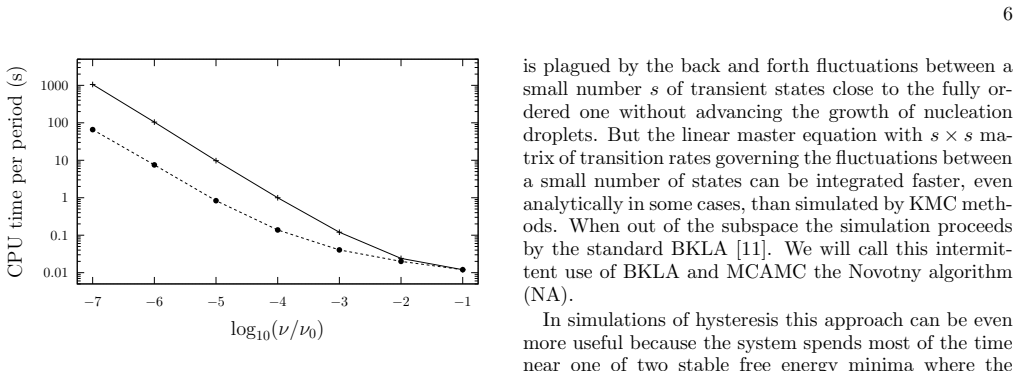
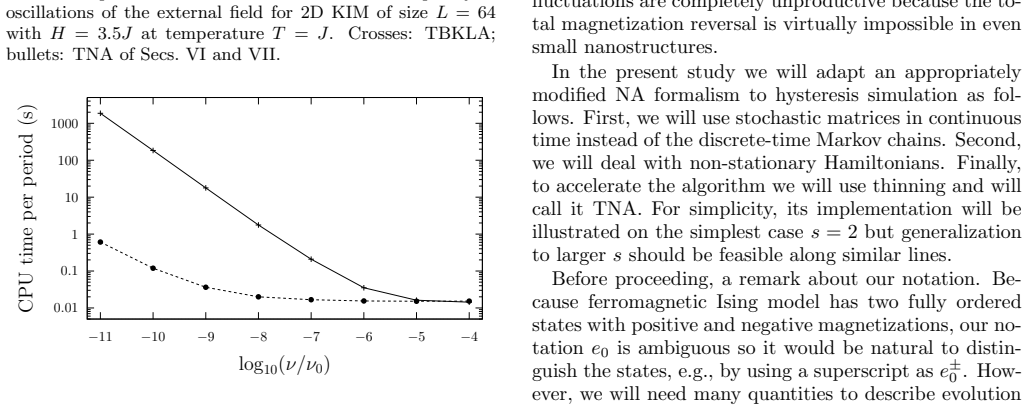
Asymmetric hysteresis To illustrate the efficiency of TBKLA we compared it with simulations by MA of asymmetric hysteresis in KIM of Ref. [20]. In our implementation of MA both the con- stant and the random time increments have been used but no do difference of the results have been noticed. The results presented in Fig. 2 show that, as expected, the effi...
-
[2]
Symmetric hysteresis From standpoint of practical applications, such as hy- perthermia, more interesting is the symmetric hystere- sis due to much larger loop areas [18]. The symmet- ric loops occur at sufficiently low frequencies [38] so we tested TBKLA in this case by simulating 2D KIM of size L = 64 [19] using two sets of parameters. One set was T = J ...
-
[3]
P. Bruscolini, A. Pelizzola, and M. Zamparo, Rate deter- mining factors in protein model structures, Phys. Rev. Lett. 99, 038103 (2007)
work page 2007
-
[4]
M. Aguilera, S. A. Moosavi, and H. Shimazaki, A uni- fying framework for mean-field theories of asymmetric kinetic Ising systems, Nat. Commun. 12, 1197 (2021)
work page 2021
-
[5]
M. W. Macy, B. K. Szymanski, and J. A. Ho lyst, The ising model celebrates a century of interdisciplinary con- tributions, npj Complexity 1, 10 (2024)
2024
-
[6]
Ducastelle, Order and Phase Stability in Alloys (North-Holland, Amsterdam, 1991)
F. Ducastelle, Order and Phase Stability in Alloys (North-Holland, Amsterdam, 1991)
work page 1991
-
[7]
A. Chatterjee and D. G. Vlachos, An overview of spatial microscopic and accelerated kinetic monte carlo methods, J. Comput.-Aided Mater. Des. 14, 253 (2007)
work page 2007
-
[8]
K. Binder and P. Virnau, Overview: Understanding nu- cleation phenomena from simulations of lattice gas mod- els, The Journal of Chemical Physics 145, 211701 (2016)
work page 2016
Show all 51 references
-
[9]
Kirkpatrick, C
S. Kirkpatrick, C. D. Gelatt, and M. P. Vecchi, Optimiza- tion by simulated annealing, Science 220, 671 (1983)
1983
-
[10]
(5) is greatly facilitated in nn KIM
where the computation of λ(t) in Eq. (5) is greatly facilitated in nn KIM. B. Simulation of high-frequency hysteresis using TBKLA As temperature lowers the spin flips become less fre- quent. But the time step in MA remains the same— 1/N ν0 which means that the rejection rate g...
-
[11]
[33] within s ≥ 3 NA
we have succeeded in simulating up to 177 orders of magnitude larger lifetimes compared to those simulated in Ref. [33] within s ≥ 3 NA. We have extended TNA for oscillating external field via thinning by a piecewise- constant majorization function. The Floquet’s theory assure...
-
[12]
Landau and K
D. Landau and K. Binder, A Guide to Monte Carlo Simulations in Statistical Physics (Cambridge University Press, 2009)
2009
-
[13]
Metropolis, A
N. Metropolis, A. W. Rosenbluth, M. N. Rosenbluth, A. H. Teller, and E. Teller, Equation of state calcula- tions by fast computing machines, J. Chem. Phys. 21, 1087 (1953)
1953
-
[14]
A. B. Bortz, M. H. Kalos, and J. L. Lebowitz, J. Comput. Phys. 17, 10 (1975)
1975
-
[15]
M. A. Novotny, Monte carlo algorithms with absorbing markov chains: Fast local algorithms for slow dynamics, Phys. Rev. Lett. 74, 1 (1995)
1995
-
[16]
E. Adam, L. Billard, and F. Lan¸ con, Class of monte carlo algorithms for dynamic problems leads to an adaptive method, Phys. Rev. E 59, 1212 (1999)
1999
-
[17]
S. A. Trygubenko and D. J. Wales, Graph transformation method for calculating waiting times in Markov chains, J. Chem. Phys. 124, 234110 (2006)
2006
-
[18]
Opplestrup, V
T. Opplestrup, V. V. Bulatov, G. H. Gilmer, M. H. Kalos, and B. Sadigh, First-passage monte carlo algorithm: Dif- fusion without all the hops, Phys. Rev. Lett. 97, 230602 (2006)
2006
-
[19]
V. I. Tokar and H. Dreyss´ e, Accelerated kinetic monte carlo algorithm for diffusion-limited kinetics, Phys. Rev. E 77, 066705 (2008)
2008
-
[20]
B. K. Chakrabarti and M. Acharyya, Dynamic transi- tions and hysteresis, Rev. Mod. Phys. 71, 847 (1999)
1999
-
[21]
M. A. Novotny, D. T. Robb, S. M. Stinnett, G. Brown, and P. A. Rikvold, Finite-temperature simulations for magnetic nanostructures, in Magnetic Nanostructures , edited by B. Akta¸ s, F. Mikailov, and L. Tagirov (Springer Berlin Heidelberg, Berlin, Heidelberg, 2007) pp. 97–117
2007
-
[22]
A. J. Giustini, A. A. Petryk, S. M. Cassim, J. A. Tate, I. Baker, and P. J. Hoopes, Magnetic nanoparticle hyper- thermia in cancer treatment, Nano LIFE 01, 17 (2010)
2010
-
[23]
S. W. Sides, P. A. Rikvold, and M. A. Novotny, Stochastic hysteresis and resonance in a kinetic Ising system, Phys. Rev. E 57, 6512 (1998)
1998
-
[24]
H. Zhu, S. Dong, and J.-M. Liu, Hysteresis loop area of the ising model, Phys. Rev. B 70, 132403 (2004)
2004
-
[25]
M. A. Novotny, G. Brown, and P. A. Rikvold, Large- scale computer investigations of finite-temperature nucle- ation and growth phenomena in magnetization reversal and hysteresis (invited), J. Appl. Phys. 91, 6908 (2002)
2002
-
[26]
Streit, Poisson Point Processes: Imaging, Tracking, and Sensing (Springer US, 2010)
R. Streit, Poisson Point Processes: Imaging, Tracking, and Sensing (Springer US, 2010)
2010
-
[27]
Pasupathy, Generating nonhomogeneous poisson pro- cesses, in Wiley Encyclopedia of Operations Research and Management Science (John Wiley & Sons, Ltd, 2011) pp
R. Pasupathy, Generating nonhomogeneous poisson pro- cesses, in Wiley Encyclopedia of Operations Research and Management Science (John Wiley & Sons, Ltd, 2011) pp. 1–11
2011
-
[28]
Ross, Introduction to Probability Models 10th Edition (Academic Press, 2010)
S. Ross, Introduction to Probability Models 10th Edition (Academic Press, 2010)
2010
-
[29]
Harrod and W
S. Harrod and W. D. Kelton, Numerical methods for re- alizing nonstationary poisson processes with piecewise- constant instantaneous-rate functions, SIMULATION 82, 147 (2006)
2006
-
[30]
Casella and R
G. Casella and R. Berger, Statistical Inference (2nd ed.) (Chapman and Hall/CRC, 2024)
2024
-
[31]
P. A. W. Lewis and G. S. Shedler, Simulation of nonho- mogeneous poisson process by thinning, Naval Res. Lo- gist. Quart. 26, 403 (1979)
1979
-
[32]
Olkin and A
I. Olkin and A. Marshall, Inequalities: Theory of Ma- jorization and Its Applications , Mathematics in Science and Engineering (Academic Press, 2014)
2014
-
[33]
Neves and R
E. Neves and R. Schonmann, Critical droplets and metastability for a glauber dynamics at very low tem- peratures., Commun. Math. Phys. 137, 209 (1991)
1991
-
[34]
P. A. Rikvold, H. Tomita, S. Miyashita, and S. W. Sides, Metastable lifetimes in a kinetic ising model: Dependence on field and system size, Phys. Rev. E 49, 5080 (1994)
1994
-
[35]
Bovier and F
A. Bovier and F. Manzo, Metastability in glauber dy- namics in the low-temperature limit: Beyond exponen- tial asymptoticsa, J. Stat. Phys. 107, 757 (2002), e-print cond-mat/0107376
2002 arXiv
-
[36]
V. A. Shneidman and G. M. Nita, Nucleation preexpo- nential in dynamic ising models at moderately strong fields, Phys. Rev. E 68, 021605 (2003)
2003
-
[37]
M. Novotny, Low-temperature long-time simulations of ising ferromagnets using the monte carlo with absorbing markov chains method, Computer Physics Communica- tions 147, 659 (2002), proceedings of the Europhysics Conference on Computational Physics Computational Modeling and S...
2002
-
[38]
S. W. Sides, P. A. Rikvold, and M. A. Novotny, Hys- teresis loop areas in kinetic Ising models: Effects of the switching mechanism, J. Appl. Phys. 83, 6494 (1998), e-print cond-mat/9710244
1998 arXiv
-
[39]
R. J. Glauber, Time-dependent statistics of the Ising model, J. Math. Phys. 4, 294 (1963)
1963
-
[40]
Z. D. Vatansever, E. Vatansever, A. Berger, A. Vasilopoulos, and N. G. Fytas, Monte carlo study of the two-dimensional kinetic Ising model under a nonantisymmetric magnetic field, Phys. Rev. E 110, 064155 (2024)
2024
-
[41]
K. Park, P. A. Rikvold, G. M. Buend ´ ıa, and M. A. Novotny, Low-temperature nucleation in a kinetic Ising model with soft stochastic dynamics, Phys. Rev. Lett. 92, 015701 (2004)
2004
-
[42]
G. M. Buend ´ ıa and P. A. Rikvold, Fluctuations in a model ferromagnetic film driven by a slowly oscillating field with a constant bias, Phys. Rev. B 96, 134306 (2017)
2017
-
[43]
J.-S. Suen, M. H. Lee, G. Teeter, and J. L. Erskine, Mag- netic hysteresis dynamics of thin co films on cu(001), Phys. Rev. B 59, 4249 (1999)
1999
-
[44]
Suen and J
J.-S. Suen and J. L. Erskine, Magnetic hysteresis dynam- ics: Thin p(1 × 1) fe films on flat and stepped w(110), Phys. Rev. Lett. 78, 3567 (1997)
1997
-
[45]
Brockett, Finite Dimensional Linear Systems (John Wiley & Sons, Inc., New York, 1970)
R. Brockett, Finite Dimensional Linear Systems (John Wiley & Sons, Inc., New York, 1970)
1970
-
[46]
Shneidman, On the lowest energy nucleation path in a supersaturated lattice gas., J
V. Shneidman, On the lowest energy nucleation path in a supersaturated lattice gas., J. Stat. Phys. 112, 293 (2003)
2003
-
[47]
V. A. Shneidman, Branching of nucleation paths in a metastable lattice gas with metropolis dynamics, New J. Phys. 7, 12 (2005)
2005
-
[48]
Korniss, P
G. Korniss, P. A. Rikvold, and M. A. Novotny, Absence of first-order transition and tricritical point in the dynamic phase diagram of a spatially extended bistable system in an oscillating field, Phys. Rev. E 66, 056127 (2002)
2002
-
[49]
V. A. Shneidman and G. M. Nita, Modulation of the nucleation rate preexponential in a low-temperature ising system, Phys. Rev. Lett. 89, 025701 (2002)
2002
-
[50]
M. A. Novotny, Low-temperature metastability of ising models: Prefactors, divergences, and discontinuities, in Computer Simulation Studies in Condensed-Matter Physics XV , edited by D. P. Landau, S. P. Lewis, and H.-B. Sch¨ uttler (Springer Berlin Heidelberg, Berlin, Hei- delb...
2003
-
[51]
Bender and S
C. Bender and S. Orszag, Advanced Mathematical Meth- ods for Scientists and Engineers I: Asymptotic Methods and Perturbation Theory, Advanced Mathematical Meth- ods for Scientists and Engineers (Springer, 1999)
1999
Reviewed August 7, 2026 · model on record in the stance chip above.
Discussion (0). Sign in to comment.