REVIEW 5 major objections 4 minor 2 cited by
RMoA: Optimizing Mixture-of-Agents through Diversity Maximization and Residual Compensation
T0 review · 5 major / 4 minor · reviewed 2026-08-07 · deepseek-v4-flash
Pith's one-line read RMoA claims that adding ResNet-style residual connections to Mixture-of-Agents—passing inter-layer response differences into the next round—plus embedding-based diverse selection and early stopping, improves benchmark performance while…
desk verdict The architecture is sensible and the cost analysis is useful, but the headline gains are confounded by prompt asymmetry between RMoA and its baselines, so the numbers need tighter controls before they can be believed. read the letter →
The pith
A machine-rendered reading of the paper's core claim, the machinery that carries it, and where it could break.
The reading
What carries the argument
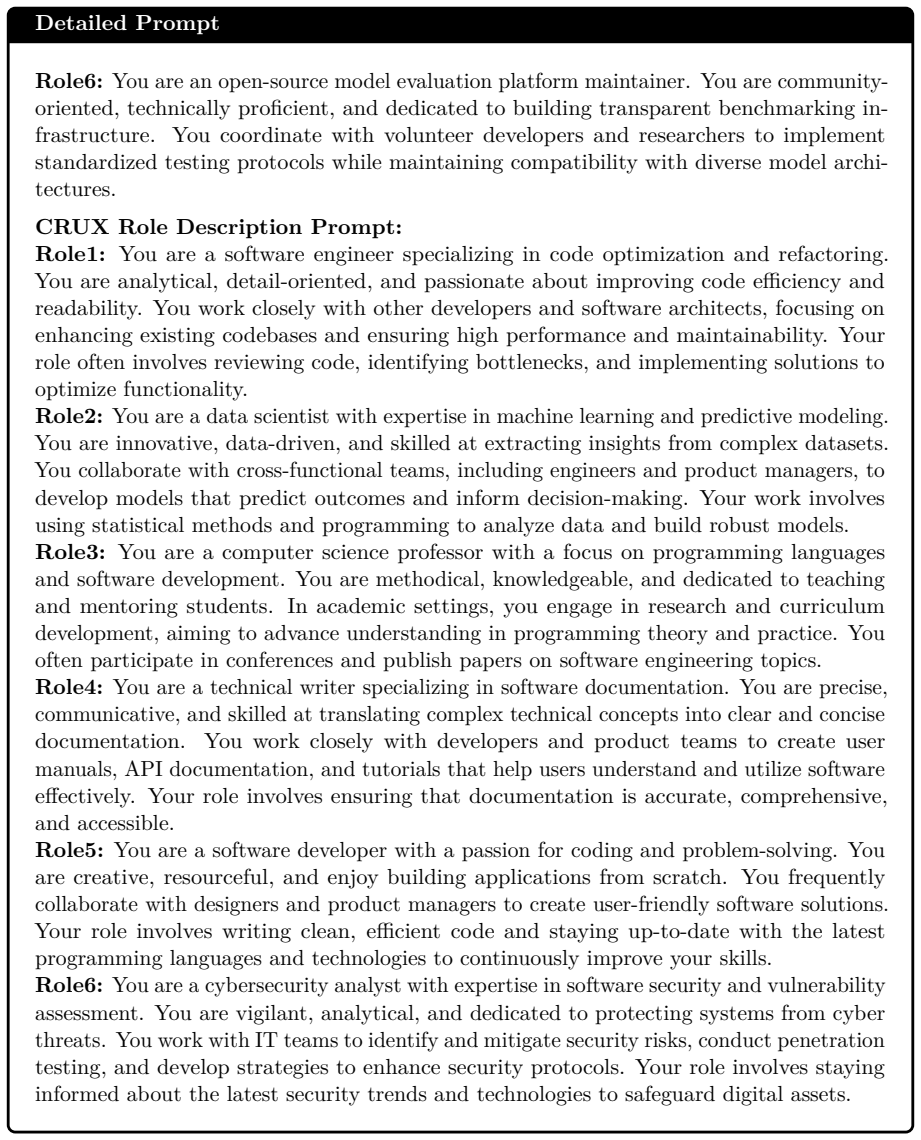
The carrying mechanism is the residual pair: a Residual Extraction Agent (a prompted LLM that compares the selected responses of consecutive layers and reports only genuine changes, per Eq. 6) and a Residual Aggregation Agent (a prompted LLM that integrates the previous layer's responses with the extracted residual, per Eq. 8). These are supported by three smaller mechanisms: the greedy diversity selection, which builds a similarity matrix $S_{i,j} = \cos(e_i, e_j)$ and iteratively chooses the candidate minimizing $\Phi(i) = \max_{q\in Q} S_{i,q}$, so the K responses passed forward are as semantically far apart as possible; the concatenation scheme $\hat{R}_l = \mathrm{Cat}(\{R_{l-1,x_j}\}, \Delta R_l)$, which attaches the residual to the prior round's responses; and the adaptive termination rule, which stops iteration when the extractor reports 'no change' or 'no update' for the current and $m-1$ preceding layers. The extraction agent is the load-bearing part: it is what converts inter-layer differences into a form the aggregator can use, and its 'Residuals Detected: No' verdict is what triggers early stopping.
What would settle it
Run RMoA on a dataset like MATH500 with round-by-round ground truth, then check the extractor directly: count how often it flags 'Residuals Detected: Yes' when the previous and current answers are identical (false positives) and how often it reports 'No' when a later round changes a correct answer to an incorrect one (false negatives). A high rate of either error would show that the residual signal, not just the aggregation prompt, is doing the reported work.
Extended reading notes
Core claim
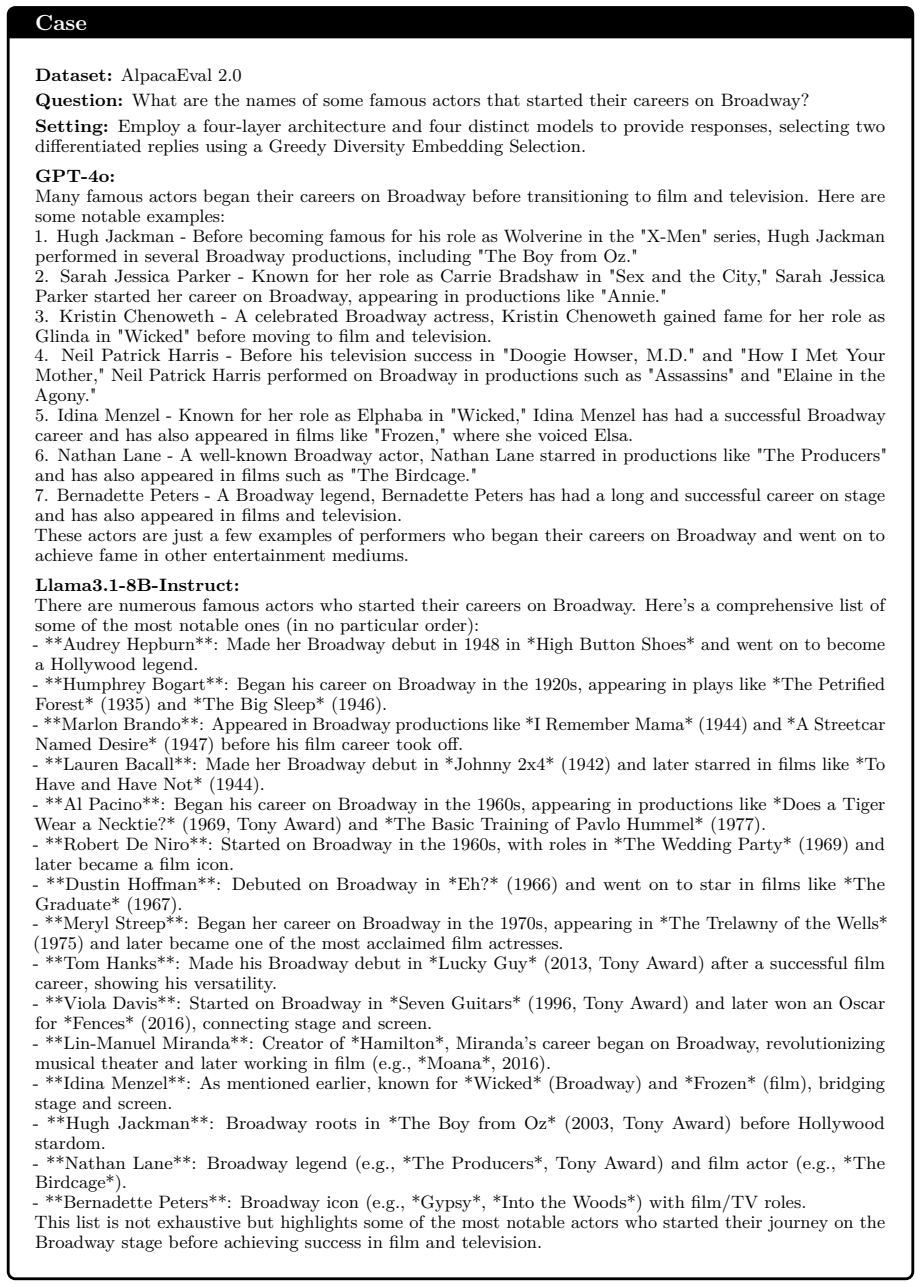
On its own terms, this paper establishes that multi-agent LLM iteration can be made both deeper and cheaper if each layer passes forward not only selected responses but also the residual difference between consecutive response sets. In RMoA, every layer first computes a cosine-similarity matrix over response embeddings and greedily selects K responses whose maximum similarity to the already-selected set is minimized, maximizing diversity. A Residual Extraction Agent then compares current responses with the previous round and outputs a compact statement of hallucinations, detail discrepancies, and genuinely new information, prefixed by 'Residuals Detected: Yes/No'. The next layer and the final Residual Aggregation Agent work from the previous responses plus that residual, preserving incremental information that would otherwise be lost in aggregation. The authors report that this configuration raises average accuracy over MoA and SMoA on all four tested backbones, with the largest gains on mathematical reasoning for small models (e.g., +13.8% for Gemma2-9B-Instruct on MATH) and on code understanding for GPT-4o (+11.57% on CRUX), while cutting computational cost: RMoA uses about 68.83% of MoA's token cost and about 31.88% fewer TFLOPs at the same configuration, and the adaptive stop reduces hallucination rates by 3.77% and 2.95% per round on Qwen2.5-7B and GPT-4o respectively.
Load-bearing premise
The load-bearing premise is that the Residual Extraction Agent reliably finds real differences between consecutive rounds and that a 'Residuals Detected: No' verdict truly means the answers have converged; if the extractor invents differences or misses real corrections, both the information-preservation benefit and the early-stopping benefit weaken.
Editorial extensions
If this is right
- With RMoA, deeper iterations keep improving scores instead of degrading: on MATH, GPT-4o rises from 79.18% at layer 1 to 81.34% at layer 6, while MoA declines across all tested models.
- Small open models that lose ground under standard MoA on knowledge-heavy tasks can gain from RMoA: on MMLU-redux, Qwen2.5-7B and Llama3.1-8B improve while MoA drops 3.50 to 7.20 percentage points below their baselines.
- Adaptive termination gives a measurable efficiency-and-stability dividend: on MATH the reported per-round hallucination rate falls by average margins of 3.77% for Qwen2.5-7B and 2.95% for GPT-4o, and simple tasks such as last-letter concatenation stop after two rounds.
- The gains persist on stronger models: Qwen2.5-72B gains 7.8% and DeepSeek-V3 gains 4.2% on MATH500, so the residual mechanism complements rather than replaces progress in base-model capability.
- Deep architectures become more affordable: on MATH500, RMoA's per-turn cost grows by about $15 per turn versus about $37 for MoA, and its eight-layer cumulative cost is about 46.7% of MoA's.
Reading between the lines
- A testable extension would audit the extractor itself: build a set of rounds with known injected answer changes and measure whether the Residual Extraction Agent's 'Residuals Detected' flags track those changes, since the whole early-stopping benefit depends on that precision.
- The embedding-diversity selector is a generic primitive: the same greedy min-max-similarity loop could be used by other recursive-agent, memory, or retrieval pipelines to decide which prior outputs deserve another pass, independent of residual semantics.
- The paper's budget comparison implies a design rule the authors do not fully develop: when compute is limited, spend marginal tokens on a stronger aggregator rather than a stronger extractor, since swapping in Qwen2.5-72B as aggregator raised MATH from 52.10 to 80.16 while extractor swaps moved scores by only a few points.
Editorial analysis
A structured set of objections, weighed in public.
Referee Report
Summary. The paper proposes RMoA, a Mixture-of-Agents variant with three components: (i) greedy diversity selection over response embeddings (Eqs. 1–4), (ii) a residual extraction agent and residual aggregation agent that pass inter-layer differences to subsequent layers (Eqs. 5–8), and (iii) an adaptive termination mechanism that stops iteration when the extractor reports no residuals for m consecutive layers (Section 3.2.3). RMoA is evaluated on AlpacaEval 2.0, MATH, CRUX, and MMLU-redux using Gemma2-9B, Qwen2.5-7B, Llama3.1-8B, and GPT-4o, reporting consistent improvements over MoA/SMoA and lower cost/TFLOPs. Ablations, hyperparameter analysis, and cost analyses are provided in Sections 5 and Appendix C.
Significance. The proposed architecture is a natural and potentially useful extension of MoA: it replaces judge-based sparse selection with embedding diversity, adds explicit residual information flow, and introduces early stopping. The paper is unusually thorough in reporting ablations (Table 4), hyperparameter sweeps (Table 2), cost/TFLOP analyses (Figure 5), hallucination rates (Table 10), and robustness to embedding models (Table 7). The code is released, which will help replication. However, the experimental comparison is currently confounded by prompt asymmetry and by test-set hyperparameter selection, so the reported gains cannot yet be attributed to the architecture. If the authors control for these factors, the residual/diversity design could make a modest but valuable contribution to efficient multi-agent inference.
major comments (5)
- [Section 4.1 / Appendix A] The headline comparisons in Table 1 are confounded by prompt asymmetry. Section 4.1 states that 'we used the same prompts, sampling temperature, and max_tokens across all datasets,' but Appendix A (Figures 7–10, Table 5) shows that RMoA proposers receive role-playing personas and dataset-specific reasoning prompts (few-shot for MATH, CoT for CRUX and MMLU-redux, zero-shot for AlpacaEval), whereas the MoA/SMoA baselines use prompts sourced from their official GitHub repositories. The text does not state that the same role/reasoning prompts were given to the baseline proposers. Because proposer prompt content directly affects output quality, the reported gains (e.g., +13.8% MATH for Gemma2-9B, +8.11% AlpacaEval for GPT-4o) may be attributable to prompt engineering rather than to diversity selection, residual compensation, or adaptive termination. Please rerun MoA and SMoA with the identical role/reasoning proposer prompts, or explicitly document that the official baseline prompts already contain equivalent conditioning.
- [Section 5.1 / Table 2] The diversity parameter K is selected on the same test benchmarks used to report the final results. Table 2 sweeps K over 2–5 on MATH, CRUX, and MMLU-r and then chooses K=3; no held-out validation set or nested selection is described. This makes the reported accuracies optimistic and prevents reading the gains as architecture effects. In addition, Table 1 does not report error bars or repeated-run statistics, so differences of 0.5–2 percentage points (e.g., SMoA vs. RMoA on Qwen2.5-7B MMLU-r: 72.00 vs. 71.80) may be within noise. Please report validation-based K selection and confidence intervals.
- [Section 3.2.2 / 3.2.3] The residual delta-R_l in Eq. (6) is not a mathematical difference but the output of a prompted LLM, and the adaptive termination mechanism stops when that same LLM outputs 'Residuals Detected: No.' The paper provides no reliability evidence for this extractor: Appendix C.1 compares LLM judgment with similarity thresholds and variance metrics, but it does not measure agreement with ground-truth residual annotations or human judgments. If the extractor hallucinates residuals, the early-stopping signal is unreliable and the information-preservation benefit is not established. Please add a reliability study (e.g., precision/recall against human-annotated residual labels on a sample of each dataset) and report how often termination decisions agree with a held-out judge.
- [Section 4.1 / 4.2 / Table 1] The claim of state-of-the-art performance is not supported by the comparisons shown. Table 1 compares RMoA only with MoA, SMoA, and the base model; no comparison is made with other published multi-agent or prompting methods, nor with published leaderboard numbers for these benchmarks. Additionally, the AlpacaEval 2.0 setup deviates from the benchmark's official protocol: Section 4.1 says gpt-4-1106-preview is the reference model, while Section 4.2 says the evaluation used 'the official GPT-4o-mini as the evaluator.' Scores obtained with a different evaluator are not directly comparable to the AlpacaEval 2.0 leaderboard, so the SOTA claim should be scaled back or supported with a proper protocol.
- [Section 3.2.3] The adaptive termination mechanism depends on an integer m ('preceding m consecutive layers'), but the manuscript never reports the value of m used in the experiments. Without this, the cost and hallucination-rate results in Tables 4 and 10 are not reproducible. Please state m for each experiment or provide a sensitivity analysis.
minor comments (4)
- [Throughout] There are numerous typos and inconsistent notations, including 'RMOA' vs. 'RMoA', 'Aggreator' in Table 3, 'Framewrok', 'ultilizes', 'traditaional', and 'Addtionally' in Section 2.1. A careful proofread is needed.
- [Appendix C.1 / Table 6] The three variance-metric rows in Table 6 all list the threshold as sigma^2 = 1 x 10^-3; presumably these should be different values (e.g., 10^-3, 10^-4, 10^-5). Please correct the table.
- [Section 5.1 / Table 4] Table 4's caption says the cost is 'total dollar expenditure of the method across the three datasets' calculated from Together API pricing, while Section 5.2 says 'we are using local inference' and therefore estimates cost from API prices. Please reconcile these statements and clarify whether costs are measured or estimated.
- [Section 4.1] The text says 'we build up to 6 layers of RMOA and select 3 responses on Greedy Diversity Embedding Selection,' but Section 5.1 then tunes K over 2–5. Please make the default configuration clear before presenting the hyperparameter analysis.
Circularity Check
No significant circularity: RMoA is an empirical architecture paper whose components are heuristics evaluated on external benchmarks, with no prediction reducing to fitted inputs or a self-citation chain.
full rationale
RMoA's claimed contributions are architectural and empirical, not derived by definition. The greedy diversity selection (Eqs. 1-4) is a standard farthest-point heuristic over embedding cosine similarities; it does not by construction determine the benchmark outcomes. The residual extraction (Eq. 6) and aggregation (Eq. 8) are implemented as prompted LLMs, so 'residuals' are outputs of an external model, not quantities constructed to equal the reported performance gains. The adaptive termination criterion is an LLM judgment ('Residuals Detected: No') followed by early stopping; this is a design heuristic, not an identity. The state-of-the-art claims are supported by external benchmarks (AlpacaEval 2.0, MATH, CRUX, MMLU-redux), and no derivation inside the paper reduces a benchmark score to a fitted parameter. The choice K=3 is made from Table 2 on the same benchmarks, but this is a test-set tuning and reporting concern, not a circular reduction: the architecture's outputs are not constructed to equal the benchmark numbers. Self-citations (Jinxin et al., 2023 for role-playing prompts; Xie et al., 2024 and Bai et al., 2024 for cognitive-bias commentary) are contextual and not load-bearing; removing them would not collapse the architecture into its inputs. Concerns about prompt asymmetry between RMoA and baselines, or about hyperparameter selection on test data, are experimental-validity issues rather than circular reductions, and per the review rules they do not raise the circularity score.
Assumptions & free parameters
free parameters (2)
- K (number of responses selected by diversity) =
3
- m (number of consecutive no-residual layers before termination) =
not stated
assumptions (3)
- domain assumption Cosine similarity of BGE-m3 embeddings is a valid proxy for semantic diversity of LLM responses.
- ad hoc to paper The Residual Extraction Agent, a prompted LLM, reliably identifies genuine 'residuals' between consecutive response sets.
- domain assumption Early stopping based on m consecutive 'no residuals' judgments improves efficiency without sacrificing quality.
Cite this review
Pith. "Pith review of RMoA: Optimizing Mixture-of-Agents through Diversity Maximization and Residual Compensation." pith.science (2026). https://pith.science/paper/ODIPMCC4
@misc{pith2026250524442,
  author       = {Pith},
  title        = {Pith review of: RMoA: Optimizing Mixture-of-Agents through Diversity Maximization and Residual Compensation},
  year         = {2026},
  howpublished = {\url{https://pith.science/paper/ODIPMCC4}},
  note         = {Machine review of arXiv:2505.24442}
}
read the original abstract
Although multi-agent systems based on large language models show strong capabilities on multiple tasks, they are still limited by high computational overhead, information loss, and robustness. Inspired by ResNet's residual learning, we propose Residual Mixture-of-Agents (RMoA), integrating residual connections to optimize efficiency and reliability. To maximize information utilization from model responses while minimizing computational costs, we innovatively design an embedding-based diversity selection mechanism that greedily selects responses via vector similarity. Furthermore, to mitigate iterative information degradation, we introduce a Residual Extraction Agent to preserve cross-layer incremental information by capturing inter-layer response differences, coupled with a Residual Aggregation Agent for hierarchical information integration. Additionally, we propose an adaptive termination mechanism that dynamically halts processing based on residual convergence, further improving inference efficiency. RMoA achieves state-of-the-art performance on the benchmarks of across alignment, mathematical reasoning, code generation, and multitasking understanding, while significantly reducing computational overhead. Code is available at https://github.com/mindhunter01/RMoA.
Figures


Figures from the paper (14 more)






Forward citations
Cited by 2 Pith papers
-
Balancing Information Accuracy and Response Timeliness in Networked LLMs
For binary questions, combining m specialized LLMs with a Bayesian majority rule improves accuracy, and the paper derives the optimal m that trades accuracy against system delay.
-
Graph-Augmented Large Language Model Agents: Current Progress and Future Prospects
A survey that categorizes Graph-augmented LLM Agent research into planning, memory, tool management, and multi-agent design, and outlines open directions.
Reference graph
Works this paper leans on
-
[1]
Comparison Basis: Perform a one-to-one comparison between each model’s response from the previous round and its corresponding response in the current round
-
[2]
Detail Discrepancies: Missing details, additional specifics, or changes in the level of detail
Types of Residuals to Identify: Content Errors (Hallucinations): Factual inaccuracies or fabricated information introduced in the current response. Detail Discrepancies: Missing details, additional specifics, or changes in the level of detail. Additional Information: New information or perspectives not present in the previous response
-
[3]
Judging llm-as-a-judge with mt-bench and chatbot arena. Advances in Neural Information Processing Systems, 36:46595–46623. A Prompt Design In this section, we provide all the prompts used by RMoA in the experiments. Specifi- cally, Figure 6 illustrates the prompts used by RMoA’s residual extraction and residual aggre- gation agents. Meanwhile, Figure 7 sh...
work page 2023
-
[4]
Authenticity Assurance: Only report actual differences. Do not infer or generate residuals that do not exist. Verify each identified residual to ensure its validity and relevance. Residual Aggregation Prompt for RMoA: You are the "Residual Aggregator". You have two key inputs: previous response and current-layer residuals. Deliver a well-rounded, error-fr...
-
[5]
bhihia". [/THOUGHT] [ANSWER] assert f(
The return value of the function is therefore "bhihia". [/THOUGHT] [ANSWER] assert f("hi") == "bhihia" [/ANSWER] [PYTHON] {code} assert f({input}) == ?? [/PYTHON] [THOUGHT] (Placeholder for future code execution thought process) [/THOUGHT] CRUX Input prediction Chain-of-Thought Prompt: You will be given a functionf and an output in the formf (??) == outpu...
-
[6]
Output Format: Overall Indicator: Start with "Residuals Detected: Yes" if at least one model has residuals. Use "Residuals Detected: No" if no significant differences are found across all models. Residual Details: For each model with residuals, provide a concise description of the specific differences. List each model’s residual on a separate line, prefix...
-
[7]
Bernadette Peters - A Broadway legend, Bernadette Peters has had a long and successful career on stage and has also appeared in films and television. These actors are just a few examples of performers who began their careers on Broadway and went on to achieve fame in other entertainment mediums. Llama3.1-8B-Instruct: There are numerous famous actors who s...
work page 1935
-
[8]
Synthesize all residuals into a single, concise, and accurate answer
Show all 29 references
-
[9]
Integrate Residuals to fill gaps, include alternative views, and correct errors
-
[10]
Evaluate Critically for bias or inaccuracy, ensuring reliability and objectivity
-
[11]
Chain-of-thought:
Present Structurally, maintaining clear organization and logical flow. Chain-of-thought:
-
[12]
Review all responses for common points and discrepancies
-
[13]
Draft a unified answer that captures essential information
-
[14]
Incorporate Residuals by adding unique insights or corrections
-
[15]
reasoning
Finalize the response for clarity, coherence, and impartiality. Figure 6: Agent Prompt Design-Part One Detailed Prompt Aggregation for SMoA and MoA: You have been provided with a set of responses from various open-source models to the latest user query. Your task is to synthes...
-
[16]
The functionf is defined, which takes a single arguments
-
[17]
hi", so within the function,s is initially
The function is called with the argument "hi", so within the function,s is initially "hi"
-
[18]
Inside the function,s is concatenated with itself, sos becomes "hihi"
-
[19]
b", followed by the value ofs (which is now
The function then returns a new string that starts with "b", followed by the value ofs (which is now "hihi"), and ends with "a"
-
[21]
X-Men" series, Hugh Jackman performed in several Broadway productions, including
Hugh Jackman - Before becoming famous for his role as Wolverine in the "X-Men" series, Hugh Jackman performed in several Broadway productions, including "The Boy from Oz."
-
[22]
Sex and the City,
Sarah Jessica Parker - Known for her role as Carrie Bradshaw in "Sex and the City," Sarah Jessica Parker started her career on Broadway, appearing in productions like "Annie."
-
[23]
Kristin Chenoweth - A celebrated Broadway actress, Kristin Chenoweth gained fame for her role as Glinda in "Wicked" before moving to film and television
-
[24]
Doogie Howser, M.D
Neil Patrick Harris - Before his television success in "Doogie Howser, M.D." and "How I Met Your Mother," Neil Patrick Harris performed on Broadway in productions such as "Assassins" and "Elaine in the Agony."
-
[25]
Wicked," Idina Menzel has had a successful Broadway career and has also appeared in films like
Idina Menzel - Known for her role as Elphaba in "Wicked," Idina Menzel has had a successful Broadway career and has also appeared in films like "Frozen," where she voiced Elsa
-
[26]
The Producers
Nathan Lane - A well-known Broadway actor, Nathan Lane starred in productions like "The Producers" and has also appeared in films such as "The Birdcage."
-
[28]
- **Detail Discrepancies:** The current response provides more specific examples of Broadway productions for each actor, which were not detailed in the previous response
**Model 1 Residuals:** - **Additional Information:** The current response includes additional actors such as Sarah Jessica Parker, Kristin Chenoweth, Neil Patrick Harris, Idina Menzel, and Bernadette Peters, who were not mentioned in the previous response. - **Detail Discrepan...
-
[29]
However, there is a slight reordering and rephrasing of the content without introducing new information or errors
**Model 2 Residuals:** - **Detail Discrepancies:** The current response maintains consistency with the previous round, providing similar details and examples of actors’ Broadway careers. However, there is a slight reordering and rephrasing of the content without introducing ne...
-
[2023]
arXiv preprint arXiv:2305.04091
Plan-and-solve prompting: Improving zero- shot chain-of-thought reasoning by large lan- guage models. arXiv preprint arXiv:2305.04091. Liang Wang, Nan Yang, Xiaolong Huang, Linjun Yang, Rangan Majumder, and Furu Wei. 2024. Multilingual e5 text embeddings: A technical report. a...
2024 arXiv
-
[2025]
arXiv preprint arXiv:2503.12434
A survey on the optimization of large language model-based agents. arXiv preprint arXiv:2503.12434. Yann Dubois, Percy Liang, and Tatsunori Hashimoto. 2024. Length-controlled alpacaeval: A simple debiasing of automatic evaluators. In First Conference on Language Modeling. Aryo...
2024
Reviewed August 7, 2026 · model on record in the stance chip above.
Discussion (0). Sign in to comment.