REVIEW 5 major objections 5 minor 1 cited by
Study of Curvature-Matter Coupling in Modified Gravity
T0 review · 5 major / 5 minor · reviewed 2026-08-07 · deepseek-v4-flash
Pith's one-line read This thesis argues that f(R,L_m) gravity—in which the action depends on both the Ricci scalar and the matter Lagrangian—can reproduce the observed late-time acceleration, a non-singular bouncing Universe, and the measured…
desk verdict A competent compilation of six fitting-driven f(R,L_m) cosmology papers; the claims are weaker than advertised because all results hinge on an unjustified L_m = rho choice. read the letter →
The pith
A machine-rendered reading of the paper's core claim, the machinery that carries it, and where it could break.
The reading
What carries the argument
The engine of the thesis is the $f(R,L_m)$ action, $S=\int f(R,L_m)\sqrt{-g}\,d^4x$, whose metric variation produces field equations that reduce to general relativity when $f(R,L_m)=R/2+L_m$. Because the theory predicts a non-vanishing divergence of the energy-momentum tensor, an extra force orthogonal to the four-velocity appears, a signature used for solar-system constraints. The workhorse technical step is the substitution $L_m=\rho$, which turns the general field equations into the Friedmann-like system used in every chapter and into the energy-balance equations that close the dynamics. Around this core the thesis wraps: a power-law or explicit Hubble parametrization to close the system, MCMC fits to cosmic-chronometer, BAO, and supernova data, energy-condition inequalities $\rho+p$, $\rho+3p$, and $\rho-p$ as diagnostic filters, the statefinder $(r,s)$ and $\mathrm{Om}(z)$ diagnostics for dark-energy classification, the bouncing scale factor $a(t)=(a_0^2+\zeta^2 t^2)^{1/2}$, and the CP-violating baryogenesis interaction $(1/M_*^2)\int\sqrt{-g}\, J^\mu\,\partial_\mu(R+L_m)\,d^4x$ whose FLRW evaluation gives $n_B/s \propto (\dot R+\dot L_m)/T_D$.
What would settle it
Redo the chapters' calculations with $L_m=-p$, the other standard identification for the matter Lagrangian, and compare the resulting $H(z)$, $q(z)$, equation-of-state, and $n_B/s$ predictions against the same datasets; if the reported agreement, such as $n_B/s\approx 7.29\times 10^{-11}$ for $\alpha=0.79$, moves outside observational errors, then the claims hold only under the original identification.
Extended reading notes
Core claim
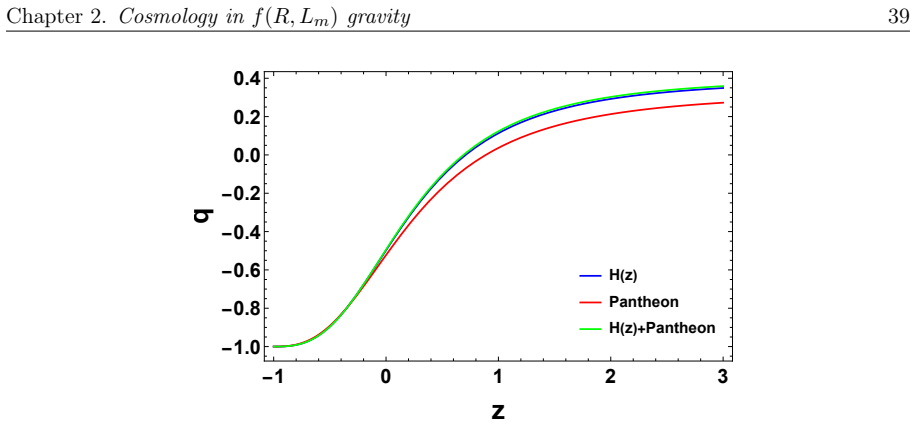
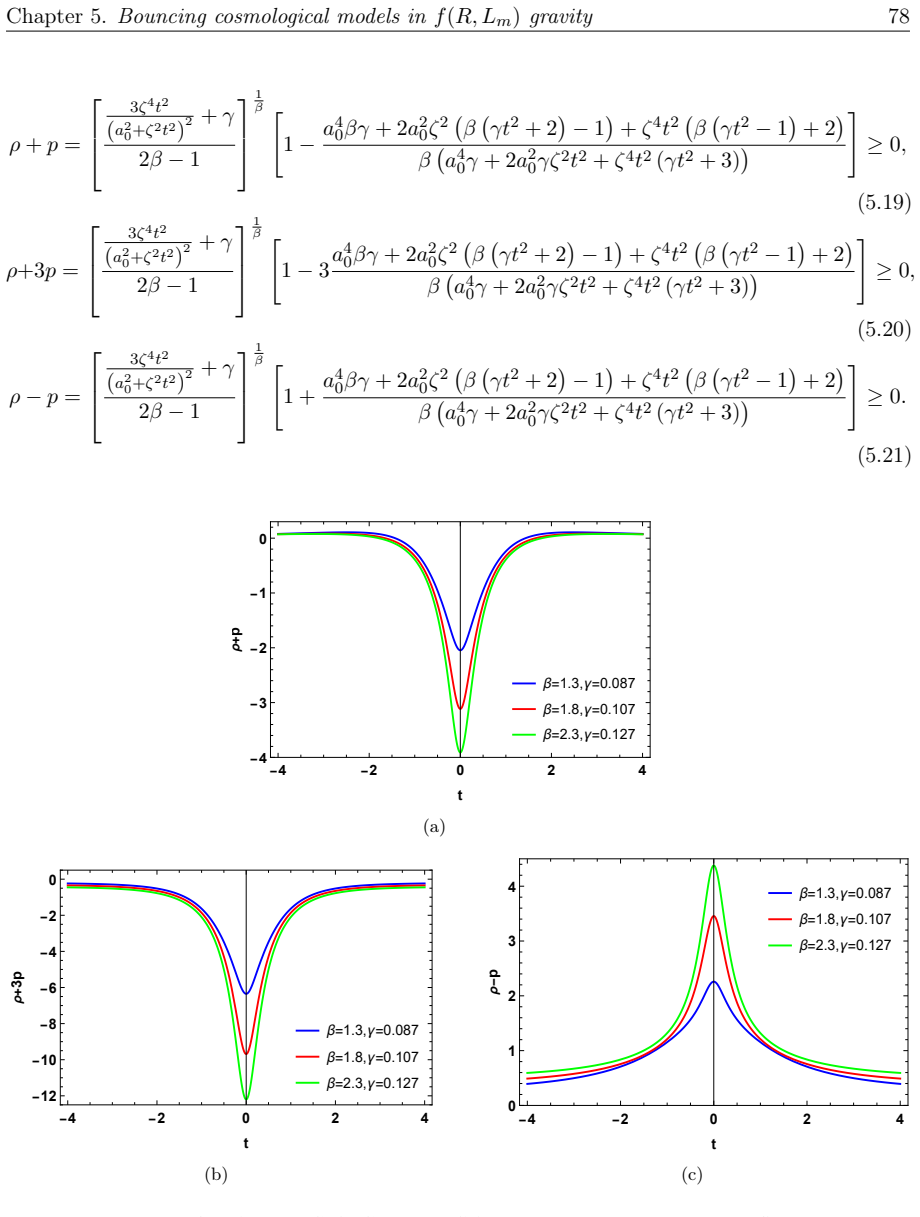
On the paper's own terms, the central discovery is that a minimal extension of the Einstein–Hilbert action in which the Lagrangian density depends jointly on $R$ and $L_m$, namely $f(R,L_m)$, is observationally viable across several independent cosmic epochs. For the model $f(R,L_m)=R/2+L_m^\alpha+\beta$, the derived Hubble rate $H(z)$ fits 57 $H(z)$ measurements and 1048 Type Ia supernovae, with best-fit $n\approx 1.07$–$1.15$ and $\beta\approx -8862$, and yields a deceleration parameter that crosses from positive to negative at $z_t\approx 0.69$–$0.89$. Using the model-independent parametrization $H(z)=H_0[(1-\zeta)+(1+z)(\zeta+\eta z)]^{1/2}$, the combined data give $H_0=71.0$, $\zeta=-0.36$, $\eta=1.3$, $q_0=-0.525$, and $z_t=0.646$, consistent with the standard cosmological model. The bulk-viscous model returns $\omega_0\approx -0.71$ and a statefinder pair $(r,s)=(0.43,0.33)$, placing the fluid in the quintessence region. The bounce chapter shows that with $a(t)=(a_0^2+\zeta^2 t^2)^{1/2}$, both nonlinear forms violate the null and strong energy conditions near the bounce while the dominant energy condition stays positive, and the second model is stable under the sound-speed criterion. Finally, with $\alpha=0.79$ and $\zeta=2$ the baryogenesis calculation yields $n_B/s\approx 7.29\times 10^{-11}$, in line with the observed value near $9\times 10^{-11}$; the generalized interaction with $\alpha=0.93$ gives $n_B/s\approx 7.01\times 10^{-11}$.
Load-bearing premise
The entire chain of Friedmann equations, $H(z)$ solutions, and baryon-to-entropy predictions assumes that the matter Lagrangian density equals the energy density, $L_m=\rho$, a choice that is conventional but not forced in curvature-matter coupling theories.
Editorial extensions
If this is right
- If the fitted $f(R,L_m)$ models are correct, the Universe's deceleration-to-acceleration transition is reproduced without a cosmological constant, with transition redshift $z_t\approx 0.65$–$0.89$ depending on dataset and model.
- The bulk-viscous $f(R,L_m)$ model predicts a present effective equation-of-state $\omega_0\approx -0.71$ and a statefinder pair $(r,s)=(0.43,0.33)$, placing the accelerated phase in the quintessence region rather than the phantom region.
- The matter-bounce solutions imply that the early Universe can pass through a non-singular bounce, with null and strong energy condition violations confined near the bounce time and the dominant energy condition satisfied, so the initial singularity is avoided.
- Gravitational baryogenesis in this framework yields a nonzero baryon-to-entropy ratio during radiation domination, roughly $7\times 10^{-11}$, consistent with big-bang nucleosynthesis and cosmic microwave background constraints for the stated parameters.
- Across all chapters the constrained parameters cluster around $H_0\approx 71$–$72$ km s$^{-1}$ Mpc$^{-1}$, placing the model between local distance-ladder and cosmic-microwave-background estimates.
Reading between the lines
- Beyond the paper: replacing the assumption $L_m=\rho$ with the equally common choice $L_m=-p$ would alter every derived expression, so a direct comparison of the two prescriptions against the same datasets would isolate how much of the claimed viability rests on that choice.
- Beyond the paper: the baryogenesis result depends on the adopted decoupling temperature $T_D$ and cutoff scale $M_*$; scanning those values would map the parameter region where $f(R,L_m)$ remains consistent with the observed baryon asymmetry.
- Beyond the paper: the fitted $H_0\approx 71$–$72$ sits between the local distance-ladder and Planck values, suggesting the framework could be tested as a resolution of the Hubble tension if the same functional forms are run against CMB and distance-ladder data jointly.
- Beyond the paper: the sound-speed stability criterion used in the bounce chapter is a necessary but not sufficient stability test; a full scalar-perturbation analysis would show whether the bouncing solutions survive as viable cosmological models.
Editorial analysis
A structured set of objections, weighed in public.
Referee Report
Summary. This thesis applies f(R,L_m) gravity to four cosmological problems: late-time acceleration (Chapters 2–4), a nonsingular matter bounce (Chapter 5), and gravitational baryogenesis (Chapter 6). For each chapter, the author derives Friedmann equations in a flat FLRW background, selects a functional form for f(R,L_m), constrains or hand-picks free parameters using H(z), Pantheon/Pantheon+SH0ES, and BAO data, and then evaluates diagnostics such as q(z), Om(z), statefinders, energy conditions, and the baryon-to-entropy ratio. The central claim is that f(R,L_m) gravity can reproduce the observed late-time acceleration, produce a phantom-like bounce, and generate n_B/s ≈ 9×10^-11. Throughout, the matter Lagrangian is set to L_m = rho with a single citation, and the parameters used for the 'predictions' are either fitted to the same data used for validation or chosen by hand.
Significance. The thesis demonstrates technical competence: the field-equation derivations follow standard variational procedures, the exact H(z) solutions are explicit, and the MCMC analyses use publicly available cosmological datasets. If the L_m = rho identification and the parameter choices were independently justified, the results would be interesting phenomenological examples of f(R,L_m) gravity. As it stands, the manuscript does not establish robust predictions: the main conclusions are contingent on a non-unique Lagrangian identification and on in-sample fitting, so the significance is illustrative rather than demonstrative. The paper would be much stronger if it tested alternative perfect-fluid Lagrangians and separated parameter estimation from model validation.
major comments (5)
- [Sec. 2.3 and repeated in Secs. 3.4, 4.3, 5.3, 6.2] The thesis sets L_m = rho for a perfect fluid, citing [166], but this is not the only standard choice. Because f_Lm and f - f_R R - f_Lm L_m appear explicitly in the field equations, choosing L_m = -rho, p, or -rho+3p changes the Friedmann equations, energy-balance equations, and the baryon-to-entropy formula. The manuscript never tests this sensitivity. This concern is load-bearing: every quantitative claim in Chapters 2–6 is derived from equations that assume L_m = rho, so the agreement with H(z), Pantheon, and n_B/s demonstrates the consistency of that identification, not the viability of f(R,L_m) gravity in general.
- [Chapter 6, Eq. (6.14) and following paragraph] The values alpha = 0.79 and zeta = 2 are chosen after the fact so that n_B/s ≈ 7.29×10^-11, and the text explicitly notes that the ratio 'can be adjusted to satisfy the observational constraints.' Calling this 'excellent agreement' is therefore not a valid test of the theory. To make a scientific claim, the model parameters must be constrained independently (e.g., by cosmological fits) and the baryon-to-entropy ratio then compared with observation, or the analysis should be presented as a parameter-space existence proof.
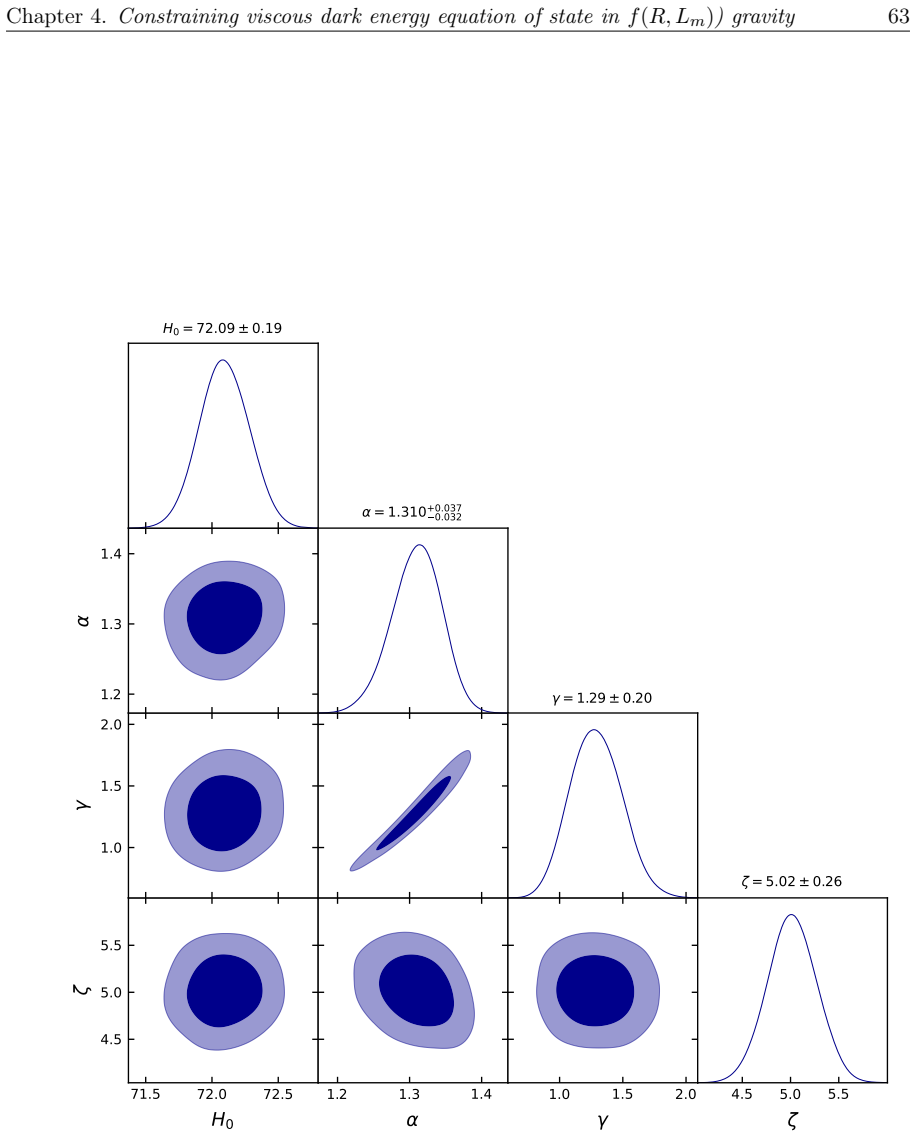
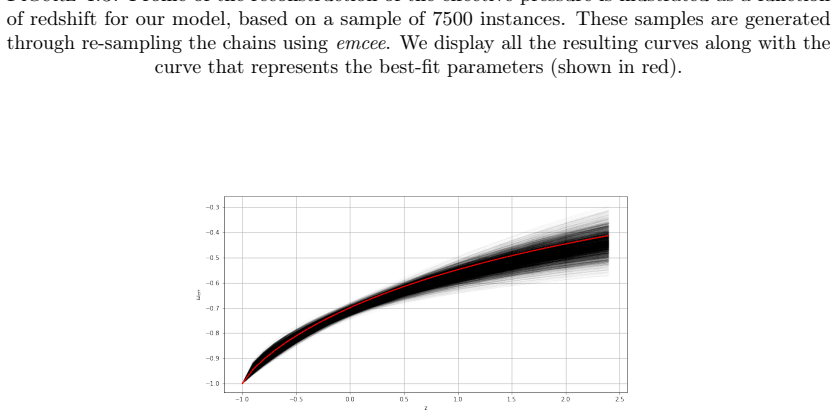
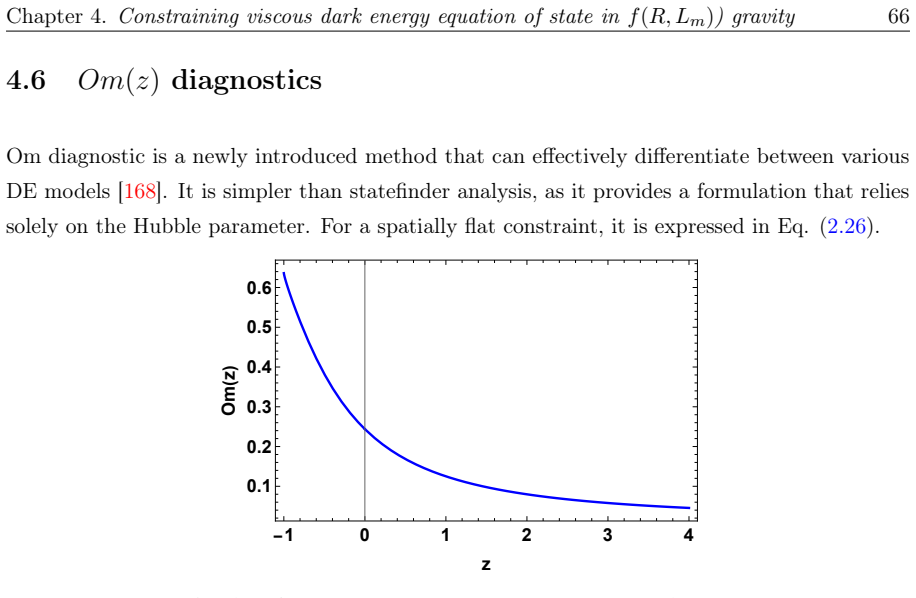
- [Chapters 2 and 4] Best-fit parameters from the same datasets are used to reconstruct q(z), Om(z), rho(z), p(z), and the effective EoS. For instance, in Sec. 2.4 the parameters n and beta are fitted to H(z)+Pantheon, and the deceleration-to-acceleration transition, stability, and Om diagnostic in Secs. 2.5–2.6 are then evaluated at those best-fit values. In Sec. 4.4 the fit to CC+Pantheon+SH0ES is followed by the reconstruction of rho, p, and omega from the same MCMC chains. These are in-sample reconstructions rather than independent tests; the manuscript should state this limitation and, if possible, add out-of-sample or cross-validation checks.
- [Sec. 3.3.1] The model-comparison statement is internally inconsistent. The text defines 'strong support' as Delta AIC < 2 and 'moderate support' as 2 < Delta BIC ≤ 6, then obtains Delta AIC = 1.83 and Delta BIC = 3.64 and concludes that the model has 'substantial support.' Moreover, BIC_model = 1672.79 is larger than BIC_LambdaCDM = 1669.15, so by the standard interpretation the data favor LambdaCDM at a moderate level. This misreading weakens the Chapter 3 claim that the parametrization is preferred over LambdaCDM.
- [Chapter 5] The bounce parameters (a0, zeta, beta, gamma, lambda, alpha) are chosen by hand, without MCMC posteriors, and the claims that the models violate NEC/SEC and are stable are based on these selected values. In particular, Eqs. (5.13)–(5.18) and Figs. 5.3–5.6 illustrate behavior for chosen parameter values; this is not a test against data. The stability conclusion using C_s^2 in Sec. 5.3.3 should also be stated more carefully: C_s^2 > 1 signals acausality or superluminal sound speed rather than mechanical instability, while C_s^2 < 0 would signal instability.
minor comments (5)
- [Sec. 3.5] The summary of the Hubble parametrization omits the eta z term from Eq. (3.1); it should read H(z) = H0[(1-zeta)+(1+z)(zeta+eta z)]^{1/2}.
- [Sec. 2.7] The text refers to the analytical solution as 'Eq. (1.25)'; the intended reference is Eq. (2.14).
- [Sec. 6.2.2] The text says 'We show n_B/s for the generalized baryogenesis interaction as a function of alpha in Fig. 1.2'; this should be Fig. 6.2.
- [Sec. 4.1] The phrase 'the density parameter is expressed as bar p = p - 3 zeta H' should read 'the effective pressure is expressed as...' to avoid confusion with the energy density rho.
- [Sec. 6.1] The description of g as the 'trace of the metric tensor' is incorrect; g denotes the determinant of the metric tensor.
Circularity Check
The baryogenesis chapter selects f(R,L_m) parameters by hand to reproduce the observed baryon-to-entropy ratio and then reports 'excellent agreement'; the rest of the thesis is standard parameter fitting, so the circularity is partial.
-
fitted input called prediction
[Chapter 6, Sec. 6.2.1, Eqs. (6.13)-(6.14) and the paragraph following Eq. (6.14)]
"As shown in Eq.(6.14), the resulting baryon-to-entropy ratio is nonzero. The ratio in Eq.(6.14) can be adjusted to satisfy the observational constraints depending on the matter content. ... Substituting g∗s = 106, gB = 1, TD = 2 × 10^12 GeV and M∗ = 2 × 10^16 GeV [267], with model parameters α = 0.79 and ζ = 2 in Eq. (6.14) the resultant baryon-to-entropy ratio reads nB/s ≃ 7.28749 × 10^−11 which is in excellent agreement with observations."
The parameters α and ζ are free parameters of the same f(R,L_m) model under test and are not constrained before the comparison. The paper explicitly states the ratio 'can be adjusted to satisfy the observational constraints,' then picks α = 0.79 and ζ = 2. Eq. (6.14) is a deterministic function of these parameters, so the resulting value ~7.3×10^-11 is forced by construction to lie near the observed ~9×10^-11. Calling this 'excellent agreement' is a tuned match, not an independent prediction; any model with two adjustable parameters could be made to hit the single observed number.
-
ansatz smuggled in via citation
[Sec. 2.3, Eqs. (2.8)-(2.9); repeated at Secs. 3.4, 4.3, 5.3, and 6.2 (Eqs. (3.17), (4.7), (5.7), (5.10), (6.8))]
"Then, for this particular f (R, Lm) model with Lm = ρ [166], the Friedmann Eqs. (2.6) and (2.7) for the matter-dominated Universe becomes 3H^2 = (2n − 1)ρ^n − β ..."
All the Friedmann equations and the baryon-to-entropy formulas (e.g., Eq. (6.4): nB/s ∝ (dot R + dot L_m)) are derived after substituting L_m = ρ, an ansatz imported via a bracket citation rather than derived from the theory. In perfect-fluid f(R,L_m) gravity, L_m is not unique: equally standard choices include L_m = −ρ, L_m = p, or L_m = −ρ + 3p. Since the field equations and the baryogenesis ratio depend explicitly on f_{L_m} and L_m, this one choice fixes the very outputs the thesis reports as predictions; another standard choice (e.g., L_m = −ρ + 3p) would make the radiation-era combination in Eq. (6.4) vanish. The results are therefore consequences of the adopted identification, not of f(R,L_m) gravity as a class.
full rationale
The thesis is mostly a standard cosmology program: choose an f(R,L_m) ansatz, fit its free parameters to H(z), Pantheon, BAO, and Pantheon+SH0ES data, and then read off derived quantities such as q(z), Om(z), energy conditions, and EoS parameters. That procedure is not circular—the fitted data are genuinely external, and quantities like q(z) are deterministic consequences of the fitted H(z) template rather than hidden inputs. The one place where a 'prediction' reduces by construction is Chapter 6: the baryon-to-entropy ratio is made to agree with observation by hand-picking α = 0.79 and ζ = 2, with the text itself acknowledging the ratio can be adjusted. This is the fitted-input-called-prediction pattern. In addition, the universal substitution L_m = ρ, justified only by citation, is load-bearing: it selects one of several perfectly-fluid matter Lagrangians and thereby determines both the Friedmann equations and the radiation-era baryogenesis signal. That makes the derived results contingent on an unvalidated input, though it is an assumption/ambiguity rather than a logical circle in the formal sense. Weighing these together, the central baryogenesis claim is partially circular, but the acceleration and bounce chapters retain independent content from their data fits, so the score is 6 rather than higher.
Assumptions & free parameters
free parameters (15)
- n (Ch2 exponent) =
1.078 (H(z)), 1.1472 (Pantheon), 1.07 (combined)
- beta (Ch2 constant) =
-8862.13 (H(z)), -8862.2 (Pantheon), -8862.103 (combined)
- H0 (Ch3) =
71 +/- 0.08
- zeta (Ch3 H-param) =
-0.36 +/- 0.033
- eta (Ch3 H-param) =
1.3 +/- 0.023
- alpha (Ch3 model I) =
0.78, 0.82, 0.86 (hand-chosen)
- lambda (Ch3 model II) =
0.6, 0.9, 1.2 (hand-chosen)
- alpha (Ch4) =
1.310 +0.037 -0.032
- gamma (Ch4 EoS) =
1.29 +/- 0.20
- zeta (Ch4 viscosity) =
5.02 +/- 0.26
- H0 (Ch4) =
72.09 +/- 0.19
- beta, gamma (Ch5 model I) =
beta 1.3-2.3, gamma 0.087-0.127
- lambda, alpha (Ch5 model II) =
lambda -0.10 to -0.20, alpha 0.5-2.5
- zeta, a0 (Ch5 bounce) =
zeta 0.624 or 0.824, a0=1
- alpha, zeta (Ch6) =
alpha=0.79 or 0.93, zeta=2
assumptions (6)
- domain assumption The Universe is described by a flat FLRW metric
- domain assumption L_m = rho (matter Lagrangian density equals energy density)
- domain assumption Perfect fluid energy-momentum tensor
- ad hoc to paper The specific functional forms of f(R,L_m) are ad hoc to this thesis
- ad hoc to paper Scale factor ansatzes in Ch5 and Ch6
- domain assumption Gravitational baryogenesis mechanism with CP-violating interaction
Cite this review
Pith. "Pith review of Study of Curvature-Matter Coupling in Modified Gravity." pith.science (2026). https://pith.science/paper/J2WNLQFO
@misc{pith2026250524470,
  author       = {Pith},
  title        = {Pith review of: Study of Curvature-Matter Coupling in Modified Gravity},
  year         = {2026},
  howpublished = {\url{https://pith.science/paper/J2WNLQFO}},
  note         = {Machine review of arXiv:2505.24470}
}
abstract
Over the past century, General Relativity (GR) has been a cornerstone of gravitational theory. However, recent cosmological observations, such as the accelerated expansion of the Universe, challenge its completeness and the standard $\Lambda$CDM model. This has motivated the development of alternative approaches, including dynamical dark energy and modifications to gravity. This thesis investigates the $f(R, L_m)$ gravity framework, which extends $f(R)$ gravity by introducing curvature-matter coupling, to address unresolved issues in modern cosmology. Chapter 1 reviews the foundations of cosmology, GR, and $\Lambda$CDM, discussing their challenges and introducing modified gravity theories. Chapter 2 studies cosmic expansion in a specific non-linear $f(R, L_m)$ model, analyzing its dynamics using updated $H(z)$ and Pantheon datasets and demonstrating a deceleration-to-acceleration transition. Chapter 3 introduces a model-independent Hubble parameter parametrization and explores cosmological variables using MCMC and combined data. Chapter 4 incorporates bulk viscosity into $f(R, L_m)$ models to explain late-time acceleration and applies Om diagnostics and energy conditions. Chapter 5 examines non-singular matter bounce cosmologies, analyzing bouncing dynamics and the evolution of cosmographic parameters. Chapter 6 addresses gravitational baryogenesis and shows how $f(R, L_m)$ gravity supports the observed baryon-to-entropy ratio. Chapter 7 summarizes the results and suggests directions for future work.
Figures


Figures from the paper (31 more)










Forward citations
Cited by 1 Pith paper
-
Transit dark energy cosmological models in generalized matter-geometry coupling theory using a non-linear form of $f(R,T,L_{m})$ function
A modified f(R,T,L_m) gravity model, fitted to CC and Pantheon data, yields an accelerating late-time universe with transition redshift near 0.6 and an effective dark energy equation of state within 1e-5 of -1.
Reference graph
Works this paper leans on
-
[166]
Harko et al.,Eur
T. Harko et al.,Eur. Phys. J. C75, 386 (2015)
2015
-
[1]
Lemaitre,Mon
G. Lemaitre,Mon. Not. Roy. Astron. Soc.91, 483 (1931)
1931
-
[2]
Einstein,Sitzber
A. Einstein,Sitzber. Preuss. Akad. Wiss.1915, 844 (1915)
1915
-
[3]
Gravitation
C. W. Misner, K. S. Thorne, J. A. Wheeler, “Gravitation”Princeton University Press, San Francisco(1973)
1973
-
[4]
Friedmann,Z
A. Friedmann,Z. Physik 10, 377 (1922)
1922
-
[5]
Lemaitre,Ann
G. Lemaitre,Ann. Scient. Soc. BrusselsA47, 49 (1927)
1927
-
[6]
Principles of Physical Cosmology
P. J. E. Peebles, “Principles of Physical Cosmology”Princeton University Press, San Francisco(1993)
1993
-
[7]
A. G. Riess et al.,Astron. J.116, 1009 (1998)
1998
Show all 278 references
-
[8]
Perlmutter et al.,Astrophys
S. Perlmutter et al.,Astrophys. J.517, 565 (1999)
1999
-
[9]
Astrophys.641, A6 (2020)
Planck Collaboration,Astron. Astrophys.641, A6 (2020)
2020
-
[10]
A. G. Riess et al.,Astrophys. J. Lett.934, L7 (2022)
2022
-
[11]
Clifton et al.,Phys
T. Clifton et al.,Phys. Rept.513, 1 (2012)
2012
-
[12]
Nojiri, S
S. Nojiri, S. D. Odintsov,Phys. Rept.505, 59 (2011)
2011
-
[13]
Capozziello, M
S. Capozziello, M. D. Laurentis,Phys. Rept.509, 167 (2011)
2011
-
[14]
C. M. Will,Living Rev. Relativ.17, 4 (2014)
2014
-
[15]
General Relativity
R. M. Wald, “General Relativity”University of Chicago Press, Chicago(1984)
1984
-
[16]
General Relativity: An Introduction for Physicists
M. P. Hobson, G. Efstathiou, A. N. Lasenby, “General Relativity: An Introduction for Physicists” Cambridge University Press, Cambridge(2006)
2006
-
[17]
D. H. Weinberg et al.,Phys. Rept.530, 87 (2013)
2013
-
[18]
D. M. Scolnic et al.,Astrophys. J.859, 101 (2018). 93 References 94
2018
-
[19]
Spacetime and Geometry: An Introduction to General Relativity
S. M. Carroll, “Spacetime and Geometry: An Introduction to General Relativity”Cambridge University Press, Cambridge(2019)
2019
-
[20]
Cosmology
S. Weinberg, “Cosmology”Oxford University Press, Oxford(2008)
2008
-
[21]
Harko, F
T. Harko, F. S. N. Lobo,Eur. Phys. J. C70, 373 (2010)
2010
-
[22]
Einstein,Sitzber
A. Einstein,Sitzber. Preuss. Akad. Wiss.142, 87 (1917)
1917
-
[23]
de Sitter,Philosophical Problems in Science63, 205 (2017)
W. de Sitter,Philosophical Problems in Science63, 205 (2017)
2017
-
[24]
de Sitter,Mon
W. de Sitter,Mon. Not. Roy. Astron. Soc.78, 3 (1917)
1917
-
[25]
Modern Geometry-Methods and Applica- tions: Part I: The Geometry of Surfaces, Transformation Groups, and Fields, 2nd edition
B. A. Dubrovin, A. T. Fomenko, S. P. Novikov, “Modern Geometry-Methods and Applica- tions: Part I: The Geometry of Surfaces, Transformation Groups, and Fields, 2nd edition” Springer, New York(1992)
1992
-
[26]
R. R. Caldwell, M. Doran,Phys. Rev. D69, 103517 (2004)
2004
-
[27]
Gravitation and cosmology: principles and applications of the general theory of relativity
S. Weinberg, “Gravitation and cosmology: principles and applications of the general theory of relativity”John Wiley and Sons(1972)
1972
-
[28]
H. P. Robertson,Astrophys. J.82, 284 (1935)
1935
-
[29]
A. G. Walker,Proc. Lon. Math. Soc.42, 90127 (1937)
1937
- [30]
-
[31]
Joyce et al.,Phys
A. Joyce et al.,Phys. Rept.568, 1 (2015)
2015
-
[32]
Astesiano, M
D. Astesiano, M. L. Ruggiero,Phys. Rev. D106, 044061 (2021)
2021
-
[33]
Katsuragawa, S
T. Katsuragawa, S. Matsuzaki,Phys. Rev. D95, 044040 (2017)
2017
-
[34]
Zaregonbadi, M
R. Zaregonbadi, M. Farhoudi, N. Riazi,Phys. Rev. D94, 084052 (2016)
2016
-
[35]
H. E. S. Velten, R. F. Vom Marttens, W. Zimdahl,Eur. Phys. J. C74, 3160 (2014)
2014
-
[36]
Di Valentino et al.,Astropart
E. Di Valentino et al.,Astropart. Phys.131, 102605 (2021)
2021
-
[37]
Di Valentino et al.,Astropart
E. Di Valentino et al.,Astropart. Phys.131, 102604 (2021)
2021
-
[38]
Joudaki et al.,Mon
S. Joudaki et al.,Mon. Not. Roy. Astron. Soc.471, 1259 (2017)
2017
-
[39]
H. A. Buchdahl,Mon. Not. Roy. Astron. Soc.150, 1 (1970)
1970
-
[40]
A. A. Starobinsky,Phys. Lett. B91, 99 (1980)
1980
-
[41]
J. D. Barrow, A. C. Ottewill,J. Phys. A: Math. Gen.16, 2757 (1983)
1983
-
[42]
P. G. Bergmann,Int. J. Theor. Phys.1, 25 (1968). References 95
1968
-
[43]
T. V. Ruzmaikina, A. A. Ruzmaikin,Sov. Phys. J. Exp. Theor. Phys.30, 372 (1970)
1970
-
[44]
B. N. Breizman, V. T. Gurovich, V. P. Sokolov,Sov. Phys. J. Exp. Theor. Phys.32, 155 (1971)
1971
-
[45]
Capozziello,Int
S. Capozziello,Int. J. Mod. Phys. D11, 483 (2002)
2002
-
[46]
Capozziello et al.,Int
S. Capozziello et al.,Int. J. Mod. Phys. D12, 1969 (2003)
2003
-
[47]
S. M. Carroll et al.,Phys. Rev. D70, 043528 (2004)
2004
-
[48]
Nojiri, S
S. Nojiri, S. D. Odintsov,Phys. Rev. D68, 123512 (2003)
2003
-
[49]
Amendola, D
L. Amendola, D. Polarski, S. Tsujikawa,Phys. Rev. Lett.98, 131302 (2007)
2007
-
[50]
Amendola, D
L. Amendola, D. Polarski, S. Tsujikawa,Int. J. Mod. Phys. D16, 1555 (2007)
2007
-
[51]
Amendola et al.,Phys
L. Amendola et al.,Phys. Rev. D75, 083504 (2007)
2007
-
[52]
Amendola, S
L. Amendola, S. Tsujikawa,Phys. Lett. B660, 125 (2008)
2008
-
[53]
S. A. Appleby, R. A. Battye,Phys. Lett. B654, 7 (2007)
2007
-
[54]
Cognola et al.,Phys
G. Cognola et al.,Phys. Rev. D77, 046009 (2008)
2008
-
[55]
Deruelle, M
N. Deruelle, M. Sasaki, Y. Sendouda,Phys. Rev. D77, 124024 (2008)
2008
-
[56]
W. Hu, I. Sawicki,Phys. Rev. D76, 064004 (2007)
2007
-
[57]
B. Li, J. D. Barrow,Phys. Rev. D75, 084010 (2007)
2007
-
[58]
E. V. Linder,Phys. Rev. D80, 123528 (2009)
2009
-
[59]
Tsujikawa,Phys
S. Tsujikawa,Phys. Rev. D77, 023507 (2008)
2008
-
[60]
Bean et al.,Phys
R. Bean et al.,Phys. Rev. D75, 064020 (2007)
2007
-
[61]
S. M. Carroll et al., New J. Phys.8, 323 (2006)
2006
-
[62]
Faulkner et al.,Phys
T. Faulkner et al.,Phys. Rev. D76, 063505 (2007)
2007
-
[63]
Pogosian, A
L. Pogosian, A. Silvestri,Phys. Rev. D77, 023503 (2008)
2008
-
[64]
Sawicki, W
I. Sawicki, W. Hu,Phys. Rev. D75, 127502 (2007)
2007
-
[65]
Y. S. Song, W. Hu, I. Sawicki,Phys. Rev. D75, 044004 (2007)
2007
-
[66]
Tsujikawa, K
S. Tsujikawa, K. Uddin, R. Tavakol,Phys. Rev. D77, 043007 (2008)
2008
-
[67]
B. Li, J. D. Barrow,Phys. Rev. D75, 084010 (2007). References 96
2007
-
[68]
Y. S. Song, H. Peiris, W. Hu,Phys. Rev. D76, 063517 (2007)
2007
-
[69]
Zhang,Phys
P. Zhang,Phys. Rev. D73, 123504 (2006)
2006
-
[70]
Schmidt,Phys
F. Schmidt,Phys. Rev. D78, 043002 (2008)
2008
-
[71]
Tsujikawa, T
S. Tsujikawa, T. Tatekawa,Phys. Lett. B665, 325 (2008)
2008
-
[72]
Brans, R
C. Brans, R. H. Dicke,Phys. Rev.124, 925 (1961)
1961
-
[73]
Chiba,Phys
T. Chiba,Phys. Lett. B575, 1 (2003)
2003
-
[74]
Ohanlon,Phys
J. Ohanlon,Phys. Rev. Lett.29, 137 (1972)
1972
-
[75]
Teyssandier, P
P. Teyssandier, P. Tourrenc,J. Math. Phys.24, 2793–2799 (1983)
1983
-
[76]
Khoury, A
J. Khoury, A. Weltman,Phys. Rev. Lett.93, 171104 (2004)
2004
-
[77]
Khoury, A
J. Khoury, A. Weltman,Phys. Rev. D69, 044026 (2004)
2004
-
[78]
Capozziello, S
S. Capozziello, S. Tsujikawa,Phys. Rev. D77, 107501 (2008)
2008
-
[79]
Brax et al.,Phys
P. Brax et al.,Phys. Rev. D78, 104021 (2008)
2008
-
[80]
Babichev, D
E. Babichev, D. Langlois,Phys. Rev. D80, 121501 (2009)
2009
-
[81]
Cartier, E
C. Cartier, E. J. Copeland, R. Madden,J. High Energy Phys.2000, 035 (2000)
2000
-
[82]
Kobayashi, K
T. Kobayashi, K. Maeda,Phys. Rev. D78, 064019 (2008)
2008
-
[83]
Kobayashi, K
T. Kobayashi, K. Maeda,Phys. Rev. D79, 024009 (2009)
2009
-
[84]
Tsujikawa, T
S. Tsujikawa, T. Tamaki, R. Tavakol,J. Cosmol. Astropart. Phys.2009, 020 (2009)
2009
-
[85]
Upadhye, W
A. Upadhye, W. Hu,Phys. Rev. D80, 064002 (2009)
2009
-
[86]
A. V. Frolov,Phys. Rev. Lett.101, 061103 (2008)
2008
-
[87]
Bertolami et al.,Phys
O. Bertolami et al.,Phys. Rev. D75, 104016 (2007)
2007
-
[88]
Harko,Phys
T. Harko,Phys. Lett. B669, 376 (2008)
2008
-
[89]
Koivisto,Class
T. Koivisto,Class. Quantum Grav.23, 4289 (2006)
2006
-
[90]
M. A. Milgrom,Astrophys. J.270, 365–370 (1983)
1983
-
[91]
J. D. Bekenstein,Phys. Rev. D70, 083509 (2004)
2004
-
[92]
C. M. Will,Living Rev. Relativ.9, 3 (2006)
2006
-
[93]
Harko, F
T. Harko, F. S. N. Lobo,Phys. Rev. D86, 124034 (2012). References 97
2012
-
[94]
Statistical Physics: Part I: 3rd edition
L. D. Landau, E. M. Lifshitz, “Statistical Physics: Part I: 3rd edition” Butterworth- Heinemann, Oxford(1980)
1980
-
[95]
The Large Scale Structure of Space-Time
S. Hawking, G. F. R. Ellis, “The Large Scale Structure of Space-Time”Cambridge University Press, Cambridge(1973)
1973
-
[96]
Brevik,Entropy, 2012, 2302 (2012)
I. Brevik,Entropy, 2012, 2302 (2012)
2012
-
[97]
Brevik, O
I. Brevik, O. Gron,Astrophys. Space Sci.347, 399 (2013)
2013
-
[98]
I. Bars, S. H. Chen, N. Turok,Phys. Rev. D84, 083513 (2011)
2011
-
[99]
J. D. Haro, Y. F. Cai,Gen. Rel. Grav.47, 95 (2015)
2015
-
[100]
A. D. Sakharov,J. Exp. Theor. Phys. Lett.2, 24 (1967)
1967
-
[101]
Dark Energy
M. Li, et al., “Dark Energy”Peking University Press, Singapore(2014)
2014
-
[102]
PracticalMathematicalOptimization: AnIntroductiontoBasicoptimization Theory and Classic and New Gradient Based Algorithms
J.A.Snyman, “PracticalMathematicalOptimization: AnIntroductiontoBasicoptimization Theory and Classic and New Gradient Based Algorithms”Springer, New York(2005)
2005
-
[103]
Pearson,Nature 72, 294 (1905)
K. Pearson,Nature 72, 294 (1905)
1905
-
[104]
Information Theory, Inference, and Learning Algorithms
D. MacKay, “Information Theory, Inference, and Learning Algorithms”Cambridge Univer- sity Press, Cambridge(2003)
2003
-
[105]
D. F. Mackey et al.,Publ. Astron. Soc. Pac.125, 306 (2013)
2013
-
[106]
Stern et al.,J
D. Stern et al.,J. Cosmol. Astropart. Phys.02, 008 (2010)
2010
-
[107]
Simon, L
J. Simon, L. Verde, R. Jimenez,Phys. Rev. D71, 123001 (2005)
2005
-
[108]
Moresco et al.,J
M. Moresco et al.,J. Cosmol. Astropart. Phys.08, 006 (2012)
2012
-
[109]
Zhang et al.,Res
C. Zhang et al.,Res. Astron. Astrophys.14, 1221 (2014)
2014
-
[110]
Moresco et al.,J
M. Moresco et al.,J. Cosmol. Astropart. Phys.05, 014 (2016)
2016
-
[111]
A. L. Ratsimbazafy et al.,Mon. Not. Roy. Astron. Soc.467, 3239 (2017)
2017
-
[112]
Moresco,Mon
M. Moresco,Mon. Not. Roy. Astron. Soc. Lett.450, L16 (2015)
2015
-
[113]
Hillebrandt, J
W. Hillebrandt, J. C. Niemeyer,Ann. Rev. Astron. Astrophys.38, 191 (2000)
2000
-
[114]
Leibundgut et al.,Astrophys
B. Leibundgut et al.,Astrophys. J.466, L21 (1996)
1996
-
[115]
Perlmutter et al.,Astrophys
S. Perlmutter et al.,Astrophys. J.483, 565 (1997)
1997
-
[116]
Leibundgut,Ann
B. Leibundgut,Ann. Rev. Astron. Astrophys.39, 67 (2001)
2001
-
[117]
J. A. Holtzman et al.,Astron. J.136, 2306 (2008). References 98
2008
-
[118]
Kessler et al.,Astrophys
R. Kessler et al.,Astrophys. J. Suppl.185, 32 (2009)
2009
-
[119]
Leaman et al.,Mon
J. Leaman et al.,Mon. Not. Roy. Astron. Soc.412, 1419 (2011)
2011
-
[120]
W. D. Li et al.,Mon. Not. Roy. Astron. Soc.412, 1441 (2011)
2011
-
[121]
Folatelli et al.,Astron
G. Folatelli et al.,Astron. J.139, 120 (2010)
2010
-
[122]
Folatelli et al.,Astron
G. Folatelli et al.,Astron. J.139, 519 (2010)
2010
-
[123]
Copin et al.,New Astron
Y. Copin et al.,New Astron. Rev.50, 436 (2006)
2006
-
[124]
R. A. Scalzo et al.,Astrophys. J.713, 1073 (2009)
2009
-
[125]
Astier et al.,Astron
P. Astier et al.,Astron. Astrophys.447, 31 (2006)
2006
-
[126]
Baumont et al.,Astron
S. Baumont et al.,Astron. Astrophys.491, 567 (2008)
2008
-
[127]
A. G. Riess et al.,Astrophys. J.607, 665 (2004)
2004
-
[128]
A. G. Riess et al.,Astrophys. J.659, 98 (2007)
2007
-
[129]
Gaztaaga, A
E. Gaztaaga, A. Cabre, L. Hui,Mon. Not. Roy. Astron. Soc.399, 1663 (2009)
2009
-
[130]
Oka et al.,Mon
A. Oka et al.,Mon. Not. Roy. Astron. Soc.439, 2515 (2014)
2014
-
[131]
Wang et al.,Mon
Y. Wang et al.,Mon. Not. Roy. Astron. Soc.469, 3762 (2017)
2017
-
[132]
C. H. Chuang, Y. Wang,Mon. Not. Roy. Astron. Soc.435, 255 (2013)
2013
-
[133]
Alam et al.,Mon
S. Alam et al.,Mon. Not. Roy. Astron. Soc.470, 2617 (2017)
2017
-
[134]
Blake et al.,Mon
C. Blake et al.,Mon. Not. Roy. Astron. Soc.425, 405 (2012)
2012
-
[135]
C. H. Chuang et al.,Mon. Not. Roy. Astron. Soc.433, 3559 (2013)
2013
-
[136]
Anderson et al.,Mon
L. Anderson et al.,Mon. Not. Roy. Astron. Soc.441, 24 (2014)
2014
-
[137]
N. G. Busca et al.,Astron. Astrophys.552, A96 (2013)
2013
-
[138]
J. E. Bautista et al.,Astron. Astrophys.603, A12 (2017)
2017
-
[139]
Delubac et al.,Astron
T. Delubac et al.,Astron. Astrophys.574, A59 (2015)
2015
-
[140]
A. F. Ribera et al.,J. Cosmol. Astropart. Phys.05, 027 (2014)
2014
-
[141]
WMAP Collaboration,Astrophys. J. Suppl.148, 175 (2003)
2003
-
[142]
Koivisto, D.F
T. Koivisto, D.F. Mota,Phys. Rev. D73, 083502 (2006)
2006
-
[143]
S. F. Daniel,Phys. Rev. D77, 103513 (2008). References 99
2008
-
[144]
Capozziello et al.,Phys
S. Capozziello et al.,Phys. Lett. B639, 135 (2006)
2006
-
[145]
Faraoni,Phys
V. Faraoni,Phys. Rev. D74, 023529 (2006)
2006
-
[146]
P. J. Zhang,Phys. Rev. D76, 024007 (2007)
2007
-
[147]
T. Liua, X. Zhanga, W. Zhaoa,Phys. Lett. B777, 286 (2018)
2018
-
[148]
A. A. Starobinsky,J. Exp. Theor. Phys. Lett.86, 157 (2007)
2007
-
[149]
Nojiri, S
S. Nojiri, S. D. Odintsov,Phys. Lett.B657, 238 (2007)
2007
-
[150]
Nojiri, S
S. Nojiri, S. D. Odintsov,Phys. Rev. D77, 026007 (2008)
2008
-
[151]
Santos et al.,Phys
J. Santos et al.,Phys. Rev. D76, 083513 (2007)
2007
-
[153]
R. C. Nunes et al.,J. Cosmol. Astropart. Phys.2017(01), 005 (2017)
2017
-
[154]
Harko,Phys
T. Harko,Phys. Rev. D81, 084050 (2010)
2010
-
[155]
Harko,Phys
T. Harko,Phys. Rev. D81, 044021 (2010)
2010
-
[156]
Nesseris,Phys
S. Nesseris,Phys. Rev. D79, 044015 (2009)
2009
-
[157]
Faraoni,Phys
V. Faraoni,Phys. Rev. D76, 127501 (2007)
2007
-
[158]
Faraoni,Phys
V. Faraoni,Phys. Rev. D80, 124040 (2009)
2009
-
[159]
J. Wang, K. Liao,Class. Quantum Grav.29, 215016 (2012)
2012
-
[160]
R. V. Labato et al.,Eur. Phys. J. C82, 540, (2022)
2022
-
[161]
R. V. Labato, G.A. Carvalho, C. A. Bertulani,Eur. Phys. J. C81, 1013 (2021)
2021
-
[162]
Pradhan et al.,Int
A. Pradhan et al.,Int. J. Geom. Meth. Mod. Phys.20, 2350105, (2023)
2023
-
[163]
Solanki, Z
R. Solanki, Z. Hassan, P. K. Sahoo,Chin. J. Phys.85, 74 (2023)
2023
-
[164]
Introduction to Cosmology
B. Ryden, “Introduction to Cosmology”Addison Wesley, SanFrancisco(2003)
2003
-
[165]
Harko, F
T. Harko, F. S. N. Lobo,Galaxies 2014, 410 (2014)
2014
-
[167]
G. S. Sharov, V. O. Vasiliev,Math. Model. Geom.6, 1 (2018)
2018
-
[168]
Sahni, A
V. Sahni, A. Shafieloo, A. A. Starobinsky,Phys. Rev. D78, 103502 (2008)
2008
-
[169]
S. K. J. Pacif, R. Myrzakulov, S. Myrzakul,Int. J. Geom. Meth. Mod. Phys.14, 7 (2017). References 100
2017
-
[170]
S. K. J. Pacif,Eur. Phys. J. Plus135, 10 (2020)
2020
-
[171]
Koussour et al.,Fortschr
M. Koussour et al.,Fortschr. Phys.71, 2200172 (2023)
2023
-
[172]
Shafieloo, A
A. Shafieloo, A. G. Kim, E. V. Linder,Phys. Rev. D87, 023520 (2013)
2013
-
[173]
C. E. Rivera, A. Najera,J. Cosmol. Astropart. Phys.03, 060 (2022)
2022
-
[174]
Banerjee, S
N. Banerjee, S. Das,Gen. Rel. Grav.37, 1695 (2005)
2005
-
[175]
J. V. Cunha, J. A. S. Lima,Mon. Not. Roy. Astr. Soc.390, 210 (2008)
2008
-
[176]
Arora et al.,Eur
D. Arora et al.,Eur. Phys. J. Plus139 371 (2024)
2024
-
[177]
M Koussour, S. H. Shekh, M. Bennai,J. High Energ. Phys.35, 43, (2022)
2022
-
[178]
Brout et al.,Astrophys
D. Brout et al.,Astrophys. J.938, 110 (2022)
2022
-
[179]
Brout et al.,Astrophys
D. Brout et al.,Astrophys. J.938, 111 (2022)
2022
-
[180]
Scolnic et al.,Astrophys
D. Scolnic et al.,Astrophys. J.938, 113 (2022)
2022
-
[181]
Perivolaropoulos, F
L. Perivolaropoulos, F. Skara,Mon. Not. Roy. Astron. Soc.520, 5110 (2023)
2023
-
[182]
A. R. Liddle,Mon. Not. Roy. Astron. Soc.377, L74 (2007)
2007
-
[183]
Solanki et al.,Commun
R. Solanki et al.,Commun. Theor. Phys.75, 075401 (2023)
2023
-
[184]
Raychaudhuri,Phys
A. Raychaudhuri,Phys. Rev.98, 1123 (1955)
1955
-
[185]
Ehlers,Int
J. Ehlers,Int. J. Mod. Phys. D15, 1573 (2006)
2006
-
[186]
Nojiri, S
S. Nojiri, S. D. Odintsov,Int. J. Geom. Meth. Mod. Phys.4, 115 (2007)
2007
-
[187]
Barcelo, M
C. Barcelo, M. Visser,Int. J. Mod. Phys. D11, 1553 (2002)
2002
-
[188]
P. H. R. S. Moraes, P. K. Sahoo,Eur. Phys. J. C77, 480 (2017)
2017
-
[189]
Visser,Phys
M. Visser,Phys. Rev. D 56, 7578 (1997)
1997
-
[190]
Myrzakulova, M
S. Myrzakulova, M. Koussour, N. Myrzakulov,Phys. Dark Univ.43, 101399 (2024)
2024
-
[191]
Hinshaw et al.,Astron
G. Hinshaw et al.,Astron. J. Supp. Series208, 19 (2013)
2013
-
[192]
Aghanim et al.,Astron
N. Aghanim et al.,Astron. Astrophys.A1, 641 (2020)
2020
-
[193]
F. B. M. D. Santos,J. Cosmol. Astropart. Phys.06, 039 (2023)
2023
-
[194]
Subramaniam et al.,Phys
G. Subramaniam et al.,Phys. Dark Univ.41, 101243 (2023)
2023
-
[195]
Brevik et al.,Int
I. Brevik et al.,Int. J. Mod. Phys. D26, 1730024 (2017). References 101
2017
-
[196]
Brevik, A
I. Brevik, A. N. Makarenko, A. V. Timoshkin,Int. J. Geom. Meth. Mod. Phys.16, 1950150 (2019)
2019
-
[197]
Brevik, B
I. Brevik, B. D. Normann,Symmetry 2020, 1085 (2020)
2020
-
[198]
N. D. J. Mohan, A. Sasidharan, T. K. Mathew,Eur. Phys. J. C77, 849 (2017)
2017
-
[199]
A. V. Astashenok, S. D. Odintsov, A. S. Tepliakov,Nucl. Phys. B974, 115646 (2022)
2022
-
[200]
Sasidharan, T
A. Sasidharan, T. K. Mathew,Eur. Phys. J. C75, 348 (2015)
2015
-
[201]
J. Ren, X. H. Meng,Phys. Lett. B633, 1 (2006)
2006
-
[202]
Brevik, O
I. Brevik, O. Gorbunova,Gen. Rel. Grav.37, 2039 (2005)
2005
-
[203]
Gron,Astrophys
O. Gron,Astrophys. Sci.173, 191-225 (1990)
1990
-
[204]
Eckart,Phys
C. Eckart,Phys. Rev.58, 919 (1940)
1940
-
[205]
S. D. Odintsov, D. S. C. Gomez, G. S. Sharov,Phys. Rev. D101, 044010 (2020)
2020
-
[206]
J. C. Fabris, S. V. B. Goncalves, R. S. Ribeiro,Gen. Rel. Grav.3, 495 (2006)
2006
-
[207]
X. H. Meng, X. Dou,Comm. Theor. Phys.52, 377 (2009)
2009
-
[208]
A. Bose, G. Sardar, S. Chakraborty,Phys. Dark Univ.37, 101087 (2022)
2022
-
[209]
Sahni et al.,J
V. Sahni et al.,J. Exp. Theor. Phys. Lett.77, 201 (2003)
2003
-
[210]
Sahoo et al.,Mod
P. Sahoo et al.,Mod. Phys. Lett. A2050095, 14 (2020)
2020
-
[211]
Kobayashi,Phys
T. Kobayashi,Phys. Rev. D94, 043511 (2016)
2016
-
[212]
Mandal et al.,Eur
S. Mandal et al.,Eur. Phys. J. Plus136, 760 (2021)
2021
-
[213]
Zubair, M
M. Zubair, M. Farooq,Eur. Phys. J. Plus138, 173 (2023)
2023
-
[214]
Bhattacharjee, P
S. Bhattacharjee, P. K. Sahoo,Phys. Dark Univ.28, 100537 (2020)
2020
-
[215]
Yousaf et al.,Phys
Z. Yousaf et al.,Phys. Scr.98, 035002 (2023)
2023
-
[216]
Barragan et al.,Phys
C. Barragan et al.,Phys. Rev. D80, 024016 (2009)
2009
-
[217]
N. Paul, S. N. Chakrabarty, K. Bhattacharya,J. Cosmol. Astropart. Phys.10, 009 (2014)
2014
-
[218]
S. D. Odintsov, V. K. Oikonomou,Phys. Rev. D90, 124083 (2014)
2014
-
[219]
Myrzakulov, L
R. Myrzakulov, L. Sebastiani,Astrophys. Space Sci.352, 281 (2014)
2014
-
[220]
S. D. Odintsov, V. K. Oikonomou,Phys. Rev. D92, 024016 (2015). References 102
2015
-
[221]
Ilyas, W
M. Ilyas, W. U. Rahman,Eur. Phys. J. C81, 160 (2021)
2021
-
[222]
A. R. Amani,Int. J. Mod. Phy. D25, 1650071 (2016)
2016
-
[223]
S. D. Odintsov, V. K. Oikonomou,Phys. Rev. D93, 023517 (2016)
2016
-
[224]
J. K. Singh et al.,Annals Phys.455, 169382 (2023)
2023
-
[225]
J. K. Singh et al.,J. High Energ. Phys.2023, 191 (2023)
2023
-
[226]
Banerjee, T
I. Banerjee, T. Paul, S. Sengupta,Gen. Rel. Grav.54, 119 (2022)
2022
-
[227]
Caruana, G
M. Caruana, G. Farrgia, J. Levi Said,Eur. Phys. J. C80, 640 (2020)
2020
-
[228]
Visser,Class
M. Visser,Class. Quantum Grav.21, 2063 (2004)
2004
-
[229]
Alam et al.,Mon
U. Alam et al.,Mon. Not. Roy. Astron. Soc.344, 1057 (2003)
2003
-
[230]
Capozziello, V
S. Capozziello, V. F. Cardone, A. Troisi,J. Cosmol. Astropart. Phys.08, 001 (2006)
2006
-
[231]
Capozziello, V
S. Capozziello, V. F. Cardone, V. Salzano,Phys. Rev. D78, 063504 (2008)
2008
-
[232]
Aviles et al.,Phys
A. Aviles et al.,Phys. Rev. D84, 103520 (2011)
2011
-
[233]
Salehi, M
A. Salehi, M. R. Setare,Gen. Rel. Grav.49, 147 (2017)
2017
-
[234]
Mandal et al.,Phys
S. Mandal et al.,Phys. Dark Univ.28, 100551 (2020)
2020
-
[235]
Chaichian, A
M. Chaichian, A. Ghale, M. Oksanen,Phys. Rev. D107, 023527 (2023)
2023
-
[236]
A. S. Koshelev, A. A. Starobinsky, A. TokarevaPhys. Lett. B838, 137686 (2023)
2023
-
[237]
Manzoor, W
R. Manzoor, W. Shahid,Phys. Dark Univ.33, 100844 (2021)
2021
-
[238]
Capozziello et al.,Phys
S. Capozziello et al.,Phys. Lett. B781, 9 (2018)
2018
-
[239]
Mandal, P
S. Mandal, P. K. Sahoo, J. R. L. Santos,Phys. Rev. D102, 024057 (2020)
2020
-
[240]
Sudarsky,Class
D. Sudarsky,Class. Quantum Grav.12, 579 (1995)
1995
-
[241]
T. C. Charters, A. Nunes, J. P. Mimoso,Class. Quantum Grav.18, 1703 (2001)
2001
-
[242]
Farajollahi, A
H. Farajollahi, A. Salehi,J. Cosmol. Astropart. Phys.07, 36 (2011)
2011
-
[243]
Burles, K
S. Burles, K. M. Nollett, M. S. Turner,Phys. Rev. D63, 063512 (2001)
2001
-
[244]
E. D. Stewart, M. Kawasaki, T. Yanagida,Phys. Rev. D54, 6032 (1996)
1996
-
[245]
Yamada,Phys
M. Yamada,Phys. Rev. D93, 083516 (2016)
2016
-
[246]
Akita, T.Kobayashi, H
K. Akita, T.Kobayashi, H. Otsuka,J. Cosmol. Astropart. Phys.2017, 42 (2017). References 103
2017
-
[247]
Takahashi, M
F. Takahashi, M. Yamaguchi,Phys. Rev. D4, 083506 (2004)
2004
-
[248]
R. H. Brandenberge, M. Yamaguchi,Phys. Rev. D68, 023505 (2003)
2003
-
[249]
A. D. Simone et al.,J. Cosmol. Astropart. Phys.8, 52 (2016)
2016
-
[250]
Trodden,Rev
M. Trodden,Rev. Mod. Phys.71, 1463 (1999)
1999
-
[251]
D. E. Morrissey, M. J. Ramsey-Musolf,New J. Phys.14, 125003 (2012)
2012
-
[252]
E. W. Kolb, A. Linde, A. Riotto,Phys. Rev. Lett.77, 4290 (1996)
1996
-
[253]
A. D. Dolgov,Phys. Rev. D24, 1042 (1981)
1981
-
[254]
Lambiase, G
G. Lambiase, G. Scarpetta,Phys. Rev. D74, 087504 (2006)
2006
-
[255]
Ramos, J
M. Ramos, J. Paramos,Phys. Rev. D96, 104024 (2017)
2017
-
[256]
S. D. Odintsov, V. K. Oikonomou,Phys. Lett. B760, 259 (2016)
2016
-
[257]
M. C. Bento, R. G. Felipe, N. M. C. SantosPhys. Rev. D71, 123517 (2005)
2005
-
[258]
V. K. Oikonomou, E. N. Saridakis,Phys. Rev. D94, 124005 (2016)
2016
-
[259]
Bhattacharjee,Int
S. Bhattacharjee,Int. J. Mod. phys. A36, 2150200 (2021)
2021
-
[260]
Bhattacharjee,Phys
S. Bhattacharjee,Phys. Dark Univ.30, 100612 (2020)
2020
-
[261]
Nozari, F
K. Nozari, F. Rajabi,Commun. Theor. phys.70, 451 (2018)
2018
-
[262]
E. H. Baffou at el.,Eur. Phys. J. C112, 112 (2019)
2019
-
[263]
P. K. Sahoo, S. Bhattacharjee,Int. J. Theor. Phys.59, 1451 (2020)
2020
-
[264]
Saleem, A
R. Saleem, A. Saleem,Eur. Phys. J. C137, 961 (2022)
2022
-
[265]
Azhar, A
N. Azhar, A. Jawad, S. Rani,Phys. Dark Univ.30, 100724 (2020)
2020
-
[266]
Bhattacharjee, P
S. Bhattacharjee, P. K. Sahoo,Eur. Phys. J. C 80, 289 (2020)
2020
-
[267]
Lambiase S
G. Lambiase S. Mohanty, A. R. Prasanna,Int. J. Mod. Phys. D22, 1330030 (2013). List of Publications Thesis Publications
2013
-
[268]
Jaybhaye, R
Lakhan V. Jaybhaye, R. Solanki, S. Mandal, P. K. Sahoo,Cosmology inf (R, Lm) gravity, Physics Letters B,831, 137148 (2022)
2022
-
[269]
Jaybhaye, R
Lakhan V. Jaybhaye, R. Solanki, P. K. Sahoo,Late time cosmic acceleration through parametrization of Hubble parameter inf (R, Lm) gravity, Physics of the Dark Universe, 46, 101639 (2024)
2024
-
[270]
Jaybhaye, R
Lakhan V. Jaybhaye, R. Solanki, S. Mandal, P. K. Sahoo,Constraining viscous dark energy equation of state inf (R, Lm)) gravity, Universe,9, 163 (2023)
2023
-
[271]
Jaybhaye, R
Lakhan V. Jaybhaye, R. Solanki, P. K. Sahoo,Bouncing cosmological models inf (R, Lm) gravity, Physica Scripta,99, 065031 (2024)
2024
-
[272]
Jaybhaye, S
Lakhan V. Jaybhaye, S. Bhattacharjee, P. K. Sahoo,Baryogenesis in f (R, Lm) gravity, Physics of the Dark Universe,40, 101223 (2023). Other Publications
2023
-
[273]
Jaybhaye, S
Lakhan V. Jaybhaye, S. Mandal, P. K. Sahoo,Constraints on Energy Conditions in f (R, Lm) Gravity, International Journal of Geometric Methods in Modern Physics,19, 2250050 (2021)
2021
-
[274]
Solanki, B
R. Solanki, B. Patel,Lakhan V. Jaybhaye, P. K. Sahoo,Cosmic acceleration with bulk viscosity in an anisotropicf (R, Lm) background. Communications in Theoretical Physics, 75(7), 075401 (2023)
2023
-
[275]
Jaybhaye, M
Lakhan V. Jaybhaye, M. Tayde, P. K. Sahoo,Wormhole solutions under the effect of dark matter inf (R, Lm) gravity, Communications in Theoretical Physics,76(5), 055402 (2024). 104 Paper presented at conferences
2024
-
[276]
Cosmology in f (R, Lm) gravity
Presented research paper entitled “Cosmology in f (R, Lm) gravity” at the conference “In- ternational Conference on Mathematical Sciences and Its Applications” organized by the School of Mathematical Sciences, Swami Ramanand Teerth Marathwada University, Nanded, Maharashtra, d...
2022
-
[277]
Constraining viscous dark energy equation of state in f (R, Lm) gravity
Presented research paper poster with flash talk entitled “Constraining viscous dark energy equation of state in f (R, Lm) gravity” at the conference “32nd meeting of Indian Association for General Relativity and Gravitation (IAGRG32)” organized by the Indian Institute of Scien...
2022
-
[278]
Baryogenesis in f (R, Lm) gravity
Presented research paper entitled “Baryogenesis in f (R, Lm) gravity” at the conference “Envisioning Mathematics Education in Line with NEP 2020” organized by the Ma- hatma Gandhi Mahavidyalaya, Ahmedpur, Maharashtra, during the period21th December, 2023
2020
-
[279]
Late time cosmic acceleration through parametrization of Hubble parameter inf (R, Lm) gravity
Presented research paper entitled “Late time cosmic acceleration through parametrization of Hubble parameter inf (R, Lm) gravity” at the conference “31st International Conference of International Academy of Physical Sciences” organized by the Pt. Ravishankar Shukla University,...
2024
Reviewed August 7, 2026 · model on record in the stance chip above.
Discussion (0). Sign in to comment.