REVIEW 4 major objections 7 minor 1 cited by
SPPSFormer: High-quality Superpoint-based Transformer for Roof Plane Instance Segmentation from Point Clouds
T0 review · 4 major / 7 minor · reviewed 2026-08-07 · deepseek-v4-flash
Pith's one-line read SPPSFormer claims state-of-the-art roof plane instance segmentation on RoofN3D and Building3D by combining two-stage high-quality superpoint generation with a superpoint Transformer, handcrafted features, a FourierKAN-augmented decoder…
desk verdict Useful superpoint-generation trick and an interesting boundary-robustness result, but the SOTA claim depends on author-produced labels that need independent verification. read the letter →
The pith
A machine-rendered reading of the paper's core claim, the machinery that carries it, and where it could break.
The reading
What carries the argument
The central object is the high-quality superpoint, a spatially coherent point group that does not mix instances at boundaries and is roughly uniform in size and shape, so the Transformer sees consistent input tokens. The load-bearing mechanism is the two-stage generation pipeline: coarse region growing with strict parameters plus local boundary relabeling, then K-means splitting of each coarse superpoint and of the unfitted noise set into a target number of clusters determined by a desired average points-per-superpoint. The decoder replaces the mask-branch MLP with FourierKAN, and traditional postprocessing, self-supervised plane completion that infers region-growing thresholds from already segmented planes plus a composite-distance boundary refinement, corrects the network outputs.
What would settle it
If an independent group reannotates RoofN3D and Building3D test sets following only geometric plane definitions, with annotators blind to algorithm outputs, and the reported Cov/WCov advantage of SPPSFormer over DeepRoofPlane shrinks or reverses on those independently labeled sets, the claim of general superiority would be falsified. A second falsifier: corrupting training-set boundary labels with a different protocol, such as symmetric label noise across all instances, and showing that SPPSFormer's Cov drop exceeds the reported small decline would falsify the boundary-insensitivity claim.
Extended reading notes
Core claim
SPPSFormer is a superpoint Transformer whose two-stage superpoint generation first produces boundary-accurate superpoints via region growing plus local boundary optimization, then splits them with K-means to enforce uniform size and shape. Feeding these superpoints into a 3D U-Net with handcrafted features and a FourierKAN-Transformer decoder, followed by self-supervised plane completion and efficient boundary refinement, achieves state-of-the-art coverage, weighted coverage, F1, and accuracy on the original and reannotated RoofN3D test sets and on the authors' Building3D roof-plane dataset. Critically, the paper claims the model is largely insensitive to plane-boundary annotation errors in the training set: retraining with boundary labels randomly swapped between nearby planes drops DeepRoofPlane's performance sharply while SPPSFormer degrades only slightly. The paper also reports that reducing point density, increasing density variation, or degrading 3D point precision on Building3D substantially lowers accuracy for both methods, with SPPSFormer consistently ahead.
Load-bearing premise
The state-of-the-art result depends on the correctness and impartiality of the evaluation labels, because the authors reannotated RoofN3D test samples they judged erroneous and annotated the Building3D test set themselves from wireframes.
Editorial extensions
If this is right
- Roof-plane segmentation accuracy on RoofN3D and Building3D should be reproducible at the reported SOTA level from the released code, trained models, and datasets.
- Training sets for plane instance segmentation need only accurate plane main bodies, not fine boundary labels, which cuts annotation cost substantially.
- Point cloud quality factors, density level, density uniformity, and point precision, should be treated as first-order experimental variables, and augmentations simulating these degradations should improve robustness on low-quality lidar.
- The two superpoint criteria and the two-stage generation recipe can be transferred to other superpoint Transformer instance segmentation tasks.
Reading between the lines
- Editorial: The reported gains over DeepRoofPlane may partly reflect label alignment, because the authors reannotated RoofN3D samples they judged erroneous and annotated the Building3D test set themselves; an independent third-party labeling study would separate method quality from label preference.
- Editorial: The self-supervised plane completion module assumes the network already segmented most planes correctly; its margin over no postprocessing should be measured on low-quality subsets rather than averaged over the full test set to test this assumption.
- Editorial: The FourierKAN benefit could be sharpened by comparing against an MLP of matched parameter count and depth under the same superpoint generation, since the ablation changes architecture while keeping the rest of the pipeline fixed.
- Editorial: A testable extension is applying the same two-stage superpoint generation to generic indoor instance segmentation benchmarks, which would show whether the size and shape uniformity criterion transfers beyond roofs.
Editorial analysis
A structured set of objections, weighed in public.
Referee Report
Summary. The paper proposes SPPSFormer, a superpoint Transformer for roof plane instance segmentation from point clouds. Its main contributions are: (1) two explicit quality criteria for superpoints and a two-stage generation process combining region growing, local boundary refinement, and K-means; (2) incorporation of handcrafted geometric features (linearity, planarity, scattering, verticality, contour) at the network input; (3) a FourierKAN-based decoder combined with a Transformer; and (4) two algorithm-based postprocessing modules, self-supervised plane completion and boundary refinement. The authors annotated 10,539 buildings from Building3D and corrected RoofN3D annotations. They report state-of-the-art results on the original and reannotated RoofN3D test sets and on Building3D, and they present robustness experiments with boundary-corrupted training annotations and degraded point-cloud quality.
Significance. If the results hold, this is a practically useful contribution for building reconstruction and rooftop photovoltaic planning. The internal evidence is generally strong: the no-improvement ablation row in Table IVa exactly reproduces the SPFormer baseline in Table I, the ablation directions are consistent, and the degradation and boundary-corruption experiments are comprehensive and clearly show advantages over DeepRoofPlane. The two-stage superpoint generation yields large ablation gains (+15.45% Cov on RoofN3D, Table IV), and the hybrid network-plus-postprocessing design gives a plausible mechanism for robustness to boundary annotation noise. The authors also promise to release code, trained models, and datasets, which would make the empirical claims checkable. The main limitation is that the evaluation labels for Building3D and the reannotated RoofN3D test set were created by the authors without an independent verification protocol, and all experiments use a single seed without variance estimates.
major comments (4)
- [Sec. IV-A and IV-D, Tables I-III] The overall SOTA claim is not yet independently checkable. The Building3D test set was annotated by the authors from wireframe annotations, and the RoofN3D test set was reannotated by the authors after flagging 457 erroneous samples. No annotation protocol, inter-annotator agreement, or external validation is reported, and the labels, code, and trained models are promised but not yet available. The original RoofN3D comparison in Table I is external and therefore less affected, but the reannotated RoofN3D (Table III) and Building3D (Table II) comparisons can encode the authors' geometric conventions, especially because the method's Plane Completion and Boundary Refinement modules (Sec. III-D) implement similar geometric logic. Please supply the release artifacts, a detailed annotation protocol, and an independent re-annotation agreement study, or evaluate on an externally labeled subset.
- [Sec. IV-C and Tables I-III] All experiments use a single fixed random seed (200), and no error bars or significance tests are reported. The Cov margins over DeepRoofPlane are 3.03% (original RoofN3D), 1.77% (Building3D), and 2.57% (reannotated RoofN3D). These margins are plausible but cannot be distinguished from seed-to-seed variation without multiple runs. Please report means and standard deviations over at least 3-5 seeds, or equivalent bootstrap intervals, for at least the main tables.
- [Sec. III-D1 and Table V] The plane completion module estimates its region-growing thresholds per test cloud from the network's own predicted plane instances, and it contributes a large +7.29% Cov gain on RoofN3D (Table V). Because HCBR and DeepRoofPlane do not have an analogous per-cloud adaptive postprocessing step, the comparison may not be strictly apples-to-apples. Please provide a sensitivity analysis of the threshold estimation (e.g., fixed global thresholds versus inferred thresholds, and sensitivity to the number of predicted planes) and clarify why the inferred thresholds cannot overfit to network errors.
- [Sec. IV-F and Tables X-XI] The boundary-robustness claim is supported by a single corruption level (swapping labels of points closer than 0.5 m). Since this robustness is a headline contribution, please report results at multiple corruption levels and with different corruption mechanisms (e.g., dilating or eroding boundaries), and state the fraction of boundary points actually swapped. Without this, the claim that the model is 'not sensitive to boundary annotations' is under-supported.
minor comments (7)
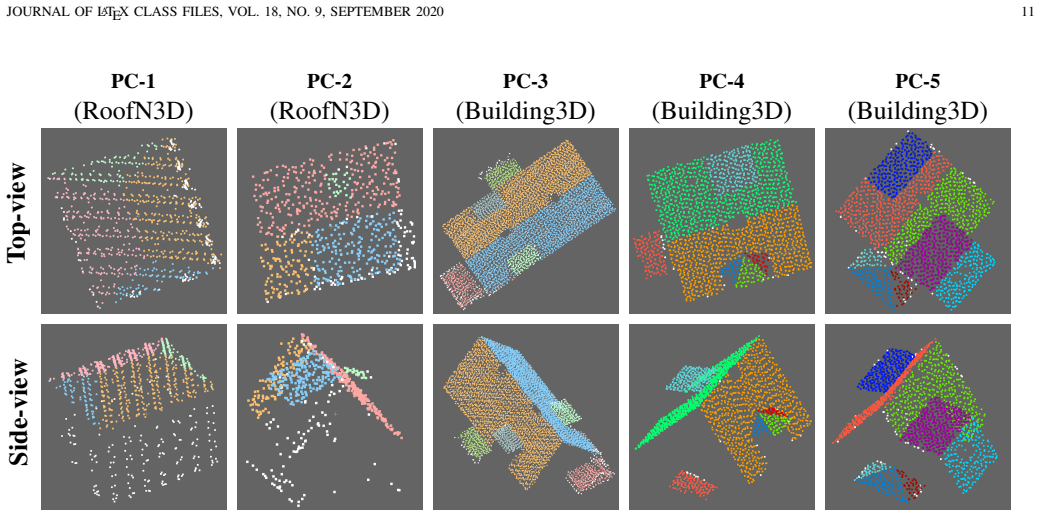
- [Fig. 6] The caption mentions 'Red dotted lines highlight representative problem areas,' but no such marks are visible or explained; please add visible annotations or a legend.
- [Sec. IV-A and IV-D] The relationship among the 457 erroneous samples (Sec. IV-A), the 49 reannotated test samples (Sec. IV-D), and the 408 reannotated training/validation samples should be stated explicitly (49 + 408 = 457) to avoid misreading.
- [Eqs. (1)-(2)] Equation (1) defines n as the desired average number of points per superpoint, but Eq. (2) uses n as a threshold; please clarify the relationship and report the actual value of n used in the experiments, since it is a free parameter.
- [Sec. III-B] The contour feature's angle threshold is user-defined but no value is given; please report it and any sensitivity analysis.
- [Tables IV-V] Tables IV and V would be more self-contained if they explicitly stated that all rows exclude postprocessing unless marked; currently the reader must infer this from the text.
- [Tables I-II] The QTPS evaluations in Tables I and II cover only 392 and 901 of the 1,000 test samples; the table captions should state this, as the text does.
- [Sec. IV-C] The implementation details should report voxel size, superpoint size n, number of decoder layers and heads, and the exact handcrafted feature dimensions for reproducibility.
Circularity Check
No significant circularity: the central SOTA claims rest on external RoofN3D benchmarks and disclosed ablations; author-created test labels are a verification concern, not a circular derivation.
full rationale
The paper's central claims are empirical and externally benchmarked. On the original RoofN3D test set, the evaluation uses pre-existing labels from RoofN3D, so the reported SOTA gain over DeepRoofPlane and HCBR is not constructed from the authors' own labels. The Building3D and reannotated RoofN3D labels were produced by the authors, which raises an independent-verification concern, but this is a reproducibility and label-impartiality issue rather than a derivation-circularity issue; it does not make any equation or prediction equivalent to its inputs by construction. The self-supervised plane completion module does estimate region-growing thresholds from the network's own segmented planes on each test cloud, but this is a disclosed test-time adaptation heuristic, not a fitted parameter renamed as a prediction, and its value is measured empirically against standard metrics. The superpoint generation criteria are design heuristics, not defined in terms of the target segmentation output, and the two-stage pipeline is described with open alternatives. The FourierKAN/Transformer decoder is a stated architectural choice. The only self-citations in the reference list are to earlier remote-sensing segmentation works and are not load-bearing for the main claims; no uniqueness theorem or prior-work-based ansatz is imported to force the method. Therefore no circular step meeting the quoted-evidence threshold can be identified, and the score is 0.
Assumptions & free parameters
free parameters (5)
- n (desired average superpoint size) =
not specified
- region growing thresholds and local boundary relabeling parameters =
not specified
- contour angle threshold =
not specified (user-defined)
- lambda in boundary refinement =
20
- plane completion thresholds (per test cloud) =
max thresholds inferred from predicted planes
assumptions (8)
- domain assumption Superpoints containing multiple instances or categories cannot have their errors corrected by the Transformer (Sec III-A1).
- ad hoc to paper Uniform size and shape of superpoints is necessary for the Transformer to learn generalizable features under limited training data (Sec III-A1).
- domain assumption Region growing with strict parameters plus local boundary relabeling from [2] produces superpoints whose boundaries are accurate enough for the Transformer (Sec III-A2).
- domain assumption K-means on 3D coordinates preserves the boundary accuracy of stage-1 superpoints while equalizing size and shape (Eq. 2-3).
- domain assumption The network's main-body plane predictions are reliable enough that the plane completion and boundary refinement modules can infer correct parameters from them (Sec III-D).
- domain assumption The manual reannotation of RoofN3D and wireframe-derived Building3D labels are correct and unbiased (Sec IV-A).
- standard math PCA-based geometric features (linearity, planarity, scattering, verticality) from [75], [76] capture meaningful local structure.
- standard math FourierKAN as introduced in [64], [65] is a valid drop-in for the MLP mask branch.
Cite this review
Pith. "Pith review of SPPSFormer: High-quality Superpoint-based Transformer for Roof Plane Instance Segmentation from Point Clouds." pith.science (2026). https://pith.science/paper/B55BXGQX
@misc{pith2026250524475,
  author       = {Pith},
  title        = {Pith review of: SPPSFormer: High-quality Superpoint-based Transformer for Roof Plane Instance Segmentation from Point Clouds},
  year         = {2026},
  howpublished = {\url{https://pith.science/paper/B55BXGQX}},
  note         = {Machine review of arXiv:2505.24475}
}
read the original abstract
Transformers have been seldom employed in point cloud roof plane instance segmentation, which is the focus of this study, and existing superpoint Transformers suffer from limited performance due to the use of low-quality superpoints. To address this challenge, we establish two criteria that high-quality superpoints for Transformers should satisfy and introduce a corresponding two-stage superpoint generation process. The superpoints generated by our method not only have accurate boundaries, but also exhibit consistent geometric sizes and shapes, both of which greatly benefit the feature learning of superpoint Transformers. To compensate for the limitations of deep learning features when the training set size is limited, we incorporate multidimensional handcrafted features into the model. Additionally, we design a decoder that combines a Kolmogorov-Arnold Network with a Transformer module to improve instance prediction and mask extraction. Finally, our network's predictions are refined using traditional algorithm-based postprocessing. For evaluation, we annotated a real-world dataset and corrected annotation errors in the existing RoofN3D dataset. Experimental results show that our method achieves state-of-the-art performance on our dataset, as well as both the original and reannotated RoofN3D datasets. Moreover, our model is not sensitive to plane boundary annotations during training, significantly reducing the annotation burden. Through comprehensive experiments, we also identified key factors influencing roof plane segmentation performance: in addition to roof types, variations in point cloud density, density uniformity, and 3D point precision have a considerable impact. These findings underscore the importance of incorporating data augmentation strategies that account for point cloud quality to enhance model robustness under diverse and challenging conditions.
Figures


Figures from the paper (5 more)



Forward citations
Cited by 1 Pith paper
-
RoofSeg: An edge-aware transformer-based network for end-to-end roof plane segmentation
RoofSeg, an end-to-end transformer with edge-aware and geometric losses, reports state-of-the-art roof plane segmentation on three benchmarks.
Reference graph
Works this paper leans on
-
[1]
Ransac-based multi primitive building reconstruction from 3d point clouds,
Z. Li and J. Shan, “Ransac-based multi primitive building reconstruction from 3d point clouds,”ISPRS Journal of Photogrammetry and Remote Sensing, vol. 185, pp. 247–260, 2022
2022
-
[2]
Roof plane segmentation from airborne lidar data using hierarchical clustering and boundary relabeling,
L. Li, J. Yao, J. Tu, X. Liu, Y . Li, and L. Guo, “Roof plane segmentation from airborne lidar data using hierarchical clustering and boundary relabeling,”Remote Sensing, vol. 12, no. 9, 2020
2020
-
[3]
A global solution to topological reconstruction of building roof models from airborne lidar point clouds,
J. Yan, W. Jiang, and J. Shan, “A global solution to topological reconstruction of building roof models from airborne lidar point clouds,” ISPRS Annals of the Photogrammetry, Remote Sensing and Spatial Information Sciences, vol. III-3, pp. 379–386, 2016
2016
-
[4]
Polyfit: Polygonal surface reconstruction from point clouds,
L. Nan and P. Wonka, “Polyfit: Polygonal surface reconstruction from point clouds,” inProceedings of the IEEE International Conference on Computer Vision (ICCV), Oct 2017
2017
-
[5]
An improved multi-task pointwise network for segmentation of building roofs in airborne laser scanning point clouds,
C. Zhang and H. Fan, “An improved multi-task pointwise network for segmentation of building roofs in airborne laser scanning point clouds,” The Photogrammetric Record, vol. 37, no. 179, pp. 260–284, 2022
2022
-
[6]
Automatic region- growing system for the segmentation of large point clouds,
F. Poux, C. Mattes, Z. Selman, and L. Kobbelt, “Automatic region- growing system for the segmentation of large point clouds,”Automation in Construction, vol. 138, p. 104250, 2022
2022
-
[7]
Segmentation and reconstruction of polyhedral building roofs from aerial lidar point clouds,
A. Sampath and J. Shan, “Segmentation and reconstruction of polyhedral building roofs from aerial lidar point clouds,”IEEE Transactions on Geoscience and Remote Sensing, vol. 48, no. 3, pp. 1554–1567, 2010
2010
-
[8]
A local tangent plane distance-based approach to 3d point cloud segmentation via clustering,
H. Chen, T. Xie, M. Liang, W. Liu, and P. X. Liu, “A local tangent plane distance-based approach to 3d point cloud segmentation via clustering,” Pattern Recognition, vol. 137, p. 109307, 2023
work page 2023
Show all 87 references
-
[9]
Splitting and merg- ing based multi-model fitting for point cloud segmentation,
L. Zhang, Y . Zhang, Z. Chen, P. Xiao, and B. Luo, “Splitting and merg- ing based multi-model fitting for point cloud segmentation,”Journal of Geodesy and Geoinformation Science, vol. 2, no. 2, pp. 78–89, 2019
2019
-
[10]
Robust segmentation and localization of structural planes from photogrammetric point clouds in construction sites,
Y . Xu, Z. Ye, R. Huang, L. Hoegner, and U. Stilla, “Robust segmentation and localization of structural planes from photogrammetric point clouds in construction sites,”Automation in Construction, vol. 117, p. 103206, 2020
2020
-
[11]
Random sample consensus: a paradigm for model fitting with applications to image analysis and automated cartography,
M. A. Fischler and R. C. Bolles, “Random sample consensus: a paradigm for model fitting with applications to image analysis and automated cartography,”Commun. ACM, vol. 24, no. 6, p. 381–395, Jun. 1981
1981
-
[12]
An improved ransac for 3d point cloud plane segmentation based on normal distribution transformation cells,
L. Li, F. Yang, H. Zhu, D. Li, Y . Li, and L. Tang, “An improved ransac for 3d point cloud plane segmentation based on normal distribution transformation cells,”Remote Sensing, vol. 9, no. 5, 2017
2017
-
[13]
Deep learning for 3d point clouds: A survey,
Y . Guo, H. Wang, Q. Hu, H. Liu, L. Liu, and M. Bennamoun, “Deep learning for 3d point clouds: A survey,”IEEE Transactions on Pattern Analysis and Machine Intelligence, vol. 43, no. 12, pp. 4338–4364, 2021
2021
-
[14]
Superpoint transformer for 3d scene instance segmentation,
J. Sun, C. Qing, J. Tan, and X. Xu, “Superpoint transformer for 3d scene instance segmentation,”Proceedings of the AAAI Conference on Artificial Intelligence, vol. 37, no. 2, pp. 2393–2401, Jun. 2023
2023
-
[15]
Efficient 3d semantic segmen- tation with superpoint transformer,
D. Robert, H. Raguet, and L. Landrieu, “Efficient 3d semantic segmen- tation with superpoint transformer,” inProceedings of the IEEE/CVF International Conference on Computer Vision (ICCV), October 2023, pp. 17 195–17 204
2023
-
[16]
Taseg: Temporal aggregation network for lidar semantic segmentation,
X. Wu, Y . Hou, X. Huang, B. Lin, T. He, X. Zhu, Y . Ma, B. Wu, H. Liu, D. Cai, and W. Ouyang, “Taseg: Temporal aggregation network for lidar semantic segmentation,” inProceedings of the IEEE/CVF Conference on Computer Vision and Pattern Recognition (CVPR), June 2024, pp. 15 3...
2024
-
[17]
Superpixel transformers for efficient semantic segmentation,
A. Z. Zhu, J. Mei, S. Qiao, H. Yan, Y . Zhu, L.-C. Chen, and H. Kret- zschmar, “Superpixel transformers for efficient semantic segmentation,” in2023 IEEE/RSJ International Conference on Intelligent Robots and Systems (IROS), 2023, pp. 7651–7658
2023
-
[18]
Large-scale als point cloud segmentation via projection-based context embedding,
H. Dai, X. Hu, J. Zhang, Z. Shu, J. Xu, and J. Du, “Large-scale als point cloud segmentation via projection-based context embedding,” IEEE Transactions on Geoscience and Remote Sensing, vol. 62, pp. 1– 16, 2024
2024
-
[19]
Point and voxel cross perception with lightweight cosformer for large-scale point cloud semantic segmentation,
S. Zhang, B. Wang, Y . Chen, S. Zhang, and W. Zhang, “Point and voxel cross perception with lightweight cosformer for large-scale point cloud semantic segmentation,”International Journal of Applied Earth Observation and Geoinformation, vol. 131, p. 103951, 2024
2024
-
[20]
Opoca: One point one class annotation for lidar point cloud semantic segmentation,
W. Huang, P. Zou, Y . Xia, C. Wen, Y . Zang, C. Wang, and G. Zhou, “Opoca: One point one class annotation for lidar point cloud semantic segmentation,”IEEE Transactions on Geoscience and Remote Sensing, vol. 62, pp. 1–10, 2024
2024
-
[21]
Pointnet++: Deep hierarchical feature learning on point sets in a metric space,
C. R. Qi, L. Yi, H. Su, and L. J. Guibas, “Pointnet++: Deep hierarchical feature learning on point sets in a metric space,” inAdvances in Neural Information Processing Systems, I. Guyon, U. V . Luxburg, S. Bengio, H. Wallach, R. Fergus, S. Vishwanathan, and R. Garnett, Eds., v...
2017
-
[22]
A boundary-aware point clustering approach in euclidean and embedding spaces for roof plane segmentation,
L. Li, Q. Li, G. Xu, P. Zhou, J. Tu, J. Li, M. Li, and J. Yao, “A boundary-aware point clustering approach in euclidean and embedding spaces for roof plane segmentation,”ISPRS Journal of Photogrammetry and Remote Sensing, vol. 218, pp. 518–530, 2024
2024
-
[23]
Automatic generation of 3-d roof training dataset for building roof segmentation from als point clouds,
G. Kong and H. Fan, “Automatic generation of 3-d roof training dataset for building roof segmentation from als point clouds,”IEEE Transactions on Geoscience and Remote Sensing, vol. 62, pp. 1–12, 2024
2024
-
[24]
KAN: Kolmogorov–arnold networks,
Z. Liu, Y . Wang, S. Vaidya, F. Ruehle, J. Halverson, M. Soljacic, T. Y . Hou, and M. Tegmark, “KAN: Kolmogorov–arnold networks,” inThe Thirteenth International Conference on Learning Representations, 2025
2025
-
[25]
Roofn3d: A database for 3d building reconstruction with deep learning,
A. Wichmann, A. Agoub, V . Schmidt, and M. Kada, “Roofn3d: A database for 3d building reconstruction with deep learning,”Photogram- metric Engineering & Remote Sensing, vol. 85, no. 6, pp. 435–443, 2019
2019
-
[26]
Building3d: A urban-scale dataset and benchmarks for learning roof structures from point clouds,
R. Wang, S. Huang, and H. Yang, “Building3d: A urban-scale dataset and benchmarks for learning roof structures from point clouds,” in Proceedings of the IEEE/CVF International Conference on Computer Vision (ICCV), October 2023, pp. 20 076–20 086. JOURNAL OF LATEX CLASS FILES, ...
2023
-
[27]
Seeded region growing,
R. Adams and L. Bischof, “Seeded region growing,”IEEE Transactions on Pattern Analysis and Machine Intelligence, vol. 16, no. 6, pp. 641– 647, 1994
1994
-
[28]
Three-dimensional surface mesh segmentation using curvedness-based region growing approach,
A. Jagannathan and E. L. Miller, “Three-dimensional surface mesh segmentation using curvedness-based region growing approach,”IEEE Transactions on Pattern Analysis and Machine Intelligence, vol. 29, no. 12, pp. 2195–2204, 2007
2007
-
[29]
Irgs: Image segmentation using edge penal- ties and region growing,
Q. Yu and D. A. Clausi, “Irgs: Image segmentation using edge penal- ties and region growing,”IEEE Transactions on Pattern Analysis and Machine Intelligence, vol. 30, no. 12, pp. 2126–2139, 2008
2008
-
[30]
Octree- based region growing for point cloud segmentation,
A.-V . V o, L. Truong-Hong, D. F. Laefer, and M. Bertolotto, “Octree- based region growing for point cloud segmentation,”ISPRS Journal of Photogrammetry and Remote Sensing, vol. 104, pp. 88–100, 2015
2015
-
[31]
Multi-value voxel connected region construction based on 3d plane extraction for airborne lidar data,
L. Wang and X. Wang, “Multi-value voxel connected region construction based on 3d plane extraction for airborne lidar data,”Journal of Geo- information Science, vol. 23, no. 9, pp. 1598–1607, 2021
2021
-
[32]
A global optimization approach to roof segmentation from airborne lidar point clouds,
J. Yan, J. Shan, and W. Jiang, “A global optimization approach to roof segmentation from airborne lidar point clouds,”ISPRS Journal of Photogrammetry and Remote Sensing, vol. 94, pp. 183–193, 2014
2014
-
[33]
An efficient global energy optimization approach for robust 3d plane segmentation of point clouds,
Z. Dong, B. Yang, P. Hu, and S. Scherer, “An efficient global energy optimization approach for robust 3d plane segmentation of point clouds,” ISPRS Journal of Photogrammetry and Remote Sensing, vol. 137, pp. 112–133, 2018
2018
-
[34]
Roof plane segmentation from lidar point cloud data using region expansion based l0 gradient minimization and graph cut,
X. Wang and S. Ji, “Roof plane segmentation from lidar point cloud data using region expansion based l0 gradient minimization and graph cut,”IEEE Journal of Selected Topics in Applied Earth Observations and Remote Sensing, vol. 14, pp. 10 101–10 116, 2021
2021
-
[35]
Efficient ransac for point-cloud shape detection,
R. Schnabel, R. Wahl, and R. Klein, “Efficient ransac for point-cloud shape detection,”Computer Graphics Forum, vol. 26, no. 2, pp. 214– 226, 2007
2007
-
[36]
Plane detection to improve 3d scanning speed using ransac algorithm,
T. Fujiwara, T. Kamegawa, and A. Gofuku, “Plane detection to improve 3d scanning speed using ransac algorithm,” in2013 IEEE 8th Conference on Industrial Electronics and Applications (ICIEA), 2013, pp. 1863– 1869
2013
-
[37]
Investigation on the weighted ransac approaches for building roof plane segmentation from lidar point clouds,
B. Xu, W. Jiang, J. Shan, J. Zhang, and L. Li, “Investigation on the weighted ransac approaches for building roof plane segmentation from lidar point clouds,”Remote Sensing, vol. 8, no. 1, 2016
2016
-
[38]
An improved ransac algorithm for point cloud segmentation of complex building roofs,
Y . Liu, Y . Li, H. Liu, D. Sun, and S. Zhao, “An improved ransac algorithm for point cloud segmentation of complex building roofs,” Journal of Geo-information Science, vol. 23, no. 8, pp. 1497–1507, 2021
2021
-
[39]
Optimal ransac method for segmentation of complex building roof planes,
J. Xu and J. Li, “Optimal ransac method for segmentation of complex building roof planes,”Geomatics and Information Science of Wuhan University, vol. 48, no. 9, pp. 1531–1537, 2023
2023
-
[40]
A multi-scale plane-detection method based on the hough transform and region growing,
X. Leng, J. Xiao, and Y . Wang, “A multi-scale plane-detection method based on the hough transform and region growing,”The Photogrammet- ric Record, vol. 31, no. 154, pp. 166–192, 2016
2016
-
[41]
Automatic extraction of building roof planes from airborne lidar data applying an extended 3d randomized hough transform,
E. Maltezos and C. Ioannidis, “Automatic extraction of building roof planes from airborne lidar data applying an extended 3d randomized hough transform,”ISPRS Annals of the Photogrammetry, Remote Sens- ing and Spatial Information Sciences, vol. III-3, pp. 209–216, 2016
2016
-
[42]
Hough transform for real-time plane detection in depth images,
E. Vera, D. Lucio, L. A. Fernandes, and L. Velho, “Hough transform for real-time plane detection in depth images,”Pattern Recognition Letters, vol. 103, pp. 8–15, 2018
2018
-
[43]
Structural plane recognition from three-dimensional laser scanning points using an improved region-growing algorithm based on the robust randomized hough transform,
Z.-h. Xu, G. Guo, Q.-c. Sun, Q. Wang, G.-d. Zhang, and R.-q. Ye, “Structural plane recognition from three-dimensional laser scanning points using an improved region-growing algorithm based on the robust randomized hough transform,”Journal of Mountain Science, vol. 20, no. 11, ...
2023
-
[44]
Identifying planes in point-clouds for efficient hybrid rendering,
R. Wahl, M. Guthe, and R. Klein, “Identifying planes in point-clouds for efficient hybrid rendering,” inThe 13th Pacific Conference on Computer Graphics and Applications, vol. 3, 2005
2005
-
[45]
Recognising structure in laser scanner point clouds,
G. V osselman, B. G. Gorte, G. Sithole, and T. Rabbani, “Recognising structure in laser scanner point clouds,”International archives of pho- togrammetry, remote sensing and spatial information sciences, vol. 46, no. 8, pp. 33–38, 2004
2004
-
[46]
Roof reconstruction of aerial point cloud based on bppm plane segmentation and energy optimization,
H. Li, S. Xiong, C. Men, and Y . Liu, “Roof reconstruction of aerial point cloud based on bppm plane segmentation and energy optimization,” IEEE Journal of Selected Topics in Applied Earth Observations and Remote Sensing, vol. 16, pp. 5828–5848, 2023
2023
-
[47]
A mean shift based competition algorithm for robust extraction of roof plane from airborne laser scanning data,
X. Huang, W. Jiang, and J. Gong, “A mean shift based competition algorithm for robust extraction of roof plane from airborne laser scanning data,” inProceedings of the San Antonio fall 2006 speciality conference, 2006
2006
-
[48]
Automatic segmentation of urban point clouds based on the gaussian map,
Y . Wang, W. Hao, X. Ning, M. Zhao, J. Zhang, Z. Shi, and X. Zhang, “Automatic segmentation of urban point clouds based on the gaussian map,”The Photogrammetric Record, vol. 28, no. 144, pp. 342–361, 2013
2013
-
[49]
6d dbscan-based segmentation of building point clouds for planar object classification,
T. Czerniawski, B. Sankaran, M. Nahangi, C. Haas, and F. Leite, “6d dbscan-based segmentation of building point clouds for planar object classification,”Automation in Construction, vol. 88, pp. 44–58, 2018
2018
-
[50]
Rapter: rebuilding man-made scenes with regular arrangements of planes,
A. Monszpart, N. Mellado, G. J. Brostow, and N. J. Mitra, “Rapter: rebuilding man-made scenes with regular arrangements of planes,”ACM Trans. Graph., vol. 34, no. 4, Jul. 2015
2015
-
[51]
Fast regularity- constrained plane fitting,
Y . Lin, J. Li, C. Wang, Z. Chen, Z. Wang, and J. Li, “Fast regularity- constrained plane fitting,”ISPRS Journal of Photogrammetry and Re- mote Sensing, vol. 161, pp. 208–217, 2020
2020
-
[52]
From planes to corners: Multi-purpose primitive detection in unorganized 3d point clouds,
C. Sommer, Y . Sun, L. Guibas, D. Cremers, and T. Birdal, “From planes to corners: Multi-purpose primitive detection in unorganized 3d point clouds,”IEEE Robotics and Automation Letters, vol. 5, no. 2, pp. 1764– 1771, 2020
2020
-
[53]
Extracting pop: Pairwise orthogonal planes from point cloud using ransac,
Y . Wu, G. Li, C. Xian, X. Ding, and Y . Xiong, “Extracting pop: Pairwise orthogonal planes from point cloud using ransac,”Computers & Graphics, vol. 94, pp. 43–51, 2021
2021
-
[54]
Point cloud oversegmentation with graph-structured deep metric learning,
L. Landrieu and M. Boussaha, “Point cloud oversegmentation with graph-structured deep metric learning,” inProceedings of the IEEE/CVF Conference on Computer Vision and Pattern Recognition (CVPR), June 2019
2019
-
[55]
Instance segmentation in 3d scenes using semantic superpoint tree networks,
Z. Liang, Z. Li, S. Xu, M. Tan, and K. Jia, “Instance segmentation in 3d scenes using semantic superpoint tree networks,” inProceedings of the IEEE/CVF International Conference on Computer Vision (ICCV), October 2021, pp. 2783–2792
2021
-
[56]
Ponderv2: Pave the way for 3d foundation model with a universal pre-training paradigm,
H. Zhu, H. Yang, X. Wu, D. Huang, S. Zhang, X. He, H. Zhao, C. Shen, Y . Qiao, T. He, and W. Ouyang, “Ponderv2: Pave the way for 3d foundation model with a universal pre-training paradigm,” 2024
2024
-
[57]
Large-scale point cloud semantic segmentation with superpoint graphs,
L. Landrieu and M. Simonovsky, “Large-scale point cloud semantic segmentation with superpoint graphs,” inProceedings of the IEEE Conference on Computer Vision and Pattern Recognition (CVPR), June 2018
2018
-
[58]
Learning superpoint graph cut for 3d instance segmentation,
L. Hui, L. Tang, Y . Shen, J. Xie, and J. Yang, “Learning superpoint graph cut for 3d instance segmentation,” inAdvances in Neural Information Processing Systems, S. Koyejo, S. Mohamed, A. Agarwal, D. Belgrave, K. Cho, and A. Oh, Eds., vol. 35. Curran Associates, Inc., 2022, p...
2022
-
[59]
A. N. Kolmogorov,On the representation of continuous functions of several variables by superpositions of continuous functions of a smaller number of variables. American Mathematical Society, 1961
1961
-
[60]
The perceptron: a probabilistic model for information storage and organization in the brain
F. Rosenblatt, “The perceptron: a probabilistic model for information storage and organization in the brain.”Psychological review, vol. 65 6, pp. 386–408, 1958
1958
-
[61]
Learning repre- sentations by back-propagating errors,
D. E. Rumelhart, G. E. Hinton, and R. J. Williams, “Learning repre- sentations by back-propagating errors,”Nature, vol. 323, no. 6088, pp. 533–536, 10 1986
1986
-
[62]
Chebyshev polynomial-based kolmogorov-arnold networks: An efficient architecture for nonlinear function approximation,
S. SS, K. AR, G. R, and A. KP, “Chebyshev polynomial-based kolmogorov-arnold networks: An efficient architecture for nonlinear function approximation,” 2024
2024
-
[63]
Wav-kan: Wavelet kolmogorov-arnold networks,
Z. Bozorgasl and H. Chen, “Wav-kan: Wavelet kolmogorov-arnold networks,” 2024
2024
-
[64]
Fourierkan outperforms mlp on text classification head fine-tuning,
A. A. Imran and M. F. Ishmam, “Fourierkan outperforms mlp on text classification head fine-tuning,” 2024
2024
-
[65]
Fourierkan-gcf: Fourier kolmogorov-arnold network – an effective and efficient feature transformation for graph collaborative filtering,
J. Xu, Z. Chen, J. Li, S. Yang, W. Wang, X. Hu, and E. C. H. Ngai, “Fourierkan-gcf: Fourier kolmogorov-arnold network – an effective and efficient feature transformation for graph collaborative filtering,” 2024
2024
-
[66]
Neural graph collaborative filtering,
X. Wang, X. He, M. Wang, F. Feng, and T.-S. Chua, “Neural graph collaborative filtering,” inProceedings of the 42nd International ACM SIGIR Conference on Research and Development in Information Re- trieval, ser. SIGIR’19. New York, NY , USA: Association for Computing Machinery...
2019
-
[67]
Kan or mlp: A fairer comparison,
R. Yu, W. Yu, and X. Wang, “Kan or mlp: A fairer comparison,” 2024. [Online]. Available: https://arxiv.org/abs/2407.16674
2024 arXiv
-
[68]
Can kan work? exploring the potential of kolmogorov-arnold networks in computer vision,
Y . Cang, Y . hang liu, and L. Shi, “Can kan work? exploring the potential of kolmogorov-arnold networks in computer vision,” 2024
2024
-
[69]
Learning transferable visual models from natural language supervi- sion,
A. Radford, J. W. Kim, C. Hallacy, A. Ramesh, G. Goh, S. Agarwal, G. Sastry, A. Askell, P. Mishkin, J. Clark, G. Krueger, and I. Sutskever, “Learning transferable visual models from natural language supervi- sion,” inProceedings of the 38th International Conference on Machine ...
2021
-
[70]
Unsupervised building extraction from multimodal aerial data based on accurate vegetation removal and image feature consistency constraint,
Y . Meng, S. Chen, Y . Liu, L. Li, Z. Zhang, T. Ke, and X. Hu, “Unsupervised building extraction from multimodal aerial data based on accurate vegetation removal and image feature consistency constraint,” Remote Sensing, vol. 14, no. 8, 2022
2022
-
[71]
Segment anything,
A. Kirillov, E. Mintun, N. Ravi, H. Mao, C. Rolland, L. Gustafson, T. Xiao, S. Whitehead, A. C. Berg, W.-Y . Lo, P. Dollar, and R. Girshick, JOURNAL OF LATEX CLASS FILES, VOL. 18, NO. 9, SEPTEMBER 2020 18 “Segment anything,” inProceedings of the IEEE/CVF International Conferen...
2020
-
[72]
Few-shot aerial image semantic segmentation leveraging pyramid correlation fusion,
W. Ao, S. Zheng, Y . Meng, and Z. Gao, “Few-shot aerial image semantic segmentation leveraging pyramid correlation fusion,”IEEE Transactions on Geoscience and Remote Sensing, vol. 61, pp. 1–12, 2023
2023
-
[73]
Smilies: A soft-multi- label-guided weakly supervised semantic segmentation framework for remote sensing images,
T. Wang, X. Zhang, G. Chen, and C. Liu, “Smilies: A soft-multi- label-guided weakly supervised semantic segmentation framework for remote sensing images,” in2023 30th International Conference on Geoinformatics, 2023, pp. 1–4
2023
-
[74]
Analysis of a complex of statistical variables into principal components
H. Hotelling, “Analysis of a complex of statistical variables into principal components.”Journal of Educational Psychology, vol. 24, pp. 498–520, 1933
1933
-
[75]
Dimensionality based scale selection in 3d lidar point clouds,
J. Demantk ´e, C. Mallet, N. David, and B. Vallet, “Dimensionality based scale selection in 3d lidar point clouds,”The International Archives of the Photogrammetry, Remote Sensing and Spatial Information Sciences, vol. XXXVIII-5/W12, pp. 97–102, 2011
2011
-
[76]
Weakly supervised segmentation-aided classification of urban scenes from 3d lidar point clouds,
S. Guinard and L. Landrieu, “Weakly supervised segmentation-aided classification of urban scenes from 3d lidar point clouds,”The Inter- national Archives of the Photogrammetry, Remote Sensing and Spatial Information Sciences, vol. XLII-1/W1, pp. 151–157, 2017
2017
-
[77]
U-kan makes strong backbone for medical image segmentation and generation,
C. Li, X. Liu, W. Li, C. Wang, H. Liu, Y . Liu, Z. Chen, and Y . Yuan, “U-kan makes strong backbone for medical image segmentation and generation,” 2024
2024
-
[78]
Demonstrating the efficacy of kolmogorov-arnold networks in vision tasks,
M. Cheon, “Demonstrating the efficacy of kolmogorov-arnold networks in vision tasks,” 2024
2024
-
[79]
Scale selection based on moran’s i for segmentation of high resolution remotely sensed images,
Y . Meng, C. Lin, W. Cui, and J. Yao, “Scale selection based on moran’s i for segmentation of high resolution remotely sensed images,” in2014 IEEE Geoscience and Remote Sensing Symposium, 2014, pp. 4895– 4898
2014
-
[80]
Normalization in unsupervised segmentation parameter opti- mization: A solution based on local regression trend analysis,
S. Georganos, M. Lennert, T. Grippa, S. Vanhuysse, B. Johnson, and E. Wolff, “Normalization in unsupervised segmentation parameter opti- mization: A solution based on local regression trend analysis,”Remote Sensing, vol. 10, no. 2, 2018
2018
-
[81]
Subtracted histogram: Utilizing mutual relation between features for thresholding,
Y . Meng, Z. Hu, X. Chen, and J. Yao, “Subtracted histogram: Utilizing mutual relation between features for thresholding,”IEEE Transactions on Geoscience and Remote Sensing, vol. 56, no. 12, pp. 7415–7435, 2018
2018
-
[82]
Efficient graph-based image segmentation,
P. F. Felzenszwalb and D. P. Huttenlocher, “Efficient graph-based image segmentation,”International journal of computer vision, vol. 59, pp. 167–181, 2004
2004
-
[83]
Adaptive regularization for image segmentation using local image curvature cues,
J. Rao, R. Abugharbieh, and G. Hamarneh, “Adaptive regularization for image segmentation using local image curvature cues,” inProceedings of the 11th European Conference on Computer Vision: Part IV, ser. ECCV’10. Berlin, Heidelberg: Springer-Verlag, 2010, p. 651–665
-
[84]
Region merging using local spectral angle thresholds: A more accurate method for hybrid segmentation of remote sensing images,
J. Yang, Y . He, and J. Caspersen, “Region merging using local spectral angle thresholds: A more accurate method for hybrid segmentation of remote sensing images,”Remote Sensing of Environment, vol. 190, pp. 137–148, 2017
2017
-
[85]
Scale-variable region-merging for high resolution remote sensing image segmentation,
T. Su, “Scale-variable region-merging for high resolution remote sensing image segmentation,”ISPRS Journal of Photogrammetry and Remote Sensing, vol. 147, pp. 319–334, 2019
2019
-
[86]
Associatively seg- menting instances and semantics in point clouds,
X. Wang, S. Liu, X. Shen, C. Shen, and J. Jia, “Associatively seg- menting instances and semantics in point clouds,” inProceedings of the IEEE/CVF Conference on Computer Vision and Pattern Recognition (CVPR), June 2019
2019
-
[87]
Robust 3-d plane segmentation from airborne point clouds based on quasi-a-contrario theory,
X. Zhu, X. Liu, Y . Zhang, Y . Wan, and Y . Duan, “Robust 3-d plane segmentation from airborne point clouds based on quasi-a-contrario theory,”IEEE Journal of Selected Topics in Applied Earth Observations and Remote Sensing, vol. 14, pp. 7133–7147, 2021
2021
Reviewed August 7, 2026 · model on record in the stance chip above.
Discussion (0). Sign in to comment.