REVIEW 3 major objections 8 minor 59 references
Neutrino emission from neutron star matter
T0 review · 3 major / 8 minor · reviewed 2026-08-07 · deepseek-v4-flash
Pith's one-line read A review of neutrino emission from neutron-star matter argues that the sharp direct Urca activation threshold is a zero-temperature artifact of the Fermi-surface approximation, already washed out at temperatures as low as 1 MeV.
desk verdict A useful review of Urca emissivity with a sharp critical comparison, but its most eye-catching claim about T=1 MeV rests on work the authors themselves mark as incomplete. read the letter →
The pith
A machine-rendered reading of the paper's core claim, the machinery that carries it, and where it could break.
The reading
What carries the argument
The central object is the correlated-basis effective interaction $\widetilde{v}_{ij}$, obtained by replacing the bare nucleon-nucleon potential with a density-dependent interaction that reproduces the ground-state energy of cold nuclear matter computed by advanced many-body methods, and the corresponding renormalized weak current $\widetilde{j}$ built from correlated wave functions. The Fermi surface approximation, which sets every participant's momentum to its Fermi momentum, is the simplification that converts momentum conservation into the sharp threshold condition; the review's key numerical move is to lift this approximation and perform the full phase-space integrations with Monte Carlo techniques while keeping the same effective interaction and current. The ratio of emissivities with and without short-range correlations isolates the dynamical quenching and exposes its density dependence.
What would settle it
Compute the direct Urca emissivity of dense npe matter in a fully finite-temperature many-body scheme, with no Fermi-surface approximation and with temperature-dependent correlation functions; if the resulting ratio of correlated to mean-field emissivity stays near unity rather than dropping to about 0.5 at 2.5 saturation density, the quenching claim fails.
Extended reading notes
Core claim
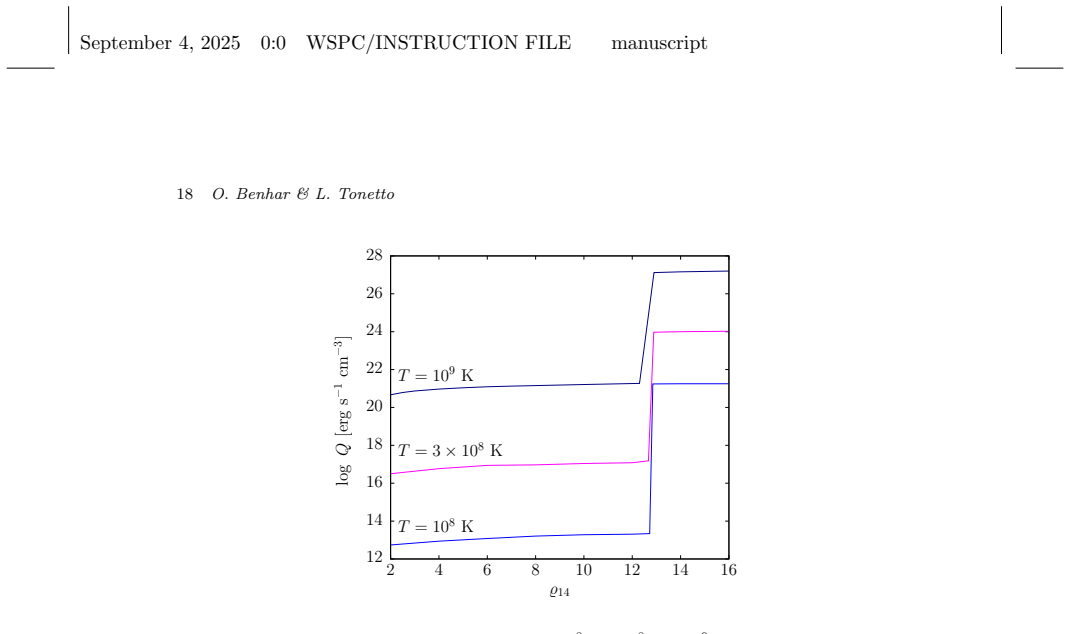
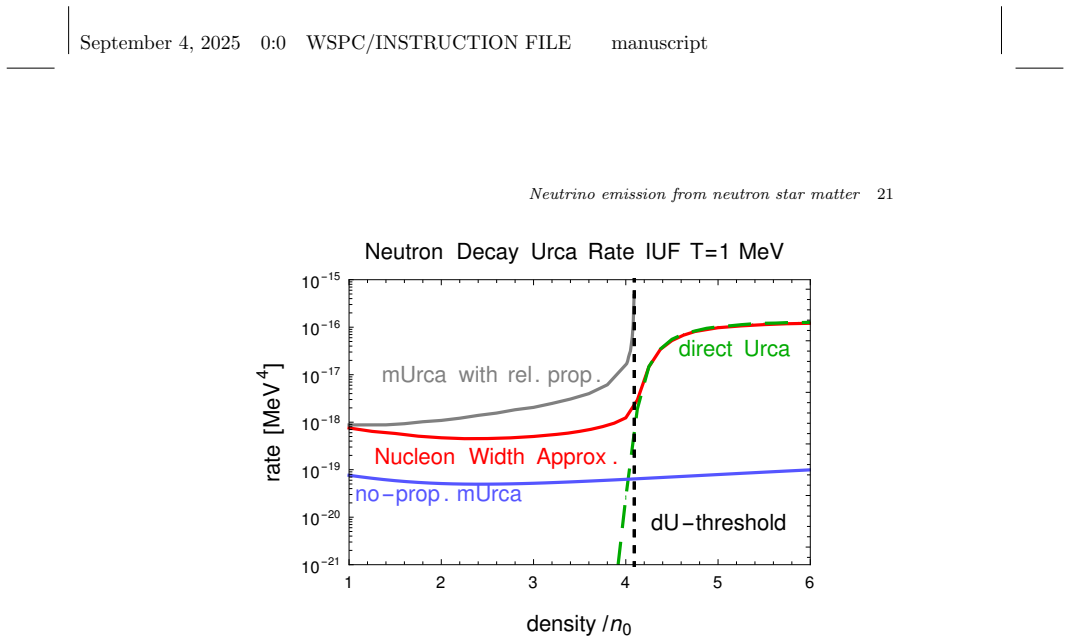
On the paper's own terms, the central discovery is that the two pillars of the standard treatment, the Fermi surface approximation and mean-field nucleon dynamics, are both quantitatively unreliable for hot neutron-star matter. The full phase-space evaluation of the direct Urca emissivity, without setting momenta to their Fermi values, shows that the step-function threshold of the low-temperature formula is smeared into a smooth rise already at 5 MeV, and that deviations are visible at 1 MeV. In parallel, replacing the free weak current with a renormalized current built from correlated wave functions reduces the emissivity by roughly a factor of two near threshold, an effect that fades as density approaches about four times saturation density. The paper further argues that modified Urca and direct Urca are not distinct mechanisms but two limits of one process once finite nucleon widths are included, and that a consistent microscopic model must supply the equation of state, composition, effective masses, and weak currents from the same Hamiltonian.
Load-bearing premise
The effective nucleon interaction used for chemical potentials, effective masses, and the renormalized weak current is built from correlation functions computed in cold matter and assumed unchanged up to roughly 20 MeV; if that interaction is inaccurate at neutron-star-core densities and temperatures, the emissivity curves and the 1 MeV conclusion would shift.
Editorial extensions
If this is right
- Neutrino-cooling simulations that switch on direct Urca only above a sharp threshold density will misorder the cooling of hot proto-neutron stars, where the process is already active at lower densities.
- The smooth transition between modified and direct Urca implies that the two mechanisms should be treated in one unified rate rather than as competing channels with a density cutoff.
- Short-range correlations reduce direct Urca emissivity by up to 50% near threshold, so cooling curves computed with mean-field currents will overestimate the neutrino luminosity there.
- Single-nucleon properties entering the rates, such as chemical potentials and effective masses, should come from the same Hamiltonian as the equation of state; mixing independent models introduces uncontrolled errors.
- A consistent treatment of thermal effects on all nuclear-matter properties is required before emissivities can be considered quantitative in the tens-of-MeV regime relevant to merger remnants.
Reading between the lines
- If the 1 MeV breakdown of full degeneracy holds, direct Urca could contribute to cooling of moderately massive neutron stars whose central densities lie below the zero-temperature threshold, which would make observed surface temperatures drop faster than threshold-based models predict.
- The same renormalized-current suppression should affect neutrino opacities in merger remnants and supernova cores, not just emissivities, because it modifies the same weak transition amplitudes; this is a testable extension for transport simulations.
- The assumed temperature independence of the correlation functions up to roughly 20 MeV could be checked directly with finite-temperature quantum Monte Carlo; a measurable temperature dependence would shift the emissivity curves at the high end.
- The unified picture of direct and modified Urca suggests that phenomenological rates fitted separately to the two processes may double-count or miss the transition region, and a single spectral-function calculation would settle the issue.
Editorial analysis
A structured set of objections, weighed in public.
Referee Report
Summary. This manuscript is a review article on neutrino emission from neutron star cores. It introduces the weak interactions of nucleons in free space and in nuclear matter, contrasts the mean-field approximation with the correlated-basis-function (CBF) approach, and discusses direct Urca and modified Urca processes. The paper presents results from the authors' own CBF-based calculations, notably that short-range correlations reduce the direct Urca emissivity by up to 50% near threshold and that full phase-space integration at T=5 and 10 MeV removes the sharp density threshold. The abstract and Section 4 make the stronger claim that the Fermi-surface approximation underlying the direct Urca threshold already fails at T≈1 MeV.
Significance. The review is clearly written and contains correct standard formulas, making it a potentially useful pedagogical introduction to the field. Its main original perspective is the consistent CBF treatment of equilibrium and dynamical properties of nuclear matter, and it explicitly acknowledges the limitations of current calculations (e.g., Section 4: 'admittedly still limited by the lack of a consistent treatment of all quantities involved in numerical calculations'). However, the central quantitative claim about failure of the degeneracy approximation at T≈1 MeV is not supported by the manuscript's own calculations and relies on a model that the paper itself qualifies as incomplete. This issue, together with the unsupported assertion about temperature-independent correlation functions, must be addressed before the paper can be recommended for acceptance.
major comments (3)
- [Section 4 / Figs. 5-6] The statement that the assumption of full degeneracy 'already fails at temperature as low as 1 MeV' is not supported by the calculations shown in this manuscript. The only full phase-space integrations of Eq. (26) are presented at T=5 and 10 MeV (Figs. 5 and 6); no T=1 MeV integration is reported. The 1 MeV claim appears to be imported from Ref. [16], whose spectral-function model (Eq. (36)) is later criticized in the same section for omitting the non-pole component of the nucleon Green's function. The paper should either present a direct T=1 MeV calculation with the same framework or explicitly attribute and qualify the claim as a result of Ref. [16] that the review regards as incomplete.
- [Section 2.2.2] The assertion that the temperature dependence of the correlation functions fij is negligible up to ~20 MeV is made without a supporting reference or calculation. Since the effective interaction evij and the renormalized weak current used at T=5 and 10 MeV are built from these T=0 correlation functions, this assumption is load-bearing for the CBF results presented in Figs. 4-6. Please either provide a citation for the finite-temperature FHNC/SOC results or clearly state this as an assumption and discuss the associated uncertainty.
- [Section 4] The sentence claiming that correlation effects lead to 'a sizeable quenching of the weak transition amplitudes driving dUrca and mUrca processes alike' is broader than the evidence displayed. The figures presented in this review (Figs. 4-6) concern only the direct Urca emissivity; no quantitative mUrca result is shown. To support the 'alike' assertion, either show the corresponding mUrca quenching or restrict the statement to the dUrca case.
minor comments (8)
- [Section 1] Typos: 'reasction mechanisms' should be 'reaction mechanisms'; 'Hamoltonian' should be 'Hamiltonian'.
- [Section 2.2.1] Typos and spacing: 'consistes' should be 'consists'; 'Fermi momentumkFN' needs a space between 'momentum' and 'kFN'.
- [Section 2.2.2] 'arenormalisation' should be 'a renormalization'.
- [Section 3.1] Typo: 'laking' should be 'lacking'.
- [Section 3.4] Typo: 'momrntum' should be 'momentum'.
- [Section 4] Typos: 'propapagtor' should be 'propagator'; 'analyised' should be 'analyzed'; 'opeators' should be 'operators'.
- [References] Reference 23: 'Chcago' should be 'Chicago'; Reference 45: 'Vicking' should be 'Viking'.
- [Figure 7 caption] 'N = n, plabels' should read 'N = n, p labels' with a space.
Circularity Check
No significant circularity: the review's quantitative content comes from explicit phase-space integrals and externally published many-body calculations, and no central prediction is equivalent by construction to a fitted input.
full rationale
The paper is a review whose central quantitative claims are (i) the sharp dUrca threshold follows from the T=0 kinematic condition k_Fn <= k_Fp + k_Fe (Eqs. (24)-(25)), not from the emissivity calculation; (ii) full phase-space integration of Eq. (26) washes out the threshold at T=5 and 10 MeV (Figs. 5-6); and (iii) short-range correlations quench the dUrca emissivity near threshold (Figs. 4-6). None of these steps reduces to its inputs: the emissivity is computed from Fermi-Dirac distributions and matrix elements, and the renormalized weak current of Eq. (17) is obtained from a cluster expansion of a realistic Hamiltonian, not fitted to the emissivity values being reported. The claim in Section 4 that degeneracy fails at temperatures as low as 1 MeV is not demonstrated by the paper's own full-phase-space calculation, which starts at 5 MeV; it is imported from Refs. [14-16], especially the Sedrakian spectral-function model of Eq. (36), which the review itself criticizes for omitting the non-pole component found in CBF calculations. This is an evidentiary weakness, but it is not circularity: the review does not define a predicted quantity in terms of the data used to produce it. The many self-citations (Refs. [17,22,50]) provide the effective interaction, proton fractions, and emissivity curves used in the figures, but these are externally published calculations with stated models (CBF, Argonne v6', UIX) and not invoked as a uniqueness theorem or as a substitute for an absent derivation. Overall, the review's chain of reasoning is transparent and no equation is equivalent by construction to a previously fitted parameter.
Assumptions & free parameters
assumptions (4)
- standard math The Fermi contact four-fermion interaction accurately describes neutrino-nucleon interactions at the energies relevant to neutron stars.
- domain assumption Nuclear dynamics is described by a non-relativistic Hamiltonian with two- and three-body potentials, and thermal effects do not modify the potential at T << m_pi.
- domain assumption Correlation functions fij are determined at T = 0 and applied at finite T up to 20 MeV.
- domain assumption npe matter: electrons ultrarelativistic and non-interacting, neutrinos stream freely, muons ignored.
Cite this review
Pith. "Pith review of Neutrino emission from neutron star matter." pith.science (2026). https://pith.science/paper/SULYSOIC
@misc{pith2026250524485,
  author       = {Pith},
  title        = {Pith review of: Neutrino emission from neutron star matter},
  year         = {2026},
  howpublished = {\url{https://pith.science/paper/SULYSOIC}},
  note         = {Machine review of arXiv:2505.24485}
}
abstract
The temperature of a newly formed neutron star is believed to be as high as $10^{11}$~K, corresponding to a thermal energy of about $10$ MeV. After a time $t \sim 50 \ {\rm s}$, the neutrino mean free path in nuclear matter exceeds the typical star radius, R~$\sim$~10 Km, and neutrino emission becomes the dominant mechanism of energy loss, eventually bringing the temperature down to $\sim10^{8}$~K. Neutrinos also play a critical role in determining the composition of matter in the star interior, consisting primarily of a charge-neutral mixture of neutrons, protons and leptons in $\beta$-equilibrium. This article provides an introduction to the weak interactions of nucleons in nuclear matter, as well as a concise review of the neutrino emission reactions taking place in the neutron star core. The approximations involved in the standard theoretical treatment of thermal and dynamical effects are analysed in the light of the recent progress of the field, and the prospects for future developments are outlined.
Figures


Figures from the paper (8 more)




Reference graph
Works this paper leans on
- [16]
- [1]
-
[2]
A. Mezzacappa, E. Endeve, O. E. Bronson Messer and S. W. Bruenn, Liv. Rev. Com- put. Astrophys. 6 (2020) 4
work page 2020
-
[3]
M. Prakash, I. Bombaci, M. Prakash, P. J. Ellis, J. M. Lattimer and R. Knorren, Phys. Rep. 280 (1997) 1
work page 1997
-
[4]
D. G. Yakovlev and C. J. Pethick, Ann. Rev. Astron. Astrophys.42 (2004) 169
work page 2004
- [5]
- [6]
-
[7]
R. W. Romani, D. Kandel, A. V. Filippenko, T. G. Brink and W. Zheng, Astrophys. J. Lett. 934 (2022) L17
work page 2022
Show all 59 references
-
[8]
Benhar, Particles 6 (2023) 611
O. Benhar, Particles 6 (2023) 611
2023
-
[9]
Yakovlev, A
D. Yakovlev, A. Kaminker, O. Gnedin and P. Haensel, Phys. Rep. 354 (2001) 1
2001
-
[10]
Chamel and P
N. Chamel and P. Haensel, Living Rev. Rel.11 (2008) 10
2008
-
[11]
B. L. Friman and O. V. Maxwell, Astrophys. J. 232 (1979) 541
1979
-
[12]
D. G. Yakovlev and K. P. Levenfish, Astronomy & Astrophysics297 (1995) 717
1995
-
[13]
P. S. Shternin, M. Baldo and P. Haensel, Phys. Lett. B786 (2018) 28
2018
-
[14]
Suleiman, M
L. Suleiman, M. Oertel and M. Mancini, Phys. Rev. C108 (2023) 035803
2023
-
[15]
M. G. Alford, A. Haber and Z. Zhang, Phys. Rev. C110 (2024) L052801
2024
-
[17]
Tonetto, Thermal effects in nuclear matter and neutron stars, PhD thesis, Sapienza University of Rome (2024)
L. Tonetto, Thermal effects in nuclear matter and neutron stars, PhD thesis, Sapienza University of Rome (2024). https://iris.uniroma1.it/handle/11573/1715868
2024
-
[18]
Tonetto and O
L. Tonetto and O. Benhar, Paper in preparation(2025)
2025
-
[19]
Benhar, A
O. Benhar, A. Lovato, A. Maselli and F. Pannarale (eds.), Nuclear Theory in the Age of Multimessenger Astronomy(CRC Press, 2024)
2024
-
[20]
Benhar and A
O. Benhar and A. Lovato, Phys. Rev. C96 (2017) 054301
2017
-
[21]
Benhar, A
O. Benhar, A. Lovato and G. Camelio, Astrophys. J. 939 (2022) 52
2022
-
[22]
Tonetto and O
L. Tonetto and O. Benhar, Phys. Rev. D106 (2022) 103020
2022
-
[23]
G. G. Raffelt, Stars as laboratories for fundamental physics(University of Chcago Press, 1996)
1996
-
[24]
Hanhart, D
C. Hanhart, D. R. Phillips and S. Reddy, Phys. Lett. B499 (2001) 9
2001
-
[25]
Carlson, S
J. Carlson, S. Gandolfi, F. Pederiva, S. C. Pieper, R. Schiavilla, K. E. Schmidt and R. B. Wiringa, Rev. Mod. Phys.87 (2015) 1067
2015
-
[26]
Baym and C
G. Baym and C. J. Pethick, Landau Fermi-Liquid Theory(John Wiley & Sons, 1991)
1991
-
[27]
Benhar, Nuclear Physics News26 (2016) 15
O. Benhar, Nuclear Physics News26 (2016) 15
2016
-
[28]
Benhar, V
O. Benhar, V. R. Pandharipande and S. C. Pieper, Rev. Mod. Phys.65 (Jul 1993) 817. September 4, 2025 0:0 WSPC/INSTRUCTION FILE manuscript Neutrino emission from neutron star matter 25
1993
-
[29]
Arrington, N
J. Arrington, N. Fomin and A. Schmidt, Annu. Rev. Nucl. Part. Sci.72 (2022) 307
2022
-
[30]
Benhar and S
O. Benhar and S. Fantoni, Nuclear Matter Theory(CRC Press, 2020)
2020
-
[31]
S. T. Cowell and V. R. Pandharipande, Phys. Rev. C67 (2003) 035504
2003
-
[32]
J. W. Clark, Progress in Particle and Nuclear Physics2 (1979) 89
1979
-
[33]
Benhar and M
O. Benhar and M. Valli, Phys. Rev. Lett.99 (2007) 232501
2007
-
[34]
Benhar, A
O. Benhar, A. Polls, M. Valli and I. Vidana, Phys. Rev. C81 (2010) 024305
2010
-
[35]
S. T. Cowell and V. R. Pandharipande, Phys. Rev. C73 (2006) 025801
2006
-
[36]
Benhar and N
O. Benhar and N. Farina, Phys. Lett. B680 (2009) 305
2009
-
[37]
Lovato, C
A. Lovato, C. Losa and O. Benhar, Nucl. Phys. A901 (2013) 22
2013
-
[38]
Lovato, O
A. Lovato, O. Benhar, S. Gandolfi and C. Losa, Phys. Rev. C89 (2014) 025804
2014
-
[39]
Sedrakian and J
A. Sedrakian and J. W. Clark, Eur. Phys. J. A55 (2019) 167
2019
-
[40]
Takatsuka, R
T. Takatsuka, R. Tamagaki and T. Tatsumi, Progress of Theoretical Physics Supple- ment 112 (1993) 67
1993
-
[41]
C. J. Pethick, Rev. Mod. Phys.64 (1992) 1133
1992
-
[42]
T. Muto, T. Takatsuka, R. Tamagaki and T. Tatsumi, Prog. Theor. Phys. Suppl.112 (1993) 221
1993
-
[43]
Tsuruta, M
S. Tsuruta, M. A. Teter, T. Takatsuka, T. Tatsumi and R. Tamagaki, Astrophys. J. Lett. 571 (2002) L143
2002
-
[44]
Gamow and M
G. Gamow and M. Schoenberg, Phys. Rev. 58 (1940) 1117
1940
-
[45]
Gamow, My World Line: An Informal Autobiography(The Vicking Press, 1970)
G. Gamow, My World Line: An Informal Autobiography(The Vicking Press, 1970)
1970
-
[46]
Benhar, Structure and Dynamics of Compact Stars(Springer, 2023)
O. Benhar, Structure and Dynamics of Compact Stars(Springer, 2023)
2023
-
[47]
Wiringa and S
R. Wiringa and S. Pieper, Phys. Rev. Lett.89 (2002) 182501
2002
-
[48]
Carlson, V
J. Carlson, V. R. Pandharipande and R. B. Wiringa, Nucl. Phys. A401 (1983) 59
1983
-
[49]
B. S. Pudliner, V. R. Pandharipande, J. Carlson and R. B. Wiringa, Phys. Rev. Lett. 74 (1995) 4396
1995
-
[50]
Benhar, A
O. Benhar, A. Lovato and L. Tonetto, Universe 9 (2023) 345
2023
-
[51]
R. B. Wiringa, V. G. J. Stoks and R. Schiavilla, Phys. Rev. C51 (1995) 38
1995
-
[52]
F. J. Fattoyev, C. J. Horowitz, J. Piekarewicz and G. Shen, Phys. Rev. C82 (2010) 055803
2010
-
[53]
Sedrakian and A
A. Sedrakian and A. E. L. Dieperink, Phys. Rev. D62 (2000) 083002
2000
-
[54]
Hen et al., Science 346 (2014) 614
O. Hen et al., Science 346 (2014) 614
2014
-
[55]
Benhar, A
O. Benhar, A. Fabrocini and S. Fantoni, Phys. Rev. C41 (1990) R24
1990
-
[56]
Fantoni and V
S. Fantoni and V. Pandharipande, Nucl. Phys. A427 (1984) 473
1984
-
[57]
Benhar, A
O. Benhar, A. Fabrocini and S. Fantoni, Nuclear Physics A505 (1989) 267
1989
-
[58]
Benhar, A
O. Benhar, A. Fabrocini and S. Fantoni, Nuclear Physics A550 (1992) 201
1992
-
[59]
Benhar, D
O. Benhar, D. Day and I. Sick, Rev. Mod. Phys.80 (2008) 189
2008
Reviewed August 7, 2026 · model on record in the stance chip above.
Discussion (0). Sign in to comment.